Daily Archives: November 3, 2007

ANALYSIS & EDITOR’S COMMENT: The blowback has yet to come

Crisis in Pakistan: Administration officials see few options for U.S.

For more than five months the United States has been trying to orchestrate a political transition in Pakistan that would manage to somehow keep Gen. Pervez Musharraf in power without making a mockery of President Bush’s promotion of democracy in the Muslim world.

On Saturday, those carefully laid plans fell apart spectacularly. Now the White House is stuck in wait-and-see mode, with limited options and a lack of clarity about the way forward.

General Musharraf’s move to seize emergency powers and abandon the Constitution left Bush administration officials close to their nightmare: an American-backed military dictator who is risking civil instability in a country with nuclear weapons and an increasingly alienated public. [complete article]

Editor’s Comment — While the neoconservatives are waging a hysterical campaign targeting unrealized nuclear risks in Iran, the fearmongers have had little to say about the nuclear actualities in Pakistan. Indeed, we now know that for decades American administrations and Congress looked the other way while Pakistan both developed its own weapons program and created the most extensive clandestine proliferation network ever known – a network that is believed to remain in tact and in operation even though in February 2004 its chief of operations, AQ Khan, was forced into what could best be described as early retirement. Paradoxically, while the drumbeat for bombing Iran grows increasingly loud, there is a stunning silence in response to the preeminent risk for nuclear terrorism. Washington’s Faustian pact with General Musharraf is now unraveling, yet we are blithely assured that Pakistan’s weapons and nuclear materials will remain safe, whoever rises to power. We have seemingly entered a Through-the-Looking-Glass world where nuclear weapons that do exist are less dangerous than those that can be imagined.

For more revelations on Washington and Islamabad’s twisted relations, read this:

‘Bush winked at Pakistan’s nuclear proliferation’
Chidanand Rajghatta, Times of India, September 5, 2007

Successive US administrations winked at Pakistan’s clandestine nuclearisation and its rampant proliferation activities, and Washington continues the charade of normalcy although proliferation activities continue to this day, an explosive new book on the subject has revealed.

The disclosures in the book Deception: Pakistan, the United States and the Secret Trade in Nuclear Weapons by Adrian Levy and Catherine Scott-Clark, which is to be released next week, are nothing short of stunning.

It charges US President Bush of perpetuating deceit in an elaborate American charade that forgave Pakistan for its nuclear transgressions as a price for keeping it from becoming an even more dangerous proposition – in other words, succumbing to Pakistani blackmail.

Describing the episode in which US officials confronted Pakistan’s military ruler Pervez Musharraf with evidence of its nuclear proliferation, the authors say “American officials knew that Musharraf had known about the nuclear trade all along. And Washington had itself not only turned a blind eye to Pakistan’s nuclear bomb project for decades but had covered it up for imperative geopolitical reasons, even when Islamabad began trading its secret technology.”

The authors credit then Deputy Secretary of State Richard Armitage of conceiving the drama in which Musharraf would promise to shut down Pakistan’s nuclear black market in return for winning continued US support for his unelected regime.

It was agreed that A Q Khan and his aides would be arrested and blamed for “privately” engaging in proliferation. “The country’s military elite – who had sponsored Khan’s work and encouraged sales of technology to reduce their reliance on American aid – were left in the clear,” the authors say, adding that “Bush subscribed to the deceit.”

However, in a worrying new claim for Washington’s non-proliferation pundits, who have spent the last two decades chasing WMD phantoms in all the wrong places, Pakistan’s proliferation has not stopped even now.

They say new intelligence reports show that Pakistan is procuring a range of materials and components that “clearly exceeds” what Islamabad needed for its domestic nuclear program.

KRL labs, A.Q.Khan’s old facility, had continued to coordinate the Pakistani sales programme and now runs a network of front companies in Europe, the Gulf and southeast Asia which deployed all the old tricks: disguising end-user certificates by shielding the ultimate destinations from sellers, and lying on customs manifests.

Most alarming, say the authors, was the finding that hundreds of thousands of components amassed by Khan, including canisters with radioactive material, had vanished since he had been put out of operation.

In other words, they write, Pakistan has continued to sell nuclear weapons technology (to clients known and unknown) even as Musharraf denies it – “which means either that the sales are being carried out with his secret blessing or that he is no more in control of Pakistan’s nuclear program than he is of the bands of jihadis in his country.”

The book then quotes Robert Gallucci, a former US diplomat who tracked Islamabad’s nuclear program from inception in 1972, as describing Pakistan as “the number one threat to the world at this moment.”

“If it all goes off, a nuclear bomb in a US or European city, I’m sure we will find ourselves looking in Pakistan’s direction,” says Gallucci.

Such observations, and other disclosures in the book, hasn’t made the slightest impression on Washington, which continues a decades-long wink-wink policy that has made Pakistan’s into what experts are increasingly
describing as the world’s most dangerous country.

The Bush administration continues to back Musharraf and is trying to engineer a coalition between the military ruler and former PM Benazir Bhutto. The latest experiment does not address the nuclear proliferation issue, where Washington is yet to even question A.Q.Khan even as Pakistan spirals out of control.

“The tragedy is that America’s gamble on Musharraf has not paid off…Musharraf presides over a country that is not only still a nuclear proliferator but the real source of the Islamist terrorism menacing the West,” say Levy and Clark-Scott.

http://timesofindia.indiatimes.com/articleshow/msid-2338421,prtpage-1.cms

Facebooktwittermail

NEWS & EDITOR’S COMMENT: Ho hum… first use of nukes since 1945?

Al-Jazeera: Strike on Syria was made by U.S. Air Force with tactical nukes

The September 6 raid over Syria was in fact carried out by the US Air Force, Al-Jazeera’s Web site reported in Arabic Friday, quoting unnamed Israeli and Arab sources as saying that two strategic US jets armed with tactical nuclear weapons executed the attack on a nuclear site under construction.

The sources were quoted as saying that Israeli F-15 and F-16 jets only provided cover for the US fighter-bombers, which carried one tactical nuclear weapon apiece. The site was hit by one bomb and totally destroyed. The use of nukes might account for the fact that the suspected plant was effectively erased from the earth, with few if any traces remaining, according to satellite photos. [complete article]

New satellite surveillance system was key Israeli tool in Syria raid

In addition to the military objective of destroying the target, the raid on Syria also had important international and domestic political overtones, notes one Israeli official. The goal was to send a strategic signal to the region about Israel’s willingness to act. Moreover, for the IAF, the mission was an important step. The armed forces are grappling with lessons learned from last year’s Lebanon war and a potential budget shift to the ground forces. As a result, the air arm wanted to signal its continued importance to national defense. [complete article]

Editor’s Comment — Former CIA officer Philip Giraldi, recently asserted that the Box-on-the-Euphrates story bears all the marks of a “classic disinformation” campaign. I beg to differ. I think the script here comes straight out of The Onion. How else can we account for such a wildly meandering narrative that spans every quarter from historic event — the first offensive use of nuclear weapons since “Fat Man” obliterated Nagasaki on August 9, 1945 — to the prosaic — a theatrical piece of budgetary infighting as the Israeli Air Force competes against the Israeli Army for a larger slice of the IDF sheqel pie — to the absurd — a Syrian super secret, so secret it couldn’t be revealed to Syria’s own military?

What next? It was Osama bin Laden’s hide out and he got killed in the attack?

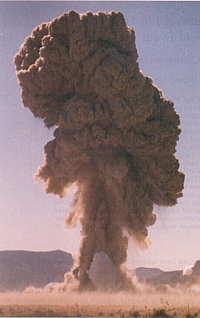
And just in case anyone wants to think seriously about the idea that a tactical nuclear weapon was used to destroy the Box on the Euphrates (or “tall building shaped like a square” to use the IAEA’s more technically precise nomenclature), this is what an explosion equivalent to a low-yield (5kt) nuclear explosion looks like:
misersgold.jpg
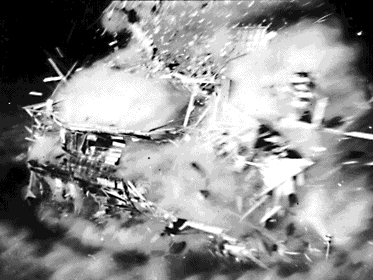
This is what happens to a house located 1,100 meters away a somewhat larger (16kt) explosion:
blast8.gif
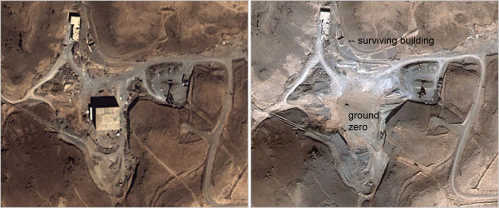
And this is a picture of the Syrian site after the attack:
noboxontheeuphrates.jpg
Note, a small building just 300 meters directly up from “ground zero” was still standing after the attack. That’s a clue — there was no nuclear shockwave that ripped through this gully.

Facebooktwittermail

OPINION: From Bandung to Davos — and back?

Global warming as white man’s burden

Readers of a certain age and inclination might remember a sometimes-incendiary, often-provocative, most-always-interesting television show on the UK’s Channel Four called Bandung File. Channel Four came to prominence in that brief hundred-flowers spring moment in the Britain of the 70s and early 80s, when Ken Livingstone, Mayor of London, was still ‘Red’ Ken, and the Greater London Council had money to spend on any number of beautiful community-driven efforts, from the Southall Black Sisters to water resources planning for the next century. Bandung File, produced by Tariq Ali and Darcus Howe, labelled itself an African-Asian news and current affairs programme. What made it quite unique was that its stated purpose was to canvas opinion from the public and policy-makers in those continents: Its topics were not just what was being done to people of color in the UK, nor even the history of colonial injustice. Instead, it focused on the current concerns of Africans and Asians — its issues ranged from apartheid to street crime in Jamaica and corruption in a Kenyan hospital. With a muckraking exuberance and flair, Bandung File drove the blade in to the hilt. And what made it such refreshing television was it was never dominated by experts from the North; instead it gave free rein to the eloquence of its Southern subjects, whether corrupt politicians or enraged citizens or passionate radicals.

It’s an odd place to begin talking about the 2007 Nobel Peace Prize, as Tony asked me to do for Rootless Cosmopolitan, but bear with me. Bandung File was named for a now rather obscure mountain town in Java: a favoured “hill station” to which British, and later brown, sahibs would retire to escape Indonesian summers. This little resort town once took centre stage in world history, in 1955, when it was the seat of an extraordinary conference, when representatives of one half of humanity met to proclaim an end to the colonial era. Some of the countries respresented were newly independent, others not yet quite so; but it was clear that the end of direct colonial rule was near, and this conference of African and Asian people met to ask, what sort of world would follow. We now call this, in an inaccurate Nothern-Hemisphere-centric worldview, the ‘Global South’… but here was born the ‘third world’ — “l’ensemble des peuples d’Asie et d’Afrique qui, n’appartenant ni à la « noblesse » européenne ni au « clergé » américain” (all the peoples of Africa and Asia who belong neither to the European aristocracy nor to the American clergy) — beautiful! The term was thus a direct extrapolation from the ‘Third Estate’ of the French Revolution, and had not acquired its current distorted meaning of distended bellies, child soldiers, and retired dictators living in splendid majesty in the homes of their former paymasters in Hawaii or on the Riviera. [complete article]

Facebooktwittermail

NEWS: The torture test

Bush administration blocked waterboarding critic

A senior Justice Department official, charged with reworking the administration’s legal position on torture in 2004 became so concerned about the controversial interrogation technique of waterboarding that he decided to experience it firsthand, sources told ABC News.

Daniel Levin, then acting assistant attorney general, went to a military base near Washington and underwent the procedure to inform his analysis of different interrogation techniques.

After the experience, Levin told White House officials that even though he knew he wouldn’t die, he found the experience terrifying and thought that it clearly simulated drowning. [complete article]

Editor’s Comment — Does Cheney have as much guts as an acting assistant attorney general? Or does he think waterboarding guidelines should include a clause that exempts anyone with a pacemaker?

Mukasey all but a shoo-in for approval

Michael B. Mukasey appeared on Friday to be all but assured of becoming the nation’s 81st attorney general when two Senate Democrats broke ranks and said they would support the retired federal judge to head the Justice Department.

While acknowledging serious concerns about his views on interrogation techniques, Sens. Dianne Feinstein of California and Charles E. Schumer of New York said they would vote to confirm Mukasey when the Senate Judiciary Committee takes up his nomination to succeed Alberto R. Gonzales on Tuesday. [complete article]

See also, John Dean on Mukasey (TPM) and The torture litmus test (Scott Horton).

Facebooktwittermail

NEWS: U.S. approves Gaza invasion; Abbas talks to Hamas

‘U.S. okays IDF wide-scale Gaza op’

The United States has given a “green light” to an IDF operation in the Gaza Strip, the Lebanese newspaper, Al-Akhbar reported Saturday morning.

The report cites “credible diplomatic sources” as saying that American approval came after Israeli intelligence impressed on US officials the importance of a wide-scale operation as an answer to the unprecedented arms smuggling within Gaza.

According to the newspaper report, the intelligence was shared during Defense Minister Ehud Barak’s last visit to Washington. Sources told Al-Akhbar that the intelligence depicted a worrying picture of an “arms race” between Hamas and the Islamic Jihad. In addition, Israel presented details of money transfers between the Islamic Jihad and the Al-Aksa’s Martyrs Brigades. [complete article]

Abbas meets West Bank Hamas leaders

The Palestinian president, Mahmoud Abbas, met Friday with a group of Hamas leaders in the West Bank, the first time he has done so since Hamas routed Fatah forces in Gaza in June.

Mr. Abbas, of the Fatah faction, said the meeting in his Ramallah office was not the beginning of a formal dialogue with Hamas. Instead, it seemed to be an effort to split more moderate Hamas officials in the West Bank from their more militant brethren in Gaza. [complete article]

Facebooktwittermail

FEATURE: What’s good for others is good for us

Is (his) biography (our) destiny?

The United States has had only one foreign policy and one national-security strategy since the transforming events of 9/11 — and this set of doctrines has been shaped by the very distinctive worldview of George W. Bush and Dick Cheney and the men and women around them. The great project of the foreign-policy world in the last few years has been to think through a “post-post-9/11 strategy,” in the words of the Princeton Project on National Security, a study that brought together many of the foreign-policy thinkers of both parties. Such a strategy, the experts concluded, must, like “a Swiss Army knife,” offer different tools for different situations, rather than only the sharp edge of a blade; must pay close attention to “how others may perceive us differently than we perceive ourselves, no matter how good our intentions”; must recognize that other nations may legitimately care more about their neighbors or their access to resources than about terrorism; and must be “grounded in hope, not fear.” A post-post-9/11 strategy must harness the forces of globalization while honestly addressing the growing “perception of unfairness” around the world; must actively promote, not just democracy, but “a world of liberty under law”; and must renew multilateral instruments like the United Nations.

In mainstream foreign-policy circles, Barack Obama is seen as the true bearer of this vision. “There are maybe 200 people on the Democratic side who think about foreign policy for a living,” as one such figure, himself unaffiliated with a campaign, estimates. “The vast majority have thrown in their lot with Obama.” Hillary Clinton’s inner circle consists of the senior-most figures from her husband’s second term in office — the former secretary of state Madeleine Albright, the former national security adviser Sandy Berger and the former United Nations ambassador Richard Holbrooke. But drill down into one of Washington’s foreign-policy hives, whether the Carnegie Endowment or the Brookings Institution or Georgetown University, and you’re bound to hit Obama supporters. Most of them served in the Clinton administration, too, and thus might be expected to support Hillary Clinton. But many of these younger and generally more liberal figures have decamped to Obama. And they are ardent. As Ivo Daalder, a former National Security Council official under President Clinton who now heads up a team advising Obama on nonproliferation issues, puts it, “There’s a feeling that this is a guy who’s going to help us transform the way America deals with the world.” Ex-Clintonites in Obama’s inner circle also include the president’s former lawyer, Greg Craig, and Richard Danzig, his Navy secretary. [complete article]

Facebooktwittermail

ANALYSIS & EDITOR’S COMMENT: Drafting diplomatic cannon fodder

Why diplomats won’t go to Iraq

At a State department “town hall” meeting on Wednesday, one participant, veteran diplomat Jack Croddy, pointed out the risks of injury and death faced by American diplomats [in Iraq]. But he hit closer to the heart of the matter when he told the director general of the Foreign Service, who was leading the meeting, “It’s one thing if someone believes in what’s going on over there and volunteers, but it’s another thing to send someone over there on a forced assignment.” On Friday, Secretary of State Condoleezza Rice, who was traveling, issued a statement saying, “We must go forward with the identification of officers to serve, should it prove necessary to direct assignments. Should others step forward, as some already have, we will fill these new jobs as we have before —with volunteers. However, regardless of how the jobs may be filled, they must be filled.” [complete article]

Editor’s Comment — The core issue here is that there is an inherent tension between loyalty and intelligence. The willingness to follow orders requires, in part, a willingness to suspend the use of ones own powers of discrimination, analysis, and judgment. Diplomats who are good are doing what they are told and probably not as good at conducting diplomacy.

Facebooktwittermail

NEWS & ANALYSIS: Action on Kurdish violence; after the surge

Turkey urges U.S. to take action on Kurdish violence

Turkish Foreign Minister Ali Babacan said Friday that Turkey wants the United States to stop talking and start taking action to help end cross-border attacks by Kurdish guerrillas in Iraq.

“We need to work on actually making things happen,” Babacan said at a news conference with Secretary of State Condoleezza Rice in Ankara. “This is where the words end and action needs to start.”

Rice stopped in the Turkish capital for emergency meetings with senior Turkish officials, including Babacan, Prime Minister Recip Tayyip Erdogan and President Abdullah Gul, ahead of an Iraq conference with regional foreign ministers Saturday in Istanbul. [complete article]

The dark side of Iraq’s good news

When Mark Twain lumped statistics together with lies and damned lies, he could have had Mesopotamia in mind. A new set of data from Iraq shows Iraqi civilian deaths on the decline, from 2,800 in January 2007 to about 800 last month. Other reports reveal that tens of thousands of Iraqis have joined local auxiliary forces to secure their neighborhoods and that U.S. forces continue to kill or capture many of the insurgency’s top leaders. Violence is down sharply in most areas. In Baghdad, troops report weeks without a roadside bomb in neighborhoods that used to be hit every day; and in Anbar, things are so good the Marines held a 5K race on the streets of Ramadi two weeks ago.

Still, the truth behind these numbers is elusive. It’s near impossible to discern whether they reflect the success of our military operations or some larger, deeper trends in Iraqi society, such as the success of the Shiite campaign to rid Baghdad of its Sunni residents. The situation does present a paradox, however. If the surge is the reason, as the generals claim, we’re in trouble, because the surge is about to end. If Iraqi reconciliation and ethnic cleansing get primary credit, and the surge is mostly acting as a catalyst, our inevitable drawdown over the next six months to pre-surge levels may not be catastrophic, because the positive trends result more from Iraqi societal shifts and less from American soldiers brokering the peace. As commanders plan for the 2008 reduction in troops, they must try to reconcile these competing explanations and find a way to sustain the success when there are fewer—or no—American soldiers on the streets. [complete article]

Facebooktwittermail

INTERVIEW: Burma today “is almost like Nazi Germany”

“The opposition has no chance right now, but this is only the beginning”

“Right now the opposition is under great stress. Burma today is as most repressive as it has ever been: they basically shut down all the cities every night, and they roam the streets and go and arrest people, it is almost like Nazi Germany. That is why the opposition has no chance right now”. Maureen Aung-Thwin, director of the Burma Project/Southeast Asia Initiative of the Open Society Institute, which is part of the Soros Foundations Network, makes no illusions about the future of the “Saffron revolution”, but she observes that the international pressure is growing, especially from the U.S. and also Europe (“can play a big role”), and that’s why she declares herself optimistic: “The trend of history is not towards more repressive dictatorships. It is impossible to totally isolate a whole population from the rest of the world in the 21st century”. [complete article]

Facebooktwittermail

NEWS: Testifying on AIPAC’s cozy relationship with the U.S. government

Defense may seek Rice and Hadley’s testimony in AIPAC case

A federal judge on Friday ordered Secretary of State Condoleezza Rice and Stephen J. Hadley, the national security adviser, to be ready to testify as defense witnesses at the trial of two former pro-Israel lobbyists accused of receiving secret national security information.

The judge, T. S. Ellis III of Federal District Court in Alexandria, Va., agreed with defense lawyers that Ms. Rice, Mr. Hadley and several other government officials could be subpoenaed because they might help the defendants demonstrate that they were engaged in traditional “back channel” lobbying — not in espionage — in their contacts with the government over Middle East policy.

Justice Department officials who are overseeing the prosecution had no immediate comment on the judge’s ruling or on whether they might appeal the decision. The State Department also declined to comment. The trial in the case is scheduled to begin in January, although a delay is considered likely. [complete article]

Facebooktwittermail