Monthly Archives: December 2007

NEWS & ANALYSIS: British PM: “We have managed now to get Iraq into a far better position” (– behind us)

British pullout stokes Iraq’s southern fire

When then-US secretary of state James Baker suspended talks with the Palestinian Liberation Organization on June 20, 1990, he famously said, “Our telephone number is 202-456-1414. When you are serious about peace, call us.”

This is what British Prime Minister Gordon Brown should have said to Iraqi leaders while visiting southern Iraq last week. After all, thanks to the indifference of Prime Minister Nuri al-Maliki and a completely paralyzed central government in Baghdad, the British-controlled city of Basra has become a hotbed for militants and Islamic fundamentalists.

Instead, Brown chose to speak to his own countrymen – downplaying unquestionable failure in Iraq – saying, “Your war is over. We have managed now to get Iraq into a far better position.” Brown’s statement was far more realistic than the 2003 speech of President George W Bush, in which he said, “Major combat operations in Iraq have ended.”

Brown did not say, however, that the British had succeeded. He literally could not say that because it would have been factually incorrect – very incorrect. He also did not say, however, that they had failed. British troops will remain in Basra, he claimed, training and assisting Iraqi authorities, until the spring of 2008. Their military role is over, however, as of mid-December. [complete article]

Triple car bombs hit south Iraq

Three car bombs have exploded in the southern Iraqi city of Amara, killing at least 39 people and injuring more than 100, police say.

Two bombs exploded in a car park packed with labourers waiting to travel to work, and a third detonated as people gathered to inspect the damage. [complete article]

Iraq rejects permanent U.S. bases: adviser

Iraq will never allow the United States to have permanent military bases on its soil, the government’s national security adviser said, calling the issue a “red line” that cannot be crossed.

“We need the United States in our war against terrorism, we need them to guard our border sometimes, we need them for economic support and we need them for diplomatic and political support,” Mowaffaq al-Rubaie said.

“But I say one thing, permanent forces or bases in Iraq for any foreign forces is a red line that cannot be accepted by any nationalist Iraqi,” he told Dubai-based al Arabiya television. [complete article]

Facebooktwittermail

NEWS, OPINION & EDITOR’S COMMENT: Moral clarity on torture

CIA spy calls waterboarding necessary but torture

A leader of the CIA team that captured the first major al Qaeda figure, Abu Zubaydah, says subjecting him to waterboarding was torture but necessary.

In the first public comment by any CIA officer involved in handling high-value al Qaeda targets, John Kiriakou, now retired, said the technique broke Zubaydah in less than 35 seconds.

“The next day, he told his interrogator that Allah had visited him in his cell during the night and told him to cooperate,” said Kiriakou in an interview to be broadcast tonight on ABC News’ “World News With Charles Gibson” and “Nightline.”

“From that day on, he answered every question,” Kiriakou said. “The threat information he provided disrupted a number of attacks, maybe dozens of attacks.” [complete article]

Editor’s Comment — “Because we’re Americans, and we’re better than that” — it’s a popular line, a curious quasi-ethical principal, and it’s John Kiriakou’s reason for no longer supporting the use of torture.

American ideals might be better than that, but Americans and their ideals are not the same. The American government sanctioned torture and American CIA officers have engaged in torture. Therein lies one of the many gaps between America and its ideals.

But to debate the issue of torture in terms of whether it is or is not un-American is to obscure a moral question that is not as complex as it is being made to appear. The issue should not hinge on whether we accept an idealized conception of what it means to be American. It has nothing to do with national identity. It hinges quite simply on whether we accept or reject the principle that the ends justifies the means.

Any time the phrase “saving American lives” enters the torture debate an ends-justifies-the-means argument is being employed. At the same time, no one actually wants to positively assert this line of reasoning. If the ends really do justifies the means then it shouldn’t make any difference what those means are — pulling out finger nails, raping relatives — why would anything be off limits if it could be shown to be effective in saving American lives?

On the other side is a pragmatic (and seemingly safe) argument: torture shouldn’t be used because it doesn’t work. It yields false confessions and there are much better non-violent means to tease out valuable information. This is also a means-ends argument that merely challenges the assumption that the means will accomplish the aims. (And not only is it a means-ends argument; it’s also rather easy to counter. All you have to do is present a case — as the CIA has just done — where it appears that torture “worked.”)

And then there’s the question of who gets tortured. To cite evidence that Abu Zubaydah may not have been a high-level al Qaeda operative is to imply that the legitimacy of torture is affected by the potential for the victim to cough up some valuable information. In other words, it implies that torture might be justifiable if it can be demonstrated that this particular person is really “worth” torturing. (Again, the CIA — on behalf of Bush-Cheney — presses the case that it has been extremely selective in who gets tortured.)

Ultimately, the only unambiguous moral position to take is to say that a calculated effort to make a human being suffer is immoral – it doesn’t make any difference who that person is or how well-intentioned the torturer might be. That’s moral clarity and that’s the principle that law and policy should embody.

The torture of Abdul Hamid al-Ghizzawi

On December 7, 2006, he was among several hundred detainees randomly selected and moved to the newest detention camp at Guantanamo, Camp 6, which was designed to hold the majority of the detainees. According to Amnesty International, and in contravention of international standards, all detainees in Camp 6 are held under conditions of “extreme isolation and sensory deprivation for a minimum of 22 hours a day in individual steel cells with no windows to the outside.”

Their cells reportedly are extremely small. The only source of light is fluorescent lighting that is on 24 hours a day and the only air is air-conditioning, both of which are controlled by the prison guards. The detainees reportedly are allowed two hours of “recreation time” a day to be spent in a metal cage measuring four feet by four feet. (That’s 1/3 the size of a ping-pong table.)

Al-Ghizzawi’s lawyer says that his guards frequently give him his “rec time” in the middle of the night or, sometimes, in the middle of the day when the cage is in the hot sun. Detainees in Camp 6 have no access to radio, television or newspapers. They are given one book a week.

According to his lawyer, Al-Ghizzawi’s eyesight has deteriorated so significantly that he is now unable to read. Thus he now spends his time pacing in his cell. All of the detainees at Guantanamo reportedly are forbidden telephone calls and family visits, and most are not allowed to touch another human being. The detainees are not given any blankets. Their only cover is a plastic sheet.

There is no reason to believe that Al-Ghizzawi’s treatment is exceptional. If his is at all an exceptional case, it is exceptional because he has twice been unanimously declared not to be an enemy combatant. [complete article]

Watching torture

The footage was blurry, shot with a handheld 8mm camera in the poor light filtering through the shack’s small windows. There was no sound—which lent merciful distance to what it showed: the interrogation of some unidentified middle-aged man, undergoing falanga, mostly (beatings to pulp the feet), though the session culminated in anal rape with a stick. What remains as a true horror in the memory is less those activities than the demeanor of the inquisitors. A couple of men in shirts were administering the torture. But a pair of interrogators stood off to one side, mostly out of the frame. They came to the victim before and after each bout, evidently asking questions. Then they’d go back out of frame, to let the next round of beatings commence. Two men in neat dark suits, professionals, just doing a job—unpleasant, perhaps, but necessary, as they saw it, for the safety of the state.

That no doubt is the true horror of the tapes the CIA destroyed—worse, even, than the sight of the torture procedures themselves. We assume it shows waterboarding, the near-drowning of someone strapped to a cruciform plank. Memories of that Savak instructional film tell me, indelibly, what the videos would have looked like: the torturers calmly pouring water over the cloth covering the victims’ faces, the frenzied chest-heavings as the bodies went into shock, the gasping and retching as each session ended. More horrifying still would have been the actions, or inactions, of all those standing around. There must have been interrogators, and an interpreter. Certainly a doctor, watching the victims’ vital signs on a monitor to gauge how long each session could last. This being America, there may have even been a lawyer on hand. All professionals, doing something unpleasant, but—you understand—necessary for the safety of the state. And at the end of the day, one assumes, they drove home to their families.

This is where 9/11 has brought us. No wonder Rodriguez destroyed those tapes. [complete article]

Lawyers cleared destroying tapes

Lawyers within the clandestine branch of the Central Intelligence Agency gave written approval in advance to the destruction in 2005 of hundreds of hours of videotapes documenting interrogations of two lieutenants from Al Qaeda, according to a former senior intelligence official with direct knowledge of the episode.

The involvement of agency lawyers in the decision making would widen the scope of the inquiries into the matter that have now begun in Congress and within the Justice Department. Any written documents are certain to be a focus of government investigators as they try to reconstruct the events leading up to the tapes’ destruction.

The former intelligence official acknowledged that there had been nearly two years of debate among government agencies about what to do with the tapes, and that lawyers within the White House and the Justice Department had in 2003 advised against a plan to destroy them. But the official said that C.I.A. officials had continued to press the White House for a firm decision, and that the C.I.A. was never given a direct order not to destroy the tapes.

“They never told us, ‘Hell, no,’” he said. “If somebody had said, ‘You cannot destroy them,’ we would not have destroyed them.” [complete article]

Editor’s Comment — Any decent mafia boss knows how to avoid implicating himself in a crime.

See also, Gitmo inmate’s lawyer urges U.S. on photos (AP).

Facebooktwittermail

NEWS: Report describes systematic White House effort to manipulate climate change science

“The Bush Administration has engaged in a systematic effort to manipulate climate change science and mislead policymakers and the public about the dangers of global warming”

For the past 16 months, the House Oversight and Government Reform Committee has been investigating allegations of political interference with government climate change science under the Bush Administration. During the course of this investigation, the Committee obtained over 27,000 pages of documents from the White House Council on Environmental Quality (CEQ) and the Commerce Department, held two investigative hearings, and deposed or interviewed key officials. Much of the information made available to the Committee has never been publicly disclosed.

This report presents the findings of the Committee’s investigation. The evidence before the Committee leads to one inescapable conclusion: the Bush Administration has engaged in a systematic effort to manipulate climate change science and mislead policymakers and the public about the dangers of global warming.

In 1998, the American Petroleum Institute developed an internal “Communications Action Plan” that stated: “Victory will be achieved when … average citizens ‘understand’ uncertainties in climate science … [and] recognition of uncertainties becomes part of the ‘conventional wisdom.’” The Bush Administration has acted as if the oil industry’s communications plan were its mission statement. White House officials and political appointees in the agencies censored congressional testimony on the causes and impacts of global warming, controlled media access to government climate scientists, and edited federal scientific reports to inject unwarranted uncertainty into discussions of climate change and to minimize the threat to the environment and the economy. [complete article]

Facebooktwittermail

NEWS & OPINION: How to engage Iran; Iraq seeks Gulf security pact including Iran

How to defuse Iran

Iran has tried tactical cooperation with the United States several times over the past two decades — including helping to secure the release of hostages from Lebanon in the late 1980s and sending shipments of arms to Bosnian Muslims when the United States was forbidden to do so.

Yet each time, Tehran’s expectations of reciprocal good will have been dashed by American condemnation of perceived provocations in other arenas, as when Iranian support for objectives in Afghanistan after the 9/11 attacks was rewarded by President Bush’s inclusion of Iran in the “axis of evil.” Today, incremental engagement cannot overcome deep distrust between Washington and Tehran — certainly not rapidly enough to address America’s security concerns.

From an Iranian perspective, serious engagement would start with American willingness to recognize Tehran’s legitimate security and regional interests as part of an overall settlement of our differences. But neither Republicans nor Democrats have been willing to consider such an approach, because of the pursuit of a nuclear weapons option and support for terrorist organizations that Iran employs to defend what it sees as its fundamental security interests. Successful United States-Iran engagement requires cutting through this Gordian knot by undertaking comprehensive diplomacy encompassing the core concerns of both sides.

From the American side, any new approach must address Iran’s security by clarifying that Washington is not seeking regime change in Tehran, but rather changes in the Iranian government’s behavior. (While Secretary Rice has said recently that overthrowing the mullahs is not United States policy, President Bush has pointedly refused to affirm her statements.) To that end, the United States should be prepared to put a few assurances on the table. [complete article]

Iraq wants Iran in Gulf security pact

Iraq’s national security adviser yesterday called on Gulf states to form a regional security pact, which would include Iran, while he reassured the area’s US allies that Baghdad is “heading West” in its foreign policies. But Mouaffak al-Rubaie also criticised Saudi Arabia and Iran for what he called settling scores on Iraqi soil and called for regional reconciliation that put sectarian differences aside.

“It is extremely important to have a regional reconciliation rather than having this heightened sectarian tension in the region,” he told delegates at a security conference held in the Bahraini capital.

“That is why Iraq is looking seriously to call for a regional security pact like the good old (1954 anti-Soviet alliance) Baghdad Pact or a Nato-style pact, with a set agenda: counter terrorism, counter narcotics, counter religious extremism and counter sectarianism,” he said. [complete article]

Facebooktwittermail

NEWS: Gang-rape cover-up by U.S., Halliburton/KBR

Gang-rape cover-up by U.S., Halliburton/KBR

A Houston, Texas woman says she was gang-raped by Halliburton/KBR coworkers in Baghdad, and the company and the U.S. government are covering up the incident.

Jamie Leigh Jones, now 22, says that after she was raped by multiple men at a KBR camp in the Green Zone, the company put her under guard in a shipping container with a bed and warned her that if she left Iraq for medical treatment, she’d be out of a job.

“Don’t plan on working back in Iraq. There won’t be a position here, and there won’t be a position in Houston,” Jones says she was told.

In a lawsuit filed in federal court against Halliburton and its then-subsidiary KBR, Jones says she was held in the shipping container for at least 24 hours without food or water by KBR, which posted armed security guards outside her door, who would not let her leave. [complete article]

Facebooktwittermail

NEWS & ANALYSIS: Exchanging Musa Qala

Taliban loses grip on last major town

Afghan and NATO troops retook the town of Musa Qala in southern Afghanistan on Monday, forcing the Taliban to withdraw from the only sizable town they hold in the country, Afghan and NATO officials said. There was no clear picture of casualties, but the Taliban and civilians said there had been heavy bombardment overnight.

The news came as Prime Minister Gordon Brown of Britain made a surprise visit to Afghanistan and met with President Hamid Karzai. About 7,000 British troops are deployed in Helmand Province, in southern Afghanistan. Retaking Musa Qala, which they abandoned more than a year ago, has been one of their main objectives in the province, which has the highest level of Taliban activity as well as illicit opium production. [complete article]

The war in microcosm

The Taliban, the Afghan army and the Nato-led forces recognise there is a stalemate in the battle for Afghanistan. Neither side appears in a position to win and impose terms, so they search for a symbolic victory that will signify the course of the war.

Now that Musa Qala has been retaken, the international forces and the Kabul government can claim, once again, that victory is not far off – bolstering shaky domestic public support and encouraging locals to consider them as probable eventual winners.

The Taliban will wait to see what the spring brings. After all, they just have to avoid defeat. The losers, of course, are the villagers. Not much of Musa Qala is likely to have survived the fighting. [complete article]

Facebooktwittermail

NEWS: Pakistan is quietly gagged

Pakistan’s news media no longer silent, but Musharraf has muted his critics

Nearly all private television channels blacked out last month by President Pervez Musharraf’s emergency decree are back on the air. But the country’s once-thriving television news media remain largely muzzled by sweeping new restrictions that journalists and Western diplomats say stifle criticism of the government.

After the blackout cost leading channels tens of millions of dollars in lost advertising revenues, owners of all but one channel agreed to stop broadcasting the country’s highest-rated political talk shows and signed the government-ordered “code of conduct.”

And under a new ordinance, unilaterally enacted by Mr. Musharraf, television journalists face up to three years in jail for broadcasting “anything which defames or brings into ridicule the head of state” and other restrictions. The law will remain in place after Mr. Musharraf ends the state of emergency, which he has promised to do on Saturday.

“He’s getting away with it, really, because the Western support is there again,” said Talat Hussain, a popular talk show host whose program is no longer aired on two stations, “Aaj TV” or “Today TV.” “There isn’t enough pressure.” [complete article]

Facebooktwittermail

ANALYSIS & EDITOR’S COMMENT: The Iranian strategic threat – shattered or just fractured?

They stole the threat from us

Iran is indeed deceptive, but it is not crazy. It operates according to a systematic political and diplomatic rationale. But since 1979 this political rationale has been swallowed up in international rhetoric, mainly American and Israeli, which has portrayed Iran as the ultimate global enemy. This is why the American report is such a great blow to Israel. The report does not dismiss the Iranian threat – though it does not substantiate it – but it snatches an important strategic asset from Israel. No longer can Israel play the regional power that charts the map of global strategic threats; the state that mobilized the world against Iran will now assume the role of nudnik.

But Israel’s real problem is that Iran is also losing its status as a strategic threat because of the report, and Israel will find it difficult to “enlist” Iran to promote its regional policy. For example, what justification will Israel have for demanding that Syria sever its relations with Iran as a condition for conducting negotiations once American intelligence has certified Iran as being somewhat acceptable? What good can come from emphasizing the ties between Iran and Hamas or Hezbollah when Iran is now portrayed as a state that no longer threatens the region? And why should the Annapolis conference be described as designed to stymie Iran?

Israel is not the only one with this problem. Its Arab counterparts, who are stuck in the same anti-Iran pit, are also panicking. When Iran’s nuclear threat is not recognized, two fronts collapse: the Iranian-Shi’ite front, which brought Israel closer to some of the Arab states, and the Israeli front against radical organizations such as Hezbollah and Hamas, or against Syria. In each of these fronts, Iran serves as a connecting axis, an enemy against which coalitions of interests were built and agreements between rivals were generated.

Thus, for example, most Arab countries perceive Iran’s involvement in Lebanon as not just an intervention by a foreign state in Arab affairs, but as a penetration by a hostile state. And Israel intensifies Hezbollah’s tactical threat into a strategic threat because of the Iran connection. Hamas is also accorded the status of a super-threat because of Israel’s efforts to link it with Iran, the mother of all threats, so that we almost forget that the Hamas threat is based only on Qassam rockets.

These enemies will revert to being only “local enemies,” not part of an axis of evil (which also collapses because of the American report). They will no longer be emissaries of a nuclear monster. Israel will have to go back to routine, boring enemies whom it can fight using checkpoints and electricity cuts. Back to Annapolis. Back to the grind.

After the fall of the Soviet Union, some people said the U.S. would have to manufacture a new strategic threat. It will be interesting to see what Israel does after the American report shattered its strategic threat. [complete article]

Editor’s Comment — The NIE, if viewed as a precision attack aimed at preventing military strikes on Iran in 2008, almost certainly hit its target. But if viewed as a strategic weapon designed to re-shape America and Israel’s approach to the Middle East, it remains to be seen whether an intelligence report alone is capable of bringing about such a sweeping effect.

Consider the difference between American views of Iran and North Korea. It is widely recognized that the North Korean people suffer a depth of oppression from their own government far greater than do the Iranians. The Islamic Republic of Iran, having become distanced from its revolutionary roots, is in many ways the most modern and Westernized of Middle Eastern countries. North Korea on the other hand is for good reason often referred to as the Hermit Kingdom. Iran put its nuclear weapons program on hold while North Korea forged ahead and put its own nuclear weapons to the test. North Korean power is concentrated in the hands of a mercurial leader, while Iranian power is more diffused through a complex power structure.

Why then should the NIE’s most significant “revelation” be the following claim?

Tehran’s decision to halt its nuclear weapons program suggests it is less determined to develop nuclear weapons than we have been judging since 2005. Our assessment that the program probably was halted primarily in response to international pressure suggests Iran may be more vulnerable to influence on the issue than we judged previously.

To say that Iran may be more vulnerable to influence than previously judged actually says more about that previous judgment than it says about Iran. And that judgment reveals the critical difference between the views of Iran and those of North Korea.

Iran is the nation state upon which American and Israeli Islamophobia is most sharply focused. Even though there are fewer reasons to regard North Korea as a rational actor, fear of North Korea’s sometimes unpredictable leadership is not matched with an image of some amorphous, demonic Korean threat.

North Korea’s inclusion in the “axis of evil” always looked like a feeble attempt to deflect the charge that the administration was waging a war on Islam. Yet in spite of its inclusion there was no matching and full-blooded demonization. As a result we are now witness to a spectacular turnaround in the Bush administration’s approach to a pariah state, known to be involved in nuclear proliferation. President Bush has just written to “Dear Chairman” Kim Jong Il, and the New York Philarmonic orchestra will soon land in Pyongyang in an effort to serenade the hermit out of its shell.

What hope is there that we might witness such conciliatory gestures aimed at Tehran?

The challenge for Iran is not merely that it nurture a budding understanding in Washington that the United States is actually dealing with a rational actor. The greater challenge lies in the undoing of a pervasive fear that has long been merchandised by people who have no interest in now either owning up to a purposeful deceit or abandoning a deep-seated prejudice.

Facebooktwittermail

OPINION: Bush’s real lie about Iran

Bush’s real lie about Iran

The latest National Intelligence Estimate on Iran’s nuclear program raises questions once again about the Bush administration’s veracity in describing a nuclear threat. But President Bush’s worst misrepresentations about the Iranian nuclear issue do not focus on whether Tehran is currently pursuing a nuclear weapons program or when Bush knew the U.S. intelligence community was revising its previous assessments. Rather, the real lie is the president’s claim that his administration has made a serious offer to negotiate with the Islamic Republic, and that Iranian intransigence is the only thing preventing a diplomatic resolution. [complete article]

See also, Intel report spurs calls for Iran talks (AP).

Facebooktwittermail

OPINION: Torture is inevitably and inextricably bound to tyranny

The president-tyrant

It is common for people today to question how any leader can be a tyrant who achieves office through popular election, and, indeed, who remains popular. But such talk is foolish and betrays an ignorance of the origins of the term and the historical context of its use. Throughout history, tyrants came to power through means of control and manipulation of popular opinion. This was so familiar a feature to the thinkers of antiquity, that Aristotle charts it as a characteristic of the tyrant. And in the history of the dark, past century, how many little men in search of a balcony came to power on the back of a jubilant and cheering mob? And indeed, no less a man that Thomas Jefferson was quick to remind his fellow citizens of this principle. And it was Jefferson who raised the cry of “tyrant” against the president, when he proceeded in disregard of the constraints of Constitution and law, setting into play a plan of persecution targeting his political opponents and the poor, downtrodden and defenseless immigrants. Jefferson spoke sharply and loudly because the republic was under siege by a popularly elected (and popular) government. He was right to have done so, and he is vindicated by history for it.

The question was whether the president has put himself above the law and assumed powers far beyond those the Constitution measured to him.

And today, America faces precisely this question. We have a president who acts in shameless disregard of the Constitution’s restraints upon his office, and who feels himself above the law, and who constantly seeks to manipulate and mislead the public. How many times just in the last week have we witnessed this? [complete article]

See also, Democratic complicity in Bush’s torture regimen (Glenn Greenwald) and The Democrats and torture (Andrew Sullivan).

Facebooktwittermail

OPINION & INTERVIEW: A process that can’t be faked

Saudis welcome Meshal in bid to broker new Hamas-Fatah talks

Saudi Arabia and Egypt are pushing Hamas and Fatah to meet in an effort to resolve the deep rift in the Palestinian movements, as Hamas political leader Khaled Meshal visits Riyadh this week.

Hamas spokesman Ayman Taha said that Meshal, who arrived in Riyadh on Saturday, would meet with senior Saudi officials to update them on the status of contact between Fatah and Hamas, which of late, has reached a dead-end.

A Fatah leader in the West Bank, Hatham Abed al-Kadr, said Sunday that Egypt has been in contact recently with Fatah and Hamas officials in attempt to bring the two sides for a meeting in Cairo after the culmination of the Eid al-Adha (Festival of the Sacrifice) in about two weeks. According to al-Kadr, the Egyptian mediation was aimed at opening negotiations between Hamas and Fatah. [complete article]

The Har Homa test

It is difficult to think of a place more suitable than Har Homa for holding the first test in the spirit of Annapolis. The comparison between Har Homa Crisis No. 2 and the development of Har Homa Crisis No. 1 can teach us whether the Israeli-Palestinian peace process has indeed started a new track or whether all the players are stuck on the old line.

Does Ehud Olmert, who pressed for the establishment of the new neighborhood in East Jerusalem, really see something different from the Prime Minister’s Bureau than what he saw from the office of the mayor of Jerusalem? Will President George W. Bush pay lip service and eventually have to eat his words, just as Bill Clinton did 10 years ago? [complete article]

Bottom-up peacebuilding in the Occupied Territories

Can you describe your role in your former position as EU Middle East Envoy:

My role was to co-ordinate a bottom-up process to compliment a diplomatic top-down process – typically an effort by the diplomatic community or politicians to come up with an agreement; often quite simply are back of envelope-types of agreement. But unless this agreement has some connection with reality and is practical in terms of real power relationships and security, and has a certain acquiescence of support at the grassroots level, then the agreement will fail at this plane: it just can’t be implemented, or it just won’t be implemented because there isn’t the support or the conviction that this is a practical start. Issues then bounce between the political and implementation plane, and back to the political plane, and there is no effective outcome from it.

One of the lessons that came out of Northern Ireland was that it was important to work both at the political level, but also at the practical and the street level in order to make the two move in the same direction. Both had to be prepared in parallel. It wasn’t possible to come in at the top table and sit down with half a dozen people in Ramallah, agree on the back of an envelope a five-point plan and fly away the next day and think the job was done – because that was usually the stage when things became unpicked. [complete article]

London’s burning for Dichter

Avi Dichter will not be going to London. The Israeli dream of taking in year-end sales, the new production of Othello or the sights of Oxford Street vanished before the public security minister’s very eyes. The Foreign Ministry advised Dichter not to participate in a conference there, because he could be arrested for involvement in the assassination of Hamas leader Salah Shehadeh, when he was Shin Bet security service head. The one-ton bomb used to target Shehadeh in 2002 left 15 people dead. [complete article]

Facebooktwittermail

NEWS: After Guantanamo, ‘reintegration’ for Saudis

After Guantanamo, ‘reintegration’ for Saudis

For five years, Jumah al-Dossari sat in a tiny cell at the U.S. prison at Guantanamo Bay, Cuba, watched day and night by military captors who considered him one of the most dangerous terrorist suspects on the planet.

In July, he was suddenly released to his native Saudi Arabia, which held a very different view. Dossari was immediately reunited with his family and treated like a VIP. He was given a monthly stipend and a job, housed and fed, even promised help in finding a wife. Today, he is a free man living on the Persian Gulf coast.

The treatment is part of a Saudi “reintegration program” designed to help Dossari, 34, and other former Guantanamo prisoners adjust to modern society and learn the meanings of Islam. About 40 of the more than 100 Guantanamo detainees from Saudi Arabia who have been transferred to Riyadh since last year have been released after participating in the program, and the rest are scheduled to be let go in coming months. [complete article]

Facebooktwittermail

NEWS, ANALYSIS & OPINION: Engaging Iran

Make Iran an offer it might refuse

The National Intelligence Estimate on Iran has upended the Bush administration’s policy toward that country. This could be a good thing, if it leads to some creative rethinking. Over the past two years the administration has made several intelligent moves in its effort to isolate Iran—keeping the Europeans onboard, rallying the Arab states—but it’s been unwilling to make a simple choice. Do we want policy change in Iran or regime change?

Imagine, for a moment, what the world looks like to Iran. The country is surrounded by powerful states with nuclear weapons—Israel, India, Pakistan, China and Russia. Across one of its borders stand some 170,000 American troops (in Iraq), across another are more than 50,000 NATO troops (in Afghanistan). The United States has been bitterly opposed to the Iranian regime for three decades. The current American president has made clear time and again that he regards the Tehran government as evil and wishes that it would fall, and Congress set aside $75 million last year to “promote democracy” in Iran. Now, if you were in Tehran, wouldn’t you buy some insurance? And in the world of international politics, a nuclear program is the ultimate insurance policy.

For Washington to threaten a regime with extinction and simultaneously expect it to disarm is a policy doomed to failure. Were we to be clear that what we seek from Tehran is only a change in behavior, a policy of sticks and carrots might actually produce results. [complete article]

CIA has recruited Iranians to defect

The CIA launched a secret program in 2005 designed to degrade Iran’s nuclear weapons program by persuading key officials to defect, an effort that has prompted a “handful” of significant departures, current and former U.S. intelligence officials familiar with the operation say.

The previously undisclosed program, which CIA officials dubbed “the Brain Drain,” is part of a major intelligence push against Iran ordered by the White House two years ago.

Intelligence gathered as part of that campaign provided much of the basis for a U.S. report released last week that concluded the Islamic Republic had halted its nuclear weapons work in 2003. Officials declined to say how much of that intelligence could be attributed to the CIA program to recruit defectors. [complete article]

Meet ‘the decider’ of Tehran. He’s not the hothead you expect

In the past, [Supreme Leader of the Islamic Republic Ayatollah Ali] Khamenei has not been averse to talking to Washington. He gave tacit support to an ill-fated memo offering direct U.S.-Iranian talks in 2003, and a year later, he publicly endorsed discussions over Iraq. But times changed after Iran dug in its heels over the nuclear issue and found itself looking down the barrels of U.S. guns. The threat of war has abated after this dramatic week, but for the man who rules Iran, two overriding concerns linger: ensuring that his regime survives and ensuring that he remains at the head of it. As the National Intelligence Estimate itself put it, “Tehran’s decisions are guided by a cost-benefit approach rather than a rush to a weapon irrespective of the political, economic, and military costs.” But Tehran’s decisions are also guided by one man, and anyone serious about understanding the sources of Iranian conduct needs to keep an eye on him. [complete article]

Iran snub of atomic pacts is denied

A former nuclear negotiator for Iran dismissed reports that the country’s current negotiator had brushed off previous agreements with Europe over the Iranian nuclear program.

Ali Larijani, the former nuclear negotiator, who is now the representative of the supreme religious leader at the Supreme National Security Council, said Thursday that Western news media had fabricated the comments, the news agency ISNA reported. [complete article]

See also, A smart side to US intelligence (Kaveh L Afrasiabi), Just 18% believe Iran has stopped nuclear weapons development program (Rasmussen Reprots), Bolton calls report on Iran ‘quasi-putsch’ (Reuters), and What we didn’t learn from the hunt for Iraq’s phantom arsenal (veteran CIA case officer, Arthur Keller).

Facebooktwittermail

ANALYSIS: Foreign policy shift

Bush engages foreign foes as policy shift accelerates

The White House said that President Bush sent a letter directly to North Korean leader Kim Jong Il seeking cooperation in implementing a pact to dismantle its nuclear arms in exchange for full normalized relations.

The move is the latest example of the White House accelerating its reversal on numerous foreign-policy fronts.

Earlier in his presidency, Mr. Bush designated Pyongyang a member of an “axis of evil” and expressed loathing for the communist state’s dictator. In recent months, however, contacts have picked up amid an accord on dismantling Pyongyang’s nuclear program.

On other fronts — particularly Iran, Syria and Lebanon — the Bush administration is also shifting tactics in ways that could affect American interests long-term, say U.S. officials and foreign policy analysts. President Bush is generally receiving praise for engaging Pyongyang and Damascus, but he is also risking alienating the Republican Party’s conservative wing, which believes the U-turns will undermine U.S. standing around the world.

“Our foreign policy is in free-fall at the moment,” said John Bolton, Mr. Bush’s former ambassador to the United Nations and an ally of Vice President Dick Cheney. Mr. Bolton argues that engaging dictators will only “diminish our prestige and influence.” [complete article]

At least he didn’t call him ‘Dear Leader’

Don’t call him “North Korea’s leader”. Call him “Chairman” – or “Dear Chairman”.

That seems to be the first lesson in etiquette that President George W Bush was persuaded to follow when he acquiesced to suggestions that he personally sign a letter to Kim Jong-il appealing to him to come clean on all he’s got going in nuclear weapons program by the end of the year.

Kim comes by the “chairman” title as chairman of North Korea’s National Defense Commission, the wellspring of his “military first” policy that leaves no doubt the armed forces, under his control, hold ultimate power over the Workers’ Party, of which Kim is general secretary.

The decision for Bush to address him as “Chairman” rather than “Excellency” or the simple “Mr” alone symbolizes the climb-down from the hard line that Bush had made the hallmark of his policy on North Korea for the first two or three years of his presidency. [complete article]

Facebooktwittermail

FEATURE: Intelligence reform

Nine little words in the NIE

Intelligence stories rarely get more complicated than this one. But this much is clear: Bush is the nation’s chief classification officer; he can make and unmake secrets at will. The White House says the president was briefed on the findings in the nearly 140-page report on Nov. 29, but the chief subject of that meeting was probably the question of declassification — whether to send the secret National Intelligence Estimate with its explosive first sentence to Congress and let it emerge in a slow agony of leaks over a matter of days or weeks, or to cauterize the wound and declassify the key judgments at the outset, hoping the argument would quickly burn itself out?

One of the basic laws of intelligence is that no big secret can be kept that can be written on the back of an envelope. No matter who first suggested declassification, it was the president who ultimately decided to release the nine words that reversed the conclusion of a previous intelligence assessment on Iran’s bomb program in 2005, and he did it because it was going to come out anyway.

One thing we know, from the document and from the fact of its declassification, is that reform of the intelligence community has apparently worked. The creation of Mike McConnell’s job as director of national intelligence has successfully insulated the CIA from pressure by the White House of the sort that played such a big role in the Iraq WMD fiasco. To call the new NIE “inconvenient” is simply another way of saying that it is not politicized. It is free from influence by policymakers. It represents the honest conclusion of the analysts given the job of deciding whether Tehran was trying to build a bomb. The fact that the NIE says what it says, and its release, both show that the White House has lost control over American intelligence. This good news probably needs a lot of hedging and qualification, but it is good all the same. [complete article]

Revisiting intelligence reform

As the Bush administration winds up nearly seven years of intelligence fiascos, a quiet revolution has been going on at the Pentagon, which controls more than 80% of America’s $60 billion intelligence budget. Since taking over from Donald Rumsfeld as secretary of defense in winter 2006, Robert Gates has greatly scaled down the Pentagon’s footprint on national security policy and intelligence. Working closely with Director of National Intelligence (DNI) Michael McConnell, he has slowly begun to assert civilian control over the key spy agencies funded by the defense budget and halted the Pentagon’s efforts to create its own intelligence apparatus independent of the CIA. The recent intelligence assessment of Iran’s nuclear ambitions, in contradicting early administration assertions, is perhaps the most significant sign of this newly won independence.

Those are significant actions. Under Rumsfeld, the Pentagon had become the dominant force in U.S. intelligence, with vast new powers in human intelligence and counterterrorism, both at home and abroad. By 2005, it was deploying secret commando units on clandestine missions in countries as far afield as the Philippines and Ecuador, sometimes without consulting with the local U.S. ambassadors and CIA station chiefs. At some point, President George W. Bush and his national security team apparently decided that the genie had to be put in the bottle, and sent Gates – a former CIA director who had worked closely with Vice President Dick Cheney during the first Bush administration – to put the kibosh on Rumsfeld’s private intelligence army.

But these efforts by Gates and McConnell to demilitarize U.S. Intelligence will never succeed until Congress, with the support of the next administration, removes the three national collection agencies – the National Security Agency (NSA), the National Geospatial-Intelligence Agency (NGA) and the National Reconnaissance Office (NRO) – from the Pentagon’s command-and-control system and places them directly, like the CIA, under the control of the Office of the Director of National Intelligence (ODNI). [complete article]

Facebooktwittermail

NEWS & OPINION: CIA torture cover-up

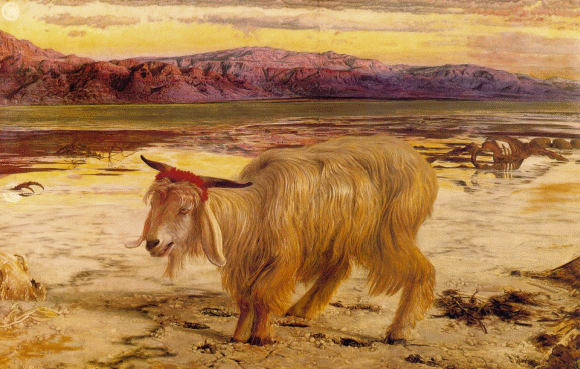
The scapegoat

scapegoat.gif
As the story concerning the CIA’s decision to destroy vital evidence of its program of detainee abuse unfolds, the Bush Administration’s posture on the matter is shifting decisively. This is called “damage control.” The Administration’s initial posture was to have CIA Director Hayden put the best face on the situation and argue that everything that was done was perfectly legal and correct.

So now we come to phase two: the fall-back position. In phase two, we learn that the president and other senior figures in the Administration know nothing about it. Instead, this was all a rogue operation by a second tier leadership figure at the CIA. And indeed, by midday yesterday, White House off-the-record explainers were extremely busy pointing fingers at one man, the designated scapegoat. [complete article]

Inquiry begins into tapes’ destruction

The Justice Department and the Central Intelligence Agency’s internal watchdog on Saturday began a joint preliminary inquiry into the spy agency’s destruction of hundreds of hours of videotapes showing interrogations of top operatives of Al Qaeda.

The announcement comes amid new questions about which officials inside the C.I.A. were involved in the decision to destroy the videotapes, which showed severe interrogation methods used on two Qaeda suspects, Abu Zubaydah and Abd al-Rahim al-Nashiri.

The agency operative who ordered the destruction of the tapes in November 2005 was Jose A. Rodriguez Jr., then the chief of the C.I.A.’s national clandestine service, known as the Directorate of Operations until 2005. On Saturday, a government official who had spoken recently with Mr. Rodriguez on the matter said that Mr. Rodriguez told him that he had received approval from lawyers inside the clandestine service to destroy the tapes. [complete article]

Hill briefed on waterboarding in 2002

In September 2002, four members of Congress met in secret for a first look at a unique CIA program designed to wring vital information from reticent terrorism suspects in U.S. custody. For more than an hour, the bipartisan group, which included current House Speaker Nancy Pelosi (D-Calif.), was given a virtual tour of the CIA’s overseas detention sites and the harsh techniques interrogators had devised to try to make their prisoners talk.

Among the techniques described, said two officials present, was waterboarding, a practice that years later would be condemned as torture by Democrats and some Republicans on Capitol Hill. But on that day, no objections were raised. Instead, at least two lawmakers in the room asked the CIA to push harder, two U.S. officials said.

“The briefer was specifically asked if the methods were tough enough,” said a U.S. official who witnessed the exchange. [complete article]

Man held by CIA says he was tortured

The first of the so-called high-value Guantánamo detainees to have seen a lawyer claims he was subjected to “state-sanctioned torture” while in secret C.I.A. prisons, and he has asked for a court order barring the government from destroying evidence of his treatment.

The request, in a filing by his lawyers, was made on Nov. 29, before officials from the Central Intelligence Agency acknowledged that the agency had destroyed videotapes of interrogations of two operatives of Al Qaeda that current and former officials said included the use of harsh techniques.

Lawyers for the detainee, Majid Khan, a former Baltimore resident, released documents in his case on Friday. They claim he “was subjected to an aggressive C.I.A. detention and interrogation program notable for its elaborate planning and ruthless application of torture” to numerous detainees. [complete article]

Facebooktwittermail

NEWS: Gulf states oppose military threats against Iran; Gates say danger persists

Gulf countries speak out against military option in Iran

Gulf countries, cautious about the nuclear standoff between the United States and Iran, signalled loudly at a regional security conference on Saturday their opposition to any military option against Tehran.

Washington, wrong-footed by its own National Intelligence Estimate in its accusations that Iran wanted nuclear weapons, has emphasised that no options have been ruled out in forcing it to end its nuclear enrichment programme. [complete article]

Gates sees Iran as still-serious threat

Defense Secretary Robert M. Gates said Saturday that Iran is a grave threat to regional security even without nuclear weapons, and called on Tehran to account for American intelligence that describes its support for terrorism and instability around the world.

Just days after Iran claimed political victory after a new American intelligence assessment found that Tehran had frozen its nuclear weapons program, Mr. Gates said Iran could restart those efforts at any time and must come clean about its efforts to build a bomb.

In a speech to a conference on regional security here, Mr. Gates dismissed those who suggested that the United States had a double standard on nuclear arms in the Middle East and that a nuclear-armed Israel was the real danger. He said that, unlike Iran, Israel had never threatened to destroy a neighbor. [complete article]

Facebooktwittermail

NEWS: Madhi Army makeover; Kirkuk’s Arab-Kurdish divide

Sadr militia moves to clean house

Militia commander Abu Maha had studied his quarry carefully, watching as the man acquired fancy suits, gold watches and the street name “Master.” Now, heavily armed and dressed in an Adidas track suit, Abu Maha told his followers it was time to act against one of their comrades.

A dozen of them gripped their assault rifles and headed out. The Master, accused of sliding into immoral behavior after stoutly defending Shiite Muslims in Iraq’s sectarian violence, was about to learn that justice in the Mahdi Army could be very rough.

Fighters such as Abu Maha have taken on a new role in recent months in the militia of Shiite cleric Muqtada Sadr. Instead of battling Sunni insurgents and U.S. troops, they are now weeding out what they consider to be black sheep within their ranks. [complete article]

As Iraqis vie for Kirkuk’s oil, Kurds become pawns

Even by the skewed standards of a country where millions are homeless or in exile, the squalor of the Kirkuk soccer stadium is a startling sight.

On the outskirts of a city adjoining some of Iraq’s most lucrative oil reserves, a rivulet of urine flows past the entrance to the barren playing field.

There are no spectators, only 2,200 Kurdish squatters who have converted the dugouts, stands and parking lot into a refugee city of cinder-block hovels covered in Kurdish political graffiti, some for President Jalal Talabani’s Patriotic Union of Kurdistan.

These homeless Kurds are here not for soccer but for politics. They are reluctant players in a future referendum to decide whether oil-rich Tamim Province in the north and its capital, Kirkuk, will become part of the semiautonomous Kurdish regional government or remain under administration by Baghdad.

Under the Iraqi Constitution the referendum is due before Dec. 31. But in a nation with a famously slow political clock, one of the few things on which Kirkuk’s Kurdish, Arab and Turkmen communities agree is that yet another political deadline is about to be missed. [complete article]

Facebooktwittermail