The One-State Solution
By Muammar Qaddafi, New York Times, January 22, 2009
T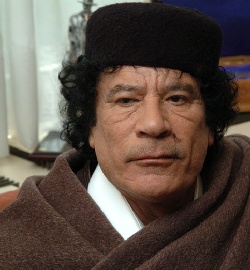 he shocking level of the last wave of Israeli-Palestinian violence, which ended with this weekend’s cease-fire, reminds us why a final resolution to the so-called Middle East crisis is so important. It is vital not just to break this cycle of destruction and injustice, but also to deny the religious extremists in the region who feed on the conflict an excuse to advance their own causes.
But everywhere one looks, among the speeches and the desperate diplomacy, there is no real way forward. A just and lasting peace between Israel and the Palestinians is possible, but it lies in the history of the people of this conflicted land, and not in the tired rhetoric of partition and two-state solutions.
Although it’s hard to realize after the horrors we’ve just witnessed, the state of war between the Jews and Palestinians has not always existed. In fact, many of the divisions between Jews and Palestinians are recent ones. The very name “Palestine” was commonly used to describe the whole area, even by the Jews who lived there, until 1948, when the name “Israel” came into use.
Jews and Muslims are cousins descended from Abraham. Throughout the centuries both faced cruel persecution and often found refuge with one another. Arabs sheltered Jews and protected them after maltreatment at the hands of the Romans and their expulsion from Spain in the Middle Ages.
The history of Israel/Palestine is not remarkable by regional standards — a country inhabited by different peoples, with rule passing among many tribes, nations and ethnic groups; a country that has withstood many wars and waves of peoples from all directions. This is why it gets so complicated when members of either party claims the right to assert that it is their land. [continued…]
A decisive loss for Israel
By Mousa Abu Marzook, The Guardian, January 22, 2009
Israel’s objectives from the war on Gaza were set long before its launch: to remove the Hamas movement and government, achieve the reinstallation of the Fatah leader, Mahmoud Abbas, in Gaza, and end the armed resistance. Two other objectives were not announced. First, restore the Israeli public’s wavering confidence in its armed forces after its defeat by Hezbollah in 2006. Second, boost the coalition government in the coming elections.
Accordingly, we declare that Israel lost, and lost decisively. What did it achieve? The killing of large numbers of civilians, children and women, and the destruction of homes, ministry buildings and other infrastructure with the most advanced US weapons and other internationally banned chemical and phosphorous elements. Almost 2,000 children were killed and injured in desperate pursuit of political goals. Many international organisations called these attacks war crimes, yet barely a word of denunciation was uttered by any western leader. What message does the EU mean to send Palestinians by its shameful silence on these crimes, when it speaks incessantly on human rights?
If anything, the last three weeks, and previous 18 months, have proved that the Palestinians can never be broken by either starvation, economic strangulation or brutal attack. European leaders have only one option: to recognise the outcome of a democratic process they had called for and supported. [continued…]
Hamas leader urges West to talk
BBC News, January 21, 2009
The political leader of Hamas, Khaled Meshaal, says that the time has come for the West to lift its boycott on his Palestinian Islamist movement.
In a speech aired on Arab satellite TV, the exiled chief said it was “time to start talking to Hamas”…
“I tell European nations… three years of trying to eliminate Hamas is enough. It is time for you to deal with Hamas, which has gained legitimacy through struggle,” Mr Meshaal said in a speech from the Syrian capital, Damascus. [continued…]
Tearing up Washington’s Middle East playbook
By Tony Karon, TomDispatch, January 22, 2009
Lest President Barack Obama’s opportunistic silence when Israel began the Gaza offensive that killed more than 1,400 Palestinians (more than 400 of them children) be misinterpreted, his aides pointed reporters to comments made six months earlier in the Israeli town of Sderot. “If somebody was sending rockets into my house, where my two daughters sleep at night, I’m going to do everything in my power to stop that,” Obama had said in reference to the missiles Hamas was firing from Gaza. “I would expect Israelis to do the same thing.”
Residents of Gaza might have wondered what Obama would have done had he been unfortunate enough to be a resident of, say, Jabaliya refugee camp. What if, like the vast majority of Gazans, his grandfather had been driven from his home in what is now Israel, and barred by virtue of his ethnicity from ever returning? What if, like the majority of the residents of this refugee ghetto-by-the-sea, he had voted for Hamas, which had vowed to fight for his rights and was not corrupt like the Fatah strongmen with whom the Israelis and Americans liked to deal?
And what if, as a result of that vote, he had found himself under an economic siege, whose explicit purpose was to inflict deprivation in order to force him to reverse his democratic choice? What might a Gazan Obama have made of the statement, soon after that election, by Dov Weissglass, a top aide to Prime Minister Ehud Olmert, that Israel’s blockade would put him and his family “on [a] diet”?
“The Palestinians will get a lot thinner,” Weissglass had chortled, “but [they] won’t die.”
Starting last June, the Sderot Obama would have noticed that, as a result of a truce brokered by Egypt, the rocket fire from Gaza had largely ceased. For the Jabaliya Obama, however, the “Weissglass Diet” remained in place. Even before Israel’s recent offensive, the Red Cross had reported that almost half the children under two in Gaza were anemic due to their parents’ inability to feed them properly. [continued…]
Obama should quit war on terror, talk to Hamas and Taliban
By Nathen Gardels, Huffington Post, January 21, 2009
Israeli’s leaders, the last practitioners of the Bush doctrine, might want to consider another course more in line with a key inaugural theme of President Barack Obama:
“Power alone cannot protect us, nor does it entitle us to do as we please, ” Obama declaimed on the Capitol steps. Instead, “our power grows through its prudent use, our security emanates from the justness of our cause, the force of our example, the tempering qualities of humility and restraint.”
(That, by the way, is pure Reinhold Niebuhr, the American theologian to whom Obama credits his worldview. His reflections on the use and limits of American power offer a better clue to where Obama is headed than any immediate policy decision which will necessarily be constrained by actions already set in motion by the previous administration.)
The place to start on a new course is to leave the “war on terror” behind and recognize that Hamas, Hezbollah and the Taliban — all of which have legitimate nationalist aspirations, but wrapped in Islamist garb — cannot be lumped into the same category as the cosmic terrorists of Al Qaeda who want to attack the US directly. The former you can negotiate with by addressing their grievances. You can’t deal with Al Qaeda because their claims are in another realm beyond this earth.
Dealing with Hamas or the Taliban doesn’t mean that if Obama talks to them they will roll over. It means that the use of force alone cannot work. It means that ignoring them won’t make them go away. [continued…]
Gaza war ended in utter failure for Israel
By Gideon Levy, Haaretz, January 22, 2009
On the morrow of the return of the last Israeli soldier from Gaza, we can determine with certainty that they had all gone out there in vain. This war ended in utter failure for Israel.
This goes beyond the profound moral failure, which is a grave matter in itself, but pertains to its inability to reach its stated goals. In other words, the grief is not complemented by failure. We have gained nothing in this war save hundreds of graves, some of them very small, thousands of maimed people, much destruction and the besmirching of Israel’s image.
What seemed like a predestined loss to only a handful of people at the onset of the war will gradually emerge as such to many others, once the victorious trumpeting subsides. The initial objective of the war was to put an end to the firing of Qassam rockets. This did not cease until the war’s last day. It was only achieved after a cease-fire had already been arranged. Defense officials estimate that Hamas still has 1,000 rockets. [continued…]
On Palestinian question, tough choices for Obama
By Steven Erlanger, New York Times, January 22, 2009
With the rule of Hamas in Gaza apparently unchallenged and its popularity growing in the West Bank, the new Obama administration faces an immediate policy choice: support a Palestinian unity government, as Egypt and the Palestinian president, Mahmoud Abbas, want, or continue to isolate Hamas and concentrate on building up the West Bank as a political alternative to radical Islam. [continued…]
Gaza war widens lead of Israel’s conservative Likud Party
By Joshua Mitnick, Christian Science Monitor, January 21, 2009
With just three weeks before voters go to the polls, the center-left government is getting high marks from the Israeli public for its pounding offensive in Gaza. But Foreign Minister Tzipi Livni and her ruling centrist Kadima Party may fall victim to the military’s success. [continued…]
Obama to shut Guantánamo site and C.I.A. prisons
By Mark Mazzetti and William Glaberson, New York Times, January 22, 2009
President Obama signed executive orders Thursday directing the Central Intelligence Agency to shut what remains of its network of secret prisons and ordering the closing of the Guantánamo detention camp within a year, government officials said. [continued…]
Obama seeks halt to legal proceedings at Guantanamo
By Peter Finn, Washington Post, January 21, 2009
In one of its first actions, the Obama administration instructed military prosecutors late Tuesday to seek a 120-day suspension of legal proceedings involving detainees at the naval base at Guantanamo Bay, Cuba — a clear break with the approach of the outgoing Bush administration. [continued…]
U.S. secures new supply routes to Afghanistan
By Richard A Oppel Jr, New York Times, January 20, 2009
Faced with the risk that Taliban attacks could imperil the main supply route for NATO troops in Afghanistan, the United States military has obtained permission to move troop supplies through Russia and Central Asia, Gen. David H. Petraeus, the top American commander in the Middle East, said on Tuesday. [continued…]




 hank you, Professor. Mr. Lowy, distinguished guests, members of the Institute, it is an honor for me to be with you today to discuss the subject of this conference, the US-Israeli Alliance Under New Administrations. As we all know, on January 20th the United States will have a new president. Three weeks later Israel will elect a new Knesset and begin the process of forming a government. Whatever the administrations, the US-Israeli relationship will remain strong. As President Elect Obama said recently, “Our alliance is based on share interests and shared values. Those who threaten Israel threaten us. I will bring to the White House an unshakable commitment to Israel’s security”. This of course reaffirmed many similar statements by his predecessors. A strong relationship has always been America’s objective and policy.
