Little more than three weeks before the presidential election, problems that include insecurity and fears of fraud are raising concerns about the credibility of the race, which President Obama has called the most important event in Afghanistan this year.
With Taliban insurgents active in half the country, many Afghans remain doubtful that the Aug. 20 election will take place at all. The Taliban issued a statement last week calling for a boycott, a threat that could deter voters in much of the south, where the insurgency is strongest.
Election officials insist that the election will go ahead. But they concede that the insecurity will prevent as many as 600 polling centers, or roughly 10 percent, from opening. Western officials acknowledge that the election will be imperfect, but say they are aiming for enough credibility to satisfy both Afghans and international monitors.
Even that goal will be hard to meet. Though increasingly unpopular here and abroad, President Hamid Karzai is still the front-runner in a field of about 40 candidates, and only one, Abdullah Abdullah, a former foreign minister for Mr. Karzai, has emerged as a serious challenger. Many Afghans are convinced that foreign powers will choose the winner and fix the result. [continued…]
Immediately after the Mashai appointment [as first deputy president] was made public, a chorus of conservative voices demanded its repeal, claiming that Mashai’s apparent sins were unforgivable. A few months ago, he had been accused of saying Islam does not have the ability to cope with twenty-first-century problems, and that Iranians have no natural enmity against the citizens of Israel. Ahmadinejad ignored demands for firing Mashai, defending him as one of the most pious men he has ever had the good fortune to meet. Aside from family ties, the two men share a passion for the messianic return of Shiism’s Twelfth Imam.
Khamenei soon sent Ahmadinejad a hand-written note declaring the Mashai appointment null and void. It was a Hokm-e Hokumati, the equivalent of a Papal Bull in Catholicism. Even then, Ahmadinejad chose to ignore the order for a week. The delay caused a minor rebellion in the cabinet, with several ministers, including the powerful ministers of intelligence, labor, and Islamic guidance, demanding that Ahmadinejad sack Mashai. Instead of heeding their advice, Ahmadinejad reportedly left the cabinet meeting in anger, sending Mashai back to chair the rest of the meeting. A few days later, he dismissed the dissenting ministers.
Of the group, the firing of Intelligence Minister Gholam Hossein Mohseni-Ejeyee is the most sensitive and important, since the ministry has become a surprising weak link in the regime’s apparatus of oppression. During Khatami’s presidency in the mid-90s, some of the ministry’s rogue elements, particularly those responsible for murder of opposition figures, were tried. Under Mohseni-Ejeyee, appointed by Ahmadinejad to the job in 2005, the ministry has been openly opposed to the broadcast of tortured “confessions” of those arrested during last month’s protests, all forced to admit that they had been pawns in a Western master-plan for a “velvet revolution” in Iran. Through leaked stories and occasional comments from “inside sources,” the intelligence ministry has been supporting the claims of the opposition–that the rebellion has been locally bred (rather than engineered by meddling foreigners), the result of perceived irregularities in the election. It is not surprising that after firing Mohseni-Ejeyee, Ahmadinejad went over the ministry of intelligence and said he was unhappy with their work. Even his effort to appoint one of Mohseni-Ejeyee’s deputies as acting minister backfired when the man refused to accept the job. Ultimately, Ahmadinejad has been forced to become the acting minister himself for the rest of his term. [continued…]
A day after Iranian authorities began a mass trial of more than 100 government opponents, state television broadcast a chilling segment in which two defendants — both prominent reform figures — said they had “changed” since being arrested, and disputed widespread claims that their publicized confessions had been coerced through torture.
The segment was broadcast shortly after a Tehran prosecutor, Saeed Mortazavi, who is running the trials, released a statement warning that anyone criticizing the trial as illegitimate, as many opposition figures have done, would also be prosecuted.
The two steps reflected an intensified effort to intimidate Iran’s opposition movement before President Mahmoud Ahmadinejad is inaugurated for a second term on Wednesday. [continued…]
A cell phone text message circulating in Tehran describes “some of the things banned in the Islamic republic: shouting ‘God is Great,’ attending Friday prayers, reading the Fatiha [the opening chapter of the Koran] and putting on a wake for the dead.”
The references are everyday practices in the life of a Muslim that the government has blocked supporters of opposition leader Mir Hossein Mousavi from doing since June 12.
Members of a paramilitary group called the Basij have shot in the direction of citizens chanting “God is great,” fired tear gas at Mousavi supporters attending Friday prayers and last week prevented Mr. Mousavi from reading the opening verse of the Koran over the grave of a protester — this in an overwhelmingly Muslim country whose government says it promotes and protects Islam.
But Iranians are continuing to chant “God is great” from their rooftops at night — as they did during the 1978-79 revolution — and to venture into the streets by the thousands to face off against baton-wielding motorcycle-mounted enforcers. [continued…]
With a mass trial of more than 100 putative dissidents under way, President Mahmoud Ahmadinejad was formally endorsed Monday as Iran’s leader for a second term. But several of his most prominent opponents, who have called his re-election fraudulent, stayed away from the event, news reports said.
The ceremony, conducted by the supreme leader, Ayatollah Ali Khamenei, came one day after state television broadcast a chilling segment of the trial in which two defendants — both prominent reform figures — said they had “changed” since being arrested and disputed widespread claims that their publicized confessions had been coerced through torture. [continued…]
Iran has perfected the technology to create and detonate a nuclear warhead and is merely awaiting the word from its Supreme Leader, Ayatollah Ali Khamenei, to produce its first bomb, Western intelligence sources have told The Times.
The sources said that Iran completed a research programme to create weaponised uranium in the summer of 2003 and that it could feasibly make a bomb within a year of an order from its Supreme Leader.
A US National Intelligence Estimate two years ago concluded that Iran had ended its nuclear arms research programme in 2003 because of the threat from the American invasion of Iraq. But intelligence sources have told The Times that Tehran had halted the research because it had achieved its aim — to find a way of detonating a warhead that could be launched on its long-range Shehab-3 missiles.
They said that, should Ayatollah Khamenei approve the building of a nuclear device, it would take six months to enrich enough uranium and another six months to assemble the warhead. [continued…]
That doesn’t mean that the United States won or achieved all of its aims or that fighting among Iraqis will stop. It doesn’t mean that Iraq is stable, democratic and relatively free of corruption.
The war is over for the United States because the Iraqis don’t really need or want American forces around anymore. Every time U.S. troops roll out of the gate with their Iraqi counterparts in Baghdad, they discredit the Iraqi forces in the eyes of their people. They make their Iraqi partners’ jobs harder. Although senior U.S. commanders understand and accept this fact privately, they will never admit it. [continued…]
When thieves shot dead eight guards and made off with $4.8 million in one of Iraq’s biggest-ever bank heists last week, fingers quickly pointed at the Sunni-led insurgency.
Extremists must be turning to crime to finance their activities, so the hypothesis went, and $4.8 million would pay for a lot of bombs.
But after a series of arrests and a sweep of a government compound, Iraqi police say the culprits were Iraqi army officers attached to the elite unit guarding Shiite Vice President Adel Abdul Mehdi. [continued…]
Amin says that he was beaten, whipped, deprived of sleep and threatened with an electric drill while being asked questions that would subsequently be put to him again during non-violent interviews by two MI5 officers. Before Amin went on trial, the judge ruled that his conditions in ISI custody had been “physically oppressive” but that he had exaggerated his mistreatment and that it fell short of torture.
Since then, Human Rights Watch (HRW), the New York-based NGO, has spoken to a number of Pakistani intelligence officers who they say corroborated the accounts of torture given by several British citizens alleging UK complicity.
In the case of Amin, according to HRW, the Pakistani sources said his account was “essentially accurate”, adding that it was a “high-pressure” case and the desire for information on the part of both British and American authorities was “insatiable”. HRW add that their sources say British intelligence officials were “perfectly aware that we were using all means possible to extract information from him and were grateful that we were doing so”. [continued…]
Punjab, the fourth and most strategic province, is the country’s heart — home to the powerful military as well as much of Pakistan’s governing class; social upheaval here would drag the whole country with it. In my travels in this province, none of the mullahs were talking about revolution. In fact, the social justice discussions that have driven political movements in the wider Islamic world — Hamas, Hezbollah, or the Sadr Army of Iraq’s Moktada al-Sadr, for example — were notably absent.
Instead, I have found a surprisingly comfortable coexistence between the mullahs, the landlords and the political elite (the latter two are often one and the same). Even the harder-line preachers, among the sternly traditional Muslims known as Deobandis, have stuck to a bland, nonconfrontational line.
One leader of a Deobandi seminary in Kabirwala, a town in southern Punjab, told me that the land was distributed as God had intended, and that the only problem with the landlords was that some were insufficiently Islamic, though now that was improving.
History explains much of the feudal outlook of the clerics in Punjab. They tend not to oppose the establishment in part because the state itself made them powerful. In the 1980s, the military dictator Zia ul-Haq gave land and money to Deobandis, a policy the United States supported because it needed both Mr. Zia and fervent jihadists in the fight against the Soviets in Afghanistan. [continued…]
After receiving eviction notices last May, three Palestinian families constituting 53 people, including 20 children, were forcibly removed from their homes under High Court order at dawn yesterday, August 2.
The Hanouns, the Rawis and the al-Ghawis, all families who fled their homes in West Jerusalem and became refugees during the 1948 War, have been living in their houses since 1956, when Jordan reached an agreement with UNRWA to resettle them. They are now living on the streets, homeless.
Just a week ago they were living inside their home and now there are Jewish settlers inside, exhibiting not the least bit of remorse for the homeless family just outside. The Hanoun family’s furniture was seized by Israeli forces and they are now responsible for paying the storage and mover fees. Meanwhile, the Jewish settlers are living with round-the-clock security, not allowing anyone near. At one house, the police actually had the nerve to tell us not to film too close, as we should respect the privacy of the new residents. [continued…]
Early in the morning on July 7, an excited crowd of more than 100 gathered in Ben-Gurion International Airport to greet 232 new Jewish immigrants to Israel who arrived from North America on an El Al charter flight organized and funded by Nefesh B’Nefesh (which means “Soul in Soul” in Hebrew). The airport’s old and defunct Terminal 1 has been transformed into a celebratory arrival hall for new immigrants brought by the nonprofit organization, which was founded in 2001 with the aim of revitalizing immigration to Israel from North America and Britain.
Recently considered by the Jewish Agency to be serious competition when it comes to immigration, NBN is now recognized as the official operator of North American immigration to Israel. After some years of animosity and tension between the two groups, the Jewish Agency, along with the Israeli government, signed a contract with NBN last September that not only grants formal recognition to NBN but also guarantees that the government and the Jewish Agency will each fund a third of NBN’s $12 million annual budget. The remaining third comes from private donors. It is noteworthy, given the fact that Israeli taxpayer money goes toward this enterprise, that so few Israelis have heard of it. [continued…]
An Israeli judge has ruled that Israel has authority over a disputed area in the Ayalon Valley, a move that could allow the confiscation of Palestinian land bordering the occupied West bank.
The decision, reported in the Israeli press on Sunday, goes against a previous agreement that all issues of sovereignty must be decided by both parties.
Unlike East Jerusalem or the Golan Heights, both considered internationally to be occupied territory, the area around Latrun, about 25km from Jerusalem, was never annexed by Israel. [continued…]
About half of Israelis believe that in order to be a “true Israeli,” one has to have been born in Israel, so finds the Israel Democracy Institute in its annual Israeli Democracy Index, published Monday.
The report, which this year focused on the integration of Russian immigrants into Israeli society, tested the prevalent notion that the integration was smooth. The findings of the study, however, suggested otherwise. The study revealed that most Russian immigrants feel that they have no power to change their immediate reality, even 20 years after the immigration from the former Soviet Union began.
The democracy poll was conducted in March 2009, and included a random sample of adult Israelis. 1,191 people were polled in three different languages: Hebrew, Arabic and Russian. The margin of error is 2.8 percent.
The study found that the mood of the Russian immigrants is generally darker, the problems they face are tougher, and that their reactions are harsher than veteran Israelis’. The immigrant sector voices more concern over Israel’s security threats, is less connected to Israel, and fewer immigrants say that they would want their children to grow up in Israel.
The report found that 77 percent of Russian immigrants support promoting Arab migration from Israel, as opposed to 47 percent of native Jews who say they would support such a policy. 33 percent of the native Jews accept the existence of Arab political parties within the Knesset, while only 23 percent of the immigrants accept this fact. 27 percent of Israelis oppose the statement “a Jewish majority is necessary for fateful decisions for the country” ? in comparison with 38 percent who opposed the same statement in 2003. These figures indicate a growing support for the stripping of political rights from Israel’s Arab minority. [continued…]
I was one of about 175 Americans who formed the VIVA PALESTINA USA Convoy that entered the Gaza Strip on Wednesday evening, July 15, 2009, carrying medical and other humanitarian aid. We entered the Gaza Strip through the Rafah crossing from Egypt with permission to stay 24 hours.
The 1.5 million people who live in the Gaza Strip have been under Israeli restrictions for over 15 years. Starting in the mid-1990s, Israel imposed restrictions on permits for Palestinian men to work in Israel. Coincident with the unilateral, non-negotiated Israeli withdrawal of settlers and its army in 2005, Israel started to restrict imports and exports. Israel tightened these restrictions in 2006 in response to Hamas winning a majority in the Palestinian Authority elections, and again in 2007 when Hamas won a mini-civil war that was initiated by Fatah and took exclusive control of the Gaza Strip. Restrictions of food, fuel, and medical supplies triggered a humanitarian crisis in the Gaza Strip with the U.N. reporting a large fraction of the people, especially children, suffering from malnutrition. The cut-off of import and export of commercial goods led to destruction of the economy and massive unemployment. The situation was made much worse by the December 2008-January 2009 bombing by Israel that resulted in over 1,400 killed and many buildings destroyed, including government and civic buildings and housing for over 100,000 people. [continued…]
In coming weeks, senior administration officials said, the White House will begin a public-relations campaign in Israel and Arab countries to better explain Mr. Obama’s plans for a comprehensive peace agreement involving Israel, the Palestinians and the Arab world.
The campaign, which will include interviews with Mr. Obama on Israeli and Arab television, amounts to a reframing of a policy that people inside and outside the administration say has become overly defined by the American pressure on Israel to halt settlement construction on the West Bank.
“We’re at a crucial moment now,” said Martin S. Indyk, a former ambassador to Israel and peace negotiator in the Clinton administration. “There are only so many visits George Mitchell can make.” [continued…]
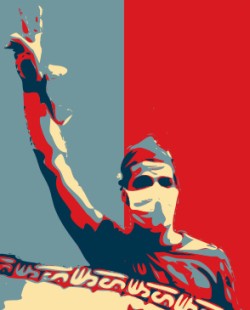
Historically speaking, the Iranian government has enjoyed four sources of legitimacy: its ability to manage state affairs (and thus the people’s consent), its official religious authority, its commitment to Iran’s independence, and a stable base of social support. All of these have now been irretrievably undone.
The massive vote rigging on June 12 brought President Mahmoud Ahmadinejad’s ability to run the state’s affairs under intense public scrutiny, and the spontaneous uprising of the people in its wake openly removed the government’s political legitimacy.
Shortly after, in his speech at Friday prayer, Ayatollah Ali Khamenei, the supreme leader, declared war on the people, threatening a violent crackdown unless the results of the election were duly accepted. This removed the last vestiges of the regime’s religious legitimacy as well.
It had been waning for some time already, not only because it stands in opposition to Islam understood as a discourse of freedom, but even within the regime and among traditionalists. Ayatollah Ali Sistani (the greatest Shia clergyman in Iraq) was opposed to the principle of Velayat-e Faqih (the rule of the imamate), and Ayatollah Hossein Ali Montazeri (Khomeini’s would-be successor who later became his critic) had argued that the doctrine was simply a proof of shirk, or false God-making. [continued…]
The Obama Administration has begun to signal that if Iran hasn’t responded positively to its offer of negotiations over the nuclear question by mid September when the UN General Assembly convenes, Washington will move to implement what Secretary of State Hillary Clinton calls “crippling action” against Iran. They’re unlikely to get Chinese and Russian assent for further UN Security Council sanctions, but the US is moving towards using its commercial and financial muscle to force third-country corporations to cut ties with Iran that enable it to trade internationally. The prime goal of these US sanctions is choking off the gasoline imports on which the Iranian economy depends because of its own limited refining capacity. Companies in Europe, India and elsewhere that enable this trade will be targeted for sanctions unless they cut off gasoline supplies to Iran. At the same time, the US is signalling that it’s urging the Israelis to wait for diplomacy to play out before they launch military strikes, subtly flicking if not quite rattling a sabre.
Yet, there’s a consensus across the political spectrum that Iran is simply not in a position to engage in nuclear talks right now, given the turmoil within the regime. And Washington’s own opening demands are still stuck in the Bush era, insisting that Iran forego the right to enrich uranium – a position rejected by all the factions in Iran. It’s not hard to see, though, that if this autumn Iran suddenly finds itself facing gasoline sanctions and sabre rattling from Israel, behind demands that it surrender what it sees as its nuclear rights, many of those who are currently challenging Mr Ahmadinejad and Mr Khamenei will change their stance if they perceive the Islamic Republic under external threat. The “crippling action” Mrs Clinton now threatens may finally achieve what Mr Ahmadinejad and Mr Khamenei have thus far failed to do – persuade the key factions of the opposition to close ranks behind the regime. [continued…]
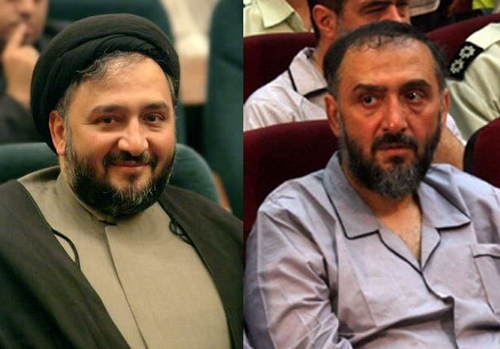
Iranian authorities accused several politicians, including former Vice President Mohammad Ali Abtahi, of planning the riots before the elections and sparking them by allegations of vote fraud.
” ‘Cheating’ was the code word for the riot in which people were mobilized to take to the streets,” the Fars news agency quoted Abtahi as saying.
“Of course, I was not in favor of Ahmadinejad’s presidency. I did not accept this election, and by that non-acceptance I prevented the growth of civil society and I betrayed Iranian culture and history,” Abtahi said, according to Fars.
The normally jovial cleric appeared gaunt and withdrawn as he sat in the courtroom. A photograph showed Abtahi reading the confession from a handwritten document. Reformist news websites quoted his wife as saying he had been drugged. His daughter told BBC Persian that his lawyer had been barred from the proceedings. [continued…]
Iran’s former President Mohammad Khatami vehemently condemned a series of confessions extracted from his political allies and broadcast on state television as part of what he described as a “show trial.”
In comments published today on his website, Khatami, onetime leader of the nation’s reformist movement, warned that the confessions aired during Saturday’s mass trial for those allegedly behind Iran’s weeks of unrest would backfire by further dividing the people from the establishment. [continued…]
President Mahmoud Ahmadinejad of Iran, under attack from a defiant protest movement that rejects his re-election as fraudulent and from a rising chorus of critics within his own hard-line camp, defended himself on Friday and denied reports that he had fallen out of favor with the country’s supreme leader.
Conservatives have accused Mr. Ahmadinejad of showing insufficient respect for the leader, Ayatollah Ali Khamenei, during a recent dispute over cabinet choices. Some have even hinted that the combative president, who is scheduled to be sworn in for a second term next week, may not last if he does not change his ways. [continued…]
Will the turmoil in Iran continue? Can Ayatollah Khamenei survive? Can the regime continue to call itself “Islamic”? Now that the supreme leader has shed his religious mantle and has trashed the constitution, the options are far narrower than you might think.
To gauge Iran’s future, it is essential to emphasize the obvious—the “Islamic” Republic of Iran was built on velayat-e-faqih, Ayatollah Khomeini’s concept of clerical oversight, which was intended to reverse Iran’s drift toward secularism under the shah.
Khomeini understood that for his imprint to be accepted, it would have to show respect for centuries of Iranian history and civilization and for the traditional Shiism practiced in Iran. This meant just rule, social and economic justice, the freedom to chose rulers, the obligation to fight oppression and the glorification of martyrdom among others—something that the shah had ignored to his own peril. Khomeini knew full well, from his own experience under the shah, that Iran, unlike other countries in the region, could not be governed by force for long. As such, Khomeini adopted a religious mantle and a new constitution to bolster his legitimacy. It looks like that same mantle has now become a noose around his successor’s neck. [continued…]
“Hamas is very close on recognition of Israel,” says Ahmed Yousef, the Islamist movement’s deputy foreign minister, speaking from the top floor of a high-rise building in Gaza City. “We show all sorts of ideological flexibility on this.” That does not, alas, mean he can unequivocally accept the three conditions the Quartet (the United States, the European Union, the UN and Russia) laid down three years ago if Hamas is to join international negotiations. But he comes close to doing so, sounding almost desperate to stretch the semantic elastic to satisfy the doubters. It is a formulation that sticks closely to the enunciations of both Khaled Meshaal, the movement’s Syria-based leader, and Ismail Haniyeh, its prime minister in Gaza.
Hamas “honours” all previous agreements of the Palestine Liberation Organisation [with Israel], which include recognition, provided the other side abides by all its reciprocal promises. Hamas is ready to extend its present “unilateral ceasefire” if the other side formally agrees to one: not exactly the Quartet’s demand for a definitive disavowal of violence. And when it comes to recognising Israel, “the issue is not Israel’s right to exist. We know Israel is there. It’s not a matter of recognition.” The distinction, it seems, is a semantic but nonetheless ticklish one: between acceptance and recognition. Some diplomats draw an analogy with the Irish republicans of Sinn Fein, who engaged in negotiations with Britain over Northern Ireland after disavowing violence, but still refused to accept the province’s legitimacy as part of the United Kingdom. [continued…]
Saudi Arabia praised the Obama administration Friday for its “early and robust focus” on the Middle East while rebuffing its efforts to push Riyadh to take confidence-building steps toward Israel.
“Incrementalism and the step-by-step approach has not, and we believe will not, achieve peace,” said the visiting Saudi foreign minister, Prince Saud al-Faisal, with Secretary of State Hillary Rodham Clinton at his side. “Temporary security, confidence-building measures will also not bring peace.”
Former Senate majority leader George J. Mitchell, President Obama’s special envoy for Middle East peace, has traveled almost monthly to the region, seeking to coax the Israelis and Palestinians into peace talks while also encouraging Arab states to offer incentives to Israel to take bold steps, such as a freeze on settlement growth in the Palestinian territories. [continued…]
Police on Sunday submitted a recommendation for the state prosecution to indict Foreign Minister Avigdor Lieberman on charges of bribery, fraud, money laundering, witness harassment and obstruction of justice.
A police source has said the investigation is “practically over,” and the body of evidence is sufficient to support an indictment on the charges.
Last month, Attorney General Menachem Mazuz met with police investigations division head Yoav Sigalovich, national fraud squad head Shlomo Ayalon and detectives involved in the investigation. [continued…]
It has been nearly a decade since the Jewish settlement of Migron appeared on the hilltop opposite this Palestinian village, beginning with a communications tower and followed by a cluster of homes and a fence around approximately 90 acres of land.
Data tucked onto the hard drive of anti-settlement activist Dror Etkes’s computer indicates that the land belongs to the residents of Burqa and nearby Deir Dibwan, and Etkes said he expects that information will one day force the settlers to leave.
The compulsion won’t come from Israel’s politicians, world public opinion or the Obama administration, Etkes contends, but from Israel’s Supreme Court, where local advocacy groups are having increased success challenging settlements with simple property claims. [continued…]
US commanders in Afghanistan aren’t the only ones worried that civilian deaths are costing them hearts and minds. The Taliban, which has planted bombs in schools and occasionally burned its opponents alive, has put out a new code of conduct for militants that appears to be an attempt to project a softer image to the Afghan people.
The little blue booklet, “The Islamic Emirate of Afghanistan’s Rules for Mujahideen,” is sort of a Scouts codee for the Taliban. Approved by Mullah Omar, titular head of the Afghan Taliban. Mujahideen or “holy warriors” are urged not to discriminate on the basis of ethnicity and to always behave “properly” with civilians. Suicide-bombing should only be used on high-value targets, and avoiding civilian casualties is paramount, the booklet says.
“Every member of the Mujahideen must do their best to avoid civilian deaths, civilian injuries and damage to civilian property. Great care must be taken,” the booklet urges Taliban fighters. “Suicide attacks should only be used on high and important targets. A brave son of Islam should not be used for lower and useless targets.” [continued…]
Why give up on poppy eradication?
Last year the Afghan government eradicated 5,000 hectares of about 159,000 that were cultivated. More than 70 military and militia men were killed and a couple of hundred million dollars were spent—tens of thousands of dollars per hectare—to destroy 3 percent of the crop. Eradication is supposed to have a double function: first, to reduce cultivation; and second, to deter farmers from planting. But nobody is deterred by a 3 percent risk. The money would be better spent on development assistance, like hospitals and schools.
You’ve suggested that Afghanistan produces much more opium than the world actually consumes.
Oh, yes. Since 2005 the Afghans have cultivated almost twice world demand. The bottom should have fallen out of the opium market. It has not. And we have been wondering what happened to the opium, where it is. Now, in a number of military operations in the southern provinces, NATO troops have found huge amounts, which is evidence that the Taliban have been sitting on huge stockpiles. [continued…]
Last September, Gen. David H. Petraeus told reporters in Baghdad that the United States had been assured by the Iraqi government that the 3,400 Iranian dissidents in a camp in eastern Iraq would continue to be protected after the Americans turned over responsibility for the camp to Iraqi forces.
Last week’s bloody melee between Iraqi police officers and the residents of the camp has not only raised fresh doubts in Washington about the worth of these assurances, but has also exposed just how little leverage American officials now have in a country they largely controlled for almost six years.
It has also forced the Obama administration to confront some of the thorny issues that bedeviled its predecessor: how to prevent Iraq from falling deeper under Tehran’s influence, and how to fashion a tough Iran policy amid delicate negotiations to dismantle the country’s burgeoning nuclear program. [continued…]
Bombings at five Shiite Muslim mosques killed 29 worshippers Friday in a series of attacks that Iraqi army and police officers are interpreting as a sign that insurgents are determined to destabilize the country now that American forces have withdrawn from Iraqi cities and towns.
“You will see them attempting to start the sectarian violence again,” said a high-ranking Iraqi army officer who commands a unit in western Baghdad. He asked not to be named because he isn’t authorized to speak to the media.
Iraqi army and police officers told McClatchy that the pattern of attacks against the armed forces and civilians resembles the tactics that the extremist Sunni group al Qaida in Iraq used before 2006. The increase in car bombs, roadside bombs and death threats indicates that the Islamic extremist group is attempting to restore ground it lost during the “surge” of American forces in 2008, the officers said. [continued…]
This website or its third-party tools use cookies, which are necessary to its functioning. By closing this banner, you agree to the use of cookies.




 istorically speaking, the Iranian government has enjoyed four sources of legitimacy: its ability to manage state affairs (and thus the people’s consent), its official religious authority, its commitment to Iran’s independence, and a stable base of social support. All of these have now been irretrievably undone.