Daily Archives: September 17, 2009

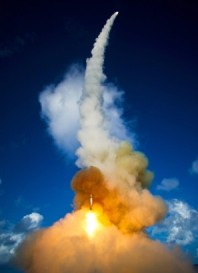
U.S. shelves nuclear-missile shield

U.S. shelves nuclear-missile shield

The White House will shelve Bush administration plans to build a missile-defense system in Poland and the Czech Republic, a move likely to cheer Moscow and roil the security debate in Europe.

Pentagon spokesman Geoff Morrell confirmed Thursday that a “major adjustment” is planned and said the decision was made to better protect U.S. forces and allies in Europe from Iranian missile attacks.

The U.S. is basing its move on a determination that Iran’s long-range missile program hasn’t progressed as rapidly as previously estimated, reducing the threat to the continental U.S. and major European capitals, according to current and former U.S. officials. [continued…]

Editor’s Comment — In this instance, missile defense could be described as a technology that might work in the future to meet a threat that might exist in the future. The Obama administration’s decision — if given it’s rosiest interpretation — can be taken to mean that it has much more interest in actual threats than potential threats.

Is this dose of realism going to color its approach to Iran? Possibly. Equally possible is that it is merely concerned with bolstering unity within the P5 plus one before confronting Iran.

Josh Rogin at Foreign Policy wrote:

…two senior officials explained the administration’s thinking about the missile-defense review.

“This is a recharacterization of what the threat is and how you respond to the threat,” one official said, explaining that previous designs were geared toward the future threat of Iranian long-range missiles, whereas the Obama team wants to focus on the missiles Iran has now, which are short- and medium-range and can only reach Europe.

In an interview with The Cable, Tauscher herself made that argument and also said she wanted to spend more on existing technologies and less on development of futuristic systems.

“What is important is to get the priority of the threat right, current versus emerging. The point of this is to understand the threat, understand what you need to deter and defeat the threat, and what you have to deploy that’s proven technology to deter and defeat the threat,” said Tauscher, “You get those right, it leads you to a place.”

Facebooktwittermail

To bomb, or to bunker? Israel’s Iran choices narrow

To bomb, or to bunker? Israel’s Iran choices narrow

The orchestrated roar of air force exercises designed to signal Israel’s readiness to attack Iranian nuclear facilities are belied, perhaps, by a far quieter project deep beneath the western Jerusalem hills.

Dubbed “Nation’s Tunnel” by the media and screened from view by government guards, it is a bunker network that would shelter Israeli leaders in an atomic war — earth-bound repudiation of the Jewish state’s vow to deny its foes the bomb at all costs.
[…]
Aerial and naval manoeuvres, leaked to the media, have told of plans to reach Iran, though this time the targets are so distant, dispersed, and fortified that even Israel’s top brass admit they could deliver a short-term, disruptive blow at most.

Hence Israel’s discreet arrangements for living with the possibility of a nuclear-armed arch-enemy — the bunkers, the missile interceptors, the talk of a U.S. strategic shield and of Cold War-style deterrence based on mutually-assured destruction.

One government intelligence analyst suggested that Israel had passed a psychological threshold by “allowing” Iran to manufacture enough low-enriched uranium (LEU) for a bomb.

“We keep fretting about whether they will have a ‘break-out capacity’, but really they’re already there,” the analyst said.

The U.N. national intelligence director has assessed Iran will not be technically capable of producing high-enriched uranium (HEU) for the fissile core of an atom bomb before 2013. [continued…]

Israel defense chief: Iran not an existential threat

Israeli Defense Minister Ehud Barak was quoted on Thursday as saying he does not view Iran as a threat to the existence of the Jewish state, a view that would seem to depart from Israeli statements of the recent past.

Israel’s mass-circulation Yedioth Ahronoth daily quoted Barak, the head of Israel’s center-left Labour party, as saying “Iran does not constitute an existential threat against Israel.”

In response to a question about Tehran’s nuclear programme which Israel has said it sees as destined to produce atomic weapons that could put its existence at risk, Barak said in an interview with the paper:

“I am not among those who believe Iran is an existential issue for Israel.” [continued…]

Intelligence agencies say no new nukes in Iran

The U.S. intelligence community is reporting to the White House that Iran has not restarted its nuclear-weapons development program, two counterproliferation officials tell Newsweek. U.S. agencies had previously said that Tehran halted the program in 2003.

The officials, who asked for anonymity when discussing sensitive information, said that U.S. intelligence agencies have informed policymakers at the White House and other agencies that the status of Iranian work on development and production of a nuclear bomb has not changed since the formal National Intelligence Estimate (NIE) on Iran’s “Nuclear Intentions and Capabilities” in November 2007. Public portions of that report stated that U.S. intelligence agencies had “high confidence” that, as of early 2003, Iranian military units were pursuing development of a nuclear bomb, but that in the fall of that year Iran “halted its nuclear weapons program.” The document said that while U.S. agencies believed the Iranian government “at a minimum is keeping open the option to develop nuclear weapons,” U.S. intelligence as of mid-2007 still had “moderate confidence” that it had not restarted weapons-development efforts. [continued…]

How to talk to Iran

The president is right [to enter talks with Iran] for many reasons. The 30-year American-Iranian psychosis is a dangerous, logic-lite hangover. When Obama gathered his Iran advisers after the June election to review intelligence, the slim pickings were slim enough to prompt a presidential “That all you got?” Ignorance breeds treacherous incomprehension.

The president is right because only creative diplomacy can head off the onrushing Iranian uranium enrichment (8,000 inefficient centrifuges and counting); because closer relations with the West represent the best long-term hope for reform in Iran; because Iran is negotiating from the relative weakness of post-June-12 revolutionary disunity; and because the strong U.S. interest lies in preventing an Israeli attack on Muslim Persia. (That’s also in Israel’s interest, by the way; the Arabs are already a handful.)

There’s a lot of verbiage — some that Orwell would have seized on — in the Iranian “package,” but that’s just the way of things in Iran. Like many much-conquered countries, not least Italy, Iran loves artifice, the dressing-up of truth in elaborate layers. It will always favor ambiguity over clarity. This is a nation whose conventions include the charming ceremonial insincerity known as “taarof” (hypocrisy dressed up as flattery), and one that is no stranger to “tagieh,” which amounts to the sacrifice of truth to higher religious imperative.

These traits are worth recalling. Gary Sick, the Carter administration official who negotiated the American hostages’ release, told me that immediately before the critical breakthrough he received a voluminous and preposterous Iranian “proposal” that almost led Carter to walk away. It proved a sideshow with a couple of useful nuggets buried in the outpourings. [continued…]

Iran bullish ahead of nuclear talks

Unless the US and its allies come up with new evidence to substantiate their allegations against Iran, their purported effort to pin on Iran the label of clandestine proliferator is destined to fall short. This is particularly so since there is as of yet no official US revision of the conclusions of its 2007 intelligence estimate. According to this, Iran halted its nuclear weapons program in 2003, shortly after the downfall of Iran’s chief nemesis, Saddam, who was also said to be aggressively pursuing a nuclear program.
Fourth, Iran’s confidence stems from Tehran’s reliance on a multi-faceted negotiation strategy, reflected in its recent “package” that states Iran’s preparedness to cooperate on the issues of “non-proliferation and disarmament” as well as on regional security, energy security, cultural and economic issues.

The advantage of this comprehensive linked approach is that it connects any US engagement with Iran to a host of issues that bind the two countries, such as drug trafficking and security in the region. This belies the contention of some US pundits that the “goal of engagement is not improved relations”, to paraphrase Chester Crocker, a former US diplomat, who in an opinion column in the New York Times under the title “Terms of Engagement” forgets that the Iranian side may also have its own ideas about engagement and that it takes two to have a diplomatic tango. [continued…]

Facebooktwittermail

Iran opposition leader sidelined from rally

Iran opposition leader sidelined from rally

A powerful former president in Iran who supports its opposition movement has been barred from speaking at a major commemorative rally there on Friday, in a striking break from precedent that suggests the country’s hard-line leaders fear the event could turn into an opposition rally.

The former president, Ali Akbar Hashemi Rafsanjani, has delivered the Friday Prayer sermon for almost 25 years on Quds Day, an annual occasion of Iranian solidarity with the Palestinian movement.

But this year he is being replaced by a hard-line cleric, Ahmad Khatami, and President Mahmoud Ahmadinejad will also speak, Iran’s state-run Press TV reported Wednesday, citing the prayers commission. [continued…]

Facebooktwittermail

Obama’s Afghanistan blind spot

Obama’s Afghanistan blind spot

On the ground, no doubt, U.S. and NATO forces are doing their best to implement a policy of limited liability in Afghanistan — meant to buy enough time for a predictable stalemate to emerge. We already know what that will look like: a non-Taliban-dominated government with friendly relations with its Pakistani neighbor. So long as Pakistan doesn’t collapse and the regime in Kabul is not nominally led by the Taliban or a similar Islamist regime opposed to the West, we can claim success after a decent interval.

There is nothing inherently wrong with this outcome. It approximates the post-Soviet situation in the country until the Taliban took control in the late 1990s. But for nearly all of that post-Soviet period, Afghanistan was embroiled in civil war among various factions, nearly all of them backed by outside powers — not simply Pakistan but also Iran, Uzbekistan, Tajikistan, Saudi Arabia, and several others.

All of Afghanistan’s neighbors have a history of interfering in Afghanistan because they fear that militants not kept busy there will eventually wreak havoc within their own borders. At the same time, all have been unwilling to tolerate the “victory” of a single Afghan contender because of deep concerns about the aims of rival backers. The fears stem from internal conflicts in all of the neighboring countries, many of which, in turn, are linked to Afghanistan.

The specter of this “international civil war” haunts those dealing with Afghanistan today. There is only one way to prevent it besides an indefinitely long and costly military occupation: an agreement among neighboring powers to respect Afghanistan’s neutrality and to lend greater political assistance to U.S. and NATO efforts on the ground. It may not be sufficient to stabilizing Afghanistan, but it is necessary. [continued…]

Obama says he won’t rush Afghanistan troop decision

On a day when his administration outlined ambitious goals for Afghanistan and Pakistan, President Obama also moved Wednesday to call a timeout in the escalating national debate over a possible troop increase in Afghanistan.

Obama insisted he would not be rushed in deciding whether to send more troops — an action favored by top military leaders but questioned by a growing number of Democrats — saying that additional time is needed to refine strategy and assess needs.

Yet the lofty goals set by the White House — such as promoting an Afghan government that can combat extremism and corruption while supporting human rights — represent difficult, time-consuming work likely to require additional military and nonmilitary commitments at a time of flagging support from Obama’s wary political base. [continued…]

NATO says U.S. airstrike in Kunduz killed 30 civilians

NATO investigators believe that 30 civilians were killed in a controversial U.S. airstrike in Afghanistan’s Kunduz province, a preliminary finding that could spark new pressure for disciplinary actions against the German and American personnel involved in the attack.

A team of military officers led by Canadian Maj. Gen. C.S. Sullivan spent more than a week probing the Sept. 4 bombing, which took place after a German commander in Kunduz ordered an airstrike on two hijacked fuel trucks that he feared would be used in a suicide attack against his troops.

North Atlantic Treaty Organization investigators believe roughly 100 people were killed in the resulting strike, including approximately 70 militants, according to people familiar with the matter. A separate Afghan government probe reached roughly the same conclusions about the militant and civilian death tolls, these people said. [continued…]

Facebooktwittermail

Is America hooked on war?

Is America hooked on war?

“War is peace” was one of the memorable slogans on the facade of the Ministry of Truth, Minitrue in “Newspeak,” the language invented by George Orwell in 1948 for his dystopian novel 1984. Some 60 years later, a quarter-century after Orwell’s imagined future bit the dust, the phrase is, in a number of ways, eerily applicable to the United States.

Last week, for instance, a New York Times front-page story by Eric Schmitt and David Sanger was headlined “Obama Is Facing Doubts in Party on Afghanistan, Troop Buildup at Issue.” It offered a modern version of journalistic Newspeak.

“Doubts,” of course, imply dissent, and in fact just the week before there had been a major break in Washington’s ranks, though not among Democrats. The conservative columnist George Will wrote a piece offering blunt advice to the Obama administration, summed up in its headline: “Time to Get Out of Afghanistan.” In our age of political and audience fragmentation and polarization, think of this as the Afghan version of Vietnam’s Cronkite moment. [continued…]

Facebooktwittermail

Letter from Baghdad: In checkpoint scrawl, reality’s counterpoint

In checkpoint scrawl, reality’s counterpoint

The writing on the walls of Baghdad’s checkpoints have little to do with reality. Grim as life is here, with everything from buildings to desiccated orchards shaded in a dull ocher, no one needs testament to that. More often, the slogans penned in graceful Arabic say what leaders of a state threatening to fail want, or what they lack.

“No to terrorism,” insists graffiti to a country still haunted by it. “Respect and be respected,” declares a motto of Iraqi soldiers, who habitually complain of disrespect. “No one is above the law,” intones a slogan to passersby, few of whom would concur.

No one disputes these days that the Americans are leaving Iraq, at least in their incarnation as an occupying power backed by more than 100,000 soldiers in a country that feels as wrecked today as it has at any time since the 2003 invasion that toppled Saddam Hussein. But no one is quite sure what kind of state they will leave behind.

The slogans of Prime Minister Nouri al-Maliki’s government give one sense, although they invariably speak with far more confidence than they inspire. Scrawled along the checkpoints, they are the words of authority. Law means obedience, as does patriotism. Allegiance is mentioned far more than democracy or freedom. [continued…]

Biden pushes Iraqi leaders on vote law, oil-bid perks

Vice President Biden pressed Iraqi leaders Wednesday to approve as quickly as possible legislation that establishes rules for the planned January general election and to make the next round of bids to develop Iraqi oil concessions more attractive to foreign investors.

In a series of meetings in the Green Zone, Biden listened to the concerns of Iraqi leaders, now in the heat of an election season that Obama administration officials acknowledge will delay until after the vote any progress on such pressing issues as passing a law on the equitable distribution of national oil revenue among Shiites, Sunnis and Kurds.

A senior administration official said Biden also made his interests known on a variety of issues, such as the need for the Iraqi parliament to adopt laws to better protect foreign investment and leaving unchanged the terms of the timetable for the withdrawal of the 130,000 U.S. troops now in the country. [continued…]

Iraq’s vice president says Iraq should call on US for security help

Iraq should consider calling for more help from US forces in the wake of August’s devastating suicide truck bombings in Baghdad, Vice President Adel Abul Madhi told the Monitor.

In an implicit criticism of Prime Minister Nouri al-Maliki’s reluctance to ask for help from the US following the June 30 pullback of combat troops, Dr. Abdul Mahdi called for a re-assesment of the role of US forces here that could result in more involvement for American troops sidelined by what he termed an over-optimistic view of security in Iraq.

“This should be reassessed once again – whether it was too early, whether it was adequate this should be assessed,” he said on Sunday when asked whether the withdrawal of combat troops from Iraqi cities has weakened security. [continued…]

Facebooktwittermail

How Hezbollah wins by losing

How Hezbollah wins by losing

Since the June 7 Lebanese parliamentary elections, an alluring but simplistic narrative has emerged in the West: because Hezbollah and its allies were defeated at the polls, the militant group would lose some of its luster and a pro-American political coalition would rule Lebanon. In fact, Hezbollah remains the country’s dominant military and political force. Moreover, it holds the key to both domestic and external stability — its actions will determine whether there is another war with Israel or if Lebanon will once again be wracked by internal conflict. By losing the election, Hezbollah also avoided being held accountable by Lebanon’s other sects — without power, there is little responsibility. [continued…]

Facebooktwittermail

Military strikes won’t help stabilise Somalia

Military strikes won’t help stabilise Somalia

The killing of Saleh Ali Nabhan, a leader of al-Shabab, in Somalia yesterday dramatically reduced the list of wanted terrorist individuals in the country. I say dramatically, because the total number of known terrorists in Somalia is no more than half a dozen. This is the paradoxical story of the war on terror in Somalia.

On the one hand, the implication of terrorism, its related activities and global reach, were not significant enough to generate serious international involvement to deal with the country. This is why we continue to see ad hoc military strikes here and there without any coherent strategy to stabilise the country, dissociate thousands of young people from becoming radicalised and, most importantly, provide vital humanitarian assistance to millions of Somalis. On the other hand, the terrorist infrastructure in Somalia is severe enough to deny the country any sense of normality and stability, or for governance to take root.

Immediately after 11 September 2001, the US decided that global terrorist networks were not rooted enough in Somalia to warrant US involvement there – militarily, diplomatically or financially. The policy of containment which was put in place really seemed to mean “we will watch the country instead of help to fix it”. To the frustration of the UN, Somali politicians and neighbouring countries, the US did not play an active part in the Somali peace and reconciliation process. Even more bizarrely, during the peace talks, the US security establishment preferred to work with warlords instead of helping to put together a Somali government. As a consequence, the US undermined the peace process itself. [continued…]

Facebooktwittermail
