
Daily Archives: October 4, 2009

Iran’s diplomatic dexterity

Iran’s diplomatic dexterity

The Geneva talks with Iran have been presented as a diplomatic victory and vindication of President Obama’s commitment to engagement. As Juan Cole wrote: “Barack Obama pwned Bush-Cheney in one day, and got more concessions from Iran in 7 1/2 hours than the former administration got in 8 years of saber-rattling.”
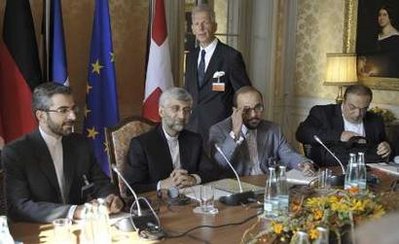
But as many commentators have been quick to describe this as a success for the administration, the role Iran played in making this happen has been largely overlooked.

The breakthrough came during talks on Thursday — or so the narrative runs.

Except, the terms of a key portion of the agreement — a deal for replenishing the fuel supply for a reactor in Tehran that produces medical isotopes — were announced the day before by President Mahmoud Ahmadinejad.

“As I said in New York, we need 19.75 percent-enriched uranium. We said that, and we propose to buy it from anybody who is ready to sell it to us. We are ready to give 3.5 percent-enriched uranium and then they can enrich it more and deliver to us 19.75 percent-enriched uranium,” Ahamdinejad was quoted by ISNA news agency as saying.

In an interview with Newsweek during his trip to New York to attend the UN General Assembly in late September, Ahmadinejad said:

“We simply don’t have the capacity to enrich at 20 percent for medicinal purposes, of the sort that we have in mind, at this stage. It’s only at 3.5 percent. We had been buying this material in the past, but not from the U.S. government. We can buy it from the United States. It doesn’t really matter who we buy it from, so we are open to it. But this does not affect the fuel cycle. But still, it seems to me a nice opening, a nice window to look through.”

A State Department background briefing given on the day of the Geneva talks confirmed:

“Iran came to the IAEA a few months ago with the request to replace this supply [for the Tehran reactor]. The IAEA consulted us and some others, some other members, and to make a long story short the United States and Russia joined together in a proposal to the IAEA which the IAEA subsequently conveyed as a response to the Iranians, to use Iran’s own LEU stockpile as the basis, as the feedstock for the reactor fuel that’s required.”

The crucial component in this deal was obviously that Iran would provide the feedstock, but as Ahmadinejad made clear on Wednesday, Iran’s decision to do that had already been made before discussions began in Geneva.

Still, the perception remains that the earlier revelations about the Fordo facility outside Qom meant that the Iranians had been diplomatically cornered.

Maybe so. But whether that’s the case may hinge on questions that remain unanswered: How and when did Iran discover that the existence of the facility was no longer secret? For that matter, is it realistic to think that the Iranians would ever have thought that this or any other construction project of such a type could progress without receiving careful and virtually constant scrutiny by America’s ever-watchful eyes in the sky? This after all is the kind of intelligence in which the US retains unparalleled prowess.


Facebooktwittermail

Report says Iran has data to make a nuclear bomb

Report says Iran has data to make a nuclear bomb

Senior staff members of the United Nations nuclear agency have concluded in a confidential analysis that Iran has acquired “sufficient information to be able to design and produce a workable” atom bomb.

The report by experts in the International Atomic Energy Agency stresses in its introduction that its conclusions are tentative and subject to further confirmation of the evidence, which it says came from intelligence agencies and its own investigations.

But the report’s conclusions, described by senior European officials, go well beyond the public positions taken by several governments, including the United States.

Two years ago, American intelligence agencies published a detailed report concluding that Tehran halted its efforts to design a nuclear weapon in 2003. But in recent months, Britain has joined France, Germany and Israel in disputing that conclusion, saying the work has been resumed.

A senior American official said last week that the United States was now re-evaluating its 2007 conclusions. [continued…]

Editor’s Comment — The New York Times is at it again: putting on quite a convincing performance as a clandestine operation that acts at the behest of governments and intelligence agencies.

Ah, but the Times is simply a messenger, relaying important information provided by “a senior European official’ who wanted to make public the contents of a so-far unpublished and incomplete IAEA report.

The political agenda here seems transparent. A report whose existence has been debated for weeks now becomes front-page news, right at the moment that delicate negotiations have only just begun.

Is this coming out now in order to add an increased sense of urgency to the diplomatic effort? I don’t think so. On the contrary, it’s about undermining that effort and the work of the IAEA.

Comments by the IAEA’s director-general, Mohamed ElBaradei, published in an interview with The Hindu seem particularly relevant here:

I have been making it very clear that with regard to these alleged studies, we have not seen any use of nuclear material, we have not received any information that Iran has manufactured any part of a nuclear weapon or component. That’s why I say, to present the Iran threat as imminent is hype.

Q: In a sense, this one outstanding issue is far less serious than the issues which prompted Iran’s referral to the Security Council!

It is a serious concern but I am not going to panic, to say it is an imminent threat that we are going to wake up and see Iran with nuclear weapons. Our job is to make sure we do not overstate or understate a case. There are enough people around to use or abuse what we say. The judgment call is very difficult, but based on what we have seen so far — we are concerned, we need to clarify this issue, we need to build confidence in the peaceful nature of Iran’s programme, we need Iran to adhere to the Additional Protocol because that will help me build confidence. But I am not going to sound an alarm and say that Iran is on the verge of developing nuclear weapons.

Facebooktwittermail

Israel names Russians helping Iran build nuclear bomb

Israel names Russians helping Iran build nuclear bomb

The West says the plant [near Qom] is tailor-made for a secret weapons programme and proves Iran’s claim that its nuclear programme is intended only for peaceful purposes is a lie. The plant is designed to hold 3,000 centrifuges — enough to produce the material needed for one bomb a year.

Iran’s conduct over the next few weeks will determine whether the West continues its new dialogue or is compelled to increase pressure with tougher United Nations and other sanctions.

Ephraim Sneh, a former Israeli deputy defence minister, warned that time was running out for action to stop the programme. “If no crippling sanctions are introduced by Christmas, Israel will strike,” he said. “If we are left alone, we will act alone.” [continued…]

Editor’s CommentThe Sunday Times has amazing intelligence sources!

Not a single IAEA inspector has set foot in the Fordo facility or seen its plans and yet we know that it is “tailor-made for a secret weapons programme”.

Right! I suppose you can argue the fact that it’s a deeply concealed structure makes it “tailor-made” for such a purpose, but that would seem to be a case of inferring that something is certain because it is unknown.

That might be so in the mind of a Sunday Times reporter, but I for one, have yet to observe such a quasi-mystical correspondence between the known and the unknown.

As for yet another Israeli threat — I’m sorry, but the more often they are made, the more implausible they become, at least to me.

The military option: Could they do it?

The U.S. military is developing technologies, including a new generation of “bunker-busting” bombs, that could destroy facilities like the one near Qom.

But there are doubts about the effectiveness of those weapons, prompting current and former U.S. officials to say that a military effort aimed at crippling Iran’s nuclear program would require dozens of missile strikes and possibly even the insertion of U.S. troops.

“If you’re going to have an effective campaign to go in and throw [Iran’s nuclear program] back years, you’re talking about a massive, massive effort,” said a former senior U.S. intelligence official who was involved in examining such scenarios.

“This is not an Iraqi reactor or a Syrian reactor,” the official said, referring to Israel’s strikes in 1981 and 2007, respectively, on above-ground nuclear facilities in those countries. “This is a different game.”

The official and others spoke on condition of anonymity when discussing millitary planning.

President Obama said shortly after taking office that he was prepared to use “all elements of American power to prevent Iran from developing a nuclear weapon.” Last week, he reiterated that he would not “rule out any options when it comes to U.S. security interests.”

The increasingly difficult nature of upholding that pledge through military strikes, however, became clearer last week when U.S. officials described the newest Iranian site, believed to be a uranium enrichment which plant which could furnish fissile material for a bomb. [continued…]

Facebooktwittermail

Iran’s brilliant chessmanship

Brilliant chessmanship

ike back-winding in a sailing race, Iran has gotten ahead of the United States and its allies that met for the nuclear talks in Geneva Thursday. Iran pulled a rabbit out of the diplomatic hat in the form of a self-disclosure to the International Atomic Energy Agency about a second uranium-enrichment plant in Qom.

On the surface, President Obama and other leaders of the G-20 group of major economic countries meeting recently in Pittsburgh seized on this revelation to mount timely new pressure on Iran. Mr. Obama went so far as claiming that the Qom site’s “configuration” indicates it is for military purposes. Iran’s initiative seemed to have all but backfired on it, as manna from heaven for the “P5 + 1” nations – permanent U.N. Security Council members Britain, France, Russia, China and the U.S. plus Germany – that are pondering fresh sanctions on Iran in case the Geneva talk fails.

Yet Secretary of State Hillary Rodham Clinton’s air of certainty – that the disclosure about the “hidden site” will add to the pressure on Iranians at the talk to “come out clean” on their nuclear program – may prove premature. More than anything, this is leverage for Iran to the detriment of Western strategy, for several reasons. [continued…]

Facebooktwittermail

What I saw at the Afghan election

What I saw at the Afghan election

Before firing me last week from my post as his deputy special representative in Afghanistan, U.N. Secretary General Ban Ki-moon conveyed one last instruction: Do not talk to the press. In effect, I was being told to remain a team player after being thrown off the team. Nonetheless, I agreed.

As my differences with my boss, Norwegian diplomat Kai Eide, had already been well publicized (through no fault of either of us), I asked only that the statement announcing my dismissal reflect the real reasons. Alain LeRoy, the head of U.N. peacekeeping and my immediate superior in New York, proposed that the United Nations say I was being recalled over a “disagreement as to how the United Nations Assistance Mission in Afghanistan (UNAMA) would respond to electoral fraud.” Although this was not entirely accurate — the dispute was really about whether the U.N. mission would respond to the massive electoral fraud — I agreed.

Instead, the United Nations announced my recall as occurring “in the best interests of the mission,” and U.N. press officials told reporters on background that my firing was necessitated by a “personality clash” with Eide, a friend of 15 years who had introduced me to my future wife.

I might have tolerated even this last act of dishonesty in a dispute dating back many months if the stakes were not so high. For weeks, Eide had been denying or playing down the fraud in Afghanistan’s recent presidential election, telling me he was concerned that even discussing the fraud might inflame tensions in the country. But in my view, the fraud was a fact that the United Nations had to acknowledge or risk losing its credibility with the many Afghans who did not support President Hamid Karzai. [continued…]

Facebooktwittermail