Weeks after the U.S.-led invasion of Iraq in the spring of 2003, as parts of the capital were still smoldering, American soldiers and diplomats turned to men like Hassan Shama and Omar Rahman Rahmani in their quest to plant the seeds of representative democracy.
In Baghdad, Iraq’s capital, they held impromptu neighborhood caucuses to appoint district and neighborhood advisory councils. The local government bodies were given no official charter, lawmaking power or public budget. In the years that followed, as the capital became a bloody battleground and the country descended into near-anarchy, council members were among the U.S. military’s staunchest allies. They provided information about extremists, offered insight into Iraqi society and gave American-imposed security measures a veneer of Iraqi legitimacy.
As U.S. troops have sharply disengaged from Baghdad in recent months, local representatives say they are feeling powerless and abandoned. The Iraqi government has taken no steps to hold elections for the councils, and the Baghdad provincial council is culling them of members it deems unqualified or unfit for service.
The looming demise of the local councils — at least as the Americans established them — is an ominous sign of the brand of democracy that is likely to reign in Iraq as the Americans depart, council members say. They worry that constituents will no longer have grass-roots representation and that power will become far more centralized in the hands of a few. [continued…]
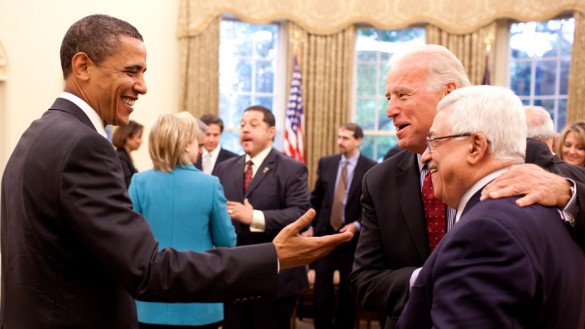
As Abbas falls, have no doubt that he got pushed by an inept administration that similarly gets weak-kneed whenever it feels pressure from either the Israel lobby or the Israeli government.
Yesterday, State Department spokesman, Ian Kelly, was asked: “What role specifically did the United States play in pressuring the Palestinian Authority to make that decision [to shelve the Goldstone report]?
Kelly, squirming like an eel, responded:
Well, I don’t know if I would accept your characterization of pressuring. I think that we recognized that we had serious concerns with the recommendations and some of the allegations. We felt very strongly that while these investigations should be investigated and addressed, that we thought on the one hand that Israel had the kind of institutions that could address these allegations. And of course, we urged Israel to address these very serious allegations.
But I think we had a broader concern that we didn’t want the report to distract us from our ultimate goal, which was to address the root causes of the tragic events of last January, and that’s the lack of a regional and lasting peace between the two parties – between the Israelis and the Palestinians. So we were concerned that we stay focused on that ultimate goal.
And we are not saying that the allegations in the report – we’re not saying that they should be ignored. We simply do not want the report itself to become any kind of impediment to this ultimate goal. We appreciate the seriousness with which the Palestinians approach this very, very difficult issue, and we respect this decision to defer discussion of the report to a later date for the reasons that I just stated – that we want to make sure that we stay focused on the ultimate goal here.
(Goldstone discussion begins at 6 minutes 55 seconds.)
What kind of tortured logic is this? On the one hand war crimes committed in Gaza are somehow extraneous to an understanding of the root causes of the conflict, yet the root cause of the conflict is conflict itself?
The administration needs to make up its mind: Either this conflict is all about violence, in which case Israeli violence can’t be ruled out of the equation. Or, the violence is merely symptomatic of underlying political injustices and a natural outcome of addressing those injustices will be a long sought peace. Take your pick.
Of course, the true sentiment that few American officials are crass enough to utter, yet apparently everyone believes, is that when Israelis kill hundreds of Palestinians they really don’t intend to kill any (“we shoot and we cry”), yet when Palestinians kill a dozen Israelis they merely fall short of accomplishing their genocidal intentions.
* * *
After taking stabs at solving the Middle East conflict, engaging Iran, bringing about global nuclear disarmament, healing the rift between Muslims and the West, shoring up the global financial system, tackling climate change and reforming America’s health care system, there are strong indications that Obama came into office intoxicated by his image as a world savior.
Even so, his cool created the impression that he might actually be impervious to the influence of adulation, but even though some of us thought he had risen above the massive projections that were being imposed on him, the evidence is that to some extent he got sucked into the myth that had been created around him.
To see Obama now as either a tragic figure or as the victim of circumstances essentially absolves him of responsibility for his own actions.
I don’t think it’s premature to be conducting an autopsy on Obama’s Middle East initiative and the first question to ask is this: Did he manage to cross the most minimal threshold for a defensible approach? That is, can he claim at least to have done no harm?
Unfortunately, the harm appears grossly evident and it hinges on his choice to raise expectations across the region and then allow those expectations to founder. Expectations dashed are much more destructive than expectations never formed. (George Bush never disappointed anyone because no one took his promises seriously. In office and life he mastered the art of setting a low bar.)
So, could Obama have entered the situation differently and put himself in a better position to at least live up to the Hippocratic oath (which, incidentally, all politicians should be forced to take)?
He could have acknowledged that he had on his plate more than any human president could address (“sorry folks, I’m not the Messiah”) and he could in his first days in office have said something like this:
“The Middle East conflict is a wound to which no easy remedy can be applied. I do not come into office claiming to have any greater powers than all of my predecessors who struggled with limited success to deal with this issue.
“I do know this, however: setting aside the many intractable political issues, there is right now a humanitarian crisis in Gaza. We haven’t had time to assess the scope of this crisis but having appointed George Mitchell as my Middle East peace envoy, I’ve asked him to put the crisis in Gaza at the top of his agenda. In the next few days he will be visiting the area to assess which needs must most urgently addressed.”
At that point, the Israel Lobby’s wheels would have started spinning frantically. But how do you conduct a campaign focused on preventing Mitchell going to Gaza and addressing a humanitarian crisis?
No doubt, phones in the White House and the State Department would have been ringing off the hook as Abe Foxman and other Jewish community leaders and Israeli officials objected, saying that such a move would not be “helpful”. But seriously, how do you conduct a public campaign whose direct aim is to prevent help reaching tens of thousands of people whose homes had been flattened?
What happened in reality? Obama and Mitchell made the choice of staying out of Gaza. Neither of them had a gun pointed at his head.
Obama had the opportunity to craft a policy that grew modestly and organically from the facts on the ground. A combination of fear, arrogance and perhaps lack of political imagination, led him to pass up that opportunity.
Palestinian Authority president Mahmud Abbas was on Tuesday “seriously studying” the possibility of asking that a UN Gaza war report be passed on to the Security Council, a senior official said.
“President Abbas is seriously studying the possibility of asking the Arab and Islamic bloc to officially take the Goldstone report to international bodies, including the UN General Assembly and the Security Council,” chief Palestinian negotiator Saeb Erakat said in a phone call from Amman.
The move appeared to mark a change in position, as the Palestinian delegation on Friday backed a move at the UN Human Rights Council to defer a vote on whether the report should be passed on. [continued…]
In his speech to the United Nations General Assembly, Israeli Prime Minister Benjamin Netanyahu vigorously took up the country’s latest strategy for responding to allegations of human rights abuses: kill the messenger. He denounced a recent report by the UN’s Human Rights Council that had accused Israel of possible crimes against humanity during its assault on Gaza last winter, calling it a “travesty,” a “farce” and a “perversion.” The Hamas terrorists Israel was up against had committed acts akin in history only to the Nazi blitz of British civilians during World War II, Netanyahu asserted. Indeed, in denying a nation’s right to resist attack, the report sought to undermine Israel’s “legitimacy.”
The head of the UN Fact-Finding Mission on the Gaza Conflict, Judge Richard Goldstone, was “upset” by the speech. “It is disingenuous, to put it lightly, what Netanyahu said,” he told The Nation. “The idea that this is aimed at delegitimating the state of Israel–that is the last thing I would want to do.” Goldstone, a Jew and a Zionist, said that Israel’s leaders were behaving contemptuously, “ignoring the specific allegations and simply launching a broadside.” [continued…]
Turkish civil society organizations and thousands of people on Monday protested Israeli invasion of Al-Aqsa Mosque and other Jewish provocations in Taksim Square, calling on Turkey to act against the destruction policy.
Started at 17 pm, people from different disticts of Istanbul attended the protest, as well as people from different cities.
Gathered in Taksim Square walked through Galatasaray High School on Istiklal Street, protesters shouted slogans in solidarity with Palestinians to condemn Israeli actions.
The group then burned the Israeli flags. [continued…]
LYNN SHERR: You’ve met with Special Envoy Richard Holbrooke?
RORY STEWART: Sure.
LYNN SHERR: What do you tell them?
RORY STEWART: Again, my message is: focus on what we can do. We don’t have a moral obligation to do what we can’t. People can get very fixed by saying, “But surely you’re not saying we ought to do nothing? Surely you’re not saying we ought to allow the Taliban to do this or that?” And I just keep saying “ought” implies “can”– you don’t have a moral obligation to do what you can’t do.
LYNN SHERR: How is your advice taken?
RORY STEWART: I think what I see at the moment is that people are polite, because they imagine maybe I have some experience with Afghanistan. But I’m one of a broad community of people — we have nine people working in my center at Harvard who’ve worked there for 20 or 30 years and the problem we all have is that if the Administration has for some reason already decided that they’re going to increase troops, they’re going to do a counterinsurgency campaign, it’s very difficult for them to take on board people coming back and saying, “Look, actually, I don’t think this is going to work. It’s a great idea. I can see why you want to do it. But by trying to do the impossible, you may end up doing nothing. I’d like to present an alternative strategy, which is lighter, more intelligent, and may end up actually achieving something.”
LYNN SHERR: And again, their reaction? They listen politely, you say?
RORY STEWART: They listen politely, but in the end, of course, basically the policy decision is made. What they would like is little advice on some small bit. I mean, the analogy that one of my colleagues used recently is this: it’s as though they come to you and they say, “We’re planning to drive our car off a cliff. Do we wear a seatbelt or not?” And we say, “Don’t drive your car off the cliff.” And they say, “No, no, no. That decision’s already made. The question is should we wear our seatbelts?” And you say, “Why by all means wear a seatbelt.” And they say, “Okay, we consulted with policy expert, Rory Stewart,” et cetera. [continued…]
A senior US security official Sunday disagreed with the assessment that Iran now knows how to make a nuclear bomb.
According to the Sunday New York Times, a secret International Atomic Energy Agency (IAEA) report says that Iran has “sufficient information to be able to design and produce a workable” atom bomb.
US National Security Adviser James Jones, however, disputed the IAEA’s findings. Asked on CNN’s “State of the Union” if Iran has the data to make a nuclear bomb, he said: “No, we stand by the reports that we’ve put out.” [continued…]
US lawmakers on Sunday vowed quick action against Iran following a report that weapons experts believe Tehran has the know-how to build an atomic bomb — even as a senior US official downplayed the news article.
A chorus of congressional voices, both Republican and Democratic, urged tough action against Tehran following a New York Times report that the International Atomic Energy Agency (IAEA) has determined Iran now has “sufficient information” to build a nuclear weapon.
US lawmakers said the revelation warranted an immediate and severe response. [continued…]
In June 2005, Mahmoud Ahmadinejad’s meteoric rise from mayor of Tehran to president of one of the most influential countries in the Middle East took everyone by surprise. One of the main reasons for the astonishment was that so little was known about him.
One recently published claim about his background comes from an article in the Daily Telegraph. Entitled “Mahmoud Ahmadinejad revealed to have Jewish past”, it claims that his family converted to Islam after his birth. The claim is based on a number of arguments, a key one being that his previous surname was Sabourjian which “derives from weaver of the sabour, the name for the Jewish tallit shawl in Persia”.
Professor David Yeroshalmi, author of The Jews of Iran in the 19th century and an expert on Iranian Jewish communities, disputes the validity of this argument. “There is no such meaning for the word ‘sabour’ in any of the Persian Jewish dialects, nor does it mean Jewish prayer shawl in Persian. Also, the name Sabourjian is not a well-known Jewish name,” he stated in a recent interview. In fact, Iranian Jews use the Hebrew word “tzitzit” to describe the Jewish prayer shawl. Yeroshalmi, a scholar at Tel Aviv University’s Center for Iranian Studies, also went on to dispute the article’s findings that the “-jian” ending to the name specifically showed the family had been practising Jews. “This ending is in no way sufficient to judge whether someone has a Jewish background. Many Muslim surnames have the same ending,” he stated. [continued…]
n the most profound financial change in recent Middle East history, Gulf Arabs are planning – along with China, Russia, Japan and France – to end dollar dealings for oil, moving instead to a basket of currencies including the Japanese yen and Chinese yuan, the euro, gold and a new, unified currency planned for nations in the Gulf Co-operation Council, including Saudi Arabia, Abu Dhabi, Kuwait and Qatar.
Secret meetings have already been held by finance ministers and central bank governors in Russia, China, Japan and Brazil to work on the scheme, which will mean that oil will no longer be priced in dollars.
The plans, confirmed to The Independent by both Gulf Arab and Chinese banking sources in Hong Kong, may help to explain the sudden rise in gold prices, but it also augurs an extraordinary transition from dollar markets within nine years.
The Americans, who are aware the meetings have taken place – although they have not discovered the details – are sure to fight this international cabal which will include hitherto loyal allies Japan and the Gulf Arabs. Against the background to these currency meetings, Sun Bigan, China’s former special envoy to the Middle East, has warned there is a risk of deepening divisions between China and the US over influence and oil in the Middle East. “Bilateral quarrels and clashes are unavoidable,” he told the Asia and Africa Review. “We cannot lower vigilance against hostility in the Middle East over energy interests and security.” [continued…]
In a single phone call to his man in Geneva, Mahmoud Abbas has demonstrated his disregard for popular action, and his lack of faith in its accumulative power and the place of mass movements in processes of change.
For nine months, thousands of people – Palestinians, their supporters abroad and Israeli anti-occupation activists – toiled to ensure that the legacy of Israel’s military offensive against Gaza would not be consigned to the garbage bin of occupying nations obsessed with their feelings of superiority.
Thanks to the Goldstone report, even in Israel voices began to stammer about the need for an independent inquiry into the assault. But shortly after Abbas was visited by the American consul-general on Thursday, the leader of the Palestine Liberation Organization got on the phone to instruct his representative on the United Nations Human Rights Council to ask his colleagues to postpone the vote on the adoption of the report’s conclusions.
Heavy American pressure and the resumption of peace negotiations were the reasons for Abbas’ move, it was said. Palestinian spokespeople spun various versions over the weekend in an attempt to make the move kosher, explaining that it was not a cancelation but a six-month postponement that Abbas was seeking.
Will the American and European representatives in Geneva support the adoption of the report in six months’ time? Will Israel heed international law in the coming months, stop building in the settlements and announce immediate negotiations on their dismantlement and the establishment of a Palestinian state in the occupied territories? Is this what adoption of the report would have endangered? Of course not. [continued…]
Editor’s Comment — The White House, having initially promised American Jewish community leaders that the Goldstone report could be assured a quiet death (it would reach a “natural conclusion” in the UN Human Rights Council and move no further), then opted for a different choice: half-life might cause fewer political ruptures than sudden death. All that was required was the Mahmoud Abbas be obliging enough to do the administration’s dirty work and get the report shelved. Obama could then maintain his serenity and keep the peace process moving forward.
What kind of imbecile thought that was a plan that would work?
* * *
Yesterday, the jailed Tanzim leader and Fatah Central Committee member Marwan Barghouti said: “whoever thinks it’s possible to make peace with the current Israeli government is being delusional.”
He also suggested that the circumstances which led to the Al-Aqsa Intifada still prevail and called on Palestinians to conduct a “peaceful resistance” campaign.
That’s something Obama and Mitchell might pause to consider.
Hamas leaders on Monday warned that President Mahmoud Abbas’ decision to delay action on a United Nations report criticizing Israel’s offensive in the Gaza Strip was in essence a “justification” of the war and encouragement of occupation.
The report, by Justice Richard Goldstone, criticized both Israel and the Palestinians for the war in January 2008. Last week the Palestinian delegation to the UN Human Rights Council dropped its support for an immediate vote on the report.
Speaking to Gaza lawmakers, Hamas Prime Minister Ismail Haniyeh accused Abbas of having “justified” the war by agreeing to defer a UN vote that would have condemned Israel’s failure to cooperate with the war crimes investigation led by South African judge Richard Goldstone. [continued…]
The Western-backed Palestinian Authority on Monday urged the world to “force [Israel] to put off its attempts to take over Jerusalem and Judaize it,” prompting Orthodox Jews in the United States to vow never to give up their historical right to the ancient city.
The Palestinian cabinet, issuing a strong statement after a meeting in the West Bank town of Ramallah, condemned what it called a plan by Jews to “perform religious rituals” in the Temple Mount compound which contains the al-Aqsa mosque, Islam’s third holiest site.
It also pledged “to confront Israel,” as Israeli security forces clashed with Arab protesters for a second day in the Jerusalem area. In response, the leading body of Orthodox Jews in America condemned the Palestinian Authority and the violence exhibited by Palestinian protesters. [continued…]
Israeli police shut down access to key Muslim holy sites in Jerusalem’s Old City on Sunday, spurring Palestinian protesters to throw rocks and bottles in protest – marking the second consecutive Sunday of disturbances near the city’s overlapping points of prayer for Jews and Muslims.
Clashes broke out in reaction to Israel’s closure of the entrances to the Dome of the Rock and the Al Aqsa Mosque, Islam’s third-holiest site. About 150 Palestinians who gathered for a prayer service near the city’s Lion’s Gate on Sunday morning hurled rocks and bottles at Israeli police, who fired tear gas in attempt to disperse the crowd. Palestinian officials said nine people were treated for light injuries, primarily tear gas inhalation. Israel said two of its policeman were sent to hospitals after being injured by rocks and bottles.
An Israeli police spokesman said that the decision to close the site was made following calls in various Palestinian media on Saturday night to march on the Haram el-Sharif (The Noble Sanctuary), as it is called in Arabic – referred to by Israelis as the Temple Mount. Several Islamic groups claim that an Israeli archeological dig below the site is endangering Al Aqsa and that it will soon collapse, a claim Israel denies. [continued…]
US commanders had been planning since late last year to abandon the small combat outpost in mountainous eastern Afghanistan where eight U.S. soldiers died Saturday in a fierce insurgent assault.
The pullout, part of a strategy of withdrawing from sparsely populated areas where the United States lacks the troops to expel Taliban forces and to support the local Afghan government, has been repeatedly delayed by a shortage of cargo helicopters, Afghan politics and military bureaucracy, U.S. military officials said.
The attack began in the early morning hours. Taliban-linked militiamen struck from the high ground using rifles, grenades and rockets against the outpost, a cluster of stone buildings set in a small Hindu Kush valley that has been manned by 140 U.S. and Afghan forces. By the end of a day-long siege, eight Americans and two Afghan security officers were dead, marking the highest toll for U.S. forces in over a year.
The deaths brought into stark relief the dilemma the Obama administration faces in Afghanistan. Without more soldiers and supplies, the Taliban and allied insurgents are gaining ground, but committing more forces could sink the country deeper into an increasingly deadly and unpopular war. [continued…]
Nine U.S. soldiers were killed and 27 were wounded during the July 13, 2008, attack, which raged for several hours and was one of the bloodiest of the Afghan war. Among the dead was [1st Lt. Jonathan] Brostrom.
In recent months, the battle of Wanat has come to symbolize the U.S. military’s missteps in Afghanistan. It has provoked Brostrom’s father to question why Jonathan died and whether senior Army officers — including a former colleague and close friend — made careless mistakes that left the platoon vulnerable. It has triggered three investigations, the latest initiated last week by Adm. Mike Mullen, the chairman of the Joint Chiefs of Staff.
And it has helped drive a broader reassessment of war strategy among top commanders in Afghanistan, who have begun to pull U.S. troops out of remote villages where some of the heaviest fighting has occurred. Senior military leaders have concluded that they lack the forces to wrest these Taliban strongholds away from the enemy and are instead focusing on more populated and less violent areas. [continued…]
National security adviser James L. Jones suggested Sunday that the public campaign being conducted by the U.S. commander in Afghanistan on behalf of his war strategy is complicating the internal White House review underway, saying that “it is better for military advice to come up through the chain of command.”
Gen. Stanley A. McChrystal, who commands the 100,000 U.S. and international forces in Afghanistan, warned bluntly last week in a London speech that a strategy for defeating the Taliban that is narrower than the one he is advocating would be ineffective and “short-sighted.” The comments effectively rejected a policy option that senior White House officials, including Vice President Biden, are considering nearly eight years after the U.S. invasion. [continued…]
Over the next few weeks, Barack Obama must make the most difficult decision of his presidency to date: whether or not to send up to 40,000 more troops to Afghanistan, as his commanding general there, Gen. Stanley A. McChrystal, has reportedly proposed.
This summer, Mr. Obama described the effort in Afghanistan as “a war of necessity.” In such a war, you do whatever you need to do to win. But now, as criticism mounts from those who argue that the war in Afghanistan cannot, in fact, be won with more troops and a better strategy, the president is having second thoughts.
A war of necessity is presumably one that is “fundamental to the defense of our people,” as Mr. Obama has said about Afghanistan. But if such a war is unwinnable, then perhaps you must reconsider your sense of its necessity and choose a more modest policy instead. [continued…]
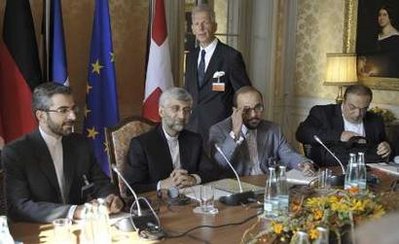
The Geneva talks with Iran have been presented as a diplomatic victory and vindication of President Obama’s commitment to engagement. As Juan Cole wrote: “Barack Obama pwned Bush-Cheney in one day, and got more concessions from Iran in 7 1/2 hours than the former administration got in 8 years of saber-rattling.”
But as many commentators have been quick to describe this as a success for the administration, the role Iran played in making this happen has been largely overlooked.
The breakthrough came during talks on Thursday — or so the narrative runs.
Except, the terms of a key portion of the agreement — a deal for replenishing the fuel supply for a reactor in Tehran that produces medical isotopes — were announced the day before by President Mahmoud Ahmadinejad.
“As I said in New York, we need 19.75 percent-enriched uranium. We said that, and we propose to buy it from anybody who is ready to sell it to us. We are ready to give 3.5 percent-enriched uranium and then they can enrich it more and deliver to us 19.75 percent-enriched uranium,” Ahamdinejad was quoted by ISNA news agency as saying.
In an interview with Newsweek during his trip to New York to attend the UN General Assembly in late September, Ahmadinejad said:
“We simply don’t have the capacity to enrich at 20 percent for medicinal purposes, of the sort that we have in mind, at this stage. It’s only at 3.5 percent. We had been buying this material in the past, but not from the U.S. government. We can buy it from the United States. It doesn’t really matter who we buy it from, so we are open to it. But this does not affect the fuel cycle. But still, it seems to me a nice opening, a nice window to look through.”
A State Department background briefing given on the day of the Geneva talks confirmed:
“Iran came to the IAEA a few months ago with the request to replace this supply [for the Tehran reactor]. The IAEA consulted us and some others, some other members, and to make a long story short the United States and Russia joined together in a proposal to the IAEA which the IAEA subsequently conveyed as a response to the Iranians, to use Iran’s own LEU stockpile as the basis, as the feedstock for the reactor fuel that’s required.”
The crucial component in this deal was obviously that Iran would provide the feedstock, but as Ahmadinejad made clear on Wednesday, Iran’s decision to do that had already been made before discussions began in Geneva.
Still, the perception remains that the earlier revelations about the Fordo facility outside Qom meant that the Iranians had been diplomatically cornered.
Maybe so. But whether that’s the case may hinge on questions that remain unanswered: How and when did Iran discover that the existence of the facility was no longer secret? For that matter, is it realistic to think that the Iranians would ever have thought that this or any other construction project of such a type could progress without receiving careful and virtually constant scrutiny by America’s ever-watchful eyes in the sky? This after all is the kind of intelligence in which the US retains unparalleled prowess.
Senior staff members of the United Nations nuclear agency have concluded in a confidential analysis that Iran has acquired “sufficient information to be able to design and produce a workable” atom bomb.
The report by experts in the International Atomic Energy Agency stresses in its introduction that its conclusions are tentative and subject to further confirmation of the evidence, which it says came from intelligence agencies and its own investigations.
But the report’s conclusions, described by senior European officials, go well beyond the public positions taken by several governments, including the United States.
Two years ago, American intelligence agencies published a detailed report concluding that Tehran halted its efforts to design a nuclear weapon in 2003. But in recent months, Britain has joined France, Germany and Israel in disputing that conclusion, saying the work has been resumed.
A senior American official said last week that the United States was now re-evaluating its 2007 conclusions. [continued…]
Editor’s Comment — The New York Times is at it again: putting on quite a convincing performance as a clandestine operation that acts at the behest of governments and intelligence agencies.
Ah, but the Times is simply a messenger, relaying important information provided by “a senior European official’ who wanted to make public the contents of a so-far unpublished and incomplete IAEA report.
The political agenda here seems transparent. A report whose existence has been debated for weeks now becomes front-page news, right at the moment that delicate negotiations have only just begun.
Is this coming out now in order to add an increased sense of urgency to the diplomatic effort? I don’t think so. On the contrary, it’s about undermining that effort and the work of the IAEA.
Comments by the IAEA’s director-general, Mohamed ElBaradei, published in an interview with The Hindu seem particularly relevant here:
I have been making it very clear that with regard to these alleged studies, we have not seen any use of nuclear material, we have not received any information that Iran has manufactured any part of a nuclear weapon or component. That’s why I say, to present the Iran threat as imminent is hype.
Q: In a sense, this one outstanding issue is far less serious than the issues which prompted Iran’s referral to the Security Council!
It is a serious concern but I am not going to panic, to say it is an imminent threat that we are going to wake up and see Iran with nuclear weapons. Our job is to make sure we do not overstate or understate a case. There are enough people around to use or abuse what we say. The judgment call is very difficult, but based on what we have seen so far — we are concerned, we need to clarify this issue, we need to build confidence in the peaceful nature of Iran’s programme, we need Iran to adhere to the Additional Protocol because that will help me build confidence. But I am not going to sound an alarm and say that Iran is on the verge of developing nuclear weapons.
The West says the plant [near Qom] is tailor-made for a secret weapons programme and proves Iran’s claim that its nuclear programme is intended only for peaceful purposes is a lie. The plant is designed to hold 3,000 centrifuges — enough to produce the material needed for one bomb a year.
Iran’s conduct over the next few weeks will determine whether the West continues its new dialogue or is compelled to increase pressure with tougher United Nations and other sanctions.
Ephraim Sneh, a former Israeli deputy defence minister, warned that time was running out for action to stop the programme. “If no crippling sanctions are introduced by Christmas, Israel will strike,” he said. “If we are left alone, we will act alone.” [continued…]
Editor’s Comment — The Sunday Times has amazing intelligence sources!
Not a single IAEA inspector has set foot in the Fordo facility or seen its plans and yet we know that it is “tailor-made for a secret weapons programme”.
Right! I suppose you can argue the fact that it’s a deeply concealed structure makes it “tailor-made” for such a purpose, but that would seem to be a case of inferring that something is certain because it is unknown.
That might be so in the mind of a Sunday Times reporter, but I for one, have yet to observe such a quasi-mystical correspondence between the known and the unknown.
As for yet another Israeli threat — I’m sorry, but the more often they are made, the more implausible they become, at least to me.
The U.S. military is developing technologies, including a new generation of “bunker-busting” bombs, that could destroy facilities like the one near Qom.
But there are doubts about the effectiveness of those weapons, prompting current and former U.S. officials to say that a military effort aimed at crippling Iran’s nuclear program would require dozens of missile strikes and possibly even the insertion of U.S. troops.
“If you’re going to have an effective campaign to go in and throw [Iran’s nuclear program] back years, you’re talking about a massive, massive effort,” said a former senior U.S. intelligence official who was involved in examining such scenarios.
“This is not an Iraqi reactor or a Syrian reactor,” the official said, referring to Israel’s strikes in 1981 and 2007, respectively, on above-ground nuclear facilities in those countries. “This is a different game.”
The official and others spoke on condition of anonymity when discussing millitary planning.
President Obama said shortly after taking office that he was prepared to use “all elements of American power to prevent Iran from developing a nuclear weapon.” Last week, he reiterated that he would not “rule out any options when it comes to U.S. security interests.”
The increasingly difficult nature of upholding that pledge through military strikes, however, became clearer last week when U.S. officials described the newest Iranian site, believed to be a uranium enrichment which plant which could furnish fissile material for a bomb. [continued…]
ike back-winding in a sailing race, Iran has gotten ahead of the United States and its allies that met for the nuclear talks in Geneva Thursday. Iran pulled a rabbit out of the diplomatic hat in the form of a self-disclosure to the International Atomic Energy Agency about a second uranium-enrichment plant in Qom.
On the surface, President Obama and other leaders of the G-20 group of major economic countries meeting recently in Pittsburgh seized on this revelation to mount timely new pressure on Iran. Mr. Obama went so far as claiming that the Qom site’s “configuration” indicates it is for military purposes. Iran’s initiative seemed to have all but backfired on it, as manna from heaven for the “P5 + 1” nations – permanent U.N. Security Council members Britain, France, Russia, China and the U.S. plus Germany – that are pondering fresh sanctions on Iran in case the Geneva talk fails.
Yet Secretary of State Hillary Rodham Clinton’s air of certainty – that the disclosure about the “hidden site” will add to the pressure on Iranians at the talk to “come out clean” on their nuclear program – may prove premature. More than anything, this is leverage for Iran to the detriment of Western strategy, for several reasons. [continued…]
Before firing me last week from my post as his deputy special representative in Afghanistan, U.N. Secretary General Ban Ki-moon conveyed one last instruction: Do not talk to the press. In effect, I was being told to remain a team player after being thrown off the team. Nonetheless, I agreed.
As my differences with my boss, Norwegian diplomat Kai Eide, had already been well publicized (through no fault of either of us), I asked only that the statement announcing my dismissal reflect the real reasons. Alain LeRoy, the head of U.N. peacekeeping and my immediate superior in New York, proposed that the United Nations say I was being recalled over a “disagreement as to how the United Nations Assistance Mission in Afghanistan (UNAMA) would respond to electoral fraud.” Although this was not entirely accurate — the dispute was really about whether the U.N. mission would respond to the massive electoral fraud — I agreed.
Instead, the United Nations announced my recall as occurring “in the best interests of the mission,” and U.N. press officials told reporters on background that my firing was necessitated by a “personality clash” with Eide, a friend of 15 years who had introduced me to my future wife.
I might have tolerated even this last act of dishonesty in a dispute dating back many months if the stakes were not so high. For weeks, Eide had been denying or playing down the fraud in Afghanistan’s recent presidential election, telling me he was concerned that even discussing the fraud might inflame tensions in the country. But in my view, the fraud was a fact that the United Nations had to acknowledge or risk losing its credibility with the many Afghans who did not support President Hamid Karzai. [continued…]
The Geneva nuclear talks were just baby steps along a long and perilous path. Still, this was a historic moment after 30 years of mutual recriminations and hyperbole.
If you have any doubt that the Geneva meetings with Iran were surprisingly productive, just go back and look at the commentary the day before they began. Even allowing for the fact that the United States and its negotiating partners (the five permanent members of the United Nations Security Council plus Germany–the P5+1–plus European Union negotiator Javier Solana) were trying to lower expectations to the political equivalent of absolute zero, it was still difficult to find anyone who anticipated anything like real progress. Yet that is what happened.
Iran had issued a bland five-page document that scarcely mentioned the nuclear issue. They insisted that the newly discovered Qom enrichment site was not only perfectly legal but utterly routine. They let it be known that they had no intention of discussing their own nuclear program in these talks. Yet, from the accounts we have so far, it appears that Iran came prepared to make concessions about Qom, permitting IAEA inspections to begin within the next two weeks or so. As for their nuclear program, almost nothing else seems to have been discussed. [continued…]
Israel is threatening to kill off a crucial West Bank economic project unless the Palestinian Authority withdraws a request to the International Criminal Court to investigate alleged Israeli crimes during last winter’s Gaza war.
Shalom Kital, an aide to defence minister Ehud Barak, said today that Israel will not release a share of the radio spectrum that has long been sought by the Palestinian Authority to enable the launch of a second mobile telecommunications company unless the PA drops its efforts to put Israeli soldiers and officers in the dock over the Israeli operation.
“It’s a condition. We are saying to the Palestinians that ‘if you want a normal life and are trying to embark on a new way, you must stop your incitement,” Mr. Kital said. “We are helping the Palestinian economy but one thing we ask them is to stop with these embarrassing charges.”
As long as the Wataniya Mobile company is unable to begin its operations, communications costs are likely to remain inordinately high for Palestinian businesses and individuals. But thwarting the company benefits four unauthorized Israeli operators who make sizeable profits in the Palestinian market using infrastructure they have set up in the illegal Israeli settlements across the West Bank. [continued…]
The paratroopers of Chosen Company had plenty to worry about as they began digging in at their new outpost on the fringe of a hostile frontier village in eastern Afghanistan.
Intelligence reports were warning of militants massing in the area. As the paratroopers looked around, the only villagers they could see were men of fighting age idling in the bazaar. There were no women and children, and some houses looked abandoned. Through their night scopes they could see furtive figures on the surrounding mountainsides.
A few days later, they were almost overrun by 200 insurgents.
That firefight, a debacle that cost nine American lives in July 2008, has become the new template for how not to win in Afghanistan. The calamity and its roots have been described in bitter, painstaking detail in an unreleased Army history, a devastating narrative that has begun to circulate in an initial form even as the military opened a formal review this week of decisions made up and down the chain of command.
The 248-page draft history, obtained by The New York Times, helps explain why the new commander in Afghanistan, Gen. Stanley A. McChrystal, is pressing so hard for a full-fledged commitment to a style of counterinsurgency that rests on winning over the people of Afghanistan even more than killing militants. The military has already incorporated lessons from the battle in the new doctrine for war in Afghanistan.
The history offers stark examples of shortcomings in the unit’s preparation, the style of combat it adopted, its access to intelligence, its disdain for the locals — in short, plenty of blame to go around. [continued…]
The last time Taliban forces swept across the Shomali Plain, they left behind a wasteland of scorched vineyards and decapitated fruit trees that farmers have spent the past eight years nursing back to life.
Now, the inhabitants of this fertile region north of Kabul are fearful that the whirlwind will come again, destroying their hopes and hard work. Yet they are deeply conflicted about whether American and NATO troops should remain here to defend them, or whether the Western forces are exacerbating problems that Afghans should settle among themselves.
These growing concerns echo the urgent debate taking place in Washington, where policymakers are sharply divided on whether to commit more troops to Afghanistan or pull them out, as well as on how to define the mission — as an effort to shore up Afghanistan’s troubled democracy or to focus more narrowly on killing Taliban and al-Qaeda fighters.
“If the foreigners leave, one man will just set fire to the next man’s house,” said Mirza Mahmad, 50, who was playing marbles with his grandson in this central Shomali town. “When I was a soldier, we defeated the Russians with old clothes and borrowed bullets, and they got stuck in the mud of Afghanistan. We need the Americans, but if they don’t win the trust of the people, they will get stuck here in the mud forever.” [continued…]
Mahmoud Ahmadinejad’s vitriolic attacks on the Jewish world hide an astonishing secret, evidence uncovered by The Daily Telegraph shows.
A photograph of the Iranian president holding up his identity card during elections in March 2008 clearly shows his family has Jewish roots.
A close-up of the document reveals he was previously known as Sabourjian – a Jewish name meaning cloth weaver.
The short note scrawled on the card suggests his family changed its name to Ahmadinejad when they converted to embrace Islam after his birth. [continued…]
This website or its third-party tools use cookies, which are necessary to its functioning. By closing this banner, you agree to the use of cookies.





 But as many commentators have been quick to describe this as a success for the administration, the role Iran played in making this happen has been largely overlooked.