
U.S. envoy resists increase in troops
The U.S. ambassador in Kabul sent two classified cables to Washington in the past week expressing deep concerns about sending more U.S. troops to Afghanistan until President Hamid Karzai’s government demonstrates that it is willing to tackle the corruption and mismanagement that has fueled the Taliban’s rise, senior U.S. officials said.
Karl W. Eikenberry’s memos, sent as President Obama enters the final stages of his deliberations over a new Afghanistan strategy, illustrated both the difficulty of the decision and the deepening divisions within the administration’s national security team. After a top-level meeting on the issue Wednesday afternoon — Obama’s eighth since early last month — the White House issued a statement that appeared to reflect Eikenberry’s concerns.
“The President believes that we need to make clear to the Afghan government that our commitment is not open-ended,” the statement said. “After years of substantial investments by the American people, governance in Afghanistan must improve in a reasonable period of time.”
On the eve of his nine-day trip to Asia, Obama was given a series of options laid out laid out by military planners with differing numbers of new U.S. deployments, ranging from 10,000 to 40,000 troops. None of the scenarios calls for scaling back the U.S. presence in Afghanistan or delaying the dispatch of additional troops.
But Eikenberry’s last-minute interventions have highlighted the nagging undercurrent of the policy discussion: the U.S. dependence on a partnership with a Karzai government whose incompetence and corruption is a universal concern within the administration. After months of political upheaval, in the wake of widespread fraud during the August presidential election, Karzai was installed last week for a second five-year term. [continued…]
Editor’s Comment — Many years ago I had a conversation — seemingly trivial at the time — yet it contained an observation as true now as it was then.
I was in Bamyan Valley in central Afghanistan (this was when the Buddha statues were still intact) talking to one of the English-speaking residents. A policeman sat on a curb nearby, well within earshot but neither I nor my interlocutor had any reason to imagine the man in his dusty uniform could understand a word we were saying.
“He’s a bit stupid,” the Afghan volunteered bluntly. “He works for the government. They don’t pay well and they don’t pay often. This is the only type of man who would take such a job.”
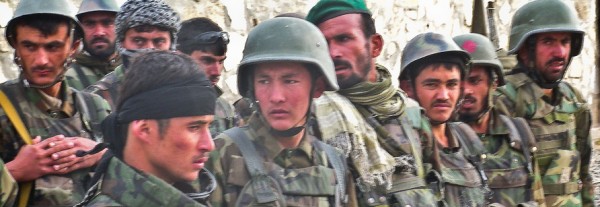
I’m reminded of that sorry-looking policeman when I look at this ragtag collection of Afghan National Army soldiers. It certainly doesn’t help that even when uniformed they are so visibly lacking in uniformity, but their collective look of bewilderment conveys better than any Congressional testimony that they are part of an ill-conceived enterprise.
President seeks clarity on turnover to Afghan government, official says
President Barack Obama does not plan to accept any of the Afghanistan war options presented by his national security team, pushing instead for revisions to clarify how and when U.S. troops would turn over responsibility to the Afghan government, a senior administration official said Wednesday.
Obama still is close to announcing his revamped war strategy, most likely shortly after he returns from a trip to Asia that ends on Nov. 19.
The president raised questions at a war council meeting on Wednesday, however, that could alter the dynamic of both how many additional troops are sent to Afghanistan and what the timeline would be for their presence in the war zone, according to the official, who spoke on condition of anonymity to discuss Obama’s thinking. [continued…]
In Afghanistan, Taliban surpasses al-Qaeda
This year, Omar’s military committee published a rule book for followers, calling on them to protect the population and avoid civilian casualties — much like U.S. counterinsurgency principles. He has railed against the corruption of President Hamid Karzai’s government, an issue that resonates with Afghans. He has also solicited support from other Muslim countries. But al-Qaeda’s agenda of global holy war and taste for mass-casualty attacks, no matter how many Muslim civilians are killed, complicate that goal.
In a February interview with al-Samoud magazine, Taliban political committee leader Agha Jan Mutassim praised the Saudi Arabian government, called for Muslim unity and said the Taliban “respects all different Islamic schools and branches without any discrimination” in Afghanistan.
Such positions may put Omar’s Taliban at odds with al-Qaeda’s extremist Sunni agenda of overthrowing what it sees as corrupt Muslim governments and targeting Shiites. Analysts said that Omar, who leads a council of Taliban commanders based in or around the Pakistani city of Quetta, wants such countries as Saudi Arabia, the United Arab Emirates and Pakistan to recognize the Taliban as a legitimate government if it regains power and that he has little interest in fomenting war elsewhere.
“We assure all countries that the Islamic Emirate of Afghanistan, as a responsible force, will not extend its hand to cause jeopardy to others,” Omar said in a written statement in September.
The messages from the Taliban leadership since the spring amount to something of a “revolution,” said Wahid Mujda, a political analyst who was a Foreign Ministry official under the Taliban government. “Al-Qaeda’s path is now different from the Taliban’s path, and they are growing more separated.” [continued…]
Welcome to the wartime contracting bazaar in Afghanistan. It is a virtual carnival of improbable characters and shady connections, with former CIA officials and ex-military officers joining hands with former Taliban and mujahedeen to collect US government funds in the name of the war effort.
In this grotesque carnival, the US military’s contractors are forced to pay suspected insurgents to protect American supply routes. It is an accepted fact of the military logistics operation in Afghanistan that the US government funds the very forces American troops are fighting. And it is a deadly irony, because these funds add up to a huge amount of money for the Taliban. “It’s a big part of their income,” one of the top Afghan government security officials told The Nation in an interview. In fact, US military officials in Kabul estimate that a minimum of 10 percent of the Pentagon’s logistics contracts–hundreds of millions of dollars–consists of payments to insurgents. [continued…]
Afghanistan is neither Vietnam nor Iraq
As President Obama contemplates a new strategy in Afghanistan, Washington is obsessed with whether the best analogy to the conflict lies in Vietnam or Iraq, with attendant and obvious implications for policy. Of course, Afghanistan has little in common with either Vietnam or Iraq in terms of history, geography, culture, or politics. There is, however, a more apt analogy, and it involves the very area in dispute.
Driven by radical Islam, Pashtun nationalism, and armed opportunism, some of the clans in Waziristan — a pair of currently militant-ridden tribal regions in Pakistan and the site of the recent anti-Taliban Pakistani military offensive — rose against British rule in 1936. The rebels improvised roadside bombs, ambushed convoys, and launched hit and run attacks on isolated outposts to drive out alien forces. They kidnapped and beheaded British soldiers and civilians. In unprotected villages, they massacred civilians who did not support them. When troops chased the rebels, they crossed the border with Afghanistan to seek refuge. (Much of this is happening today on either side of Waziristan’s border with Afghanistan.)
Chasing down rebels, patrolling roads, and keeping supply lines open was — and remains — hazardous duty. Soldiers in Waziristan learned to vary their activities or paid with their lives. D. S. Richards in The Savage Frontier quotes a British soldier on “the cardinal Frontier principle of never doing the same thing in the same way twice running,” because “[s]omeone was always watching — someone with an inborn tactical sense, someone who missed nothing.” [continued…]



