Monthly Archives: November 2009

Why are the United States and Israel at the top of human rights hit lists?

Why are the United States and Israel at the top of human rights hit lists?

Human Rights Watch and its rights-watching peers have heard it all. They’re quasi-terrorists with an anti-U.S. ax to grind or perhaps stealth fighters for global capitalists. They’ve been accused of being anti-Semitic, anti-Asian, and anti-African at one time or another. Since the human rights movement began in the early 1970s, the criticism has grown as fast as the stacks of reports, op-eds, and analysis that the organizations’ analysts produce.

Six years ago, we decided it was time to systematically examine the accusations flying from all directions. After subjecting human rights organizations’ work to a barrage of statistical tests, we found that everyone was right. Yes, the watchdogs have biases. But they might make those groups more effective at pushing the human rights cause. Whichever side of the fence you fall on, there’s no denying it: There’s a politics to human rights.

It was bound to happen. Despite the drive for neutrality that watchdogs strive for, they were playing in a political minefield. Just take reporting on Israel, which has been the source of consistent controversy from both sides. The debate turned especially nasty two weeks ago when one of Human Rights Watch’s own — Bob Bernstein, chair of the group’s board from 1978 to 1998 — lambasted his protégé in a New York Times op-ed for dwelling excessively on Israeli abuses. “Human Rights Watch has lost critical perspective on a conflict,” he claimed. [continued…]

Facebooktwittermail

Opposition supporters clash with Iranian security force

Opposition supporters clash with Iranian security forces

Street battles between Iranian security forces and anti-government demonstrators erupted Wednesday after opposition supporters tried to disturb state-sanctioned rallies marking the 30th anniversary of the takeover of the U.S. Embassy, witnesses and state media reported.

Security forces posted on nearly every street corner in the city center heavily outnumbered protesters and broke up crowds using batons, tear gas and warning shots, state media reported. Foreign media representatives were allowed to cover only the government-sanctioned rally, in front of the building that formerly housed the U.S. Embassy in Tehran.

In Washington, President Obama called on the Iranian government to decide whether it wants to focus on the past or the future. “Iran must choose,” he said in a statement marking the 30th anniversary of what he described as the unjust hostage-taking.

Clashes were reported in several places in the city center and in Shiraz, a city 420 miles south of the capital. Most demonstrators were unable to convene for long periods, as motorcycle units of the Revolutionary Guard Corps arrived to disperse them. [continued…]

Facebooktwittermail

Israel’s unbroken legacy of righteous victimhood

Some victims we are

The kill ratio was 100-to-1 in our favor. The destruction ratio was much, much greater than that. To this day, thousands of Gazans are living in tents because we won’t let them import cement to rebuild the homes we destroyed. We turned the Gaza Strip into a disaster area, a humanitarian case, and we’re keeping it that way with our blockade.

Meanwhile, here on the Israeli side of the border, it’s hard to remember when life was so safe and secure.

So let’s decide: Who was the victim of Operation Cast Lead, them or us?

No question – us. We Israelis were the victims and we still are. In fact, our victimhood is getting worse by the day. The Goldstone report was the real war crime. The Goldstone report, the UN debates, Amnesty International, Human Rights Watch, the Red Cross, B’Tselem, the traitorous soldiers of Breaking the Silence and the Rabin Academy – those were the true crimes against humanity. This is what’s meant by “war is hell.”

It is we who’ve been going through hell from the war in Gaza. It is we who’ve been suffering.

Gazans? Suffering? What’s everybody talking about?

We let them eat, don’t we?

This imaginary monologue is how we actually see ourselves today. We initiated the war in Gaza, we waged one of the most one-sided military campaigns anyone’s ever seen – and we’re the victims.

We’re fighting off the world with the Holocaust; witness Prime Minister Binyamin Netanyahu at the UN with his Auschwitz props. “We won’t go like lambs to the slaughter again,” vowed his protégé, Finance Minister Yuval Steinitz, in a cabinet discussion of the Goldstone report.

Auschwitz, lambs to the slaughter, Operation Cast Lead. To Israelis today, it’s all of a piece, it’s one story, one unbroken legacy of righteous victimhood.

The truth is that the State of Israel has never been a victim, and our likening of ourselves to the 6 million has been embarrassing from the beginning – but now? After what we did in Gaza? With the stranglehold we have on that society, while we over here live free and easy?

Victims? Lambs to the slaughter? Us?

No, this has gone beyond embarrassing; this is out-and-out shameful.

And, despite our excuses, it’s not that we’re “traumatized” by the past into believing that we’re still weak, still the frightened, powerless Jews about to be led to the gas chambers. Many Holocaust survivors still believe this, and to some very limited extent, this vestigial fear still takes up space in the Israeli mind.

But by now, 64 years after the Holocaust, 42 years after seeing in the Six Day War how strong we’d become, we know, whether we admit it to ourselves or not, that we aren’t the victims anymore. We know we aren’t a continuation of the 6 million but rather a deliberate and stark departure from them.

THE REASON we tell ourselves and the world that we are victims is because we know, whether we admit it to ourselves or not, that victimhood is power. Victimhood is freedom. A victim can’t be told to restrain himself. A victim fighting for survival can’t be accused of abusing his power because, after all, his back is to the wall, he’s desperate.

On the facts, it’s very hard to convince ourselves, let alone the world, that Gaza and its Kassams have pushed Fortress Israel’s back to the wall, that we’re desperate, that we’re struggling to survive. So, to convince ourselves and the world that this really is so, we do two things.

One, we refuse to acknowledge any facts that mar this image of ourselves as victims, and instead go over and over and over only the facts that fit the picture.

We talk only about the thousands of Kassams fired at Sderot; we never mention the thousands of Gazans we killed at the same time.

We talk only about Gilad Schalit; we never mention the 8,000 Palestinian prisoners we’re holding.

And we never mention our ongoing blockade of Gaza or the devastation it does to those people.

The second thing we do to convince ourselves and the world that we’re still victims is to never, ever, ever let go of the Holocaust – because that’s when we really were victims. Victims like nobody’s ever known, victims a million times worse than the Gazans.

Auschwitz, lambs to the slaughter. Remember us, the people of the Holocaust? That wasn’t the Middle East’s superpower you saw fighting in Gaza.

That was the 6 million.

So you can’t blame us. We’re immune from your criticism. We’re the biggest victims the world has ever known. We’re desperate, so don’t tell us about kill ratios and disproportionate use of force and collective punishment. We’re fighting for our survival.

This is what we tell ourselves and the world, and, in the face of what we did and are still doing in Gaza, it has become intolerable. We are not the 6 million. The 6 million were powerless Jews three generations ago; we cannot wrap our abuses of power in their tragedy.

Instead, let’s take a good, hard look at what we did and what we’re doing in Gaza. Then let’s take a good, hard look in the mirror. And then let’s admit who’s the true victim here and now, and, more importantly, who isn’t.

Editor’s Comment — Larry Derfner is a columnist for the conservative Jerusalem Post. Presumably the paper’s editors feel moderately comfortable publishing his provocative commentaries because the paper provides “balance” with other pieces by rabid Likudniks like Caroline Glick. Still, at this time I doubt that there is a single newspaper editor in the United States who would have the guts to publish Derfner’s piece.

Even so, the times they are a-changin’.

Americans are losing patience with Israel and the media knows it. It will be a while before we see a New York Times editorial calling for a cooling in US-Israeli relations, but the views of ordinary Americans are now percolating up through newspaper letters pages. This is where editors are testing the water to see how much space they might dare provide for more honesty when the topic is Israel.

Views once only voiced at the political margins of the blogosphere are now moving into the mainstream. Only yesterday, Andrew Sullivan — not known as an anti-Zionist — had this to say:

One question that should always be asked of an ally: what is that ally doing for the US? Since the end of the Cold War, that question has been increasingly hard to answer with respect to Israel.

Strategically, Israel is obviously a huge burden for the US, making relations with Muslim or Arab nations much harder, and undermining any attempt to portray American intervention in, say, Iraq or Afghanistan, as beneficent rather than predatory. It’s a big drain on the Treasury, as Israel consumes a vast amount of military and non-military aid.

Meanwhile, Congress continues to march in lockstep with the Israel lobby — but this can’t go on forever. As the taboos on criticizing Israel and questioning US-Israeli relations break down, members of Congress will come under increasing pressure to explain how they can justify supporting a country that has become a strategic liability at America’s expense. Israel’s most stalwart defenders should send their donations to a pro-Israel lobby of their choice, but they should no longer expect that support to be subsidized by the US taxpayer.

Facebooktwittermail

Congressman speaks out in defense of the Goldstone report

Baird on HR 867: ‘This is about whether it is right to restrict the movements and hopes of more than 1 million people every single day’

From the great Congressman Brian Baird, the clinical psychologist who represents Rachel Corrie’s district in Washington, and who has been to Gaza, warning his fellows about the vote today on a resolution to condemn the Goldstone report:

Before House Members vote on H.Res. 867, regarding the U.N. Goldstone report on the Gaza conflict, there are a few questions worth asking.

First, why are we bringing this resolution to the floor without ever giving former South African Constitutional Court Justice Richard Goldstone a hearing to explain his findings? Have those who will vote on H.Res. 867 actually read the resolution? Have they read the Goldstone report? Are they aware that Justice Goldstone has issued a paragraph-by-paragraph response, available on my Web site at baird.house.gov, to H.Res. 867 pointing out that many of its assertions are factually inaccurate or deeply misleading?

Since scarcely a dozen House Members have actually been to Gaza , what actual firsthand knowledge do the rest of the Members of Congress possess on which to base their judgment of the merits of H.Res. 867 or the Goldstone report? [continued…]

Facebooktwittermail

Who wants to die for Obama?

One-term president?

I am told by people I respect that Barack Obama cannot pull out of both Iraq and Afghanistan without becoming a one-term president. I think that may be true. The charges from various quarters would be toxic—that he was weak, unpatriotic, sacrificing the sacrifices that have been made, betraying our dead, throwing away all former investments in lives and treasure. All that would indeed be brought against him, and he could have little defense in the quarters where such charges would originate.

These are the arguments that have kept us in losing efforts before. They are the ones that made presidents Kennedy, Johnson, and Nixon pass on to their successors in the presidency the draining and self-lacerating Vietnam War. They are the arguments that made President George W. Bush pass on two wars to his successor.

One of the strongest arguments for continued firing up of these wars is that none of these presidents wanted to serve only one term (even Lyndon Johnson, who chose not to run for a second full term). But what justification is there for buying a second presidential term with the lives of hundreds or thousands of young American men and women in the military? [continued…]

Hollow victory

The conventional wisdom among most Republicans is that while the United States had serious difficulty in Vietnam during the early years, by the early 1970s things were turning around, and victory was on the verge. Unfortunately, the craven Democrats in Congress bowed to widespread anti-war sentiment and forced the Ford administration to end almost all support to South Vietnam, allowing the North Vietnamese to win the war in 1975. In the GOP version of the story, this decision was a disastrous mistake.

There has been a lot of talk lately about what the Vietnam War tells us about Afghanistan. According to the Republicans, the United States is once again at the crossroads of losing another critical war because of feckless Democrats, only this time in Afghanistan. They contend that while, yes, the United States has mismanaged the war over the past eight years, Washington has now found a formidable military leader in General Stanley McChrystal. He knows how to defeat the Taliban and keep al Qaeda out of Afghanistan. However, the major obstacle he faces isn’t in Afghanistan, it’s here at home: the American public is war-weary and the Democrats — who control both Congress and the White House — have no enthusiasm for the greater sacrifices that General McChrystal recommends.

This narrative is unconvincing for at least two reasons. First, the United States was not close to victory in Vietnam by the early 1970s, because the South Vietnamese army could not stand on its own. This was manifestly apparent in 1971 when that army invaded Laos and was badly chewed up by North Vietnamese ground forces. To stand any chance of holding off Hanoi’s offensives, the South Vietnamese army needed massive amounts of American airpower, which effectively meant that the U.S. military would have to continue fighting in Vietnam indefinitely just to maintain a stalemate. That hardly qualifies as being on “the brink” of victory.

In Afghanistan, there is little reason to think that the United States can decisively defeat the Taliban, mainly because they can melt into the countryside or go to Pakistan whenever they are outgunned, returning to fight another day (just as they did after the initial U.S. victory in 2001). Furthermore, the Karzai regime, corrupt and incompetent, stands little chance of ever truly being able to rule the country and keep the Taliban at bay, which means that the American military will have to stay there to do the job for many years to come.

But even if success was at hand in Vietnam and the United States could in the near future win quickly in Afghanistan, there is a second and more important flaw in the Republican narrative: Victory is inconsequential. [continued…]

Facebooktwittermail

A stalemate looms in Obama’s Mideast peace effort

A stalemate looms in Obama’s Mideast peace effort

The Obama Administration’s bid to relaunch an Israeli-Palestinian peace process is falling apart faster than you can say settlement freeze — in no small part because President Obama began his effort by saying settlement freeze. On Monday, Secretary of State Hillary Clinton found herself struggling to persuade skeptical Arab foreign ministers to see the silver lining in Israel’s “No, but …” answer to the U.S. demand that Israel halt all construction in the occupied West Bank and East Jerusalem. At least Israeli Prime Minister Netanyahu was offering to restrain settlement activity, Clinton argued, but Arab leaders, whom Obama had hoped would make reciprocal gestures towards normalization of ties with Israel, were not buying. For Arab League secretary Amr Moussa, Clinton’s message offered a grim outlook for the Administration’s peace efforts: “I still wait until we have our meetings and decide what we are going to do,” Moussa reportedly said Monday in Morocco, where Clinton was meeting with Arab leaders. “But failure is in the atmosphere all over.”

Asking the Arab states to accept Israel’s offer to simply slow down construction in the West Bank and its refusal to stop building and demolishing Palestinian homes in East Jerusalem — after President Obama publicly and repeatedly demanded it — has battered the Administration’s credibility in Arab capitals. And Palestinian Authority President Mahmoud Abbas reiterated on Monday his refusal to heed Washington’s call to begin negotiating with Netanyahu in the absence of a settlement freeze. Abbas has promised his public and his own Fatah movement, which is deeply skeptical of the prospects for dealing with Israel’s current hawkish government, that he won’t return to the table until Netanyahu has signaled his bona fides by halting all construction in the West Bank and East Jerusalem. [continued…]

Pulling the plug on the two-state solution

The two-state solution was on life-support when Obama took office, and at first it appeared he might make a serious effort to nurse it back to health and make it a reality. At least, that’s what he said he was going to do. Instead, he and his Secretary of State are in the process of pulling out the plug. But what will they do when “two states for two peoples” isn’t an option and everybody finally admits it, and the Palestinians begin to demand equal rights in “greater Israel?” Will the United States support their claims for equality, democracy, and individual rights, or will it continue to defend and subsidize what will then be an apartheid state? Well, if it’s up to our courageous reps in Congress, you know what the answer will be. [continued…]

Facebooktwittermail

Iran’s politics stand in the way of a nuclear deal

Iran’s politics stand in the way of a nuclear deal

Iran’s leadership has once again equivocated after agreeing to a deal that would ease its nuclear standoff with the West. But this time, that may be as much a product of the nation’s smoldering political crisis as it is a negotiating tactic, political analysts and Iran experts said.

Tehran has yet to state publicly why it objects to the deal, in which it would ship its low-enriched uranium out of the country for additional processing and eventual return as fuel rods for a civilian reactor. But Iran experts say the very caustic, and very public, nature of the debate in Iran over the proposed nuclear deal suggests that the deep divisions cemented by the summer’s disputed presidential election have complicated, if not undermined, the ability to resolve such a major issue.

“Since the 1979 revolution it is rare for the political elite to disagree so openly with an issue of this significance,” said Mehrzad Boroujerdi, a political scientist at Syracuse University. [continued…]

Facebooktwittermail

NIAC and J Street, progressive foreign policy groups, become political targets

NIAC and J Street, progressive foreign policy groups, become political targets

In the usually wonky world of non-profit issue-advocacy organizations, a decidedly political campaign has been waged against foreign policy institutions that promote diplomacy over militarism.

Two relatively new organizations — each covering distinctly opposite ends on the spectrum of Middle Eastern affairs — have been the target of withering public relations attacks in recent weeks and months.

The National Iranian American Council (NIAC), an organization that promotes diplomatic engagement between the U.S. and Iran, sprung to prominence recently for its active media presence in the aftermath of Iran’s disputed elections though its influence in the nation’s capital had been felt long before then. But as NIAC’s voice grew louder in foreign policy circles, so too did the vehemence of its critics. [continued…]

Facebooktwittermail

US blocks ‘Syria torture’ lawsuit

US blocks ‘Syria torture’ lawsuit

A US federal appeals court has ruled that a Canadian man cannot sue the US after he was held at a New York airport and then transferred to Syria, where he alleges he was tortured.

Maher Arar, a Syrian-born software engineer, was detained by US authorities during a stopover in New York while heading home to Canada in 2002, and then sent to Syria because he was suspected of having links to al-Qaeda.

Arar says he was held in a Syrian jail for almost a year and that he was beaten and whipped with electrical cables during his detention.

In a 7-4 vote on Monday, the US court of appeals for the Second Circuit agreed with a lower court that Arar could not sue US officials, saying that he did not have legal standing. [continued…]

Facebooktwittermail

Fareed Zakaria interviews Matthew Hoh

Fareed Zakaria interviews Matthew Hoh

(The CNN embedded video above works in IE, Chrome but not Firefox.)

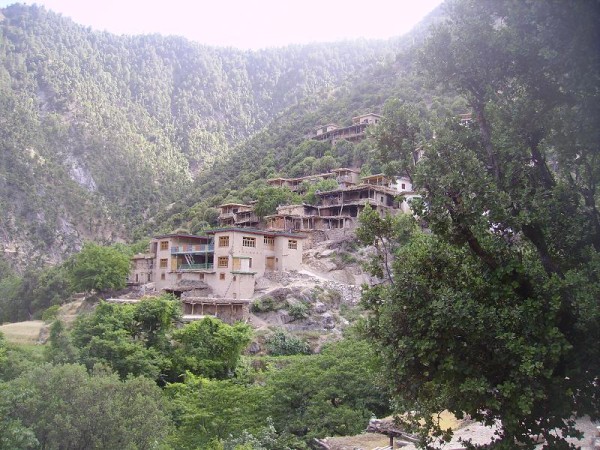
Matthew Hoh: The first place where I really had — where this was codified for me and where I started to understand what we were doing and how we were involved — the Korengal Valley, which I’m sure a lot of your viewers are familiar with. It’s been on the cover of TIME Magazine. The “New York Times” refers to it as the valley of death. Off the top of my head, unfortunately, I can’t remember how many American soldiers we have lost there, but it’s probably 30 or 40.

This is a valley, I don’t know, 15, 20 kilometers long. There’s only 10,000 people in it. They speak their own language. They speak Korengali. In the year 2009 we have a valley with people who speak their own language. Their only trade is the timber trade. And when they move their timber, they don’t even leave their valley. Most of the time, I believe, they just take it to the Mazar Valley, and a middleman picks it up and brings it to Pakistan for them.

We show up. We enter their valley. We occupy the richest man’s timber mill. And then we bring in Afghan army and Afghan police, who aren’t from there.

And then what do we do? Then we have the Afghan police and Afghan army. They say to the Korengalis, they say, “These mountains here that your families have been cutting trees down, sustaining yourselves for hundreds of years, you don’t own them. The central government does. And you have to pay tax on that.”

I’m not sure how many people anywhere else in the world wouldn’t take up arms against something like that.

And so, and for every Korengal we’re in, like I said before, there’s a hundred we’re not. And there’s like — and that would happen in those other valleys, the same thing, too, in the south. [Interview transcript]

Editor’s Comment — The “valleyism” that Hoh describes contains a crucial message for Americans considering the war in Afghanistan: this is a quagmire far more complex than Vietnam since America and its allies have sparked a thousand wars.

But perhaps more important than this military observation is the way the concept of valleyism should transform the value judgments outsiders make about Afghans and the land they inhabit.

What foreign armies and policymakers are up against is an incomparable level of adaptation where the non-transferable governing force is local knowledge — the means through which Afghans have made their homes in a land that others find utterly inhospitable.

In an analysis for the New York Times, David Sanger talks about Hamid Karzai as a flawed vessel in which the West had invested its hopes that Afghanistan could be saved and that Karzai could be re-legitimized through an election:

The question was whether that vote would demonstrate that a desolate nation that has always been at the mercy of larger powers would show it could find its own way.

In this image of a “desolate nation” that has yet to “find its own way,” there isn’t even an inkling that in many ways Afghanistan, as a patchwork of local communities, has found its own way admirably. Its greatest problem is that this is a way that few outsiders appreciate — especially those coming from a nation where human worth is so often measured by the size of someone’s bank balance.

As Rory Stewart says: “In every case, Afghans are more competent, more canny, more capable than we acknowledge, and we are less so.”

With Karzai, U.S. faces weak partner in time of war

With the White House’s reluctant embrace on Sunday of Hamid Karzai as the winner of Afghanistan’s suddenly moot presidential runoff, President Obama now faces a new complication: enabling a badly tarnished partner to regain enough legitimacy to help the United States find the way out of an eight-year-old war.

It will not be easy. As the evidence mounted in late summer that Mr. Karzai’s forces had sought to win re-election through widespread fraud to defeat his main challenger, Abdullah Abdullah, administration officials made no secret of their disgust. How do you consider sending tens of thousands of additional American troops, they asked in meetings in the White House, to prop up an Afghan government regarded as illegitimate by many of its own people?

The answer was supposed to be a runoff election. Now, administration officials argue that Mr. Karzai will have to regain that legitimacy by changing the way he governs, at a moment when he is politically weaker than at any time since 2001.

“We’re going to know in the next three to six months whether he’s doing anything differently — whether he can seriously address the corruption, whether he can raise an army that ultimately can take over from us and that doesn’t lose troops as fast as we train them,” one of Mr. Obama’s senior aides said. He insisted on anonymity because of the confidentiality surrounding the Obama administration’s own debate on a new strategy, and the request by Gen. Stanley A. McChrystal, the American military commander in Afghanistan, for upward of 44,000 more troops.

“Needless to say,” the senior aide added, “this is not where we wanted to be after nine months.”

That is a huge understatement. [continued…]

Why all the president’s Afghan options are bad ones

In the worst of times, my father always used to say, “A good gambler cuts his losses.” It’s a formulation imprinted on my brain forever. That no-nonsense piece of advice still seems reasonable to me, but it doesn’t apply to American war policy. Our leaders evidently never saw a war to which the word “more” didn’t apply. Hence the Afghan War, where impending disaster is just an invitation to fuel the flames of an already roaring fire.

Here’s a partial rundown of news from that devolving conflict: In the last week, Nuristan, a province on the Pakistani border, essentially fell to the Taliban after the U.S. withdrew its forces from four key bases. Similarly in Khost, another eastern province bordering Pakistan where U.S. forces once registered much-publicized gains (and which Richard Holbrooke, now President Obama’s special envoy to the region, termed “an American success story”), the Taliban is largely in control. It is, according to Yochi Dreazen and Anand Gopal of the Wall Street Journal, now “one of the most dangerous provinces” in the country. Similarly, the Taliban insurgency, once largely restricted to the Pashtun south, has recently spread fiercely to the west and north. At the same time, neighboring Pakistan is an increasingly destabilized country amid war in its tribal borderlands, a terror campaign spreading throughout the country, escalating American drone attacks, and increasingly testy relations between American officials and the Pakistani government and military. [continued…]

Facebooktwittermail

Clinton: Israel’s settlement offer falls short of U.S. wishes

Clinton: Israel’s settlement offer falls short of U.S. wishes

Israel’s offer to restrain settlement expansion is an unprecedented and positive step but still falls short of Washington’s wishes, U.S. Secretary of State Hillary Clinton said on Monday.

“The Israelis have responded to the call of the U.S., the Palestinians and the Arab world to stop settlement activity by expressing a willingness to restrain settlement activity,” she told reporters in the Moroccan city of Marrakesh.

“This offer falls far short of what our preference would be but if it is acted upon it will be an unprecedented restriction on settlements and would have a significant and meaningful effect on restraining their growth.” [continued…]

Editor’s Comment — Now as always, the substance of US-Israeli relations is a process through which agreements can be found on language.

Israel seeks and promotes the “right” language and it vigorous fights against the “wrong” language.

Meanwhile Israel will do whatever it chooses. It’s only concern with its American friends is that they have the good manners to talk about Israel’s actions in a favorable way. Thousands of housings units will continue to be built on occupied Palestinian territory but even as this is happening, Israel will be lauded for its “restraint.”

Benjamin Netanyahu is no doubt now glowing with satisfaction as his erstwhile harsh teacher, an administration that only a few months ago admonished the Israeli leader for not doing his “homework” on halting settlement growth, has now become an obedient and loving student.

Israel’s pathological view of peacemaking

Like Israel’s government, Israel’s public never tires of proclaiming to pollsters its aspiration for peace and its support of a two-state solution. What the polls do not report is that this support depends on Israel defining the terms of that peace, its territorial dimensions, and the constraints to be placed on the sovereignty of a Palestinian state.

An American president who addresses the Arab world and promises a fair and evenhanded approach to peacemaking is immediately seen by Israelis as anti-Israel. The head of one of America’s leading Jewish organizations objected to the appointment of Senator Mitchell as President Obama’s peace envoy because, he said, his objectivity and evenhandedness disqualified him for this assignment.

The Israeli reaction to serious peacemaking efforts is nothing less than pathological — the consequence of an inability to adjust to the Jewish people’s reentry into history with a state of their own following 2,000 years of powerlessness and victimhood.

Former Prime Minister Yitzhak Rabin, whose assassination by a Jewish right-wing extremist is being remembered this week in Israel, told Israelis at his inauguration in 1992 that their country is militarily powerful, and neither friendless nor at risk. They should therefore stop thinking and acting like victims.

Prime Minister Benjamin Netanyahu’s message that the whole world is against Israel and that Israelis are at risk of another Holocaust — a fear he invoked repeatedly during his address in September at the United Nations General Assembly in order to discredit Judge Richard Goldstone’s Gaza fact-finding report — is unfortunately still a more comforting message for too many Israelis. [continued…]

Palestinians say new U.S. approach imperils peace

Palestinian officials on Sunday criticized the United States for what one called “backpedaling” on demands that Israel stop settlement construction in the occupied West Bank, saying the Obama administration’s change of approach on the issue damaged the likelihood of a peace agreement.

“If America cannot get Israel to implement a settlement freeze, what chance do the Palestinians have of reaching agreement” on the even more complex set of issues involved in final peace talks, chief Palestinian negotiator Saeb Erekat said in a written statement.

“We are at a critical moment,” Erekat said. “The way forward, however, is not to drop the demand for Israel to comply with its obligations.” [continued…]

Editor’s Comment — This is how the narrative has been twisted:

Although Israeli Prime Minister Binyamin Netanyahu rebuffed the initial U.S. demand, he also offered alternatives that, while short of what the Palestinians wanted, were still characterized by Secretary of State Hillary Rodham Clinton over the weekend as “unprecedented” concessions made in hopes of helping direct talks resume.

Netanyahu has shown flexibility and the Palestinians are being intransigent. No suggestion that the Palestinians’ mistake was simply to believe that President Obama was a man of his word.

‘Barghouti to run for presidency if Abbas resigns’

Marwan Barghouti instead of Mahmoud Abbas? The associates of the senior Fatah leader jailed in Israel are examining the possibility that he will announce his candidacy for president should elections be held as planned and should the current president surprisingly decide not to run again for the post.

Recently, following the dead end reached in the peace talks, officials close to Palestinian President Mahmoud Abbas reported that the Abbas is exhausted. However, Abbas has not threatened to resign, though his associates say that the option cannot be ruled out that he will not run in the upcoming presidential elections.

“True the president is exhausted; true he is not satisfied with the situation; and true he prefers not to contend, but, as of now, and I say this with confirmed information, the president will be the Fatah candidate in the elections. The question is whether the elections will be held,” said a senior Fatah source to Ynet. [continued…]

Jordan and Egypt accuse Israel of ‘derailing’ peace efforts

Leaders of Jordan and Egypt on Sunday warned that Israel’s unilateral actions in East Jerusalem and other Arab areas were “derailing” efforts aimed at resuming peace negotiations with the Palestinians, and would thereby have a “catastrophic” effect on the region.

The remarks came in a joint communique issued at the end of a whirlwind visit to Cairo by Jordan’s King Abdullah II where he held talks with Egyptian President Hosni Mubarak, according to Jordan’s official Petra news agency.

The two leaders discussed the “catastrophic consequences on the region’s stability and security resulting from the failure to seize the current opportunity for making peace,” the statement said.] [continued…]

Facebooktwittermail

Opposition in Iran urges continuing challenge

Opposition in Iran urges continuing challenge

As Iran prepares for a major commemorative rally on Wednesday, the leaders of the opposition movement called over the weekend for a renewed challenge to the government, setting the stage for a possible showdown between protesters and the police.

Although the opposition leaders, Mir Hussein Moussavi and Mohammad Khatami, did not openly call for street protests, their remarks were widely seen as a call to arms on a day of considerable symbolic importance.

The occasion is the 30th anniversary of the takeover of the United States Embassy in Tehran by hard-line students on Nov. 4, 1979. The day is marked every year with anti-American rallies. [continued…]

Neocon smear on “Iran’s man in DC?”

Did Michael Goldfarb, a former John McCain staffer and now an editor of the neoconservative Weekly Standard, defame Trita Parsi, the founder and president of the National Iranian American Council, by suggesting that Parsi is working for the Iranian government?

Last week, Goldfarb described Parsi as “the Iranian regime’s man in Washington.” Goldfarb didn’t present any evidence to support this. He stated it as fact and moved on. When I emailed Goldfarb asking if he meant to say literally that Parsi is working for the Iranian government, he doubled down, replying, “If it walks like an ayatollah and quacks like an ayatollah…. Maybe you should do your due dilligence [sic] on Trita Parsi.” [continued…]

Diehl disappointed that Iranian dissidents failing to follow Western playbook

In an op-ed that reveals far more about him than about Iran’s Green Movement, Jackson Diehl expresses disappointment that Iran’s dissidents apparently aren’t all Western-style democrats. Diehl kicks things off with a bit of the dusty old Orientalism:

The enduring nature of Iran is to frustrate outsiders who work by the usual rules of political logic or who seek unambiguous commitments. The West relearned that truth last week as the government of Mahmoud Ahmadinejad dragged a straightforward plan to swap its enriched uranium for fuel rods into a swamp of double talk and counterproposals.

Those crafty Iranians — they’re so crafty! Unlike we Westerners, who always do things that make perfect rational sense. In point of fact, the P5+1’s uranium swap plan was itself a response to Iran’s original idea “to refuel the Tehran research reactor through purchasing fuel assemblies from international providers, including the United States.” Iran has apparently refused the uranium swap plan, and that’s bad news, but it shouldn’t be too much to expect the Deputy Editorial Page Editor of The Washington Post to be able to analyze this without resorting to tired cultural stereotypes. [continued…]

Facebooktwittermail

Military refines a ‘constant stare against our enemy’

Military refines a ‘constant stare against our enemy’

The Pentagon plans to dramatically increase the surveillance capabilities of its most advanced unmanned aircraft next year, adding so many video feeds that a drone which now stares down at a single house or vehicle could keep constant watch on nearly everything that moves within an area of 1.5 square miles.

The year after that, the capability will double to 3 square miles.

Military officials predict that the impact on counter-terrorism operations in Afghanistan will be impressive.

“Predators and other unmanned aircraft have just revolutionized our ability to provide a constant stare against our enemy,” said a senior military official. “The next sensors, mark my words, are going to be equally revolutionary.”

Unmanned MQ-9 Reaper aircraft now produce a single video feed as they fly continuously over surveillance routes, and the area they can cover largely depends on altitude. The new technology initially will increase the number of video feeds to 12 and eventually to 65.

Like the Reaper and its earlier counterpart, the Predator, the newest technology program has been given a fearsome name: the Gorgon Stare, named for the mythological creature whose gaze turns victims to stone.

Unmanned aircraft, used both for surveillance and for offensive strikes, are considered the most significant advance in military technology in a generation. [continued…]

Editor’s Comment — This “advance” promotes and rests upon the core delusion of the modern era: that what can be seen is more real and more significant than what cannot be seen.

Yet consider how much inevitably eludes the “constant stare” of a drone: names, relationships, intentions, history — everything that transforms the gray shapes of human figures appearing on a drone controller’s monitor, into living breathing human beings. And here’s a prediction: one advance that’s unlikely to be made will be that these images are improved from black and white to color. In color, operatives would have to deal with the sight of blood.

And this leads to the other key dimension of high-tech killing: “The technology allows us to project power without vulnerability,” said a senior Defense official.

In other words, America’s most highly evolved warriors are able to kill without the slightest risk of being killed.

Callousness will soon be worth more to the Pentagon than courage.

Facebooktwittermail

Two-State Solution: The Broadway Musical

Two-State Solution: The Broadway Musical

Remember a mere five months ago when Hillary Clinton, with all the toughness she had displayed during her primary campaign, said bluntly: “[Obama] wants to see a stop to settlements — not some settlements, not outposts, not ‘natural growth’ exceptions”?

The whole administration — presumably with expert coaching by Rahm Emanuel — was sending a strong message to Israel: We know your games and we’re not going to take any crap.

Freezing settlements — this was the litmus test for Benjamin Netanyahu to demonstrate his ability to engage in the so-called peace process.

Within a few weeks the administration’s Iran policy was in disarray — in the aftermath of the disputed presidential election — and terrified of the charge that he was being tough on Israel while soft on Iran, Obama’s resolve withered. Netanyahu bounced back and he has been riding high ever since.

Back in June, Netanyahu was admonished for not doing his homework. Now he’s thrown it in the trash and gets praise for offering “restraint on the policy of settlements” — even as Israel demolishes Palestinian homes in East Jerusalem and Palestinian citizens of Israel protest against the ethnic cleansing of Jerusalem.

Meanwhile, as Netanyahu mocks the idea that Washington has the capacity or will to apply pressure on an Israeli government, J Street, “the political arm of the pro-Israel, pro-peace movement,” after launching itself onto the stage of mainstream American politics through its first national conference last week, must somehow strive to keep the two-state-solution dream alive.

The two-state solution is indeed the stuff of dreams — at least the dreams of Zionists who find the idea of equality between Jews and non-Jews abhorrent, or as J Street’s Jeremy Ben-Ami puts it, “a nightmare for the Jewish people.”

Perhaps Washington is not the best place for dream believers. Maybe it’s time for a glitzy Two-State Solution on Broadway.

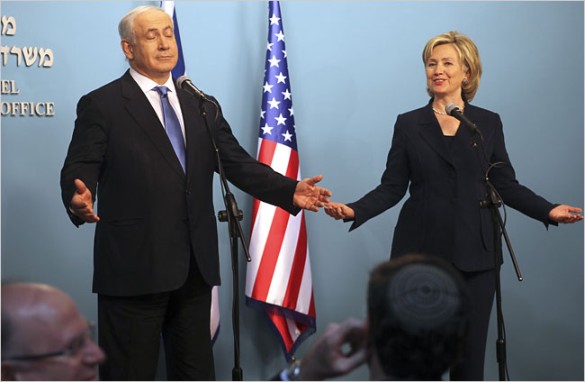
Oh look!

Bibi and Hillary are already auditioning.

J Street: Do we really need another Jewish-only road?

If you’re Palestinian, you know about checkpoints. There are over 600 checkpoints in the West Bank alone. They block, obstruct, frustrate and kill. Women die in childbirth at checkpoints, students are kept from attending school, parents from visiting their children, laborers from going to work. No one can swim in the sea. Israeli Jews are waved through checkpoints. They can swim in the sea. No problem. Jews travel freely on a complex system of Jewish-only roads and live on the Jewish side of the Separation Barriers along hundreds of miles of walls and fortified fences that keep Palestinians out. Palestinians live in an open air prison. Sometimes there is a moment of spring and the guards open the gates. But spring never lasts long. Blockades, nightly incursions, full-scale invasions, imprisonment, collective punishment, land theft, water theft, denial of education, health care, an economic future, frequent beatings and no freedom of movement is the daily bread of Palestinians. You can’t travel more than three miles without encountering a check point. Talk about stress.

J Street was a place where Jews talked to Jews about the Israeli-Palestinian conflict. Few Palestinians were present. Apparently they didn’t make it through the checkpoint. The narrative of J Street, like most Jewish narratives about the Israeli-Palestinian conflict, reflects the nature of the conflict as seen through a Jewish lens: Palestinians are physically absent. A Jew who seeks to express her activism in solidarity with Palestinians is in danger of loosing her ‘I love Israel’ card at a mainstream Jewish checkpoint. There were checkpoints at J Street. Some people were allowed in but not officially asked to participate, some were dis-invited, and some were not considered to be part of the conversation in the first place. [continued…]

Editor’s Comment — As Ahmed Moor eloquently puts it:

A purely Jewish focus on a more-than-Jewish problem causes many leftist Jews to take a paternalistic view of Palestinians. Rather than equals whose inalienable rights form the crux of the case against Zionism, the Palestinians are the clay of Jewish humanism, waiting to be fully actualized by thoughtful and reflective Jewish hands.

Facebooktwittermail

America, stop sucking up to Israel

America, stop sucking up to Israel

Now is the time to say to the United States: Enough flattery. If you don’t change the tone, nothing will change. As long as Israel feels the United States is in its pocket, and that America’s automatic veto will save it from condemnations and sanctions, that it will receive massive aid unconditionally, and that it can continue waging punitive, lethal campaigns without a word from Washington, killing, destroying and imprisoning without the world’s policeman making a sound, it will continue in its ways.

Illegal acts like the occupation and settlement expansion, and offensives that may have involved war crimes, as in Gaza, deserve a different approach. If America and the world had issued condemnations after Operation Summer Rains in 2006 – which left 400 Palestinians dead and severe infrastructure damage in the first major operation in Gaza since the disengagement – then Operation Cast Lead never would have been launched.

It is true that unlike all the world’s other troublemakers, Israel is viewed as a Western democracy, but Israel of 2009 is a country whose language is force. Anwar Sadat may have been the last leader to win our hearts with optimistic, hope-igniting speeches. If he were to visit Israel today, he would be jeered off the stage. The Syrian president pleads for peace and Israel callously dismisses him, the United States begs for a settlement freeze and Israel turns up its nose. This is what happens when there are no consequences for Israel’s inaction. [continued…]

Justice Goldstone and the Jews

We Jews should be very proud of Richard Goldstone. In an ancient tradition of Jewish self-questioning and uncomfortable truth-telling, the author of the recent report from the UN Fact Finding Mission on the Gaza Conflict has braved personal vilification and institutional mendacity to describe the crimes committed by Israeli forces in the course of their invasion of Gaza in December 2008.

To be sure, the Goldstone Report also itemizes the crimes of Hamas, notably in its campaign of rocket-firing into Israel. But the scale of human rights abuses by Israel vastly outdoes anything Hamas could hope to have achieved: Israeli civilian victims of Hamas rocket attacks numbered less than ten. The attack on Gaza by the IDF resulted in at least 1,100 Palestinian civilian deaths. The major perpetrator of human rights abuses in this conflict is without question the State of Israel, and Justice Goldstone records as much.

That the Israel of Benjamin Netanyahu has chosen to conduct an international campaign against Justice Goldstone and his report need not surprise us. Israel refused to cooperate with the UN investigation; long before its conclusions were published, Netanyahu had set in motion a campaign to deny and denigrate them. More dispiriting, and of greater political consequence, is the pitiful and humiliating response of the Obama Administration. The “fierce urgency of now” apparently required that Washington join Tel Aviv in discrediting the Goldstone Report, and with it the UN inquiry. [continued…]

Israel wants to seek, not have, peace with Syria

It’s hard not to marvel at Defense Minister Ehud Barak’s rhetorical skills, how he constantly invents a new way – an original expression – to not say anything. Last week he described Syria as a “central brick in any stable peace agreement.” But there will be no peace with Syria because Israel, according to Barak, “has sought in the past and will continue to seek in the future ways to advance peace with Syria.”

Still, Syria will certainly earn a few more terms of endearment, maybe even move up from “central brick” to “cornerstone,” and if it behaves itself, “linchpin.” Who knows, Syria may even win the gold and become the “bedrock” of a stable peace agreement. But because Israel is so busy seeking ways to advance peace with Syria, there will be no peace. [continued…]

Gas from Gaza, mobile phones in Palestine and a $1m peace prize …Tony Blair and the Middle Eastern Eldorado

… a Mail on Sunday investigation reveals that [Tony Blair] has been mixing business with Middle East politics since the early years of his premiership and that, since becoming a part-time peace envoy on leaving office in 2007, he has exploited his superb contacts to pursue a multi-million-pound fortune.

Some of the most potentially lucrative of those relationships can be traced back to that BG Gaza gas deal – connections that helped pave the way to the opening up of the Arab world’s new Eldorado, the colossal and mostly untapped wealth of Colonel Gaddafi’s Libya.

‘In Arabic, there is a special word – “eghtina”,’ said Khadr Musleh, a political analyst in the Palestinian West Bank capital, Ramallah.

‘It means “self-enrichment through public office”. It doesn’t imply anything illegal and in the Middle East it’s considered totally normal. Yet it is a little surprising to see a former British Prime Minister and international peace envoy behaving in the same way.’

Blair’s Middle East-focused business career has been a triumph. The access to the region’s rulers conferred by his position as an ex-PM and peace envoy must have huge attraction for potential clients of Tony Blair Associates, the secretive ‘consultancy’ that does not publish accounts which he runs with Jonathan Powell, his former Downing Street chief of staff. Its first clients are two of the world’s richest families – the royals of Kuwait and Abu Dhabi.

Tony Blair Associates is modelled on Henry Kissinger Associates, an outfit led by President Nixon’s former Secretary of State. Fittingly, perhaps, Kissinger was on the jury that awarded Blair the $1million Dan David Prize earlier this year, the ‘Israeli Nobel Prize’. Like Blair, Kissinger is employed by American bank JP Morgan. The citation praised Blair’s ‘exceptional leadership’ and ‘moral courage’.

Blair has promised to give most of the prize to his Faith Foundation, a charity set up to promote religious understanding. Thanks to his lucrative contract to advise JP Morgan for a salary of £2million a year, he does not need the money. [continued…]

Prosecutor: top scientist Nozette admitted actual spying for Israel

Did a federal prosecutor just make the inflammatory accusation that top government scientist Stewart Nozette has admitted to giving classified information to the Israeli government?

By our reading of this AP story, that’s exactly what happened at a hearing in U.S. district court in Washington yesterday.

Nozette is accused of attempted espionage for allegedly selling classified information to an FBI employee posing as a Mossad agent. But the Feds have explicitly said that Israel is not accused of any wrongdoing. [continued…]

Facebooktwittermail

Afghan challenger drops out of runoff election

Afghan challenger drops out of runoff election

President Hamid Karzai’s challenger withdrew Sunday from next weekend’s runoff election, effectively handing the incumbent a victory but raising doubts about the government’s credibility at a time when the U.S. is seeking an effective partner in the war against the Taliban.

Former Foreign Minister Abdullah Abdullah said he made his decision after Karzai turned down his demands for changes to the Independent Election Commission and other measures that he said would prevent massive fraud, which marred the first round of balloting on Aug. 20.

Abdullah stopped short of calling for an electoral boycott and urged his followers “not to go to the streets, not to demonstrate.” [continued…]

U.S. combat injuries rise sharply

More than 1,000 American troops have been wounded in battle over the past three months in Afghanistan, accounting for one-fourth of those injured in combat since the U.S.-led invasion in 2001.

The dramatic increase in amputees and other seriously injured service members comes as October marks the deadliest month for U.S. troops in Afghanistan. [continued…]

Facebooktwittermail

Why the Iranian nuclear deal was bound to fail

Why the Iranian nuclear deal was bound to fail

The surest sign yet that the Iranian nuclear deal is in deep trouble is its endorsement by Israel’s prime minister, Benjamin Netanyahu.

“A positive first step,” Mr Netanyahu called the deal. This was in marked contrast to his own defence minister, Ehud Barak, who complained earlier that the agreement accorded Iran “legitimisation for enriching uranium for civilian purposes on its soil, contrary to the understanding that those negotiating with it have about its real plans”.

Mr Barak and Mr Netanyahu march in lockstep when it comes to Iran. The reason for their apparent disagreement is simple. Mr Barak dismissed the proposed deal when it looked as if Iran might accept it. Mr Netanyahu’s approval came only after Iran’s response was interpreted by the western powers as a “no”. [continued…]

Why Obama’s Iran policy will fail

While the tone of the Obama administration is different from that of its predecessor, and some of its foreign policies diverge from those of George W. Bush, at their core both administrations subscribe to the same doctrine: Whatever the White House perceives as a threat — whether it be Iran, North Korea, or the proliferation of long-range missiles — must be viewed as such by Moscow and Beijing.

In addition, by the evidence available, Barack Obama has not drawn the right conclusion from his predecessor’s failed Iran policy. A paradigm of sticks-and-carrots simply is not going to work in the case of the Islamic Republic. Here, a lesson is readily available, if only the Obama White House were willing to consider Iran’s recent history. It is unrealistic to expect that a regime which fought Saddam Hussein’s Iraq (then backed by the United States) to a standstill in a bloody eight-year war in the 1980s, unaided by any foreign power, and has for 30 years withstood the consequences of U.S.-imposed economic sanctions will be alarmed by Washington’s fresh threats of “crippling sanctions.” [continued…]

Facebooktwittermail

Turkey plans to dump dollar in trade with Iran

Turkey plans to dump dollar in trade with Iran

Turkey is seeking to switch to payments in national currencies for $10 billion worth of trade with neighbouring Iran to lessen exchange rate risks and bolster trade volumes, a Turkish government source said on Friday.

Turkey has made similar proposals to China and Russia in recent months.

Iran proposed earlier this week during a visit by Turkish Prime Minister Tayyip Erdogan that the two countries should conduct bilateral trade in their own currencies as part of widening economic ties.

Bilateral trade jumped to $10.3 billion in 2008 from $2.4 billion in 2003, with Turkey running a large deficit largely due to its gas imports. Ankara and Tehran aim to boost the volume to $20 billion in the next few years. [continued…]

Turkey, Iran sign strategic deal to carry gas to Europe

Iran and Turkey signed a number of deals on Wednesday to facilitate the efficient flow of gas through Turkey to Europe, including accords on allocating some of Iran’s South Pars gas field to the Turkish Petroleum Corporation (TPAO), allowing Iranian gas to be transported via Turkey and allowing Turkmenistan’s natural gas to be pumped to Turkey via Iran, during Turkish Prime Minister Recep Tayyip Erdoğan’s visit to Turkey’s southeastern neighbor.

Turkish Energy Minister Taner Yıldız said the deals provided advantages for Turkey in the use and the sale of some phases of the South Pars gas field. “Its conditions and prices will be negotiated later,” the minister added. Iran, which has the world’s second-largest natural gas reserves, is Turkey’s second-biggest supplier of natural gas after Russia. Turkey had signed a preliminary deal in November 2008 for Iranian gas to be exported to Europe through Turkey and for Turkey to produce gas in the South Pars field.

The investment would amount to $3.5 billion. But this deal has been delayed by objections from the United States, which opposes new energy deals in Iran as part of Western efforts to isolate Tehran over its nuclear program. [continued…]

Facebooktwittermail