
How America won the Nobel Peace Prize
H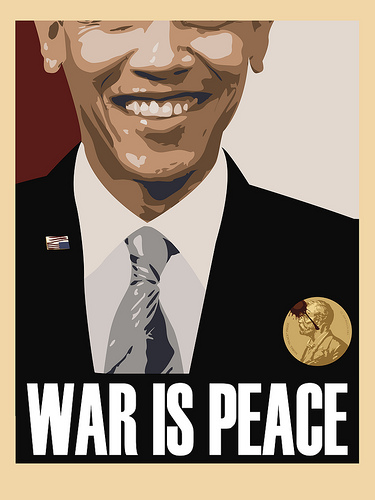 aving been nominated for the peace prize after only ten days in office; having spent the previous three weeks as a president-elect who silently monitored the slaughter in Gaza; and having just assumed the role of commander-in-chief in two wars, for Barack Obama to then craft a credible way to accept an accolade as this year’s most celebrated man of peace, was always going to demand some rhetorical creativity.
Still, this surely ranks as a first: to use the peace prize ceremony as an opportunity to justify war.
Speaking in Oslo last night, Obama said: “the instruments of war do have a role to play in preserving the peace.”
Only within a nation that has largely managed to insulate itself from the effects of war could such a statement be made.
Sixty-four years earlier, in the shadow of two world wars, Americans had a much greater interest in condemning war than in presenting arguments for its justification.
“… our position is that no grievances or policies will justify resort to aggressive war. It is utterly renounced and condemned as an instrument of policy,” wrote Supreme Court Justice Robert H Jackson, on August 12, 1945, when laying out the foundation for the Nuremberg Trials.
On that basis, every war that the United States has fought since World War Two has been branded as a war of necessity — not a war of aggression. Likewise the war that Obama has now made his own is one that he claims to be both necessary, just, and unavoidable. Yet its justness rests on a logical non sequitur: the war in Afghanistan is just because of 9/11.
To say “because of 9/11” is both to present a reason and to simultaneously seal that reason inside a locked box. The logical connection between 9/11 and the war in Afghanistan is apparently so direct and unswerving that even now, those who voice skepticism are generally viewed as either un-American, irrational or naive.
Even so, on September 11, 2001, few Americans had the conviction that this country, out of necessity, was about to go war. President Bush had to present a logical and moral argument and he did so by enunciating what became the first iteration of the Bush doctrine and the foundation for the war on terrorism: “we will make no distinction between the terrorists who committed these acts and those who harbor them.”
On that basis, the Bush administration constructed a legal argument for bombing Afghanistan and killing thousands of people who had nothing whatsoever to do with the attacks.
The unspoken truth was that the US government enacted and the American people supported a war of vengeance. Had the lust for reprisal been tempered with foresight of the carnage and chaos that the following eight years would bring, America’s war of necessity might have been seen then as no more necessary than it is widely seen now.
The “necessity” that took America to war in Afghanistan is no different than the choice Israel makes when it bulldozes the family home of a suicide bomber. This accords with the ancient principle of settling scores, rebalancing power, and reasserting a position of dominance. It’s about showing your enemies and showing the world that you remain top dog. And therein lies the intractability of this war. More troops have to sent in now to buy time for Obama to figure how, without loss of face to himself or this country, the troops can be pulled out later.
As the US president reflects on the principles of a just war, he’s sending young American men and women overseas on the promise that they’re heading out on a path that should bring them back home.
Remember when Obama talked about ending the mindset that took us to war?
I do, but apparently he doesn’t.



