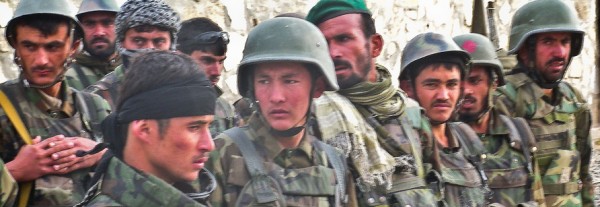
Obama’s new “strategy” is no strategy at all. It is a cynical and politically motivated rehash of Iraq policy: Toss in a few more troops, throw together something resembling local security forces, buy off the enemies, and get the hell out before it all blows up. Even the dimmest bulb listening to the president’s speech could not have missed the obvious link between the withdrawal date for combat troops from Iraq (2010), the date for beginning troop reductions in Afghanistan (2011), and the domestic U.S. election cycle.
So we are faced with a conundrum. Obama is one of the most intelligent men ever to hold the U.S. presidency. But no intelligent person could really believe that adding 30,000 troops to Afghanistan, a country four times larger than Vietnam, for a year or two, following the same game plan that has resulted in dismal failure there for the past eight years, could possibly have any impact on the outcome of the conflict.
Arthur Conan Doyle’s character Sherlock Holmes used to say that “when you have eliminated the impossible, whatever remains, however improbable, must be the truth.” The only conclusion one can reach from the president’s speech, after eliminating the impossible, is that the administration has made a difficult but pragmatic decision: The war in Afghanistan is unwinnable, and the president’s second term and progressive domestic agenda cannot be sacrificed to a lost cause the way that President Lyndon B. Johnson’s was for Vietnam. The result of that calculation was what we heard on Dec. 1: platitudes about commitment and a just cause; historical amnesia; and a continuation of the exact same failed policies that got the United States into this mess back in 2001, concocted by the same ship of fools, many of whom are still providing remarkably bad advice to this administration. [continued…]
Labels will soon show whether food from the West Bank, such as strawberries, dates and olives, comes from Palestinian farms or Israeli settlements, to give buyers a clearer choice.
Supermarkets and other retailers have decided to follow controversial new government guidance, despite Israel’s anger that it will provoke a boycott of its goods.
Goods will specify “produce of the West Bank (Israeli settlement produce)” or “produce of the West Bank (Palestinian produce)”. The Government has decided that produce from Israeli settlements may not be labelled “produce of Israel” because the area is not within the state’s internationally recognised boundaries.
Traders labelling goods from the occupied territories as Israeli produce also face possible enforcement action for breaching EU legislation.
The move immediately provoked a diplomatic spat with Yigal Palmor, the Israeli foreign affairs spokesman. He condemned the move, saying that it was “catering to the demands of those whose ultimate aim is the boycott of Israeli products”. He said: “It is a matter of concern.” [continued…]
Editor’s Comment — Indeed, this surely is a matter of concern to the Israeli government. I wonder how quickly British consumers will respond appropriately and stop buying stolen goods?
An Israeli minister has predicted there will be 10,000 new settlers in the occupied West Bank over the next 10 months and insisted that a moratorium did not freeze but only limited construction.
“Over the next 10 months the population of 300,000 will grow by at least 10,000 residents,” said Benny Begin, a minister without portfolio from Prime Minister Benjamin Netanyahu’s Likud party, in comments broadcast on public radio on Friday.
“Properly speaking, this is not a freeze. We are not planning to freeze life but only to impose certain limits on construction” in Israeli settlements in the West Bank, Begin said on Thursday night in Tel Aviv. [continued…]
Palestinian Authority President Mahmoud Abbas on Friday said that Israel must rein in settlers’ ‘brutal’ actions, after assailants vandalized a mosque in the West Bank village of Yasuf, torching furniture and spraying Nazi slogans in Hebrew on the premises.
“The torching of the mosque in Yasuf is a despicable crime, and the settlers are behaving with brutality,” said Abbas, who called the act a violation of religious freedom.
“The settlers’ unruly behavior must be stopped,” Abbas added after meeting on Friday with United Arab List-Ta’al chairman Ahmed Tibi in Amman.
Defense Minister Ehud Barak earlier on Friday condemned the vandalization of the West Bank mosque, allegedly at the hands of settlers protesting Israel’s temporary freeze on settlement construction. [continued…]
How would you resolve the conflict between Fatah and Hamas?
Marwan Barghouti: During my time in prison brothers from various parties and I were able to draft a prisoners document which became the framework for a national unity document that all 13 Palestinian parties signed on June 27, 2006. It is the first document in the history of Palestinian parties, that the PLO, Hamas, and Islamic Jihad participated in and agreed on a state with 1967 borders, and accepted the PLO and the president of the Palestinian Authority to negotiate in the name of Palestinians, and accepted the call for a national unity government. The conflict will be resolved by referring back to this document and with the signature of all [parties] on the Egyptian national reconciliation document, and by resorting to presidential and legislative elections, and by respecting the law and ending internal strife and through the reestablishment of a national unity government. [continued…]
Private security guards from Blackwater Worldwide participated in some of the C.I.A.’s most sensitive activities — clandestine raids with agency officers against people suspected of being insurgents in Iraq and Afghanistan and the transporting of detainees, according to former company employees and intelligence officials.
The raids against suspects occurred on an almost nightly basis during the height of the Iraqi insurgency from 2004 to 2006, with Blackwater personnel playing central roles in what company insiders called “snatch and grab” operations, the former employees and current and former intelligence officers said.
Several former Blackwater guards said that their involvement in the operations became so routine that the lines supposedly dividing the Central Intelligence Agency, the military and Blackwater became blurred. Instead of simply providing security for C.I.A. officers, they say, Blackwater personnel at times became partners in missions to capture or kill militants in Iraq and Afghanistan, a practice that raises questions about the use of guns for hire on the battlefield.
Separately, former Blackwater employees said they helped provide security on some C.I.A. flights transporting detainees in the years after the 2001 terror attacks in the United States.
The secret missions illuminate a far deeper relationship between the spy agency and the private security company than government officials had acknowledged. Blackwater’s partnership with the C.I.A. has been enormously profitable for the North Carolina-based company, and became even closer after several top agency officials joined Blackwater. [continued…]
Today’s Times disclosures can be seen as an extension of the claims made by Erik Prince in his curious Vanity Fair interview that he was a proud but informal operative of the CIA, notwithstanding his unsuccessful attempts to sign up through the front door. In a discussion with Jeremy Scahill at The Nation, I noted that the interview appeared to be carefully laying the foundations for a “graymail” defense for Prince, should federal prosecutors move against him. One common form of “graymail” for a figure who has a relationship with the U.S. intelligence community is to warn that, if prosecuted, he will have to spill the beans on his covert activities in order to defend himself. The tactic has proven widely effective. [continued…]
Defense Secretary Robert M. Gates arrived here on Thursday for talks with Prime Minister Nuri Kamal al-Maliki, but the prime minister said he was too busy to see Mr. Gates because he had to defend himself before a Parliament outraged by a recent series of bombings.
American defense officials insisted that Mr. Maliki had not rebuffed the defense secretary, but it was not until late on Thursday, hours after Mr. Gates landed in Baghdad, that they said that Mr. Maliki had agreed to see him on Friday morning. Mr. Gates’s aides scrambled to rearrange his schedule. [continued…]
In the video, one of hundreds filmed during Iran’s nationwide demonstrations on Monday, an enraged woman’s voice can be heard as a paramilitary truck runs a motorbike off the road amid a crowd of fleeing protesters.
“This is the Islamic Republic!” she shouts, gesturing at the vehicle.
That message has grown increasingly common in recent protests, as demonstrators have made it clear that their target is not just President Mahmoud Ahmadinejad, or the disputed election that returned him to power in June, but the entire foundation of Iran’s theocracy.
During Monday’s demonstrations, the civil tone of many earlier rallies was noticeably absent. There was no sign of the opposition leader Mir Hussein Moussavi, a moderate figure who supports change within the system, and few were wearing the signature bright green of his campaign. [continued…]
Sadegh Shojai fled Iran after government agents raided his Tehran apartment, seizing his computer and 700 copies of a book he published on staging revolutions.
Now, he and his wife spend their days in this isolated Turkish town in a cramped, coal-heated apartment that lacks a proper toilet. But Mr. Shojai, 28 years old, continues to churn out articles on antigovernment Web sites about Iranian political prisoners, and helps to link students in Tehran with fellow students in Europe.
“I feel very guilty that I have abandoned my friends and countrymen, so I make up for it by burying myself in activism here,” he says.
He’s part of a small but spreading refugee exodus of businesspeople, dissidents, college students, journalists, athletes and other elite Iranians that is transforming the global face of Iran’s resistance movement. [continued…]
This website or its third-party tools use cookies, which are necessary to its functioning. By closing this banner, you agree to the use of cookies.