Of ants and men By Christine Kenneally, Slate, December 1, 2009
In The Superorganism: The Beauty, Elegance, and Strangeness of Insect Societies, Bert Holldobler and E.O. Wilson survey the last 15 years of myrmecological research. Picking up where their Pulitzer Prize-winning The Ants left off, The Superorganism is a completely wonderful book. It is packed with astonishing findings and beautiful illustrations, and, happily, it also contains enough information about ant civilization to set up a few ants-vs.-humans scenarios. Let us skip lightly over the fact that to compare ants and humans is to pit thousands of species against just one. Rather, let’s start with the idea that we begin the contest evenly matched—at 6.6 billion humans and approximately 5 million billion ants, humans and ants have roughly the same biomass. What if a global disaster struck? Who would come out on top?
We won’t be able to declare one species smarter or better—each is wildly successful in its own niche, and at any rate, that would make as much sense as saying one is better-looking than the other. Still, we can wonder about how robust life is at such extreme ends of the genes-mind spectrum. What if, for example, you hammered the Earth with a volcano or a big rock from space? Who would survive? Or think about that classic of speculative fiction—mass sterility. Imagine that both ants’ and humans’ biological clocks sputter and stop, and reproduction just doesn’t work as it used to. Is life as we know it over? Perhaps a mysterious plague has moved unnoticed among us until one morning we awake and 70 percent of both populations has disappeared? Could civilization recover? Either one? [continued…]
Cars breezed by the trimmed green hedges and flowers of Baghdad’s Nisoor Square on Friday, while pedestrians strolled past billboards of smiling men and women promoting national elections. Little trace was left of the September 2007 day when Blackwater security guards opened fire on the crowded intersection, killing 17 civilians.
On Thursday, a judge in a U.S. federal court had thrown out the criminal prosecution of five Blackwater guards involved in the shootings. The consequences of that decision were still being felt Friday by survivors of the attack, politicians and ordinary Iraqis, who expressed feelings of helplessness at the hands of the United States.
The Iraqi government vowed to seek an appeal. Victims and others said they doubted they would ever see justice, convinced the American government considers their blood cheap.
U.S. District Judge Ricardo Urbina ruled that prosecutors of the five security guards had wrongly relied on statements the defendants made to State Department investigators under the promise of immunity. The guards, who were facing counts of manslaughter and firearms violations, maintained they opened fire in response to an attack. Iraqis dispute that. [continued…]
Iraq said Friday that it will file a lawsuit against five Blackwater security guards cleared of manslaughter charges in the 2007 killing of 17 Iraqi civilians, an act a government official called murder.
The Iraqi government also will ask the U.S. Justice Department to appeal a federal judge’s “unfair and unacceptable” dismissal of the charges Thursday, spokesman Ali al-Dabbagh said.
An Iraqi man wounded in the 2007 incident also voiced his anger Friday, saying U.S. District Judge Ricardo Urbina’s dismissal of the charges showed “disregard for Iraqi blood.” [continued…]
On 30 November 2009 Foreign Policy magazine published its ’Top 100 Global Thinkers’ list. We were naturally skeptical since the selection included Dick Cheney, General Petraeus, Larry Summers, Thomas Friedman, Bernard-Henri Lévy, David Kilcullen, Ayaan Hirsi Ali, Salam Fayyad, The Kagan Family (yes, all of them) and Ahmed Rashid among others. We don’t consider any of these people thinkers, let alone having global significance, and we couldn’t help but notice that the main thrust of all their work aligns with the global military and economic agenda of the US government. In response we asked twelve of our writers and editors to nominate their Top 20 global thinkers of 2009. Our criteria included choosing those who inspire critical thinking, as well as those who have been able to buck received wisdom and shape public debate. Always agreeing with their statements and positions was not a requisite, but in all cases our selections involved nominating those who have spurred people to challenge or enhance their own thinking in different ways. The following is our unranked list. [continued…]
After we published our list of 20 Top Global Thinkers, we thought we would be remiss if we did not also honor those media figures and institutions who bring these voices to us in the first place. With the goal of recognizing those individuals and institutions responsible for exemplary reportage and awareness-raising in 2009, we asked our editors and writers to name their choices for the top 20 media figures, be they journalists, publications or publishers. We aggregated these nominations into the following list. Like our 20 Top Global Thinkers, our criteria for choosing media figures included people/publications/publishers who have shown a commitment to challenging power, holding it accountable, highlighting issues pertaining to peace and social justice and producing output that encourages critical thinking and questions conventional wisdom. [continued…]
Here we go again. Another botched terrorist attack, and a much-needed excuse for some agenda-driven American ideologues to demand opening “new fronts” in the “war on terror”, with “profiling” of Muslims at airports expected to be at the core of the airport security review announced yesterday by Gordon Brown. I am sorry, but that thinking is wrong, flawed, and will make matters worse.
Yemen is not a willing home to al-Qaeda – it is victim to an ideology exported from neighbouring Saudi Arabia. In our desire to blame and, eventually, bomb, let us not forget the other Yemen: one of the last bastions of traditional, serene Islam. Yemeni Sufis have been imparting their version of normative Islam for centuries through trade and travel. Hundreds of British Muslims have been studying in Yemen’s pristine Islamic institutions. They have returned to Britain connected to an ancient chain of spiritual knowledge and now lead several Muslim communities with the Sufi spirit of love for humans, dedication to worship, and service to Islam. [continued…]
U.S. President Barack Obama has for the first time publicly accused an offshoot of al-Qaeda over the alleged Christmas Day bomb plot to blow up a US plane.
He said it appeared Yemen-based al-Qaeda in the Arabian Peninsula had armed and trained the accused, 23-year-old Nigerian Umar Farouk Abdulmutallab. [continued…]
Mr Abdulmutallab’s story demonstrates how difficult it is to build a stereotype of the radical Islamist willing to give his life for the jihadist cause.
Students who shared classrooms and accommodation with Mr Abdulmutallab in Yemen and Britain describe a young man who befits the image portrayed in the photograph – smiling, intelligent and good-looking. He was devoutly religious – in the picture he dons a white Muslim skullcap – but did not display outward signs of extremism, they say. Rather, he was quiet and kept to himself – more introvert than fanatic.
Other Africans, from Comoros, Kenya and Somalia, who have been involved in al-Qaeda activities, have come from humbler backgrounds. But Mr Abdulmutallab was born into Nigeria’s elite, and there is little in his African background to suggest he was a terrorist in the making. [continued…]
One year has passed since the savage Israeli attack on the Gaza Strip, but for the people there time might as well have stood still.
Since Palestinians in Gaza buried their loved ones – more than 1,400 people, almost 400 of them children – there has been little healing and virtually no reconstruction.
According to international aid agencies, only 41 trucks of building supplies have been allowed into Gaza during the year.
Promises of billions made at a donors’ conference in Egypt last March attended by luminaries of the so-called “international community” and the Middle East peace process industry are unfulfilled, and the Israeli siege, supported by the US, the European Union, Arab states, and tacitly by the Palestinian Authority (PA) in Ramallah, continues. [continued…]
Editor’s Comment — Ali Abunimah, who has just left Cairo after attending the thwarted Gaza Freedom March, adds on his blog:
To talk about the siege of Gaza in the abstract is one thing, but to actually come to Egypt and find that Gaza is harder to visit than a prison is like a bucket of cold water. The Egyptian government may be efficient at few things, but it is highly efficient at maintaining the siege. Buses hired to take all the marchers to Gaza were prevented from showing up. Those who tried to get to Gaza under their own steam were turned back or detained at their hotel in Al Arish. It was very very frustrating. But whatever frustration we felt is one millionth of the frustration of the besieged Palestinian people in Gaza. So perhaps in some way it is better then that we did not get in, because Egypt gave us a small taste of what it serves every day to people in Gaza — and a small taste of what Egyptians face when they challenge their government’s policies.
The question was like an electric shock to the six or so Palestine solidarity activists, including myself, as we were standing inside a classroom at a school in Gaza City.
“Why the Palestinians? Why are we the only ones suffering?” asked a Palestinian girl who was probably about nine or ten-years-old. And then the enormity of what the people of Gaza go through every day hit me.
Most of us were Americans and one was Canadian, and we were delivering some of the $17,000 in school supplies that Jessica Campbell and Julia Hurley, two members of the Gaza Freedom March student delegation, had brought and raised on their own. [continued…]
…there is perhaps no better time than this to review Israel’s 10 Worst Mistakes of the Last 10 Years:
1. The Siege of Gaza – The stated goal of the siege was to undermine Hamas and to goad Gazans into rejecting Hamas rule. The effect of the siege has been to focus and intensify Palestinian anger against Israel, increase Gazans’ dependency on Hamas social welfare arms, enrich Hamas coffers through tunnel taxation and foreign donations, and sap Palestinian support for Fatah, which, through its back-channel encouragement for the siege, is seen as a betrayer and a boot-licker in the eyes of many Palestinians.
2. The Siege of Gaza – The blockade was ostensibly a means to stem the influx of weaponry into Gaza. In practice, with shipments the size of automobiles flowing through the tunnels, the Hamas arsenal has grown ever more sophisticated, now believed to include Iranian-manufactured rockets capable of striking Tel Aviv and Ben-Gurion Airport from the Strip.
3. The Siege of Gaza – In the eyes of the world community, the overwhelming collective punishment – and the relative silence of Israelis in response – has gutted Israeli claims to the moral high ground. It has undercut sympathy for Israelis living within Qassam range. It has kept open the moral wounds of the Gaza War, cramping rebuilding efforts, enshrining universal unemployment, and ensuring agonizing homelessness as the coastal winter gathers full force. Israeli officials have quietly take steps of astounding insensitivity, arbitrarily barring such goods as school supplies.
4. The Siege of Gaza – The siege has been presented in the past as a means of pressing Hamas to release Gilad Shalit. Not only does he remain captive, the terms of a prospective deal appear not to include lifting the siege. The siege has been presented in the past as a means of pressuring Gazans to end rocket fire. But rocket fire only increased after the siege was put in place. Finally, Cast Lead, the Gaza war a year ago, might have been prevented altogether, had Israel adhered more closely to the Egyptian-brokered Hamas-Israel truce agreement of June, 2008, and lifted the siege more completely in response to a drop in rocket fire.
5. The Siege of Gaza – The siege works to the detriment of U.S. support for Israel. In February, Secretary of State Hillary Clinton signaled anger at Israel over obstacles to humanitarian aid entering the strip. The message came soon after Senate Foreign Relations Committee Chairman John Kerry, visiting Gaza, learned that Israel had blocked shipments of pasta, ruling it off the list of permitted humanitarian aid items.
6. The Siege of Gaza – The fact that the siege has failed so completely in achieving its stated aims, reinforces the impression that its real purpose is punitive.
7. The Siege of Gaza – The siege places Israeli officials in jeopardy of being charged with violating the Fourth Geneva Convention and other international codes, as outlined in detail in the Goldstone Report. Referring to the siege, paragraph 1335 of the report states that: “From the facts available to it, the Mission is of the view that some of the actions of the Government of Israel might justify a competent court finding that crimes against humanity have been committed.”
8. The Siege of Gaza – With the siege under the direct aegis of Defense Minister Ehud Barak and his deputy, Matan Vilnai, the moral failings of the siege could prove the coup de grace to an already foundering Labor Party.
9. The Siege of Gaza – The siege threatens to destabilize the rule of Hosni Mubarak in Egypt, posing a potential threat to Israeli-Egyptian peace and Israeli security.
10. The Siege of Gaza – The siege corrupts the moral values of all Israelis, who, whether or not they are aware of what is being done to the people of Gaza, bear ultimate responsibility for all acts being carried out in their name. [continued…]
Iran’s opposition leader on Friday pledged to remain defiant in the face of new threats — including calls by hard-liners for his execution — and said he was ready to sacrifice his life in defense of the people’s right to protest peacefully against the government.
Mir Hossein Mousavi’s remarks come after the worst unrest since the immediate aftermath of the disputed June presidential election. At least eight people died during anti-government protests on Sunday, including Mousavi’s nephew.
In one of his strongest statements to date, Mousavi said he was “ready for martyrdom” — the sacrifice of one’s life for a higher cause — and lashed out at the bloody crackdown the authorities are waging against the opposition. [continued…]
As the deadline for Iran to respond to the international community’s offer regarding its nuclear program passed Thursday, the US has toughened its rhetoric and is looking increasingly to sanctions rather than diplomacy.
That has pleased Israel, which wants strong action against the Islamic Republic as it continues to enrich uranium in defiance of international demands and has rejected US President Barack Obama’s outstretched hand.
The next step, according to Ambassador to the US Michael Oren, should be “imposing crippling sanctions” on the Teheran regime, which is in keeping with the pledge Oren said Obama made to Prime Minister Binyamin Netanyahu in May that the US would end the engagement phase toward Iran if it were unsuccessful by year’s end.
Oren told The Jerusalem Post that “there isn’t an Israeli view and an American view” on the Iranian question, but rather “one view.” [continued…]
Editor’s Comment — Israel is desperate to sustain the myth that Israeli and American interests are indistinguishable from one another, yet Israel’s insistence on pushing for crippling sanctions at this moment exposes the ugly truth: Israel regards the Iranian opposition movement as a threat.
If the Islamic Republic’s regime collapses, Israel will lose its indispensable enemy. An Israel that can no longer drum up support on the basis that it faces a so-called existential threat will find it much harder to cloak its own brutality.
The advance of democracy in Iran means the advance of Israel’s international status as a pariah state. If they could now secretly send advisers to coach Ayatollah Khamenei on how to most effectively suppress the uprising, I have little doubt the Israelis would gladly do so.
In a sign that this was a decade that many people would sooner forget, the 2000s came to an end without finding a name.
For Alan Philips, writing in The National: “The defining characteristic of the past 10 years is how much we have been deceived – by political leaders, economic gurus and indeed by ourselves. It has been a decade of deception.”
Time magazine declared under a headline reading Goodbye (at last) to the Decade from Hell: “Bookended by 9/11 at the start and a financial wipeout at the end, the first 10 years of this century will very likely go down as the most dispiriting and disillusioning decade Americans have lived through in the post-World War II era.” [continued…]
This website or its third-party tools use cookies, which are necessary to its functioning. By closing this banner, you agree to the use of cookies.

 In The Superorganism: The Beauty, Elegance, and Strangeness of Insect Societies, Bert Holldobler and E.O. Wilson survey the last 15 years of myrmecological research. Picking up where their Pulitzer Prize-winning The Ants left off, The Superorganism is a completely wonderful book. It is packed with astonishing findings and beautiful illustrations, and, happily, it also contains enough information about ant civilization to set up a few ants-vs.-humans scenarios. Let us skip lightly over the fact that to compare ants and humans is to pit thousands of species against just one. Rather, let’s start with the idea that we begin the contest evenly matched—at 6.6 billion humans and approximately 5 million billion ants, humans and ants have roughly the same biomass. What if a global disaster struck? Who would come out on top?



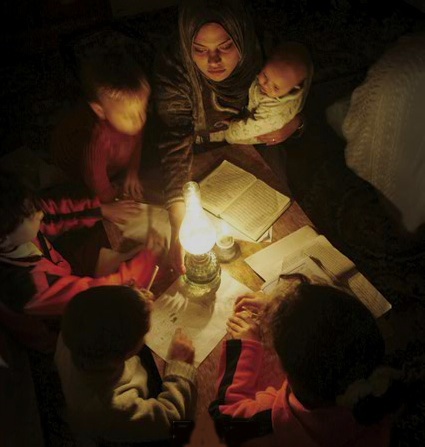 he question was like an electric shock to the six or so Palestine solidarity activists, including myself, as we were standing inside a classroom at a school in Gaza City.