Monthly Archives: January 2011

How WikiLeaks could save the internet

Evgeny Morozov writes:

American diplomacy seems to have survived Wikileaks’s “attack on the international community,” as Hillary Clinton so dramatically characterized it, unscathed. Save for a few diplomatic reshuffles, Foggy Bottom doesn’t seem to be deeply affected by what happened. Certainly, the U.S. government at large has not been paralyzed by the leaks—contrary to what Julian Assange had envisioned in one of his cryptic-cum-visionary essays, penned in 2006. In a fit of technological romanticism, Assange may have underestimated the indispensability of American power to the international system, the amount of cynicism that already permeates much of Washington’s political establishment, and the glaring lack of interest in foreign policy particulars outside the Beltway.

Indeed, it’s not in the realms of diplomacy or even government secrecy where Wikileaks could have its biggest impact. If the organization wants to leave a positive imprint on the world, it should turn to a different mission entirely: forcing the general public to re-examine some of the organizing assumptions behind today’s Internet.

Regardless of what happens to Assange, Wikileaks has the potential to catalyze a worldwide campaign that could do for the Internet what the Greens did for the environment in the 1970s: start a much-needed conversation about the potentially corrosive impact of corporate interests on the public good, a conversation that may eventually coalesce into a broader political movement. Ironically, it’s not what Assange did, but what American companies and politicians did in response to the publication of the cables, that has given thousands of geeks a cogent alternative vision for the future of the Internet.

At the very heart of that vision lies the desire to ensure that the kind of problems that have plagued Wikileaks’s online presence since the publication of the diplomatic cables are never repeated in the future. It’s an impressive list of difficulties: Access to the Wikileaks.org domain was disrupted after its domain provider got cold feet; Amazon famously booted Wikileaks off its servers; PayPal, Visa, and MasterCard cut their ties to Wikileaks as well, significantly hampering its ability to raise donations. Bank of America went further, refusing to process any Wikileaks-related transactions, even prompting an angry editorial from The New York Times. It is also important not to forget that Wikileaks could have been in a considerably worse position if some other Internet companies—Facebook, Twitter, Google—chose to behave like Amazon and PayPal. Google could have made the text of the cables—or even any pages bearing the word “Wikileaks”—disappear from its search index. Twitter could have followed the path of Bank of America and refused to publish (or index) any tweets containing the words “Wikileaks,” “Assange,” or “Cablegate.” Facebook could have banned access to Wikileaks fan pages for anyone with an American IP address, as it did with the “Everybody Draw Muhammed Day” page for users in India and Pakistan.

While some of the companies that targeted Wikileaks were subject to direct political pressure from American politicians, others seem to have volunteered—a decision that must have been easy to make given all the Wikileaks-bashing in Congress. Wikileaks survived these betrayals; but the myth that today’s Internet is the best of all possible worlds didn’t.


Facebooktwittermail

The man who spilled the secrets

Vanity Fair tells the story of the fraught relationship between Julian Assange and The Guardian newspaper.

On the afternoon of November 1, 2010, Julian Assange, the Australian-born founder of WikiLeaks.org, marched with his lawyer into the London office of Alan Rusbridger, the editor of The Guardian. Assange was pallid and sweaty, his thin frame racked by a cough that had been plaguing him for weeks. He was also angry, and his message was simple: he would sue the newspaper if it went ahead and published stories based on the quarter of a million documents that he had handed over to The Guardian just three months earlier. The encounter was one among many twists and turns in the collaboration between WikiLeaks—a four-year-old nonprofit that accepts anonymous submissions of previously secret material and publishes them on its Web site—and some of the world’s most respected newspapers. The collaboration was unprecedented, and brought global attention to a cache of confidential documents—embarrassing when not disturbing—about American military and diplomatic activity around the world. But the partnership was also troubled from the start.

In Rusbridger’s office, Assange’s position was rife with ironies. An unwavering advocate of full, unfettered disclosure of primary-source material, Assange was now seeking to keep highly sensitive information from reaching a broader audience. He had become the victim of his own methods: someone at WikiLeaks, where there was no shortage of disgruntled volunteers, had leaked the last big segment of the documents, and they ended up at The Guardian in such a way that the paper was released from its previous agreement with Assange—that The Guardian would publish its stories only when Assange gave his permission. Enraged that he had lost control, Assange unleashed his threat, arguing that he owned the information and had a financial interest in how and when it was released.

The Guardian partnership was the first of its kind between a mainstream media organization and WikiLeaks. The future of such collaborations remains very much in doubt. WikiLeaks, torn by staff defections, technical problems, and a crippling shortage of money, has been both battered and rejuvenated by the events of the past several months. A number of companies—PayPal, Visa, and MasterCard—stopped acting as conduits for donations, even as international publicity has attracted high-profile supporters and many new donors. Kristinn Hrafnsson, a close associate of Assange’s and a WikiLeaks spokesman, promises that WikiLeaks will pursue legal action against the companies. Although it is not known where the instigation came from, hackers launched a wave of sympathy attacks on PayPal, Visa, and MasterCard operations, and temporarily shut them down. Assange himself, arrested in December on behalf of Swedish authorities for questioning in a sexual-assault investigation, spent time in a British prison before being granted release on bail. At press time, he awaits a decision on extradition and, in the meantime, must wear an electronic anklet, must check in with authorities daily, and must abide by a curfew. Some are pressing the U.S. government to take action against him under the Espionage Act or some other statute. Whatever the fate of WikiLeaks itself, the nature of the Internet guarantees that others will continue to step into its shoes. “The WikiLeaks concept will bring about other organizations and I wish them well,” Hrafnsson says, even as he insists that WikiLeaks is “functioning fully” without Assange.

Facebooktwittermail

Taliban not quite twelve feet tall

The theory behind President Obama’s Afghan surge (beyond the moronically simplistic “if it worked in Iraq, it should work in Afghanistan”) was the notion that after “sustained pressure,” “a more robust approach” — or whatever euphemism one chooses for an operation designed to kill more people — the US and Nato would be in a better position to try and negotiate an end to the war.

Now comes an unofficial Nato assessment: in spite of the surge, the Taliban are standing tall. In fact, when presenting a resistance to foreign forces at a ratio of 1:12, you have to wonder what the Pentagon, fielding its million-dollar-a-year soldiers, is learning from the Taliban in terms of the economics of warfare.

The Associated Press reports:

The Taliban are pitted against about 140,000 ISAF troops — two-thirds of them Americans — and over 200,000 members of the government’s security forces.

This gives the allies a numerical advantage of at least 12:1 — one of the highest such ratios in modern guerrilla wars. At the height of the Vietnam War, the U.S. and its allies had an advantage of between 4-5 to 1 over their Communist foes.

When one Afghan fighter with no body armor and little more than an AK-47 can effectively stand up to a dozen modern soldiers (obviously not all of whom are actually on the battlefield), even the war’s most stalwart defenders should be paying attention to the fabulous waste of money. The allies so-called numerical advantage means that for every dollar the Taliban spends, the Pentagon is wasting several hundred.

For how many more decades can the Pentagon continue fighting wars that it is incapable of winning — and draining the US economy in the process — before the knuckleheads across America who have been spellbound by the words “national security” finally wake up and say, enough?

Facebooktwittermail

War with Iran postponed — at least until after the 2012 US presidential election

Reuters reports:

Israel believes Iran will not be able to produce a nuclear bomb before 2015 and a top Israeli official has counseled against pre-emptive military strikes, intelligence assessments published Friday showed.

Given in a briefing by Mossad director Meir Dagan upon his retirement Thursday, the assessments pointed to new Israeli confidence in U.S.-led sanctions and covert action designed to discourage or delay Tehran’s uranium enrichment program.

They were also in line with Israeli Prime Minister Benjamin Netanyahu’s circumspection — echoing misgivings voiced more publicly by the Obama administration — about resorting to force against Iran, which denies seeking nuclear arms and has vowed to retaliate against Israel and U.S. interests for any such attack.

“Iran will not achieve a nuclear bomb before 2015, if that,” Dagan said, according to a transcript obtained by Reuters.

Facebooktwittermail

The Israeli equivalent of the burning of the Reichstag

Yossi Gurvitz writes:

The decision taken by the Knesset plenum yesterday, to create a parliamentary investigative committee for “the phenomenon of de-legitimization of the IDF in the world on the part of Israeli organization”, has nothing whatsoever to do with an investigation. Israel has investigative procedures: if there’s a suspicion of a crime, either the police or the GSS investigate it, and transfer the information they gather to the prosecution, which then decides if an indictment is in order; then the courts have their say – admittedly, all too often sounding suspiciously like the prosecution.

What the Knesset did yesterday was de-legitimizing of a political camp; an accusation of treason by one camp of another, masquerading as an investigation. The process was amazing: a few days ago, Faina Kirshenbaum, an MK of Yisrael Beitenu, tabled her motion, and it reached the Plenum with lightning speed. The person responding to Kirshenbaum’s motion on behalf of the government was Danny “The Chair” Ayalon, the deputy Foreign Minister and a member of Kirshenbaum’s party, who, displaying a rare height of cynicism, accused the left organizations of “trying to undermine Israeli democracy”. There was just one minor problem with Ayalon’s speech: As Minister Michael Eithan noted in shock and disgust (Hebrew), Ayalon had no business representing the government since it did not debate the issue and made no decision about it. But Eithan’s legalistic nitpicking belongs to a bygone era, the one before the “Second Zionist Revolution”, led by Avigdor Liberman and his pawns.

The Speaker of the Knesset, Rubi Rivlin, one of the last dew pillars of democracy in the current Knesset, savaged (Hebrew) the decision – supported by the right wing parties, but also by three Kadima MKs – and called it a show trial. And which voice is missing? Which dog did not bark? The voice of Binyamin Netanyahu, whose government did not debate Kirshenbaum’s decision yet supported it, and that of the Nobel Peace Prize winner and president, Shimon Peres. Apparently they had nothing to say.

What we saw last night was a final breaking of the rules of the games, the use of an investigation for the persecution of political rivals, the Israeli equivalent of the burning of the Reichstag. That, as may be recalled, was not just the torching of a physical building, but the excuse used by the revolutionary right to politically persecute their rivals, including elected deputies of the left parties (and, a few weeks later, also of the more moderate right wing parties). The taunting of the brownshirts of their rivals was reflected in MK Danny Danon’s victory chant yesterday: “You, my colleagues on the left, should hear today the words of the song: ‘sometimes the party is over’”. (Inarticulateness in the original).

And, yes: the democracy party in Israel is over. People who still mistakenly think Israel is the “only democracy in the Middle East” should be informed this title is no longer relevant. One doubts whether Ayalon, Kirshenbaum, Danon and the rest understand just how much aid they provide to the de-legitimization of Israel, but the process ought to be completed: finish off the legitimacy of the Zionist regime and the Liberman-Ayalon government. No loyalty must be shown to such a regime, if we hope to salvage something of what used to be Israel. If Israel is to live, the Zionist regime must pass away. This must be said everywhere, but particularly outside of Israel. As a long series of fascist regimes – from Italy through Germany to the Serbia of Milosevic – the people living under such regimes cannot save themselves, cannot wake out of the nightmare on their own, but require a strong external intervention. Since most Israelis love hating leftists, but love their vacations in Europe and their consumerism even more, let’s hope some heavy duty economical sanctions will do the job.

Facebooktwittermail

Egypt Muslims to act as “human shields” at Coptic Christmas Eve mass

Al-Ahram reports:

“Although 2011 started tragically, I feel it will be a year of eagerly anticipated change, where Egyptians will stand against sectarianism and unite as one,” Father Rafaeil Sarwat of the Mar-Mina church told Ahram Online. The Coptic priest was commenting on the now widespread call by Muslim intellectuals and activists upon Egyptian Muslims at large to flock to Coptic churches across the country to attend Coptic Christmas Eve mass, to show solidarity with the nation’s Coptic minority, but also to serve as “human shields” against possible attacks by Islamist militants.

Mohamed Abdel Moniem El-Sawy, founder of El-Sawy Culture Wheel was among the promiment Muslim cultural figures who first floated the bold initiative.

“This is it. It is time to change and unite,” asserted journalist Ekram Youssef, another notable sponsor of the intiative, in a telephone interview with Ahram Online. She added that although it is the government’s responsibility to act and find solutions to bring an end to such violations, “it is time for Egyptian citizens to act to revive the true meaning of national unity.”

Following last year’s Coptic Christmas Eve attack on congregants as they left their church in the Upper Egyptian city of Naga Hamady, Youssef created the crescent and cross logo with the slogan “A nation for all” – that was adopted during the past couple of days by many of Egypt’s 4 million Facebook users as their profile picture.

Facebooktwittermail

The murder of Salmaan Taseer

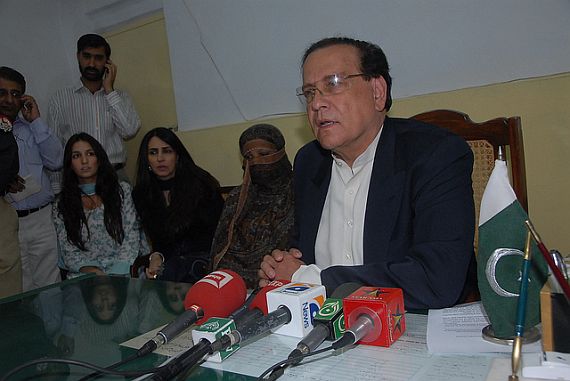
Governor of the Punjab Salmaan Taseer visits Aasia Bibi, a Christian woman condemned to death under Pakistan's Blasphemy Law, November 20, 2010.

Robin Yassin-Kassab writes:

Salmaan Taseer, governer of Pakistan’s Punjab province, has been shot dead by one of his own security detail for the supposed crime of defending Aasia Bibi, a Christian woman threatened with execution under Pakistan’s blasphemy law. The law was introduced by the British and given extra teeth by military dictator Zia ul-Haq, and is commonly used for the pursuit of grudges against the weak. The most disturbing aspect of Taseer’s murder is that both puritanical Deobandi and traditionalist ‘Sufi’ Barelvi religious leaderships have expressed support for it. Many Pakistanis are lionising Taseer’s murderer. For decades sections of Pakistan’s ruling elite have peddled religio-nationalist chauvinism as a stop-gap substitute for social justice. The result is today’s ugly combination of elite and mob rule. I reviewed a book by Taseer’s son here. Below, novelist Mohammed Hanif reports from Karachi:

Minutes after the murder of the governor of Pakistan’s Punjab province Salmaan Taseer I saw a veteran Urdu columnist on a news channel. He was being what, in breaking news jargon, is called a “presenter’s friend”. “It is sad of course that this has happened but . . .”

I watched in the desperate hope that he wouldn’t go into the ifs and buts of a brutal murder in the middle of Pakistan’s capital. By this time we knew that Governor Taseer had been shot dead by a man in police uniform, probably one of his own police guards. The news ticker on screen informed us that the postmortem was under way. Later we would find out that he took 27 bullets. Not a single shot was fired by his security detail. It seemed too early for analysis, but the presenter’s friend looked mildly smug, as if he had been mulling over arguments in his head long before the governor was shot. Although it wasn’t required, the presenter egged him on. “But you see these are sensitive matters. He should have watched his words. He shouldn’t have spoken so carelessly.”

What were the late governor’s words? I knew about his outspoken stance on the case of Asia Bibi, a Christian woman sentenced to death in a blasphemy case. In a village near Lahore, she served water to some Muslim women who refused to drink it from her glass. (This is quite a common expression of prejudice against lower-caste Christians in Pakistan.) They argued. A couple of days later, the village mullah filed a case saying she had insulted our Prophet.

I knew about his habit of making fun of his political foes, mostly through Twitter. But I still wanted to find out what his exact words were. If a billionaire who is also a governor and enjoys the highest level of security imaginable in Pakistan, can be shot for saying something, it’s in everyone’s interest to find out what those words were. I mean what if you were to utter those words by mistake?

The presenter chipped in helpfully. “Yes, he did call our blasphemy law a black law.” Thoughtfully, the presenter’s friend nodded his head in agreement.

Murder solved. [Continue reading.]

Facebooktwittermail

Sadr’s sure rise to power

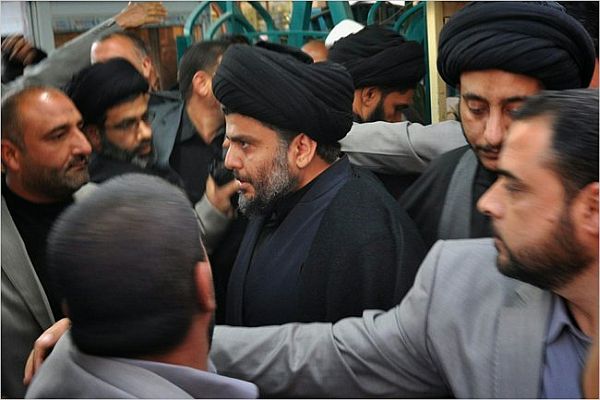
If one believes in such a thing as an arc of destiny, the one clear line that has spanned the last seven years in Iraq almost without wavering has been the ascent of Muqtada al-Sadr — the man who for so many years was referred to derisively by Western journalists as a “firebrand cleric.” Even now, while the New York Times adopts the more neutral “populist cleric”, Sadr is defined by what he opposes (he is “the United States’ most enduring foe”) and he is put on a par with the prime minister (“the rare Iraqi figure who can compete in stature with Prime Minister Nuri Kamal al-Maliki”). But unlike Sadr, Maliki holds his power through political office and the backing that office receives from the United States. No sooner that Maliki becomes a former prime minister than almost as soon he will likely become a forgotten prime minister. Sadr’s power base is far less ephemeral.

Tony Karon writes:

Anyone remember what Jay Garner, the first U.S. viceroy in Baghdad in 2003, answered when asked how long American troops would be in Iraq? “Look back on the Philippines around the turn of the 20th century,” he told an interviewer. “They were a coaling station for the navy, and that allowed us to keep a great presence in the Pacific. That’s what Iraq is for the next few decades: our coaling station that gives us great presence in the Middle East.” Instead, as radical anti-American cleric Muqtada al-Sadr made a triumphant return this week from self-imposed exile in Iran to assume a central role in the newly elected government, it is looking increasingly likely that the U.S. military presence in Iraq will be terminated by the end of this year.

The end of 2011 is, of course, when all U.S. troops are required to leave Iraq under the Status of Forces Agreement negotiated with the Iraqi government by the Bush Administration in December 2008. To stay beyond that, they’d have to be asked by the Iraqi government. But the assumption ever since the agreement, often publicly stated, has been that as that the deadline would be renegotiated. Indeed, in the year that followed the agreement, the U.S. spent $496 million on base construction in Iraq — bringing the total spent on putting down military roots in Iraq since 2005 to $2.1 billion. Four “superbases” have been constructed as hubs of the U.S. military presence there.

But the recently completed formation of a new Iraqi government underscores the fact that Iraqi sovereignty is real and U.S. influence there is limited.

Facebooktwittermail

The tyranny of the national security state

Andrew Bacevich writes:

American politics is typically a grimy business of horses traded and pork delivered. Political speech, for its part, tends to be formulaic and eminently forgettable. Yet on occasion, a politician will transcend circumstance and bear witness to some lasting truth: George Washington in his Farewell Address, for example, or Abraham Lincoln in his Second Inaugural.

Fifty years ago, President Dwight D. Eisenhower joined such august company when, in his own farewell address, he warned of the rise in America of the “military-industrial complex.” An accomplished soldier and a better-than-average president, Eisenhower had devoted the preponderance of his adult life to studying, waging, and then seeking to avert war. Not surprisingly, therefore, his prophetic voice rang clearest when as president he reflected on matters related to military power and policy.

Ike’s farewell address, nationally televised on the evening of January 17, 1961, offered one such occasion, although not the only one. Equally significant, if now nearly forgotten, was his presentation to the American Society of Newspaper Editors on April 16, 1953. In this speech, the president contemplated a world permanently perched on the brink of war—“humanity hanging from a cross of iron”— and he appealed to Americans to assess the consequences likely to ensue.

Separated in time by eight years, the two speeches are complementary: to consider them in combination is to discover their full importance. As bookends to Eisenhower’s presidency, they form a solemn meditation on the implications—economic, social, political, and moral—of militarizing America.

Facebooktwittermail

Obama administration apparently complicit in the torture of an American teenager

Glenn Greenwald writes:

Gulet Mohamed is an 18-year-old American citizen whose family is Somalian. His parents moved with him to the U.S. when he was 2 or 3 years old, and he has lived in the U.S. ever since. In March, 2009, he went to study Arabic and Islam in Yemen (in Sana’a, the nation’s capital), and, after several weeks, left (at his mother’s urging) and went to visit his mother’s family in Somalia, staying with his uncle there for several months. Roughly one year ago, he left Somalia and traveled to Kuwait to stay with other family members who live there. Like many teenagers who reach early adulthood, he was motivated in his travels by a desire to see the world, to study, and to get to know his family’s ancestral homeland and his faraway relatives.

At all times, Mohamed traveled on an American passport and had valid visas for all the countries he visited. He has never been arrested nor — until two weeks ago — was he ever involved with law enforcement in any way, including the entire time he lived in the U.S.

Approximately two weeks ago (on December 20), Mohamed went to the airport in Kuwait to have his visa renewed, as he had done every three months without incident for the last year. This time, however, he was told by the visa officer that his name had been marked in the computer, and after waiting five hours, he was taken into a room and interrogated by officials who refused to identify themselves. They then handcuffed and blindfolded him and drove him to some other locale. That was the start of a two-week-long, still ongoing nightmare during which he was imprisoned for a week in an unknown location by unknown captors, relentlessly interrogated, and severely beaten and threatened with even worse forms of torture.

Facebooktwittermail

WikiLeaks: Israelis demanded bribes before allowing goods into Gaza

Reuters reports:

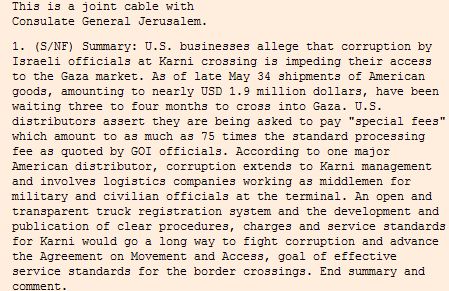
U.S. distributors accused Israel in 2006 of charging exorbitant fees to allow their goods into Gaza and an Israeli general admitted corruption existed at a major border crossing, a U.S. diplomatic cable shows.

The cable, obtained by WikiLeaks and published Thursday by the Norwegian newspaper Aftenposten, said frequent closures of the Karni crossing had “exacerbated the problem of access and appears to have forced up the cost of bribes” paid to Israelis.

The disclosures predate the 2007 armed takeover of the Gaza Strip, home to 1.5 million Palestinians, by Hamas Islamists hostile to the Jewish state. Israel has cited the Hamas threat in justifying a controversial blockade it has kept on Gaza, with Egyptian help.

“As of late May 34 shipments of American goods, amounting to nearly USD 1.9 million dollars, have been waiting three to four months to cross into Gaza,” said the cable, classified “secret” by the U.S. ambassador to Israel at the time, Richard Jones.

“U.S. distributors assert they are being asked to pay ‘special fees’ which amount to as much as 75 times the standard processing fee as quoted by GOI (Israeli government) officials.”

The cable quoted distributors for several U.S. companies complaining that payoffs were required to move their trucks to “a spot near the head of the so-called ‘Israeli line’,” which progressed more quicker to help Israelis supplying Palestinians.

“According to business contacts, allegations of corruption at Karni have a long history,” the cable said.

Facebooktwittermail

What Iranians really think

Abbas Milani writes:

The failure of American and British governments to predict the fall of the shah in 1979 was one of the biggest intelligence failures of the twentieth century. In the aftermath of that monumental mess, the British government ordered a policy review to learn what went wrong. They identified three main errors: inattention to the brutality of the regime’s secret police (SAVAK), insufficient knowledge of the corruption of the ruling elite and a lack of focus on the intellectual life of Iran.

Today, thirty years later, the dominant discourse on American policy toward Tehran often suffers from exactly the same three maladies. As the nuclear impasse with Iran continues, the new Republican majority in the House of Representatives is likely to pressure the Obama administration for harsher measures against the clerical regime, so the debate about the stability of the Iranian elite and the power of the opposition, and about what would be the right U.S. policy, is only likely to increase.

In the weeks before the policy of ending subsidies on food and petroleum was implemented, several leading security officials of the regime threatened the people with harsh punishment should they react to the new economic landscape. Lest anyone missed the message, and lest anyone did not hear about the prison sentences against leaders of the opposition, the regime also organized a major show of force in Terhan—a “security exercise,” they said—intended to remind the people of what might happen if they dared demonstrate against the new harsh reality. In the days after the implementation of the policy, every night President Ahmadinejad is reported to have convened special sessions with his cabinet to address or contain any problem. The regime was clearly worried that any small incident might act as a trigger that would once again lead to mass demonstrations.

Facebooktwittermail

Troubling trends in the Middle East

In an examination of the “five mostly troubling trends from 2010 that will probably define and plague the Middle East for the year ahead,” Rami G Khouri writes:

The transformation of the formerly localized Arab-Israeli conflict into the fulcrum of a much wider regional confrontation with strong religious overtones bodes ill for the region in the years ahead.

The Arab-Israeli conflict now anchors a much more violent and complex stand-off that sees some Arab states (notably Syria), Iran and powerful Arab Islamist resistance movements like Hamas and Hezbollah working together to repel not only Israeli territorial aggression, but what they see as wider American-Israeli hegemonic ambitions in the Arab-Islamic Middle East.

The narrow competing claims of Palestinians and Israelis in a small corner of the region have now transformed into a regional and quasi-global existential battle among powerful actors who seem prepared to fight to the finish.

Large regional and global conflicts will now more easily find local proxies to wage the battle, while local feuds will often escalate quickly into more fierce and intractable conflicts because of the association with foreign actors.

Facebooktwittermail

In Iraq, Turkey demonstrates the effectiveness of soft power

Anthony Shadid reports:

A Turkey as resurgent as at any time since its Ottoman glory is projecting influence through a turbulent Iraq, from the boomtowns of the north to the oil fields near southernmost Basra, in a show of power that illustrates its growing heft across an Arab world long suspicious of it.

Its ascent here, in an arena contested by the United States and Iran, may prove its greatest success so far, as it emerges from the shadow of its alliance with the West to chart an often assertive and independent foreign policy.

Turkey’s influence is greater in northern Iraq and broader, though not deeper, than Iran’s in the rest of the country. While the United States invaded and occupied Iraq, losing more than 4,400 troops there, Turkey now exerts what may prove a more lasting legacy — so-called soft power, the assertion of influence through culture, education and business.

“This is the trick — we are very much welcome here,” said Ali Riza Ozcoskun, who heads Turkey’s consulate in Basra, one of four diplomatic posts it has in Iraq.

Turkey’s newfound influence here has played out along an axis that runs roughly from Zakho in the north to Basra, by way of the capital, Baghdad. For a country that once deemed the Kurdish region in northern Iraq an existential threat, Turkey has embarked on the beginning of what might be called a beautiful friendship.

In the Iraqi capital, where politics are not for the faint-hearted, it promoted a secular coalition that it helped build, drawing the ire of Iraq’s prime minister, Nuri Kamal al-Maliki, along the way. For Iraq’s abundant oil and gas, it has positioned itself as the country’s gateway to Europe, while helping to satisfy its own growing energy needs.

Just as the Justice and Development Party of Prime Minister Recep Tayyip Erdogan has reoriented politics in Turkey, it is doing so in Iraq, with repercussions for the rest of the region.

Facebooktwittermail

Another step towards fascism — Israeli parliament forms “committee of persecution”

Haaretz reports:

The Knesset plenum voted Wednesday to establish a parliamentary panel of inquiry to investigate left-wing Israeli organizations that allegedly participate in delegitimization campaigns against Israel Defense Forces soldiers.

The initiative, brought forth by Foreign Minister Avigdor Lieberman’s Yisrael Beiteinu faction, called primarily to investigate the sources of funding for these groups. The panel will essentially be charged with looking into where these groups have been attaining their funds, particularly whether this money is coming from foreign states or even organizations deemed to be involved in terrorist activities.

The knesset’s approval of the proposal comes after Attorney General Yehuda Weinstein ruled in August that no investigation should be launched against such groups. The initiative has been met with anger from both the opposition and human rights groups.

The discussion at the Knesset on Wednesday was charged, filled with heckling and interruptions. A significant number of security guards were on hand to prevent physical altercations between the opposing members of Knesset.

MK Fania Kirshenbaum (Yisrael Beiteinu ), who submitted the proposal, alleged during the debate that the groups targeted for investigation were to blame for foreign actions aimed at delegitimizing Israel and its officials.

“These groups provide material to the Goldstone commission [which investigated the Gaza war] and are behind the indictments lodged against Israeli officers and officials around the world,” Kirshenbaum said, referring to a series of arrest warrants issued over the last few years.

“They are trying to silence the very people who administrate the State of Israel’s foreign relations,” she declared. “These organizations are responsible for branding IDF soldiers as war criminals and encourage defamations.”

In her presentations, Kirshenbaum singled out one group which she claimed went into local Israeli schools to convince pupils that “joining the IDF is unethical” and to advise them how to dodge conscription. A panel of inquiry, said Kirshenbaum, would investigate just who was in charge of the bodies providing these Israeli groups with financial assistance.

While Yisrael Beiteinu had garnered a majority in favor of the proposal before it was brought to vote, the matter raised the ire of human rights groups and left-wing politicians alike.

Meretz MK Nitzan Horowitz called the initiative “a shame on the Knesset”, declaring Tuesday that: “The persecution campaign against human rights and citizens rights groups has reached a new low.”

The purpose of such a committee was essentially to silence criticism, Horowitz said, a move that should be seen as, “a brutal act of political persecution using a coalition majority and Knesset funding, under the legal guise of an investigation committee.”

“Human rights and citizens rights group save the honor of Israel in the world and maintain its character as a democratic state,” Horowitz said. “It is moves like that being led by Yisrael Beiteinu that lead to Israel’s delegitimization in the world and present Israeli democracy as fake. All to whom Israeli democracy is dear must oppose this committee of persecution.”

Sixteen human rights groups signed an open letter protesting the initiative, including ACRI, B’Tselem, Yesh Din, Machsom Watch, Adalah, Mossawa Center, Ir Amim and Hotline for Migrant Workers.

“Investigate us all, we have nothing to hide. You are invited to read our reports and our publications. We will be happy if for a change you relate in a germane way to our questions instead of trying to besmirch us. It did not work in the past and it will not work this time,” the letter said.

Facebooktwittermail

Israeli media acting like North Korean media

Didi Remez, whose blog is Coteret, provides a translation of an interview with the Israeli human rights attorney, Micheal Sfard, who appeared on Israel Defense Forces Radio yesterday morning.

Niv Raskin, IDF Radio: Now we turn to the IDF investigation on the death of protester Jawaher Abu Rahma. According to the IDF investigation, senior officers say it’s a kind of fabrication. The Bilin protester didn’t die of [tear] gas inhalation; she was a cancer patient. We want to talk about this issue with the family’s lawyer, Attorney Michael Sfard.

Attorney Michael Sfard: The IDF didn’t publish, its court journalists did.

Raskin: What do you mean?

Sfard: What I mean is that no IDF officer was willing to talk on-record. The IDF Spokesperson didn’t even put out a communiqué. Everything was done through journalists. They weren’t presented with even one document. I have never encountered such crazy fabricated blood libel.

Raskin: With your permission, let’s review the facts, at least as they were published. First, according to the reports, according to the investigation conducted by the IDF, there was no report of a wounded woman on Friday. According to those officers, at least, this casts doubt over whether she was at the protest at all.

Sfard: Niv, I don’t know where to start. There’s almost no word, no letter, of truth in the sentence you just uttered. And the most terrible thing is that I don’t know how Israeli media, which had the extraordinary courage to topple a Prime Minister [Olmert – DR] over corruption, acts like the North Korean media when it’s about something the IDF wants to achieve. There isn’t even one substantiating foundation for any of the components you described. Jawaher was at the protest. Dozens of people saw her there. I spoke to eyewitnesses who were beside her at the protest. Jawaher collapsed at the protest. She wasn’t sick like the IDF Spokesperson said on Friday. She didn’t have cancer as he’s saying today.

Raskin: Those officers ask why there aren’t photos of her at the protest when there dozens of photos from it.

Sfard: Because the IDF shot so much gas, that it was everywhere in the village and people all over were affected by it. The IDF has to this day refused order the opening of an [official] investigation. How is it supposed to obtain the photos? The Judge Advocate General hasn’t, until this very moment, ordered the opening of an investigation. So, on the one hand, they don’t open an investigation. On the other hand, they come up with these fabrications. If the IDF invested a tiny fraction of the energy it’s investing in fabrications, in investigating itself, lives would be saved because the IDF would know where its action were wrong.

Raskin: Let’s, with your permission, try to return to factual issues. The gaps in the timeline. According to the Palestinian medical reports, a blood sample was taken from Abu Rahme 40 minutes before she even arrived at the hospital. How does that work?

Sfard: Look at what we’re discussing. Do you know how many medical files I’ve seen where, under the pressure of a life threatening incident, someone wrote 2 instead of 3? That’s what’s important? According to what the IDF is telling journalists and journalists are telling us, is that she was a cancer patient. Is there one [real] journalist at Yediot this morning? Can the senior reporters — Nahum Barnea, Shimon Shiffer and Sever Plocker — ask the reporters and editors if they have one document substantiating the claim that she had leukemia? This is a farce! If we find an incorrect noting of a time, do we absolve the IDF of responsibility for her death?

Raskin: You’re criticizing the media?

Sfard: Of course.

Raskin: I’m not sure that’s the correct address. Someone gave them this version. Those were senior officers. Another allegation, they say, is that her clothes didn’t smell of tear gas, contradicting the Palestinian claims. They [also] talk about a quiet funeral, not the kind they have for Shahids [martyrs in Arabic — DR] and that the Palestinians usually know how to leverage [these funerals] for a PR advantage and that didn’t happen this time.

Sfard: Hold on, I want to understand, are you serious? The IDF is claiming that because it was a quiet funeral, she died from an illness and not by its hands? Is that a serious argument? So the IDF’s proof that she wasn’t at the protest is that there wasn’t rioting [at the funeral]? Look what’s become of us! I have to prove that there was or wasn’t a smell on Jawaher’s clothes when the IDF won’t investigate the incident? The IDF is talking about some kind of examination conducted by its officers. These aren’t people who know how to investigate.

Raskin: To summarize, bottom line, you’re saying that she wasn’t sick?

Sfard: What the hell? What sickness? She had an ear problem. We..really…her ear problem. Yesterday I got 20 calls from 20 reporters requesting an explanation what kind of problem she had with her ear. Let’s assume she had an ear problem. Does she deserve to die at a protest for it?

Raskin: A couple of days ago we spoke to her uncle who was with her at the protest. He said she was suffering from a kind of asthma and that she had suffered from respiratory problems over the past few years. That means that you can’t say she a clean medical record. Not that means anything. But it’s an important thing to say.

Sfard: Look, Niv. I’m not a Palestinian. I’m an Israeli and you’re an Israeli. I want to tell you..why not put out an orderly communiqué saying: ‘This is a tragic incident and we will investigate it. We use tear gas and other non-lethal weapons precisely so things like this won’t happen. We’ll look into how this happened.’ Then task the military police with a serious investigation, because a protester has died. This is important because, if an Israeli protester dies, it won’t matter what illness he had, the police will investigate seriously.

Raskin: Attorney Michael Sfard, representing the Abu Rahme family, thanks for joining us. I’ll just point out in this context that in contrast to what Attorney Sfard says, the item on the IDF investigation appears in all the [Israeli] media and not just in Yediot Aharonot, which Sfard attacked.

Facebooktwittermail

WikiLeaks: Israel told US it would keep Gaza near collapse

Reuters reports:

Israel told U.S. officials in 2008 it would keep Gaza’s economy “on the brink of collapse” while avoiding a humanitarian crisis, according to U.S. diplomatic cables published by a Norwegian daily on Wednesday.

Three cables cited by the Aftenposten newspaper, which has said it has all 250,000 U.S. cables leaked to WikiLeaks, showed that Israel kept the U.S. Embassy in Tel Aviv briefed on its internationally criticized blockade of the Gaza Strip.

The territory, home to 1.3 million Palestinians, is run by the Islamist Hamas group, which is shunned by the West over its refusal to recognize Israel, renounce violence or accept existing interim Israeli-Palestinian peace deals.

“As part of their overall embargo plan against Gaza, Israeli officials have confirmed to (U.S. embassy economic officers) on multiple occasions that they intend to keep the Gazan economy on the brink of collapse without quite pushing it over the edge,” one of the cables read.

Israel wanted the coastal territory’s economy “functioning at the lowest level possible consistent with avoiding a humanitarian crisis,” according to the November 3, 2008 cable.

Facebooktwittermail