Monthly Archives: January 2011

Why think tanks attract sycophantic opportunists

Benjamin H. Friedman lists the reasons think tank analysts lack intellectual independence. Think tanks are shaped by five forces creating political bias:

The first is institutional funding. If you take government or industry money, you will hesitate to undertake research that offends your sponsors. Many people see foundations as somehow cleaner money, but they too have agendas. Even those of us that rely on donations from many individuals of an ideological persuasion get selected to advance that ideology and thus cannot much violate it.

Second, personal profit biases ideas. Many defense and homeland security experts, especially the most prominent ones, work for defense contractors or investment companies in that industry.

Third is ambition. Those concerned with defense analysts’ independence tend to focus on money, but as Hans Morgenthau tells us, power matters more. Analysts tend to reflect the views of one party because they hope to serve it or because their employer does. Those pining for jobs in the Obama or Thune administration are not going to tell you exactly what they think about Afghanistan without considering how their would-be bosses would react.

A fourth bias in defense analysis is what academics call a selection bias. Just as people that go into the international development business are likely to support increased foreign aid, defense analysts are more likely than most to be hawkish people.

Fifth is social convention. When these pressures point in a particular direction, it seems impolite and for many people uncomfortable to swim against the tide. And we unconsciously adjust our political views to fit in with those around us.

Facebooktwittermail

How the Dubai debacle showcased Israeli arrogance and Mossad’s incompetence

In a feature article for GQ Magazine, Ronen Bergman, senior political and military analyst for the Israeli newspaper Yedioth Ahronoth, describes the rise and fall of Israel’s Mossad under the leadership of Meir Dagan.

“Dagan’s unique expertise,” Israeli prime minister Ariel Sharon once said, “is the separation of an Arab from his head.”

Under Dagan’s command, dozens of Mossad’s elite operatives are now fugitives as a result of the bungled assassination of the Hamas commander, Mahmoud Al-Mabhouh, in Dubai in January 2010.

The organization Dagan is credited with having resuscitated from a coma has now been thrown into disarray.

[I]n 2002, Prime Minister Ariel Sharon tapped Dagan, a former military commander with a reputation for ruthless, brutal efficiency, to restore the spy agency to its former glory and preside over, as he put it, “a Mossad with a knife between its teeth.” “Dagan’s unique expertise,” Sharon said in closed meetings, “is the separation of an Arab from his head.”

Notorious for his aggressive, verbally abusive style of leadership, he is an ideologically rigid man who, according to several people inside the organization, shows the door to anyone who dares to voice an opinion different from his. As one Mossad veteran told me, “It is extremely difficult to get your opinion heard in his presence, unless it supports his. He is unable to accept criticism or even another opinion. It’s almost as if he treats his opposition like an enemy.” Dagan is also reported to have stated on several occasions that he does not believe there is anyone within the Mossad today who is worthy to replace him.

Bergman provides a detailed account of the Dubai operation and the numerous mistakes made by the Israelis in spite of the risks they were running, operating in a hostile country.

As far as the Mossad is concerned, there are two types of countries in the world. There are “base countries” (essentially, the West), in which the Mossad, like most other intelligence agencies, is able to operate with relative ease. In these countries, operatives have access to multiple getaway routes in case of emergency (and there are Israeli embassies to escape to as a last resort); it is assumed that if a Mossad spy is caught in a base country, a discreet solution can likely be found with the assistance of the local intelligence services—an option referred to in the Mossad as the “soft cushion”). “Target countries,” however, are enemy states in which operating undercover is significantly more dangerous. There are no easy escape routes (and no friendly embassy to run to), and being caught in these countries will almost certainly result in physical torture and either a protracted jail term or, quite possibly, death.

[On January 19, 2010] Al-Mabhouh is expected to land in Dubai at 3 p.m. At 1:30, Kevin Daveron [who along with Gail Folliard and Peter Elvinger were the operation’s commanders — each of these being assumed names] leaves his hotel and heads to the team’s designated meeting place—the lobby of a different hotel, where none of the team members is staying, that was selected in advance for its convenient location. On the way to the meeting, he walks through the lobby of a third hotel and enters the rest­room. When he emerges, he is no longer bald but now has a full head of hair and is wearing glasses. The security camera outside the entrance to the men’s and women’s bathrooms was recording all of this in real time. Had an alert guard noticed what was going on, the mission might have ended quite differently, with the target alive and the team members imprisoned in a hostile country.

Gail Folliard also leaves her hotel and on her way to the meeting uses the same restroom entrance as Daveron, from which she too emerges in a wig. Oddly, Folliard and Daveron are the only ones at the meeting who have changed their appearances. Given that the operatives are under the constant gaze of security cameras throughout the city, the “new” Daveron and Folliard run the risk of being linked to the “old” Daveron and Folliard through the identity of the individuals they’ve met with and passed by throughout the day—the kind of mistake that is almost incomprehensible for an elite Mossad team to make.

Despite the fact that Dubai is a hostile environment—a distant Arab state with ties to Iran—many details of the mission suggest the Mossad treated it as if they were operating inside a base country. The use of Payoneer cards is one obvious example. For the most part, prepaid debit cards are only used domestically within the United States, and while Payoneer does issue debit cards that are valid internationally, these are relatively rare. That several of the team members were using the same type of unusual card issued by the same company—one whose CEO, Yuval Tal, is a veteran of an elite Israeli Defense Force commando unit—gave the Dubai police a common denominator to connect the various members of the team.

Why did the Mossad permit things to go so wrong in Dubai? In a word, the answer is leadership. Because Dagan refashioned the Mossad in his own image, and because he drove out anyone who was willing to question his decisions, there was no one in the agency to tell him that the Dubai operation was badly conceived and badly planned. They simply did not believe that a minnow in the world of intelligence services such as Dubai would be any match for Israel’s Caesarea fighters.* As one very senior German intelligence expert told me: “The Israelis’ problem has always been that they underestimate everyone—the Arabs, the Iranians, Hamas. They are always the smartest and think they can hoodwink everyone all the time. A little more respect for the other side—even if you think he is a dumb Arab or a German without imagination—and a little more modesty would have saved us all from this embarrassing entanglement.”

The Dubai fiasco caused a great deal of damage to Israel, to the Mossad, and to its relations with other Western intelligence organizations. It led to unprecedented revelations of Mossad personnel and methods, far more than any previous bungled operation. A number of states who believe that their passports were forged or otherwise misused by the agency have expelled Mossad representatives. The British response in particular was furious. And Israel’s long-standing security-and-intelligence cooperation with Germany has also been dealt a hugely damaging blow. In early June, the head of the Caesarea unit in the Mossad—who had been considered the leading contender to eventually replace Dagan—offered his resignation. As for Dagan’s future, before Dubai he had hoped that the liquidation of Al-Mabhouh would ensure yet another extension of his tenure as director of the agency. But that has not come to pass. At the time of this writing, it is assumed that he will not continue. And so the Mossad “with a knife between its teeth” likely is entering another period of confusion and self-doubt.

“There is no doubt Dagan received an organization on the verge of coma and brought it back to its feet,” one Mossad veteran of many years told me. “He increased its budget, won great successes, and most important, he rebuilt its pride. The problem is that multiplying its volume of activity many times over came with the price of compromising on security protocols. And along with success came hubris. Together, they brought the Dubai debacle. And now, in some areas, his successor will find a Mossad even worse off than Dagan found in 2002.”

*Most of the operatives here are members of a secretive unit within the Mossad known as Caesarea, a self-contained organization that is responsible for the agency’s most dangerous and critical missions: assassinations, sabotage, penetration of high-security installations. Caesarea’s “fighters,” as they are known, are the elite of the Mossad. They rarely interact with other operatives and stay away from Mossad headquarters north of Tel Aviv, instead undergoing intensive training at a separate facility to which no one else in the agency has access. They are forbidden from ever using their real names, even in private conversation, and—with the exception of their spouses—their families and closest friends are unaware of what they do. As one longtime Caesarea fighter recently told me, “If the Mossad is the temple of Israel’s intelligence community, then Caesarea is its holy of holies.”

Facebooktwittermail

Once a terrorist, always a terrorist — unless you’re an Israeli

David Cole challenges the Supreme Court’s idiotic ruling on the definition of “material support” offered to designated terrorist organizations.

Did former Attorney General Michael Mukasey, former New York Mayor Rudolph Giuliani, Tom Ridge, a former homeland security secretary, and Frances Townsend, a former national security adviser, all commit a federal crime last month in Paris when they spoke in support of the Mujahedeen Khalq at a conference organized by the Iranian opposition group’s advocates? Free speech, right? Not necessarily.

The problem is that the United States government has labeled the Mujahedeen Khalq a “foreign terrorist organization,” making it a crime to provide it, directly or indirectly, with any material support. And, according to the Justice Department under Mr. Mukasey himself, as well as under the current attorney general, Eric Holder, material support includes not only cash and other tangible aid, but also speech coordinated with a “foreign terrorist organization” for its benefit. It is therefore a felony, the government has argued, to file an amicus brief on behalf of a “terrorist” group, to engage in public advocacy to challenge a group’s “terrorist” designation or even to encourage peaceful avenues for redress of grievances.

Don’t get me wrong. I believe Mr. Mukasey and his compatriots had every right to say what they did. Indeed, I argued just that in the Supreme Court, on behalf of the Los Angeles-based Humanitarian Law Project, which fought for more than a decade in American courts for its right to teach the Kurdistan Workers’ Party in Turkey how to bring human rights claims before the United Nations, and to assist them in peace overtures to the Turkish government.

But in June, the Supreme Court ruled against us, stating that all such speech could be prohibited, because it might indirectly support the group’s terrorist activity. Chief Justice John Roberts reasoned that a terrorist group might use human rights advocacy training to file harassing claims, that it might use peacemaking assistance as a cover while re-arming itself, and that such speech could contribute to the group’s “legitimacy,” and thus increase its ability to obtain support elsewhere that could be turned to terrorist ends. Under the court’s decision, former President Jimmy Carter’s election monitoring team could be prosecuted for meeting with and advising Hezbollah during the 2009 Lebanese elections.

At the heart of the Supreme Court justices view of terrorism is that it can be defined more in terms of who terrorists are than in what they do. In essence, it declares: once a terrorist, always a terrorist (unless the US government decides otherwise).

This view has become almost a religious orthodoxy in the United States over the last decade. Hence, it is only among hardcore advocates of human rights that the fact that men now being imprisoned primarily because of fears about what they might do in the future, is seriously being challenged.

But if this once-a-terrorist-alway-a-terrorist view was actually applied with rigor, how could the United States justify its support for Israel? Former prime minister Menachim Begin was a terrorist. Tzipi Livni’s parents were terrorists. Terrorism played a vital role in the creation of Israel. And yet material support from the US government to Israel flows in abundance. Different strokes for different folks, I guess.

Facebooktwittermail

Don’t deny detainees their day in court

Amos N. Guiora and Laurie R. Blank write:

The idea that every person deserves his or her “day in court” is a fundamental principle in the United States and many countries worldwide. Yet more than nine years after 9/11, the United States remains paralyzed not just about how to give the thousands of detainees in U.S. custody around the world their day in court but about whether to give them that day in court.

Multiple judicial forums have been created to try nonstate actors who have perpetrated war crimes from Rwanda to Sierra Leone to Cambodia to the former Yugoslavia — to give them their day in court. That makes the failure to answer this question for post-9/11 detainees particularly perplexing and deeply troubling.

Two successive administrations have been incapable of answering what should be the most basic questions: if, how and where to try terrorists. In the meantime, post-9/11 detainees languish in indefinite detention. The result is a fundamental and overwhelming violation of the rights of individuals who are no more than suspects, in either past or (more problematic) future acts.

The Obama administration now intends to issue an executive order establishing indefinite detention without trial for detainees at Guantanamo Bay. This decision will formalize this violation of basic rights. Denying individual accountability will now be official U.S. policy and law.

Facebooktwittermail

The conventional right-wing wisdom in Israel

Yaniv Reich at Hybrid States notes:

A brilliant, must-see video by the Eretz Nehederet show in Israel.

What is most remarkable about this short satirical piece is how realistic it is. It can be considered satire, but it unfortunately reflects far too common thoughts that have infected Israeli critical thinking capacities. Like conservatives who can’t tell that Stephen Colbert is mocking them, I suspect a number of right-wing Israeli hacks will self-identify with this video. Maybe they’ll even try to redesign early childhood education around these innovative ideas.

Facebooktwittermail

‘The Left has nowhere to go’

Chris Hedges writes:

Ralph Nader in a CNN poll a few days before the 2008 presidential election had an estimated 3 percent of the electorate, or about 4 million people, behind his candidacy. But once the votes were counted, his support dwindled to a little over 700,000. Nader believes that many of his supporters entered the polling booth and could not bring themselves to challenge the Democrats and Barack Obama. I suspect Nader is right. And this retreat is another example of the lack of nerve we must overcome if we are going to battle back against the corporate state. A vote for Nader or Green Party candidate Cynthia McKinney in 2008 was an act of defiance. A vote for Obama and the Democrats was an act of submission. We cannot afford to be submissive anymore.

“The more outrageous the Republicans become, the weaker the left becomes,” Nader said when I reached him at his home in Connecticut on Sunday. “The more outrageous they become, the more the left has to accept the slightly less outrageous corporate Democrats.”

Nader fears a repeat of the left’s cowardice in the next election, a cowardice that has further empowered the lunatic fringe of the Republican Party, maintained the role of the Democratic Party as a lackey for corporations, and accelerated the reconfiguration of the country into a neo-feudalist state. Either we begin to practice a fierce moral autonomy and rise up in multiple acts of physical defiance that have no discernable short-term benefit, or we accept the inevitability of corporate slavery. The choice is that grim. The age of the practical is over. It is the impractical, those who stand fast around core moral imperatives, figures like Nader or groups such as Veterans for Peace, which organized the recent anti-war rally in Lafayette Park in Washington, which give us hope. If you were one of the millions who backed down in the voting booth in 2008, don’t do it again. If you were one of those who thought about joining the Washington protests against the war where 131 of us were arrested and did not, don’t fail us next time. The closure of the mechanisms within the power system that once made democratic reform possible means we stand together as the last thin line of defense between a civil society and its disintegration. If we do not engage in open acts of defiance, we will empower a radical right-wing opposition that will replicate the violence and paranoia of the state. To refuse to defy in every way possible the corporate state is to be complicit in our strangulation.

Facebooktwittermail

Psychologists protest ‘inhumane, harmful’ treatment of Bradley Manning

Raw Story reports:

A psychologists’ group has sent a letter to Defense Secretary Robert Gates asking him to “rectify the inhumane, harmful, and counterproductive treatment” of the Army private accused of being WikiLeaks’ source for the US State Department cables.

In a letter dated Monday, Psychologists for Social Responsibility (PsySR) argued that PFC Bradley Manning, who has been held in solitary confinement at the Marine Corps brig in Quantico for the past five months, may be the victim of political retribution. The group also suggested that the psychological damage Manning may be suffering from spending 23 hours a day alone may ruin his bid for a fair trial.

“History suggests that solitary confinement, rather than being a rational response to a risk, is more often used as a punishment for someone who is considered to be a member of a despised or ‘dangerous’ group,” the letter stated. “In any case, PFC Manning has not been convicted of a crime and, under our system of justice, is at this point presumed to be innocent.”

Facebooktwittermail

Combined Systems Inc’s lethal products

Following the death of Jawaher Abu Rahmah, four American peace activist groups have written to the US manufacturer that supplies the Israeli military with CS gas products. The letter states:

As US groups committed to justice and peace, we are writing to ask that Combined Systems Inc. cease providing CSI equipment to the Israeli government in response to the Israeli military’s ongoing and foreseeable misuse of CSI crowd control equipment to kill and maim protesters in the Occupied Palestinian Territories. The Israeli military has demonstrated a pattern of misuse of your equipment, directly leading to the death and injury of unarmed demonstrators in the Occupied Palestinian Territories. Over the last two years alone, the Israeli military has used your products to kill two peaceful protesters from one family in the West Bank village of Bil’in, to severely injure two peaceful protesters from the US, and to seriously injure many more. According to the the Israeli human rights group B’Tselem, two other Palestinians were killed by Israeli tear gas in 2002.

As noted on CSI’s website, “Israeli Military Industries” are among CSI’s “military customers and development partners.” CSI has an ethical and legal responsibility to ensure that the Israeli government is using CSI products according to product guidelines. Unfortunately, the Israeli military has a well-documented track record of systematically using excessive force against civilians, including with CSI products as outlined below, and thus is not an appropriate customer for CSI.

Paul Ford, Vice President of Sales and Marketing for CSI, in a 2009 edition of Special Operations Report [PDF], described the company’s approach to “Non-Lethal Weapons” (NLW) for military forces and law enforcement agencies around the world.

“CSI’s goal is to continue to provide innovative new NLW technologies to save lives and enhance the options available to operators, rather than taking them away,” says Ford. “We’ve finally entered an age where we now have safer options and acceptance, set apart from otherwise conventional lethal force means, which offer immediate compliance by way of NLWs. We’re proud to be a company that has embraced the concept: we can do more by means of compliance with technology rather than with injury or death.”

If CSI takes its corporate mission seriously, it should recognize that its reputation is being seriously undermined by the Israeli military’s unwillingness or inability to use CSI products in compliance with the manufacturer’s directions. In the hands of Israeli conscript soldiers who have little concern for the life or welfare of unarmed protesters, CSI non-lethal weapons no longer live up to that name and instead are causing injury and death.

Facebooktwittermail

The Israeli-Palestinian alliance that worries the Israeli government

In an analysis on the political fallout from the killing of Jawaher Abu Rahmah, a Palestinian women who died after inhaling tear gas fired by Israeli troops in the West Bank on Friday, Tony Karon writes:

[T]he news of Abu Rahmah’s death has highlighted a new alliance emerging between a small number of Israeli leftists and Palestinians engaged in unarmed mass protest action. Scores of Israeli activists had actually joined Friday’s demonstration, and they challenged the IDF claim that tear gas was fired only after stones were thrown by protesters. The news that Abu Rahmah had died brought hundreds of Israeli Jews to a protest in Tel Aviv on Saturday night outside Israel’s Defense Ministry, where a handful were arrested. More were held later by the police after 25 protesters converged on the residence of the U.S. ambassador to Israel and allegedly threw some of the U.S.-made tear-gas canisters collected in Bil’in onto his lawn.

The self-described leftists and anarchists engaged in direct action in concert with unarmed Palestinian protests are a negligible presence on an Israeli political spectrum whose median has moved steadily to the right over the past decade. But their actions may be directed less at the Israeli political mainstream than at international civil society. The Israeli protesters often use English rather than Hebrew in placards and slogans, and explicitly connect Israel’s occupation of Palestinian territories with South Africa’s apartheid system. That’s intended as a signal to international civil society, which helped end the apartheid regime through its support for boycotts and economic sanctions in the 1980s. Joseph Dana, an Israeli activist and the media coordinator for the Palestinian Popular Struggle Coordination Committee, says these Israeli leftists are “seeking to use the privileged access their voice carries in North America and Europe to add power to the voice of the Palestinians they struggle alongside, sidestepping engagement with [an Israeli] society that is unwilling to listen.”

Their numbers may be relatively small, but the activists are certainly making their presence felt. Weekly demonstrations against Israeli settlement activity in the Sheikh Jarrah neighborhood of East Jerusalem regularly draw scores of Israelis, who have also ventured out to demonstrations elsewhere in the West Bank. Just last week, Israeli anarchist Jonathan Pollak was sentenced to three months in an Israeli prison for his role in a bicycle protest against the Gaza blockade three years ago. In court for his sentencing, an unrepentant Pollak wore a T-shirt bearing the face of slain South African antiapartheid activist Steve Biko.

As much as it irks Israel’s liberal supporters in the West, the apartheid comparison with Israel’s occupation is being drawn more and more frequently, even by current Israeli Defense Minister Ehud Barak. Barak, of course, was using it to warn his countrymen of the danger of failing to achieve a two-state solution, which leaves Palestinians effectively ruled by a state that denies them citizenship. But its function for Tel Aviv leftists is to spur the international community to action — hoping that the fact that it comes from Jewish Israelis will counter any hesitation based on sensitivity to charges of anti-Semitism in the West.

The growing assertiveness of Israel’s leftists has the authorities worried.

Facebooktwittermail

Why American journalists won’t stand up for the First Amendment

At Newsweek, Ben Adler asks: why aren’t American journalists standing up for WikiLeaks. He sees three reasons:

1. Refusal to engage in advocacy: American journalists, unlike many of their foreign counterparts, have a strong commitment to objectivity and nonpartisanship. At many mainstream media organizations, signing petitions is verboten, and many journalists impose such rules on themselves. According to Shapiro, who co-wrote the Columbia letter, when they circulated the document, “Some people said, ‘As a journalist, I make it my practice never to sign a petition.’ ” As an example, Bill Grueskin, the dean of academic affairs at Columbia’s Journalism School, did not sign. Asked why by NEWSWEEK, he said he’s “not much of one for signing group letters.”

2. Opposition to Assange’s purpose: That same notion of objectivity shared by journalists makes many of them suspicious of WikiLeaks’s journalistic bona fides. Assange has an advocacy mission: to disrupt the functioning of governments. Many investigative journalists, like the famous muckrakers at the turn of the last century, have had a similar orientation, says Shapiro, who wrote the book Shaking the Foundations: 200 Years of Investigative Journalism in America. “WikiLeaks springs from the same purpose as investigative journalism: a sense that the system is corrupt and the truth can be told,” says Shapiro. “It’s a reformist rather than radical agenda.” Even so, many mainstream reporters, editors, and producers might see associating with Assange as inappropriately endorsing an advocacy mission.

3. Opposition to Assange’s methods: Some journalists, while perhaps believing Assange should not be prosecuted, are so disgusted with his approach that they are reluctant to weigh in publicly. Sam Freedman, a journalism professor at Columbia University, did not sign the letter his colleagues circulated because, “I felt the letter did not adequately criticize the recklessness—the disregard for the consequences of human lives—of a massive dump of confidential info.” Freedman says prosecuting Assange would set a dangerous precedent for legitimate journalists. But many think, as Freedman does, that Assange did not exhibit the judiciousness that a journalist must when releasing classified information.

Some would take issue with that. WikiLeaks did, in fact, offer the State Department an opportunity to request that sensitive information be withheld. But pointing to WikiLeaks as a paradigm of a free press at work is not a position many journalists want to find themselves in. “From a legal perspective, the media may not want this to be the test case,” says Dan Abrams, NBC’s legal analyst and the founder of the Mediaite blog. “This example is almost a classic law school worst-case scenario for testing the bounds of the First Amendment. [Journalists] think it’s within his rights to do have done it, but they think he ought not to have done it. That’s the fundamental tension in the way the media’s covering the story, and the tepid defenses.”

In other words, American journalists are too objective and too highly principled to align themselves with WikiLeaks.

Or maybe it has more to do with the fact that most American journalists receive their pay checks from media corporations whose own cozy relations with the US government must not be put in jeopardy by an anarchic organization like WikiLeaks.

When self-interest and the status quo so closely coincide, why speak up? And when newspapers are constantly making staff cuts, who imagines that the fiercest advocates of First Amendment rights will also be seen as the most reliable “team players” — the ones who can be confident that they will be among the last thrown off board?

Facebooktwittermail

Substantial evidence contradicts the Israeli army’s version of the events surrounding the death of Jawaher Abu Rahmah

The Popular Struggle Coordination Committee just released the following statement:

Since yesterday, the army has been promoting in the Israeli media a mendacious version regarding the events that led to the death of Jawaher Abu Rahmah of Bil’in on Friday, 31 December 2010. According to the army’s version, Jawaher was not injured by tear gas and was possibly not even present at the demonstration. The army spokesperson did not see fit to publish an official statement on the matter, instead passing the information to the media in the name of anonymous “army sources.”

The facts of the matter, which are supported by the testimony of eyewitness who were present at the demonstration, as well as by the ambulance driver who evacuated her to the hospital, contradict completely the army’s version:

Soubhiya Abu Rahmah, mother of Jawaher: “I was standing beside Jawaher on the hill that is near the place where the demonstration took place, when we were injured by a cloud of tear gas. Jawaher began to feel unwell from inhaling the gas and started to move back from the place; soon after that she vomited and collapsed. We took her to the nearest road, and from there she was evacuated by ambulance to the hospital, where she remained until her death. She was not sick with cancer, nor did she have any other illness; and she was not asthmatic.”

Ilham Fathi: I was on the roof of my house, which is located a few meters from where Jawaher stood. When the cloud of tear gas moved in our direction, I went downstairs in order to close the windows. While I was closing one of the windows, I saw her lose consciousness from the gas and ran over to her, together with Islam Abu Rahmah, in order to pull her away. We picked her up together and carried her to my garden. We called for help and she began to vomit and foam at the mouth. Phone: 059-5127887

Islam Abu Rahmah: “I was standing with Jawaher, her mother and my grandmother in order to watch the confrontation that was going on just in front of us, in the area of the fence. The wind moved the gas in our direction, making our eyes itch and tear up. After that she (Jawaher) began to cough and foam at the mouth. Soon after that she became weak and lay down on the ground. I succeeded in carrying her as far as the Abu Khamis home, about 40 meters in the direction of her house, but then she became terribly weak, vomited violently and foamed at the mouth. She was having difficult breathing and lost her sense of direction. We got a few women to help her by waving a paper fan over her face in order to provide some oxygen. After that she was taken to the hospital.”

Saher Bisharat, the ambulance who evacuated Jawaher: “We received Jawaher near the entrance that is parallel to the fence, which is where the demonstration was taking place. She was still partially conscious, answered questions, and said that she had choked on gas. I took her straight to the hospital.” (Click here to view the Red Crescent report). Phone: 059-9374348

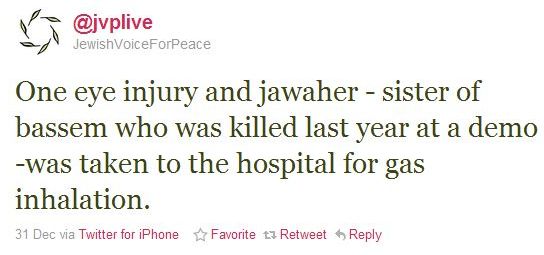
The army has also claimed that the reports about Abu Rahmeh’s injuries started to arrive only several hours after the incident, in the evening. That claim is contradicted by a tweet sent by the NGO Jewish Voices for Peace (JVP), which reports the injury of Jawaher, including her name, in real time (click here to view). The tweet was sent at 2:36 pm (4:36 am on the West Coast of the United States). Wafa, the Palestinian news service, published a report that includes the injury of Jawaher Abu Rahmah shortly after the event (click here to view).

Also according to “army sources,” which remain anonymous, Jawaher Abu Rahmah suffered from a serious illness, possibly leukemia; the “sources” postulate that she died from a pre-existing condition rather than tear gas inhalation. Several sources reject that claim.

Dr. Uday Abu Nahlah: “Jawaher Abu Rahmah was employed in my home on a regular basis. On Thursday she was at work as usual, healthy, only one day before her death.” Phone: 059-9796827 (English and Arabic).

Jawaher had an inner ear infection, which affected her balance, for which she was recently given a CT scan. The radiologist who performed the CT scan, Dr. Hamis Al Sahfi’i, confirmed that the brain scan was normal (for the CT scan results click here). Jawaher had a minor health issue involving fluids in her inner ear. Her physicians insist that she did not suffer from any illness or from any symptoms that might, if combined with tear gas, lead to her death.

There is not, nor could there be, any indication that Abu Rahmah had cancer; in fact, she was in good health. The director of the hospital refutes the claim that she died from a pre-existing condition:

Mohammed Aida, director of the Ramallah health center where Abu Rahmah received her care: “Jawaher Abu Rahmah died from lung failure that was caused by tear gas inhalation, leading to a heart attack. She arrived at the hospital only partly conscious, and then lost consciousness completely.” Click here for the hospital’s official medical report.

Mohammed Khatib, a member of Bil’in’s Popular Coordinating Committee: “The army is trying to evade its responsibility for Jawaher’s death with lies and invented narratives that have no basis. They are spreading these lies and invented narratives via the media, which is not bothering to do basic fact checking. Our version is supported by named sources and with medical documents. In a properly functioning society, the army’s version, which has been spread by anonymous sources, would not be considered worthy of publication.”

Facebooktwittermail

Israeli military tries to cover up killing of an unarmed Palestinian protester

As was widely reported on Saturday, Jawaher Abu Rahmah, a 36 year-old Palestinian woman from Bilin, died after inhaling tear gas at a demonstration in the West Bank village on Friday.

The moment at which Jawaher was evacuated by ambulance from the scene was recorded by Rebecca Vilkomerson Emily Schaeffer from Jewish Voice for Peace who tweeted: “One eye injury and jawaher — sister of bassem who was killed last year at a demo — was taken to the hospital for gas inhalation.”

Israeli Defense Forces officials are now propagating disinformation through a network of right-wing bloggers and stooges in the Israeli press, suggesting the Jawaher did not even attend the demonstration.

One such blogger, The Muqata, who attended an “exclusive” IDF briefing — exclusive, presumably, to bloggers willing to parrot whatever they were told — said: “We have never heard of anyone dying from inhaling tear gas…”

The U.S. Army Center for Health Promotion and Preventive Medicine warns that at a concentration of 2mg per cubic meter, CS gas “is immediately dangerous to life…” The Army advises, in the event of inhalation: “remove the victim to fresh air immediately; perform artificial respiration if breathing has stopped; keep the victim warm and at rest; seek medical attention immediately.”

The goal of the IDF and its apparatchiks is to sow doubt. But as Jerry Haber at The Magnes Zionist writes:

Even an idiot can see that the IDF is using the same “methodology” that Holocaust deniers use to raise questions about the number of Jews killed, or the presence of gas chambers to kill Jews, etc. That methodology is to “raise questions,” to “point out contradictions”, to suggest that the evidence is not convincing, to insinuate that those who make the claims are not to be trusted.

What is equally evident is that at a time when barely a day goes by without new evidence emerging of the racism which is endemic across Israel, the IDF feels acutely vulnerable when its disregard for human life is once again in the spotlight.

Denial is another name for desperation.

Facebooktwittermail

2010, the year of assassination by drones

The Asian News International news agency reports:

As many as 2,043 people, mostly civilians, were killed in US drone attacks in northwestern parts of Pakistan during the last five years, a research has revealed.

The yearly report of Conflict Monitoring Centre (CMC) has termed the CIA drone strikes as an ”assassination campaign turning out to be revenge campaign”, and showed that 2010 was the deadliest year ever of causalities resulted in drone-hits in Pakistan.

According to the report, 134 drone attacks were reported in Pakistan’s FATA region in 2010 alone, inflicting 929 causalities. December 17 was the deadliest day of 2010 when three drone attacks killed 54 people in Khyber Agency.

Regarding civilian causalities and attacks on women and children, the report said: “People in the tribal belt usually carry guns and ammunition as a tradition. US drone will identify anyone carrying a gun as a militant and subsequently he will be killed.”

“Many times, people involved in rescue activities also come under attack. The assumption that these people are supporters of militants is quite wrong,” The Nation quoted the CMC report, as stating.

The document cited the Brooking Institute”s research, which suggested that with every militant killed, nearly ten civilians also died.

It also mentioned a related research report of Campaign for Innocent Victims in Conflict (CIVIC), which underlined that at least 2,100 civilians were killed and various others injured during 2009, in the ongoing war on terror and drone attacks.

The CMC report, “2010, The Year of Assassination by Drones,” can be read here [PDF].

Facebooktwittermail

From Bilin to Tel Aviv, outrage at killing of Jawaher Abu Rahmah

At Electronic Intifada, Joseph Dana writes:

“I am in shock, we are in shock,” Hamde Abu Rahmah told me as we stood outside the small cemetery in Bilin where 36-year-old Jawaher Abu Rahmah was buried on Saturday. One day earlier, on 31 December, Jawaher was killed after inhaling US-made tear-gas fired by Israeli soldiers at demonstrators in the occupied West Bank village. Jawaher’s brother Bassem was killed by Israeli occupation forces in a similar manner in 2009.

“We simply did not think that this would happen. We deal with tear-gas on a regular basis but the amount that they used and the strength was something we have not yet seen,” continued Hamde, Jawaher’s cousin who has reported on and photographed Bilin’s regular demonstrations against Israel’s wall and occupation since 2008.

Friday’s demonstration, on New Year’s Eve, was enormous. Over 1,000 people — Palestinians, Israelis and internationals — joined villagers in Bilin to call for an end to Israel’s wall. Israel tried to stop the demonstration before it even began by creating a ring of military checkpoints on roads encircling the village to prevent non-villagers from attending. However, their strategy failed as hundreds of activists trekked through the rolling hills to reach the village.

Even prime minister of the Ramallah-based Palestinian Authority, Salam Fayyad, briefly joined the demonstration leading from the village center to the area of the wall. How Fayyad reached the village and why he left so quickly was unclear to everyone, some joked that the soldiers let him through the checkpoints because they consider him a Zionist.

Facebooktwittermail

WikiLeaks: US government, acting on behalf of Monsanto, targeted EU over GM crops

[Updated below]

Make no mistake: Monsanto poses an infinitely greater threat to the world than al Qaeda.

The US government still marches in lockstep with this corporate behemoth which is intent and already frighteningly successful in its campaign to claim ownership over the global food supply.

The Guardian reports:

The US embassy in Paris advised Washington to start a military-style trade war against any European Union country which opposed genetically modified (GM) crops, newly released WikiLeaks cables show.

In response to moves by France to ban a Monsanto GM corn variety in late 2007, the ambassador, Craig Stapleton, a friend and business partner of former US president George Bush, asked Washington to penalise the EU and particularly countries which did not support the use of GM crops.

“Country team Paris recommends that we calibrate a target retaliation list that causes some pain across the EU since this is a collective responsibility, but that also focuses in part on the worst culprits.

“The list should be measured rather than vicious and must be sustainable over the long term, since we should not expect an early victory. Moving to retaliation will make clear that the current path has real costs to EU interests and could help strengthen European pro-biotech voices,” said Stapleton, who with Bush co-owned the St Louis-based Texas Rangers baseball team in the 1990s.

In other newly released cables, US diplomats around the world are found to have pushed GM crops as a strategic government and commercial imperative.

In a recent interview on Democracy Now!, Jeffrey Smith, executive director of the Institute for Responsible Technology, was asked to compare the Obama administration with the Bush administration on the issue of biotechnology.

President Obama, while he was campaigning here in Iowa, promised that he would require labeling of genetically modified crops. And since most Americans say they would avoid GMOs if labeled, that would have eliminated it from the food supply. But, you see, he and the FDA have been promoting the biotechnology. And unfortunately, the Obama administration has not been better than the Bush administration, possibly worse.

For example, the person who was in charge of FDA policy in 1992, Monsanto’s former attorney, Michael Taylor, he allowed GMOs on the market without any safety studies and without labeling, and the policy claimed that the agency was not aware of any information showing that GMOs were significantly different. Seven years later, because of a lawsuit, 44,000 secret internal FDA memos revealed that that policy was a lie. Not only were the scientists at the FDA aware that GMOs were different, they had warned repeatedly that they might create allergies, toxins, new diseases and nutritional problems. But they were ignored, and their warnings were even denied, and the policy went forth allowing the deployment GMOs into the food supply with virtually no safety studies. That person in charge is now the U.S. food safety czar in the Obama administration.

If you haven’t seen it already, watch Food Inc. (2008). This is the part of the documentary dealing with Monsanto’s ownership of the soy bean and the draconian means it uses to prevent farmers replanting seed grown on their own fields.

Update: Aaron Turpen writes:

Monsanto, the world’s largest producer of genetically modified seeds and of America’s most-used herbicide RoundUp, is finally showing signs of breaking. Earlier this year, the company was named Company of the Year by Forbes Magazine. Forbes has since apologized for that award while stock market commentator Jim Cramer has named Monsanto to be “the worst stock of 2010.”

So what’s happening to the GMO Giant?

Several things are happening at once, bringing the powerful company down to earth. First, Monsanto’s best-selling product, RoundUp (glyphosate), has seen its patent run out. This means cheaper competition, especially in large, foreign markets like Asia. Second, the company is also seeing many of its core seed buyers turning to other sources because of the growing threat of RoundUp-resistant crops.

Facebooktwittermail

Wikileaks: Israel plans total war on Lebanon, Gaza

Juan Cole writes:

The Norwegian newspaper Aftenposten has summarized an Israeli military briefing by Israeli Chief of Staff Gen. Gabi Ashkenazi of a US congressional delegation a little over a year ago and concludes that

The memo on the talks between Ashkenazi and [Congressman Ike] Skelton, as well as numerous other documents from the same period of time, to which Aftenposten has gained access, leave a clear message: The Israeli military is forging ahead at full speed with preparations for a new war in the Middle East.

The paper says that US cables quote Ashkenazi telling the US congressmen, “I’m preparing the Israeli army for a major war, since it is easier to scale down to a smaller operation than to do the opposite.”

The general’s plans are driven by fear of growing stockpiles of rockets in Hamas-controlled Gaza and in Hizbullah-controlled Southern Lebanon, the likely theaters of the planned major new war. Ashkenazi does not seem capable of considering that, given a number of Israeli invasions and occupations of those regions, the rockets may be primarily defensive.

Facebooktwittermail

Gazan youth’s manifesto for change

The Guardian reports:

The meeting takes place in a bare room in a block of flats in the centre of Gaza City. No photographs, no real names – those are the conditions.

This is the first time that a group of young Palestinian cyber-activists has agreed to meet a journalist since launching what it calls Gaza Youth’s Manifesto for Change. It is an incendiary document – written with courage and furious energy – that has captivated thousands of people who have come across it online, and the young university students are visibly excited, but also scared. “Not only are our lives in danger; we are also putting our families at risk,” says one of them, who calls himself Abu George.

Gaza Youth’s Manifesto for Change is an extraordinary, impassioned cyber-scream in which young men and women from Gaza – where more than half the 1.5 million population is under 18 – make it clear that they’ve had enough. “Fuck Hamas…” begins the text. “Fuck Israel. Fuck Fatah. Fuck UN. Fuck UNWRA. Fuck USA! We, the youth in Gaza, are so fed up with Israel, Hamas, the occupation, the violations of human rights and the indifference of the international community!”

It goes on to detail the daily humiliations and frustrations that constitute everyday life in the Gaza Strip, the Palestinian slice of land that Israel and Egypt have virtually sealed off from the world since Hamas was elected to power in 2006.

GAZAN YOUTH’S MANIFESTO FOR CHANGE

Fuck Hamas. Fuck Israel. Fuck Fatah. Fuck UN. Fuck UNWRA. Fuck USA! We, the youth in Gaza, are so fed up with Israel, Hamas, the occupation, the violations of human rights and the indifference of the international community! We want to scream and break this wall of silence, injustice and indifference like the Israeli F16’s breaking the wall of sound; scream with all the power in our souls in order to release this immense frustration that consumes us because of this fucking situation we live in; we are like lice between two nails living a nightmare inside a nightmare, no room for hope, no space for freedom. We are sick of being caught in this political struggle; sick of coal dark nights with airplanes circling above our homes; sick of innocent farmers getting shot in the buffer zone because they are taking care of their lands; sick of bearded guys walking around with their guns abusing their power, beating up or incarcerating young people demonstrating for what they believe in; sick of the wall of shame that separates us from the rest of our country and keeps us imprisoned in a stamp-sized piece of land; sick of being portrayed as terrorists, homemade fanatics with explosives in our pockets and evil in our eyes; sick of the indifference we meet from the international community, the so-called experts in expressing concerns and drafting resolutions but cowards in enforcing anything they agree on; we are sick and tired of living a shitty life, being kept in jail by Israel, beaten up by Hamas and completely ignored by the rest of the world.
There is a revolution growing inside of us, an immense dissatisfaction and frustration that will destroy us unless we find a way of canalizing this energy into something that can challenge the status quo and give us some kind of hope. The final drop that made our hearts tremble with frustration and hopelessness happened 30rd November, when Hamas’ officers came to Sharek Youth Forum, a leading youth organization (www.sharek.ps) with their guns, lies and aggressiveness, throwing everybody outside, incarcerating some and prohibiting Sharek from working. A few days later, demonstrators in front of Sharek were beaten and some incarcerated. We are really living a nightmare inside a nightmare. It is difficult to find words for the pressure we are under. We barely survived the Operation Cast Lead, where Israel very effectively bombed the shit out of us, destroying thousands of homes and even more lives and dreams. They did not get rid of Hamas, as they intended, but they sure scared us forever and distributed post traumatic stress syndrome to everybody, as there was nowhere to run.

We are youth with heavy hearts. We carry in ourselves a heaviness so immense that it makes it difficult to us to enjoy the sunset. How to enjoy it when dark clouds paint the horizon and bleak memories run past our eyes every time we close them? We smile in order to hide the pain. We laugh in order to forget the war. We hope in order not to commit suicide here and now. During the war we got the unmistakable feeling that Israel wanted to erase us from the face of the earth. During the last years Hamas has been doing all they can to control our thoughts, behaviour and aspirations. We are a generation of young people used to face missiles, carrying what seems to be a impossible mission of living a normal and healthy life, and only barely tolerated by a massive organization that has spread in our society as a malicious cancer disease, causing mayhem and effectively killing all living cells, thoughts and dreams on its way as well as paralyzing people with its terror regime. Not to mention the prison we live in, a prison sustained by a so-called democratic country.

History is repeating itself in its most cruel way and nobody seems to care. We are scared. Here in Gaza we are scared of being incarcerated, interrogated, hit, tortured, bombed, killed. We are afraid of living, because every single step we take has to be considered and well-thought, there are limitations everywhere, we cannot move as we want, say what we want, do what we want, sometimes we even cant think what we want because the occupation has occupied our brains and hearts so terrible that it hurts and it makes us want to shed endless tears of frustration and rage!

We do not want to hate, we do not want to feel all of this feelings, we do not want to be victims anymore. ENOUGH! Enough pain, enough tears, enough suffering, enough control, limitations, unjust justifications, terror, torture, excuses, bombings, sleepless nights, dead civilians, black memories, bleak future, heart aching present, disturbed politics, fanatic politicians, religious bullshit, enough incarceration! WE SAY STOP! This is not the future we want!

We want three things. We want to be free. We want to be able to live a normal life. We want peace. Is that too much to ask? We are a peace movement consistent of young people in Gaza and supporters elsewhere that will not rest until the truth about Gaza is known by everybody in this whole world and in such a degree that no more silent consent or loud indifference will be accepted.

This is the Gazan youth’s manifesto for change!

We will start by destroying the occupation that surrounds ourselves, we will break free from this mental incarceration and regain our dignity and self respect. We will carry our heads high even though we will face resistance. We will work day and night in order to change these miserable conditions we are living under. We will build dreams where we meet walls.

We only hope that you – yes, you reading this statement right now! – can support us. In order to find out how, please write on our wall or contact us directly: freegazayouth@hotmail.com

We want to be free, we want to live, we want peace.
FREE GAZA YOUTH!
GYBO
December, 2010

Gaza Youth Breaks Out at Facebook.

Facebooktwittermail

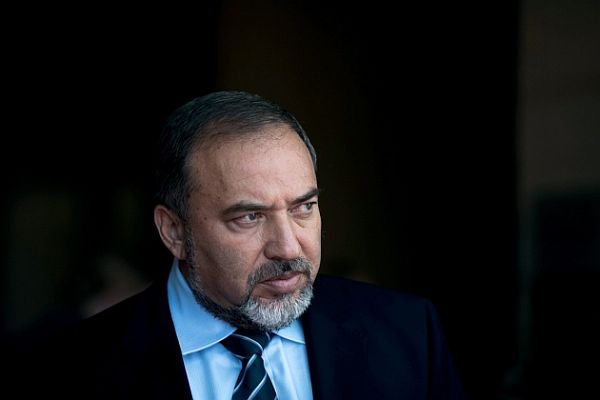
Lieberman: ‘I am the mainstream’

Newsweek refers to Avigdor Lieberman as “Israel’s most popular politician,” but then calls him its “far-right” foreign minister. He is indeed, but since he is also — in his words — “the mainstream,” it’s time the American mainstream media desist from portraying him as being on the political fringe.

Lieberman is a mainstream politician in a far-right country.

Racism has been normalized in what should now be universally recognized as a racist state — Israel cannot claim to be nor should be characterized by others as a liberal democratic state. Were it such, Lieberman could not possibly have risen this far.

Lieberman talks about his plan to strip at least 10 percent of Israelis of their citizenship:

You’re talking about drawing a line so that how many Israeli Arabs will no longer be part of Israel?

At least half.

Polls suggest that 90 percent or more of Israeli Arabs don’t want that.

You have 20 percent of the population that’s the Arab minority. You have 80 percent that’s Jewish. From 80 percent of the Jewish population, 70 percent support this idea.

So even if a resident of [the Israeli Arab town] Umm al-Fahm, for instance, doesn’t want to become part of Palestine, if a majority in the country says he has to, he has no choice?

He can continue to live in his property, his house, his land [and become a citizen of Palestine], or he can move to Israel.

Facebooktwittermail