Monthly Archives: March 2011

CIA killer gets “pardoned” in exchange for $2 million blood money

In order to make sure Hillary Clinton can enjoy cordial exchanges with her counterparts in Pakistan during her upcoming visit, CIA contractor Raymond Davis just got “pardoned” by the families of the men he killed in late January.

Dawn reports:

The US government did not pay any compensation to the families of two Pakistanis killed by Raymond Davis, US Secretary of State Hillary Clinton said on Wednesday.

She said the US did not pay to win Davis’s release, but she didn’t dispute that the men’s families were compensated.

The News reports:

The families of the murdered men, Fahim and Faizan, accepted the blood money of 2.34 million dollars (equal to Rs200 million) while, according to sources, four US visas were also part of the deal.
[…]
The counsel of the bereaved families, Manzoor Butt alleged that the families of Faizan and Fahim were forcibly brought from their homes to the court.

Lawyers for the families said they had been held on gun-point for four hours at the jail court where Davis was being tried on Wednesday, but had not been allowed to witness proceedings. They were also warned against uttering a word before the media, sources said.

Facebooktwittermail

How the West empowered Gaddafi and undermined the Arab democratic revolution

“I am very worried about #Libya. I do not want #Gaddafi to win this, and the complicity of the international community is allowing him to.” @Sandmonkey (Mahmoud Salem), Cairo, March 16.

“The fierce urgency of now” is a concept that Obama abandoned the day he got elected. The Decider got replaced with The Deliberator.

For this president, no decision has ever been so urgent that it couldn’t be mulled over for weeks or months. Meanwhile, what for Obama was empty campaign rhetoric, has for Muammer Gaddafi become his means of survival. As the US and Europe have dawdled and deliberated, the Libyan uprising has effectively been crushed.

The New York Times now reports:

With the advances made by loyalists, there is growing consensus in the Obama administration that imposing a no-flight zone over Libya would no longer make much of a difference, a senior official said. Just moving the ships and planes into place to impose an effective no-flight zone, the official said, would take until April, too late to help rebels hunkered down in Benghazi. While administration officials said the United States would not obstruct efforts by other countries to build support for a no-flight zone in the United Nations, President Obama met with his National Security Council on Tuesday to consider a variety of other options to respond to the deteriorating situation. Among those options are jamming Libyan government radio signals and financing the rebel forces with $32 billion in Libyan government and Qaddafi family funds frozen by the United States. That money could be used either for weapons or relief. The meeting broke without a decision, the official said.

“This is another indication of the constant exploration of different options that we have to increase the pressure on the Qaddafi regime as we go forward,” the White House press secretary, Jay Carney, said Tuesday.

But in fact, the administration’s options have narrowed with the dwindling viability of a no-flight zone. The White House is considering more aggressive airstrikes, which would make targets of Colonel Qaddafi’s tanks and heavy artillery — an option sometimes referred to as a “no-drive zone.” The United States or its allies could also send military personnel to advise and train the rebels, an official said.

But given the lack of consensus behind a no-flight zone, these options are viewed as even less likely.

Simon Tisdall writes:

Disagreement between European countries over Libya has moved from the merely embarrassing to the wholly humiliating, after Germany again blocked Anglo-French no-fly zone proposals at a G8 meeting in Paris. The EU’s Libya debacle is now the foreign policy equivalent of last year’s eurozone meltdown, and similarly damaging to its global credibility and influence. Once again, Europe is being forced to confront an unpalatable truth: unless the US takes the lead, nothing gets done. Europe has not been entirely passive in the face of Muammar Gaddafi’s accelerating counter-attack on rebel forces. The EU has imposed sanctions, frozen the assets of leading figures and backed an arms embargo. It has also loudly proclaimed that Gaddafi must go. But these measures have made no appreciable difference on the ground.

On the question of military intervention, there are almost as many opinions as there are EU members. Britain and France are the most outspoken advocates of a no-fly zone. Germany has been the most vocal opponent. Italy – Libya’s former colonial power – havers and trims like a Berlusconi defence lawyer. Last week’s EU summit refused to back a no-fly zone. So did Nato. Today’s G8 communique does not even mention it.

Alain Juppé, France’s foreign minister, suggested Europe had left it too late to stop Gaddafi winning. “If we had used military force last week to neutralise some airstrips and the several dozen planes that they have, perhaps the reversal taking place to the detriment of the opposition wouldn’t have happened,” Juppé told Europe-1 radio. “But that’s the past. What is happening today shows us that we may have let slip by a chance.”

With outright victory now close at hand, Saif al-Islam Gaddafi, in an interview on Euronews, said that a UN decision on a no-fly zone would be of no consequence: “Military operations are over. Within 48 hours everything will be finished. Our forces are almost in Benghazi. Whatever the decision, it will be too late.”

Since France was the first country to recognize the Transitional National Council in Benghazi, he was asked his opinion of the French president, Nicolas Sarkozy:

Sarkozy must first give back the money he took from Libya to finance his electoral campaign. We funded it and we have all the details and are ready to reveal everything. The first thing we want this clown to do is to give the money back to the Libyan people. He was given assistance so that he could help them. But he’s disappointed us: give us back our money. We have all the bank details and documents for the transfer operations and we will make everything public soon.

Al Jazeera reports:

Members of the European Parliament have blasted the European Union for a weak response to the crisis.

Guy Verhofstadt, a former Belgian prime minister, said, to repeated rounds of applause: “This makes me sick!”

In Libya we can change the course of events. There are thousands of heroes. We know who they are but Gaddafi knows as well. He knows their names and their families. If he takes Benghazi it will be nothing more than a massacre, a new Srbrenica, a new Rwanda, a new Darfur.

This makes me sick of the EU. We have learnt nothing at all of history. When Gaddafi is back shall we say business as usual? Are we going to close our eyes again? Will we add one black page more to European history?

Rebecca Harms, a German MEP, said the EU was “refusing to line up on the right side, on the side of the just, and the Arab world will not forget or pardon this weakness from Europe”.

One piece of commentary effectively sums up the Obama administration’s role in what is becoming a disaster for the people of Libya:

New administrations anticipate foreign policy as if it will be baseball or football—a complicated team sport, bound by rules, at which they will succeed by dint of individual skill, clever plays and their all-knowing coach. They suit up, only to discover that their sport will be rafting on a uncharted river in full flood, filled with rocks and whirlpools, through which the frantic crew paddles in opposite directions.

Thus too the Obama administration. It came into office planning resets, nuclear zeroes and Israeli-Palestinian peace. It finds itself instead coping with a vast revolution of politics, society and thought in the Arab world—unforeseen and unforeseeable, fraught with opportunity and danger.

For the moment, the administration has survived several rapids—ditching Egypt’s President Hosni Mubarak in some confusion and with embarrassing but not indecent haste; nudging the ruler of Bahrain into reform without quite pitching him overboard; and, thus far, avoiding a complete capsizing of the boat in Yemen.

But with regard to Libya it has made mistakes that could haunt this country for years to come. The administration prides itself on the president’s unhurried deliberation, his reluctance to act before considering all the angles, his strategic silences and extended consultations. But steer a raft on a wild river that way, and you end up in the water.

From the outset there were three possible outcomes in Libya: Moammar Gadhafi could go quickly, he could go slowly, or he could stay. The best chance of helping him go quickly would have been an unambiguous declaration of intent to see him off, and the willingness to lead a military effort—most likely a no-fly zone—to help Libyan rebels overthrow his regime.

There was momentum a few weeks ago as one town after another fell to enemies of the regime. A stream of defections, betrayals and surrenders seemed to spell Gadhafi’s doom. The time to intervene is when a small push can have the greatest psychological effect, even if military planners would prefer to do it only after orchestrating a three-week air-defense suppression campaign.

Instead of seizing the opportunity, the administration made cumulative mistakes. It was slow in insisting that Gadhafi had to go—but is now committed to that end, exposing itself to humiliation if he does not. It allowed the Pentagon to publicly disparage military measures, reassuring Gadhafi and dispiriting the rebels, when a discreet and menacing silence would have done far less harm. It called for an international effort when the lesson of decades is that NATO and the United Nations find it impossible to act without American leadership. And when the French government showed strategic initiative and pluck, it undercut a major ally.

The moment has passed. The only question now is whether Gadhafi goes slowly, over months, or not at all. Senior American intelligence officials inconveniently observed the other day in front of Congress that the latter seems the likely outcome. What will happen if they are right?

The administration will have put itself in the position of willing the ends, but not the means—a humiliating position for a great power. Gadhafi will need to recover access to European resources to rebuild his oil industry and regain access to his country’s plundered wealth. He can do that in any of a number of ways. He could threaten to open up the spigot of massive African emigration through Libya, to resume work on weapons of mass destruction, or to sponsor terror—all of which he has done in the past. A divided Europe, which includes a timorous Germany and an Italy preoccupied with the prime minister’s bunga bunga parties, will yield.

The administration is teaching dictators, and the populations they oppress, that you can get away with large-scale mayhem if you avoid YouTube. Instead, let the hard men do their work with assault rifles in alleys and soldering irons in lonely cellars. The thuggish leaders will be emboldened, the populations either despairing or desperate. If one hopes to aid the Arab awakening in the direction of more open and just societies, rather than to empower Islamist terror, this policy is perverse. And, finally, the U. S. has provided cover and reassurance for other unsavory actors—a deafening silence, for example, as Iran arrests leaders of the opposition.

This is a disaster for the people of Libya. It is a moral and political calamity for a generation of Western leaders whose reactions to Rwanda and Srebrenica consisted of ineffectual squeaks of dismay. It may deflect the Arab awakening into directions that will horrify us. And it says dangerous things about American foreign policy. Unless it is reversed, the administration’s Libya policy will convince the world that the U.S. is a feeble friend and an ineffectual foe, paralyzed by its own ambivalence.

That this analysis would come from, Elliot Cohen — a neoconservative proponent of military intervention — is hardly surprising. But to those who have warned about the dire implications of Western involvement in a no-fly zone, I would simply ask: who has been well-served by the West’s non-involvement in what will soon be declared a failed revolution?

Facebooktwittermail

Libyan uprising close to collapse as Gaddafi’s troops near Benghazi

The Guardian reports:

Muammar Gaddafi’s effort to defeat the rebels before international support can come seems to be paying off, with the uprising close to collapse as the US ended weeks of stalling to join Britain and France in supporting a United Nations resolution to impose a no-fly zone over Libya.

A vote is expected this week, but is likely to come too late to support the rebellion. Gaddafi’s troops, backed by air power, moved into the town of Ajdabiya, clearing the way to the rebel stronghold of Benghazi, 90 miles away. Residents of the city were fleeing towards the border with Egypt.

Washington is facing accusations, particularly from the rebels, that delay had given the Libyan leader the space he needed. “They have betrayed us,” Ahmed Malen, one of the revolutionary volunteers pasting anti-Gaddafi posters on walls in Benghazi. “If they kill us all, the west will have blood on its hands. They do not believe in freedom. They are cowards.”

President Barack Obama will face criticism from Democrats as well as Republicans if the rebellion collapses.

France’s foreign minister, Alain Juppé, admitted that a no-fly zone might now be too late. “If we had used military force last week to neutralise some airstrips and the several dozen planes that they have, perhaps the reversal taking place to the detriment of the opposition wouldn’t have happened,” Juppé told Europe-1 radio.

The Obama administration, already fighting two wars, was reluctant to join a third and challenged the value of a no-fly zone. But, after the Arab League countries met and agreed a request on Saturday for a no-fly zone, the US along with Britain, France and Lebanon supported a draft UN resolution to be presented to the UN security council.

Although victory by Gaddafi would make a no-fly zone redundant, the draft resolution also includes measures that would remain in some degree relevant, mainly expanding sanctions, such as stricter enforcement of the arms embargo, freezing the assets of more members of the Gaddafi regime and extending a travel ban, and ordering countries to stop mercenaries flying from their airports to Libya.

A security council source, noting Gaddafi’s advances, said: “Time is of the essence.” But he acknowledged that the security council was slow moving and that while a vote could be held this week, it could spill over into next week. “The negotiations will be tough,” he added.

France’s UN ambassador, Gerard Araud, told reporters: “We are deeply distressed by the fact that things are worsening on the ground, that the Gaddafi forces are moving forward and the council has not yet reacted.”

The US shift comes after securing a promise that Arab countries would contribute forces to policing the no-fly zone. Countries such as Saudi Arabia, the United Arab Emirates and Jordan would be asked to provide planes. Washington is worried that a purely western force would be counter-productive, alienating Arab opinion and damaging the changes elsewhere in the Arab world.

But the rate of advance by Gaddafi may make a no-fly zone academic. The street-by-street fighting promised by rebel’s military leader, Abdel Fattah Younis, failed to materialise. Younis was Gaddafi’s interior minister until recently and now has a $4m (£2.48m) bounty on his head.

In an interview with the Italian newspaper Il Giornale, he derided international discussionof a no-fly zone. The Libyan leader told the rebels: “There are only two possibilities: surrender or run away.”

Gaddafi’s seizure of the coastal road at Ajdabiya opens the way not only to Benghazi but to Tobruk and control of Libya’s border with Egypt. The coastal road divides at Ajdabiya, offering Gaddafi’s forces the opportunity to bypass Benghazi to seize towns to the east and then besiege the rebels’ de facto capital from both sides.

Akram Ramadan, a British-born Libyan broadcaster who returned to the UK from Bengazhi this week, said: “Everything is already too late. Whatever they decide, it is a month too late. Libyans are disappointed with the response of the west.”

Facebooktwittermail

Smile sweetly and say peace for the cameras — and bring in the big guns

Tahiyya Lulu writes:

The international community is taking weeks to decide whether to impose a no-fly zone over Libya. Meanwhile, in the eerie quiet of a Bahraini afternoon a deployment of 1,000 soldiers from the Saudi Arabia who are part of the Pensinsula Shield Force entered the country.
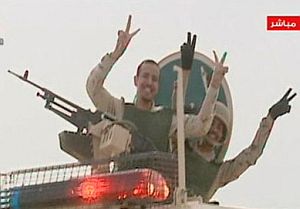
Bahrain TV proudly aired clips showing cheering Saudi soldiers in their tanks and armoured personnel carriers as they rolled across the 16-mile causeway between the two countries. Tellingly, a man at the parapet of a tank sits behind his machine gun waving a peace sign at the camera. This is a snapshot of the regime’s current strategy, smile sweetly and say peace for the cameras – and bring in the big guns.

While pro-government commentators allege Iranian support of the current uprising, US defence secretary Robert Gates, who visited Bahrain on March 12, said there is no evidence of interference from Tehran. Unsurprisingly though, the White House issued a statement on Monday saying it does not consider the entry of Saudi troops on to Bahraini land an invasion.

Since the beginning of this uprising – which calls for constitutional reform, an investigation into theft of public land worth billions of dollars, and an end to systematic discrimination, among other things – the regime has implemented a soft-talk big-stick strategy. Its security personnel killed two protesters, and the king appeared on national television to speak of his regret, promising an independent investigation to hold those responsible accountable. Two days later, government security personnel stormed the encampment of protesters at the now-famous Pearl roundabout, killing four more. Later the same day, the crown prince appeared on TV urging calm, while the Bahraini army opened fire on unarmed demonstrators, killing another two.

The government then said it was open to dialogue with protesters (who are understandably sceptical). Distrust of the government emerges from a history of state oppression and reneged promises much longer than this long month of protest in Bahrain.

Our mothers and fathers, teachers, lawyers, activists and unionists were among the people of Bahrain who expressed their social and political grievances and desires for change in 1954, 1965, 1972, 1994, and 2002. The response of the government has always been the same: unleashing violence against calls for meaningful change, exaggerating the superficial self-imposed changes which include little concession towards sharing of power, and turning to its powerful friends for backing.

Associated Press reports:

Frenzied clashes swept Bahrain Tuesday, a day after a Saudi-led military force entered the country to defend its Sunni monarchy from a Shiite-led protest movement. Hundreds of demonstrators were injured by shotgun blasts and clubs, a doctor said.

As the government’s crackdown intensified, the Bahraini king declared a three-month state of emergency Tuesday that gave his military chief wide authority to battle protesters demanding political reforms and equal rights for Shiites. One demonstrator was shot in the head and killed, and a Saudi official said one of his country’s soldiers was shot dead by a protester.

The force of more than 1,000 Saudi-led troops from several Gulf nations saw its first day of action to help prop up the U.S.-backed regime in Bahrain. Its intervention was the first major cross-border military action to challenge one of the revolts sweeping across the Arab world.

Not surprisingly, the claim by the Saudi official cited in the AP report turned out to be false.

Reuters reports:

A member of Bahrain’s security forces was killed on Tuesday in clashes with thousands of protesters, state television and the information ministry said, denying earlier reports that a Saudi policeman had also died.

“A member of the security forces passed away in Maameer this evening when he was deliberately run over by one of the rioters,” Bahrain’s Ministry of Information said.

And maybe the story will change yet again and we’ll learn that the vehicle involved was one of the security services’ own.

Yesterday, Amnesty accused the government of using excessive force:

Amnesty International has called on the Bahrain authorities to hold security forces accountable over the use of excessive force after police fired rubber bullets at close range at demonstrators in the capital Manama.

Hundreds of protesters are reported to have been injured over the weekend. On Friday, anti-government protesters sought to march to the royal palace in Riffa but were blocked by security forces and armed government supporters.

On Sunday, police used batons and fired tear gas and rubber bullets at protesters who sought to block Manama’s financial district and demonstrated at Bahrain University.

The disturbances were the first major violence since Crown Prince Salman bin Hamad al-Khalifa ordered the military off the streets nearly three weeks ago.

“This further resort to excessive force by Bahrain’s security forces is alarming and unacceptable,” said Malcolm Smart, Amnesty International’s Director for the Middle East and North Africa. “The government must now rein in its forces. Those responsible for attacking peaceful protestors and using excessive force must be held to account.”

Meanwhile, the Committee to Protect Journalists reported that Bahraini security forces and plainclothes officers are obstructing news coverage of ongoing political unrest by attacking journalists.

Facebooktwittermail

The fight for Libya

The Guardian reports:

Libya’s revolutionary leadership is pressing western powers to assassinate Muammar Gaddafi and launch military strikes against his forces to protect rebel-held cities from the threat of bloody assault.

Mustafa Gheriani, spokesman for the revolutionary national council in its stronghold of Benghazi, said the appeal was to be made by a delegation meeting the French president, Nicolas Sarkozy, and the US secretary of state, Hillary Clinton, in Paris on Monday, as G8 foreign ministers gathered there to consider whether to back French and British calls for a no-fly zone over Libya.

“We are telling the west we want a no-fly zone, we want tactical strikes against those tanks and rockets that are being used against us and we want a strike against Gaddafi’s compound,” said Gheriani. “This is the message from our delegation in Europe.”

Asked if that meant that the revolutionary council wanted the west to assassinate Gaddafi, Gheriani replied: “Why not? If he dies, nobody will shed a tear.”

But with diplomatic wrangling focused on the issue of the no-fly zone, there appeared to be little immediate prospect of a foreign military assault on Gaddafi’s forces, let alone an air strike against the Libyan dictator.

Christian Science Monitor reports:

On Libya’s eastern front, taking towns may be easy for Col. Muammar Qaddafi – but holding them is something else again.

After days of being pounded by rocket fire and bombing runs from forces loyal to Qaddafi, Libya’s rebel army piled into their pickup trucks yesterday afternoon and cut a ragged retreat from the oil town of Brega to Ajdabiya, 40 miles to the east. They left mounds of ammunition and supplies behind them as they fled, Qaddafi’s fighters surging behind.

That was all according to plan, says Mohammed el-Majbouli.

“We drew [Qaddafi’s forces] forward, and then we maneuvered behind them and trapped them,” says Mr. Majbouli, a former member of Qaddafi’s special forces who is now organizing rebel fighters.

He says a reserve force of rebels with military training had been hidden in homes in the eastern third of the sprawling petrochemical complex at Brega. After the Qaddafi men passed at about 8 p.m. last night, the rebels came out, retaking the town as well as about 20 prisoners from Qaddafi’s forces.

Majbouli’s claim of victory, which is also made by senior officers who have defected to the rebel cause, could not be independently confirmed. But if he is right, it would be the fourth time Brega has changed hands in less than two weeks, emphasizing the strange, shimmering nature of the conflict being fought in Libya’s coastal desert.

While it remains easy for Qaddafi to rain mortars and rockets on rebel checkpoints, he doesn’t appear to have more than a few thousand men, at most, committed to his eastward advance. Without indiscriminate fire on the cities of Ajdabiya or Benghazi – just the sort of act that might galvanize the international community into action, which Qaddafi is likely keen to avoid – it’s hard to see his forces advancing quickly much farther east.

On Saturday, The Guardian reported:

Muammar Gaddafi’s army won control of a strategic rebel-held Libyan town and laid siege to another as the revolutionary administration in Benghazi again appealed for foreign military help to prevent what it said would be the deaths of hundreds of thousands of people if the insurgents were to lose.

The rebels admitted retreating from the oil town of Ras Lanuf – captured a week ago – after two days of intense fighting and that the nearby town of Brega was now threatened.

The revolutionary army, in large part made up of inexperienced young volunteers, has been forced back by a sustained artillery, tank and air bombardment about 20 miles along the road to the rebel capital of Benghazi.

The head of Libya’s revolutionary council, Mustafa Abdel Jalil, claimed that if Gaddafi’s forces were to reach the country’s second-largest city it would result in “the death of half a million” people.

Robin Yassin-Kassab writes:

In 2003 America and Britain invaded Iraq without a United Nations mandate. Today NATO is emphasising that it won’t move without both a UN resolution and substantial political support from the Arabs. The Arab League has now called for a no-fly zone.

At the League meeting Omani foreign minister Yusuf bin Alawi warned that if the Arabs didn’t take a strong stance they would open the door to unwanted foreign interference. This may seem contradictory: at the same time he asked the UN to intervene. But his point is a good one. If NATO forces act under a UN resolution and responding to an Arab request, the Arabs will be well-placed to end the intervention at the right moment.

I understand the worries of those who fear Western intervention, after all the West’s crimes against the Arab world. I wish the Arabs were capable of moving by themselves (and I certainly hope that once the revolutions have run their course we will finally see an independent Arab world taking care of internal Arab problems). I like Asa’ad Abu Khalil’s idea of using Egypt and Tunisa as staging posts for volunteer Arab soldiers who wish to aid their brothers in Libya.

It’s a difficult, cloudy situation. The only clear thing is that the Libyans need immediate help. The Transitional National Council’s warning that half a million will be killed is not mere rhetoric, but an entirely logical and legitimate fear.

Ahram Online reports:

Thousands of Libyans march down the Corniche in Benghazi, chanting, “Free Libya,” “Revolutionaries,” “Beasts,” and other slogans. It is part of their military training. They are all volunteers, who chose to become fighters and join the rebel forces in areas like Ras Lanuf, Brega and Zawiyah , which are experiencing heavy air strikes by Gaddafi’s forces.
Among those is Ahmed, 25 years old, an Egyptian who has worked in construction in Libya for the past four years. In spite of his family’s pleas, he refuses to leave Libya. “I came to Libya and it was prosperous, I will leave it as prosperous as it was. I will stay here and fight with my friends until Libya is free, just like Egypt is free now,” said Ahmed who looked pale, but seemed very confident of victory and liberation.

Ahmed is one of many Egyptians who decided to stay and join the Libyan revolution. The volunteers are from both genders and all ages. Nada, 18, is a student who was born to an Egyptian mother and a Libyan father. She was born in Alexandria, but moved to Benghazi at the age of eight and has been living there ever since. She still visits Egypt every year.

“I love Egypt, it’s my second home, but I love Libya too, and I am going to stay and fight where I am needed,” said Nada passionately. Nada wears her hair short and she looks very practical in her suit and yellow shirt, which signifies that she is one of the organizers of the anti-Gaddafi sit-in. She joined the sit-in on February 18, along with her mother, another supervisor.

The Independent reports:

Four men have been arrested for the murder of an Al Jazeera journalist and evidence has emerged that Muammar Gaddafi’s regime is sending undercover squads to carry out a campaign of assassinations, rebel officials claimed yesterday.

The Independent was told that four men were caught in the city of Ajdabiya with evidence linking them to the death of Ali Hassaon Al Jaber, who was killed near Benghazi on Saturday. Under questioning, the suspects allegedly confessed they had been ordered to silence opposition figures and drive out international presence from territories of the protest movement.

Facebooktwittermail

The Arab spring is brighter than ever

Brian Whitaker writes:

“The Arab world’s much-heralded collective push toward democracy is now in jeopardy,” an article for McClatchy newspapers in the US informed its readers at the weekend.

The fact that autocratic regimes in Libya, Bahrain and Yemen are fighting back with lethal force should surprise no one. The more surprising thing is that Zine al-Abidine Ben Ali in Tunisia and Hosni Mubarak in Egypt – two leaders previously regarded as firmly entrenched – were toppled after such a short struggle.

Nor does the fightback mean, as the article’s headline suggests, that the outlook for democracy is dimming across much of the Middle East. Looking at the region as a whole, the prospects have never been brighter.

But there is another – far bigger – problem with this revolution-in-jeopardy analysis. By focusing on “democracy” and the ousting of dictators, it ignores a large part of what the Arab revolt is about. It’s the same mistake that George Bush made with his calls for democracy and “regime change” in the Middle East – calls that were directed mainly against the regimes deemed hostile towards the US and paid little attention to the desires of ordinary Arabs.

Arabs don’t talk much about democracy as such, and they tend to be cynical about elections. They do talk increasingly about “freedom”, though what they mean by it is not quite what Bush meant. They want freedom from corruption and political cronyism, and the freedom to make their own choices – an end to repression and government attempts to control the minutiae of people’s lives.

Democracy may be one way of working towards that but it is rarely seen as a goal in itself, and while regime change is certainly an important part of the revolt, its younger activists (at least) have their eyes set on changing whole systems, not just the political leaders.

Facebooktwittermail

Why Palestinians will protest on March 15

Rawan Abu-Shahla writes:

We are a group of Palestinian youths who have come together for the sole purpose of leaving behind our political identities and affiliations, and deciding to put our best interests above all else, united under our Palestinian flag. We have called for peaceful demonstrations on Tuesday, 15 March across the Palestinian nation — in the Gaza Strip and West Bank, the territories of 1948 and the Palestinian diaspora, calling out together one slogan: “The people want to end the division!”

We call for peaceful actions in support of unity in the Palestinian political scene under one banner, the Palestine Liberation Organization (PLO).

Division in the Palestinian body politic has affected every aspect of our lives: socially, economically, educationally and intellectually. It is ordinary Palestinians who have paid the price of the four-year long division that serves no one but the Israeli occupier.

Our campaign to end the division started out as a thought which stirred discussion, and some youths decided to give it a try and did everything possible to make this initiative happen. Day after day, the idea grew and became a plan and then a public decision to not be silenced anymore, not to be terrorized or oppressed and most importantly, not to be ignored and forgotten anymore. That is how we came to our decision to demonstrate on 15 March, state the public’s refusal of the status quo and the practices of the political “leadership.”

Facebooktwittermail

Europeans are losing their illusions about Israel

Daud Abdullah writes:

In Europe, Israel has historically enjoyed a high level of support, not least because it was perceived as a progressive democracy in a sea of Arab backwardness. At the same time, most Europeans knew very little about the Israel-Palestine conflict: as recently as 2004, the Glasgow University Media Group found that only 9% of British students knew that the Israelis were the illegal occupiers of Palestinian land. Astonishingly, there were actually more people (11%) who believed that the Palestinians were occupying the territories.

However, according to a new poll by ICM for the Middle East Monitor, Europeans’ perception of Israel has changed decisively, and their understanding of the Israel-Palestine conflict, while still giving some cause for concern, has improved significantly. The survey of 7,000 people in Germany, France, Spain, Italy, the Netherlands and Britain reveals only a small minority (10%) now believe their countries should support Israel rather than the Palestinians, while many more, 39%, think they should not.

Facebooktwittermail

The Saudi intervention in Bahrain is a slap in the face of the US

Jean-François Seznec writes:

On Saturday, March 12, U.S. Defense Secretary Robert Gates visited Bahrain, where he called for real reforms to the country’s political system and criticized “baby steps,” which he said would be insufficient to defuse the crisis. The Saudis were called in within a few hours of Gates’s departure, however, showing their disdain for his efforts to reach a negotiated solution. By acting so soon after Gates’s visit, Saudi Arabia has made the United States look at best irrelevant to events in Bahrain, and from the Shiite opposition’s point of view, even complicit in the Saudi military intervention.

The number of foreign troop is so far very small and should not make one iota of difference in Bahrain’s balance of power. The Bahraini military already total 30,000 troops, all of whom are Sunnis. They are under control of Crown Prince Salman bin Hamad al-Khalifa and supposedly fully faithful to King Hamad bin Isa al-Khalifa. Bahrain also has a similar number of police and general security forces, mainly mercenaries from Baluchistan, Yemen, and Syria, reputed to be controlled by the prime minister and his followers in the family.

At this time, therefore, the Saudi intervention is largely a symbolic maneuver. It is so far not an effort to quell the unrest, but intended to scare the more extreme Shiite groups into allowing negotiations to go forward. The crown prince recently laid out six main issues to be discussed in talks, including the establishment of an elected parliament empowered to affect government policy, fairly demarcated electoral constituencies, steps to combat financial and administrative corruption, and moves to limit sectarian polarization. He notably failed to mention one of the opposition’s primary demands — the prime minister’s resignation.

The Saudi move, however, risks backfiring. It is extremely unlikely that the Saudi troops’ presence will entice moderate Shiite and Sunni opposition figures to come to the table — the intervention will force them to harden their position for fear of being seen as Saudi stooges. The demands of the more extreme groups, such as the Shiite al-Haq party, are also likely to increase prior to negotiations. These elements, having seen job opportunities go to foreign workers and political power dominated by the ruling family for decades, have grown steadily disenchanted with prospects of talks.

The crown prince is well aware that the Saudi intervention only makes a negotiated solution to this crisis more challenging, so it is difficult to imagine that he invited the Saudis into Bahrain. The more liberal Khalifas, such as the crown prince, know very well that the only way out of the crisis is to obtain the resignation of the prime minister and some of the more extreme Sunni ministers.

However, the prime minister — with whom Gates did not meet with during his weekend visit — does not appear to have any intention of resigning and is the most likely figure behind the invitation to the Saudis to intervene. Although details are still sketchy, he is likely joining with the Saudi king to pass the message to the United States that he is in charge and no one can tell him what to do. Furthermore, it signals that the Saudis agree with Bahrain’s conservatives that the Shiite must be reined in rather than negotiated with, even at the cost of telling the United States to kiss off.

The Saudi intervention may also have been precipitated by the deepening rift between the extreme Sunni elements and the liberal Khalifas. If the Saudis are indeed heading to Riffa, it is possible they are tasked with defending the Khalifa stronghold not so much against the Shiite rabble but against the Bahraini military, which is under the command of the crown prince. The Saudi intervention would therefore be an effort by the prime minister and the Saudis to pressure the crown prince into not giving in to the protesters’ demands and to fall in line with their plans to secure Bahrain as the personal fiefdom of the Khalifas and their tribal allies.

Facebooktwittermail

Saudis move troops into Bahrain to crush pro-democracy movement

CNN opts for the anodyne and official phrasing “Gulf Cooperation Council security forces,” but the troops who just marched into Bahrain are Saudis.

When US Defense Secretary Gates visited Bahrain on Friday, I assume King Hamad bin Issa al-Khalifah gave the US advance warning that his Kingdom would shortly be under something resembling Saudi martial law — just to make sure Washington would voice no more than minimal objections to the latest effort to crush Bahrain’s strengthening democracy movement.

The New York Times reports:

The White House issued a statement on Sunday that said the United States strongly condemned violence that had occurred in Bahrain and Yemen, and added, “We urge the government of Bahrain to pursue a peaceful and meaningful dialogue with the opposition rather than resorting to the use of force.”

And as the Khalifa family and their Saudi overlords ignore this request, what will the White House do? Withdraw the US Fifth Fleet? Not likely!

The Bahrain Youth Society for Human Rights describes the Saudi military presence as “an overt occupation of the kingdom of Bahrain and a conspiracy against the unarmed people of Bahrain.” Even while the White House urges the Bahrain government to engage the opposition in dialogue, no doubt Washington will dismiss the suggestion that Bahrain is now under occupation.

Given that Bahrainis already face brutality from security services — the majority of whom are foreign — I don’t know whether they will find the Saudi presence any more intimidating.

To have an idea of what protesters have been up against in recent days, just watch this video showing an unarmed man being hit by tear gas cannisters shot at point blank range:

GCC and now Arab League support for a no-fly zone over Libya (which they most likely expect will not be imposed), has I suspect, less to do with any concern about the fate of Libya’s revolutionaries than it does in fostering a permissive climate in which the Gulf states’ autocratic rulers can offer each other mutual support in their own efforts to counter the political demands coming from their own subjects. Support for a NFZ provides these monarchies with an opportunity to posture as defenders of Arab freedom at the same time that they suppress Arab freedom. Likewise, by opposing Gaddafi, the Gulf rulers want to cast their dictatorships as benign in contrast to Gaddafi’s brutal rule.

Facebooktwittermail

The fight for Libya

Samia Nakhoul reports:

By the time the outside world agrees on a response to Libyan leader Muammar Gaddafi’s bloody onslaught against a popular revolt, it could all be over.

The advance of Gaddafi’s better-armed forces, who seem to have shown little regard for civilians when storming in to retake rebel strongholds, has outrun the slow pace of hesitant initiatives being discussed by European, U.S. and Arab leaders.

An Arab League call for the United Nations to impose a no-fly zone to protect the revolt, was welcomed by France, which has taken a lead in backing the rebels and will host G8 foreign ministers in Paris Monday.

But others, notably the United States and other European Union states such as Germany, remain very cautious about military engagement. No U.N. Security Council meeting had yet been scheduled, despite events racing in Libya.

“The international community is dragging its feet,” said Saad Djebbar, a London lawyer and expert on Libyan affairs. “The diplomatic pace is very slow. There is an urgency to act quickly before those people are finished off by Gaddafi’s forces.”

“The international community has to act now — not only to protect Benghazi from an onslaught but because of what it means for the rest of the world if Gaddafi is allowed to remain the leader of Libya,” said Geoff Porter, a U.S.-based political risk consultant who specializes in North Africa.

After the relatively peaceful and speedy overthrow of Arab strongmen in Egypt and Tunisia, Western disarray on Libya may persuade other authoritarian rulers facing unrest, from Yemen to Bahrain, that the best antidote to revolt is violence.

“If they allow Gaddafi to win, that would encourage other Arab despotic regimes to use brutal force against their people to stamp out revolt,” Djebbar said. “This will erase the gains of the people power we have seen in Egypt and Tunis.

“It sends a very bad signal to other movements.”

Reuters reports:

Muammar Gaddafi’s troops seized the strategic Libyan oil town of Brega on Sunday, forcing rebels to retreat eastward and putting extra pressure on world powers still deliberating on a no-fly zone.

The government offensive had already driven the rebels out of Ras Lanuf, another oil terminal 100 km to the west on the coast road, and the seizure of Brega and its refinery deprived the rebels of more territory and yet another source of fuel.

The government, in a message on state television, said it was certain of victory and threatened to “bury” the rebels, who it linked to al Qaeda and “foreign security services.”

Riad Kahwaji writes:

Some Arab defense experts believe it is time for the Arab States to stand up and take responsibilities in their own hands and come to the aid of the Libyans. Retired Major General Khaled Al-Bu Ainnain, former commander of the United Arab Emirates Air Force and Air Defense, believes that some GCC states and Egypt can mount a joint operation and successfully enforce an NFZ over Libya. “The UAE Air Force can deploy couple of squadrons – one F-16 Block 60 and another Mirage 2000-9 – the Saudi Air Force can deploy a couple of F-15S squadrons and Egypt a couple of F-16 squadrons out of Mersi Matrouh Air Base in western Egypt,” Al-Bu Ainnain said. “This would provide 120 fighters and attack aircrafts that would be backed with airborne early warning planes like Egyptian E-2C Hawkeye or Saudi AWACS, some unmanned aerial vehicles (UAV) for reconnaissance, and air-refueling tankers from Saudi Arabia and couple of Egyptian or UAE helicopter squadrons comp osed of Apache Longbow gunships, Blackhawks and Chinook helicopters, for search and rescue missions.” Crews and troops needed for the operation could be quickly airlifted to western Egypt, and even Algeria, within hours using a large fleet of UAE and Egyptian C-130 and Qatari C-17 transporters.

Observers believe the area of operations for any force executing an NFZ over Libya now would be confined to the area between the capital Tripoli and the City of Cert and down south to Sebha in the center. The rest of the country is under rebel control. The Libyan Air Force is comprised of aging Cold War-era Soviet supplied fighters like Su-22, MiG-21 and MiG-23 and one remaining operational Mirage F-1 and some 30 MiMi-24 Helicopter gunships. According to reports out of Libya, only few Su-22 and MiG-23 aircrafts were seen involved in the air raids in addition to MiMi-24 gunships. As for Air Defense, Gadhafi’s forces are believed to be in possession of a few batteries of Soviet-era SAM-2, SAM-3 and SAM-6 surface to air missiles. “All of the Libyan Air Defense SAM’s and radars can be taken out swiftly by the arsenal of smart weapons and cruise missiles in possession today by GCC and Egyptian Air Forces,” Al-Bu Ainnain said. “Runways can be destr oyed with bunker-busters to ground all the jets, and the gunships can be easily destroyed on the ground.” He pointed out that GCC and Egyptian Air Forces have considerably enhanced their joint-operations capabilities as a result of almost annual exercises they have done together along with the U.S. and some EU countries. “Issues related to command and control and interoperability would be resolved quickly which would ensure a smooth running of NFZ operations.”

The Washington Post reports:

Defense Secretary Robert M. Gates said Saturday that the U.S. military, already fighting two wars in Muslim nations, would have no trouble enforcing a no-fly zone over Libya if President Obama orders one.

The comments appeared designed to counter the criticism surrounding his earlier remarks on the issue and came as the Arab League endorsed a no-fly zone to protect Libya’s civilians from forces loyal to Libyan leader Moammar Gaddafi.

Gates indicated earlier this month that the creation of a no-fly zone would be a “big operation.” NATO would need to deploy an array of air power to target not only defense systems and fighter jets, but also the low-flying attack helicopters that Gaddafi has used against rebels and civilian protesters.

The assessment drew criticism, in particular, from those who favor a more aggressive American response to the Libyan conflict, now tilting back in favor of Gaddafi’s better-armed forces. Some accused Gates of inflating the dangers and scope of a no-fly zone mission over a large desert country with a small population.

Facebooktwittermail

Obama’s regime of secrecy

Mark Benjamin reports:

It shouldn’t be much of a surprise that State Department spokesman P.J. Crowley has resigned his post in wake of his too-candid assessment of the incarceration conditions of suspected Wikileaker Private First Class Bradley Manning.

Last Thursday, Crowley told a panel at MIT that the Pentagon’s treatment of Manning at the Marine bring at Quantico, Va., was “ridiculous and counterproductive and stupid.”

The very next day, President Obama told reporters that he felt Manning’s confinement conditions were “appropriate.” His answer telegraphed a problem for Crowley. “I’ve actually asked the Pentagon whether or not the procedures that have been taken in terms of his confinement are appropriate and are meeting our basic standards,” Obama said, suggesting some of those procedures were to protect Manning’s safety. “They have assured me that they are.”

Manning is currently being held alone in his cell 23 hours a day, and was reportedly being stripped naked at night before being given a tear-proof smock for sleeping. Free speech advocates are shocked, and, as I wrote last week on TIME.com, concerned over Obama’s record as the most aggressive prosecutor of suspected government leakers in U.S. history.

Those advocates have wondered whether the penchant for secrecy in the Obama administration comes from the President, or those around him. Obama’s statement on Manning, followed by Crowley’s resignation, seem to suggest some of this comes from the President himself.

Facebooktwittermail

The new Israeli Left

Joseph Dana and Noam Sheizaf write:

As the controversial 443 highway, which connects Tel Aviv with Jerusalem by passing through the West Bank, begins to curve toward Israel’s capital, the eye is inevitably drawn to an imposing gray structure with massive concrete walls, part of the Ofer Military Prison. Commuters are barely aware of what takes place behind those walls, and that’s no accident—the Ofer compound, comprising a military court, detention center and prison, is just one of many black holes that enable Israelis to go on with their daily lives, unaware of the everyday realities of the occupation.

Inside, a man in shackles enters the courtroom. He is wearing a brown prison suit, and his exhausted eyes exchange glances with his wife. The two haven’t met outside the courtroom in more than a year, and for some reason the prison guards are frantically moving the wife so she doesn’t sit too close to her husband, who is officially a “security risk.” Soon the military judge, outfitted in a light green Israel Defense Forces (IDF) uniform and an army beret, enters the room and begins the proceedings.
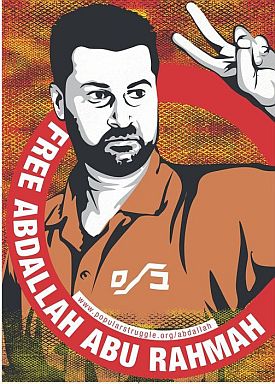
This trial could be any one of the thousands that have taken place at Ofer. Israeli military justice is swift and unflinching: according to the Israeli human rights organization Yesh Din, the conviction rate at Ofer is an astounding 99.7 percent. Hearings are short, and apart from relatives who use the opportunity to see their loved ones, nobody bothers to attend or report on the proceedings. But today is different. The small courtroom is full, with twenty European diplomats—including the British general consul, Sir Vincent Fean—as well as a handful of Israelis who have become close to the prisoner through years of joint action.

The prisoner, Abdallah Abu Rahmah, a 39-year-old schoolteacher and father of three, has already been convicted and has served a sentence for incitement and organizing illegal protests in the West Bank village of Bil’in. But after a prosecutor’s appeal, the judge ordered that he be kept in prison. Abu Rahmah would later receive an additional six months of prison time.

It wasn’t only friendship that brought the Israelis to Ofer. They see the case against Abu Rahmah as part of a new effort to crush unarmed resistance in the West Bank. For them, Abu Rahmah is not just another Palestinian activist. By leading the mostly nonviolent weekly protests in his village against Israel’s separation wall, he has become the face of a new uprising against the occupation and a key player in a kind of activism that has united Jews, Palestinians and people from around the world—one that carries a message of hope, something as unusual and unexpected in this part of the world as the recent uprisings that have toppled Arab tyrannies. It is a hope that can even penetrate the forbidding walls of the Ofer military compound.

Facebooktwittermail

Intifada update

Saudi Arabia’s day of little rage
Friday was Saudi Arabia’s “day of rage”, planned for and anticipated for weeks. But, in the event, there wasn’t even a grumble – unless you count the ongoing protests in the eastern province which had been going on for a week.

The protests in the east, where the Saudi Shia minority is concentrated, were mostly to call for the release of political prisoners. However, across the country there was silence. Many were expecting it to be so, but some wonder why.

Two main factors played a role in this silence. The first was the government’s preparation, with the interior ministry’s warning and the senior clerics’ religious decree prohibiting demonstrations and petitions.

During the week there was also a huge campaign to discourage demonstrations. Saudis were bombarded on TV, in SMS messages and online with rumours that the demonstrations were an Iranian conspiracy, and that those who went out in the streets would be punished with five years’ prison and fines in the thousands of riyals.

Finally, on Friday itself, there was an intimidating security presence all over the major cities, with checkpoints on the roads and helicopters flying above. (Eman Al Nafjan)

Inside Egypt’s revolution and the last days of Mubarak
One editor called me recently to ask for examples of over-the-top extravagance on the part of Mubarak’s family and inner circle. He wanted something outrageous, on par with Imelda Marcos’s shoe collection, or Uday Hussein’s bizarre sex parties. There is really nothing to offer on that level.

Instead, Mubarak’s ultimate crime will be treating his people with contempt – openly disrespecting them for so long that many Egyptians lost both respect for themselves and their ability to change anything that was happening around them.

Mubarak’s 29 years in power had a genuinely corrosive effect on Egyptian society and psychology. He took a proud and ancient civilization and presided over the virtual collapse of its citizens’ sense of public empowerment and political engagement. He taught them how to feel helpless, then made them forget they had ever felt any other way. (Ashraf Khalil)

Oman ruler shifts lawmaking powers
Oman’s ruler is granting lawmaking powers to officials outside the royal family in the boldest reforms yet aimed at quelling protests for jobs and a greater public role in politics.

Sunday’s decree by Sultan Qaboos bin Said follows sweeping cabinet shake-ups and promises for thousands of new civil service posts since demonstrations began late last month in the tightly ruled nation.

The decree gives the abilities to make laws and regulations to two councils one elected and another appointed by the sultan. But it is not immediately clear if the sultan would retain veto power. (Al Jazeera)

Yemen police fire on protesters
Dozens of anti-government protesters in Yemen have been injured after security forces fired live rounds and tear gas at demonstrators in the capital.

Witnesses said police and supporters of the ruling General People’s Congress party attacked protesters occupying University Square on Sunday with live gunfire and tear gas.

Several thousand people had gathered in Sanaa early in the day, setting up barricades in an effort to separate themselves from riot police.

Witnesses said most of the wounded were suffering severe effects from tear gas but some were hit by bullets and two of them were thought to be in a serious condition. (Al Jazeera)

U.S. investigates Bahraini security forces in crackdown
The Obama administration has launched an investigation into the role of Bahraini security forces in violent crackdowns on protesters last month, part of a broader reassessment of U.S. security assistance and big-ticket arms sales to long-time Arab allies caught up in a wave of popular revolts.

Antigovernment protesters tried to break through the human wall created by security forces to stop the march held in Riffa, south of Manama, on Friday.

In a March 10 letter to Sen. Patrick Leahy, a Vermont Democrat who chairs a Senate panel that oversees foreign aid, the State Department said Washington was “investigating the actions of the Bahraini police and Ministry of Interior forces and assessing their conduct in connection with the protests” last month.

In addition, the State Department said “the administration is reevaluating its procedures for reviewing U.S. security assistance and defense sales during periods of domestic unrest and violence and has specifically included Bahrain in this reassessment.” (Wall Street Journal)

Facebooktwittermail

Libya’s armed protest movement at the edge of an abyss

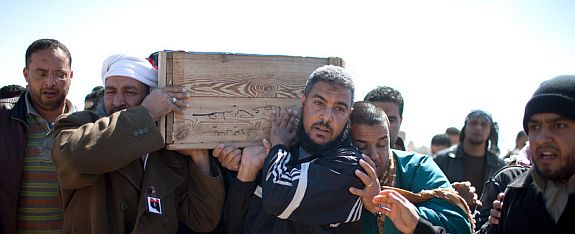
The coffin of Emad al-Giryani, a former petroleum engineer who fought for the opposition in Ras Lanuf. Some Obama administration officials have said privately that the level of violence in Libya would have to approach the scale of that in Rwanda or Bosnia in the 1990s before the United States would engage militarily. (New York Times)

As some commentators solemnly warn about the dangers of a backlash if the Arab democratic revolution was to become poisoned by American involvement in a no-fly zone over Libya, they fail to note a rising chorus inside Libya: anger towards the United States because of its reluctance to become involved.

There’s stunning paradox here. Three decades ago, America’s support of the Mujahadeen in Afghanistan sowed the seeds for a jihad against America. And now, America’s lack of support for a revolution in Libya may eventually have the same effect.

There are those who would on this basis jump to the conclusion that this demonstrates a visceral hatred of America across the Muslim world, but I would argue the exact opposite: that it demonstrates that attitudes towards America in a region in which it exerts so much influence are predominantly pragmatic and rooted in the present tense: they are a response to whatever the United States is doing or is not doing at any particular time.

Anthony Shadid in one of the finest pieces of reporting to come out of Libya since the fighting started, writes from Ras Lanuf:

Everyone here seems to have a gun these days, in a lawlessness tempered only by revolutionary ebullience. Young men at the front parade with the swagger that a rocket-propelled grenade launcher grants but hint privately that they will try to emigrate if they fail. Anti-American sentiments build, as rebels complain of Western inaction. And the hint of radicalization — religious or something more nihilist — gathers as the momentum in the three-week conflict clearly shifts to the forces of one of the world’s most bizarre leaders.

“This better not go on any longer,” said Dr. Salem Langhi, a surgeon who was working around the clock at a hospital that was abandoned as Colonel Qaddafi’s forces rushed in. “It will only bring misery and hard feelings among people. Losing lives and limbs doesn’t make anyone optimistic.”

No one seems to know what to call this conflict — a revolution, a civil war or, in a translation of what some call it in Arabic, “the events,” a shorthand for confusing violence. It certainly looks like a war — the thud of shelling in the distance offers a cadence to occasional airstrikes, their targets smoking like oil fires that turn afternoon to dusk. The dead and dismembered are ferried in ambulances driven by medical students.

But especially for the rebels, there is an amateurishness to the fighting that began as a protest and became an armed uprising.

“We’re here because we want to be,” said one of the fighters, Mohammed Fawzi.

His sense of a spontaneous gathering offers a prism through which to understand the war: the front at Ras Lanuf is the most militarized version of Tahrir Square in Cairo, where hundreds of thousands wrote a script of opposition and street theater that brought down a strongman everyone thought would die in office. The fighting here feels less like combat in the conventional sense and more like another form of frustrated protest.

Some vehicles bear the inscription Joint Security Committee, but nothing is all that coordinated across a landscape that seems anarchic and lacking in leadership. Fighters don leather jackets from Turkey, Desert Fox-style goggles, ski masks, cowboy hats and World War II-era British waistcoats.

Slogans are scrawled in the street just miles from the fighting. “Muammar is a dog,” one reads. A man who bicycled for three days from Darnah, far to the east, became a local celebrity at the front. Free food is offered, as it was in the canteens in Tahrir, and fighters rummaged through donated clothes. “These are American jeans!” one shouted.

Young men revel in the novelty of having no one to tell them not to play with guns. “God is great!” rings out whenever a volley of bullets is fired into the air.

“Some guys consider this a lot of fun, and they’re hoping the war lasts a lot longer,” said Marwan Buhidma, a 21-year-old computer student who credited video games with helping him figure out how to operate a 14.5-millimeter antiaircraft battery.

An hour or so before Friday’s headlong retreat, a gaggle of young men in aviator sunglasses and knit caps danced on military hardware, thrusting weapons into the air.

“Where is the house of the guy with really bad hair?” they chanted, referring to Colonel Qaddafi, jumping on spent cartridges and empty milk cartons. “Let’s go down the road and see it!”

The protests across the Arab world have disparate demands — from power-sharing in Bahrain to the dismantling of the regime in Egypt. But the demographic shift they represent as a generation comes of age is their constant. It is no different in Libya, where the young look at their parents’ lives in disgust and vow that they will not live without dignity, a say in their future and a constitution — a catchall term for the rule of law.

Nearly 70 percent of Libya’s population is under the age of 34, virtually identical to Egypt’s, and a refrain at the front or faraway in the mountain town of Bayda is that a country blessed with the largest oil reserves in Africa should have better schools, hospitals, roads and housing across a land dominated by Soviet-era monotony.

“People here didn’t revolt because they were hungry, because they wanted power or for religious reasons or something,” said Abdel-Rahman al-Dihami, a young man from Benghazi who had spent days at the front. “They revolted because they deserve better.”

The seeming justice of that revolt has prompted moments of naïveté — time and again, young people express amazement that Colonel Qaddafi’s forces would deploy tanks and warplanes against them — with an incipient and unpredictable frustration over demands unmet.

The revolt remains amorphous, but already, religion has emerged as an axis around which to focus opposition to Colonel Qaddafi’s government, especially across a terrain where little unites it otherwise. The sermon at the front on Friday framed the revolt as a crusade against an infidel leader. “This guy is not a Muslim,” said Jawdeh al-Fakri, the prayer leader. “He has no faith.”

Deserting officers have offered what leadership there is, along with some men who call themselves veterans of fighting in Afghanistan or an Islamist insurgency in eastern Libya in the 1990s. The shift remains tentative — and far short of the accusations made by Colonel Qaddafi that he faces an insurgency led by Al Qaeda — but even the opposition acknowledges the threat of radicalization in a drawn-out conflict.

Dr. Langhi, the surgeon, said he scolded rebels who called themselves mujahedeen — a religious term for pious fighters. “This isn’t our situation,” he pleaded. “This is a revolution.”

Sitting on ammunition boxes, four young men from Benghazi debated the war, as they watched occasional volleys of antiaircraft guns fired at nothing. They promised victory but echoed the anger heard often these days at the United States and the West for failing to impose a no-flight zone, swelling a sense of abandonment.

Facebooktwittermail

Benghazi’s rebels know it is now them or Gaddafi

Chris McGreal reports:

Ask people in Benghazi what awaits them if Muammar Gaddafi’s army fights its way back into the rebel capital and the chances are they will talk about Huda Ben Amer.

Today she is one of the Libyan dictator’s most closely trusted lieutenants, but nearly three decades ago Ben Amer was a young woman in Benghazi keen to earn a name with the regime. Her moment came at the public hanging of one of Gaddafi’s opponents in 1984. Ben Amer rushed forward as the unfortunate man dangled from the rope, wrapped her arms around his body and used her weight to pull down until he was dead.

That stomach-churning performance won her Gaddafi’s attention, and Ben Amer rose to become powerful, rich and twice mayor of Benghazi. It also earned her the enduring hatred of many in a city long viewed by the regime as riddled with subversion, where she is spoken of with the same depth of loathing and fear as the dictator.

When the revolution erupted in Benghazi last month, a crowd descended on Ben Amer’s sprawling white mansion and, on discovering that she was out of the city, burned it to the ground.

“If we lose, Huda Ben Amer will hang all of us,” said Walid Malak, an engineer turned revolutionary who has armed himself with a Kalashnikov plundered from a military base abandoned by Gaddafi’s forces. “Everyone in Benghazi knows it’s them or us.”

Facebooktwittermail

Arab League calls on UN to enforce no-fly zone over Libya

The Wall Street Journal reports:

The Arab League on Saturday called on the United Nations Security Council to enforce a “no-fly zone” over Libyan airspace, marking a decisive diplomatic victory for rebel forces opposed to Moammar Gadhafi, the Libyan ruler.

The announcement will bolster calls by some European leaders to intervene in the violent confrontation between rebels and Col. Gadhafi’s military.

The U.S. and the European Union had deferred to the 22-member league of Arab nations to determine whether outside military forces should intervene.

The air superiority of forces loyal to Col. Gadhafi has helped tip the balance of power against the antigovernment uprising based in the eastern part of the country. On Saturday, government forces tightened their grip on the coastal road linking government-held territory to the rebel-controlled east, the Associated Press reported.

Col. Gadhafi’s forces all but routed rebels in the coastal oil-refining city of Ras Lanuf earlier this week and completed their assault on Zawiya, a rebel stronghold west of Tripoli, Libya’s capital.

Deliberations will now go to the U.N. Security Council, where permanent members China and Russia are thought to oppose the proposed no-fly zone.

Abdel Hafeez Goga, the deputy head of the Benghazi-based provisional rebel government, the Transitional National Council, praised the Arab League decision.

“We welcome and salute their decision and look at it as a step forward to the imposition of no-fly-zone imposition,” he told a news conference in Benghazi.

Facebooktwittermail

Libya: fear of collapse — ‘we need a no-fly zone’

Jon Lee Anderson writes:

Yesterday, as the government appeared to take control of the western city of Zawiya, Seif al-Islam Qaddafi made a public vow that was extensively texted and retweeted in Libya:

Hear it now, I have only two words for our brothers and sisters in the east: We’re coming.

A Libyan friend reached me by cell phone from Benghazi to ask how things were; people there had heard the news of the crumbling front line and were growing worried, he said. He mentioned the threats made by Seif Qaddafi yesterday. For the first time, it seems, people in “liberated” Libya were beginning to wonder if their freedom was to be short-lived, and if they might soon see Qaddafi’s troops attacking them in Benghazi itself.
There were far fewer reporters and photographers at the front today. We learned that rebel authorities had set up a roadblock outside the city of Ajdabiya—the last before Benghazi—to prevent them from coming to the front. A dozen of us had stayed the night in Brega, however, and were able to reach the front line, where we were immediately accosted by fighters who asked us not to take photographs of them. Zaid, a civil engineer who had accompanied me to the front line from Benghazi, explained: “They believe that the images—especially on television—are helping Qaddafi to find targets to attack.” As the day wore on, though, the fighters’ wariness wore off, and once again they were coming up to anyone who looked foreign to wave “V” signs in front of camera lenses and declare, “Qaddafi majnoun“—crazy—“Where is America?” and “Tell Obama to do something; why hasn’t he done anything? We need a no-fly zone.”

Facebooktwittermail