Retired US Army general and NATO’s former supreme allied commander in Europe, Wesley Clark, says Libya doesn’t provide the US with enough oil for the fate of the country to be regarded as a vital interest. Not only that, the US is busy helping democracy movements in Iraq and Afghanistan!
In 2001, when the United States went into Afghanistan, it was clear that we had to strike back after the attacks of Sept. 11. And we’re still there, despite all the ambiguities and difficulties, because we have a vital interest in combating al-Qaeda and similar terrorist groups there and across the border in Pakistan.
How do we apply this test to Libya? Protecting access to oil supplies has become a vital interest, but Libya doesn’t sell much oil to the United States, and what has been cut off is apparently being replaced by Saudi production. Other national interests are more complex. Of course, we want to support democratic movements in the region, but we have two such operations already underway – in Iraq and Afghanistan. Then there are the humanitarian concerns. It is hard to stand by as innocent people are caught up in violence, but that’s what we did when civil wars in Africa killed several million and when fighting in Darfur killed hundreds of thousands. So far, the violence in Libya is not significant in comparison. Maybe we could earn a cheap “victory,” but, on whatever basis we intervene, it would become the United States vs. Gaddafi, and we would be committed to fight to his finish. That could entail a substantial ground operation, some casualties and an extended post-conflict peacekeeping presence.
I have great respect for you and your site but find myself dumbfounded by your enlisting Leon Wieseltier in your campaign to impose (or as you would say “respond to the rebels’ pleas”) a NFZ [no-fly zone] in Libya. The right or wrong of such a move is highly debatable. I for one feel no honest observer of the last twenty years of US/NATO interventions can see much wisdom or efficacy in such action even with the possibility (by no means assured) of it bringing about the desired outcome of rebel (who exactly?) success and the tyrant’s fall. Wieseltier, a deluded apologist for extreme violence (Iraq, Bosnia and where else?) shows his true “humanitarian intervention” colors by solemnly citing the awful Samantha Powers. Her “sad” (for reasons other than those he cites) book “A Problem From Hell” the much lauded whitewash of U.S. slaughter (by simply ignoring it) is the Bible used by the Humanitarian Interventionists to justify violence they -liberals- wish to unleash. One of several major lies Powers propagates is the fiction that the US “stood idly by” in Rwanda when in fact it was very much involved with Kagame and his invasion of Rwanda (to this day supporting his murderous rampages in DRC). If you’re going to insist that US/NATO –responsible for some of the most grievous violations of international law resulting in the deaths of millions of innocent civilians– bomb (see Sec Def Gates) Libya I would respectfully suggest you don’t let neo-con hacks like Wieseltier make your case for you.
I can’t see why you think the US would magically change its spots after decades of murderous policies and merely float above Libya like some guardian angel, do its NFZ thing, make things safe for Libyan democracy and then turn around and fly off into the sunset. Even if the US were to morph into an egalitarian and neutral police force devoid of its mighty imperial baggage the proposed NFZ would be fraught with unnecessary risk of disaster for the Libyan people themselves. No such use of power has ever been so clinically used without serious consequences in the form of entanglements and debts owed not to mention the usual unforeseen tangential horrors of war all highly probable and predictable even if it didn’t involve the players and history in this instance. Powerful state actors are not designed to do work free of charge. The idea that the US can use military force in Libya without further destabilizing the region seems ludicrous to me.
My response:
You refer to my “campaign to impose (or as you would say ‘respond to the rebels’ pleas’) a NFZ in Libya”.
Whether a no-fly zone is imposed disregarding the preference of rebels, or is enforced in response to rebel pleas, is an all-important distinction. I don’t support foreign intervention that would amount to the US or any other outside power simply trying to impose its will on Libya. Neither do I see any evidence that such a move is on the cards. The idea that the US is itching to involve itself in another imperial adventure implies that the US has learned nothing from Iraq.
When Obama says we are slowly tightening the noose on Gaddafi, the operative word is not “noose” — it’s “slowly”. However much he and other Western leaders might profess an interest in seeing Gaddafi ousted, their primary interest is in seeing him restrain his brutality just enough that the outside powers don’t get drawn in.
Note that Obama said the US would stand up for “defenseless civilians” in Libya. In other words, they can’t expect any help from the US unless they stop fighting. That’s not much of an offer to those fighters now retreating from Ras Lanuf. In fact, it’s an invitation for Gaddafi to retake Brenghazi. If its residents try to defend their stronghold, they won’t be defenseless civilians. But if they lay down their weapons, Gaddafi can reassert control without a fight.
Those who are now vehemently opposing a no-fly zone might stop to consider whether they are actually aiding and abetting in what might end up as an opened-ended process to isolate Gaddafi that ultimately causes more harm to the Libyan people than anyone else. For governments which like to structure foreign policies around easy-to-demonize enemies, Gaddafi is more useful remaining in power than in being overthrown.
Although there have been numerous reports in which rebel leaders and individual fighters are directly quoted appealing for swift implementation of a no-fly-zone, I have not seen a single statement in which rebels say they do not want a no-fly zone. There are plenty of statements saying they don’t want foreign troops on Libyan soil — I share their assumption that a no-fly zone will not be a precursor to an invasion simply because the US and NATO are indeed overstretched in Afghanistan. The Pentagon doesn’t want to trumpet its lack of capacity — it prefers to council caution.
If I cite Wieseltier or anyone else, that doesn’t mean I’m endorsing everything that individual has ever written. I trust that the readers here have enough critical intelligence to evaluate statements based on their substance and not the hallowed or hollow authority of the source.
Wieseltier says the White House is “so haunted by past Arab anger at American action in the Middle East that it cannot recognize present Arab anger at American inaction in the Middle East.” The validity of that statement doesn’t hinge on who wrote it. The frustration on the ground in Libya which Wieseltier references from a New York Times report is also evident in this statement from Salem Abdel Wahad, a 30-year-old Libyan rebel soldier:
We find one thing strange: the position of the United states. It’s impossible that the U.S. would not have imposed a no-fly zone, impossible, unless they have some agreement with Gaddafi against the Libyan people.
You say “The idea that the US can use military force in Libya without further destabilizing the region seems ludicrous”. Maybe. But as the Arab democratic revolution develops, we either accept and even dare I say celebrate the fact that this is a hugely destabilizing process, or we say that in the interests of regional stability, it would be much better if these angry Arabs temper their desire for political freedom.
The Arab democratic revolution is bad for America — at least in the short term. It’s pushing up gas prices and it’s harming the economy — and most Americans don’t really give a shit about whether Libyans or pretty much anyone else have democratic freedoms or live under oppression. The same kind of myopic self-interest applies to the US government. So, trying to build up public pressure in support of foreign assistance to Libya’s rebels is not about appealing to idealistic instincts where they are unlikely to be found. It’s about trying to enlist support for a just cause even if that support comes tainted with a bundle of dubious interests.
The fact that I support calls for a NFZ does not mean that I believe this would necessarily decisively tip the balance in the rebels’ favor, but if implemented fast enough it could place an urgently needed obstacle on Gaddafi’s path to victory and give the rebels some breathing space. This is and will remain their fight.
If Libyans could secure their freedom through non-violent protests, Gaddafi would already have been toppled. But since he chose to use violence to maintain his rule, those who had already risen up against him were left with a choice: be rounded up and executed or imprisoned, or to fight for their lives. I think they made the right choice and that their fight is worthy of support by anyone who opposes oppression. Those who believe that stability should be our overriding concern can continue watching and hoping that things quieten down soon. But have no doubt, if Gaddafi holds on, autocratic rulers across the region will have taken note that the West remains, as it has long been, a willing partner in rule by force — even as we profess our love of democracy.
Only days ago, rebels were boldly promising to march on Surt, Colonel Qaddafi’s hometown, then on to Tripoli, where opposition leaders predicted its residents would rise up. But the week has witnessed a series of setbacks, with a punishing government assault on Zawiyah, near the capital, and a reversal of fortunes in towns near Ras Lanuf, whose refinery makes it a strategic economic prize in a country blessed with vast oil reserves.
There was a growing sense among the opposition, echoed by leaders in opposition-held Benghazi and rebels on the front, that they could not single-handedly defeat Colonel Qaddafi’s forces.
“We can’t prevail unless there’s a no-fly zone,” said Anis Mabrouk, a 35-year-old fighter. “Give us the cover, and we’ll go all the way to Tripoli and kill him.”
That seemed unlikely, though. Even without warplanes, Colonel Qaddafi’s government could still marshal far superior tanks, armor and artillery, along with the finances and organization to prosecute a counteroffensive.
President Obama signaled Friday that the U.S. military might intervene in Libya at the point that “defenseless civilians” are under attack by forces loyal to Col. Moammar Kadafi, but said even then he would weigh the costs of sending American personnel and carefully consider whether such an operation would be “sustainable.”
In a news conference at the White House, Obama pointedly declined to endorse a view expressed by his director of national intelligence, James Clapper, who testified before Congress this week that rebel forces probably will not be able to defeat Kadafi.
While Obama said the option of military force remains on the table, he made it clear he does not think the situation merits it yet. He said he would want to avoid “defenseless civilians who were massacred by Kadafi’s forces,” repeating past massacres in the Balkans and Rwanda.
Gaddafi has already likened his onslaught on his own population to Israel’s war on Gaza — a war President-elect Obama watched in silence — so perhaps he’ll restrain himself from bombing Benghazi and simply place the city under siege. He can be reasonably confident he’ll suffer no more than a verbal rebuke from Obama, since a massacre in slow motion won’t really look like a massacre.
Darkness is descending on the Libyan struggle for freedom, and we are helping to lower it. While the various secretaries were articulating their abdications, Qaddafi was committing a slaughter in Zawiyah and employing his monopoly of the skies to drive the rebels out of Ras Lanuf. An eastern offensive is clearly imminent. (This is not a civil war. This is a war by a dictator upon his people. There is no other half of the Libyan population fighting for Qaddafi.) All this, of course, affects the sensitivities of the Libyan freedom fighters. “We’re waiting for the Americans to follow,” a rebel spokesman bitterly told Anthony Shadid and David Kirkpatrick of The New York Times about Sarkozy’s splendid decision to recognize the Libyan provisional government. (Morally America now lags behind France!) Shadid and Kirkpatrick also reported that “as NATO member nations met in Brussels to discuss options for Libya, the rebels cursed the United States and its allies for failing to impose a no-flight zone.” Why is the White House content to foment this variety of anti-Americanism? The answer is that it is so haunted by past Arab anger at American action in the Middle East that it cannot recognize present Arab anger at American inaction in the Middle East.
And the president? He declares that Qaddafi must go and that we will stand with the Libyan people, and then he does nothing. No, that’s not right. He consults and consults, and his staff works round the clock, and economic sanctions are instituted against the rampaging dictator who has tens of billions of dollars in cash. Obama is prepared to act, just not consequentially. He does not want the responsibility for any Arab outcome. He says they must do it for themselves. But they are doing it for themselves. They merely need help. And the help they need is easy for us to provide. (Jam their fucking communications.) And their cause is freedom, which is allegedly our cause. What they seek from Obama is an extended hand. What they are getting is a clenched fist. If Muammar Qaddafi takes Benghazi, it will be Barack Obama’s responsibility. That is what it means to be the American president. The American president cannot but affect the outcome. That is his burden and his privilege. He has the power to stop such an atrocity, so if the atrocity is not stopped it will be because he chose not to use his power. Perhaps that is why Obama has been telling people, rather tastelessly, that it would be easier to be the president of China. Obama will not be rushed. He is a man of the long game. But the Libyan struggle for freedom, and the mission of rescue, is a short game. That is the temporality of such circumstances. If you do not act swiftly, you have misunderstood the situation. Delay means disaster. Does Obama have any idea of what Qaddafi’s victory will mean for the region and its awakening?
We have flinched this way before. For many days I have had a sickening 1992–1995 feeling. Consider these sentences, from a book I lugubriously took off my shelf: “Why does the United States stand so idly by? The most common answer is, ‘We didn’t know.’ This is not true. … A second response to the question of why the United States did so little is that it could not have done much to stop the horrors. [But] the only way to ascertain the consequences of U.S. diplomatic, economic, or military measures would have been to undertake them. … If anything testifies to the U.S. capacity for influence, it is the extent to which the perpetrators kept an eye trained on Washington and other Western capitals as they decided how to proceed. … The real reason the United States did not do what it could and should have done to stop genocide was not a lack of knowledge or influence but a lack of will. Simply put, American leaders did not act because they did not want to.” The Libyan calamity is not genocide, but genocide is not the only horror that has a claim on American agency. I have taken those wise sentences from “A Problem from Hell,” Samantha Power’s sad, great study of earlier American failures to act against mass-murdering tyrants. Is Obama now writing his own chapter in that story? Why do we not still remember that story? It is disgusting, as the Libyan rebels are driven further and further back, to learn that we must discover it all over again.
Hillary Clinton’s spokesman has launched a public attack on the Pentagon for the way it is treating military prisoner Bradley Manning, the US soldier suspected of handing the US embassy cables to WikiLeaks.
PJ Crowley, the assistant secretary of state for public affairs at the US state department, said Manning was being “mistreated” in the military brig at Quantico, Virginia. “What is being done to Bradley Manning is ridiculous and counterproductive and stupid on the part of the department of defence,” he said.
Crowley’s comments signal a crack within the Obama administration over the handling of the WikiLeaks saga in which hundreds of thousands of confidential documents were handed to the website.
As news of the remarks rippled through Washington, President Obama was forced to address the subject of Manning’s treatment for the first time.
Asked about the controversy at a White House press conference, Obama revealed he had asked the Pentagon “whether or not the procedures that have been taken in terms of his confinement are appropriate and are meeting our basic standards. They assure me that they are.”
Obama would not respond specifically to Crowley’s comments, which are the first critical remarks from within the administration about the handling of Manning. The prisoner is being held for 23 hours in solitary confinement in his cell and stripped naked every night.
Nicolas Sarkozy has called for targeted air strikes against Muammar Gaddafi’s regime if his forces use chemical weapons or launch air strikes against civilians.
As the EU foreign policy chief, Lady Ashton, warned that a no-fly zone could risk civilian lives in Libya, the French president told an emergency EU summit in Brussels that air strikes may soon be justified.
“The strikes would be solely of a defensive nature if Mr Gaddafi makes use of chemical weapons or air strikes against non-violent protesters,” Sarkozy said. The French president qualified his remarks by saying he had many reservations about military intervention in Libya “because Arab revolutions belong to Arabs”.
Sarkozy said he had won the support of David Cameron for his plan which would have to be approved by the UN, Arab states and Libyan opposition groups.
In recent years, AIPAC’s main message has been about Iran and its view of the dangers posed by the Iranian nuclear program. Speaker after speaker at various AIPAC conferences over the past decade (including, most histrionically, Prime Minister Binyamin Netanyahu) has invoked the Holocaust when discussing the possibility of an Iranian nuclear weapon.
These speakers laid the groundwork for AIPAC’s presentation of legislation imposing “crippling sanctions” on Iran — along with the declaration that the military option remained “on the table” if sanctions failed to end Iran’s nuclear program. Most of the sanctions legislation enacted by Congress and signed into law by the president originated at AIPAC.
But this year Iran will have to compete for attention with AIPAC’s worries about the democratic revolutions that are sweeping the Arab world. For AIPAC, as for Netanyahu, those revolutions have already turned 2011 into an annus horribilis and the year is not even half over.
Early indications are that the main theme that will dominate the conference will be that Israel, once again, has “no partner” to negotiate with. This is an old theme, but one that receded as the Israeli right came to view the Palestinian Authority (led by Mahmoud Abbas and Salam Fayyad) as not only partners but as collaborators in maintaining the status quo.
As Al Jazeera‘s Palestine Papers demonstrated, Abbas and Fayyad rarely said “no” to the Netanyahu government — which made them the only kind of partners acceptable to the Netanyahu-Lieberman-Barak troika.
But, fearing that it might be next to fall to democracy, the PA started showing some spine recently. It refused to yield to U.S. and Israeli demands that it shelve the United Nations Security Council Resolution condemning settlements. It absolutely refuses to negotiate with Israelis until Israel stops gobbling up the land they would be negotiating over. And, most disturbing of all to Netanyahu and company, it says that it intends to unilaterally declare a Palestinian state this summer.
Netanyahu, who needs the illusion of movement to ensure that there isn’t any, is suddenly feeling the heat.
Reflecting on the results of a survey on American attitudes towards Islam, Jonathan Wright writes:
Maybe it’s time that educational curricula made a deliberate effort to explain the diversity of opinion within such communities, emphasizing the way that believers, as individuals and as groups, emphasize the doctrines that suit their worldly interests and political dispositions. Any religion that has existed for so many centuries across such a vast geographical expanse offers a wide range of alternative doctines, many of them incompatible or contradictory. ‘Islam’ as a stable unitary construct hardly exists, except in the most banal sense, however much both Muslims and their enemies might claim that it does. Only individual Muslims can endow the label with meaning, and each Muslim does so in a way that is never identical to the way other individual Muslims do so. This is widely accepted among theoreticians (Aziz al-Azmeh comes to mind – “There are as many Islams as there are situations which contain it”), but it’s clearly taking quite a while for this to sink in among the general public. One day, the Pew Research Center might offer people who respond to such surveys an option reflecting this insight.
Yesterday, I wrote about the fictitious excuse being offered to justify why Obama is continuing the indefinite detentions and military commissions which defined the Bush/Cheney Guantanamo detention scheme: it’s Congress’ fault. Today we have a new excuse: it’s Bush’s fault. Because Bush tortured some of the detainees, this reasoning goes, Obama is incapable of prosecuting them, yet because many of those detainees are Terrorists and/or Too Dangerous to Release (even though they can’t be convicted of anything), he has no real choice but to keep imprisoning them without charges. Here are the NYT Editors — even as they criticize Obama’s indefinite detention policy — making this case, one frequently heard from Obama supporters offering excuses for his policy of indefinite detention:
[T]he Obama administration has still chosen to accept the concept of indefinite detention without trial, which represents a stain on American justice. The president made that acceptance clear in a speech in May 2009. To some degree, he was forced into it by the Bush administration’s legacy of torture and abuse, which made some important cases impossible to prosecute.
And here’s Andrew Sullivan making a somewhat different but related claim, and then going even further, suggesting that the only thing that ever bothered him about Guantanamo was the torture, not the fact that people were being indefinitely imprisoned without a shred of due process:
My fundamental concern has always been humane treatment. When Gitmo was a torture camp, it was indefensible. . . . [Those equating Obama’s detention policies with Bush’s] omit that the very dilemma – prisoners with no formal charges, no serious evidence, and radicalized by torture and unjust imprisonment – was created by Bush in the first place. I’d release those against whom there is no credible evidence. But I can understand the security and political concerns of releasing men who could join Jihadists in, say, Yemen.
There’s a serious moral flaw in the NYT‘s reasoning, and two even worse empirical flaws with this excuse-making for indefinite detention. There are several compelling reasons why the use of torture-obtained evidence is barred by every civilized country for use in prosecution, and has been barred for decades if not centuries. A primary reason is because the most basic norms of Western morality demand that torture not be rewarded, which is what happens when the fruits of it are admissible in court to prosecute people. Those who say that Obama is justified in imprisoning people without charges because the evidence against them was obtained via torture and is thus unusable in court are repudiating this long-standing Western moral principle by justifying imprisonment based on evidence obtained by coercion (we know they’re guilty because of the evidence we got from torture, so we have to detain them).
Israel’s Prime Minister Binyamin Netanyahu has reportedly decided to appoint an ultra-hawk, one of Israel’s leading national-religious icons, as his new national security adviser.
If media reports are correct, Netanyahu’s new pick for the important position is Major-General (res.) Yaakov Amidror, who in the past advocated for reoccupying the Gaza Strip and staying there “for many years.” Earlier this month, Amidror wrote that “negotiations with the Palestinians and even an agreement with the Palestinians (…) will not benefit Israel in any way as it faces the threats that might emerge in the future.”
Amidror retired from the IDF in 2002, after serving as the head of the analysis wing of Israel’s military intelligence and as the commander of the IDF’s academies. After retiring from the IDF, he wrote extensively for Israeli think tanks and daily newspapers. His paper trail leaves no doubt about his extreme views, which included vicious attacks on the New Israel Fund, sharp criticism of the Obama administration’s “naive” Middle East policy, and dismissive views regarding the viability and advisability of creating a Palestinian state in the West Bank and Gaza.
Amidror is associated with the ultra-right national-religions party “The Jewish Home.” In 2008, he headed a commission tasked with composing the party’s list for the general elections. The party, which is dominated by former National Religious Party (NRP) politicians, supports a “greater Israel” ideology and is considered the most authentic political representative of the ideological messianic settlers in the West Bank.
The momentum shifted decisively Thursday in an uprising that has shaken Col. Muammar el-Qaddafi’s four decades of rule, as rebels fled from this strategic refinery town under a sustained land, air and sea assault by government forces.
The fighting was a stark illustration of the asymmetry of the conflict, pitting protesters turned rebels against a military with far superior arms and organization and a willingness to prosecute a vicious counterattack against its own people.
Usually ebullient rebels acknowledged withdrawing Thursday, even as the fledgling opposition leadership in Benghazi scored diplomatic gains with France’s recognition of it as the legitimate government and senior American officials’ promise to talk with its leaders.
“We are coming,” Colonel Qaddafi’s son, Saif al-Islam, told reporters in Tripoli.
Western nations took new steps to isolate the Qaddafi government, but the measures stopped well short of any sort of military intervention and seemed unlikely to be able to reverse the momentum.
The cautious response underscored what is at stake in a race against time in the most chaotic and unpredictable of the uprisings to shake the Arab world — whether the opposition can secure more international recognition and a no-flight zone to blunt Colonel Qaddafi’s offensive before rebel lines crumble in the coastal oil towns west of Benghazi.
The New York Times reports that as the White House announced a five-point program designed to isolate and ultimately drive Gaddafi from power, the administration’s own intelligence chief told Congress he didn’t believe the Libyan leader could be ousted.
The White House campaign to convince both Colonel Qaddafi’s loyalists and NATO allies that the Libyan dictator’s days are numbered were undercut by a military assessment given earlier in the day by the director of national intelligence, James R. Clapper. Responding to questions, Mr. Clapper told members of the Senate Armed Services Committee that Colonel Qaddafi had a potentially decisive advantage in arms and equipment that would make itself felt as the conflict wore on.
“This is kind of a stalemate back and forth,” he said, “but I think over the longer term that the regime will prevail.”
Mr. Clapper also offered another scenario, one in which the country is split into two or three mini-states, reverting to how it was before Colonel Qaddafi’s rule. “You could end up with a situation where Qaddafi would have Tripoli and its environs, and then Benghazi and its environs could be under another mini-state,” he said.
The White House was clearly taken aback by the assessment that Mr. Qaddafi could prevail, and Mr. Donilon, talking to reporters a few hours later, suggested that Mr. Clapper was addressing the question too narrowly.
“If you did a static and one-dimensional assessment of just looking at order of battle and mercenaries,” Mr. Donilon said, one could conclude that the Libyan leader would hang on. But he said that he took a “dynamic” and “multidimensional” view, which he said would lead “to a different conclusion about how this is going to go forward.”
“The lost legitimacy matters,” he said. “Motivation matters. Incentives matter.” He said Colonel Qaddafi’s “resources are being cut off,” and ultimately that would undercut his hold on power.
Such differing assessments rarely surface in public in the midst of a crisis, although in the early days of the Egypt uprising there were conflicting assessments of the stability of the Mubarak government. Mr. Clapper’s job, created in the wake of the Sept. 11 attacks, was intended to conduct exactly the kind of all-source analysis that Mr. Donilon talked about. But the White House said later Thursday it retained full confidence in Mr. Clapper.
One prominent Republican senator, however, said that the intelligence director should lose his job. Senator Lindsey Graham of South Carolina, a member of the Armed Services Committee, said in a statement that Mr. Clapper’s assessment “will make the situation more difficult for those opposing Qaddafi,” adding, “It also undercuts our national efforts to bring about the desired result of Libya moving from dictator to democracy.”
In Brussels, meanwhile, NATO all but rejected a no-flight zone over Libya and agreed only to reposition warships in the region and plan for humanitarian aid.
Mr. Gates, who has been strongly resistant to a no-flight zone, said in a news briefing after a two-hour meeting of NATO defense ministers that planning for a possible no-flight zone would continue, “but that’s the extent of it.”
The Libyan interim Transitional National Council says the UK government will soon join France in recognizing revolutionary administration as Libya’s legitimate government.
A spokesperson for the Provisional Transitional National Council of Libya in Benghazi, the capital of the revolution, said the council’s representatives were in talks with Britain, among other European countries to recognize the Libyan revolutionary council.
Iman Bugaighis described the talks with the British officials as “favorable.”
Bugaighis appreciated France, in particular, for dismissing Muammar Qaddafi’s rule and recognizing the council as the “only legitimate representative of the Libyan people.”
“We thank the French government for being the first to recognise the Libyan revolutionary council,” Bugaighis said. “We will not forget the role of France. We will remember it long after the revolution is over.”
Is the free world again going to stand around talking while a people struggles to gain its freedom? I remember with tears the last broadcast from Hungary as the rebellion of 1956 was being crushed by Soviet tanks. I was born as the Spanish republic was being betrayed by the liberal democracies. The Libyan people have proved their bravery and no one – from Cameron and Clinton down – doubts the justice of their cause. It cannot be beyond our leaders to get anti-tank weapons – and tanks – to them now. If the rebellion fails, our leaders will stand in the dock with the statesmen who have stood idly by so many times before, washing their hands as the people’s blood flows.
Ralph Blumenau challenged a Guardian editorial which amounted to a rationalization for international inaction. With an apparent conviction that the righteous have a greater force on their side, the editorial declared: “Their biggest weapon remains their cause and who they are.” And it concluded: “The more brutality Gaddafi employs, the quicker he hastens his own end.” Blumenau notes: “A prediction without evidence. Think Mugabe.”
Meanwhile, Ghaith Abdul-Ahad, arguably the British newspaper’s most intrepid correspondent, has gone missing in Western Libya.
While the Libyan revolt is playing out in vastly different ways, and with far greater bloodshed, it is part and parcel of the democratic revolutionary process rising across the Arab world and beyond. And just as in Egypt, Tunisia, Yemen, Bahrain, and elsewhere, there is no evidence that the Libyan population supports foreign military involvement.
To the contrary, although at least part of the anti-Qaddafi leadership is indeed calling for some kind of military intervention, there appears to be widespread public opposition to such a call. Certainly there is fear that such foreign involvement will give credibility to Qaddafi’s currently false claims that foreigners are responsible for the uprising. But beyond that, there is a powerful appeal in the recognition that the democracy movements sweeping the Middle East and North Africa are indigenous, authentic, independent mobilizations against decades-long U.S.- and Western-backed dictatorship and oppression.
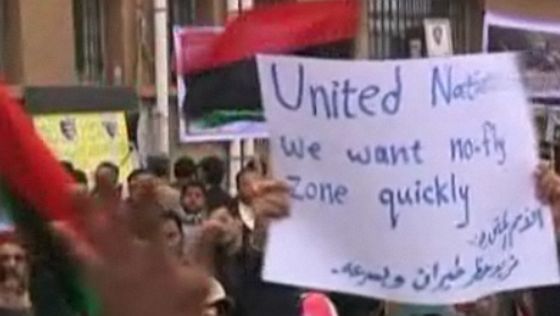
At a demonstration after a funeral for rebel fighters in Benghazi (shown in the video below) protesters can be seen holding up signs saying “Libyans Need No-Fly Zone” and “United Nations: we want no-fly zone quickly.”
Perhaps the signs were being held aloft by foreign agents, or maybe these particular Libyans have not been paying enough attention to Washington’s think tanks and don’t know how difficult a no-fly zone is to operate or what wider military involvement it might entail.
Or, maybe those outside Libya who refuse to make any distinction between a no-fly zone implemented in response to Libyan appeals and a no-fly zone imposed without consultation, simply don’t want to hear what Libyans are saying when it conflicts with the views to which so many non-interventionists seem so deeply attached.
Mustafa Abdul-Jalil, head of the Interim Transitional National Council based in Benghazi, in an interview with CNN reiterated his appeal for the international community to immediately impose a no-fly zone.
Is anyone listening?
There seems to be a highly questionable logic at work here among the opponents of a no-fly zone: if Gaddafi can effectively crush his opponents, then the uprising can’t have had enough popular support, but if there’s sufficient popular support, then no outside support is necessary.
In other words, the message to the revolution is this: if you’re going to win, you won’t need our help, but if you need our help, you probably won’t win. Good luck guys.
Does this have implications for the Palestinians?
Isn’t the Boycott, Divestment and Sanctions movement a form of foreign intervention?
If the Palestinians in the West Bank can’t muster the will or the force to kick out the Israeli occupiers, then maybe outsiders should not be making any effort to tip the balance of power.
Good revolutions, as the White House cynically says, grow organically. And believe me, contrary to all the anti-imperialist fear-mongering that’s going around right now, moderately tough-talk notwithstanding, Obama’s actually firmly on the side of the non-interventionists. The international community and especially the US and even more so the Pentagon, are loathe to get involved in this conflict.
So who do you want to align yourself with? US Defense Secretary No-No-Fly Zone Gates or Pro-No-Fly-Zone Mustafa Abdul-Jalil?
To those who argue that US involvement would undermine the credibility of the revolution, consider this observation by Salem Abdel Wahad, a 30-year-old Libyan rebel soldier:
We find one thing strange: the position of the United states. It’s impossible that the U.S. would not have imposed a no-fly zone, impossible, unless they have some agreement with Gaddafi against the Libyan people.
There is no neutrality in this war. If you don’t support the revolution, you are by default against it.
The debate for and against a no-fly zone is not closed, but it should at least be met on honest terms — without concealing the fact that Libyan appeals for a no-fly zone are only growing louder, and without claiming that a no-fly zone would inevitably lead to a full-blown Western intervention. Can a no-fly zone help or are there more effective alternatives?
Aviation Week spoke to two retired US Air Force generals who say that the difficulties in imposing a no-fly zone have been over-stated by the Pentagon.
Any attack, the two generals contend, would be far more limited in scope and greater in effect than critics have suggested.
“[Defense Secretary Robert] Gates has said that a no-fly zone can’t stop helicopters,” the first Gen. says “That’s wrong. There are only three places in Libya where helicopters can stage, fuel, rearm and re-equip – one in Tripoli, one in Benghazi and one in the eastern oil fields that are in the hands of the rebels. They are all near the coast. All the rest of Libya is barren.
“The U.S. Air Force has specialized in operations to take down integrated air defense, crater runways and destroy helicopter staging areas,” he says. “We know where they are. You can shoot down low-flying helicopter with Aim-9X Sidewinders. The suppression would take 24-48 hours with assets that aren’t being used for Iraq or Afghanistan.
Former US diplomat Peter Galbraith described the way a no-fly zone operates to Mark Colvin on Australia’s ABC News:
PETER GALBRAITH: Generally what happens is that once you’ve declared the no-fly zone, that the target air force is unwilling to fly its aircraft, of the pilots themselves individually are unwilling to fly and so by and large you don’t then need to have patrols to enforce it.
In the case of the no-fly zone that was over Iraq during the time that Saddam Hussein was in power, the Iraqis never actually challenged it, and so it was able to be enforced by a couple of planes patrolling every day.
MARK COLVIN: Do you first though have to take out their radar and other navigational aids?
PETER GALBRAITH: Not necessarily. Again if you declare it, there’s a good chance that the country will choose not to challenge it, or again that the pilots will stop to fly. But it’s also important to remember that in the case of Libya a significant purpose here is psychological. You have a country where a large segment of the population, including of the armed forces, has gone over to the rebellion.
The others may be sympathetic to the rebellion, or certainly are not necessarily committed to Gaddafi who are looking to say, to see how this is going to turn out. And once it’s clear, that Gaddafi is not going to remain in power, they are not going to defend him.
And so one of the purposes of declaring a no-fly zone is to send a signal that the international community is determined that he will not be able to put down the rebellion and this will perhaps hasten his departure or will make people, make it clear that he is not in fact going to succeed in putting down the rebellion.
There are those, such as Stephen Kinzer, who regard this as “a highly obscure conflict” — as though we really don’t know enough to judge what’s going on.
And for those of us simple-minded observers who see what is happening in Libya as just one current in the rising tide of the Arab democratic revolution and who see this trend as historic and inspiring, in spite of the fact that we do not know what it will lead to, it’s not hard to support the Libyan revolution — even though Libya after Gaddafi seems likely to involve a measure of chaos.
The alternative — that Gaddafi might succeed in crushing this popular uprising — would not only be bad for Libya, but bad for countless people across the Arab world who currently dream of the possibility of liberating themselves from the suffocating grip of autocratic power.
Anti-interventionists argue that Libyans can and must win this fight on their own. Self-appointed saviors from the West would indeed be unwelcome. But is that really what’s on the horizon? Is President Obama or anyone else currently recruiting support for a coalition of the willing, eager to liberate Libya and cast out the tyrant?
To intervene is “to interfere, usually through force or threat of force, in the affairs of another nation.”
Libya’s revolutionaries have made it clear that they don’t want a direct military intervention on Libyan soil. But that’s not a rejection of all outside support. Indeed, the Interim Transitional National Council in its founding statement said: “we request from the international community to fulfil its obligations to protect the Libyan people from any further genocide and crimes against humanity…”
How can that request be fulfilled? Would a no-fly zone help? If that is what is explicitly requested, then it does not constitute a form of interference. Assistance in response to an appeal for help is not an imposition.
Instead of pro- and anti-interventionists indulging in an ideological debate, what is called for right now is dialogue — not between these two camps but between representatives of the Libyan revolutionary movement and those national and international bodies which are ready to offer assistance.
Still, there are those who want to draw a sharp divide between military and non-military aid. Food for the hungry but no guns for the fighters. And what about medical assistance for those injured on the battlefield? Or intelligence information? Or jamming communications?
There are all sorts of ways of supporting the fight without dropping bombs, but first you have to take sides. If you’re not willing to take sides, the question about intervention is moot, but if you support the revolution, the only question is: how can Gaddafi be defeated?
The head of the interim government in eastern Libya pleaded Wednesday for the international community to move quickly to impose a no-fly zone over Libya, declaring that any delay would result in more casualties.
“It has to be immediate action,” Mustafa Abdul-Jalil told CNN in an exclusive interview in this eastern opposition stronghold. “The longer the situation carries on, the more blood is shed. That’s the message that we want to send to the international community. They have to live up to their responsibility with regards to this.”
Anti-interventionists might prefer to turn a deaf ear to this appeal, or perhaps question Abdul-Jalil’s authority to speak for the revolution, but I’d say it’s time to set aside this outworn debate. It’s time to support the Libyan revolution.
How does the revolution in Egypt compare with the American Revolution? There is no comparison. It is more impressive and more important. So far.
In the United States, the American Revolution is sacred history. As a result, Americans tend to associate its slogans and symbols with the whole concept of revolution. If the peculiarities of this habit help prevent Americans from recognising the significance of events in Egypt, both countries will pay a price.
For the leaders of the American Revolution, colonial North America had been a place of social mobility and prosperity. In a European context, the American patriots belonged to the minor gentry class.
No European society allowed members of the minor gentry the prominent roles in political life that the British colonies had offered Americans. When they rebelled against Great Britain, over taxes and in the name of freedom, they were the freest and least taxed people in the western world.
As to the much-noted hypocrisy of slaveholders rebelling in the name of freedom, the English writer Samuel Johnson gave the line for the ages, when he asked, “How is it that we hear the loudest yelps for liberty among the drivers of negroes?”
In contrast, the people of Egypt for decades lived under a cruel military dictatorship. The Mubarak regime almost destroyed a once vibrant Egyptian middle class. The Mubarak family, according to recent reports, accumulated as much as $70bn worth of assets, held mostly in foreign banks and real estate. In contrast to the free and prosperous American revolutionaries, Egyptian resistance broke out from an impoverished and oppressed people.
A demonstration commemorating International Women’s Day was attacked on Tuesday afternoon in Cairo’s Tahrir Square. More than 200 men charged on the women – forcing some to the ground, dragging others out of the crowd, groping and sexually harassing them as police and military figures stood by and failed to act.
It was a shocking wake-up call. Even in Tahrir Square, the symbol of Egypt’s newfound freedom, it seems that it’s going to take much more than a revolution to overhaul the deep-seated misogyny that some Egyptian men so freely and openly impose on the country’s female population.
The female demonstrators – myself among them – had been protesting against Egypt’s chronic sexual harassment problem, against the many barriers women face in public life, and against the pervasive conservatism that curtails the freedom of women in society at large. The women chanted slogans that had been used in the revolution itself, calling for freedom, justice and equality. But their demonstration quickly attracted a counter-protest.
The women’s chants calling for an “Egypt for all Egyptians” were drowned out by retaliations such as “No to freedom!” shouted by the opposing group. The men charged at the female protesters, who had been standing on a raised platform in the middle of Tahrir Square, and shouted: “Get out of here.”
On International Women’s Day, women rights activists in Egypt called for a one million women march at Cairo’s Tahrir Square.
I arrived in Tahrir around 2pm local time [12GMT] on Tuesday March 8, but was surprised to see the sheer volume of men who outnumbered the women, as if it was International Men’s Day!
However, as the crowd trickled in, it grew into hundreds but very far from the planned one million!
Ironically, the few women, I came across in the beginning, were oblivious of the fact that it was a women’s day march.
After negotiating through the maddening crowd I finally managed to meet Nehad Abo Alomsan, the organiser of the march.
Nehad, also the chair for Egyptian centre for women’s right, explained the concept behind the event, “We marked the celebration to salute all the martyrs, men and women, and to remind the society of the role the women played during the revolution.”
“Women stood shoulder to shoulder by the men, but post-revolution when it came to the decision-making process they were excluded.”
Emphasising the importance of participation of women in any democratic transition, Nehad expressed her disappointment at the lack of female experts in the constitutional committee.
“We just want to draw the attention of the decision makers and appeal to the women that if they keep silent now then they will lose everything. The involvement of women is not a demand it’s a principle,” she said.
Barack Obama, the US president, has still not fully grasped the essence of the revolutions underway in the Arab world. He genuinely seems to believe that the people rallying for democracy in the region are making a pro-Western, if not pro-Israeli, statement.
“All the forces that we’re seeing at work in Egypt are forces that naturally should be aligned with us, should be aligned with Israel – if we make good decisions now and we understand sort of the sweep of history,” Obama recently told a group of Democrats in Florida.
I am not sure how Obama drew this conclusion, but he is either terribly misinformed or engaged in a serious bout of wishful thinking.
His statements, however, echo the assessments of many American pundits, some of whom have been celebrating the fact that anti-Israeli or American slogans have not dominated the recent and ongoing uprisings.
It is true that the protesters are not focusing on Israel.
But to say that these forces could be natural allies of Israel and the West is to take a huge leap into a highly inaccurate assessment of the situation. The US president is misreading the message of the protesting Arab masses.






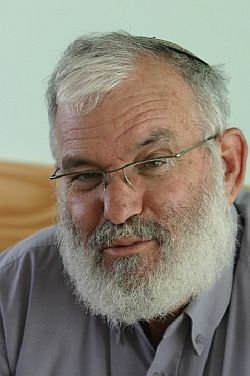 Israel’s Prime Minister Binyamin Netanyahu has reportedly decided to appoint an ultra-hawk, one of Israel’s leading national-religious icons, as his new national security adviser.