Monthly Archives: March 2011

Permanent temporariness

Alastair Crooke writes:

It was in 2003 that I realised something fundamental had changed. The door to the room in which I was sitting flew open. In stalked a figure still dressed in a dark overcoat and scarf. He evidently could contain himself no longer. I was in Downing Street with the prime minister’s foreign affairs adviser, David Manning; the overcoated figure bursting into our meeting was Jack Straw. He wanted to tell Manning that he had persuaded Joschka Fischer, the German foreign minister, to add Hamas to the EU list of terrorist movements. His tale of his conversion of Fischer was wrapped in expressions of outrage at Hamas. It wasn’t so much the proscription that shocked me. A ceasefire, which I had helped facilitate, had broken down. What was new was the elation with which Straw greeted the banning. I don’t know what Manning thought, but he will have been aware that the terrorist ‘list’ is one of those things from which it’s almost impossible to get a name removed. The consequences for diplomacy, for the politics of peace-making, would be profound, possibly irreversible; but Straw wasn’t worried. Manning, I knew, believed strongly that there could be no solution to the Israel-Palestine issue without Hamas involvement and had firmly supported EU efforts at inclusive peace-building. Officially, the EU remained committed to a political solution, but it now seemed that two key member states were heading in the opposite direction – towards a militarised resolution. The wind had changed.

There had already been hints that a political solution was no longer at the forefront of Whitehall thinking. Not long before, a senior British official had told me bluntly that my methods of building popular consent – holding ‘town hall’ meetings with all factions, working with Hamas, shuttling between Palestinians on the ground and President Arafat to ensure broad participation and continued momentum – were passé. We were in a new era, and it required new thinking: ‘The road to Jerusalem now passes through Baghdad,’ the official insisted. He was speaking just before the 2003 invasion. The message was clear: the Islamic resistance in Palestine was to be neutralised, and psychologically defeated, by the massive display of Western force in Iraq, rather than brought into the political process. Britain and the US expected that the chastened Palestinians would then make the necessary concessions to Israel. What was striking was the official’s conviction that such an outcome was inevitable.

These were heady days for American and British officials and enthusiasm for the ‘war on terror’ was soaring. At our first meeting, Manning’s Downing Street successor, Nigel Sheinwald, told me angrily that security in Palestine could be achieved by eradicating the ‘virus’ of Hamas from Gaza, and eliminating its ‘disease’ from the region. He had no interest in helping to create legitimate Palestinian security services, representative of a cross-section of the community. The language was Washington’s. The Palestinian conflict was seen not as a problem in its own right, but as a subset of a war against ‘extremism’ – another domino to be pushed over in order to strengthen the ‘moderates’. A senior Israeli intelligence official later told me, privately, that he believed the change had begun in earnest in September 2003, after Arafat forced Mahmoud Abbas – a favoured figure in Washington – to resign as prime minister. Angry and frustrated, Bush called Blair. He complained that the Europeans ‘were dancing around Arafat’, while the US was left to do the ‘heavy lifting’ with Israel. Bush also complained that he did not see peace-building as compatible with his ‘war on terror’. Al-Jazeera’s recent release of the Palestine Papers has cast some light on all this: the documents include copies of British covert plans from 2003 and 2004 to ‘degrade’ the capabilities of opponents to the Palestinian Authority, to disrupt their communications, intern their members, close their civil and charitable organisations, remove them from public bodies, and seize their assets. Blair had set aside the lessons of peace-building, so recently learned in Northern Ireland, and embraced the doctrine of counter-insurgency.

The shift in the British position, under American pressure, sabotaged European policy. It undermined the EU’s commitment to promoting Palestinian unity by suppressing, at the covert, security level, opposition to the PA, removing from Palestinian institutions not only all members of Hamas and Islamic Jihad but even those elements in Fatah who had been involved in the second intifada. From now on, the EU would ‘talk the talk’ of encouraging Palestinian unity, while several of its most prominent member states were ‘walking the walk’ of a security-led repression of the very movements the EU was trying to encourage into the political arena. The result was that when Hamas – rather than being demoralised or psychologically defeated by shock and awe in Baghdad – comfortably won the 2006 Palestinian parliamentary elections, the EU was forced into a militarised security response. The new commitment to counter-insurgency meant that there was no prospect of exploring the political possibilities of Hamas’s win. After the election the UN envoy to the Middle East, Alvaro de Soto, wrote a memo to the UN secretary general complaining that the conditions for entering into a dialogue with Hamas had been deliberately set so that Hamas would be unable to meet them – thus engineering its exclusion. De Soto resigned from the UN soon afterwards.


Facebooktwittermail

The fight for Libya

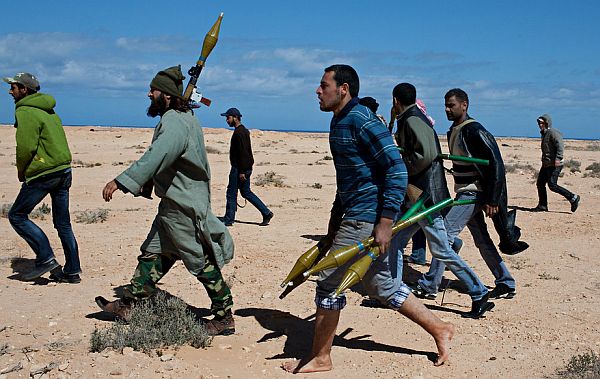
Chris McGreal reports from Ras Lanuf, where thousands of young volunteers now provide the bulk of the rebel force that has swept along Libya’s eastern coast:

Gaddafi’s air force has bombed Ras Lanuf repeatedly, cutting off the town’s water supply on Tuesday and destroying housing. On Monday the victims included a civilian, Mohammed Ashtal, who was killed with three of his children when an air strike hit their car.

The bombing has put the inexperienced fighters on edge as they constantly scan the sky for planes. Every now and then a shout goes up. Someone claims there is a MiG jet. No one can see it but hundreds of weapons let loose in a futile wave of fire in every direction. Young men swivel anti-aircraft guns, letting go bursts of shells with a deadening thud. Kalashnikov bullets pop furiously.

Not long after one such false alarm, the young fighters raced out of town towards the front despite the pleas of their more experienced commanders to maintain their defensive lines and positions guarding a nearby oil refinery.

It was all very worrying for Fathi Mohammed, torn between admiration of young men willing to risk their lives in pursuit of freedom and despair at their lack of discipline. The 46-year-old former captain in Gaddafi’s special forces is trying to instil some organisation in the bands of fighters who have descended on Ras Lanuf.

“They’re not under control,” he said. “Some of these guys, they just took guns from the military camp in Benghazi and came here without anyone knowing what they are doing. We are trying to make them into organised teams but it’s not easy.”

Rajab Hasan, another former soldier tasked with training, chipped in: “They need a leader. We don’t have enough leaders.”

Mohammed expressed his concern at the implications of all this carefully. The rebel army has done well until now, advancing and then staving off attempts by Gaddafi’s forces to break through. But he acknowledged that the rebels could face a problem if its enemy is able to launch a sustained attack.

Mohammed does not want to concede that defeat might be a possibility, even though a rumour has swept the rebels that Gaddafi is amassing tanks for a frontal assault. But he does recognise that victory is not certain. “It’s not impossible to get to Tripoli. If God is with us,” he said. Still, Mohammed does not question the courage of the young fighters. “They are brave. They have the courage. It’s a popular war. There’s a lot of enthusiasm.”

The New York Times reports:

In less than three weeks, an inchoate opposition in Libya, one of the world’s most isolated countries, has cobbled together the semblance of a transitional government, fielded a ragtag rebel army and portrayed itself to the West and Libyans as an alternative to Col. Muammar el-Qaddafi’s four decades of freakish rule.

But events this week have tested the viability of an opposition that has yet to coalesce, even as it solicits help from abroad to topple Colonel Qaddafi’s government.

Rebels were dealt military setbacks in Zawiyah and the on outskirts of Ras Lanuf on Tuesday, part of a strengthening government counteroffensive. Meanwhile, the oppostion council’s leaders contradicted one another publicly. The opposition’s calls for foreign aid have amplified divisions over intervention. And provisional leaders warn that a humanitarian crisis may loom as people’s needs overwhelm fledgling local governments.

“I am Libya,” Colonel Qaddafi boasted after the uprising erupted. It was standard fare for one of the world’s most outrageous leaders — megalomania so pronounced that it sounded like parody. It underlined, though, the greatest and perhaps fatal obstacle facing the rebels here — forging a substitute to Colonel Qaddafi in a state that he embodied.

“We’ve found ourselves in a vacuum,” Mustafa Gheriani, an acting spokesman for the provisional leadership, said Tuesday in Benghazi, the rebel capital. “Instead of worrying about establishing a transitional government, all we worry about are the needs — security, what people require, where the uprising is going. Things are moving too fast.”

“This is all that’s left,” he said, lifting his cellphone, “and we can only receive calls.”

The question of the opposition’s capabilities is likely to prove decisive to the fate of the rebellion, which appears outmatched by government forces and troubled by tribal divisions that the government, reverting to form, has sought to exploit. Rebel forces are fired more by enthusiasm than experience. The political leadership has virtually begged the international community to recognize it, but it has yet to marshal opposition forces abroad or impose its authority in regions it nominally controls.

The Guardian reports:

Nato has launched 24-hour air and sea surveillance of Libya as a possible precursor to a no-fly zone, amid signs of growing Arab support for western military intervention to stop the bombing of civilians.

British and French diplomats at the UN headquarters in New York have completed a draft resolution authorising the creation of a no-fly zone which could be put before the security council within hours if aerial bombing by pro-Gaddafi forces causes mass civilian casualties.

“It would require a clear trigger for a resolution to go forward,” a western diplomat said. In such an event, there would be pressure on Russia and China not to use vetoes. Western officials believe support for a no-fly zone from the Islamic world, as well as from the Libyan opposition and Libyan diplomats at the UN, would put Moscow and Beijing on the defensive.

The Gulf Co-operation Council, the Organisation of the Islamic Conference and the secretary general of the Arab League have called for the protection of Libyan civilians while rejecting the intervention of western ground troops. Turkey, the most reluctant Nato member state, has relaxed its opposition and allowed contingency planning to go ahead.

The decision to step up air and sea monitoring was taken on Monday by the North Atlantic Council, a meeting of ambassadors from Nato’s 28 member states.

Foreign Policy reports:

The State Department believes that supplying any arms to the Libyan opposition to support their struggle against Col. Muammar al-Qaddafi would be illegal at the current time.

“It’s very simple. In the U.N. Security Council resolution passed on Libya, there is an arms embargo that affects Libya, which means it’s a violation for any country to provide arms to anyone in Libya,” State Department spokesman P.J. Crowley said on Monday.

Crowley denied reports that the United States had asked Saudi Arabia to provide weapons to the Libyan opposition, and also denied that the United States would arm opposition groups absent explicit international authorization.

Pressed by reporters to clarify whether the Obama administration had any plans to give arms to any of the rebel groups in Libya, Crowley said no.

“It would be illegal for the United States to do that,” he said. “It’s not a legal option.”

Crowley’s blanket statement seemed to go further than comments on Monday by White House spokesman Jay Carney, who said, “On the issue of … arming, providing weapons, it is one of the range of options that is being considered.”

The New York Times reports:

As wealthier nations send boats and planes to rescue their citizens from the violence in Libya, a new refugee crisis is taking shape on the outskirts of Tripoli, where thousands of migrant workers from sub-Saharan Africa have been trapped with scant food and water, no international aid and little hope of escape.

The migrants — many of them illegal immigrants from Ghana and Nigeria who have long constituted an impoverished underclass in Libya — live amid piles of garbage, sleep in makeshift tents of blankets strung from fences and trees, and breathe fumes from a trench of excrement dividing their camp from the parking lot of Tripoli’s airport.

For dinner on Monday night two men killed a scrawny, half-plucked chicken by dunking it in water boiled on a garbage fire, then hacked it apart with a dull knife and cooked it over an open fire. Some residents of the camp are as young as Essem Ighalo, 9 days old, who arrived on his second day of life and has yet to see a doctor. Many refugees said they had seen deaths from hunger and disease every night.

The airport refugees, along with tens of thousands of other African migrants lucky enough to make it across the border to Tunisia, are the most desperate contingent of a vast exodus that has already sent almost 200,000 foreigners fleeing the country since the outbreak of the popular revolt against Col. Muammar el-Qaddafi nearly three weeks ago.

Libya’s Interim Transitional National Council now has a website with this introductory statement:

In this important historical juncture which Libya is passing through right now, we find ourselves at a turning point with only two solutions. Either we achieve freedom and race to catch up with humanity and world developments, or we are shackled and enslaved under the feet of the tyrant Mu’ammar Gaddafi where we shall live in the midst of history. From this junction came the announcement of the Transitional National Council, a step on the road to liberate every part of the Libyan lands from Aamsaad in the east to Raas Ajdair in the west, and from Sirte in the north to Gatrun in the south. To liberate Libya from the hands of the tyrant Mu’ammar Gaddafi who made lawful to himself the exploitation of his people and the wealth of this country. The number of martyrs and wounded and the extreme use of excessive force and mercenaries against his own people requires us to take the initiative and work on the Liberalization of Libya from such insanities.

To reach this goal, the Transitional National Council announced its official establishment on 5th March 2011 in the city of Benghazi, stating its perseverance towards the aim of relocating its headquarters to our capital and bride of the Mediterranean, the city of Tripoli.

To connect with our people at home and abroad, and to deliver our voice to the outside world, we have decided to establish this website as the official window of communication via the world wide web.

May peace and God’s mercy and blessings be upon you
Long live Libya free and dignified

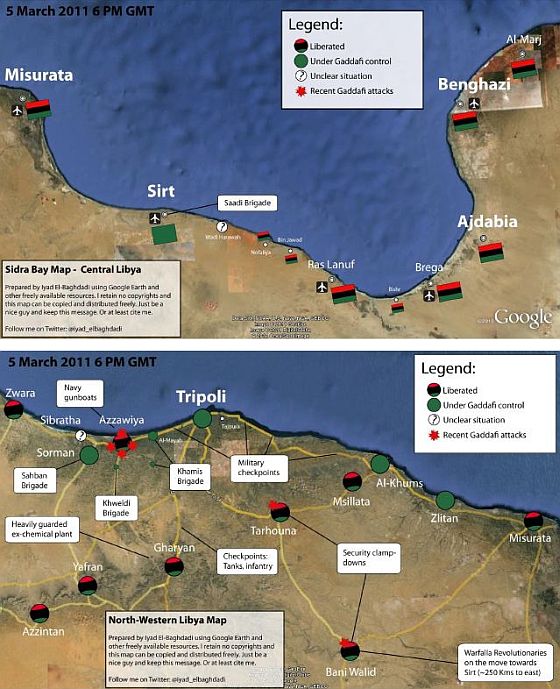
Map of the revolution:

Facebooktwittermail

Obama’s mistake in Libya

Christopher Dickey writes:

President Barack Obama and European heads of state are enthralled spectators to events on the ground in Libya, waiting and watching for the first real massacre. Once that happens—once they allow that to happen, standing by as Muammar Gaddafi loyalists with air power and tanks slaughter scores of civilians—then Western leaders may actually feel they have enough political cover to get involved. Actually, it would be better from the Obama-Cameron-Sarkozy point of view if hundreds of civilians get killed. Anything less, it would seem, and it’s a no-go even for a no-fly zone.

That is what British Foreign Minister William Hague is saying when he talks about “a clear trigger” and “a demonstrable need that the whole world can see” before a no-fly option can be hammered through the U.N. Security Council. That’s what President Obama had in mind when he warned Gaddafi on March 3 that “those who perpetrate violence against the Libyan people will be held accountable.” He was talking, you will note, about retribution after the fact.

The American military, meanwhile, is so damn tremulous at the prospect of a military engagement in Libya that Gen. David Petraeus and Defense Secretary Robert Gates were caught by an open mic on Monday making an ironic joke when Gates landed in Afghanistan:

“Flying a little bigger plane than normal,” said Petraeus. “You gonna launch some attacks in Libya or something?”

“Heh-heh, yeah,” Gates chuckled. “Exactly.” Nothing could be farther from his intentions.

Given all the lessons learned far too late in Afghanistan and Iraq since 2003, one can understand the reticence of the uniformed services. But, in fact, the explanations given for caution about imposing a no-fly zone in this case are mistaken, if not willfully misleading, on just about every count. When I read a blind quote from a White House staffer in Tuesday morning’s New York Times saying Obama “keeps reminding us that the best revolutions are completely organic,” I tried to convince myself our learned head of state is not, in fact, such a fool as his staffer. Organic? Meaning totally home-grown and self-sustaining? Ask the French, for instance, how “organic” the American Revolution really was.

If we Westerners are worried about popular sentiment in the Arab world, which would be something novel for us, then the opinion we need to satisfy should be that of the young people in the streets who have risen against their dictators. They represent, after all, some two-thirds of the region’s population.

“We’ll be watching carefully to make sure we’re on the right side of history,” Obama told us last week. But then he equivocated, as usual, saying the U.S had to take “all the various equities into account.” Those are not exactly inspiring words to protesters in Libya literally begging for international protection from Gaddafi’s air force. “We don’t want a foreign military intervention, but we do want a no-fly zone,” as one rebel fighter told the Associated Press. “We are all waiting for one.” The rebels can take on “the rockets and the tanks,” he said, “but not Gaddafi’s air force.” The longer the West wrings its hands while the Libyan protesters-turned-rebels twist in the wind, the more the West will be resented, not applauded.

Facebooktwittermail

Zero hour in Benghazi

Nicolas Pelham writes:

Two and a half weeks after shrugging off Colonel Qaddafi’s dictatorship, the rebels are continuing their carnival outside the courthouse in Benghazi, the city on Libya’s east coast where they have made their headquarters. Roaring crowds taunt Qaddafi to send his planes and tanks, and promise to brave them as they did his anti-aircraft guns. Mannequins with military boots swing from lampposts, enacting the colonel’s hanging. Cartoon graffiti of him as Abu Shafshufa—literally “father of the fuzzy hair”—cover the surrounding walls. And in cafes broadcasting Arabic news, Qaddafi’s appearance triggers cries of zanga, zanga, or dead-end.

Western civil rights movements had Jim Morrison’s “Five to One”: “The old get the old and the young get stronger. They’ve got the guns, but we’ve got the numbers. Gonna win, yeah we’re takin’ over. Your ballroom days are over, baby.” Benghazi’s version is Adil Mshaitil, a 37-year-old Islamist doctor and former inmate of Qaddafi’s jails studying in London whose recordings have likewise become anthems for the Libyan uprising. “We’ll stay here until our pain disappears,” sings his voice—pure, pietist, and unaccompanied—against the backdrop of hooting and gunfire. “We will come alive and sweetly sing. Despite all the vengeance, we will reach the summit and scream to the heavens. We’ll stand together with balm and a pen.”

Volunteers have replaced the authoritarian government. Stalls have sprouted across the forecourt of the rebel headquarters, serving free cups of macchiato, the ubiquitous legacy of Italy’s colonialism. Nine-year-old boys patrol the crawling traffic, cautioning drivers to buckle their seatbelts. Their brothers guard the central bank, and mow the lawns. Salim Faitouri, an oil engineer until the uprising began, has been supervising a catering operation that prepares hot meals for demonstrators and Benghazi’s poor.

The rebels’ euphoria waxes and wanes with news from the violent front—now about halfway between Benghazi and the Libyan capital Tripoli to the west—and their own efforts to forge a new governing authority. Thanks to his brutality, Colonel Qaddafi has successfully turned the democracy uprising into a war in which, while the rebels have higher morale, he has the most money and arms. By killing many times more people than died in Egypt’s uprising—in a population less than a tenth the size—he has slowed the rebellion, something that neither Tunisia’s nor Egypt’s erstwhile leaders could achieve.

But unlike the uprisings in Egypt and Tunisia, the revolt in Benghazi and across eastern Libya is fully fledged. Qaddafi’s revolutionary committees, people’s congresses, and security apparatus have disbanded, offering no interim stopgap. Even transitional institutions have to be built from scratch, by a population that for forty years has been severed from governing norms, and before that took lessons from Italian fascism.

The east now has a National Transitional Council, which claims authority over the remnants of the armed forces and which is led by the former justice minister Mustafa Abdel Jalil. But many in the youth revolution consider the slight elderly former judge with an old-timer’s red felt hat too old-school. In the first days of their uprising, he was still in Qaddafi’s government; he defected on February 21, after protesting the colonel’s “excessive use of violence” against protesters. Aside from Abdel Jalil, all but six of the council’s members have refused to identify themselves for fear of reprisals and the council despite promises of transparency meets behind closed doors. Its first newspaper is as partisan and sycophantic as those it replaced.

Supporters emphasize Abdel Jalil’s revolutionary credentials, but it is unclear whether he can fill the vacuum. Beyond the courthouse, government departments and schools have yet to open. And despite the council’s goading, many shops, police stations, and military bases remain shuttered, apparently because their proprietors are still hedging their bets. Though there has been little crime, frequent gunfire punctures Benghazi’s nights.

Some speak of a lurking hidden paw of the colonel. “His revolutionary committees come out at night and shoot randomly,” says a National Transitional Council member. Businessmen receive warnings by text message. People who previously gave me their names are now asking that they be retracted. “Qaddafi has lived with us for so long, he entered our hearts,” apologizes an oil engineer talking oil politics. In a traffic jam, a car pulls up alongside mine and a Qaddafi loyalist reprimands my driver after eavesdropping. “We are all Muammar,” the driver obediently responds, curtailing his anti-Qaddafi tirade. In an alleyway of Benghazi’s old city, a tailor who normally stitches abayas—black tunics for women—shrinks when asked why he is now sewing rebel flags. “I have to make money,” he apologizes, and clams up.

Their fears are not unfounded. Though it has lost its buildings, Qaddafi’s internal security apparatus remains at least partially in place. Hotel receptionists subserviently field calls from a regime informer seeking information about al-Jazeera. Intruders broke into one of the very few European consulates still open here, stole its computers, and warned the consul, who had lived for two decades in the city, to flee. In this highly centralized state in which communications are routed through Tripoli, the Qaddafis still retain control over the Internet, which they can flick off with a switch—as they did on the afternoon of March 3 (it remains off)—and over both mobile phone companies. Mohammed Qaddafi, the colonel’s eldest son, owns all three. As the colonel noted in a recent speech, “it’s my country.”

Facebooktwittermail

For just an extra $20 billion from US taxpayers, Israel can offer “stability” in defense against the Arab democratic threat

The Wall Street Journal reports:

Israel will need to boost military spending and may seek an additional $20 billion in U.S. security assistance to help it manage potential threats stemming from popular upheavals in the Arab world, Defense Minister Ehud Barak said Monday.

Still, he said Israel shouldn’t fear changes in the region or the risk of offering bold concessions in a renewed bid to achieve peace with the Palestinians.

“It’s a historic earthquake…a movement in the right direction, quite inspired,” Mr. Barak said in an interview with The Wall Street Journal, surveying the youthful revolts in Egypt, Tunisia, Libya and the Gulf. “It’s a movement of the Arab societies toward modernity.”

In the short term, however, Israel worries that adversaries Iran and Syria “might be the last to feel the heat” of regional unrest, he said, and that public pressure could push new leaders in Egypt away from that country’s 1979 peace treaty with the Jewish state.

“The issue of qualitative military aid for Israel becomes more essential for us, and I believe also more essential for you,” said Mr. Barak, a former prime minister. “It might be wise to invest another $20 billion to upgrade the security of Israel for the next generation or so….A strong, responsible Israel can become a stabilizer in such a turbulent region.”

Facebooktwittermail

Egypt’s syndicalist future?

Nathan Brown writes:

What Egyptians have termed their “revolution” is now beginning to look like one. Seen from afar, it appears that the military rulers have struggled successfully to hold most state institutions intact and slow the pace of change, but the Egyptian political order is still being fundamentally rewritten. The core constitutional demands of a diverse opposition-for freer and more democratic politics-are not being silenced or diverted.

Yet if Egyptians will find their political system freer, it may not be in a fully liberal sense. There is already far greater pluralism and greater freedom of both expression and organization. Such trends are likely to entrench themselves more deeply. But from a purely institutional perspective, something else seems to be happening as well: a variety of strong actors are escaping from presidential control and finding their own voices. Egypt was always a state of strong institutions–when seen from the bottom up. From the top down, all those institutions have been dominated by a strong presidency. Labor unions, professional associations, parts of the judiciary, the parliament, large parts of the press, the military, the security apparatus, the ruling party, and even legal opposition parties have all been silenced, brought to heel, or remolded to serve presidential will. With the presidency vacant and Egypt now ruled by a military committee that governs by Facebook posts and short communiqués, all those institutions are now struggling to act on their own. And leaders within those bodies too associated with the old ways are coming under intense pressure and many may be tossed out. In many of Egypt’s institutions, mini-revolutions seem to be brewing against leaders who had been co-opted into cravenly serving the president.

The emerging outcome of Egypt’s revolution thus might be as much syndicalist as liberal. “Syndicalism” is a dimly remembered term at best, referring to a way of organizing society in strong and autonomous (generally class-based) constituencies; it was a leftist ideology that served as an alternative to communism and sometimes merged with anarchism. But Egypt’s syndicalism-as it is emerging-is neither fully leftist nor entirely class based. It is anything but anarchic. And its driving force is not a nineteenth century European ideology but a twenty-first century sense that those who have exercised political and economic power have done so only in their own personal interests; this is seen as a time to make them responsive instead to the needs of various groups in society.

Facebooktwittermail

Saudi Arabia is losing its fear

Eman Al Nafjan writes:

In Riyadh the mood is tense; everyone is on edge wondering what will happen on Friday – the date the Saudi people have chosen for their revolution. The days building up to Friday so far have not been as reassuring as one would like.

On 4 March, there were protests in the eastern region and a smaller protest here in Riyadh. The protests in the eastern region were mainly to call for the release of Sheikh Tawfiq al-Amer, who had been detained after giving a sermon calling for a constitutional monarchy.

The protest in Riyadh was started by a young Sunni man, Mohammed al-Wadani, who had uploaded a YouTube video a few days before, explaining why the monarchy has to fall. After the protests, 26 people were detained in the eastern region and al-Wadani was taken in soon after he held up his sign near a major mosque in Riyadh.

It’s not just the people who are on edge; apparently the government is also taking this upcoming Friday seriously. Surprisingly, Sheikh Amer was released on Sunday, while usually political detentions take much longer.

All this week, government agencies have been issuing statements banning protests. First it was the interior ministry that promised to take all measures necessary to prevent protests. Then the highest religious establishment, the Council of Senior Clerics, deemed protests and petitions as un-Islamic. The Shura Council, our government-appointed pretend-parliament, also threw its weight behind the interior ministry’s ban and the religious decree of prohibition. But you can’t blame the clerics or the Shura for making these statements – the status quo is what’s keeping them in power and comfortable.

Facebooktwittermail

How the West can tip the balance towards a free Libya

Aziz Meshiea, a Libyan reader of War in Context writes on his blog:

Qaddafi’s support inside the country is so wafer-thin and dependent on his ability to show continued strength in suppressing any resistance, is a pretty well understood fact inside the country.

As a Libyan myself, I see anti-interventionist essays and it truly irritates me. So here is a short list of what would be welcomed by Libyan’s trying to defeat Qaddafi.

1. A no-fly zone would NOT give Qaddafi more support but LESS. The mere idea that Western force will aid rebels will increase the rate at which his “followers” will defect to what they see as the winning side. The same can be said for targeted bombings, a tactic already called for by leaders of the rebel army.

2. As the NYT (http://www.nytimes.com/2011/03/05/opinion/05Gonzales.html) recently suggested communications for the rebels can be boosted by flying signal re-routers an boosters allowing the rebels to coordinate attacks and defense against the better equipped Government forces.

3. Similar to #2, jamming Government military communications would also be feasible and can be done from many miles away effectively blinding the fixed-wing forces and potentially handicapping the attack coordination of the government forces

4. Jam and disable all state media broadcasts especially but not limited to Libyan State TV. This would seriously hamper Qaddafi’s effort to demoralize the people in Tripoli who, like their brothers and sisters outside, would vastly prefer a nation without Qaddafi within it. This has the added advantage of silencing the Idiot Dictator.

None of the above suggestions would likely cost a single foreign life, would not involve foreign intervention on the ground and would greatly improve relations between the New Arab world and the West.

How anyone can argue [for] a hands-off approach in Libya, where the side of despotism is vastly better equipped and vastly more ruthless than any other Arab regime, is beyond me.

Facebooktwittermail

The fight for Libya

Reuters reports Gaddafi may be looking for a way out:

Al Jazeera said Gaddafi had proposed to Libyan rebels to hold a meeting of parliament to pave the way for him to step down with certain guarantees.

It said Gaddafi made the proposal to the interim council, which speaks for mostly eastern areas controlled by his opponents. It quoted sources in the council as saying Gaddafi wanted guarantees of personal safety for him and his family and a pledge that they not be put on trial.

Al Jazeera said sources from the council told its correspondent in Benghazi that the offer was rejected because it would have amounted to an “honorable” exit for Gaddafi and would offend his victims.

The London-based daily Asharq al-Awsat and the daily al-Bayan, based in the United Arab Emirates, also cited unnamed sources as saying Gaddafi was looking for an agreement.

A source close to the council told Reuters he had heard that “one formula being proposed by the other side would see Gaddafi hand power to the head of parliament and leave the country with a certain guaranteed sum of money.”

“I was told that this issue of money is a serious obstacle from the national council’s point of view,” he said, adding that his information came from a single source close to the council.

Essam Gheriani, a media officer for the council, said: “No such offer has been put to the council as far as I am aware.”

Haaretz reports:

Long-time Libyan leader Muammar Gadhafi said Monday in an interview with TV network France 24 that his violent crackdown on opposition protesters is akin to Israel’s efforts to defend itself from extremism during its 2009 Gaza war against Hamas.

Libya has come under international scrutiny in recent weeks, in response to violent clashes between the Libyan military and anti-Gadhafi rebels, confrontations which caused what are estimated to be hundreds of deaths.

On Monday, UN Secretary General Ban Ki-moon dispatched a team to Tripoli to assess the humanitarian situation in the wake of the Libyan crisis, criticizing the Libya military’s “disproportionate use of force.”

Speaking with France 24 later Monday, however, Gadhafi defended his military’s right to oppress rebel activity, comparing his crackdown to Israel’s war against Hamas in the Gaza Strip in 2009, saying that “even the Israelis in Gaza, when they moved into the Gaza strip, they moved in with tanks to fight such extremists.”

Abigail Hauslohner reports from Ajdabiyah:

The provisional government in Benghazi says it needs time and reinforcements but insists that it is making progress nonetheless. To oversee the ramshackle force, the newly formed National Council appointed a Defense Minister, Omar Hariri, a former general who led an unsuccessful revolt against Gaddafi in 1975. Military officers in Benghazi says Hariri’s appointment will signal a shift to a more organized fighting force.

For the moment, the motley army has an overwhelming, undisciplined spirit in the place of military organization. The young men whoop and yell and set off celebratory gunfire with the slightest excuse. At a checkpoint in Brega on March 4, a blast of heavy machine-gun fire shattered the desert silence even as some men tried to restrain the exuberance of their younger compatriots. Wanis Kilani, an engineer turned volunteer fighter, shakes his head at the chaos. “So much ‘Blah blah blah,’ ” he says. “You know, we can’t prevent them from coming here because they all want to help — even the crazy, the young, even sick people want to help.” He explains, mostly to himself, that it’s a people’s army coming together. “We are not rebels,” he says. “We are mujahedin.”

The word is a loaded one for Westerners, a reminder of the holy warriors of Afghanistan who turned from fighting the Soviet Union to aiding Osama bin Laden. But it bears weight in liberated east Libya as well. Islamic scholars here have said that pious Muslim men in particular were persecuted under Gaddafi, and they may yet be a vocal and determined force in the fight to bring down the dictator. “He tried to stop people from going to dawn prayer because people who do this are very devout,” says Sheik Abdel Hamid Ma’toub, a religious leader in Benghazi. “He knows that the most dangerous people in Libya are those who go to dawn prayers.” That’s because, he says, the men who pray fear God, not Gaddafi.

Caught on open mic: Petraeus and Gates joke about attacking Libya

Facebooktwittermail

Obama is the change Bush could believe in

Thanks to Antony Loewenstein for the headline.

Politico reports:

The Obama administration, which famously pledged to be the most transparent in American history, is pursuing an unexpectedly aggressive legal offensive against federal workers who leak secret information to expose wrongdoing, highlight national security threats or pursue a personal agenda.

In just over two years since President Barack Obama took office, prosecutors have filed criminal charges in five separate cases involving unauthorized distribution of classified national security information to the media. And the government is now mulling what would be the most high-profile case of them all – prosecuting WikiLeaks founder Julian Assange.

That’s a sharp break from recent history, when the U.S. government brought such cases on three occasions in roughly 40 years.

The government insists it’s only pursuing individuals who act with reckless disregard for national security, and that it has an obligation to protect the nation’s most sensitive secrets from being revealed. Anyone seeking to expose malfeasance has ample opportunity to do so through proper channels, government lawyers say.

But legal experts and good-government advocates say the hard-line approach to leaks has a chilling effect on whistleblowers, who fear harsh legal reprisals if they dare to speak up.

Not only that, these advocates say, it runs counter to Obama’s pledges of openness by making it a crime to shine a light on the inner workings of government – especially when there are measures that could protect the nation’s interests without hauling journalists into court and government officials off to jail.

The New York Times reports:

President Obama reversed his two-year-old order halting new military charges against detainees at Guantánamo Bay, Cuba, on Monday, permitting a resumption of military trials under rules he said provide adequate rights for defendants but implicitly admitting the failure for now of his pledge to close the prison camp.

Mr. Obama said in a statement he remains committed to closing Guantánamo some day and to charging some terrorist suspects in civilian criminal courts, as occurred throughout the administration of George W. Bush administration and has continued under Mr. Obama. But Congress has blocked the transfer of prisoners from Guantánamo to the United States for trial, undermining at least for the time being the administration’s plan to hold civilian trials for Khalid Shaikh Mohammed, the chief planner of the Sept. 11 attacks, and other accused terrorists.

An executive order signed by the president on Monday sets out new rules requiring a review of all detainees’ status within a year and every three years after that to determine whether they remain a threat to Americans. The order also requires compliance with the Geneva Conventions and the international treaty that bans torture and inhumane treatment.

Civil liberties advocates, who had been expecting the moves since they were forecast in an article in The New York Times in January, expressed deeply mixed feelings about the new policies. On the positive side, some said that the executive order may permit detainees imprisoned for years without trial to have their cases heard and potentially settled by plea agreement. In addition, the executive order avoids enshrining a system of indefinite detention in law and is restricted to the 172 prisoners currently held at Guantánamo.

But Elisa Massimino, president of Human Rights First, said that despite those factors, the continuation of detention at Guantánamo and military commissions more than two years after Mr. Obama took office is a disappointment.

“This is a step down the road toward institutionalizing a preventive detention regime,” Ms. Massimino said. “People in the Mideast are looking to establish new rules for their own societies, and this sends a mixed message at best.”

Facebooktwittermail

Intifada update

Storming Egypt State Security
The video speaks for itself. We stormed into the notorious political police main HQ in Cairo after the authorities didn’t dismantle the apparatus. We did it ourselves.

The end of the video shows an former Islamist detainee who discovered an electric torture tool explaining how he was tortured on it.

Glory to the martyrs of the Egyptian Revolution. (Mohamed Abdelfattah)

Hamas makes first contact with new Egyptian leaders
Gaza’s Hamas rulers on Monday contacted Egypt’s new leadership for the first time since a popular revolt toppled Hosni Mubarak from power last month, a statement from the Islamist group said.

Hamas leader in Gaza Ismail Haniyeh telephoned Egypt’s new Prime Minister Essam Sharaf to congratulate him on his post and urged him to help lift an Israeli blockade of the coastal territory, a statement from Haniyeh’s office said.

Gaza shares a border with Israel and Egypt. Both countries have limited the movement of people and goods into and from Gaza since Hamas seized the territory in 2007, a policy which has crippled the enclave’s economic growth. (Reuters)

West Bank wind of change
The PLO leadership called for a Day of Rage across the occupied territories on 25 February, following the US veto of a United Nations Security Council resolution one week earlier condemning Israel’s continued settlement building. It sought thereby to deflect growing discontent at the Palestinian Authority (PA) and direct indignation at the US for protecting Israel. Though Hamas also condemned the veto, Gaza remained calm.

In Hebron, a thousand turned out to protest against the Jewish settlements in the heart of the city, clashing with Israeli soldiers (IDF); as the protests spread, the PA sent in their riot police to help the IDF. In Ramallah, the PA failed to mobilise support for their Day of Rage. A day earlier, Palestinian youth had already taken to its streets, in a separate protest, to demand national unity between the PA and Hamas. Scuffles broke out between supporters of PA president Mahmoud Abbas and Palestinians demanding an end to the Oslo accords.

After the regimes in Egypt and Tunisia fell, the PA had moved quickly to counter the spreading wave of people power. Al-Jazeera’s release of the leaked “Palestine papers” in January, exposing a relationship between the Palestinian leadership and Israel based on concessions to, and collusion with, the occupation, had already undermined PA legitimacy. The PA watched nervously as Egypt’s president Hosni Mubarak was forced from office, and adopted a policy of containment. The chief PLO negotiator Saeb Erekat resigned, Abbas declared there would be presidential and legislative elections by September, and prime minister Salam Fayyad dissolved his cabinet.

According to PA spokesman Ghassan Khatib, Erekat’s departure was in response to the Palestine papers, not the events in Egypt. Khatib explained that there was a vast difference between the Palestinian situation and the rest of the region: “The cabinet reshuffle was overdue but the events in Egypt sped it up. Here it’s not the same as elsewhere; there is a democratic process that has been disrupted by occupation and the internal division” between competing authorities in the West Bank and Gaza.

Though the call for elections suggests the PA’s concern to move with the winds of change, Khatib said it had other intentions: “President Abbas didn’t imagine elections in the West Bank without Gaza. For elections to happen in Gaza, it would require national unity, and I think the chances of that are very low.” The call for elections – a show of intent, not a decree – was “an attempt by the PLO to put pressure on Hamas to go ahead and allow elections in Gaza”. (Joseph Dana and Jesse Rosenfeld)

In Tunisia, political ambiguity breeds violence
Tunisia vibrated with palpable euphoria in the days after mass protests forced Zine El Abidine Ben Ali to decamp to Saudia Arabia.

A few short weeks on, utopic expectations of a sweeping break with the old regime are colliding with concerns that the country is edging towards political and economic crisis.

“There’s a big discussion underway between those that are concerned that genuine revolution be realised, and those that are really concerned that the power vacuum will lead to chaos,” says Michael Willis, a lecturer at Oxford University’s School of Oriental Studies.

Tunisians are split into two general camps: what might be called the ‘idealists,’ who refuse to rest until every last relic of the old regime has been stripped away, and the ‘realists” who fear that, however imperfect and in need of reform the existing institutions may be, instability and lack of governance could open the way for either the military or the barely-ousted regime to take power.

The idealist group includes a tactical alliance of Islamists, trade unionist and far-left groups, while the reformers include centre-left opposition parties, conservatives, former allies of Ben Ali and independents who have stepped into the political sphere for the first time.

Until the deadlock between the two sides is bridged, the country is floating in a state of limbo.

Lurking in the shadows, both groups are quick to say, are Ben Ali loyalists poised to profit from any ambiguity to re-establish their political might. Each side accuses the other of being infiltrated by former members of the recently disbanded RCD (Constitutional Democratic Rally) party. (Al Jazeera)

Facebooktwittermail

Is a no-fly zone what Libyans want?

Jerry Haber observes:

[L]iberal interventionists are highly selective in their moral outrage, and … suffer from a “Saving-Private-Ryan” complex – they will intervene to save people with whom they identify, people on their side. But if the civilians happen to be on other the side of their tribal divide, they become silent.

Indeed. None of those now calling for a no-fly zone over Libya have called for a no-fly zone over Gaza. The difference clearly hinges on whether one has a greater affiliation with those dropping the bombs or those getting bombed.

But does this shed any light on the question of whether a no-fly zone should be enforced over Libya? Not really.

If we reduce such questions to questions of affiliation then all we will ever do is look to see where “my people” stand. If enough progressives start calling for a no-fly zone, then suddenly it becomes the right thing. But if its advocates are all neocons or neo-liberals, then it can’t be right.

This isn’t analysis — it’s politics reduced to the expression of allegiance.

So, turning back to the question of a no-fly zone, let’s forget about whether Charles Krauthammer or Sarah Palin think it’s a good idea, and let’s at least expose the array of questions embedded in what is falsely being presented as a single question. The question is not simply, do you favor or oppose a no-fly zone being imposed over Libya?

The first question is: who, if anyone, has the capability to effectively impose a no-fly zone?

I can’t give an authoritative answer to that question, but I would assume that a combined NATO force would have the capacity — though I might be wrong, given the commitments in Afghanistan and Iraq. The Arab League now backs a no-fly zone. If some of its members also contributed forces, this might diminish the perception that a no-fly zone was strictly a Western intervention.

The second question is: would a no-fly zone have a desirable impact on the civil war?

So far, Gaddafi does not seem to have relied heavily on his ability to bomb or fire missiles on his opponents, so even if a no-fly zone was already in place, it’s not clear that it would have had much impact on the fight thus far. Even so, if Benghazi ends up getting flattened, no one will be served by the hindsight that a no-fly zone could have prevented that from happening.

The third question is: on whose authority could a no-fly zone be implemented?

This can be viewed as a legal question but it’s really a question of political legitimacy.

As with so many good intentions, there is a narcissistic current underlying many of the current calls for intervention:

  • the perceived need that “we must do something” even when it’s not clear that the proposed course of action can be implemented or will be effective
  • the need to promote the image of the United States as a force for good in the world
  • the need to show the world that the US is capable of limiting the power of tyrants
  • the need for prominent figures to assume a proactive political posture in order to sharpen the contrast with their political opponents

None of these serves well as a lens for focusing on the actual needs of the Libyan people.
In an editorial, The Guardian notes:

Some Libyan rebels have called for a no-fly zone, but until now – and this may change – the mood of the Libyan uprising is that this is their fight and their fight alone. Quite apart from the unwarranted legitimacy a bombing campaign would (once again) confer on the Libyan leader among his rump support in Tripoli and the damage it would do to attempts to split his camp, a major western military intervention could have unforeseen political consequences for the very forces it would be designed to support. A no-fly zone saved lives in Kurdish northern Iraq, but failed to protect the Shias in the south under Saddam Hussein. The moral strength of the Libyan rebels and their political claim to represent the true voice of the people both rest partly on the fact that, like the Egyptians and the Tunisians, they have come this far alone. The revolt is theirs, they are no one else’s proxy, and the struggle is about ending tyranny rather than searching for new masters. Even if Gaddafi’s forces succeed in checking the advance of rebel forces, and the civil war becomes protracted, it is the home-grown nature of this revolt that contains the ultimate seeds of the destruction of Gaddafi’s regime. Thus far, it is Gaddafi and his sons who have had to import hired guns from abroad.

The need to maintain a self-reliant revolution can be overstated. I doubt that any of the weaponry of any value that either side is using right now was manufactured in Libya. This is a fight engaging Libyan hands and hearts but using foreign arms. What those outside the fight must attend to above all else is the Libyan voice.

President Obama has already said that Muammar Gaddafi has lost his legitimacy as Libya’s leader, so an important and necessary precursor to the whole debate about providing military or non-military assistance to Libya’s revolutionaries, is formal recognition of their leadership: the Interim National Transitional Council in Benghazi.

The Council has formed an executive team headed by Dr Mahmoud Jebril Ibrahim El-Werfali and Dr Ali Aziz Al-Eisawi who will represent Libya’s foreign affairs and have been delegated the authority to negotiate and communicate with all members of the international community and to seek international recognition.

The Transitional Council’s third decree dated March 5, ends: “we request from the international community to fulfil its obligations to protect the Libyan people from any further genocide and crimes against humanity without any direct military intervention on Libyan soil.”

That seems to leave open the question about whether a no-fly zone is being sought.

If Obama want to show he’s a man of action, the most decisive thing he could do right now is recognize the Transitional Council and send an official US representative to Benghazi to find out exactly what forms of assistance the revolutionaries seek and see what kinds of assistance the US and its allies might be able to provide.

Facebooktwittermail

The fight for Libya

As a debate continues in Washington and other Western capitals on the necessity, advisability or feasibility of some kind of foreign intervention in Libya, Britain has demonstrated why Libyans of any persuasion have good reason to question the intentions of outsiders.

After a British “diplomatic team” made up of six SAS special forces soldiers and two MI6 intelligence officers was captured four days ago, Libyan revolutionary commanders reasonably asked how they were supposed to know that their captives represented the British government and were not in fact a group of Israeli spies.

According to Guardian sources, the British intelligence and special forces unit were caught near the al-Khadra Farm Company, 18 miles (30km) south-west of Benghazi. A senior member of Benghazi’s revolutionary council said: “They were carrying espionage equipment, reconnaissance equipment, multiple passports and weapons. This is no way to conduct yourself during an uprising.

“Gaddafi is bringing in thousands of mercenaries to kill us, most are using foreign passports and how do we know who these people are?

“They say they’re British nationals and some of the passports they have are British. But the Israelis used British passports to kill that man in Dubai last year.”

The Guardian reported:

The six SAS troops and two MI6 officers were seized by Libyan rebels in the eastern part of the country after arriving by helicopter four days ago. They left on HMS Cumberland, the frigate that had docked in Benghazi to evacuate British and other EU nationals as Libya lurched deeper into conflict. The diplomatic team’s departure marked a perfunctory end to a bizarre and botched venture.

“I can confirm that a small British diplomatic team has been in Benghazi,” said William Hague, the foreign secretary. “The team went to Libya to initiate contacts with the opposition. They experienced difficulties, which have now been satisfactorily resolved. They have now left Libya.”

Audio of a telephone conversation between the UK’s ambassador to Libya, Richard Northern, and a senior rebel leader was later leaked.

Northern suggested in the call that the SAS team had been detained due to a misunderstanding.

The rebel leader responded: “They made a big mistake, coming with a helicopter in an open area.”

Northern said: “I didn’t know how they were coming.”

Despite the failure of the mission, Hague indicated that Britain would continue to try to make contact with the opposition.

“We intend, in consultation with the opposition, to send a further team to strengthen our dialogue in due course,” he said. “This diplomatic effort is part of the UK’s wider work on Libya, including our ongoing humanitarian support. We continue to press for Gaddafi to step down and we will work with the international community to support the legitimate ambitions of the Libyan people.”

The Financial Times reports:

The oppositions’ volunteer forces have shown a willingness to go into battle, but lack the capacity to launch a big offensive. The fighting over the oil towns of Brega and Ras Lanuf has been over in hours and it has not been clear if regime forces tactically withdrew or were defeated. Col. Gaddafi’s forces have air superiority and are better equipped, but appear to be concentrated on regaining control of the western cities of Zawiya and Misurata, and there has been no major battle for cities in the east. The opposition has ruled out any negotiations and know that if they did give up their fight they would probably be the victims of a backlash from the regime.

What started as a popular uprising increasingly bears the hallmarks of a civil war and a country split between the opposition-controlled east and the regime’s strongholds of Tripoli, Sirte and Sabha in the south. Army, air force and navy units have defected and increasing numbers of civilians are donning looted military uniforms and taking up weapons to fight Col Gaddafi’s forces.

The opposition says that if the international community imposes a no-fly zone and launches air strikes against regime forces’ strongholds, they can win although they have repeatedly warned against the deployment of foreign ground troops, saying that would create another Iraq or Afghanistan. But Col Gaddafi has proved that he is willing to use all means to retain power and will not give up without a huge fight.

Reuters political risk correspondent, Peter Apps, reports:

Foreign powers hope threatening Libyan leader Muammar Gaddafi with a war crimes trial at The Hague will help drive him from office, but some worry such talk might instead leave him thinking he has no way out.

The United Nations Security Council voted unanimously to refer Libya to the International Criminal Court following its crackdown on protesters. ICC chief prosecutor Luis Moreno-Ocampo said on Monday attacks on civilians could be a crime against humanity and warranted a full investigation.

But — just as with previous ICC probes into Congolese warlords, Sudan’s president and Uganda’s Lord’s Resistance Army — there is the lingering worry that prosecutions will make compromise and finding a solution harder.

Part of the problem, experts say, is that there is simply no real way to know what impact the threat will have on Libya’s always somewhat erratic leader.

“It’s a difficult balancing act,” said Alia Brahimi, a research fellow on North Africa at the London School of Economics. “There is a risk that taking an absolute moral and legalistic approach and talking about war crimes charges simply reinforces Gaddafi’s idea that he has nowhere else to go and no option to step down. But on the flip side, it sends a strong message to those around him.”

Facebooktwittermail

Palestine and the Arab democratic revolution

Mustafa Barghouthi writes:

The rush and tumult of events makes it hard, sometimes, to draw the most important general conclusions from their significance. This said, the revolutionary tidal wave, which began in Tunisia and Algeria, reached its crest in Egypt and is currently sweeping other countries such as Libya and Bahrain, offers a unique opportunity to watch how people can reshape history as they reconstruct their fates and futures. It also offers a rare scientific window to observe the birth of the new from the old and to study a moment of qualitative transformation that culminated from a long process of quantitative accumulation and that manifests the dialectical laws of social dynamics with utmost clarity.

What happened in Tunisia and then in Egypt, and what will certainly follow in other places, cannot be produced or fabricated by a political party, movement or force, domestic or otherwise. The uprisings are the product of a long cumulative evolution, lasting years, decades or perhaps even centuries in some areas, that eventually erupted into millions-strong grassroots protest movements of a magnitude unprecedented in the modern history of the Arab world, and perhaps in its entire history. Perhaps the only moment of similar size, scope and breadth is the first popular Palestinian Intifada, in its first year (1987-88). Sadly, the Oslo Accords undermined the magnificent initial results of this uprising and destroyed a historic opportunity to end the Israeli occupation. We should add that this Palestinian revolutionary moment was never sufficiently documented, first due to the differences in size and strategic importance compared to the Egyptian case, and second due to the lack of media coverage and unprecedented sophistication in communications technology that was available to Egypt today.

The events in Egypt today — as was the case in Tunisia and in all great revolutions, such as the French and Russian revolutions — epitomise what sociologists call a “revolutionary moment”. Such a moment occurs when the governed refuse to be ruled as they had been and when the rulers can no longer govern in the same manner. It is a momentous event. It is one that political parties, movements and forces, and intellectuals and spontaneous popular action can prepare for. But it is far bigger than anyone could have expected, planned for or attempted to produce. Great revolutions cannot be made. They erupt, like volcanoes, atop of the mounting force of huge and long-suppressed social and political contradictions.

It is precisely because these contradictions have been pent- up for so long, prevented from expressing themselves and unable to vent their anger, that the moment of explosion is too powerful to cap or control. Therefore, political parties and forces should be careful not overrate their own size, role and or abilities with respect to this condition. They might be akin to a midwife who is there to help with a safe delivery, but they did not produce the embryo or induce the birth, and they are not the mother (the people), or even the surrogate mother.

Rather than blaming themselves for their actions in the past, political forces should focus on their role at present, which is to ensure the safety of the birth and the health of the infant, and to safeguard it against any attempts on the part of the old order to abort, kill or stunt it. The revolution, or the eruption, may produce a newborn, but it cannot guarantee its survival and wellbeing. This is one of the tasks of an organised and aware intellectual vanguard.

The phenomenon that is unfolding before our eyes today is not restricted to Egypt; it has its roots in the state of the Arab world as a whole. That Tunisia was the first country to react is due to the fact that it was the weakest link in the chain of an interconnected order, whose profound internal contradictions, some of which are old and others of which are relatively new, have long needed to be resolved.

Facebooktwittermail