Turkish Prime Minister Recep Tayyip Erdogan on Monday called on Egyptians to adopt a secular constitution, noting that secularism does not mean renouncing religion.
A secular state respects all religions, Erdogan said in an interview with the private satellite TV channel Dream before heading to Egypt for a two-day visit.
“Do not be wary of secularism. I hope there will be a secular state in Egypt,” Erdogan said.
He stressed that people have the right to choose whether or not to be religious, adding that he is a Muslim prime minister for a secular state.
Erdogan said Egypt needs to meet some requirements for establishing a modern state, including better management of human resources, more attention to education, improved management of financial resources and eliminating corruption.
Erdoğan, visiting Egypt at the start of a North Africa tour, said Israel continued taking steps that undermine its own legitimacy, noting that it killed nine Turks on an aid ship trying to break the blockade of Gaza last year and more recently shot dead five Egyptian soldiers.
He reiterated that a UN report defending the Israeli blockade of Gaza as legal was “null and void” for Turkey and insisted that Turkey’s relations with Israel will not return to normal unless Israel apologizes for the 2010 raid, pay compensation for families of the victims and lifts the blockade of Gaza.
“Turkey does not recognize the Gaza blockade,” Erdoğan said, reiterating that Turkey will take measures to ensure freedom of navigation in the eastern Mediterranean and vowed that Turkey will press for an International Court of Justice review of the blockade.
“States, just like individuals, have to pay the price for murders, for acts of terrorism they committed so that we can live in a more just world,” he said.
The Turkish prime minister also said the Israeli-Palestinian conflict was a “matter of humanity” and added that the current status quo can no longer be maintained. He vowed support for Palestinian efforts for recognition at the UN General Assembly. “Our Palestinian brothers should be able to have their own state. It is time for the flag of Palestine to fly at the UN,” he said, calling on the Arab League countries to support the Palestinian bid.
Turkey’s Military Electronics Industry (ASELSAN) has produced a new identification friend or foe (IFF) system for Turkish jet fighters, warships and submarines and the new software, contrary to the older, US-made version, does not automatically identify Israeli planes and ships as friends, a news report said on Tuesday.
The new IFF has already been installed in Turkish F-16s and is expected to be installed in all Navy ships and submarines, the report, published in Turkish daily Star, said. It will be fully operational when it is installed in all military planes, warships and submarines.
The F-16 jet fighters, purchased from the US, came with pre-installed IFF software that automatically identifies Israeli fighters and warships as friends, disabling Turkish F-16s from targeting Israeli planes or ships. ASELSAN-made IFF will allow Turkish military commanders to identify friends and foes on the basis of national considerations.
Turkey was unable to make modifications to the friend or foe identification codes in US-made F-16s, while Israel was given a different version of the software allowing Israeli authorities to make modifications. Israel was also authorized to view the version given to Turkey, according to Star.
Turkey said on Tuesday that its military may launch a ground offensive against terrorist Kurdistan Workers’ Party (PKK) targets in northern Iraq at any time in accordance with ongoing talks with Iraqi Kurdish officials as part of cooperation against the PKK.
Interior Minister İdris Naim Şahin said in response to questions from reporters as to whether Turkey is pondering a ground operation in northern Iraq that talks with the Kurdish regional administration in northern Iraq are still under way and that a cross-border ground offensive could be launched at any time just like aerial strikes. In August, the Turkish military launched aerial attacks on PKK targets in northern Iraq, killing up to 160 terrorists.
The PKK uses its bases in northern Iraq to launch attacks on Turkey. Its Iranian wing, the Party for a Free Life in Kurdistan (PJAK), is also involved in clashes with Iranian forces.
Last week, Foreign Ministry Undersecretary Feridun Sinirlioğlu travelled to Iraq and discussed the issue of the fight against terrorism, as well as bilateral and regional issues, with Iraqi Kurdish officials. Sinirlioğlu’s visit to Iraq comes amid a surge in PKK attacks on Turkish troops. Dozens of troops were killed in PKK attacks over the past couple of months.
Leader of the outlawed Kurdistan Workers’ Party (PKK) has demanded an apology from Israel for helping the capture of PKK’s jailed leader Abdullah Öcalan back in 1999 after reports that Israel may use the PKK against Turkey in the face of increasing tensions between the two countries.
Karayılan’s remarks came three days after a report suggesting that Israeli Foreign Minister Avigdor Lieberman offered to hold meetings with leaders of the PKK in response to Turkey’s sanctions on Israel due to its refusal to apologize for flotilla deaths.
Karayılan told pro-PKK Firat news agency on Monday that the PKK is a “principled organization” and that it is not a movement that “could be used against any state.”
Israeli daily Yedioth Ahronoth reported on Friday that the hawkish Israeli foreign minister had been planning to meet with PKK leaders in Europe to discuss cooperation with the terrorist group in every possible way. Lieberman has been planning a series of measures to retaliate against Turkey over an apology row, including providing military aid to the outlawed PKK, the daily said.
Aisha Gdour, a school psychologist, smuggled bullets in her brown leather handbag. Fatima Bredan, a hairdresser, tended wounded rebels. Hweida Shibadi, a family lawyer, helped NATO find airstrike targets. And Amal Bashir, an art teacher, used a secret code to collect orders for munitions: Small-caliber rounds were called “pins,” larger rounds were “nails.” A “bottle of milk” meant a Kalashnikov.
In the Libyan rebels’ unlikely victory over Col. Muammar el-Qaddafi, women did far more than send sons and husbands to the front. They hid fighters and cooked them meals. They sewed flags, collected money, contacted journalists. They ran guns and, in a few cases, used them. The six-month uprising against Colonel Qaddafi has propelled women in this traditional society into roles they never imagined. And now, though they already face obstacles to preserving their influence, many women never want to go back.
“Maybe I can be the new president or the mayor,” Ms. Gdour, 44, said Monday afternoon as she savored victory with other members of her rebel cell. They are three women who under the old government ran an underground charity that they transformed into a pipeline for rebel arms.
But in the emerging new Libya, women are so far almost invisible in the leadership. Libya’s 45-member Transitional National Council includes just one woman. The council’s headquarters does not have a women’s bathroom.
In neighboring Egypt, women have had trouble preserving gains from their own revolution. And in his exceedingly eccentric way, Colonel Qaddafi may have had a more expansive view of appropriate female behavior than some conservative Libyan families.
Still, much as Rosie the Riveter irreversibly changed the lives of American women after World War II, Libyan women say their war effort established facts on the ground that cannot be easily undone. Women from many walks of life are knitting small rebel support cells into larger networks, brainstorming what they can do next to help build a post-Qaddafi Libya.
The National Transitional Council (NTC) must get a grip on armed anti-Gaddafi groups to stop reprisal attacks and arbitrary arrests, Amnesty International warned as it released a major report into human rights violations during the Libyan conflict.
The 107-page report The Battle for Libya: Killings, Disappearances and Torture reveals that while al-Gaddafi forces committed widespread crimes under international law during the conflict, forces loyal to the NTC have also committed abuses that in some cases amounted to war crimes.
“The new authorities must make a complete break with the abuses of the past four decades and set new standards by putting human rights at the centre of their agenda” said Claudio Cordone, Senior Director at Amnesty International.
“The onus now is on the NTC to do things differently, end abuses and initiate the human rights reforms that are urgently needed.”
Bob Turner, the Republican candidate campaigning to replace disgraced Democratic Rep. Anthony Weiner, picked up a crucial endorsement last week when Democratic Assemblyman Dov Hikind threw his support to him. Hikind is the former leader of the the Jewish Defense League (JDL), which the FBI lists as a terror organization. He was also a confidant of the fanatical Israeli settler leader Meir Kahane, who called for the “slaughter” of Palestinians. Under Kahane’s direction, Hikind operated a front group with the JDL cadre Victor Vancier (aka Chaim Ben Pesach), who served 10 years in prison for carrying out numerous firebomb attacks on innocent people, and openly contemplated killing the renowned Palestinian professor Edward Said. According to journalists Michael Karpin and Ina Friedman, “Hikind had been suspected [by the FBI] of similar activities” including a string of six bombings against Arab-American targets across the United States.
Hikind once told the journalist Robert I. Friedman that he supported a Jewish terrorist underground that assassinates Nazis. “If it is a group that is made up of people who are intelligent professionals and their goal is to execute those clearly responsible for killing tens of thousands, then I would have no trouble with that,” Hikind said. Hikind added that he also favored the assassination of Arab-American supporters of the PLO. The JDL was widely suspected of killing Arab-American Anti-Discrimination committee western regional director Alex Odeh in 1985, though the FBI was never able to apprehend the likely perpetrators. In 2001, JDL leaders Irv Rubin and Earl Krugel were arrested for conspiring to blow up a Los Angeles-area mosque and assassinate Republican Rep. Darrell Issa, who is of Lebanese descent.
Hikind’s terrorist links were never raised by Bob Turner’s Democratic opponent, David Weprin. Instead, Weprin joined Turner in the pro-Israel competition that has become a hallmark of American political campaigns, attacking President Barack Obama’s policy towards Israel as “outrageous.”
We are all going to be invited to the funeral of the two-state solution if and when the UN General Assembly announces the acceptance of Palestine as a member state.
The support of the vast majority of the organization’s members would complete a cycle that began in 1967 and which granted the ill-advised two-state solution the backing of every powerful and less powerful actor on the international and regional stages.
Even inside Israel, the support engulfed eventually the right as well as the left and center of Zionist politics. And yet despite the previous and future support, everybody inside and outside Palestine seems to concede that the occupation will continue and that even in the best of all scenarios, there will be a greater and racist Israel next to a fragmented and useless bantustan.
The charade will end in September or October — when the Palestinian Authority plans to submit its request for UN membership as a full member — in one of two ways.
It could be either painful and violent, if Israel continues to enjoy international immunity and is allowed to finalize by sheer brutal force its mapping of post-Oslo Palestine. Or it could end in a revolutionary and much more peaceful way with the gradual replacement of the old fabrications with solid new truths about peace and reconciliation for Palestine. Or perhaps the first scenario is an unfortunate precondition for the second. Time will tell.
Prime Minister Benjamin Netanyahu’s cabinet on Sunday approved a plan to relocate tens of thousands of Bedouin from their unrecognized villages into settlements with official state status.
The plan emerges from the Prawer Report, drafted to find a solution to the problem of unrecognized villages in the Negev.
As part of the plan, some 20,000 to 30,000 Bedouon will be relocated to recognized settlements including Rahat, Khura and Ksayfe. The plan also includes financial compensation for those relocated, as well as alternate plots of land. The program is estimated to cost the state NIS 6.8 billion.
Opponents of the plan have accusing the government of evacuating people from their homes for no justified reason and against their will.
Bedouin representative called the decision “a declaration of war,” and some 150 members of the community gathered outside the prime minister’s office in Jerusalem on Sunday to protest the decision.
“This stupid government will be responsible for a Bedouin Intifada in the Negev,” said Arab MK Taleb al-Sana, who took part in the protest.
Adalah, the Legal Center for Arab Minority Rights in Israel, slammed the government’s approval of the plan as a major violation of basic rights, pointing out that it would result in the uprooting of tens of thousands of people and the demolition of many Bedouin villages.
The Association for Civil Rights in Israel in June submitted its objections to the Prawer Report and argued that the conditions it sets for recognizing Bedouin villages are prejudicial.
These include meeting minimal levels of population density, contiguity and economic sustainability. The criteria established, the organization maintains, flout principles of equality and justice in the distribution of resources. “If the same criteria were applied to the Jewish population, whole settlements – including community settlements, observatories, kibbutzim and moshavim – would be doomed,” the association notes.
Moreover, according to its claims, Bedouin villages are planned without considering the needs of the population, which is largely agrarian and rural, not urban. The association also opposes making any planning for the Bedouin conditional on settling disputes over land ownership.
Jordanian King Abdullah II said Monday that Israel’s position in the Middle East has deteriorated in the wake of the recent wave of Arab uprisings, telling a group of intellectuals that the Palestinians now have a “more secure future” than Israel.
Israel’s position is “more problematic than it has been in the past”, Abdullah told the group of authors and academics gathered at the royal palace in Amman, according to Army Radio.
The Jordanian king told the group that he had expressed these views on a recent visit to the United States. An Israeli intellectual told the king that he believed that the Arab Spring would serve Israeli interests, whereupon Abdullah answered he felt that the opposite would be true.
King Abdallah also related to proposals advocated by some Israeli rightists that his country fulfill the national aspirations of the Palestinian people. Abdallah called this so-called “Jordanian option” an unacceptable fantasy plan. He said that Jordan can never take the place of a substitute Palestinian homeland.
The king added that no American or European official has ever pressured him to support a solution to the Palestinian refugee problem that would come at the expense of the kingdom, according to Israel Radio.
Turkish Prime Minister Tayyip Erdogan saw “cause for war” with Israel last year after a deadly raid on a Turkish ship headed for Gaza, according to a transcript of a recent interview.
State news agency Anatolia released late on Sunday what it said was an original Turkish-language transcript of an interview Erdogan gave to Al Jazeera television last week. It included elements not broadcast as well as original wording for sensitive comments that had been transmitted only in Arabic translation.
Among previously unpublished elements, Erdogan said Israel’s deadly raid last year on the Gaza-bound flotilla would have justified going to war: “The attack that took place in international waters did not comply with any international law. In fact, it was cause for war. However, befitting Turkey’s greatness, we decided to act with patience,” he said.
The transcript in Turkish from Anatolian, apparently provided by Erdogan’s office, also gave the following account of the prime minister’s response to a question on what Turkey would do to ensure free passage for its ships in the Mediterranean.
“Right now, without a doubt, the primary duty of Turkish navy ships is to protect its own ships,” Erdogan said.
“This is the first step. And we have humanitarian aid that we want to carry there. This humanitarian aid will not be attacked any more, as it was the case with Mavi Marmara.”
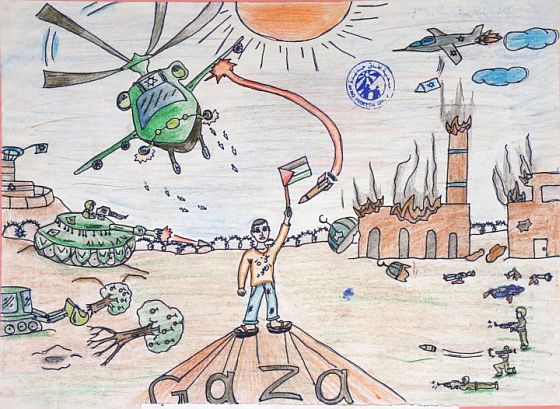
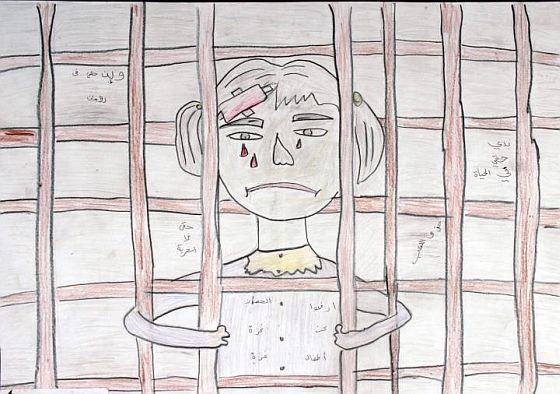
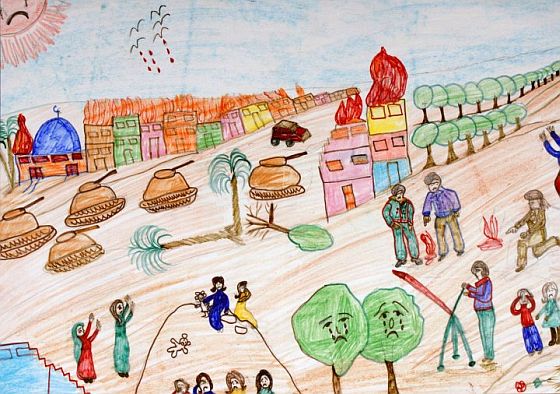
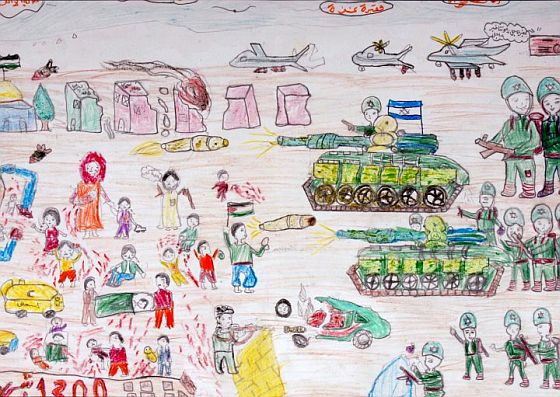
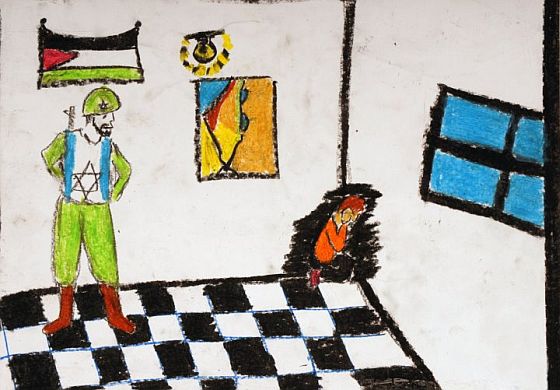
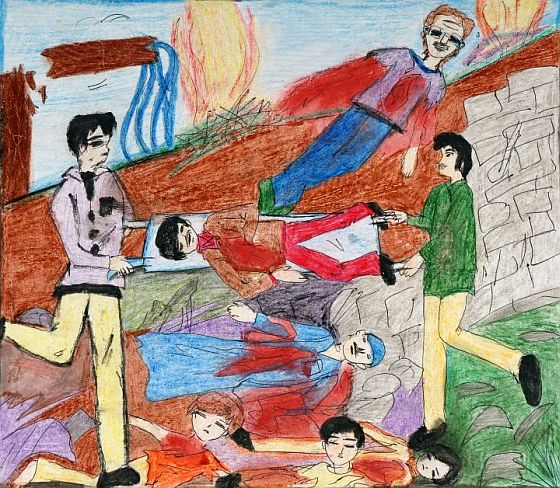
Berkeley, CA’s Middle East Children’s Alliance broke the news yesterday that the exhibit of children’s artwork from Gaza that they had worked on for months with Oakland’s Children’s Museum of Art was suddenly canceled by the board before the planned September 24 opening reception. The show featured drawings by children about Israel’s infamous Operation Cast Lead, the military assault of December 2008-January 2009 that led to the deaths of some 1,400 Palestinians, over 300 of them children.
(Check regularly at mecaforpeace.org for updates and planned actions- they won’t be taking this lying down.)
The Museum of Children’s Art in Oakland (MOCHA) has decided to cancel an exhibit of art by Palestinian children in the Gaza Strip. The Middle East Children’s Alliance (MECA), which was partnering with MOCHA to present the exhibit, was informed of the decision by the Museum’s board president on Thursday, September 8, 2011. For several months, MECA and the museum had been working together on the exhibit, which is titled “A Child’s View From Gaza.”
MECA has learned that there was a concerted effort by pro-Israel organizations in the San Francisco Bay Area to pressure the museum to reverse its decision to display Palestinian children’s art.
Barbara Lubin, the Executive Director of MECA, expressed her dismay that the museum decided to censor this exhibit in contradiction of its mission “to ensure that the arts are a fundamental part of the lives of all children.”
“We understand all too well the enormous pressure that the museum came under. But who wins? The museum doesn’t win. MECA doesn’t win. The people of the Bay Area don’t win. Our basic constitutional freedom of speech loses. The children in Gaza lose,” she said.
“The only winners here are those who spend millions of dollars censoring any criticism of Israel and silencing the voices of children who live every day under military siege and occupation.”
Egyptian activists and politicians accused the ruling military leaders of breaking a promise to end emergency law, after authorities said they would reintroduce special security courts following an attack on the Israeli embassy.
Eight months after protesters toppled President Hosni Mubarak and the military took power on an interim basis, many supporters of the protest movement say they are concerned that the military rulers are backsliding on reform pledges.
Ending emergency law, seen as a tool of Mubarak’s repression, has long been a key demand.
Israel pulled its ambassador out of Egypt after protesters stormed the building housing Israel’s embassy on Friday night.
Egypt’s military rulers said they would try suspects in emergency state security courts. Emergency law would now apply in cases such as blocking of roads, publishing false information and weapons possession, they said.
The measures add to a list of developments that activists say worry them, including the banning of cameras from important trials including that of Mubarak himself, and the army’s failure so far to set a firm date for a parliamentary election.
“The new procedure violate the constitutional decree that the military council issued after Mubarak, in which it pledged to end the state of emergency within six months and said a public referendum had to take place for it to be extended,” Mohamed Adel, leader of the April 6 youth group, told Reuters.
“Egyptian law has many rules against thugs and terrorism, so I still don’t see a reason to extend emergency law,” he added.
Presidential candidate Mohamed ElBaradei said: “It is the normal right of every Egyptian to be tried in front of an ordinary judge, but it is unfortunately not what we see as we are relying more on military and extraordinary courts.”
Emergency law was widely applied under Mubarak’s rule to stifle opposition. The law, in place for decades, gives the state ultimate powers to question or detain citizens.
It was due to be lifted before the parliamentary election which is expected anytime starting November. No poll date has yet been set, although the army has said procedures for a vote, such as voter registration, will start in September.
The Muslim Brotherhood, one of Egypt’s most organised political groups, condemned the use of emergency courts in one of its strongest statements against the military to date. The group, expected to benefit from an early vote, has tended to take a softer line than other activists in the past.
“We confirm our rejection of any attempt to abuse the events to issue martial laws or decrease the margin of freedoms,” the group’s political wing, the Freedom and Justice party, said.
The Islamist group condemned violence by protesters targeting the embassy and other police sites, but also blamed the army for not taking a tough enough stance against Israel.
Presidential hopeful and former Brotherhood leader Abdel Moneim Abul Futuh said he feared the new security measures were “part of a pre-prepared scenario to take over the revolution.”
“I warn the governing power in Egypt against moving forward in this path. And I hope everyone knows the Egyptian people will not allow such scenarios and will not allow their revolution to be aborted.”
Egyptians marched on the Israeli embassy in Cairo on Friday, demolished a wall built around the embassy building to protect it and stormed the Nile tower block that houses the mission.
Egyptian security forces raided the offices of an Egyptian affiliate of the Al Jazeera news network known for attentive coverage of street protests, eliciting allegations on Sunday of a crackdown on the news media as the military-led transitional government seeks to ensure law and order after allowing an angry mob to invade the Israeli Embassy over the weekend.
The raid on the television network came as both the Egyptian and Israeli governments began tentative steps to repair the diplomatic breach between the awkward allies after the embassy attack on Friday night.
The raid also came after a warning last week by Egypt’s minister of media, Osama Heikal, that the government would take legal action against stations that “endanger the stability and security” of the nation, and some analysts said they feared the raid could signal a broader effort to curtail the new freedoms of expression experienced since the uprising that ousted former President Hosni Mubarak this year.
The network, Al Jazeera Live Egypt, was founded in the aftermath of the uprising and has become known for its attentive, if not sensational, coverage of street protests, including the Israeli Embassy attack on Friday. The raid forced the network to halt its programming for a period before it resumed broadcasting from Al Jazeera’s headquarters in Doha, Qatar.
Officials of the Interior Ministry said they had raided the network because it lacked a license, and that neighbors had complained about noise. Numerous satellite channels have sprung up since the revolution, and Mr. Heikal, the media minister, said in his statement last week that the government would stop issuing new permits because of concerns about broadcasts that endangered stability.
But Islam Lotfy, a lawyer for the channel, said the channel had applied for a license in March without a response.
According to identical accounts offered by Egyptian officials and foreign diplomats in Cairo, Egypt had asked Israel before the developments of last Friday to keep the Israeli ambassador in Tel Aviv and to reduce the volume of its staff to the minimum, but Netanyahu insisted on sending the ambassador back only a few days before the latest protest.
“We are not expelling him, but we thought a long holiday for the Israeli ambassador in Egypt would be useful for all of us now; unfortunately, Israel thought otherwise and when anger erupted on Friday evening they had to solicit the intervention of the Americans who sent a plane to carry him and the rest of the staff out of Egypt,” said one official.
Today, there is a tacit agreement between Egypt and Israel that the long holiday for the ambassador is in place and there are guarantees offered by Cairo to both Washington and Tel Aviv that stepped up security measures will be in place to prevent another attack on the embassy.
In the Islamist Al-Dawa Al-Salafiya (Salafist Call) reaction statement to the protesters’ storming of the Israeli embassy in Cairo on 9 September, they slammed the attack as “not thought-out,” which will work in the favour of Israel.
The Salafist movement claims that the 9 September mobbing of the embassy “will work in favour of Israel and will transform them from perpetrators to victims and the focus will shift from our demands to amend the Camp David agreement to Israel’s calls for help to protect their embassy in Egypt.”
The movement also pointed out that the “Egyptians are united in their hate for Israel (thank God). We must fight cultural normalisation [with Israel] and we should push for the international isolation of Israel.”
The group also condemned the statement released by President Obama in which he told Egypt to “honour its international obligations to safeguard the security of the Israeli embassy,” and reminded the US president that Egypt has changed after the January 25 Revolution.
The statement also claimed that most of the calls for violence are actually from a US-backed ex-police officer, Omar Afifi, who resides in the US and uses the internet to incite divisions in Egypt.
The Israeli government must be exhilarated that it is no longer being held responsible for the chaotic events taking place in Egypt. Instead they are now being portrayed as victims of a different “foreign hand,” which sponsored the storming of their embassy in Cairo.
Friday’s incident at the Israeli Embassy, in which thousands of angry protestors – surprisingly – managed to storm the embassy, is being portrayed by Egypt’s flagship newspaper Al-Ahram as fueled by elements of the “counter-revolution” that seeks the fall of the Egyptian state.
In its main headline, the paper speaks of “the involvement of a number of neighboring countries in providing ‘huge beyond imagination’ funds to Egyptian NGOs.”
Justice Minister Abdel Aziz al-Guindi told Al-Ahram that a country from the Gulf gave LE181 million to a small Egyptian NGO.
Guindi added that he has received a report that shows that several neighboring countries have offered million of pounds to Egyptian human rights and civil society organizations, some of which are not registered.
He also said that he has submitted a report to the head of the Supreme Council of the Armed Forces (SCAF) and the prime minister to take appropriate action against the inflow of funds, adding that the cabinet will announce the report’s findings within the next few days.
Guindi added that these “foreign hands” – and local ones – have been behind other incidents of violence in Egypt, seeking to sabotage state institutions, undermine national security, and intimidate citizens.
One might cast doubt over the relationship between the demonstrations in front of the Israeli Embassy and a small NGO receiving millions of pounds, but Al-Ahram doesn’t address such logical inconsistencies.
An editorial in the same paper echoes the article’s sinister tone, with a lead blaring, “The secrets of the plot facing Egypt.”
It reads, “Today, the details of the plot facing Egypt are appearing. The plot doesn’t challenge the Egyptian revolution only; more dangerously, it aims to make Egypt reel in chaos.”
Following the events at the Israeli Embassy, the Egyptian government announced its intent to fully implement the decades-old Emergency Law.
It’s easy to forget that the repeal of the state of emergency was a top demand of protesters who took the streets against former President Hosni Mubarak in January and February. That mood has clearly changed now, although the SCAF declared last month that they had begun the process of ending the state of emergency before parliamentary elections that are expected to be held in November.
Despite this very fact, state-run Al-Gomhurriya praised the move of fully implementing the exceptional measures enshrined in the widely-reviled law. The newspaper runs a lengthy feature quoting “legal experts” defending the re-implementation of the law, saying that such a move would restore the prestige of the state and its stability.
There is unacknowledged freedom associated with whatever becomes inscribed in our individual and collective experience of transformative events. For many older Americans the events most vividly remembered are likely to be Pearl Harbour, the assassination of JFK, and the 9/11 attacks, each coming as a shock to societal expectations.
I doubt that other societies would have a comparable hierarchy of recollections about these three days that are so significant for an understanding of American political identity over the course of the last seventy years.
To make my point clearer, most Japanese would almost certainly single out Hiroshima, and possibly the more recent disaster that followed the 3/11/11 earthquake and tsunami that led to the Fukushima meltdown. Germans, and many Europeans, are likely to be inclined to remember the fall of the Berlin Wall, while most citizens of former colonies are undoubtedly moved by the day on which their national independence was finally achieved.
Because American responses to such transformative events are likely to be global in their effect, there is a greater tendency to share American preoccupations, but this is misleading because interpretations diverge depending on place and time. This diversity amid universality is probably truer for 9/11 than any other recent transformative event, not because of the drama of the attacks, but as a result of the connections with surges of violence unleashed both prior to the attacks and in their aftermath, what I would identify as the perspectives of 9/10 and 9/12.
Shifting ever so slightly the perspective of the observer radically alters our sense of the event’s significance. Just as 9/12 places emphasis on the American response – the launching of “the global war on terror”, 9/10 calls our attention to the mood of imperial complacency that preceded the attacks.
This national mood was (and remains) completely oblivious to the legitimate grievances that pervaded the Arab world.
These grievances were associated with Western appropriations of the region’s resources, Western support lent to cruel and oppressive tyrants throughout the Middle East, lethal and indiscriminate sanctions imposed for an entire decade on the people of Iraq after the first Gulf War, deployment of massive numbers of American troops close to Muslim sacred sites in Saudi Arabia, and America’s role in Israel’s oppressive dispossession of Palestinians and subsequent occupation.
From these perspectives, the crimes of 9/11 were an outgrowth of the wrongs of 9/10 and unreflectively led to the crimes and strategic mistakes made since 9/12.
In recent years, the Department of Homeland Security has provided grants for hundreds of police departments across America to buy $300,000 Lenco BearCats in the name of counter-terrorism.
In the wake of the September 11 attacks in 2001, a strange consensus quickly emerged in Washington: this was just al Qaeda’s first homeland assault. There would be further attacks and most likely what was to come would be even worse — far worse.
With a sense of foreboding and determination we ventured into the third great era for America as world leader — what was briefly dubbed a New American Century.
First came the fight against global fascism which resulted in unqualified victory at the end of World War Two.
Then came the American-led Western alliance to halt the advance of communism.
Even if the collapse of the Soviet Union didn’t bring communism to an end, the end of the Cold War supposedly marked the dawn of a New Global Order in which America reigned supreme as the sole Super Power.
And if after the Cold War, a decade of globalization lacked the ideological clarity needed to satisfy conservative America’s sense of righteousness and moral purpose, or the military focus that would satisfy the Pentagon, all of that was to end with 9/11 as once again the United States assumed its role as world savior.
A president whose own sense of purpose had until then extended no further than his desire to continue a family tradition, was now fired up with a mission as he led the world in a struggle between good and evil.
Yet behind Bush’s apparent boldness was the confidence of a man making a very safe bet.
In response to the attacks the president and the political class across America made a simple calculation: if they were to overstate the threat posed by terrorism they could do so with virtually no political risk and potentially great political rewards. Indeed, the greater the exaggeration the less the risk.
At the same time an honest assessment of the threat posed by al Qaeda would be freighted with enormous risk.
That meant that a dishonest assessment of the threat posed by terrorism would also be a safe assessment.
If there were no further major attacks then this would be taken as the measure of a successful counter-terrorism policy; not a reflection of al Qaeda’s inherent weakness.
Bush immediately understood this and quickly declared war. This, the neocons rapturously declared, was Bush’s great “insight”: we’re at war.
Since we couldn’t be sure exactly where the enemy was located, then just to be safe, we assumed he was everywhere. So this wasn’t going to be just another war — it would be a global war.
America had defeated fascism and then communism and now it was going to take on a battle soon predicted to last for the rest of our lives: a long war against global terrorism.
With the smoke still rising from the ruins of the Twin Towers, no one had the guts to state the obvious: whatever threat al Qaeda might pose, it was surely minute compared to the Soviet nuclear arsenal during the Cold War or the nation-crushing military forces of Japan and Germany during World War Two.
If 9/11 had really been another Pearl Harbor, where was the amassed power that made it clear: this is just the beginning, there is much worse to come?
Asymmetric threats notwithstanding, could a few terrorist camps in eastern Afghanistan really constitute a credible threat to the preeminent military and economic power in the world?
Even if there was evidence that al Qaeda had diabolical ambitions, the evidence of its capabilities was much less impressive. When the long-predicted follow-up attacks emerged, they weren’t exactly attacks on America. Shoe bombers and underpants bombers could put hundreds of lives at risk but they didn’t really threaten a whole nation.
The cowards’ logic dictates, however, that no risk is too small and no security strategy too expensive. America could never become too safe.
The application of this logic not only opened the door to the creation of a massive new government bureaucracy, Homeland Security — along with its attendant terrorism industry — but it also made a war against Iraq look unavoidable.
An operational link between Saddam Hussein and al Qaeda did not need to be conclusively proved; it would be sufficient to merely generate fear about such a possibility. We didn’t need to know that he had weapons of mass destruction; we merely needed to fear that he might soon possess them.
Again and again we were impressed to believe that possible threats were more important than imminent danger. Fear became the signpost to necessity.
And the political class, whether inside or outside government, bought into this idea with virtually no dissent.
By the time this strategic outlook could be seen to have bankrupted this country, everyone who had been promoting it would have already reaped their own political and material rewards.
If challenged — don’t you think you’ve spent too much? — the glib answer was bound to come back: who can set a price on the value of American life?
Well, tell that to the unemployed. Tell that to Americans who have vastly less reason to worry about al Qaeda than they do about paying their mortgage.
A decade after 9/11 how many Americans should be in any doubt that $6 trillion is too much?
“There’s going to be a terrorist strike some day,” warns former Bush administration official Richard Clarke. “And when there is, if you’ve reduced the terrorism budget, the other party — whoever the other party is at the time — is going to say that you were responsible for the terrorist strike because you cut back the budget. And so it’s a very, very risky thing to do.”
But note, very clearly: that is a political risk — much less a security risk. It endangers politicians much more than the people they represent.
“You can look, if you’re objective,” acknowledges Clarke, “at all of this money and all of this effort and say: What would have happened if we hadn’t done that? And in almost every case, nothing would have happened.
“It’s true that there hasn’t been another attack. It’s not true that all of this expenditure and all of these people have stopped it.”
Immediately after 9/11 the most frequently cited threat to America supposedly came from al Qaeda sleeper cells — an invisible enemy within, poised to strike again. Such sleeper cells either never woke up, or more likely never existed.
Instead, a different threat emerged — not one made up of a few fanatical Muslims, but instead filled with thousands of seemingly loyal Americans. Men and women who thought that they could help protect this country and get rich in the process. Like traders in a stock market for emotions, they realized that fear would never get over-priced.
As this country faces a much graver economic threat than any threat from terrorism, political boldness and courage are called for, yet none can be found. America’s political, military and commercial elites have spent the last decade betting on fear, investing in fear and consumed by fear.
In a culture of unchallenged fear, we find thus ourselves ruled by cowards.
This website or its third-party tools use cookies, which are necessary to its functioning. By closing this banner, you agree to the use of cookies.




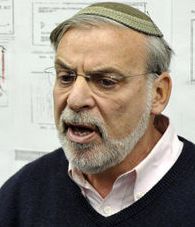 Bob Turner, the Republican candidate campaigning to replace disgraced Democratic Rep. Anthony Weiner, picked up a crucial endorsement last week when Democratic Assemblyman Dov Hikind