Stephen Rohde writes: The USA Patriot Act became law ten years ago today. Bearing the awkward name, Uniting and Strengthening America by Providing Appropriate Tools Required to Intercept and Obstruct Terrorism Act, it passed the US Senate by an overwhelming vote of 96-1, with only Sen. Russ Feingold (D-Wisconsin) in dissent, voicing deep concerns about the impact the new law would have on civil liberties and privacy rights.
During the debate over the Patriot Act, Senator Feingold observed that the “founders who wrote our Constitution and Bill of Rights exercised that vigilance even though they had recently fought and won the Revolutionary War. They did not live in comfortable and easy times of hypothetical enemies. They wrote a Constitution of limited powers and an explicit Bill of Rights to protect liberty in times of war, as well as in times of peace.”
He traced the dark periods in our nation’s history when civil liberties took a back seat to what appeared at the time to be the legitimate exigencies of war, including the Alien and Sedition Acts, the suspension of habeas corpus during the Civil War, the internment of Japanese-Americans, German-Americans, and Italian-Americans during World War II, the blacklisting of alleged communist sympathizers during the McCarthy era, and the surveillance and harassment of antiwar protesters, including Dr. Martin Luther King Jr., during the Vietnam War.
Justin Elliot talks to Michael Kazin, professor of history at Georgetown and author of “American Dreamers: How the Left Changed a Nation” about where Occupy Wall Street is heading.
We’re now a month-plus into this. Does Occupy Wall Street remind you of any past movements or does it seem like a fundamentally new type of thing?
This is the first time in a long time, perhaps since the 1930s, that the left — and I think this protest does belong to the left, though a lot of people who are involved in it wouldn’t call themselves that — has focused on economic injustice as a central issue. That is both new and of course harks back to the beginnings of the New Deal. At that time, most activists on the left were primarily targeting economic inequality — in the form of wages, the lack of democracy at work, and resistance by industrial corporations to recognizing unions. What’s obviously different now is that Occupy Wall Street has been put together by people who are proud of being children of the Internet age: with horizontal organization, leaderlessness and consensus decision-making. The main tactic is about hanging out with and learning from one another. There is no sense of how the tactic will lead to either taking political power or having a big share of political power. This movement seems to think from tactic to tactic, rather than tactic to strategy.
Is there precedent for this kind of form and structure?
Many a protest campaign begins this way. The sit-ins at Woolworth lunch counters beginning in February 1960 had an end — desegregation of public facilities — but they weren’t quite sure of where it was going after that. They just thought, “This is a neat tactic that will draw attention.” And it did. That began with four students in Greensboro, N.C. But it soon blossomed, and now their lunch counter is in the Smithsonian. The movement against the Vietnam War also began with very small protests in 1964, and then grew into ones with hundreds of thousands of demonstrators. So protests can grow and become catalysts for larger and more diverse movements.
The two examples you just mentioned had obvious, discrete goals they were trying to accomplish. In contrast, Occupy Wall Street has only a broad theme. Are there precedents for this?
There was Coxey’s Army in 1894, which was the first group to march on Washington. They were mostly unemployed people with a vague demand for public jobs. But they were basically just pissed off about the widespread depression of that era, and they were determined to compel Congress and the president to do something. Like Occupy, they did not have a well-worked-out agenda. Historians disagree about what effect the march had. But it certainly dramatized the situation of the poor and the unemployed, much as Occupy Wall Street is trying to do. People marched from around the country on Washington; they took freight trains, and hitchhiked on wagons, and walked a lot, too. It was very dramatic and the press covered it very widely. But the depression continued until 1897.
What can Occupy learn from history about how to sustain itself beyond the initial burst of interest and energy?
I think protests like this have to progress from tactic to strategy if they are going to endure. They have to either start their own organization — as the sit-in movement started SNCC — or link up with other organizations. The problem with that strategy is that what’s gotten people’s attention is the clever, somewhat novel tactic Occupy is using — and the participatory, very small-d democratic nature of it. The next step will inevitably not be that clever and novel. But for it to go anywhere, the Occupiers have to figure out, to some degree, what kind of demands they want to make. That doesn’t mean they need a 12-point program, but maybe a three-point program. They have to figure out what sort of relationship they want to have with existing groups on the left. But with no leaders and everything run by consensus, how do you make these decisions?
What’s more likely to happen — and I think to some extent already is happening — is that this will become a catalyst for other people to do other kinds of things about economic inequality. I think it’s likely that Occupy Wall Street will be seen as a spark. I think it’s unlikely that people are going to stay in the park for month upon month unless they are homeless. Most people eventually will want to get on with their lives. In the end, a tactic, no matter how successful, is just a tactic.
Micah Sifry writes: Overall interest in the Occupy Wall Street movement appears to be cresting at the moment, with affiliation through the nearly 500 Facebook pages that we’ve been tracking starting to top out and organic interest in the topic also showing signs of calming down on Google search. At the same time, the movement–which deliberately has avoided appointing leaders and spokespeople–continues to expand its networked base. Nearly 250 of those Facebook groups have at least 1,000 members. Another 70 “Occupy X” Twitter accounts also have at least 1000 followers. And in a fascinating development noticed by Shane Castlen, who is tracking all of these metrics on his CollectiveDisorder.com website, while the main Reddit community for OWS now has more than 10,000 members, a number of local Occupy groups are slowly building their own “subreddits” focused on the news and debates occurring around their own encampments. Boston, Los Angeles, Austin, Chicago, DC, Orlando, Philadelphia, Seattle, Richmond, Omana, Columbus, South Dakota and Boise are all active there.
If Tahrir Square inspires the Occupy movement, police forces across America appear to think the most useful lessons on handling popular unrest come from Pearl Roundabout, Bahrain. That means that when ordinary American citizens take a stand and symbolically proclaim: this is our land, the police will sooner or later respond with violence in order to assert the power of the state.
From that perspective, the lesson from Bahrain earlier this year was clear: all necessary force must be used in order to prevent protesters retaining their hold on an occupied public space.
This is being done in the name of public order, yet it appears to be a thinly veiled effort to crush political dissent — even while politicians voice sympathy with the concerns of the protesters. (Let’s not forget that the Bahraini royal family also knew how to make timely PR statements.)
Tools designed to quell riots and provide “non-lethal” means to rein in violent protests — tear gas, pepper spray, batons, and stun grenades — are now being used to suppress non-violent political protest.
This is how the Oakland police decided to assert state power yesterday afternoon and evening:
Tim at Occupy Oakland writes: Around 2am word spread that riot police were massing in around the area where Occupy Oakland has been for more than two weeks. Hundreds of people gathered and began to make non-violent barricades at all the entrances to the plaza.
At about 4:30am, riot police appeared on all corners of the encampment. There were roughly 500 to 700 riot police in total.
The entire plaza was completely barricaded on all sides, with palates, trash cans, chairs, a gigantic christmas wreath, police barricades from a neighboring street
Occupiers began chanting ‘go home’ as they always do when police show up at Occupy Oakland, but it quickly became clear that there was an overwhelming number of police from at least four different jurisdictions.
As people continued to chant and fell back within the barricade, off of the street, the police announced that we would be arrested within the encampment. They said [they’d use force to disperse demonstrators within] five minutes, and within a minute they fired the first rounds of flash-bang grenades and rubber bullets, and then tear gas into the camp, hitting and injuring multiple people. [Continue reading and see photos…]
San Francisco Chronicle reports: Police fired tear gas at least five times Tuesday night into a crowd of several hundred protesters backing the Occupy movement who unsuccessfully tried to retake an encampment outside Oakland City Hall that officers had cleared away more than 12 hours earlier.
Police gave repeated warnings to protesters to disperse from the entrance to Frank Ogawa Plaza at 14th Street and Broadway before firing several tear gas canisters into the crowd at about 7:45 p.m. Police had announced over a loudspeaker that those who refused to leave could be targeted by “chemical agents.”
Protesters scattered in both directions on Broadway as the tear gas canisters and several flash-bang grenades went off. Regrouping, protesters tried to help one another and offered each other eye drops.
One wounded woman, who others said had been hit by one of the canisters, was carried away by two protesters.
One protester, 35-year-old Jerry Smith, said a tear gas canister had rolled to his feet and sprayed him in the face.
“I got the feeling they meant business, but people were not going to be intimidated,” Smith said. “We can do this peacefully, but still not back down.”
Police forcibly dispersed the crowd with tear gas again about 9:30 p.m., when protesters began throwing objects at them. As protesters scattered, police closed off Broadway between 13th and 16th streets.
Minutes later, protesters regrouped at the 15th Street entrance to the plaza. Protesters began throwing objects again. Police responded by firing more tear gas canisters.
The protesters were trying to make good on a vow to retake an encampment that Occupy Oakland activists had inhabited for 15 days, until police evicted them early Tuesday.
The evening protest started around 5 p.m., when about 400 people began marching from the main library at 14th and Madison streets toward the plaza, which police had barricaded and city officials had declared would be closed for at least several days.
Egyptian activists Asmaa Mahfouz and Ahmed Maher visited Zuccotti Park to briefly join Occupy Wall Street on Monday. Thanassis Cambanis writes: People asked about the role of women in the Egyptian uprising, the connections between youth and labor movements, and the importance of social media. Some of the questions were well intended but astonishingly vague: “How do you overthrow a system?” one man asked. Maher politely replied, “It’s easier to overthrow a dictator than an entire system.” He didn’t belabor the point that the Egyptian revolutionaries, so far as they are concerned, have not yet won; they still are fighting their system. Egypt’s military rulers have staged a vicious campaign against Maher’s April 6 movement, accusing them with no evidence of working as American spies and subjecting them to a public inquiry.
The Americans wanted to know how they could help Egypt.
“Get your revolution done. That’s the biggest help you can give us,” Mahfouz said, expressing the hope that America would one day cut off the $1.3 billion yearly payments that sustain Egypt’s military.
She also advised Occupy Wall Street to select its own leaders and craft a simple message “that no one can change.”
On Monday evening at Zuccotti Park, Mahfouz was eager to model the fiery disobedience with which she’s inspired so many Egyptians. “Let’s march!” she said after an hour-long question-and-answer session, grabbing an Egyptian flag and flashing the victory sign with both hands.
A few hundred demonstrators fell in line behind her and Maher, who gamely joined the English chants. The police allowed the march onto Wall Street itself, and at each corner the American leaders consulted an officer about the preferred route. Weary of the somewhat stilted slogans, which lacked the umph and rhythm of Egyptian chants, Mahfouz and Maher taught the crowd the iconic cry of the Arab uprisings: “Al shaab yurid isqat al nizam,” or “The people demand the fall of the regime.” The crowd adopted its own hybrid: “Al shaab yurid isqat Wall Street.”
As they wound back to Zuccotti Park, demonstrators awaited a cue from the police before crossing Broadway. It was too much for Mahfouz. She stopped in the middle of the intersection, stopped traffic, pumped a fist in the air, and demanded the fall of Wall Street. Nervous demonstrators skittered to the sidewalk, leaving Mahfouz with just the cameras and a few dozen stalwarts who seemed willing to accept her invitation to be arrested.
Peter Rothberg writes: More than six weeks into the occupation of Zuccotti Park by a ragtag band of a few hundred anti-corporate activists, Occupy Wall Street has quickly grown into an international movement and potent symbol of popular outrage over the widening gaps between rich and poor and the way that government has been hijacked to transfer wealth upwards to the one percent.
The movement’s message has also gone surprisingly mainstream, as my colleague Katha Pollitt detailed in her latest Nationcolumn explaining the OWS’s appeal and why unlikely suspects like Deepak Chopra and Suze Orman have jumped on the Occupy Wall Street wagon.
After the first week of protests, I wrote a brief guide featuring some tips on how to help the then-burgeoning movement. Now, I’ve updated that primer with new suggestions and specific tips for supporting some of the many regional Occupy actions that have recently been established.
How to Support Occupy Wall Street
1. Go to Liberty Plaza to join those that Occupy Wall Street if you can. This is the epicenter of the movement and the inspiration for what’s happening across the country. Carpools are being arranged va this Facebook group.
2. Send non-perishable food, books, magazines, coffee, tea bags, aspirin, blankets and socks to the UPS Store, c/o Occupy Wall Street, 118A Fulton St, #205, NY, NY 10038.
3. Have pizza delivered to the protestors at Liberty Plaza. Call Majestic Pizza Corp at 212-349-4046 and have your credit card ready.
4. Tell the nation’s mayors to respect the people’s right to free assembly. The eviction of the Liberty Square occupation on Wall Street was averted by massive public protest from those in the square and from others. When you learn that an occupation is threatened, please use this list, courtesy of activist Cryn Johannsen, to find the mayor’s phone number and ask him or her to let the protestors protest.
5. Circulate word of Occupy College’s national series of Teach-ins on November 2nd and 3rd. More than 100 schools have signed on to date.
IRIN reports: Egyptian NGOs hoping for greater freedoms and more space to operate after the fall of Hosni Mubarak’s government say they have encountered just the opposite: an unprecedented clampdown by the post-revolution military rulers.
“Following Egypt’s historic protests calling for basic political freedoms, it is deeply disturbing that the Egyptian military has targeted Egypt’s democracy and human rights community in ways not even dared during Mubarak’s despotic rule,” wrote Stephen McInerney, executive director of the Washington-based Project on Middle East Democracy (POMED).
The first parliamentary elections since Mubarak’s fall are scheduled for 28 November, but NGO leaders say the transitional government led by the Supreme Council of the Armed Forces (SCAF) has mounted a “smear campaign” against them by accusing them of receiving millions of dollars from foreign donors to destabilize the country – going so far as to say the violence on the streets of Cairo during and after the revolution was supported by foreign funding channelled through NGOs.
Many of the local organizations being targeted intended to monitor the upcoming elections, but have been prevented from doing so by the Electoral Commission. SCAF has already banned foreign groups from monitoring the vote.
“This [smear campaign] is yet another episode in the suffering of NGOs in this country,” Maged Adeeb, the chairman of local NGO National Centre for Human Rights, told IRIN. “By accusing us of receiving funds and using them in weakening Egypt’s security, the government creates an unbridgeable gap between us and ordinary citizens.”
In a recent conference in Cairo, Negad Al Borae, a leading civil society activist, said the new government was collaborating with some political powers – namely members of the former ruling party – to destroy the nation’s NGOs.
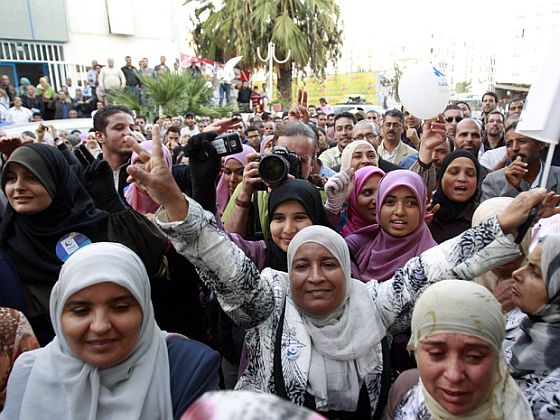
Tony Karon writes: Tunisia’s election and Libya’s celebration of the overthrow of Col. Muammar Gaddafi won’t have made for a happy weekend among those fevered heads in Washington who believe the West is locked in an existential struggle with political Islam: If anything, the Islamist tones of the Libyan celebrations, coupled with the Islamist victory in the Tunisian polls will have evoked the collapsing dominoes of Vietnam-era anti-communist metaphor.
“We are an Islamic country,” said Mustafa Abdel Jalili, leader of Libya’s Western-backed Transitional National Council in his speech proclaiming his country’s liberation on Saturday. “We take the Islamic religion as the core of our new government. The constitution will be based on our Islamic religion.” As Jalili spoke of lifting a Gaddafi era ban on polygamy and called for an Islamic banking system (which bans charging interest on loans), he was greeted by thunderous chants of “Allahu Akbar” (“God is great”). The character of Libya’s rebellion, at least among those doing the fighting rather than those doing the talking to Western governments, has been far more Islamist than its NATO backers may care to admit. Indeed, conspicuously absent from Jalili’s Benghazi liberation speech was Mahmoud Jibril, the Western-backed interim prime minister forced out at the behest of Islamist and regional militias, who accused him of trying to sideline them.
Jalili’s comments underscore the likelihood that a post-Gaddafi Libya will have a strongly Islamic character. Having emerged from a 42-year secular dictatorship, the smart money says that some version of political Islam will likely trounce any liberal rivals in the race to represent a national vision when a country riven by tribal and regional rivalries goes to the polls eight months from now.
In Tunisia, meanwhile, where some 90% of voters turned out to vote in the Arab rebellion’s first democratic poll, the only question remains whether the Islamist Ennahda party wins an outright majority, or must settle for a plurality of the vote that will requires it to lead a coalition government. Opposition parties had conceded on Monday, even before the count was completed, it was clear that Ennahda had won by far the largest share. The party’s leaders made clear, however, that they intended to seek a coalition.
There’s good reason to suspect that Tunisia’s electoral outcome will be repeated in an Egyptian poll: The main political contest there may turn out to be the one between the Muslim Brotherhood and its more radical Salafist challengers than between the Brotherhood and the secular liberals.
There’s no inherent contradiction between Islam and democracy — the range of political parties in the Muslim world claiming to be guided by Islamic values ranges from Turkey’s moderate, modernizing AK Party to the radical fundamentalist Salafis. Post-Saddam Iraq has been ruled by coalitions led by Shi’ite Islamist parties since its first election in 2005.
Democratically elected governments in the Arab world — most of which are likely to include a strong Islamist component, particularly when emerging from years of secular dictatorship — are highly unlikely to follow U.S. policy on Israel or Iran, but that doesn’t preclude them establishing pragmatic, cooperative relationships with the West. And if Washington’s yardstick for judging Arab political outcomes was the extent of support they yield for its own positions on Israel and Iraq, the U.S. would have to rely exclusively on dictators and monarchs.
Jonathan Steele writes: Having launched what became known as the Arab spring, Tunisia has now led the region by holding a clean election with an enthusiastic turnout and highly encouraging results. The three parties that have come out on top in the most democratic of north African states have no links with the capital city’s upper middle class or those sections of the business community that benefited from the ousted Ben Ali dictatorship. They both have a tradition of struggling for democratic values.
As in post-Mubarak Egypt, there was reason to fear that the old regime would re-emerge in Tunisia with new faces, but this now seems unlikely. The party that has emerged from the poll most strongly is An-Nahda (Renaissance), which suffered massive repression under Ben Ali and has won great respect for its sacrifices. This party of modern democratic Islam campaigned hard on the two issues that concern most Tunisians: corruption and unemployment, particularly youth unemployment.
While several smaller secular parties tried to manipulate Islamophobia – a relatively easy card to play given the official state-controlled media’s demonisation of the Islamists over several decades – their efforts have failed. Voters had their first chance to listen to An-Nahda’s candidates and they were not put off by what they heard. An-Nahda made special efforts to show that it wanted an inclusive government of national unity and would respect all points of view. It also reached out to voters in the more impoverished interior, making it clear it would not be just a party of the Mediterranean coast as Ben Ali’s regime had been.
The Associated Press reports: A moderate, once-banned Islamist party in Tunisia was on track Tuesday to win the largest number of seats in the first elections prompted by the Arab Spring uprisings, according to partial results.
The Tunisian electoral commission said the Ennahda party has won 15 out of 39 domestic seats so far in a 217-member assembly meant to write a new constitution. Together with the results announced Monday from Tunisians living abroad, Ennahda now has 24 out of 57 seats total, or just over 42 percent.
The final results from Sunday’s elections could boost other Islamist parties running in elections in North Africa and the Middle East.
Jillian Schwedler writes: The Arab Spring initiated a jarring series of events in 2011 that illustrate the radical political possibilities of just being present. When the regime won’t listen, when being heard as an individual isn’t really a viable option, simply standing together and being seen can be profoundly political and empowering.
But will just “being there” really bring significant change?
Revolutions never happen overnight. They result from accumulations of dozens, even hundreds of moments, often stretching over a period of years, that make possible the ruptures that emerge when vast numbers of people begin to imagine, and then to demand, an alternative to their living conditions. We have been seeing these moments over the past year, first in the Middle East but then spreading to England, Brazil, Spain, Great Britain, the United States, and elsewhere. In this sense, we are experiencing a revolutionary moment in which the popular perception of what is possible has indisputably shifted in a way unseen on a global scale since 1968.
This moment is revolutionary, even though revolutions are not imminent everywhere. People around the globe are simultaneously imagining alternatives to the conditions under which they live, and they recognise such movements taking place elsewhere and feel a connection, a kinship, with other who are taking to the streets and reclaiming public spaces. For some, the imagined future entails a fundamental change in the structures of government; for others, it entails an alternative to the economic status quo. But for all of them, often for the first time in generations, an alternative future feels possible and tangible rather than fantastical.
Revolutionary moments don’t always foster revolutions, of course. Political revolutions are only possible when the repressive security apparatuses that defend the regime – the army, the police, and other agencies of force – become divided. When armies divide, when some leaders and their troops defect, that is when a revolution becomes possible. But even this does not mean that a revolution will be successful. It can lead to a regime change, even a rapid or peaceful one, but more often it can lead to a bloody, protracted civil war. But for many of the citizens – albeit not for all of them – sustained bloodshed is preferable because it keeps alive the hope that an alternative future is finally within grasp. Witnessing people choose these bloody moments of possibility over the (sometimes bloody) status quo has a dramatic impact. If they can do it-when the obstacles they have successfully overcome were far more daunting than the ones we face – why are we acquiescing to the repressive conditions that limit the possibilities of our own lives?
Although many hope to dismiss its potential, Occupy Wall Street represents just such a revolutionary moment. It is a politics of refusal because of its strong and sustained rejection of a system that dismisses the economic struggles of most of the people on the globe. It is a refusal to feel helpless and powerless in the face of economic policies that favour banks and corporations at the expense of flesh and blood. That refusal has been manifest in the retaking of public spaces, an outpouring of people into places where their frustrations and grievances become visible. Merely standing together in public can be a radical political act because governments around the world seek to control how public spaces are used, preserving them for certain kinds of loyal and conforming citizens. “Undesirables” – the homeless, the punks, skateboarders, graffiti artists, groups of young men, and of course protesters who question the prevailing political and economic policies – must all be cleared from those spaces, sometimes at high costs. Who is welcome? Nuclear families, particularly if they are spending money.
Meir Javedanfar writes: The message from Iran’s most powerful man was clear: the post of president could be removed sometime in the future. If this happened, the parliamentary system could instead be used to elect officials holding executive power. ‘There would be no problem in altering the current structure,’ stated Iranian Supreme Leader Ali Khamenei in a speech in the city of Kermanshah on Sunday.
What we have here is a tussle between Khamenei and President Mahmoud Ahmadinejad over their respective legacies. And Khamenei is taking this matter so seriously that he’s threatening to remove the very position of the presidency altogether. For now, this is only a threat. But it’s one that can’t be ignored, especially by Ahmadinejad.
Ahmadinejad isn’t eligible to run for president again when his term expires in June 2013, as Iran’s Constitution is clear a president can run for only two consecutive terms. To ensure his legacy, then, Ahmadinejad seems to be backing his right hand man Esfandiar Rahim Mashaei as a presidential candidate. Ahmadinejad likely hopes that with Mashaei as president, he will be able to retain a powerful cabinet position – think an Iranian twist on what Vladimir Putin has done in Dmitry Medvedev’s government. When Mashaei finishes his four year term, Ahmadinejad would then be able to use his likely high profile in Meshai’s government as a platform to develop a renewed bid for the presidency.
This concerns Khamenei, and rightly so.
Mashaei is an extremely divisive figure. Many conservatives despise him. For some, it is because of reports that he married a former member of the opposition Mujahedeen-e-Khalq (MEK), which he was interrogating in the early 1980s, as well as reports that his brother was also member of the same organization. Others, though, are furious that he said publicly that the people of Iran have no problem with the people of Israel.
Jealousy is another factor. Soon after Meshai’s daughter married Ahmadinejad’s son, his political career started to take off. From once being a virtually unknown politician, these days Mashaei is seen as Ahmadinejad’s right hand man (some even speculate that it’s Mashaei that holds the real power in the Ahmadinejad government).
But the animosity felt toward Mashaei isn’t confined to Iranian politicians – even Ahmadinejad’s brother Davood has been attacking him publicly. Ahmadinejad’s son-in-law, Mehdi Khorshidi, meanwhile, has joined in on the attacks against Meshai. Some believe that Davood left his post as chief of the presidential inspection unit because of Meshai.
It’s clear, then, that if Mashaei runs for president, it will create ferocious pitched political battles inside Iranian politics, conflicts that could even spark violence. This is the last thing Khamenei needs for a regime that already faces sanctions and a host of economic problems, as well as opposition from the Green movement. Khamenei therefore won’t want serious conflict among conservatives, who in the political world of the Islamic Republic are his biggest supporters.
All the way along, there will be Egypt’s traditional electoral mayhem: thugs, intimidation, cash handouts, ballot stuffing, strong-arm local families, clan and mosque. Most people think there is bound to be violence (there always is), and the obfuscation of lawsuits countering close or convoluted results (there always are). If people don’t understand what they are voting for, and if the results are obscured by irregularities, the Egyptian people will have no sense that they have participated in a free and fair election.
In any case, the mandate of the new parliament will be, as far as I can tell, to do one thing only. To elect, choose, or appoint (the mechanism remains totally unclear) within a given six month period, a hundred member constitutional committee that will then have a further six months to draft a new constitution. The new constitution will then be ratified (or maybe not) by national referendum. Subsequently, presidential elections will be held—perhaps some time in 2013.
Whatever shop-assembly version emerges, the Supreme Council of Armed Forces have made it clear they will retain control over the appointment of the Prime Minister and the cabinet as well as control over the budget. Egyptians will not be voting in a new government. The nasty irony may be that if the crowds in Tahrir Square had accepted Mubarak’s proposal to step down in September, they might have elected a new President by now. (How free those elections would be is another question.) Increasingly it has begun to appear that the Supreme Council of Armed Forces wants to stretch a transition out over the longest possible time frame, affording it, inevitably, greater control.
Frank Rich writes: During the death throes of Herbert Hoover’s presidency in June 1932, desperate bands of men traveled to Washington and set up camp within view of the Capitol. The first contingent journeyed all the way from Portland, Oregon, but others soon converged from all over—alone, in groups, with families—until their main Hooverville on the Anacostia River’s fetid mudflats swelled to a population as high as 20,000. The men, World War I veterans who could not find jobs, became known as the Bonus Army—for the modest government bonus they were owed for their service. Under a law passed in 1924, they had been awarded roughly $1,000 each, to be collected in 1945 or at death, whichever came first. But they didn’t want to wait any longer for their pre–New Deal entitlement—especially given that Congress had bailed out big business with the creation of a Reconstruction Finance Corporation earlier in its session. Father Charles Coughlin, the populist “Radio Priest” who became a phenomenon for railing against “greedy bankers and financiers,” framed Washington’s double standard this way: “If the government can pay $2 billion to the bankers and the railroads, why cannot it pay the $2 billion to the soldiers?”
The echoes of our own Great Recession do not end there. Both parties were alarmed by this motley assemblage and its political rallies; the Secret Service infiltrated its ranks to root out radicals. But a good Communist was hard to find. The men were mostly middle-class, patriotic Americans. They kept their improvised hovels clean and maintained small gardens. Even so, good behavior by the Bonus Army did not prevent the U.S. Army’s hotheaded chief of staff, General Douglas MacArthur, from summoning an overwhelming force to evict it from Pennsylvania Avenue late that July. After assaulting the veterans and thousands of onlookers with tear gas, MacArthur’s troops crossed the bridge and burned down the encampment. The general had acted against Hoover’s wishes, but the president expressed satisfaction afterward that the government had dispatched “a mob”—albeit at the cost of killing two of the demonstrators. The public had another take. When graphic newsreels of the riotous mêlée fanned out to the nation’s movie theaters, audiences booed MacArthur and his troops, not the men down on their luck. Even the mining heiress Evalyn Walsh McLean, the owner of the Hope diamond and wife of the proprietor of the Washington Post, professed solidarity with the “mob” that had occupied the nation’s capital.
The Great Depression was then nearly three years old, with FDR still in the wings and some of the worst deprivation and unrest yet to come. Three years after our own crash, we do not have the benefit of historical omniscience to know where 2011 is on the time line of America’s deepest bout of economic distress since that era. (The White House, you may recall, rolled out “recovery summer” sixteen months ago.) We don’t know if our current president will end up being viewed more like Hoover or FDR. We don’t know whether Occupy Wall Street and its proliferating satellites will spiral into larger and more violent confrontations, disperse in cold weather, prove a footnote to our narrative, or be the seeds of something big.
What’s as intriguing as Occupy Wall Street itself is that once again our Establishment, left, right, and center, did not see the wave coming or understand what it meant as it broke. Maybe it’s just human nature and the power of denial, or maybe it’s a stubborn strain of all-American optimism, but at each aftershock since the fall of Lehman Brothers, those at the top have preferred not to see what they didn’t want to see. And so for the first three weeks, the protests were alternately ignored, patronized, dismissed, and insulted by politicians and the mainstream news media as a neo-Woodstock for wannabe collegiate rebels without a cause—and not just in Fox-land. CNN’s new prime-time hopeful, Erin Burnett, ridiculed the protesters as bongo-playing know-nothings; a dispatch in The New Republic called them “an unfocused rabble of ragtag discontents.” Those who did express sympathy for Occupy Wall Street tended to pat it on the head before going on to fault it for being leaderless, disorganized, and inchoate in its agenda.
Despite such dismissals, the movement, abetted by made-for-YouTube confrontations with police, started to connect with the mass public much as the Bonus Army did with a newsreel audience. The week after a Wall Street Journal editorial claimed that “no one seems to care very much” about the “collection of ne’er-do-wells” congregating in Zuccotti Park, the paper released its own poll, in collaboration with NBC News, finding that 37 percent of Americans supported the protesters, 25 percent had no opinion, and just 18 percent opposed them. The approval numbers for Occupy Wall Street published in Time and Reuters were even higher—hitting 54 percent in Time. Apparently some of those dopey kids, staggering under student loans and bereft of job prospects, have lots of parents and friends of all ages who understand exactly what they’re talking about.
Pam Martens writes: Wall Street’s audacity to corrupt knows no bounds and the cooptation of government by the 1 per cent knows no limits. How else to explain $150 million of taxpayer money going to equip a government facility in lower Manhattan where Wall Street firms, serially charged with corruption, get to sit alongside the New York Police Department and spy on law abiding citizens.
According to newly unearthed documents, the planning for this high tech facility on lower Broadway dates back six years. In correspondence from 2005 that rests quietly in the Securities and Exchange Commission’s archives, NYPD Commissioner Raymond Kelly promised Edward Forst, a Goldman Sachs’ Executive Vice President at the time, that the NYPD “is committed to the development and implementation of a comprehensive security plan for Lower Manhattan…One component of the plan will be a centralized coordination center that will provide space for full-time, on site representation from Goldman Sachs and other stakeholders.”
At the time, Goldman Sachs was in the process of extracting concessions from New York City just short of the Mayor’s first born in exchange for constructing its new headquarters building at 200 West Street, adjacent to the World Financial Center and in the general area of where the new World Trade Center complex would be built. According to the 2005 documents, Goldman’s deal included $1.65 billion in Liberty Bonds, up to $160 million in sales tax abatements for construction materials and tenant furnishings, and the deal-breaker requirement that a security plan that gave it a seat at the NYPD’s Coordination Center would be in place by no later than December 31, 2009.
The surveillance plan became known as the Lower Manhattan Security Initiative and the facility was eventually dubbed the Lower Manhattan Security Coordination Center. It operates round-the-clock. Under the imprimatur of the largest police department in the United States, 2,000 private spy cameras owned by Wall Street firms, together with approximately 1,000 more owned by the NYPD, are relaying live video feeds of people on the streets in lower Manhattan to the center. Once at the center, they can be integrated for analysis. At least 700 cameras scour the midtown area and also relay their live feeds into the downtown center where low-wage NYPD, MTA and Port Authority crime stoppers sit alongside high-wage personnel from Wall Street firms that are currently under at least 51 Federal and state corruption probes for mortgage securitization fraud and other matters.
In addition to video analytics which can, for example, track a person based on the color of their hat or jacket, insiders say the NYPD either has or is working on face recognition software which could track individuals based on facial features. The center is also equipped with live feeds from license plate readers.
The Guardian reports: Julian Assange, co-founder of WikiLeaks, has announced that the whistleblowing website is suspending publishing operations in order to focus on fighting a financial blockade and raise new funds.
Assange, speaking at a press conference in London on Monday, said a banking blockade had destroyed 95% of WikiLeaks’ revenues.
He added that the blockade posed an existential threat to WikiLeaks and if it was not lifted by the new year the organisation would be “simply not able to continue”.
The website, behind the publication of hundreds of thousands of controversial US embassy cables in late 2010 in partnership with newspapers including the Guardian and New York Times, revealed that it was running on cash reserves after “an arbitrary and unlawful financial blockade” by the Bank of America, Visa, Mastercard, PayPal and Western Union.
WikiLeaks said in a statement: “The blockade is outside of any accountable, public process. It is without democratic oversight or transparency.
“The US government itself found that there were no lawful grounds to add WikiLeaks to a US financial blockade. But the blockade of WikiLeaks by politicised US finance companies continues regardless.”
Assange said donations to WikiLeaks were running at €100,000 a month in 2010, but had dropped to a monthly figure of €6,000 to €7,000 this year.
Heather Gautney asks:Is this what democracy looks like? That’s perhaps the first question prompted by the swirl of tents, signs, news choppers and police motorcycles that have colored the Occupy Wall Street protests. But there are two other questions we should be asking as well. Is democracy even possible in a context of extreme instability and social inequality, in which 1 percent of the population owns and polices the other 99 percent? And who, among our distinguished set of 2012 candidates, really wants to narrow this gap?
Thus far, the Occupy movement is checking “None of the Above” on the ballot box. Since mid-September, it has instead decided to represent itself in the streets. And if you think there aren’t concrete, policy-related demands being made there, have another look: Everything from education to housing, health care, environment, energy and security are up for grabs. All of these institutions are in need of fixing, and all of them are making the list.
These acts of self-representation—or direct democracy—do not compute among mainstream politicians and their pundits. Occupy does not speak the language of party or ideology, and this has not boded well for a system that relies on polls, predictability and reductive thought. Social movements are, by their very nature, complex, organic and indeterminate. They operate at the deepest levels of how we view each other and the world we live in.
This movement is no exception. You can’t reduce this kind of public outcry to dichotomies like liberal and conservative, or Blue and Red. And you certainly can’t dismiss it as fringe and un-American. Occupy is a popular movement, not a Tea Party, and the act of sticking up for yourself is as American as apple pie.
Despite this apparent disconnect, the Occupy movement has received honorable mention at the highest levels of government, though I suspect this has more to do with polls and constituencies than with genuine understanding. After a Time Magazinesurvey revealed that 54 percent of Americans actually support these rabble-rousers, our politicians started to take notice. Occupy is actually more popular among the American people than the U.S. Congress—and that must really hurt.
That 54-percent figure was likely behind flip-flopper Mitt Romney’s overnight change of heart. Just days into October, Romney called the protesters “dangerous” instigators of “class warfare.” A week later, he switched gears and expressed “worry” for the 99 percenters. All the sudden this multi-millionaire, private-sector guru has become a man of the people. Who knew?
Then there’s Barack Obama. The guy we all wanted to love. With his usual charm, he empathized with the Occupy-ers, said not everyone in Corporate America was playing by the rules and, once again, took us on a stroll down Main Street. But in the tug of war between Main Street and Wall Street, Obama has made his loyalties clear. Just take a look at the long list of Wall Street contributors to his campaign. Unfortunately, Mr. President, you are the company you keep.
“The bonus system has gone beyond a means of rewarding talent and is now Wall Street’s primary business,” the newspaper editorial stated, adding: “Institutions take huge gambles because the short-term returns are a rationale for their rich payouts. But even when the consequences of their risky behavior come back to haunt them, they still pay huge bonuses.”
Well thought and well put, but for one thing: If you were looking for bonus excess despite miserable operations, the best recent example I can think of is Gannett, which owns USA Today.
The week before the editorial ran, Craig A. Dubow resigned as Gannett’s chief executive. His short six-year tenure was, by most accounts, a disaster. Gannett’s stock price declined to about $10 a share from a high of $75 the day after he took over; the number of employees at Gannett plummeted to 32,000 from about 52,000, resulting in a remarkable diminution in journalistic boots on the ground at the 82 newspapers the company owns.
Never a standout in journalism performance, the company strip-mined its newspapers in search of earnings, leaving many communities with far less original, serious reporting.
Given that legacy, it was about time Mr. Dubow was shown the door, right? Not in the current world we live in. Not only did Mr. Dubow retire under his own power because of health reasons, he got a mash note from Marjorie Magner, a member of Gannett’s board, who said without irony that “Craig championed our consumers and their ever-changing needs for news and information.”
But the board gave him far more than undeserved plaudits. Mr. Dubow walked out the door with just under $37.1 million in retirement, health and disability benefits. That comes on top of a combined $16 million in salary and bonuses in the last two years.
And in case you thought they were paying up just to get rid of a certain way of doing business — slicing and dicing their way to quarterly profits — Mr. Dubow was replaced by Gracia C. Martore, the company’s president and chief operating officer. She was Mr. Dubow’s steady accomplice in working the cost side of the business, without finding much in the way of new revenue. She has already pocketed millions in bonuses and will now be in line for even more.
Forget about occupying Wall Street; maybe it’s time to start occupying Main Street, a place Gannett has bled dry by offering less and less news while dumping and furloughing journalists in seemingly every quarter.
This website or its third-party tools use cookies, which are necessary to its functioning. By closing this banner, you agree to the use of cookies.