Monthly Archives: October 2011

Libya prepares for liberation ceremony

The Guardian reports: Libya’s transitional government will finally declare the country liberated on Sunday following the capture and killing of the ousted dictator Muammar Gaddafi.

Military official Abdel-Rahman Busin said the governing National Transitional Council (NTC) had begun preparations for a liberation ceremony on Sunday in the eastern city of Benghazi, birthplace of the Libyan revolution.

The declaration of liberation comes after Nato announced it would officially end its seven-month operation in Libya on 31 October.

In another step towards transforming the former dictatorship into a democracy, the interim prime minister Mahmoud Jibril said on Saturday that Libyans should be allowed to vote within eight months to elect a national council that would draft a new constitution and form an interim government.

In the meantime, the priority was to remove weapons from the country’s streets and restore stability and order, Jibril said at the World Economic Forum in Jordan.

“The first election should take place within a period of eight months, maximum, to constitute a national congress of Libya, some sort of parliament,” he said.

“This national congress would have two tasks: draft a constitution, on which we would have a referendum, and the second to form an interim government to last until the first presidential elections are held.”

The Nato secretary general, Anders Fogh Rasmussen, said late on Friday that the 31 October end to the alliance’s operation would be confirmed formally next week. Diplomats said Nato air patrols would continue over Libya for the next nine days as a precautionary measure to ensure the stability of the new regime and would be gradually reduced, assuming there were no further outbreaks of violence.

Facebooktwittermail

After Gaddafi, exhaustion and elation on the streets of Tripoli

Ian Black reports: Martyrs Square in the heart of Tripoli has seen many celebrations since the revolution in August, but the mood on Friday was different. There was jubilation, certainly, but a sense too that something even more profoundly liberating has taken place.

Libya’s first day without Muammar Gaddafi was one for angry reflection about the past, optimism for the future, and a feeling that the ripples of his violent death will embolden those still fighting tyranny on the other fronts of the Arab spring.

Noon prayers in what used to be called Green Square attracted only a few thousand worshippers who gathered under an unseasonably hot sun. Residents of the capital seemed both elated and exhausted after a night of unfettered joy at Thursday’s news from Sirte about the demise of the man who dominated this country for more than 40 years.

“In the beginning of the revolution we believed that the fall of the tyrant would just take a day or two, then a week or two, and then a month or two,” said Sheikh Hamza Abu Faris, his elegant classical Arabic interrupted by calls of “Allahu Akbar” and salutes to the martyrs that echoed off the ramparts of the Ottoman citadel where the “brother leader” used to harangue the crowds.

“I am happy Gaddafi is dead,” grinned Abdullah Ali, a scrawny teenager hawking cigarettes under the Italianate arcade on the side of the square, where revolutionary memorabilia are displayed on wooden stands.

“It’s a bit strange actually,” admitted Hatem, a driver. “Gaddafi had been there all our lives. He forced people to love him. And now he’s really gone.”

Zakaria Bishti, an IT expert, recently returned home from California to find a different Libya to the one he left 13 years ago. “I can see the difference since the revolution,” he said. “People are happier, they are looking to the future. Now they feel that they will benefit from all the oil we sell, that they can live better lives.”

Businessman Omar Miftah, squatting on the pavement in a white robe as he listened to the sheikh’s sermon, was blunt about the meaning of what had happened: “Without Gaddafi,” he pronounced, “things can only get better.”

People want to be certain of the fate of his son Saif al-Islam and intelligence chief Abdullah Senussi. Still, they are now little more than details.

Facebooktwittermail

MI5 references emerge in phone hacking lawsuit

The New York Times reports: A British private detective at the center of the phone hacking scandal that has shaken Rupert Murdoch’s media empire cited the MI5 file of a close friend of Princes William and Harry in notes he kept on his work for the tabloid The News of the World, according to a suit filed in London.

But the court papers, released to The New York Times, do not clearly indicate whether the detective, Glenn Mulcaire, accessed the highly classified intelligence file directly, was told of its contents or was simply noting its existence.

The documents, dated Sept. 23, accuse Mr. Mulcaire and the now-closed News of the World of invading the privacy of Guy Pelly, a London nightclub owner and a confidant of the princes. The defendants, the suit says, hacked Mr. Pelly’s cellphone, set up an e-mail address in his name and flew him to Las Vegas on false pretenses to trick him into revealing details about his royal friends.

But the most intriguing accusation relates to at least two references to Mr. Pelly’s MI5 profile in Mr. Mulcaire’s detailed records. He kept copious notes covering his conversations with his employers at the tabloid, his sources, his methods and the information he gleaned.

One reference, the suit said, was in an electronic file titled “Project Guy W. Pelly,” which “included his mobile number, his parents’ landline number, his parents’ address and a further reference to the MI5 profile.”

Somewhat ambiguously, the suit states: “It is to be inferred that individuals close to members of the Royal Family have MI5 profiles and that this information was obtained unlawfully by the Defendants.”

Facebooktwittermail

Iraq’s government, not Obama, called time on the U.S. troop presence

Tony Karon writes: President Barack Obama’s announcement on Friday that all 40,000 U.S. troops still in Iraq will leave the country by New Year’s Eve will, inevitably, draw howls of derision from GOP presidential hopefuls — this is, after all, early election season. But the decision to leave Iraq by that date was not actually taken by President Obama — it was taken by President George W. Bush, and by the Iraqi government.

In one of his final acts in office, President Bush in December of 2008 had signed a Status of Forces Agreement (SOFA) with the Iraqi government that set the clock ticking on ending the war he’d launched in March of 2003. The SOFA provided a legal basis for the presence of U.S. forces in Iraq after the United Nations Security Council mandate for the occupation mission expired at the end of 2008. But it required that all U.S. forces be gone from Iraq by January 1, 2012, unless the Iraqi government was willing to negotiate a new agreement that would extend their mandate. And as Middle East historian Juan Cole has noted, “Bush had to sign what the [Iraqi] parliament gave him or face the prospect that U.S. troops would have to leave by 31 December, 2008, something that would have been interpreted as a defeat… Bush and his generals clearly expected, however, that over time Washington would be able to wriggle out of the treaty and would find a way to keep a division or so in Iraq past that deadline.”

But ending the U.S. troop presence in Iraq was an overwhelmingly popular demand among Iraqis, and Prime Minister Nuri al-Maliki appears to have been unwilling to take the political risk of extending it. While he was inclined to see a small number of American soldiers stay behind to continue mentoring Iraqi forces, the likes of Shi’ite cleric Moqtada al-Sadr, on whose support Maliki’s ruling coalition depends, were having none of it. Even the Obama Administration’s plan to keep some 3,000 trainers behind failed because the Iraqis were unwilling to grant them the legal immunity from local prosecution that is common to SOF agreements in most countries where U.S. forces are based.

So, while U.S. commanders would have liked to have kept a division or more behind in Iraq to face any contingencies — and, increasingly, Administration figures had begun citing the challenge of Iran, next door — it was Iraqi democracy that put the kibosh on that goal. The Bush Administration had agreed in 2004 to restore Iraqi sovereignty, and in 2005 put the country’s elected government in charge of shaping its destiny. But President Bush hadn’t anticipated that Iraqi democracy would see pro-U.S. parties sidelined and would, instead, consistently return governments closer to Tehran than they are to Washington. Contra expectations, a democratic Iraq has turned out to be at odds with much of U.S. regional strategy — first and foremost its campaign to isolate Iran.

Facebooktwittermail

How the austerity class rules Washington

Ari Berman writes: In September the Committee for a Responsible Federal Budget (CRFB), a bipartisan deficit-hawk group based at the New America Foundation, held a high-profile symposium urging the Congressional “supercommittee” to “go big” and approve a $4 trillion deficit reduction plan over the next decade, which is well beyond its $1.2 trillion mandate. The hearing began with an alarming video of top policy-makers describing the national debt as “the most serious threat that this country has ever had” (Alan Simpson) and “a threat to the whole idea of self-government” (Mitch Daniels). If the debt continues to rise, predicted former New Mexico Senator Pete Domenici, there would be “strikes, riots, who knows what?” A looming fiscal crisis was portrayed as being just around the corner.

The event spotlighted a central paradox in American politics over the past two years: how, in the midst of a massive unemployment crisis—when it’s painfully obvious that not enough jobs are being created and the public overwhelmingly wants policy-makers to focus on creating them—did the deficit emerge as the most pressing issue in the country? And why, when the global evidence clearly indicates that austerity measures will raise unemployment and hinder, not accelerate, growth, do advocates of austerity retain such distinction today?

An explanation can be found in the prominence of an influential and aggressive austerity class—an allegedly centrist coalition of politicians, wonks and pundits who are considered indisputably wise custodians of US economic policy. These “very serious people,” as New York Times columnist Paul Krugman wryly dubs them, have achieved what University of California, Berkeley, economist Brad DeLong calls “intellectual hegemony over the course of the debate in Washington, from 2009 until today.”

Its members include Wall Street titans like Pete Peterson and Robert Rubin; deficit-hawk groups like the CRFB, the Concord Coalition, the Hamilton Project, the Committee for Economic Development, Third Way and the Bipartisan Policy Center; budget wonks like Peter Orszag, Alice Rivlin, David Walker and Douglas Holtz-Eakin; red state Democrats in Congress like Mark Warner and Kent Conrad, the bipartisan “Gang of Six” and what’s left of the Blue Dog Coalition; influential pundits like Tom Friedman and David Brooks of the New York Times, Niall Ferguson and the Washington Post editorial page; and a parade of blue ribbon commissions, most notably Bowles-Simpson, whose members formed the all-star team of the austerity class.

The austerity class testifies frequently before Congress, is quoted constantly in the media by sympathetic journalists and influences policy-makers and elites at the highest levels of power. They manufacture a center-right consensus by determining the parameters of acceptable debate and policy priorities, deciding who is and is not considered a respectable voice on fiscal matters. The “balanced” solutions they advocate are often wildly out of step with public opinion and reputable economic policy, yet their influence endures, thanks to an abundance of money, the ear of the media, the anti-Keynesian bias of supply-side economics and a political system consistently skewed to favor Wall Street over Main Street.

Facebooktwittermail

99ers join Occupy Wall Street movement

Arthur Delaney writes: Fed up with a long jobless spell, Kian Frederick raged against economic injustice during a protest in New York City.

“We’re tired of blaming the victim,” Frederick said during a speech before she and three others were arrested for blocking the street. “If you’re not in the richest 2 percent, you’re struggling. We have to ask the question, why are corporations, major corporations, sitting on millions and billions of record profits by their own account yet they’re still not hiring? We have to ask the question why our government continues to fight itself and ignore our needs.”

Her speech and arrest happened last November, nearly a year before the Occupy Wall Street protests became an international sensation. Way before many of the occupiers took up the cause of the 99 percent, there were “99ers” — the very long-term jobless. Their protests were smaller, and they got less attention. Now several 99ers and the long-term jobless, including Frederick, have joined the Occupy Wall Street cause.

Facebooktwittermail

How income inequality skyrocketed and the 1 percent profited from the decline of unions

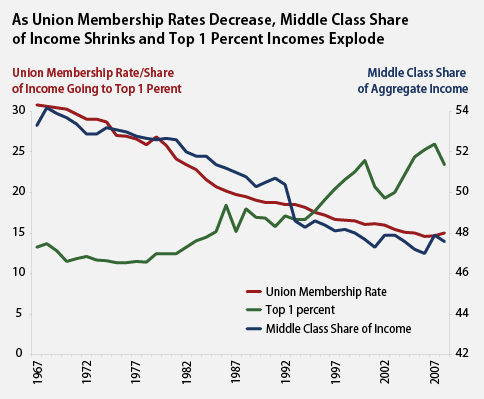
Zaid Jilani writes: This evening, House Majority Leader Eric Cantor (R-VA) will give a speech at the University of Pennsylvania’s Wharton School of Business about how to address income inequality, likely trying to capitalize on the 99 Percent Movement he once derided as unruly “mobs.” Although exactly what policies Cantor will suggest to deal with this social problem are unknown, it’s unlikely that he will touch on one of the chief drivers of American income inequality: the decline of unions.

As CAP’s David Madland and Nick Bunker show in the following chart, the middle class’s share of national income has steadily declined as the percentage of the population in labor unions has fallen. At the same time, the top 1 percent’s share of national income has exploded:

Facebooktwittermail

Syria uses U.S. technology in cyber crackdown

Hamed Aleaziz writes: As the autocratic regime in Syria brutally cracks down on a pro-democracy opposition, it is using technology developed by an American company, Blue Coat Systems, to suppress dissent and block access to the internet, tech experts say.

Two weeks ago, Telecomix, a tech activist group, released information from the Syrian government-run Syria Telecommunications Establishment. The release revealed gigabytes of electronic records, called log files, dating back to late July and early August of this year, and the material indicates that Syria’s government is using Blue Coat’s devices [PDF] to prevent its citizens from accessing social media, video-sharing, and other websites. By using the devices, the Syrian regime can block information about its abuses from getting out of the country and monitor web activity. (Peter Fein, a hacktivist with Telecomix, says the information came from "publicly accessible, completely unsecured servers which were found using traditional network scans.") Selling most US-manufactured goods to Syria has been forbidden by US law since 2004.

Jacob Appelbaum, a tech expert and computer science researcher at the University of Washington who was dubbed "The Most Dangerous Man in Cyberspace" by Rolling Stone, said in an email that "the log files are direct evidence" that Syria is utilizing Blue Coat’s technology. "Every IP address in all of the information released is registered in Syria," Appelbaum added. "Every IP address routes from Syria or from known Syrian equipment with the expected latency of machines run in Syria." Appelbaum believes that the Syrian government uses Blue Coat’s device to monitor citizens’ internet activity, record it for future reference, and then take action against dissidents. "That is to say that it’s a super policeman with a general warrant who spies on every person, records everything about that person and their activities and then it acts as the judge, jury and executioner," he wrote.

Facebooktwittermail

The end of the Gaddafi cult

Juan Cole writes: The final weeks of Muammar Qaddafi’s violent and coercive life reminded me vividly of Jim Jones and the People’s Temple Cult. It was obvious from late last August that Qaddafi had lost. The people in his own capital of Tripoli rose up against him in all but a few small neighborhoods, courageously defying his murderous elite forces.

Qaddafi had on more than one been occasion offered exile abroad, but sneaked off to his home town of Sirte to make a suicidal last stand. His glassy-eyed minions determinedly fired every last tank and artillery shell they had stockpiled right into the city that sheltered them in order to stall the advancing government troops. This monumentally stupid last stand turned Sirte into Beirut circa the 1980s, as gleaming edifices deteriorated into Swiss cheese and then ultimately blackened rubble. Qaddafi had favored Sirte with magnificent conference centers and wood-paneled conference rooms even as he starved some Eastern cities of funds, and in his death throes he took all his gifts back away from the city of his birth, making it drink the tainted Kool-Aid of his maniacal defiance of reality.
[…]
The last stand at Sirte was very like Jim Jones’s last stand in the jungles of Guyana. Jones was an American religious leader who gradually went mad, demanding more and more sacrifice and obedience from the members of his People’s Temple congregation, which then gradually became a cult. I define a cult as a group wherein the leader makes very high demands for obedience and self-sacrifice, and the values of which diverge from those of mainstream society. When the outside world seemed clearly to be pursuing the People’s Temple into Guyana, with a Congressmen showing up in Jonestown to rescue a handful of adherents who wanted to go home, Jones reacted with fury, first sending a militia to kill the congressman and the defectors, and then instructing his followers to drink poisoned Kool-Aid. Many were injected with cyanide laced with liquids or shot. Those who would not agree voluntarily to be “translated” to the next world together with their messianic leader would be subjected to the ultimate coercion.

Qaddafi’s stand at Sirte underlined the cultish character of his politics, with the Revolutionary Committees and Khamis Brigades resembling the enforcers in Jim Jones’s encampment. The tragic episode highlights the irrationality, fanaticism, violence and tyranny of his acolytes.

It would have been better had Qaddafi been left alive to stand trial. The exact circumstances of his death are murky, but it appears that some of his loyalists may have attempted to rescue him from government troops and he died in the firefight or was dispatched lest he be sprung from captivity and serve as a rallying point for the remaining handful of cultists.

Those who expect Libya now to fragment, or to turn into a North African Baghdad, are likely to be disappointed. It is improbable that Qaddafi’s cult will long survive him, at least on any significant scale. Libya has no sectarian divides of the Sunni-Shiite sort. Almost everyone is a Sunni Muslim. It does have an ethnic divide, as between Arabs and Berbers. But the Berbers are bilingual in Arabic, and are in no doubt as to their Libyan identity. The Berbers vigorously joined in the revolution and more or less saved it, and are very likely to be richly rewarded by the new state.

The east-west divide only became dire because Qaddafi increasingly showed favoritism toward the west. A more or less democratic government that spreads around the oil largesse more equitably could easily overcome this divide, which is contingent and not structural.

Libyan identity is not in doubt, and most Libyans are literate and have been through state schools. Most Libyans live in cities where tribal loyalties have attenuated.

There will be conflicts, and factionalism is a given. The government is a mess, with only a small bureaucracy and limited pools of persons with management skills. But oil states in the Gulf facing similar problems back in the 1960s and 1970s just imported Egyptian bureaucrats and managers, and Egypt and Tunisia have a surplus of educated potential managers who face under-employment of their skills at home. Oil states most often generate enough employment not only for their own populations but for a large expatriate work force as well. Just as the pessimists were surprised to find that post-Qaddafi Tripoli was relatively calm and quickly overcame initial problems of food, water and services, so they are likely to discover that the country as a whole muddles through.

One of the most perverse features of a strand of “progressive” attitudes towards the war in Libya (evident among quite a few commenters on this site) is that if post-Gaddafi Libya turns out not to fall apart, this will be a cause of secret disappointment to those who invested so deeply in their own apocalyptic predictions. As I’ve said from the outset, this isn’t an argument worth expending much energy in, proving one side is right and the other wrong, since it’s an argument that doesn’t need to be won — events themselves will be the proof.

Having said that, I want to say more about the issue of cultism, because like Juan Cole, many other observers have noted the cultish features of Gaddafi’s rule.

Cults tend to be associated with religious belief rather than political rule and for that reason what could be seen around Gaddafi is more often described as cult-like rather than as being unambiguously a cult.

Cole provides a reasonable working definition of a cult: “I define a cult as a group wherein the leader makes very high demands for obedience and self-sacrifice, and the values of which diverge from those of mainstream society, and the values of which diverge from those of mainstream society.”

But what needs to be underlined is that cults are not defined by exotic belief systems.

The stereotypical image of a cult would be a group like Marshall Applewhite’s Heaven’s Gate whose members committed suicide in 1997 with the expectation that they would thereby board a spacecraft and escape from Earth.

The problem with associating cults with such belief systems is that the weirdness of these beliefs are really a distraction from the underlying social psychology that binds the cult together.

Cults have two core attributes:

1. Cult members surrender their own autonomy by submitting themselves to the rule of a charismatic individual who has some kind of messiah complex. This is different from obedience to rule by say a monarch, because whereas there is a sharp divide between the king/queen and his/her subjects, cult members and cult leaders are bonded in the experience of merging in a supra-personal identity. Gaddafi didn’t simply rule Libya — he became Libya and his closest devotees could no longer differentiate between their love for him and their love for their country.

2. As a social entity, a cult depends on a rigid boundary between the inside and the outside. From the inside, outsiders are viewed as being so other and so lost that the outsiders’ word and the world they inhabit become worthless in the eyes of the cult. Communication only flows inside a closed and self-reinforcing system and as this closed society evolves, the contagion of unchallenged delusion infects the cult leader as much if not more than the cult followers. As rational as it might have been for Gaddafi to surrender or engineer a safe exit, he couldn’t do so without losing his identity — an edifice of such giant proportions that it became impossible to deconstruct.

The inherent structural weakness of every cult offers a lesson to society at large: a healthy society does not merely tolerate dissent; it recognizes dissent as an essential attribute of social vitality.

Dissent is the king’s fool. Without dissent there is no engine of adaptation.

Facebooktwittermail

Obama’s gift to the Koch brothers and curse to the planet

Jamie Henn, Co-founder and Communications Director of 350.org, writes: Here’s a unique political strategy for you: in the lead up to a crucial election, as anti-corporate sentiment is sweeping the nation, consider giving a huge handout to a major corporation that happens to be your biggest political enemy and is already spending hundreds of millions to defeat you and your agenda.

If that seems too crazy to believe, welcome to the Obama 2012 campaign.

Right now, President Obama is faced with the most crucial environmental decisions he is going to face before the 2012 election: whether or not to approve the permit for the controversial Keystone XL pipeline, a 1,700 mile fuse to the largest carbon bomb on the continent, the Canadian tar sands.

The Keystone XL isn’t just an XL environmental disaster — the nation’s top climate scientists say that fully exploiting the tar sands could mean “essentially game over” for the climate — it also happens to be an XL sized handout to Big Oil and, you guessed it, the Brothers Koch. You want fries with that?

Earlier this year, when Representative Henry Waxman (D-Calif.) attempted to investigate whether or not the Koch Brothers stood to gain from the pipeline, the chairman of the House Committee on Energy and Commerce, Fred Upton (R-Mich.) called the idea an “outrageous accusation” and “blatant political sideshow.” Is it even necessary to mention that reports show Koch and its employees gave $279,500 to 22 of the energy committee’s 31 Republicans and $32,000 to five Democrats?

As you might expect, Upton was completely wrong. Reporters at InsideClimateNews and elsewhere proved that the Koch’s stand to make a fortune with the construction of the pipeline. The brothers already control close to 25 percent of the tar sands crude that is imported into the United State and own mining companies, oil terminals, and refineries all along the pipeline route. You can bet that the champagne will be flowing in Koch HQ when toxic tar sands crude starts moving down the pipe.

Which brings us back to Obama. It’s not too late for the president to intervene and stop the Koch Brothers from pocketing another profit at the expense of the American people. Because it crosses an international border, in order for the Keystone XL pipeline to be built the Obama administration must grant it a “presidential permit” that states that the construction project is in the national interest of the United States.

President Obama can deny the permit, right now, and shut down this flow of cash to the Kochs. In doing so, he’ll show that our national interest isn’t always determined by the 1%, in this case a few big oil companies and the Koch Brothers, but by the 99% of us who have to pay the price for their greed.

Denying the permit will also send a jolt of electricity through President Obama’s base, the millions of us who went out and volunteered and donated to the campaign because we believed in a candidate who said that it was time to “end the tyranny of oil.” In fact, this November 6, thousands of us former believers will be descending on Washington, DC to surround the White House with people carrying placards with the President’s own words in an attempt to resuscitate the 2008 Obama who seemed capable of standing up to folks like the Kochs. You can join here.

I can’t say that I’m privy to what the Obama 2012 campaign will advise the president to do when it comes to the pipeline. But if I was sitting in Chicago watching the Koch Brothers assembled their army of lobbyists across the nation, I’d be thinking that XL handout wasn’t such a good idea.

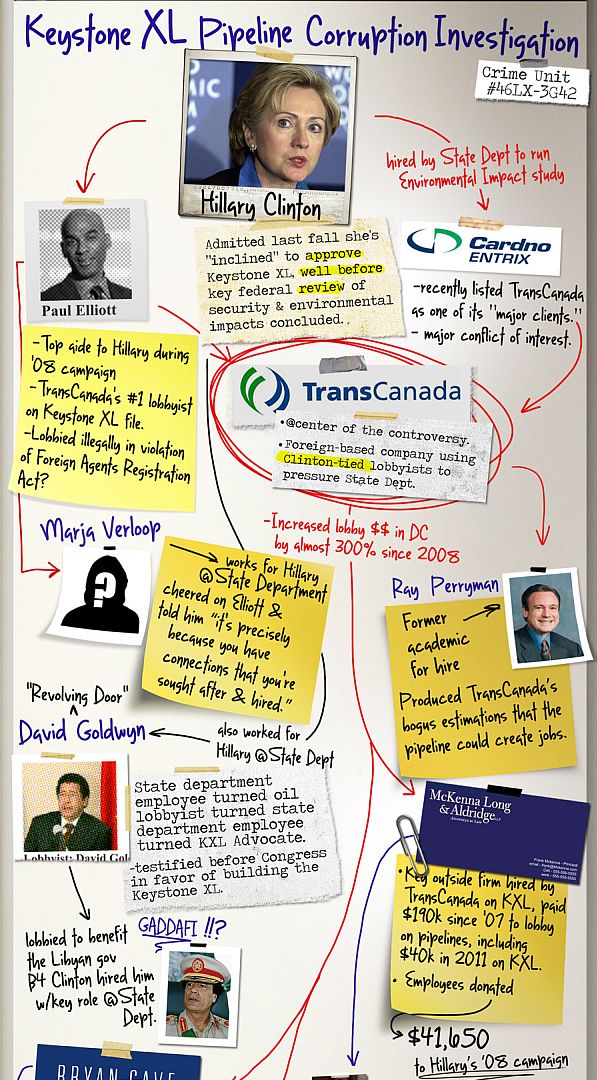
The Keystone XL pipeline network of corruption revealed through an investigation by DeSmogBlog, Oil Change International, The Other 98% and Friends of the Earth (click on the image below to view the complete network):

Facebooktwittermail

Keeping Libya’s promise after Gaddafi’s death

Larbi Sadiki writes: The Arab Spring, still unfolding, began with death. But that is how life is laboured into this world. And the significance and substance of new life can sometimes be commensurate with the “volume” of death, or the size and stature of the deceased.

Gaddafi was larger than life. He was a “prophet” of revolution, then pan-Arabism, and then pan-Africanism, gradually moving his amorphous programme of statehood from nationalism to transnationalism. On the way, he littered his political history with unruliness, spreading his death squads far and wide, lending support in funding and arms to all and sundry, from Ireland to Chad.

The the self-appointed “prophet”, mentor, architect and non-president president of Libya, “king of kings” of all Africa, wanted a larger power ratio than that occupied by demographically sparse Libya. He sought the mirage of power that would reflect the the country’s huge surface area and the largesse beneath the Libyan Sahara, its reserves of black gold.

One thing stood in his way: his narcissism. It was bigger than even that of Narcissus himself.

That is why the death of Gaddafi unleashes huge potentialities and possibilities that will enliven the remarkable Libyan people. Now it is their turn – after the thousands of deaths, injuries, the devastation, pain and suffering – to breathe life into the new Libya, the post-Gaddafi Libya. But there are challenges.

There is no need for Libyans to reinvent the wheel. The task now is to “quarantine” their passions. Like their Egyptian or Tunisian neighbours, Libyans should not surrender their revolution. Indeed, the bathing water of this revolution has been bloody, and ought to be poured out, discarded. The baby born from this process will need more than nursing: It will need many loving, but – above all else – “thinking”, parents.

Today, they are tasked with laying down their weapons and their emotions to nurture their revolution, or risk the very life of the infant-revolution’s condition. New conditioning – post-conflict reconstruction – needs rational tutelage. This needs to be rationality within Libyan specificity, and all of its complexities – tribal, regional, ideological, and even personal – must now measure to the challenge of life-giving in all its entirety.

Facebooktwittermail