Monthly Archives: October 2011

The evolutionary roots of collective intelligence

Big Think: For much of the 20th century, social scientists assumed that competition and strife were the natural order of things, as ingrained as the need for food and shelter. The world would be a better place if we could all just be a little more like John Wayne, the thinking went.

Now researchers are beginning to see teamwork as a biological imperative, present in even the most basic life forms on Earth. And it’s not just about fairness, or the strong lifting up the weak. Collective problem-solving is simply more efficient than rugged individualism.

Facebooktwittermail

A dark day in Israel

In early October, Eyal Raz described the incident on which this Bloggingheads conversation centers: Were you ever at a lynching? Were you ever someplace where an unbridled mob was beating you and your friends and then chasing you to beat you again? Were you ever the victim of wild violence before the blind eyes of policemen who ignored your desperate calls for help? Have you ever felt abandoned? The following story begins with blood, but its point is the abandonment.

What happened Friday afternoon at the entrance to the settlement of Anatot was a pogrom, a lynching. There’s no other way to describe an event in which hundreds of large men are wildly beating and pursuing a nonviolent group of male and female activists for an extended period of time. There’s no way to convey to those who weren’t there the threatening sense of the approaching dark – not in words, not in pictures, not even in video.

They came to destroy, to break, perhaps even to kill. They used their hands, their fists and their teeth, along with stones, pipes and knives. They aimed for the photographers, the women, for the young and the old alike. They brought individuals down to the ground and assaulted them as they lay there, surrounded. They pounced on the hindmost of those trying to flee as they pursued their battered victims.

And all this was taking place before the very eyes of the police, who didn’t do a thing to prevent people from being hurt. It all passed, as usual, in a thunderous silence.

Facebooktwittermail

The Occupy Wall Street image that marks the end of the global consensus

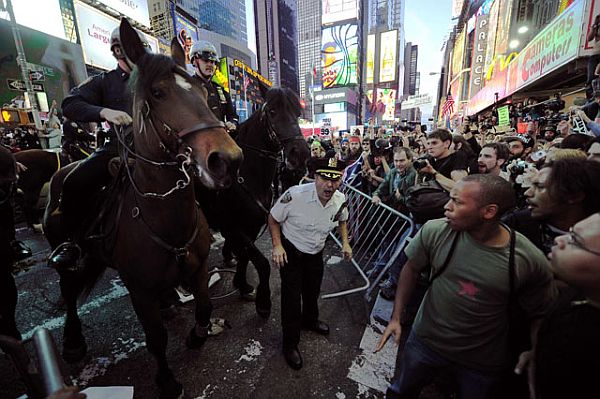
Jonathan Jones writes: A New York police officer leans forward and yells as if attempting, with the sheer force of his anger, to hold back time. His rage is understandable for, in this photograph, you can actually see the world turn upside down and all that was solid melt into air. This truly is a picture of a turning point in the history of the world.

It shows the moment when Occupy Wall Street campaigners reached Times Square, whose giant hoardings glow brightly in broad daylight even as furious protesters confront mounted police. When this photograph was taken, movements were simultaneously starting up around the world in emulation of Occupy Wall Street and its attempt to hold finance capitalists to account. In London and Vancouver, Brussels and – with a violent twist – in Rome, the call went out and the people came. But of all the weekend’s photographs of global protest against capitalist excess, this, surely, is the image that will endure.

That is because it captures the surrealism of a moment when the stabilities and certainties of an era suddenly became yesterday’s distant memory. Times Square makes a powerful setting for this picture. Shiny walls of towing glass, the citadels of corporate entertainment, dazzle among the giant screens – is that Apu from The Simpsons? – in the bright autumn air.

But no one is entertained. The faces in the crowd are genuinely angry and determined. A man in the foreground has a red star on his T-shirt. Sixty years ago they hunted reds in Times Square, metaphorically at least, as America fought the cold war. Today that red star says it all. These people have not come to protest just against a bad law or a single issue, but the system itself. They are putting capitalism in the dock. The photograph powerfully captures this moment because it so vividly shows the symbols of the order of things that inhabitants of western economies have up to now accepted.

There were “anti-capitalist” protests in the boom years but these were self-evidently marginal to a society lapping up the joys of credit. Today, the world is ready to listen to Occupy Wall Street and its claim to speak for the 99% against the profiteering 1%. Everyone knows what they are talking about and everyone can see some truth in it.

Facebooktwittermail

Occupy Wall Street finds mainstream support

Will Oremus writes: If Occupy Wall Street is a fringe movement, it’s looking like a pretty big fringe.

In a Quinnipiac University poll released Monday, two-thirds of New York City voters said they support the protests. The backers included 81 percent of Democrats and, perhaps more surprisingly, 35 percent of Republicans. And an overwhelming majority, 87 percent, said it’s “okay that they are protesting.”

And for all the criticism lobbed at the protesters for not having a formal list of demands, their general message seems to be getting across. Nearly three-fourths of New York City voters said they understand the protesters’ views “very well” or “fairly well.”

Respondents split evenly on whether police are handling the protests well.

And who’s to blame for the nation’s economic mess? Thirty-seven percent of New York City voters fingered George W. Bush, while 21 percent blamed Wall Street, 18 percent Congress, and 11 percent President Obama. Those figures are probably not representative of the nation at large, however. The survey’s demographic summary shows that 55 percent of those polled were Democrats, while just 13 percent were Republicans, reflecting New Yorkers’ liberal bent.

Still, the numbers suggest it’s not just hippies and socialists who are rooting for the movement. The Washington Post’s Plum Line blog asks, “What if working class Americans actually like Occupy Wall Street?” Blogger Greg Sargent quotes union leader Karen Nussbaum as saying that the protests have helped organizers sign up tens of thousands of recruits in recent weeks:

“These are not the folks who normally wear dreadlocks and participate in drum circles,” Nussbaum says. “They’re working class moderates who work as child care employees or in cafeterias or in construction. They’re people who work in lower middle class suburbs around the country.” Pressed on whether the movement’s excesses and lack of a clear agenda risk alienating such voters, Nussbaum said: “We’re proving every day that that’s not the case.”

Indeed, a national poll last week found that the Occupy movement is twice as popular as the Tea Party. A Siena poll of New York state voters this week turned up similar numbers, with 49 percent saying they’d rather join Occupy Wall Street, while 28 percent picked the Tea Party.

Facebooktwittermail

Time for the U.S. to stop bankrolling Israel’s defense

Walter Pincus, in a column for the Washington Post, writes: As the country reviews its spending on defense and foreign assistance, it is time to examine the funding the United States provides to Israel.

Let me put it another way: Nine days ago, the Israeli cabinet reacted to months of demonstrations against the high cost of living there and agreed to raise taxes on corporations and people with high incomes ($130,000 a year). It also approved cutting more than $850 million, or about 5 percent, from its roughly $16 billion defense budget in each of the next two years.

If Israel can reduce its defense spending because of its domestic economic problems, shouldn’t the United States — which must cut military costs because of its major budget deficit — consider reducing its aid to Israel?

First, a review of what the American taxpayer provides to Israel.

In late March 2003, just days after the invasion of Iraq, President George W. Bush requested the approval of $4.7 billion in military assistance for more than 20 countries that had contributed to the conflict or the broader fight against terrorism. Israel, Jordan, Egypt, Afghanistan, Pakistan and Turkey were on that list.

A major share of the money, $1 billion, went to Israel, “on top of the $2.7 billion regular fiscal year 2003 assistance and $9 billion in economic loans guaranteed by the U.S. government over the next three years,” according to a 2003 study by the Congressional Research Service (CRS).

Then in 2007, the Bush administration worked out an agreement to raise the annual military aid grant, which had grown to $2.5 billion, incrementally over the next 10 years. This year, it has reached just over $3 billion. That is almost half of all such military assistance that Washington gives out each year and represents about 18 percent of the Israeli defense budget.

In addition, the military funding for Israel is handled differently than it is for other countries. Israel’s $3 billion is put almost immediately into an interest-bearing account with the Federal Reserve Bank. The interest, collected by Israel on its military aid balance, is used to pay down debt from earlier Israeli non-guaranteed loans from the United States.

Another unique aspect of the assistance package is that about 25 percent of it can be used to buy arms from Israeli companies. No other country has that privilege, according to a September 2010 CRS report.

The U.S. purchases subsidize the Israeli arms business, but Washington maintains a veto over sales of Israeli weapons that may contain U.S. technology.

Look for a minute at the bizarre formula that has become an element of U.S.-Israel military aid, the so-called qualitative military edge (QME). Enshrined in congressional legislation, it requires certification that any proposed arms sale to any other country in the Middle East “will not adversely affect Israel’s qualitative military edge over military threats to Israel.”

In 2009 meetings with defense officials in Israel, Undersecretary of State Ellen Tauscher “reiterated the United States’ strong commitment” to the formula and “expressed appreciation” for Israel’s willingness to work with newly created “QME working groups,” according to a cable of her meetings that was released by WikiLeaks.

The formula has an obvious problem. Because some neighboring countries, such as Saudi Arabia and Egypt, are U.S. allies but also considered threats by Israel, arms provided to them automatically mean that better weapons must go to Israel. The result is a U.S.-generated arms race.

MJ Rosenberg writes: Aid to Israel is virtually the only program, domestic or foreign, that is exempt from every budget cutting proposal pending in Congress. No matter that our own military is facing major cuts along with Medicare, cancer research and hundreds of other programs, Israel’s friends in Congress in both parties make sure that aid to Israel is protected at current levels.

Back when I was a Congressional staffer, I was part of the process by which aid to Israel was secured. Every member of the Congressional Appropriations Committees sent a “wish list” to the chairman of the committee telling him or her which programs he wanted funded and by what amounts. Each letter reflected the particular interest of a particular Representative or Senator and of his own district or state.

There was always one exception: aid to Israel, which apparently is a local issue for every legislator. The American Israel Public Affairs Committee (AIPAC) would provide the list of Israel’s aid requirements for the coming year and, with few if any exceptions, every letter would include the AIPAC language. Not a punctuation mark would be changed.

At the end of the process, the AIPAC wish list would become law of the land. (Woe to any Member of Congress who dared to resist the AIPAC juggernaut).

That is how it has been for decades and not even the current economic crisis is likely to change it. On this issue, Congress is hopeless and will remain so as long as its members rely so heavily on campaign contributions (PAC or individual) delivered by AIPAC.

JTA reports: Mitt Romney said he would increase defense assistance to Israel, raise the U.S. military profile near Iran and recognize Israel as a Jewish state.

Facebooktwittermail

With $53 million arms sale, U.S condones ongoing repression of Bahraini people

Last week, Josh Rogin reported: Five Democratic senators wrote to Secretary of State Hillary Clinton on Wednesday to ask her to delay a planned $53 million arms sale to Bahrain because of the island kingdom’s continued violence against protesters.

“We recognize the administration’s commitment to the United States’ strategic relationship with Bahrain… However, the Bahrain government’s repressive treatment of peaceful protesters during the past several months is unacceptable,” the senators wrote in their Oct. 12 letter [PDF], obtained by The Cable.

“The United States must make it clear to the government of Bahrain that its ongoing human rights violations and unwillingness to acknowledge legitimate demands for reform have a negative impact on its relationship with the United States.”

The letter’s signatories were Senate Foreign Relations Middle East and North Africa Subcommittee chairman Robert Casey (D-PA), Senate Majority Whip Richard Durbin (D-IL), and Sens. Robert Menendez (D-NJ), Benjamin Cardin (D-MD), and Ron Wyden (D-OR).

The letter accuses the Bahrain government of torture and notes reporting by Human Rights Watch that states Bahrain’s government has killed 34 protesters, arrested 1,400 more, and dismissed 3,600 people from their jobs for anti-government activities.

“Completing an arms sale to Bahrain under the current circumstances would weaken U.S. credibility at a critical time of democratic transition in the Middle East,” the senators wrote.

Today, Gulf News reports: Washington has finalised a $53 million (Dh195 million) weapons deal with Bahrain, a top US diplomat has said. “Congress has expressed no opposition to this sale,” said Stephen Seche, Deputy US Assistant Secretary of State for Arabian Peninsula Affairs.

The deal is part of a move to defend Bahrain from aggression, Seche said at a roundtable meeting, local media reported.

The official said that the US looked forward to the recommendations by an international panel that investigated the events that hit Bahrain in February and March and their consequences.

The Bahrain Independent Commission of Inquiry (BICI), set up in June, is scheduled to announce its findings on October 30. The BICI, locally known as the Bassiouni Commission, after its leader Professor M. Cherif Bassiouni an expert in international criminal, human rights and humanitarian law, has interviewed thousands of people in its quest to appreciate what really happened.

“I think we would like to wait for the Commission report to speak for itself. We have been encouraged by the process that has ensued here since the Commission first arrived in Bahrain. They have been very thorough and Mahmoud Cherif Bassiouni has spoken publicly about the response. He has been encouraged by the receptivity of all aspects of the Bahraini government to probe into the different questions, their need to get to as much information in the time they had,” Seche said.

“This is a positive development and we believe that the Commission’s findings will reflect a process which has been thorough and comprehensive and very professional. We will look forward to the recommendations,” he was quoted as saying.

This week, the “Manama Document: Bahrain’s road to freedom and democracy,” a joint document written by opposition groups, was released. It calls on the monarchy to relinquish political power.

In the presence of an unelected government under statesmanship of a single person for 40 years, some 80 per cent of public land ended being controlled by senior members from the royal family and other influential figures. Consequently, this has placed constraints on availability of lands for the purposes of developing projects for housing, municipality, education and health facilities.

Still, the country suffers from an acute poor distribution of wealth and widespread poverty notwithstanding Bahrain being an oil exporting nation, exporting some 200,000 barrels per day. Wrong policies like extending citizenship to foreign nationals have further undermined distribution of wealth in the country.

Against a backdrop of political dictatorship, economic failure and social confusion of government policies, people of Bahrain had pressed for change. Popular demands date back to 1923 with calls made for participation in decision making and 1938 for having an elected assembly with full legislator and regulatory powers. In reality, popular uprisings kept reemerging almost like those of 1954, 1965 and still 1994-2000, the largest of its kind at the time. Thus, there were the revolts of 1954 plus that of March 1965 as well as that of 1994-2000.

Still, affected primarily by events in Tunisia and Egypt as part of Arab Spring, nearly half of Bahrain’s people took to the streets in early 2011 pressing for democracy, respect of human rights and sustained human development. Yet, the demands call for retaining the royal family in terms of ruling and governing without powers, as a true constitutional monarchy.

In short, Bahrain is undergoing rivalry between two camps, one demanding democracy, comprising of people of all walks of life and diverse ideologies with another struggling to maintain the status quo despite need for addressing political, economic and social challenges.

Last month, in an editorial, the Washington Post called on Congress to block the sale of arms to a regime that continues to repress its people.

The rulers of Bahrain, an island nation in the Persian Gulf that hosts the U.S. 5th Fleet, undoubtedly worry that their harsh crackdown on a peaceful pro-democracy movement could damage vital relations with Washington. The government has hired a pricey Washington lobbying firm and regularly dispatches senior officials to stroke the administration and Congress. It has repeatedly promised to free political prisoners, reverse a mass purge of suspected protesters from government jobs and negotiate meaningful reforms of the al-Khalifa monarchy, a Sunni dynasty that rules over a majority-Shiite population.

Yet the regime hasn’t kept its promises — and its unjustified and self-defeating repression goes on. The latest brazen step came Thursday, when a special security court sentenced 20 doctors and other medical professionals to lengthy prison terms after a grossly unfair trial. The doctors were charged with stockpiling weapons and trying to overthrow the regime; in fact, their offense was treating injured protesters who arrived at their hospital and reporting what they saw to international media. A host of human rights groups, including Human Rights Watch and Amnesty International, pronounced the trial a travesty; Human Rights First said the medics had given “consistent and credible accounts of being tortured into giving confessions.”

The convictions came just a day after a court upheld the convictions of 21 opposition leaders, including clerics, members of political parties, human rights activists and bloggers. None are guilty of violence, but all were nonetheless accused of terrorism; eight received life sentences. They, too, have offered credible reports of torture. Another human rights group, Freedom House, said the rulings continued “a pattern of repression that belies any promises of meaningful reform by the government.”

Such a unanimous verdict from human rights groups ought to spell trouble for a government that depends on the United States for defense and enjoys a free-trade agreement with it. Yet there is no sign of serious friction between the Obama administration and the al-Khalifa family. Administration spokesmen have largely kept quiet as the crackdown has proceeded. On the military front, it is business as usual. This month the Pentagon notified Congress of a plan to sell Bahrain armored Humvees and anti-tank missiles worth $53 million.

The message this sends is unmistakable: The regime’s crackdown will not affect its cozy relationship with the United States. This is dangerous for the United States as well as for Bahrain, because the government’s attempt to suppress legitimate demands for change from a majority of the population is ultimately doomed to failure. Bahrain’s ruling family should be given more reason to worry about its standing in Washington. A congressional hold on the arms package would be a good way to start.

Facebooktwittermail

Significant holes in U.S. legal case against alleged Iran plotter

Marcy Wheeler writes: In the wake of the Obama Administration’s announcement that an Iranian-American used car salesman had set up a plot to kill the Saudi Ambassador to the U.S., a number of Iran and intelligence experts have raised questions about the plausibility of the alleged Iranian plot.

But few have commented on problems in the legal case presented against the used car salesman, Manssor Arbabsiar, and his alleged co-conspirators from Iran’s Quds Force, a branch of its special forces. There is a handful of what appear to be holes in the complaint. Though individually they are small, taken together they raise difficult questions about the government’s case. The apparent holes also seem to match up with some of the same concerns raised by skeptical Iran analysts, such as Arbabsiar’s rationale in confessing and the extent of his connection to the Quds Force.

The government claims that Arbabsiar sought out someone he thought was a Mexican drug cartel member in May; he was actually a Drug Enforcement Agency confidential informant. Over a series of meetings, the government alleges, Arbabsiar arranged to forward $100,000 to the informant as down payment for the attack, promised $1.5 million more, and agreed that the informant should kill Saudi Ambassador Adel al-Jubeir with a bomb blast at a DC restaurant, one that would possibly be full of civilians and U.S. members of Congress.

In the complaint [PDF] against Arbabsiar, the government has described four pieces of evidence to support its allegations (it undoubtedly has more intelligence that it doesn’t describe in the complaint):

  • Taped conversations and phone calls between the informant and Arbabsiar
  • Details about a $100,000 bank transfer described as a down payment for the assassination
  • Taped conversations Arbabsiar had with his alleged co-conspirator, Quds Force member Gholam Shakuri, while Arbabsiar was in FBI custody
  • A confession Arbabsiar made after he was arrested on September 29

Two of the conversations between Arbabsiar and the informant, on July 14 and July 17, include very damning comments. Arbabsiar tells the informant, “he wants you to kill this guy” and goes on to say that it is “no big deal” if the informant kills hundreds of civilians and some Senators in the course of the assassination.

But there is a problem with each of these four key pieces of evidence.

Al Jazeera reports: Mahmoud Ahmadinejad, the president of Iran, has said that an alleged plot to kill the Saudi ambassador to the Washington was fabricated by the US to cause a rift between Tehran and Riyadh, and to divert attention from US economic problems.

In an exclusive interview with Al Jazeera in Tehran on Monday, Ahmadinejad said that anyone who hears the claims “laughs”, but warned the US to be mindful of the allegations it makes.

“We’re not worried about expressing our opposition … The US administration is sorely mistaken. The US administration might want to divert attention from what’s going on inside the US,” he said, speaking through a translator, during an interview broadcast live.

“The economic problems of the US are very serious, and by accusing Iran it’s not going to solve any problem.”

Facebooktwittermail

The deal behind the “Shalit deal”: prisoners, power, racism

Toufic Haddad writes: Passing judgment on the Shalit deal cannot take place from a detached precipice of moral or political purity but, rather, must derive from an appreciation for the basic balance of forces at play between the contending parties and their historical precedents in relations between one another. There are no absolute criteria for judging such matters, with interests and needs within each negotiating party variegated, subject to shifts over time, and difficult to quantify to begin with.

For this reason, it is helpful to begin analyzing the Shalit deal by understanding that before Shalit’s capture, Israel refused to recognize Hamas as a legitimate political entity; this non-recognition continued despite the Hamas victory in democratic elections in 2006. Israel subsequently refused all formal interaction with Hamas, encouraging other countries to do the same. Soon after Shalit’s capture, Israel’s Prime Minister’s Bureau reiterated this stance, asserting, “There will be no negotiations to release prisoners…The government of Israel will not give in to extortion by the Palestinian Authority and the Hamas government, which are headed by murderous terror organizations. The Palestinian Authority bears full responsibility for the welfare of Gilad Shalit and for returning him to Israel in good condition.”

In this respect, the very sealing of a deal with Hamas was a major Israeli concession. Israel sought every possible way to retrieve Shalit without having to negotiate, but failed. The weeks after the capture of Shalit witnessed more than 400 Palestinians killed in Israel’s “Operation Summer Rains” in a failed effort to retrieve him. Israel’s massive offensive “Operation Cast lead” in December 2008/January 2009, which left 1400 Palestinians dead, also put the recovery of Shalit as a central objective of the mission. The siege of Gaza is still justified as necessary in the context of Shalit’s continued detention.

All of this was part and parcel of a broader Israeli strategy vis-à-vis Palestinians which entailed not only the historic rejection of all Palestinian political rights, but an on-the-ground military doctrine which holds that “might makes right,” Israel has a “long arm of justice,” and Israel will “burn into [Palestinian] consciousness” their own defeat.

Viewed in this context, Shalit’s capture and detention for five years, and Hamas’ ultimate successful negotiation for a prisoner release are all the more impressive.

Gideon Levy writes: [Gilad Shalit] will return not to a country but rather to a telenovela in which emotions are forever and always the only language. It must be hoped that he will return in good mental health, but he certainly won’t be returning to a healthy society. He will return to a society in psychosis. The national psychosis surrounding his fate began the day he was captured, and is now reaching its peak. The IDF readied a few sets of uniforms for him, it was reported, in the event that the national boy lost a great deal of weight – the main thing is to show him off in uniform, as befits a war hero.

Yedioth Ahronoth has already launched a sales campaign disguised under the banner of “Do you want to write to Gilad?” and the hundreds of thousands of yellow ribbons that fluttered from every tree and the side mirrors of every car will flutter for the last time in the autumn breeze. Israel will once again pat itself on the back in sticky solidarity, in brotherhood and in mutual responsibility – there’s no one like us.

Over the weekend a retired brigadier general already wrote, “That’s exactly the difference between us and them.” (What exactly is the difference? That wasn’t clear. ) And a general in the reserves declared: “Hamas has a heart of stone” (as if someone who detains tens of thousands of Palestinian prisoners, some of them political, some of them without trial, some of them held for years with no family visits, has a heart of gold ).

In the last five years not a single Israeli has remained apathetic about Shalit’s fate. That is how it should be, and it is cause for pride. That humanization of a single soldier, with a (pale ) face, with (noble ) parents and a (worried ) grandfather, and even his having been turned into a “boy,” is a sign of a humanitarian society. One can even somehow accept the frenetic nature of Israeli society, which goes from one extreme situation to another in a flash. The two soldiers who were killed during Shalit’s abduction are unknown soldiers, Shalit became an iconic hero; Yitzhak Rabin turned overnight from a despised prime minister into a saint. MIA soldiers have been forgotten, other captive soldiers never became national symbols, and only Shalit became what he became.

Five years with only a rare news broadcast that did not mention his existence. Apparently there was something about Shalit and about his parents that captured the nation’s heart. And this too is only for the good.

The problem starts with the ridiculous crowns we claimed for ourselves and with the hypocrisy, emptiness and blindness characterizing them. The campaign to free Shalit, which was not free of repellent aspects, such as the efforts to prevent visits to Palestinian prisoners, turned into a campaign of the state, a pressure release valve for the demonstration of caring and civil involvement – hollow and shallow, just like the “candle youth” who sobbed over Rabin’s murder and voted for Netanyahu in the next election.

Who isn’t against terror and for Shalit’s release? But that same sobbing society did not for a moment ask itself, with honesty and with courage, why Shalit was captured. It did not for a moment say to itself, with courage and with honesty, that if it continued along the same path there will be many more Gilad Shalits, dead or captured. In successive elections it voted, again and again, for centrist and right-wing governments, the kind that guarantee that Shalit will not be the last. It tied yellow ribbons and supported all of the black flags. And no one ever told it, with courage and with honesty: Shalit is the unavoidable price of a state that chooses to live by the sword forever.

Facebooktwittermail

Ending the 30-year stranglehold on the human imagination

David Graeber writes: It’s becoming increasingly obvious that the real priority of those running the world for the last few decades has not been creating a viable form of capitalism, but rather, convincing us all that the current form of capitalism is the only conceivable economic system, so its flaws are irrelevant. As a result, we’re all sitting around dumbfounded as the whole apparatus falls apart.

What we’ve learned now is that the economic crisis of the 1970s never really went away. It was fobbed off by cheap credit at home and massive plunder abroad – the latter, in the name of the “third world debt crisis”. But the global south fought back. The “alter-globalisation movement“, was in the end, successful: the IMF has been driven out of East Asia and Latin America, just as it is now being driven from the Middle East. As a result, the debt crisis has come home to Europe and North America, replete with the exact same approach: declare a financial crisis, appoint supposedly neutral technocrats to manage it, and then engage in an orgy of plunder in the name of “austerity”.

The form of resistance that has emerged looks remarkably similar to the old global justice movement, too: we see the rejection of old-fashioned party politics, the same embrace of radical diversity, the same emphasis on inventing new forms of democracy from below. What’s different is largely the target: where in 2000, it was directed at the power of unprecedented new planetary bureaucracies (the WTO, IMF, World Bank, Nafta), institutions with no democratic accountability, which existed only to serve the interests of transnational capital; now, it is at the entire political classes of countries like Greece, Spain and, now, the US – for exactly the same reason. This is why protesters are often hesitant even to issue formal demands, since that might imply recognising the legitimacy of the politicians against whom they are ranged.

When the history is finally written, though, it’s likely all of this tumult – beginning with the Arab Spring – will be remembered as the opening salvo in a wave of negotiations over the dissolution of the American Empire. Thirty years of relentless prioritising of propaganda over substance, and snuffing out anything that might look like a political basis for opposition, might make the prospects for the young protesters look bleak; and it’s clear that the rich are determined to seize as large a share of the spoils as remain, tossing a whole generation of young people to the wolves in order to do so. But history is not on their side.

We might do well to consider the collapse of the European colonial empires. It certainly did not lead to the rich successfully grabbing all the cookies, but to the creation of the modern welfare state. We don’t know precisely what will come out of this round. But if the occupiers finally manage to break the 30-year stranglehold that has been placed on the human imagination, as in those first weeks after September 2008, everything will once again be on the table – and the occupiers of Wall Street and other cities around the US will have done us the greatest favour anyone possibly can.

Facebooktwittermail

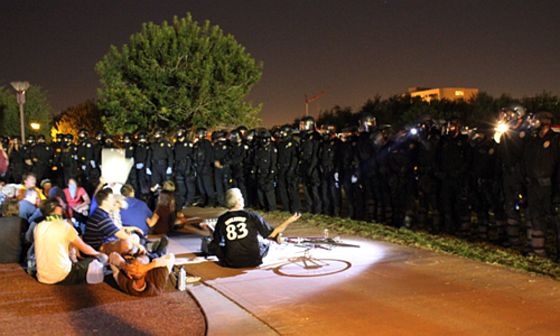
Occupy Phoenix — who do the police protect and serve?

Police arrested 45 protesters attending Occupy Phoenix on Saturday night. Photo: Mauro Whiteman for the Downtown Devil.

The Associated Press reports: Authorities in Arizona arrested nearly 100 people after two separate protests in support of the Occupy Wall Street movement.

The 53 arrests in Tucson and 45 in Phoenix on Saturday night came hours after peaceful protests against financial institutions as part of a series of such demonstrations across the country. Police said demonstrators in each city failed to leave parks at curfew.

Facebooktwittermail

What’s behind the “Iranian plot”?

Laura Secor writes: The weirdness of the Arbabsiar case has, unfortunately, fed a mill that already loves to churn up conspiracies. Who benefits? Blowing up a Washington, D.C., restaurant to kill a Saudi ambassador: exactly what would Iran stand to gain? Is that particular Saudi ambassador really in the way of any Iranian political objective? It doesn’t take a foreign-policy mastermind or an evil genius to see that assassinating him could only result in increased hostilities between Iran and the United States, Saudi Arabia, and Israel. At worst, it could furnish the perfect pretext for a military attack on Iran. At best, it might provoke Saudi Arabia to harass Iran with all the means at its disposal: driving down the price of oil, suppressing Bahraini Shiites, stirring up sectarian trouble in Iraq, and encouraging the Syrian opposition, to name a few.

I’ve long believed that the Iranian regime stands to gain from provoking external antagonism— up to a point. Not war, but rumors of war: the Iranian regime excels in dancing up to the line, then drawing back. (Here again the current plot looks out of character: too brash, too clumsy, too direct.) From its very inception, the Islamic Republic defined and strengthened itself by promoting an atmosphere of siege, whether the external enemy was Iraq, the United States, or the West more generally. That the Islamic Republic is an affront to America, and that America presents a military threat and a cultural onslaught, is practically a raison d’être. After 1989, with the end of the Iran-Iraq war and the petering out of the Cold War, sustaining this atmosphere became more difficult. Fortunately for the Supreme Leader, Ali Khamenei, it got a lot easier during the Bush years, with the Axis of Evil and with U.S. troops in two neighboring countries.

The Obama Administration, however, confounded all that. It came in with a rhetoric of engagement and dialogue. And yet it took less than two years for parties on all sides to once again sound the alarm about a coming U.S. war with Iran.

I’m skeptical. Part of that is experience: the alarm has been sounding for decades, and the war never comes. Part is the creeping suspicion that too many people have too much invested in stoking hysteria. The Iranian regime wants its people to believe the Americans will attack, because it believes this will help it hang on to power. The U.S. government wants the Iranians to believe it just might attack, because otherwise the United States has very little leverage in nuclear negotiations. The Israelis want the Iranians to fear an American attack, because they believe this will deter Iranian moves against Israeli interests. The Saudis, too, would like to use a bellicose American ally as leverage against Iran, their regional rival. Then, there’s American domestic politics. The Republicans bluster against Iran to prove that they are tough and that the Democrats are appeasers; the Democrats bluster against Iran to prove that they are no such thing. The neoconservative right encourages the conclusion that the only solution is military; the anti-imperialist left forever argues that the neoconservatives are secretly steering America toward war. It could be my sheer perversity that prevents me from believing what everyone wants me to believe. Or it could be that none of these parties have satisfactorily proved that anyone actually in power believes an attack on Iran would advance American interests more than it would set them back.

Gareth Porter writes: On May 24, when Arbabsiar first met with the DEA informant he thought was part of a Mexican drug cartel, it was not to hire a hit squad to kill the ambassador. Rather, there is reason to believe that the main purpose was to arrange a deal to sell large amounts of opium from Afghanistan.

In the complaint, the closest to a semblance of evidence that Arbabsiar sought help during that first meeting to assassinate the Saudi ambassador is the allegation, attributed to the DEA informant, that Arbabsiar said he was “interested in, among other things, attacking an embassy of Saudi Arabia”.

Among the “other things” was almost certainly a deal on heroin controlled by officers in the Islamic Revolutionary Guard Corps (IRGC). Three Bloomberg reporters, citing a “federal law enforcement official”, wrote that Arbabsiar told the DEA informant he represented Iranians who “controlled drug smuggling and could provide tons of opium”.

Because of opium entering Iran from Afghanistan, Iranian authorities hold 85 percent of the world’s opium seizures, according to Iran’s Fars News Agency. Iranian security personnel, including those in the IRGC and its Quds Force, then have the opportunity to sell the opium to traffickers in the Middle East, Europe and now Mexico.

Mexican drug cartels have begun connecting with Middle Eastern drug traffickers, in many cases stationing operatives in Middle East locations to facilitate heroin production and sales, according to a report last January in Borderland Beat.

But the FBI account of the contacts between Arbabsiar and the DEA informant does not reference any discussions of drugs.

Interview with Gareth Porter — Part One:

Interview with Gareth Porter — Part Two:

Facebooktwittermail

Why Cornel West was arrested in memory of MLK, in support of the Occupy movement

John Nichols writes: On the day that President Obama and others celebrated the memory of the Rev. Dr. Martin Luther King Jr. at the dedication of Washington’s King memorial, Dr. Cornel West was a few blocks away—celebrating King with activism on behalf of economic justice and the "Occupy" movement.

After attending the dedication of the King memorial, West joined a "Stop the Machine! Create a New World!" protest march.

On the steps of the U.S. Supreme Court, with fellow activists, he called out the high court for making decisions that allow corporations to dominate the economic life and the politics of the nation.

"We want to bear witness today that we know the relation between corporate greed and what goes on too often in the Supreme Court decisions," West declared. "We want to send a lesson to ourselves, to our loved ones, our families, our communities, our nation and the world, that out of deep love for working and poor people that we are willing to put whatever it takes (on the line)—even if we get arrested today—and say we will not allow this day of Martin Luther King Jr’s memorial to go by without somebody going to jail. Because Martin King would be here right with us, willing to throw down out of deep love."

Facebooktwittermail

Global day of rage: Hundreds of thousands march against inequity, big banks as occupy movement grows

From Buenos Aires to Toronto, Kuala Lumpur to London, hundreds of thousands of people rallied on Saturday in a global day of action against corporate greed and budget cutbacks, demanding better living conditions and a more equitable distribution of wealth and resources. Protests reportedly took place in 1,500 cities, including 100 cities in the United States — all in solidarity with the Occupy Wall Street movement that launched one month ago in New York City.

Facebooktwittermail

Charting inequality in America

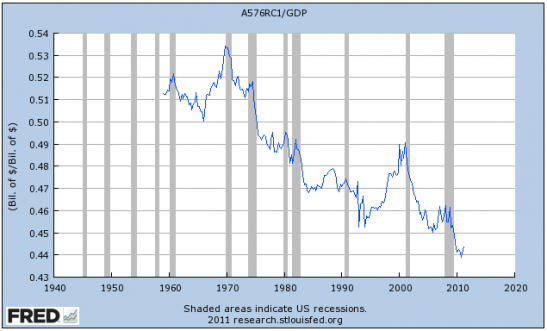
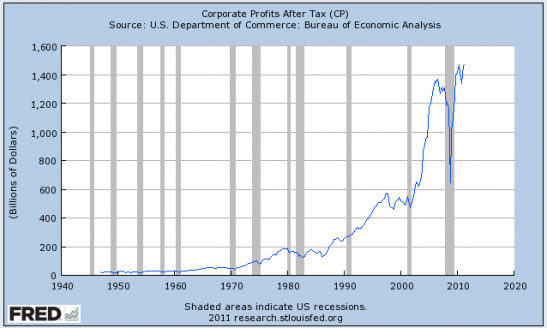
Henry Blodget writes: Inequality in this country has hit a level that has been seen only once in the nation’s history, and unemployment has reached a level that has been seen only once since the Great Depression. And, at the same time, corporate profits are at a record high.

In other words, in the never-ending tug-of-war between “labor” and “capital,” there has rarely—if ever—been a time when “capital” was so clearly winning.

Wages as a percent of the US economy are the lowest they have ever been.

Corporate profits are at an all-time high

See 30 more charts tracking inequality in the United States.

Facebooktwittermail

Israel plans new settlement of 2,600 homes that will isolate Arab East Jerusalem

The Guardian reports: Israel has submitted plans to build the first big Jewish settlement in the occupied territories in 25 years, in a move condemned as an “assassination” of attempts to revive peace negotiations.

A leading Israeli peace group, Peace Now, denounced the plan to build 2,600 homes at Givat Hamatos on the southern edge of Jerusalem as a “game changer” because it would virtually cut off the Arab east of the city from the rest of the occupied West Bank.

The UN, the EU and Britain joined the Palestinians in condemning the move as provocative at a time when the major powers are struggling to rekindle negotiations while the Palestinian bid for statehood is still before the UN security council.

The Palestinian leadership, which has said there can be no new talks if settlement building continues, said the plans were further evidence that Israel “wants to destroy the peace process”.

Givat Hamatos would form a big part of the crescent of Jewish settlements which, in parallel with the West Bank wall and fence, has increasingly isolated East Jerusalem from the rest of the occupied territories. Israeli peace activists say the intention is to solidify Israel’s claim to all of Jerusalem and to minimise the amount of the city ceded to an independent Palestine. Work could begin as early as next year.

Facebooktwittermail

Mark Cuban’s soapbox advice to the OWS movement and then some

On Blog Maverick, Mark Cuban writes: I may not know much, but I know a lot of it. So I decided to share my opinions and thoughts on what I would do if the OWS movement either elected me Grand Poobah or asked for my advice:

1. The Great Lie of Wall Street.

Every CEO tells the same great white lie. It is at the heart of every communication. It is at the heart of every financial decision. It is, at it’s very base, the reason why you all are in the 99pct and they are in the 1pct. The Lie ?

Great CEO White Lie = “We are acting in the best interests of shareholders.”

When a CEO utters this lie, everyone automatically forgives whatever they do. Add 10k jobless to the unemployment rolls ? Sorry, we did it in the BEST INTEREST OF SHAREHOLDERS. Merge or buy a company and cut back across the board ? We did it in the Best Interest of Shareholders.

The problem is that unless the company is losing money and it is the only way to keep the company alive, in this era of 9.1pct unemployment it NEVER is in the BEST INTEREST OF SHAREHOLDERS.

Shareholders , whether they own shares directly or through mutual funds or pensions do not live in a corporate vacuum. Their lives are impacted by far more than the share price of a stock. Every layoff in the name of more earnings per share puts a stress on the economy, on the federal, state and local governments which is in turn paid for through taxes or assumption of government debt by….wait for it.. the same shareholders CEOs say they want to benefit.

If OWS really wants to change corporate structure and impact the economy, talk to shareholders. Talk to your parents, uncles/aunts, cousins, friends who own shares of stocks either directly or indirectly and have them state loudly and clearly that they would rather have a higher Price to Earnings Ratio and even a lower stock price than have their TAXES increase in order to support all the people laid off from their jobs in the name of shareholders !

You might even consider buying a share of stock. Just 1. Maybe you can all pitch in and then go to a shareholders meeting and let them know how you feel about the best interests of shareholders.

2. Push to Make All Financial Institutions Partnerships

We should make all investment banks become reporting partnerships (meaning they still have the same reporting requirements they have today ). I would have no problem with our government loaning money to the partners of Goldman Sachs and Morgan Stanley and other Too Big To Fail Institutions so that they can buy back all public shares of their stock. Of course all those partners would become personally liable for repaying that money back to the government. It would probably be about 120B dollars in total to take these 2 companies private. That is far, far less than a possible bailout would cost.

Those personal guarantees would change EVERYTHING in the banking industry. It would change the decision making process across the board. There would be a moral hazard to every decision. Today , a wrong decision and they vacation on their yacht. As a partner, the wrong decision and they are protesting right next to the OWS crowd as a 99pct er. It would be the definition of having “skin in the game”

3. Limit the Size of Student Loans to $2,000 per year

Crazy ? Maybe, maybe not. What happened to the price of homes when the mortgage loan bubble popped ? They plummeted. If the size of student loans are capped at a low level, you know what will happen to the price of going to a college or university ? It will plummet. Colleges and universities will have to completely rethink what they are, what purpose they serve and who their customers will be. Will some go out of business ? Absolutely. That is real world. Will the quality of education suffer ? Given that TAs will still work for cheap, I doubt it.

Now some might argue that limiting student loans will limit the ability of lower income students to go to better schools. I say nonsense on two fronts. The only thing that allowing students to graduate with 50k , 80k or even more debt does is assure they will stay low income for a long, long time after they graduate ! The 2nd improvement will be that smart students will find the schools that adapt to the new rules and offer the best education they can afford. Just as they do now, but without loading up on debt.

The beauty of capitalism is that people like me will figure out new and better ways to create and operate for profit universities that educate as well or better as today’s state institutions, AND I have no doubt that the state colleges and universities will figure out how to adapt to the new world of limited student loans as well.

Finally, the impact on the overall economy will be ENORMOUS. There is more student loan debt than credit card debt outstanding today. By relieving this burden at graduation, students will be able to participate in the economy

4. Tax the Hell Out of Wall Street; Give it to Main Street

In a world of High Frequency Trading and black box trading that does nothing but create a platform for “financial hackers” to turn the market into their own proprietary financial playground, we need to figure out a way to revert the Stock and Bond Markets, and the derivative instruments created from these equities, back to their original purpose, a place to raise capital for growing business. Instead, today its a platform for financial engineers and hackers looking to exploit every and any opportunity. When 60pct or more of trades are from High Frequency/Algorithmic traders and the correlation for every market index rushes past .7, the market is no longer a market, its a platform.

The simplest way to change this is to place a very simple per share tax on every transaction. 10 cents a trade. Every share. Every option. Every Bond. Every currency transaction. Every trade.

Facebooktwittermail