The Guardian reports: Even by Afghanistan‘s high standards, the massacre of Shia worshippers in Kabul on Tuesday 6 December was an act of stomach-churning brutality. A suicide bomber posing as a pilgrim on Ashura, one of the holiest days of the calendar of Shia Islam, had inveigled his way into the middle of a packed crowd of men, women and children. Witnesses watching from the rooftop of the nearby Abu Fazal shrine said body parts flew up into the air near the epicentre of the blast when the unknown bomber detonated himself.
The clearing smoke revealed a scene strewn with lifeless and often mangled bodies, lying in circles around the blackened area of tarmac where the bomber had stood. A young girl who had somehow miraculously survived was snapped by a photographer wailing into the air. Among the 55 killed there were no police officers or soldiers or anyone who might remotely be considered a “legitimate” target of the Taliban-led war against the Afghan government.
The Taliban itself was quick to condemn the attack in strong terms, while an extremist Pakistan-based movement called Lashkar- e-Jhangvi al Almiv has been fingered. If it really was a unilateral operation launched without the consent of the Taliban’s leadership it is another worrying sign of how the insurgency in Afghanistan is spinning out of control, becoming crueller and ever more willing to inflict horrendous damage on ordinary civilians.
But not everyone thinks such horrors are an entirely bad thing. Indeed, some within the US war machine have long argued the emergence of a nastier insurgency could be really quite useful for Nato‘s war aims. So useful, in fact, that foreign forces should try to encourage such behaviour.
One of them was Peter Lavoy, a former chairman of the US National Intelligence Council, the body that examines data from across the US government’s intelligence gathering machine and turns it into high-grade analysis that is rarely discussed publicly. At a closed-door meeting with ambassadors at Nato headquarters in Brussels in December 2008, Lavoy spelled out a strategy for winning the war in Afghanistan that has never been uttered publicly: “The international community should put intense pressure on the Taliban in 2009 in order to bring out their more violent and ideologically radical tendencies,” he said, according to a State Department note-taker in the room. “This will alienate the population and give us an opportunity to separate the Taliban from the population.”
His words, which we only know courtesy of WikiLeaks, are extraordinary because they have been proven at least partially right. They also differ fundamentally from the publicly stated strategy in Afghanistan. Known as population-centric counterinsurgency, or Coin, the fundamental principle is that foreign forces should try to keep ordinary Afghans safe from insurgents and thereby win their support.
The idea that Nato may actually be trying to make the population less secure appalls observers. “It just goes completely against the ethos of the American military not to take more risks in order to protect civilians,” says John Nagl, a retired lieutenant-colonel who co-wrote the US army’s field manual on countering guerrilla warfare. “I find it hard to believe elements of the US military would want to deliberately put more risk on to civilians.”
But behind the scenes, powerful voices continue to argue for a harder-edged strategy that makes the lives of ordinary Afghans more miserable, not less. Michael Semple, a regional expert on the Taliban, says it is an outlook he runs across in discussions with Nato officials: “I have heard serious, thinking officers articulate the idea that provoking Taliban fighters into acts of extreme violence against the population could be taken as a sign of Coin progress, prior to the final victory when the people turn against them.”
Monthly Archives: December 2011
Newt, the Jews and an “invented people”
At the New Yorker, David Remnick comments on Newt Gingrich’s incendiary claim that the Palestinians are an “invented people.”
Gingrich and his fellow Republicans have sensed a potential softening in the Jewish vote. In 2008, only African-Americans were more solidly behind Barack Obama, who, according to exit polls, won seventy-eight per cent of the Jewish vote. But the Republicans are hoping to woo at least the more conservative sector of Jewish Americans—those who feel that Obama has been too hard on Benjamin Netanyahu. And, because Gingrich has a little learning and a darkly sophisticated memory for intellectual battle, he catered to his cause by employing the word “invented.” In this context, the word summons a 1984 bestseller that was once totemic on the Jewish right (and still is, for some): “From Time Immemorial: The Origins of the Arab-Jewish Conflict Over Palestine,” by Joan Peters.
Peters, who was not a historian, put forward a purportedly scholarly construction based on the notion, as Golda Meir famously put it, that there is “no such thing as a Palestinian people.” The book, which is an ideological tract disguised as history, made the demographic argument that most people who call themselves Palestinians have short roots in the territory and are Arabs who came from elsewhere. It suggests that the territory that is now Israel was all but “uninhabited” before the Zionist movement began. It was a book that implicitly made the argument that Palestine was a tabula rasa waiting for its Jewish revival; or, as the old slogan had it: “a land without a people for a people without a land.”
The book was not only a commercial success; it also won plaudits from Saul Bellow, Barbara Tuchman, Martin Peretz, Theodore H. White, Lucy Dawidowicz, Arthur Goldberg, and Elie Wiesel. For a time, it was wielded as a means to dismiss Palestinian claims on the land, and a means to be dismissive of Palestinians entirely. The book was thoroughly discredited by an Israeli historian, Yehoshua Porath, and many others who dismantled its pseudo-scholarship. Even some right-wing critics, like Daniel Pipes, who initially reviewed the book positively, later admitted that Peters’s work was shoddy and “ignores inconvenient facts.”
Philip Weiss, following a point that many of his readers seized on after he praised Remnick’s commentary yesterday, notes:
Remnick left out Norman Finkelstein’s role in exposing the fraud; he gave credit to an Israeli:
The book was thoroughly discredited by an Israeli historian, Yehoshua Porath, and many others who dismantled its pseudo-scholarship.
Remnick’s link was to Porath’s 1986 review of the book, “From Time Immemorial,” in the New York Review of Books.
This is a misrepresentation of intellectual history. The story of Norman Finkelstein’s exposure of Joan Peters is one of the great intellectual whodunnits of the Israel-Palestine issue. Finkelstein’s career began with this undertaking, which long preceded Porath’s– in fact, Porath actually cites Finkelstein’s work in his footnotes.
Here’s some of what Finkelstein has written on Peters’ work:
Israel turning into theocracy
Eric Alterman writes: It is becoming increasingly obvious that a break between Israel and Diaspora Jewry, particularly its American variety, is fast approaching. The reason for this is that Israel is slowly but inexorably turning into a conservative theocracy while the Diaspora is largely dedicated to liberal democracy.
The strategy of the “pro-Israel” camp among American Jewish organizations and neoconservative pundits has been, so far, one of avoidance of unpleasant facts coupled with unpleasant insinuations about the loyalties of those who insist on taking them seriously. But denial can work in only the short term, and only with an American Jewish population that identifies closely with Israel and relates all threats back to the Holocaust. These conditions, like the generation that sustained them, are not long for this world. Once this aging constituency is gone, the truth will prove unavoidable and it will be too late to deny it any longer.
Israel is no democracy, and it never has been with regard to the 4 million Arabs in the West Bank and Gaza. It has always been a decidedly imperfect democracy concerning its own Arab citizens.
Lately, however, it has become less and less democratic with regard to the rights of its Jewish population. For reasons of demography, the Israeli body politic is increasingly dominated by Haredi Jews on the one hand, and secular nationalists, many of whose families emigrated from Russia, on the other. Neither group demonstrates any intrinsic interest in liberal political niceties like free speech, minority political rights or civil liberties.
UN says deaths in Syria unrest exceed 5,000
Al Jazeera reports: More than 5,000 people are now believed to have been killed in the Syrian government’s crackdown on protests, the United Nations rights chief has told the UN Security Council.
The UN’s Navi Pillay said on Monday there were reports of increased attacks by opposition groups on President Bashar al-Assad’s security forces but highlighted “alarming” events in the besieged protest city of Homs, according to diplomats in the closed meeting.
More than 14,000 people are estimated to have been detained and at least 300 children are among the dead, Pillay told the 15-nation council, according to diplomats.
She estimated that at least 12,400 have fled into neighbouring countries since the anti-government protests erupted in March.
Hezbollah identifies undercover CIA officers in Lebanon in dangerous spy war
The Associated Press reports: The militant group Hezbollah has revealed the identities of CIA officers working undercover in Lebanon, a blow to agency operations in the region and the latest salvo in an escalating spy war.
Hezbollah made the names public in a broadcast Friday night on a Lebanese television station, al-Manar. Using animated videos, the station recreated meetings purported to take place between CIA officers and paid informants at Starbucks and Pizza Hut.
The disclosure comes after Hezbollah managed to partially unravel the agency’s spy network in Lebanon after running a double agent against the CIA, former and current U.S. intelligence officials said. They requested anonymity to discuss matters of intelligence.
In June, Hezbollah chief Hassan Nasrallah bragged that his group had identified at least two spies working for the CIA. It is not clear whether one of those spies was, in fact, the same double agent working for Hezbollah, which is considered a terrorist group by the U.S. Nasrallah has called the U.S. Embassy in Beirut a “den of spies.”
The fiasco happened despite top CIA officials being warned to be extra careful when handling informants after Hezbollah and Lebanese officials arrested scores of Israeli spies in 2009.
The outing of the officers is particularly damaging because it will hinder the ability of these CIA employees to work overseas again — especially in the Internet age where references to their names will be widely available to other foreign intelligence agencies.
Robert Wright talks to Alexey Sidorenko about protests in Russia
New evidence that Iran hijacked U.S. stealth drone — updated
Updated: I guess the egg’s on my face this time. Turns out the video the Iranians broadcast (see below) is not an RQ-170 — it’s a Lockheed Polecat on a test flight. (Thanks goes to reader “blowback” for pointing this out.)
As the story about Iran’s capture of an RQ-170 stealth drone continues to unfold, it is the credibility of American officials that keeps on getting shredded.
Here’s the latest from the Associated Press:
Officers in the Revolutionary Guard, Iran’s most powerful military force, have claimed the country’s armed forces brought down the surveillance aircraft with an electronic ambush, causing minimum damage to the drone.
American officials have said that U.S. intelligence assessments indicate that Iran neither shot the drone down, nor used electronic or cybertechnology to force it from the sky. They contend the drone malfunctioned.
Is this how a malfunctioning drone makes a perfect landing on an Iranian airstrip?
President Obama says the U.S. has asked for its drone back. But Iran has no intention of returning it and claims to be in the final stages of extracting data from it according to one lawmaker.
The Washington Post reports:
Parviz Sorouri, a key member of the parliament’s national security and foreign policy committee, told Iranian state television that the extracted information would be used to file a lawsuit against the United States over the “invasion” by the unmanned aircraft.
He asserted that Iran would “soon” start to reproduce the drone after a nearly finished process of reverse engineering was completed. “In the near future, we will be able to mass produce it. . . . Iranian engineers will soon build an aircraft superior to the American [drone] using reverse engineering,” he was quoted as saying.
Sorouri also said the country’s armed forces would soon conduct an exercise on closing the Strait of Hormuz, the narrow waterway between the Gulf of Oman and the oil-rich Persian Gulf.
Noting the strategic importance of the strait, Sorouri said, “We will hold a military maneuver on how to close the Strait of Hormuz soon,” the Iranian Students’ News Agency reported. “If the world wants to make the region insecure, we will make the world insecure.”
Blogger, Rami al-Jarrah, describes his escape from Syria
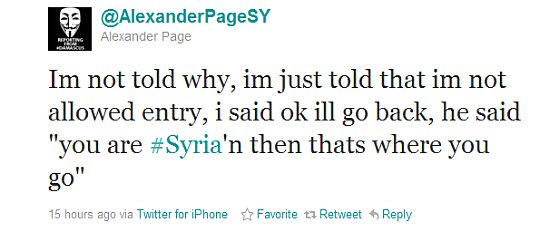
Rami al-Jarrah, who was blogging and tweeting from Syria under the pseudonym “Alexander Page,” just fled the country after his real identity became known to the intelligence services. Upon his arrival in Qatar he almost got sent back to Syria but thanks to a swift outpouring of support on Twitter, he was allowed in.

Syrians ‘strike for dignity’
Predator drones employed by U.S. police
The Los Angeles Times reports: Armed with a search warrant, Nelson County Sheriff Kelly Janke went looking for six missing cows on the Brossart family farm in the early evening of June 23. Three men brandishing rifles chased him off, he said.
Janke knew the gunmen could be anywhere on the 3,000-acre spread in eastern North Dakota. Fearful of an armed standoff, he called in reinforcements from the state Highway Patrol, a regional SWAT team, a bomb squad, ambulances and deputy sheriffs from three other counties.
He also called in a Predator B drone.
As the unmanned aircraft circled 2 miles overhead the next morning, sophisticated sensors under the nose helped pinpoint the three suspects and showed they were unarmed. Police rushed in and made the first known arrests of U.S. citizens with help from a Predator, the spy drone that has helped revolutionize modern warfare.
But that was just the start. Local police say they have used two unarmed Predators based at Grand Forks Air Force Base to fly at least two dozen surveillance flights since June. The FBI and Drug Enforcement Administration have used Predators for other domestic investigations, officials said.
“We don’t use [drones] on every call out,” said Bill Macki, head of the police SWAT team in Grand Forks. “If we have something in town like an apartment complex, we don’t call them.”
The drones belong to U.S. Customs and Border Protection, which operates eight Predators on the country’s northern and southwestern borders to search for illegal immigrants and smugglers. The previously unreported use of its drones to assist local, state and federal law enforcement has occurred without any public acknowledgment or debate.
Increased U.S. drone strikes questioned
U.S.-Pakistan relations deteriorate
Al Jazeera reports: The US has vacated the Shamsi air base in Pakistan’s Balochistan province after a 15-day ultimatum given by Islamabad, prompted by the deaths of at least 24 of its soldiers in a NATO air raid last month.
Sunday’s withdrawal was completed when the final flight carrying US personnel and equiptment flew out.
Nine planes carrying personnel and 20 carrying equiptment – including drone aircraft and weapons – left for neighbouring Afghanistan, officials said.
Shamsi was believed to be the staging post for US drones operating in northwest Pakistan and neighbouring Afghanistan.
Meanwhile, a senior Pakistani military official told a US television network on Sunday that his country “will shoot down any US drone that enters its territory”.
Al Jazeera’s Kamal Hyder, reporting from Islamabad, said that Pakistani parliamentarians had “asked their air chief whether they had the capability to shoot down the drones if they were to violate their frontiers”.
“The air chief told them point blank that the decision to shoot down the drones was a political one and if they were ordered to do so they would comply,” he said.
Why ‘we the people’ must triumph over corporate power
Bill Moyers writes: Rarely have so few imposed such damage on so many. When five conservative members of the Supreme Court handed for-profit corporations the right to secretly flood political campaigns with tidal waves of cash on the eve of an election, they moved America closer to outright plutocracy, where political power derived from wealth is devoted to the protection of wealth. It is now official: Just as they have adorned our athletic stadiums and multiple places of public assembly with their logos, corporations can officially put their brand on the government of the United States as well as the executive, legislative, and judicial branches of the fifty states.
The decision in Citizens United v. Federal Election Commission giving “artificial entities” the same rights of “free speech” as living, breathing human beings will likely prove as infamous as the Dred Scott ruling of 1857 that opened the unsettled territories of the United States to slavery whether future inhabitants wanted it or not. It took a civil war and another hundred years of enforced segregation and deprivation before the effects of that ruling were finally exorcised from our laws. God spare us civil strife over the pernicious consequences of Citizens United, but unless citizens stand their ground, America will divide even more swiftly into winners and losers with little pity for the latter. Citizens United is but the latest battle in the class war waged for thirty years from the top down by the corporate and political right. Instead of creating a fair and level playing field for all, government would become the agent of the powerful and privileged. Public institutions, laws, and regulations, as well as the ideas, norms, and beliefs that aimed to protect the common good and helped create America’s iconic middle class, would become increasingly vulnerable. The Nobel Laureate economist Robert Solow succinctly summed up the results: “The redistribution of wealth in favor of the wealthy and of power in favor of the powerful.” In the wake of Citizens United, popular resistance is all that can prevent the richest economic interests in the country from buying the democratic process lock, stock, and barrel.
America has a long record of conflict with corporations. Wealth acquired under capitalism is in and of itself no enemy to democracy, but wealth armed with political power — power to choke off opportunities for others to rise, power to subvert public purposes and deny public needs — is a proven danger to the “general welfare” proclaimed in the Preamble to the Constitution as one of the justifications for America’s existence.
Depression and democracy
Paul Krugman writes: It’s time to start calling the current situation what it is: a depression. True, it’s not a full replay of the Great Depression, but that’s cold comfort. Unemployment in both America and Europe remains disastrously high. Leaders and institutions are increasingly discredited. And democratic values are under siege.
On that last point, I am not being alarmist. On the political as on the economic front it’s important not to fall into the “not as bad as” trap. High unemployment isn’t O.K. just because it hasn’t hit 1933 levels; ominous political trends shouldn’t be dismissed just because there’s no Hitler in sight.
Let’s talk, in particular, about what’s happening in Europe — not because all is well with America, but because the gravity of European political developments isn’t widely understood.
First of all, the crisis of the euro is killing the European dream. The shared currency, which was supposed to bind nations together, has instead created an atmosphere of bitter acrimony.
Specifically, demands for ever-harsher austerity, with no offsetting effort to foster growth, have done double damage. They have failed as economic policy, worsening unemployment without restoring confidence; a Europe-wide recession now looks likely even if the immediate threat of financial crisis is contained. And they have created immense anger, with many Europeans furious at what is perceived, fairly or unfairly (or actually a bit of both), as a heavy-handed exercise of German power.
Nobody familiar with Europe’s history can look at this resurgence of hostility without feeling a shiver. Yet there may be worse things happening.
Russia’s middle class rises up against Putin
The Independent reports: “I’m not sure exactly how to explain why I’ll be at the protest,” says Alan Gatsunaev, sipping green tea in a Moscow cafe.
“It just feels like I can’t not be there.” The 30-year-old Muscovite, wearing a grey cardigan and sporting carefully trimmed facial hair, does not look much like an angry protester. A successful real estate consultant, he has benefited from the rise in incomes and economic possibilities under the rule of Vladimir Putin over the past decade, and can invariably be found on Friday and Saturday nights sipping cocktails in upmarket Moscow nightclubs.
Before this week, he had never been to an opposition protest. But, he says, after Mr Putin announced in September that he planned to stand in March elections for a return to the presidency, he began to think enough was enough. After Sunday’s parliamentary elections gave Mr Putin’s United Russia party 49 per cent of the vote, despite the fact that hardly anybody he knew admitted to voting for them, he attended rallies on Monday and Tuesday night, and is one of about 35,000 who have signed up on Facebook to attend a rally in central Moscow this afternoon that will call for new elections.
“I have never thought of myself as a political person, and I think the first time I heard the name Surkov was six months ago,” says Mr Gatsunaev, referring to Vladislav Surkov, a key Kremlin aide who has been the chief ideologist of Russia’s political system during the rule of Mr Putin and his stop-gap replacement, Dmitry Medvedev.
“But I have changed recently. The thing that is most offensive is the level of cynicism. With the internet you can literally see that you are being lied to, and people have just lost patience.”
The Associated Press reports: Russian President Dmitry Medvedev said on Sunday that he has ordered a probe into the allegations of electoral fraud during the Dec. 4 parliamentary vote.
Tens of thousands rallied in Moscow and other cities on Saturday in the largest anti-government protest in Russia’s post-Soviet history to protest the reported fraud and demand the departure of Prime Minister Vladimir Putin.
Medvedev on Sunday broke two days of silence by posting a comment on his Facebook page.
“I disagree with the slogans as well as with the speeches that were made at the rallies,” he said, but added that he gave instruction for a check of the reports of fraud. He did not mention who would carry out the probe.
Medvedev’s post generated over 1,000 mostly angry comments within 50 minutes.
“Shame!” and “We don’t believe you!” were the most common.
The real definition of terrorism
Glenn Greenwald writes: The FBI yesterday announced it has secured an indictment against Faruq Khalil Muhammad ‘Isa, a 38-year-old citizen of Iraq currently in Canada, from which the U.S. is seeking his extradition. The headline on the FBI’s Press Release tells the basic story: “Alleged Terrorist Indicted in New York for the Murder of Five American Soldiers.” The criminal complaint previously filed under seal provides the details: ‘Isa is charged with “providing material support to a terrorist conspiracy” because he allegedly supported a 2008 attack on a U.S. military base in Mosul that killed 5 American soldiers. In other words, if the U.S. invades and occupies your country, and you respond by fighting back against the invading army — the ultimate definition of a “military, not civilian target” — then you are a . . . Terrorist.
Here is how the complaint, in the first paragraph, summarizes the Terrorism charge against ‘Isa:
By “outside of the United States,” the Government means: inside Iraq, ‘Isa’s country. The bulk of the complaint details conversations ‘Isa allegedly had over the Internet, while he was in Canada, with several Tunisians who wanted to engage in suicide attacks aimed at American troops in Iraq; he is not alleged to have organized the Mosul attack but merely to have provided political and religious encouragement (the network of which he was allegedly a part also carried out a suicide attack on an Iraqi police station, though ‘Isa’s alleged involvement is confined to the attack on the U.S. military base that killed the 5 soldiers along with several Iraqis, and the Terrorism indictment is based solely on the deaths of the U.S. soldiers).
In an effort to depict him as a crazed, Terrorist fanatic, the complaint includes this description of conversations he had while being monitored:
Is that not exactly the mindset that more or less anyone in the world would have: if a foreign army invades your country and proceeds to brutally occupy it for the next eight years, then it’s your solemn duty to fight them? Indeed, isn’t that exactly the mentality that caused some young Americans to enlist after the 9/11 attack and be hailed as heroes: they attacked us on our soil, and so now I want to fight them? [Continue reading…]
When truth survives free speech
David Carr writes: Last week, a story came across my desk that seemed to suggest that a blogger had been unfairly nailed with a $2.5 million defamation award after a judge refused to give her standing as a journalist. A businessman who was the target of the blogger’s inquiries brought the suit.
I went to work on a blog post, filled with filial umbrage, saddened that the Man once again had used a boot heel to crush truth and free speech. But after doing a little reporting, I began to think that what scanned as an example of a rich businessman using the power of the courts to silence his critic was actually something else: a case of a blogger using the Web in unaccountable ways to decimate the reputation of someone who didn’t seem to have it coming.
The ruling on whether she was a journalist in the eyes of the law turned out to be a MacGuffin, a detail that was very much beside the point. She didn’t so much report stories as use blogging, invective and search engine optimization to create an alternative reality. Journalists who initially came to her defense started to back away when they realized they weren’t really in the same business.
On the surface, it seemed that the blogger, Crystal Cox, was doing the people’s work. A blogger and real estate agent in Montana who spent a lot of time fighting with the National Association of Realtors, Ms. Cox took an interest a few years ago in the bankruptcy of Summit Accommodators, an intermediary company in Bend, Ore., that held cash to complete property exchanges. The company went belly up and Federal prosecutors indicted three senior executives — a fourth pleaded guilty — charging them with conspiring to defraud clients of millions.
Kevin D. Padrick, a lawyer in Oregon, was appointed as trustee in the case after the company entered bankruptcy. Prompted by the postings of someone whom Mr. Padrick was going after to recover assets — the daughter of one of the men who was indicted — Ms. Cox began suggesting in her blog posts that Mr. Padrick had used inside information and illegal measures to take control of the remaining assets and enrich himself.
In a long-running series of hyperbolic posts, she wrote that Mr. Padrick and his company, the Obsidian Finance Group, had engaged in bribery, tax fraud, money laundering, payoffs and theft, among other things. Her one-woman barrage did not alter the resolution of the Summit affair, but it was effective in ruining Mr. Padrick.
In a phone interview, he told me his business as a financial adviser had dropped by half since Ms. Cox started in on him, and any search of his name or his company turned up page after page on Google detailing his supposed skullduggery, showing up under a variety of sites, including Bend Oregon News, Bankruptcy Corruption, and Northwest Tribune.
As it turned out, all of the allegations and almost all of the coverage in the case were coming from Ms. Cox, who churned URL’s and cut-and-pasted documents to portray Mr. Padrick as a “thug,” and a “thief” who “committed tax fraud” and who may have “hired a hit man” to kill her while engaging in “illegal and fraudulent activity.”
Here’s the problem. None of that was ever proved, nor was it picked up by other mainstream media outlets.
Even a broken clock is right twice a day, but there is nothing in Mr. Padrick’s professional history or the public record that I found to suggest he is any of those things. He was appointed as a trustee by the court, he was subjected to an F.B.I. background check, and there have been no criminal investigations into his conduct. About 85 percent of the funds have been returned to the creditors, which seems to be a good result.
Gingrich favors rapid expansion of Israeli settlements in the West Bank — calls Palestinians ‘terrorists’
Having stirred outrage by calling Palestinians an “invented people,” in last night’s GOP presidential debate New Gingrich went even further by saying, “these people are terrorists.”
I guess if he becomes president, at least the United States will have to abandon the pretense that it has any role as a mediator between Israelis and Palestinians.
In a conference call organized by the National Council of Young Israel and broadcast on The Yeshiva World News on Friday, Gingrich took a question from Mort Klein, president of the Zionist Organization of America.
Klein is more forthright than some of Gingrich’s other Zionist friends might be — he unequivocally opposes a two-state solution.
Last year he said: “As much as we all want Israel to have peace with the Arabs, Israel can and will survive and thrive without it — as they have since 1948.”
Israel doesn’t need peace — this is the conviction that explains the Israeli intransigence that long ago turned the so-called peace process into a charade.
What those who don’t believe in peace do believe in, is the need for the United States to ensure that Israel maintains its “qualitative military edge” — a commitment that the Obama administration has supported even more strongly than its predecessors.
A nuclear-armed Iran would undermine Israel’s military hegemony in the Middle East and so many of Israel’s supporters are willing to back another war — usually on the pretext that it would prevent a second holocaust — rather than tolerate a significant shift in the regional balance of power.
In spite of the hysterical campaign propaganda that some American politicians are now using, “[f]ew in Netanyahu’s inner circle believe that Iran has any short-term plans to drop a nuclear weapon on Tel Aviv, should it find a means to deliver it,” according to Netanyahu confidant, Jeffery Goldberg.
Klein’s question for Gingrich was on the expansion of settlements, but the strategic perspective they share is that Israel can continue to exist and prosper in a permanent state of war. From that perspective, the two most important features of the relationship between Israel and the United States are that the U.S. continues to maintain a steady flow of military aid and it remains willing to engage in wars that Israel cannot fight alone. It comes down to blood and money.
Note too that a necessary condition that helps ensure that Americans will acquiesce in fulfilling this need is that we must also share the Zionist faith in the sustainability of permanent war.
The unshakable bond that unites Israel and the United States — a bond that in American politics has become an object of cultish devotion — is an absolute faith in war. Perhaps the only thing that will be able to shake that faith will be economic ruin.
Klein: What is your position about the right of Jews to live in Judea and Samaria [the West Bank] and the right of Jews to live in communities there at this present time?
Gingrich: Well, it depends on where exactly you define the boundaries. I do not oppose any development in the [Israeli occupied] areas, because I think that’s part of the negotiating process. To the degree that the Palestinians want to stop the developments they need to reach a deal in which they recognize the right of Israel to exist… As long as they are waging war on Israel, they are in no position to complain about developments. I think the whole peace process has been absurd and has created a psychologically almost impossible position for the average person because once you say there’s a peace process you wonder why the Israelis aren’t being more forthcoming. But if you say, look, we’re still in the middle of a war. They’re still trying to destroy the country — they’re still firing rockets, they still have terrorists coming in — then you all of a sudden understand what the real situation on the ground is, and in that setting, why would the Israelis slow down in maximizing their net bargaining advantage?
In other words, settlement expansion is a bargaining tool and thus the more Israelis there are living in the West Bank, the better Israel’s negotiating position.
As a Palestinian negotiator once said, this is like trying to divide a pizza with someone who is intent on eating the whole pie before it gets divided.
The Washington Post reports on responses to Gingrich’s claim that the Palestinians are an “invented people”:
Michigan Sen. Carl Levin sharply criticized Gingrich’s comments as cynical attempts to curry support with Jewish voters and unhelpful to the peace process.
“The vast majority of American Jews (including this one) and the Israeli Government itself are committed to a two-state solution in which Israelis and Palestinians live side-by-side as neighbors and in peace,” Levin said in a statement. “Gingrich offered no solutions — just a can of gasoline and a match.”
Reuters reports:
[Hanan] Ashrawi, a member of the Palestine Liberation Organisation Executive Committee, said Gingrich’s remarks harked back to days when the Palestinians’ existence as a people was denied by Israelis such as Golda Meir, prime minister from 1969 to 1974.
“It is certainly regressive,” she said. “This is certainly an invitation to further conflict rather than any contribution to peace.”
“This proves that in the hysterical atmosphere of American elections, people lose all touch with reality and make not just irresponsible and dangerous statements, but also very racist comments that betray not just their own ignorance but an unforgivable bias,” she said.
Fawzi Barhoum, a Hamas spokesman in Gaza, said the Gingrich remarks “were grave comments that represented an incitement for ethnic cleansing against the Palestinians.”