Monthly Archives: December 2011

Israel: Publishing in a country that has outlawed free speech

In its relentless slide towards outright fascism, Israel has imposed an effective prohibition on political debate around the issue of boycott, divestment and sanctions (BDS). At +972, Dimi Reider describes the effect of the new law by answering the question, What is +972‘s stance on BDS?

The simple answer is that we don’t have one. The website is a collective of authors, each of whom have their own opinions about BDS. Some oppose it, some support it; some, like yours truly, support the D but are not particularly fond of the BS. But unfortunately, our ability to freely discuss this key aspect of the fight against the occupation has been severely and deliberately crippled by recent legislation. We may still carry opinions on BDS; but outright calls for boycott, divestment and sanctions hold far too great a risk for our site – a risk we are not in the financial position to take. Since we are legally responsible for all content appearing on the website, this obligates us to erase outright calls, and only outright calls for BDS from the comment thread as well.

Here is how it works: In May 2011, the Knesset passed the notorious “Boycott Law”. The Boycott Law does not make it a criminal offence or even misdemeanour to call for boycott. Neither any of us, nor any of readers will go to jail for making such a call. But the law does allow anyone who feels they have been materially impaired by that hypothetical call to sue us for damages – without actually proving any damages were suffered. In other words, if a reader was to publish a comment explicitly calling for BDS, tomorrow the website could be slammed with a massive lawsuit by some other reader or a right-wing “lawfare” organisaton. Even if we won the case in the long run, the legal fees would have sunk us very quickly – our budget is minimal, not to say minute, and we have no assets we can liquify and throw into the fight.

Facebooktwittermail

Egyptian women march against military rule

Sarah Carr reports: It was an image that shocked Egypt and within hours went viral: the woman in the exposed blue bra being beaten and kicked by a gang of soldiers during an attack on Tahrir Square protesters.

In a press conference on Sunday, General Adel Emara, a member of the ruling Supreme Council of the Armed Forces (SCAF), downplayed the incident, telling reporters that “they should consider all the circumstances” before judging.

On Tuesday, women responded. Some 4000 took to the streets in a march organized by the Mohamed ElBaradei Campaign and the April 6 Youth Movement.

Later on Tuesday evening, the SCAF issued an apology to the “women of Egypt,” in its statement Number 91.

“The SCAF reaffirms its upmost respect and admiration for the women of Egypt and their right to protest and of positive participation in political life on the path of democratic change Egypt is currently witnessing,” the statement reads. “All legal measures have been taken to hold officials accountable for transgressions,” it continues.

In Tahrir Square, women gathered, surrounded by men whose linked hands formed a cordon to protect them. One of the men, Mohamed Fathy, said he supported the idea of a women-only march because “they are here defending their rights and have to have their say.”

After circling the square once the march proceeded through downtown Cairo — the scene in 2007 of horrific mass assaults during the Eid vacation when packs of youths sexually assaulted women.

Their chants, “Girls of Egypt are a red line” — a variation on the now-abandoned “The Egyptian army is a red line” — echoed around the street. From balconies, office workers clapped and cheered. The women chanted for them to join them saying, “Come down from your houses, Tantawi undressed your girls.” Field Marshal Hussein Tantawi is the head of the SCAF.

There was pervasive anger against the army, with frequent chants for the SCAF to leave power and condemnation of violence by military “riff-raff”.

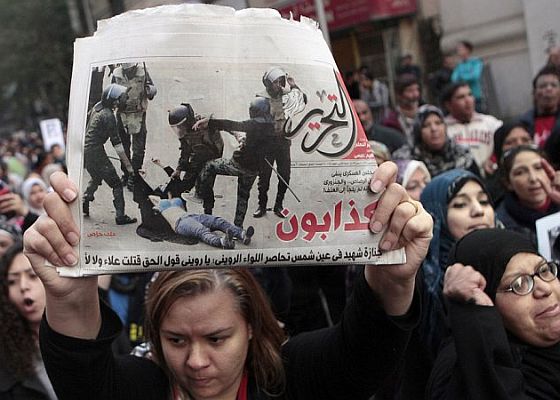
“Tantawi is the supreme commander of harassment and violation of honor,” one placard read. Other posters declared that the military consists of “liars” — a reference to the Sunday edition of independent newspaper Al-Tahrir, the front page of which made the accusation next to a picture of the woman in the blue bra.

Naglaa Talat marched carrying her two-year-old daughter.

“I had to come after I saw the picture of the naked girl in the newspapers — the images were enough to make any respectable person come. I have daughters and I came for them,” Talat told Egypt Independent.

Like many of the protesters, Talat insisted that Tantawi must leave power and the SCAF hand over power to civilian rule.

Facebooktwittermail

The secret program empowering Obama to kill anyone, anywhere, without any explanation

The Washington Post reports: Since September, at least 60 people have died in 14 reported CIA drone strikes in Pakistan’s tribal regions. The Obama administration has named only one of the dead, hailing the elimination of Janbaz Zadran, a top official in the Haqqani insurgent network, as a counterterrorism victory.

The identities of the rest remain classified, as does the existence of the drone program itself. Because the names of the dead and the threat they were believed to pose are secret, it is impossible for anyone without access to U.S. intelligence to assess whether the deaths were justified.

The administration has said that its covert, targeted killings with remote-controlled aircraft in Pakistan, Yemen, Somalia and potentially beyond are proper under both domestic and international law. It has said that the targets are chosen under strict criteria, with rigorous internal oversight.

It has parried reports of collateral damage and the alleged killing of innocents by saying that drones, with their surveillance capabilities and precision missiles, result in far fewer mistakes than less sophisticated weapons.

Yet in carrying out hundreds of strikes over three years — resulting in an estimated 1,350 to 2,250 deaths in Pakistan — it has provided virtually no details to support those assertions.

In outlining its legal reasoning, the administration has cited broad congressional authorizations and presidential approvals, the international laws of war and the right to self-defense. But it has not offered the American public, uneasy allies or international authorities any specifics that would make it possible to judge how it is applying those laws. [Continue reading…]

Facebooktwittermail

This bastardised libertarianism makes ‘freedom’ an instrument of oppression

George Monbiot writes: Freedom: who could object? Yet this word is now used to justify a thousand forms of exploitation. Throughout the rightwing press and blogosphere, among thinktanks and governments, the word excuses every assault on the lives of the poor, every form of inequality and intrusion to which the 1% subject us. How did libertarianism, once a noble impulse, become synonymous with injustice?

In the name of freedom – freedom from regulation – the banks were permitted to wreck the economy. In the name of freedom, taxes for the super-rich are cut. In the name of freedom, companies lobby to drop the minimum wage and raise working hours. In the same cause, US insurers lobby Congress to thwart effective public healthcare; the government rips up our planning laws; big business trashes the biosphere. This is the freedom of the powerful to exploit the weak, the rich to exploit the poor.

Rightwing libertarianism recognises few legitimate constraints on the power to act, regardless of the impact on the lives of others. In the UK it is forcefully promoted by groups like the TaxPayers’ Alliance, the Adam Smith Institute, the Institute of Economic Affairs, and Policy Exchange. Their concept of freedom looks to me like nothing but a justification for greed.

So why have we been been so slow to challenge this concept of liberty? I believe that one of the reasons is as follows. The great political conflict of our age – between neocons and the millionaires and corporations they support on one side, and social justice campaigners and environmentalists on the other – has been mischaracterised as a clash between negative and positive freedoms. These freedoms were most clearly defined by Isaiah Berlin in his essay of 1958, Two Concepts of Liberty. It is a work of beauty: reading it is like listening to a gloriously crafted piece of music. I will try not to mangle it too badly.

Put briefly and crudely, negative freedom is the freedom to be or to act without interference from other people. Positive freedom is freedom from inhibition: it’s the power gained by transcending social or psychological constraints. Berlin explained how positive freedom had been abused by tyrannies, particularly by the Soviet Union. It portrayed its brutal governance as the empowerment of the people, who could achieve a higher freedom by subordinating themselves to a collective single will.

Facebooktwittermail

Mass march by Cairo women in protest over soldiers’ abuse

The New York Times reports: Thousands of women massed in Tahrir Square here on Tuesday afternoon and marched to a journalists’ syndicate and back in a demonstration that grew by the minute into an extraordinary expression of anger at the treatment of women by the military police as they protested against continued military rule.

Many held posters of the most sensational image of violence over the last weekend: a group of soldiers pulling the abaya off a prone woman to reveal her blue bra as one raises a boot to kick her. The picture, circulated around the world, has become a rallying point for activists opposed to military rule, though cameras also captured soldiers pulling the clothes off other women.

The march, guarded by a cordon of male protesters, was a surprising turn. In Egypt, as in other countries swept by the revolts of the Arab Spring, women played important roles, raising hopes that broader social and political rights would emerge along with more accountable governments. But with the main popular focus on preparing for elections and protesting the military’s continued hold on power, women here had grown less politically visible.

The women’s protest came on the fifth day of violent clashes between Egyptian soldiers and protesters. The severity of the military’s defense of its hold on power, even as the newly elected Parliament begins to take shape, has restored a degree of unity that had been missing among the civilian political factions, liberal and Islamist, since the ouster of President Hosni Mubarak in February.

Facebooktwittermail

Sunni leader in Iraq denies ordering assassinations

The New York Times reports: The political crisis in Iraq deepened on Tuesday, as the Sunni vice president angrily rebutted charges that he had ordered his security guards to assassinate government officials, saying that Shiite-backed security forces had induced the guards into false confessions.

In a nationally televised news conference, the vice president, Tariq al-Hashimi, blamed the Shiite-led government of Prime Minister Nuri Kamal al-Maliki for using the country’s security forces to persecute political opponents, specifically Sunnis.

“The accusations have not been proven, so the accused is innocent until proven guilty,” Mr. Hashimi said at the news conference in Erbil, in the Kurdish north of Iraq. “I swear by God I didn’t do this disobedience against Iraqi blood, and I would never do this.”

He added: “The goal is clear, it is not more than political slander.”

Standing in front of an Iraqi flag, Mr. Hashimi questioned why Mr. Maliki had waited until the day after the American military withdrew its troops from Iraq to publicly lay out the charges.

Almost as significant as what Mr. Hashimi said was where he said it: in Erbil, the capital of the semi-autonomous northern region of Kurdistan. Because of the region’s autonomy, Mr. Maliki’s security forces cannot easily act on a warrant issued Monday to arrest Mr. Hashimi.

Mr. Hashimi said he would not return to Baghdad, effectively making him an internal exile. The case against him should be transferred to Kurdistan where he could face a fair trial, he said.

Facebooktwittermail

Fragile and unbalanced in 2012

Nouriel Roubini writes: The outlook for the global economy in 2012 is clear, but it isn’t pretty: recession in Europe, anaemic growth at best in the United States, and a sharp slowdown in China and in most emerging-market economies. Asian economies are exposed to China. Latin America is exposed to lower commodity prices (as both China and the advanced economies slow). Central and Eastern Europe are exposed to the eurozone. And turmoil in the Middle East is causing serious economic risks – both there and elsewhere – as geopolitical risk remains high and thus high oil prices will constrain global growth.

At this point, a eurozone recession is certain. While its depth and length cannot be predicted, a continued credit crunch, sovereign-debt problems, lack of competitiveness, and fiscal austerity imply a serious downturn.

The US – growing at a snail’s pace since 2010 – faces considerable downside risks from the eurozone crisis. It must also contend with significant fiscal drag, ongoing deleveraging in the household sector (amid weak job creation, stagnant incomes, and persistent downward pressure on real estate and financial wealth), rising inequality and political gridlock.

Elsewhere among the major advanced economies, the United Kingdom is double-dipping, as front-loaded fiscal consolidation and eurozone exposure undermine growth. In Japan, the post-earthquake recovery will fizzle out as weak governments fail to implement structural reforms.

Meanwhile, flaws in China’s growth model are becoming obvious. Falling property prices are starting a chain reaction that will have a negative effect on developers, investment and government revenue. The construction boom is starting to stall, just as net exports have become a drag on growth, owing to weakening US and especially eurozone demand. Having sought to cool the property market by reining in runaway prices, Chinese leaders will be hard put to restart growth.

They are not alone. On the policy side, the US, Europe and Japan, too, have been postponing the serious economic, fiscal and financial reforms that are needed to restore sustainable and balanced growth.

Facebooktwittermail

Obama administration considers censoring Twitter

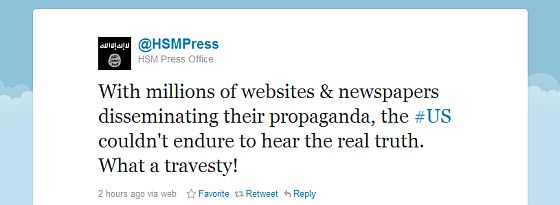
With millions of websites & newspapers disseminating their propaganda, the #US couldn't endure to hear the real truth. What a travesty!

Tweet from Harakat Al-Shabaab Al Mujahideen, Somalia's Islamist insurgent movement.

How dangerous can 140 characters be?

Apparently if those 140 characters are being fired onto the web through the Twitter account of al Shabib, Somalia’s militant jihadist movement, then the national security of the United States could be in jeopardy.

The New York Times reports:

American officials say they may have the legal authority to demand that Twitter close the Shabab’s account, @HSMPress, which had more than 4,600 followers as of Monday night.

The most immediate effect of the Obama administration’s threat appears to have been that @HSMPress (which has so far only made 114 tweets) has subsequently gained hundreds of new followers.

Is Twitter itself about to take a stand in defense of freedom of speech?

A company spokesman, Matt Graves, said [to a Times reporter] on Monday, “I appreciate your offer for Twitter to provide perspective for the story, but we are declining comment on this one.”

Last Wednesday, the New York Times reported from Nairobi in Kenya:

Somalia’s powerful Islamist insurgents, the Shabab, best known for chopping off hands and starving their own people, just opened a Twitter account, and in the past week they have been writing up a storm, bragging about recent attacks and taunting their enemies.

“Your inexperienced boys flee from confrontation & flinch in the face of death,” the Shabab wrote in a post to the Kenyan Army.

It is an odd, almost downright hypocritical move from brutal militants in one of world’s most broken-down countries, where millions of people do not have enough food to eat, let alone a laptop. The Shabab have vehemently rejected Western practices — banning Western music, movies, haircuts and bras, and even blocking Western aid for famine victims, all in the name of their brand of puritanical Islam — only to embrace Twitter, one of the icons of a modern, networked society.

On top of that, the Shabab clearly have their hands full right now, facing thousands of African Union peacekeepers, the Kenyan military, the Ethiopian military and the occasional American drone strike all at the same time.

But terrorism experts say that Twitter terrorism is part of an emerging trend and that several other Qaeda franchises — a few years ago the Shabab pledged allegiance to Al Qaeda — are increasingly using social media like Facebook, MySpace, YouTube and Twitter. The Qaeda branch in Yemen has proved especially adept at disseminating teachings and commentary through several different social media networks.

“Social media has helped terrorist groups recruit individuals, fund-raise and distribute propaganda more efficiently than they have in the past,” said Seth G. Jones, a political scientist at the RAND Corporation.

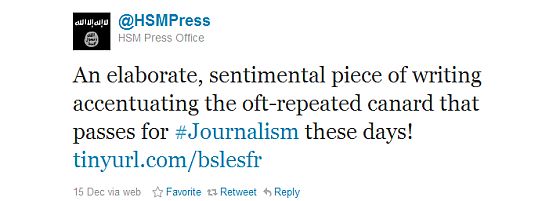
The Times reporter, Jeffrey Gettleman, sounds quite indignant that al Shabib should have the audacity to be using Twitter, so he can hardly have been surprised that his article prompted this exchange between @HSMPress and one of their followers:
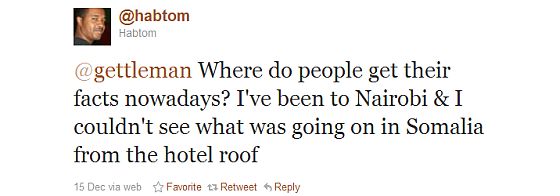
@gettleman Where do people get their facts nowadays? I've been to Nairobi & I couldn't see what was going on in Somalia from the hotel roof
An elaborate, sentimental piece of writing accentuating the oft-repeated canard that passes for #Journalism these days!
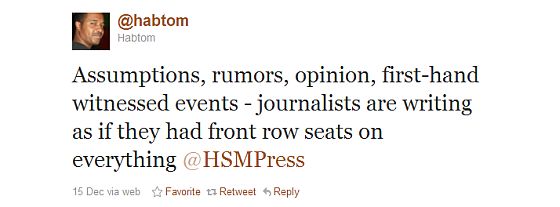
Assumptions, rumors, opinion, first-hand witnessed events - journalists are writing as if they had front row seats on everything @HSMPress
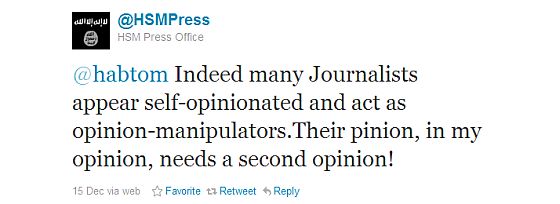
@habtom Indeed many Journalists appear self-opinionated and act as opinion-manipulators.Their pinion, in my opinion, needs a second opinion!
Somalia is not the only front in the new war on Twitter.

The Washington Post reports on Twitter battles in Afghanistan:

U.S. military officials assigned to the International Security Assistance Force, or ISAF, as the coalition is known, took the first shot in what has become a near-daily battle waged with broadsides that must be kept to 140 characters.

“How much longer will terrorists put innocent Afghans in harm’s way,” @isafmedia demanded of the Taliban spokesman on the second day of the embassy attack, in which militants lobbed rockets and sprayed gunfire from a building under construction.

“I dnt knw. U hve bn pttng thm n ‘harm’s way’ fr da pst 10 yrs. Razd whole vilgs n mrkts. n stil hv da nrve to tlk bout ‘harm’s way,’ ” responded Abdulqahar Balkhi, one of the Taliban’s Twitter warriors, who uses the handle ­@ABalkhi….

U.S. military officials say the dramatic assault on the diplomatic compound convinced them that they needed to seize the propaganda initiative — and that in Twitter, they had a tool at hand that could shape the narrative much more quickly than news releases or responses to individual queries.

“That was the day ISAF turned the page from being passive,” said Navy Lt. Cmdr. Brian Badura, a military spokesman, explaining how @isafmedia evolved after the attack. “It used to be a tool to regurgitate the company line. We’ve turned it into what it can be.”

So how’s @isafmedia exploiting the power of Twitter? With tweets like this?
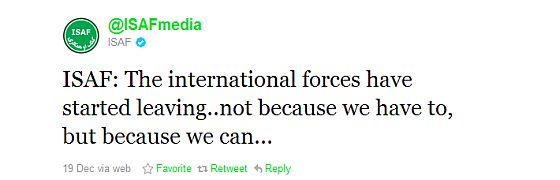
A we’re-winning-the-war tweet like this might sound good inside ISAF’s Twitter Command Center, but I don’t think it’s going to impress anyone else.

The problem the Obama administration is up against is not the threat posed by its adversaries on Twitter; it is that its own ventures into social media are predictably inept. Official tweets lack wit and tend to sound like the clumsy propaganda. But when losing an argument, the solution is not to look for ways to gag your opponent — that’s how dictators operate.

The Pentagon prides itself on its smart bombs. Can’t it come up with a few smart tweets?

Facebooktwittermail

Israel’s emerging ‘Jewish Hezbollah’?

Mark Perry writes: Seven months ago, during the early morning hours of May 30, Jewish settlers visiting Joseph’s Tomb in Nablus in the Palestinian West Bank engaged in a shoving match with IDF soldiers deployed to protect them. Within minutes, the confrontation escalated; several soldiers were punched by Jewish worshippers and rocks rained down on the soldiers from settlers atop the tomb. A YouTube video of the incident was later circulated on the internet at the request of the IDF. The Nablus incident was among the first in a growing series of confrontations between settlers and the Israeli military — and it sent shock waves through the Israeli military establishment. Brig. General Yoav Mordechai called the settlers “irresponsible lawbreakers” and pointed out that the IDF in the West Bank was deployed to protect settlers from “terrorists.” His message was clear: the settler confrontation had placed the lives of his soldiers at risk.

Mordechai’s statement must have brought wry smiles to Palestinian villagers near Nablus, whose olive groves have been burned and mosques desecrated by the same settlers who attacked the IDF detachment. But the Joseph’s Tomb incident was only the beginning: throughout July and August, settlers from Yitzhar — a hotbed of settler extremism — forced a series of confrontations with the IDF until, in August, a stone-throwing incident pitting settlers against Palestinians threatened to get out of control, with the IDF pushing Palestinians away from the settlers in order to protect them from the violence — and not the other way around. “It was an amazing scene,” a Palestinian organizer who witnessed the incident said during a recent trip to Washington. “At one point, one of the IDF commanders turned to me and said, ‘why don’t you do us a favor and just shoot these people?'”

The settler-on-IDF confrontations have increased over the last weeks, sending ripples of concern through the Israeli establishment. While no senior Israeli elected official has yet to suggest that the program of settlement expansion needs to be rethought, the viewpoint is the subject of sotto voce reflections throughout the Jewish state. After all, the unstated goal of the national settlement enterprise is to put obstacles in the way of Palestinian national claims — not to seed a nascent and nasty internal conflict. Now, and particularly if the confrontations continue (or escalate), Israeli officials will have to ask themselves whether it is wise to continue a program that is providing the equivalent of a Palestinian fifth column. It’s not as if the Palestinians haven’t noticed. Asked about the recent settler-IDF dust-ups near Nablus, a serving Palestinian legislator waves away a question about whether or not Abu Mazen and company will return to the peace talks: “What we ought to do is sit back and watch,” he says, “while Israel starts to unravel.”

“I don’t want to exaggerate, but it’s time to call this what it is,” a veteran IDF officer noted in a recent telephone conversation on the Nablus incident. “It might be news in America, but it’s no secret in Israel. This is a very real crisis. What we have here is the birth of a state within a state. The birth of a kind of Jewish Hezbollah.” [Continue reading…]

Facebooktwittermail

Renewed threat of sectarian conflict as Iraq’s Sunni vice president faces arrest

As Al Jazeera reported yesterday and the New York Times reports today, Iraqis have given scant attention to the departure of the last American troops as the country heads into a deepening political crisis.

Iraq’s Shiite-dominated government was thrown into crisis on Monday night as authorities issued an arrest warrant for the Sunni vice president, accusing him of running a personal death squad that assassinated security officials and government bureaucrats.

The sensational charges against Tariq al-Hashimi, one of the country’s most prominent Sunni leaders, threatened to inflame widening sectarian and political conflicts in Iraq just one day after the last American convoy of American troops rolled out of the country into Kuwait.

The accusations were broadcast over Iraqi television, in a half-hour of grainy video confessions from three men identified as Mr. Hashimi’s bodyguards. They spoke of how they had planted bombs in public squares, driven up to convoys carrying Iraqi officials and opened fire.

Under the direction of Mr. Hashimi’s top aides, the men said, they gunned down convoys carrying Shiite officials and planted roadside bombs in traffic circles and wealthy neighborhoods of Baghdad, then detonated them as their targets drove by. One of the men said Mr. Hashimi had personally handed him an envelope with $3,000 after one of the attacks.

It was impossible to substantiate any of the accusations aired in the confessions.

An aide in Mr. Hashimi’s office said the three men had indeed worked for the vice president, but he denied all of the allegations. The aide said Mr. Hashimi was in the northern region of Kurdistan, meeting with Kurdish officials to defuse the worsening political standoff with Prime Minister Nuri Kamal al-Maliki.

Reidar Visser, an analyst of Iraqi politics and editor of the blog historiae.org, called the situation the worst crisis Iraq had faced in five years.

“Any leading Sunni politician seems now to be a target of this campaign by Maliki,” Mr. Visser said. “It seems that every Sunni Muslim or secularist is in danger of being labeled either a Baathist or a terrorist.”

Facebooktwittermail

The Arab Spring and the West: seven lessons from history

Seumas Milne writes: There’s a real sense in which, more than any other part of the former colonial world, the Middle East has never been fully decolonised. Sitting on top of the bulk of the globe’s oil reserves, the Arab world has been the target of continual interference and intervention ever since it became formally independent.

Carved into artificial states after the first world war, it’s been bombed and occupied – by the US, Israel, Britain and France – and locked down with US bases and western-backed tyrannies. As the Palestinian blogger Lina Al-Sharif tweeted on Armistice Day this year, the “reason World War One isn’t over yet is because we in the Middle East are still living the consequences”.

The Arab uprisings that erupted in Tunisia a year ago have focused on corruption, poverty and lack of freedom, rather than western domination or Israeli occupation. But the fact that they kicked off against western-backed dictatorships meant they posed an immediate threat to the strategic order.

Since the day Hosni Mubarak fell in Egypt, there has been a relentless counter-drive by the western powers and their Gulf allies to buy off, crush or hijack the Arab revolutions. And they’ve got a deep well of experience to draw on: every centre of the Arab uprisings, from Egypt to Yemen, has lived through decades of imperial domination. All the main Nato states that bombed Libya, for example – the US, Britain, France and Italy – have had troops occupying the country well within living memory.

If the Arab revolutions are going to take control of their future, then, they’ll need to have to keep an eye on their recent past. So here are seven lessons from the history of western Middle East meddling, courtesy of the archive of Pathé News, colonial-era voice of Perfidious Albion itself. [Continue reading…]

Facebooktwittermail

Don’t break the internet

At Stanford Law Review, Mark Lemley, David S. Levine, and David G. Post, write: Two bills now pending in Congress—the PROTECT IP Act of 2011 (Protect IP) in the Senate and the Stop Online Piracy Act (SOPA) in the House—represent the latest legislative attempts to address a serious global problem: large-scale online copyright and trademark infringement. Although the bills differ in certain respects, they share an underlying approach and an enforcement philosophy that pose grave constitutional problems and that could have potentially disastrous consequences for the stability and security of the Internet’s addressing system, for the principle of interconnectivity that has helped drive the Internet’s extraordinary growth, and for free expression.

To begin with, the bills represent an unprecedented, legally sanctioned assault on the Internet’s critical technical infrastructure. Based upon nothing more than an application by a federal prosecutor (or, in certain circumstances, an intellectual property rights holder) alleging that a foreign website is “dedicated to infringing activities,” Protect IP authorizes courts to order all U.S. Internet service providers, domain name registries, domain name registrars, and operators of domain name servers—a category that includes hundreds of thousands of small and medium-sized businesses, colleges, universities, nonprofit organizations, and the like—to take steps to prevent the offending site’s domain name from translating to the correct Internet protocol address. These orders can be issued even when the domains in question are located outside of the United States and registered in top-level domains (e.g., .fr, .de, or .jp) whose operators are themselves located outside the United States; indeed, some of the bills’ remedial provisions are directed solely at such domains.

Directing the remedial power of the courts towards the Internet’s core technical infrastructure in this sledgehammer fashion has impact far beyond intellectual property rights enforcement—it threatens the fundamental principle of interconnectivity that is at the very heart of the Internet. The Internet’s Domain Name System (DNS) is a foundational block upon which the Internet has been built and upon which its continued functioning critically depends; it is among a handful of protocols upon which almost every other protocol, and countless Internet applications, rely to operate smoothly. Court-ordered removal or replacement of entries from the series of interlocking databases that reside in domain name servers and domain name registries around the globe undermines the principle of domain name universality—the principle that all domain name servers, wherever they may be located across the network, will return the same answer when queried with respect to the Internet address of any specific domain name. Much Internet communication, and many of the thousands of protocols and applications that together provide the platform for that communication, are premised on this principle.

Facebooktwittermail

Saudi prince invests $300 million in Twitter

Owning three percent of Twitter might not amount to a controlling stake, but when the Saudis start investing in social media you can bet that making money is not their only interest.

The New York Times reports: Prince Walid bin Talal of Saudi Arabia announced a $300 million stake in the social media site Twitter, as the billionaire expands his holdings in the United States.

The investment by Prince Walid and his investment company, Kingdom Holding, represents roughly 3 percent of the company. Prince Walid, who owns 95 percent of Kingdom Holding, said in a statement that the purchase was part of a strategy “to invest in promising, high-growth businesses with a global impact.”

With Twitter, Prince Walid — who also own stakes in American blue chip companies including Citigroup, General Motors and Apple — gains a foothold in the fast-growing social networking space. The microblogging service, which has more than 100 million active users, is part of an elite group of Internet companies that have rapidly attracted users in recent years and that have garnered multi-billion dollar valuations.

Twitter has been increasingly popular in the Arab world, where it was credited with playing a role in the recent uprisings across North Africa and the Gulf. Arabic is now the fastest growing language used on Twitter, according to the data intelligence company Semiocast. The volume of Arabic messages increased by 2,146 percent in the 12 months ending in October.

“We believe that social media will fundamentally change the media industry landscape in the coming years. Twitter will capture and monetize this positive trend,” Ahmed Reda Halawani, Kingdom Holding’s executive director of private equity and international investments, said in a statement.

Facebooktwittermail

Egyptian army targets women protesters

Egyptian army soldiers beat a woman protester

Al-Masry Al-Youm reports: Local human rights watchdogs on Sunday accused the Egyptian military of systematically targeting female political activists, and demanded that Egypt’s military rulers admit to violations committed against demonstrators.

In a joint statement, five human rights organizations accused military rulers of exercising “unprecedented violence against protesters, with the targeting of female activists being a distinctive feature of the proceedings to disperse sit-ins, as depicted in pictures and video clips showing protesters being arrested, beaten, dragged and stripped of their clothes.”

In this video, army soldiers are seen beating an older female activist named Khadiga al-Hennawy.

While this video shows army soldiers dragging, beating and striping a female protester in the street.

The statement was signed by Nazra for Feminist Studies, the Cairo Institute for Human Rights Studies, the Association for Freedom of Thought and Expression, the Hisham Mubarak Law Center and the Women and Memory Association.

They also called for the establishment of an independent judicial committee to investigate crimes against peaceful protestors.

Facebooktwittermail

The battle for Upper Egypt

Lauren E. Bohn writes: Assiut feels far away from the famed epicenter of Tahrir Square. The oft-neglected peripheral region of Upper Egypt (the cultivated valley of the Nile from Cairo in the north to Aswan, 535 miles south) has been plagued by institutional apathy for years, long dismissed as a dead-end, from where one travels to the capital for work and never returns. When Egypt’s contentious de-facto leaders, the Supreme Council of the Armed Forces (SCAF), speak of a silent but loyal majority, or “liberals,” fret about the backward religious and violence-prone rural areas, they have cities like Assiut in mind. But the reality is far more complicated. Assiut and Tahrir are bound together by personal connections and shared concerns — inextricable ties that suggest a far more nuanced emerging Egypt than is generally felt from the central nerve of Cairo.

The new Assiut, which prides itself on being the capital of Upper Egypt, features a distinct pastiche of Salafis, felool, or remnants (a word used to describe holdovers from the Mubarak era), the popular Muslim Brotherhood, a smattering of activists, and a vaguely Egyptian brand of tribalism. Officials from the Mubarak era still cling to power, while Tahrir’s activists find few points of entry into a skeptical environment. Outside the city’s few main streets, Assiut’s mustard-hazed landscape is home to 3.5 million people spread throughout some 1,000 villages. With 24 parliamentary seats, it was a major target, and now bellwether, in the new electoral competition reshaping Egyptian politics.

Though some activists will tell you they had their own “Tahrir Square” in Assiut, by and large, the countryside remained marginally engaged with the uprisings that took Cairo by hold. Protestors continue to call for a prompt end to military rule, blaming SCAF for their inept, and even malevolent, handling of Egypt’s transition to democracy. But, it is easy to find indifference or even hostility to ongoing protests in places where most people get their news from a largely pro-SCAF state television and almost nobody has access to follow revolutionaries on Twitter. Ayad Hamza, 46, a barber in the small village of Ezbet El Geish dismisses Tahrir as a farce. “These kids are stupid. They have nothing else to do but cause trouble,” he said, mopping his cracked floor. “It’s not a revolution they’re making, but a nightmare.” This is the kind of sentiment SCAF has been banking on — one they say resonates in Egypt. But it misses important linkages between the periphery and the political battles waged in Cairo, and naively exaggerates their indifference.

Facebooktwittermail

Bleak future for returning U.S. veterans

The Economist reports: Brett Quinzon did two tours in Iraq before leaving active duty in May. Originally from Minnesota, Mr Quinzon now lives in Thomaston, a small town around 65 miles south of Atlanta. A grey December morning found him filling out forms in Atlanta’s large veterans’ hospital, seeking treatment for depression. Since returning from Iraq, he says he has “more anger issues”, and finds himself “more watchful and on-guard in public situations” than he was before he deployed. That is not unusual: many soldiers return from the battlefield with psychological scars. Between January and May, as he prepared to leave active duty, Mr Quinzon applied for hundreds of jobs. The search proved difficult: like many veterans, he enlisted right after high-school, and lacks a college degree. But persistence paid off. He is now an apprentice at a heating and air-conditioning company, and is being trained as a heavy-equipment operator.

Not all recent veterans are so lucky. Around 800,000 veterans are jobless, 1.4m live below the poverty line, and one in every three homeless adult men in America is a veteran. Though the overall unemployment rate among America’s 21m veterans in November (7.4%) was lower than the national rate (8.6%), for veterans of Iraq and Afghanistan it was 11.1%. And for veterans between the ages of 18 and 24, it was a staggering 37.9%, up from 30.4% just a month earlier.

If demography is indeed destiny, perhaps this figure should not be surprising. More soldiers are male than female, and the male jobless rate exceeds women’s. Since so many soldiers lack a college degree, the fact that the recession has been particularly hard on the less educated hits veterans disproportionately. Large numbers of young veterans work—or worked—in stricken industries such as manufacturing and construction. Whatever the cause, this bleak trend is occurring as the last American troops leave Iraq at the end of this year, and as more than 1m new veterans are expected to join the civilian labour force over the next four years.

Facebooktwittermail