Author Archives: News Sources

Libyan authorities give Islamist militia two days to leave their bases

The Guardian reports: The Libyan authorities have given armed groups two days to vacate military bases and compounds as they seek to capitalise on the wave of people power that drove an Islamist militia from Benghazi at the weekend.

Jihadist militias in Derna, Libya’s Islamist stronghold, threw in the towel on Sunday, withdrawing from their stronghold and announcing they were disbanding to avoid a repeat of the scenes in Benghazi in which angry crowds sent armed gunmen fleeing. One of the routed militias was blamed for an attack on the US consulate two weeks ago that left four Americans dead including the ambassador, Chris Stevens.

The de facto head of state, Muhammad Magariaf, president of Libya’s parliament, met Benghazi politicians and security officials, anxious to fill a security vacuum that has emerged from the weekend violence, in which at least 11 people died.

“The army chief Yussef al-Mangoush and Muhammad Magariaf have ordered all illegitimate militias should be removed from compounds and hand over their weapons to the national army,” said Adel Othman al-Barasi, a spokesman for the defence ministry, according to Reuters. “A committee made up by the military police has been formed to take over the compounds and the weapons and hand these over to the army.”

Facebooktwittermail

New Arab realities

Rami G. Khouri identifies five genuinely historic, new and meaningful developments in many of the Arab states in transformation, after 21 months of the Arab uprisings:

1. New legitimacies are coming into play, including legitimate governance structures, leaders and political actors, replacing their former counterparts that enjoyed incumbency but had long ago lost legitimacy. The transition from mass public humiliation to newfound legitimacy in national governance and the exercise of power is the single most important foundational change that is taking place in these Arab uprisings and national reconfigurations. These new legitimacies provide the foundation on which all other new developments occur, especially new national systems of governance and citizen rights.

2. New actors now participate in the process of contested politics that will shape national governments systems and policies at home and abroad; these include most notably revolutionary and other youth, individual citizens with the power to choose and change governments and presidents, Muslim Brothers and more hard-line Salafist Islamists (some of whom lead or participate in coalition governments), tribes (some with militias), secular-nationalist political parties, the armed forces that now engage in open rather than secret politics, the judiciary, civil society groups, and private sector interests.

We should note three important aspects of these new players. They all emanate from these Arab societies and did not parachute in from abroad, and they now operate in public and with populist democratic legitimacy, rather than working in the shadows as many of them did before, including the military, tribal forces, the private sector, and some Islamists. They reflect the important development that very few people are now excluded or marginalized, as was the case previously when the vast majority of citizens were shut out from the decision-making process. And, they evolve and change, as they share or seek power via the consent of the governed; they soften or harden positions and clarify their policies in response to citizen demands, and so they act in a political manner, reflecting their need to remain legitimate and credible in the eyes of their supporters and the public at large. [Continue reading…]

Facebooktwittermail

Israeli occupation strong as ever on Capitol Hill

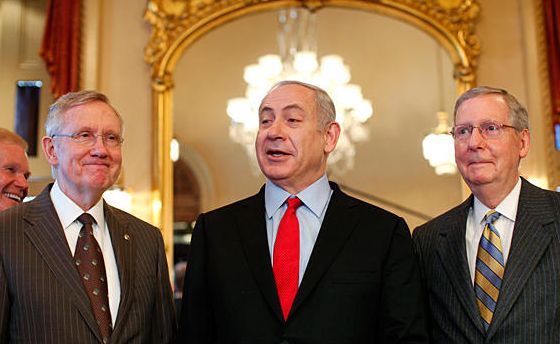
Benjamin Netanyahu flanked by Congressional courtiers Reid and McConnell.

Ali Gharib writes: After midnight yesterday, the Senate voted 90 to 1 to express the “sense of the Congress” as weighing in on the debate about what red lines the U.S. should declare against Iran. You’ll remember this issue as the one roiling the relationship between Benjamin Netanyahu and President Obama at the moment. On the Hill, almost everyone — including most of the Democrats — just sided with Netanyahu.

The resolution, initially introduced by Sen. Lindsey Graham (R-SC) in the Spring, laid out a non-binding position that “strongly supports United States policy to prevent the Government of the Islamic Republic of Iran from acquiring a nuclear weapons capability” and “rejects any United States policy that would rely on efforts to contain a nuclear weapons-capable Iran.” Obama has set his red line at Iran producing nuclear weapons rather than the “capability” to do so, a phrase loaded with a special yet ill-defined meaning in proliferation matters.

The “capability” debate was initially framed as one over “containment” in February, and hawks like Graham found little bipartisan support until their position became a centerpiece of the AIPAC policy conference in March. But the initial resolution from Graham in May stalled. Then things rose into the national consciousness.

This month, an unprecedented campaign by Benjamin Netanyahu to get Obama to shift his Iran red line drew jeers from liberals and even Members of Congress. Sen. Barbara Boxer (D-CA) upbraided Netanyahu for interjecting himself in American politics. AIPAC took notice, e-mailing its members last week with articles on Obama’s refusal to lower his threshold for war and Netanyahu’s denials of interference. The debate seemed, for now, over, with Obama victorious. Then this week, Majority Leader Reid surprised everyone by re-introducing the Graham resolution.

Facebooktwittermail

Syrian opposition figures meet in Damascus

The Associated Press reports: Syrian opposition figures called Sunday for the overthrow of President Bashar Assad at a rare meeting of anti-regime groups held in the government-controlled capital Damascus, a possible attempt by the gathering to position itself as an alternative to the armed rebellion.

Rebels fighting Assad typically dismiss the so-called “internal opposition” as too lenient on the Syrian dictator, so the strong statements from the 16 parties in the National Coordination Body for Democratic Change in Syria may be aimed at gaining credibility among Syrians who despise the regime but are weary of an uprising that has since devolved into a grinding and bloody civil war. Assad’s government tightly restricts criticism in areas it controls.

But the group would have its work cut out for itself to have its peace initiative, centered on a cease-fire, gain traction. Many rebels look askance at any political plan short of Assad’s immediate ouster, seeing it as a play for time.

Ambassadors from Iran and Russia attended Sunday’s conference. Both countries support Assad, suggesting the regime authorized the gathering to bolster its own rhetoric that there should be a peaceful settlement to the Syrian crisis through dialogue.

A statement distributed to journalists said the participants at the conference have agreed on a number of principles, mainly “overthrowing the regime with all its symbols” while emphasizing the need for “peaceful struggle to achieve the goals of the revolution.”

Facebooktwittermail

Libyan crackdown on unauthorized militias spreads to Tripoli

AFP reports: A Libyan crackdown on lawless militias spread to the capital on Sunday after armed groups that have not been integrated into state institutions were ordered to disband and evacuate their bases.

Commander in chief Yussef al-Mangush said on his Facebook page that the armed forces had dislodged a militia from a military complex on the highway to Tripoli International Airport, arresting militiamen and confiscating their weapons.

The sound of gunfire was heard in the area at 9 am (0700 GMT) and lasted less than a minute, an AFP journalist said, but Mangush made no mention of casualties.

“We will carry out these kind of operations for the next two or three weeks until we dislodge all armed groups not under the authority of the State,” an army officer told AFP on condition of anonymity.

On Saturday, the army issued an ultimatum ordering militias and armed groups to evacuate military compounds, state property and the properties of members of the former regime in and near Tripoli, the official LANA news agency reported.

Facebooktwittermail

Palestinians need a one-state solution

Ghada Karmi writes: It is one year this week since the Palestinians applied for UN membership. President Mahmoud Abbas’s impassioned plea to the UN’s General Assembly for support of the We Palestinian case on 23 September 2011 won him much praise, even from his detractors. But it came to nothing, and no further Palestinian application for UN membership was made. Now, however, the statehood issue is back on the Palestinian agenda.

Abbas has recently threatened to relaunch the UN application if Israeli settlement expansion continues. This time he would seek UN non-member observer state status, but has yet to decide to consult with Arab and other states, and it may come to nothing again. Only a bankruptcy of ideas could be driving him towards this move, given the present situation of US acquiescence to regional Israeli hegemony, and Israel’s stunning success in diverting world attention from the conflict on its doorstep to Iran’s nonexistent nuclear weapons.

The president also faces serious trouble at home. The Palestinian economy, dependent on aid, is staggering under a chronic budget deficit and external debt of a billion dollars, nearly a fifth of GDP. Donor funding has declined from $1 billion to $750 million, and the Palestinian Authority has delayed paying 153,000 employees, prompting protests. Mass strikes and demonstrations have rocked the West Bank for days.

The protesters want an amendment of the 1994 Paris protocol, a key part of the Oslo accords that govern economic relations between Israel and the PA. Its main effect has been to keep the Palestinian economy dependent on Israel. It pegs Palestinian tax rates to Israel’s much higher ones, lays open Palestinians markets to Israel, though the reverse is not true, and through various restrictions, forces the Palestinian to trade only with Israel. The resulting poverty and 40% youth unemployment have pushed people on to the streets, and they now demand the resignation of the Palestinian prime minister, Salam Fayyad, and of the PA itself. Now Abbas has proposed cancelling the whole Oslo accords, including the economic and security agreements. However, no decision was reached, and whether it’s another empty threat remains to be seen. [Continue reading…]

Facebooktwittermail

Saudi millions and special forces expertise turn Syria’s rebels into a fighting force

The Daily Telegraph reports: Hidden under olive groves in the rolling countryside of Syria’s northern Idlib province, of which a vast swathe is now in opposition hands, more than a dozen training camps have been set up in which young men prepare for the fight against President Bashar al-Assad’s military.

In one camp seen by The Daily Telegraph this week, recruits were put through their paces on an arduous obstacle course. Timed to the shouts of Commander Abdel Kadr, a military officer who has defected, the men vaulted walls, scrambled under razor wire mesh and swung along ropes in the tree tops.

Two men looked on from the tented sleeping quarters nearby. Tall with shaven heads, fair skin, bulging pectoral muscles, and biceps covered in tattoos, they were incongruous among the scrawny young fighters. They could not speak Arabic and were extremely unhappy in the presence of The Daily Telegraph.

The men, who use the code names Radwan and Mohammed, come from Scandinavia, but have requested that the country not be disclosed.

Though they refused to speak, saying only that they were “here to help”, recruits in the Free Syrian Army told this newspaper that the men were ex-special forces working as military advisers.

“The Free Syrian Army at first didn’t exist, it was just an idea. Now we are trying to turn this into a reality,” said Louay al-Mokdad, a coordinator for the FSA in charge of channelling much of the foreign funding into Syria. Unlike most of Syria’s rebel “brigades”, who, with informal behaviour and mismatched uniforms bear little relation to a conventional army, the men in this training camp wore identical uniforms and conducted themselves with military discipline.

As Commander Kadr arrived, the men sprung to attention with a salute. Answers were given in the shouted delivery of soldiers responding to a command.

“We have 20 men training, 12 on vacation and some on missions,” said one recruit. To some questions he replied that the information was “classified” and the “strength of an army is in its secrets”.

For three weeks the men are subjected to extensive physical training, gun practice on a firing range, lessons in military discipline, and instruction in military tactics, such as how to attack a sniper or move under fire. Trainees cannot leave the camp without permission.

Failure to follow the rules leads to “hard physical punishment” or expulsion. Many of the men undergoing the extensive training are civilians.

“I was studying in Damascus and I went to the first protests,” said a 21-year-old, who would not give his name. “And then the massacres started. You see it on TV and you hate it, and then you feel it and you hate it more. Then either you die with your hate or you go to fight.”

There are 18 such training camps spread across Idlib province, as well as some in the suburbs of Damascus, FSA commanders said. Rebels denied that other camps also had foreign advisers, but one source said it was something that was under consideration.

Facebooktwittermail

Egypt’s president spells out terms for U.S.-Arab ties

The New York Times reports: On the eve of his first trip to the United States as Egypt’s new Islamist president, Mohamed Morsi said the United States needed to fundamentally change its approach to the Arab world, showing greater respect for its values and helping build a Palestinian state, if it hoped to overcome decades of pent-up anger.

A former leader of the Muslim Brotherhood and Egypt’s first democratically elected president, Mr. Morsi sought in a 90-minute interview with The New York Times to introduce himself to the American public and to revise the terms of relations between his country and the United States after the ouster of Hosni Mubarak, an autocratic but reliable ally.

He said it was up to Washington to repair relations with the Arab world and to revitalize the alliance with Egypt, long a cornerstone of regional stability.

If Washington is asking Egypt to honor its treaty with Israel, he said, Washington should also live up to its own Camp David commitment to Palestinian self-rule. He said the United States must respect the Arab world’s history and culture, even when that conflicts with Western values.

And he dismissed criticism from the White House that he did not move fast enough to condemn protesters who recently climbed over the United States Embassy wall and burned the American flag in anger over a video that mocked the Prophet Muhammad.

“We took our time” in responding to avoid an explosive backlash, he said, but then dealt “decisively” with the small, violent element among the demonstrators.

“We can never condone this kind of violence, but we need to deal with the situation wisely,” he said, noting that the embassy employees were never in danger. [Continue reading…]

Facebooktwittermail

Bodies of six militiamen found in Benghazi after attacks on bases

The Guardian reports: The Libyan city of Benghazi was tense after the bodies of six militiamen apparently executed after the storming of a base on the southern outskirts were discovered in a field.

The bodies were found the day after crowds marched on three militia bases, including that of Ansar al-Sharia, blamed by many in the city for the murder of the US ambassador, Chris Stevens, earlier this month. Funerals were held for nine protesters killed when crowds tried to force their way into the Rafallah al-Sahati militia base early on Saturday morning.

The militia was the only one of three to fire back when demonstrators swarmed over their bases, following a rally on Friday in which 30,000 people vowed to retake the streets of the city.

The interior minister, Fawzi Abdul Al, who was criticised for his failure to launch a full investigation of the murder of Stevens and three fellow diplomats, criticised the action of the crowds, saying the militias should have been given more time to incorporate into the official security forces.

The mood in Benghazi is one of both triumph and sorrow at the toll of dead and wounded. Mohammed El Kish, whose cousin was killed by a stray bullet more than a mile from the clashes, said: “He was not even involved in the actions, it is terrible.”

City hospitals were braced for more violence after the Rafallah al-Sahati militia reoccupied its looted base. Several hundred unarmed people gathered outside. “This is not good, they should not be here. When the funerals have finished there will be trouble,” said Ashraf Saleh.

Police remained in control of the Ansar al-Sharia compound, which is now a looted ruin. A spokesman for Ansar al-Sharia, whose units have dispersed outside the city, insisted they had withdrawn rather than confront protesters “for reasons of security”.

The chaos at the heart of Libya’s government remains, with some angry that Rafallah was attacked after it had formally been incorporated into the Libyan army. Such designations are lost on many ordinary Libyans, who say many militias from last year’s revolution have simply cut deals with ministries, enabling them to form what are in essence private armies.

Facebooktwittermail

MEK decision: multimillion-dollar campaign led to removal from terror list

The Guardian reports: Supporters of a designated Iranian terrorist organisation have won a long struggle to see it unbanned in the US after pouring millions of dollars into an unprecedented campaign of political donations, hiring Washington lobby groups and payments to former top administration officials.

A Guardian investigation, drawing partly on data researched by the Centre for Responsive Politics, a group tracking the impact of money in US politics, has identified a steady flow of funds from key Iranian American organisations and their leaders into the campaign to have the People’s Mojahedin Organisation of Iran removed from the list of terrorist organisations.

The US secretary of state, Hillary Clinton, is expected to notify Congress that the MEK will be removed from the terrorism list in the coming days.

The campaign to bury the MEK’s bloody history of bombings and assassinations that killed American businessmen, Iranian politicians and thousands of civilians, and to portray it as a loyal US ally against the Islamic government in Tehran has seen large sums of money directed at three principal targets: members of Congress, Washington lobby groups and influential former officials.

Prominent among the members of Congress who have received fund is Ileana Ros-Lehtinen, the chair of the House of Representatives foreign affairs committee. She has accepted at least $20,000 in donations from Iranian American groups or their leaders to her political campaign fund.

Other recipients include Congressman Bob Filner, who was twice flown to address pro-MEK events in France and has pushed resolutions resolutions in the House of Representatives calling for the group to be unbanned. More than $14,000 in expenses for Filner’s Paris trips were met by the head of an Iranian American group who also paid close to $1m to a Washington lobby firm working to get the MEK unbanned.

A Texas Congressman, Ted Poe, received thousands of dollars in donations from the head of a pro-MEK group in his state at a time when he was a regular speaker on behalf of its unbanning at events across the US, describing the organisation as the ticket to regime change in Iran.

Mike Rogers, chairman of the House of Representatives intelligence committee, has also received the backing of individuals and groups that support the unbanning of the MEK. Rogers has been among the strongest supporters in Congress of delisting the group, sponsoring resolutions and pressing other members of Congress to support the cause.

A leading advocate of unbanning the MEK and chairman of the foreign affairs committee’s oversight subcommittee, congressman Dana Rohrabacher, has received thousands of dollars in donations from supporters of the banned group this year alone. [Continue reading…]

Facebooktwittermail

Islamist militias kicked out of their bases by Benghazi protesters

The Libya Herald reports: Hundreds of protesters demanding an end to militia rule in Libya have stormed the compound of the Ansar Al-Sharia brigade, the Islamist group suspected of involvement in last week’s murder of US Ambassador Christopher Stevens.

The demonstrators arrived at the Ansar Al-Sharia headquarters on Nasr square yesterday evening (formerly Kish square), and demanded the brigade leave immediately or the facility would be destroyed.

The brigadesmen initially pleaded that they were comparatively few in number, firing warning shots into the air, but were evicted in clashes that left several people wounded.

It has been reported that the demonstrators released four prisoners inside the base and carried away weapons found inside whilst chanting “Libya, Libya” and “No more Al-Qaeda”.

Part of the compound was set alight by the demonstrators before the national army arrived and took control of the scene.

Members of Ansar Al-Sharia were also confronted at Al-Jalaa hospital, where they operate as guards, and told either to leave or face the use of force.

An administrator at the hospital subsequently told the Libya Herald that all of the Ansar Al-Sharia brigadesmen had fled.

Ansar Al-Sharia have reportedly put out a statement accusing those involved of being drunk and on drugs, a claim that has been likened by local people to one formally issued by Muammar Qaddafi against the revolutionaries as a means of discrediting them.

Protesters also took control of a base belonging to the Abu Salim Brigade in Benghazi as well as the headquarters of the Rafallah Al-Sahati brigade, located at a farm in Hawari district, some 15 kilometres from Benghazi’s city centre.

At least four people were reported to have been killed and 40 wounded in clashes at the Rafallah Al-Sahati base, according to AFP, and there are also reports of prisoners being released inside that facility.

Leaders of the Islamist brigade, which is notionally under the control of the Ministry of Defence, accused Qaddafi loyalists of instigating the violence and said they had video evidence to prove it.

The events follow an unprecedented demonstration in Benghazi earlier in the day, when an estimated 30,000 people participated in a rally calling for the disbanding of militias and the establishment of a regular army and police force.

Time magazine adds: The militia and Islamist phenomenon exists in other parts of the country. But Libyans there will find it harder to replicate Benghazi’s example. The city of Misrata with its dozens of militias is a state onto itself, running several prisons and preventing foreigners from entering. The city of Zintan has equally powerful brigades and has refused to turn over Gaddafi’s son Saif al-Islam to the national government. In both towns the brigades are admired for their role in the revolution and do not suffer from the militia backlash that has become widespread in Benghazi in the wake of the consulate attack. And as long as such brigades retain their societal support, it will be a long time before the scenes in Benghazi will be repeated in other parts of Libya.

Facebooktwittermail

Religious intolerance on the rise worldwide, says U.S. report

The Guardian reports: Three-quarters of the world’s human population of seven billion live under strong government curbs on religion, or among serious “social hostilities” involving faith issues, find researchers.

The US and UK, say the researchers, are among countries showing a worrying rise in religious discrimination.

The conclusions of the project, conducted by the Pew Research Centre, an American thinktank,’s Forum on Religion and Public Life, were published on Thursday. The analysis, of 197 countries and territories, identifies a sharp rise in religious limits globally and a 6% increase in restrictions in the four years until 2010.

The survey, The Rising Tide of Restrictions on Religion, is the second successive one by Pew to note increasing intolerance worldwide.

Painting a stark picture of a “rising tide” of intolerance and government restrictions on religious matters, the report cites evidence including “crimes, malicious acts and violence motivated by religious hatred or bias, as well as increased government interference with worship or other religious practices”.

The project notes an acceleration in intolerance, reporting a 63% rise from mid-2009 to mid-2010 in numbers of countries that increased government restrictions, in comparison with Pew’s last survey that had noted a 56% rise.

Remarking on the trend, the report says: “The number of countries where harassment or intimidation of specific religious groups took place rose from 147 as of mid-2009, to 160 as of mid-2010.” [Continue reading…]

Facebooktwittermail

Pakistan minister announces $100,000 bounty on anti-Islam film maker

Dawn reports: A Pakistani federal minister has announced a bounty of $100,000 on the maker of the American film “Innocence of Muslims” disrespecting the Holy Prophet (PBUH), DawnNews reported.

Speaking here at a press conference on Saturday, the Federal Minister for Railways Ghulam Ahmed Bilour said that he was aware that it was a crime to instigate the people for murder, but he was ready to commit the crime. He added that there was no way to instill fear among blasphemers other than taking this step.

The minister also called on members of the Taliban and al Qaeda for their support, saying that if members of the banned militant organisations kill the maker of the blasphemous movie, they will also be rewarded.

Facebooktwittermail