Laura Miller reviews Liberation Square by Ashraf Khalil: The overthrow of Hosni Mubarak’s regime in Egypt last year served as dramatic proof that the Arab Spring wasn’t just a passing, or purely Tunisian, phenomenon. Egypt’s revolution heralds the coming obsolescence of the late-20th-century-style militarized pseudo-democracy in the Middle East, and its influence has extended as far as Wall Street’s Zuccotti Park. Future generations will surely study Tahrir Square and what happened there intensively, but anyone in search of an expert account today need look no further than Ashraf Khalil’s “Liberation Square: Inside the Egyptian Revolution and the Rebirth of a Nation.”
Khalil is a Cairo-based journalist who reports on the Middle East for a variety of Western publications. While it’s impressive that he has published “Liberation Square” before the one-year anniversary of the uprising, it’s not unusual. Reporters routinely crank out quickie books on major news events, and these tend to be rushed and lumpy creations, nearly as ephemeral as the newspaper stories on which they’re based. What’s remarkable about “Liberation Square” is how good it is, how well written, how perfectly calibrated in its amounts of background, commentary and prognostication — and above all how thrilling it is to read.
“Liberation Square” is also far from impartial, though I doubt there are many readers who will fault it for that. As a longtime Cairene, Khalil is able to quickly and vividly sketch the mindset of his countrymen as, a mere year ago, they faced the demoralizing prospect of Mubarak’s son, Gamal, continuing his father’s nepotistic, kleptocratic style of governance into the foreseeable future. He knows the jokes they told and the shame they felt — as a nation of famously “clever, resourceful and resilient” people, inheritors of an ancient and storied civilization — at being dominated by a pack of bullies, liars and incompetents.
Juan Cole lists the myths: 1. The upheavals of 2011 were provoked by the Bush administration’s overthrow of Saddam Hussein in Iraq Bzzt! Wrong answer. None of the young people who made this year’s revolutions ever pointed to Iraq as an inspiration. The only time Iraq was even brought up in their tweets was as a negative example (“let’s not let ourselves be divided by sectarianism, since that is what the Americans did in Iraq.”) Americans are so full of self-admiration that they cannot see Iraq as it is, and as it is perceived in the Arab world. Iraq is not a shining city on a hill for them. It is a violent place riddled with sectarian hatred, manipulated by the United States, and suffering from poor governance and dysfunctional politics. I did interviewing with activists last summer in Tunisia and Egypt. The youth do not want to be like Iraq! They want to be like Turkey, or, now, Tunisia.
2. President Obama was wrong to ask Egyptian President Hosni Mubarak to step down. This position has been taken by Israeli Prime Minister Binyamin Netanyahu and King Abdullah of Saudi Arabia. It is a crazy thing to say. Mubarak could not have stayed in power, with nearly a million people in the streets and order breaking down in the country. If anything Obama was far too slow to act, and there was danger of Egypt turning seriously anti-American if he had not stepped in when he did. Trying to keep a dictator in power who has worn out his welcome is always a big mistake on the part of a great power, as was seen in the case of the shah of Iran.
3. Muslim radicalism benefited from the revolutions in the Arab world. So far, at least, the beneficiaries of the upheavals have been both secular, left-leaning dissidents and Muslim religious parties. Neither is violent. In Tunisia, the new president, Moncef Marzouki, is a staunch secularist. The al-Nahda (Ennahda) religious party got about 40 percent of the seats in parliament. But neither sort of movement is radical or violent. Likewise, the Muslim Brotherhood in Egypt is now peaceful and talks moderately, and is attacked for it by the radicals such as Ayman al-Zawahiri. Muslim radicals have not been able to take advantage of these largely peaceful movements in the way they could of George W. Bush’s invasion and occupation of Iraq, which really did fuel the spread of violent extremism. Nobel Peace Prize winner Tawakkol Karman of Yemen argues that if democracy can be achieved in the Arab world, it will finish off violent extremism, which only flourishes under dictatorship. [Continue reading…]
Jillian C. York writes: For several years, discussions about global Internet freedom have focused primarily on what are widely considered the world’s two most restrictive countries: China and Iran. But while China’s ‘Great Firewall’ is indeed the most sophisticated system of censorship and Iran’s persecution of bloggers unprecedented, the Arab world — the 22 Arabic-speaking states and territories stretching from Morocco to Saudi Arabia — is the most Internet-restrictive region on earth.
In 2010, four Arab countries (Syria, Tunisia, Egypt, and Saudi Arabia) were named to Reporters Without Borders’ Enemies of the Internet [PDF] list, while two more (the UAE and Bahrain) were designated as ‘under surveillance.’ Freedom House’s Freedom on the Net 2011 [PDF] report (released early in the year) saw two of the region’s countries (Tunisia and Egypt) slide backwards, and The OpenNet Initiative claimed in their most recent regional report that “Internet censorship in the Middle East and North Africa is on the rise, and the scope and depth of filtering are increasing.” Meanwhile, a glance at the Threatened Voices project’s map shows China and Iran immediately followed by Egypt and Tunisia when it comes to repression of bloggers.
Therefore, when Egyptians and Tunisians kicked off 2011 with a bang, ousting entrenched leaders Hosni Mubarak and Zine El Abidine Ben Ali, observers were hopeful that the two countries–both of whose pro-democracy movements had strong contingencies of free expression advocates–would move in the right direction toward Internet freedom.
Issandr El Amrani writes: The turbulence that has hit Egypt since mid-November seems, at first glance, mostly a testament to the poor performance of the Supreme Council of the Armed Forces (SCAF) in handling the transition away from the rule of Husni Mubarak. Having assumed power on February 10, the SCAF moved quickly to attain the stamp of popular legitimacy through a March 19 referendum on constitutional amendments. Since then, however, the conclave of generals has stumbled over the flawed logic of its own plan for the transition, as well as ad hoc decision making and a high-handed, dismissive attitude toward the new politics of the country. The SCAF’s plan, in brief, was to engineer a restoration of civilian rule that shielded the army’s political and economic prerogatives from civilian oversight, and perhaps bolstered those roles, yielding a system not unlike the “deep state” that prevailed for decades in Turkey. Such was the system in Egypt, in fact, under Mubarak.
As a return to civilian government looms, with Parliament set to reopen and presidential elections scheduled for no later than July 2012, the SCAF is no closer to securing such behind-the-scenes dominance for the military and is much further from winning popular consent to that arrangement. Indeed, for much of the political class and a not inconsequential slice of public opinion, the violence of the early winter has reduced the military’s moral authority to a level unseen since its defeat at Israel’s hands in 1967.
In some respects, this delegitimization is not unlike the erosion of Mubarak’s authority over the 2000s: Just as the deposed president, once deemed untouchable, became the butt of activist and media scorn from late 2004 onward, the military now finds itself subjected to unprecedented criticism and scrutiny. The difference is that the SCAF’s fall from grace is occurring at an accelerated pace, propelled by the new faith in participatory politics unleashed by the January uprising and the army’s own bungling. [Continue reading…]
Simon Tisdall writes: It would be fun to be upbeat, big and bouncy about 2012 – but gloomy facts get in the way. In international affairs, at least, the year ahead looks like a miserable affair, likely to be characterised, in headline terms, by the three nos: no peace, no prosperity, and no progress.
In conflict zones from the Middle East to Africa and Asia, there is scant prospect of relief in 2012 and good grounds for believing that worse is to come. Economically speaking, the monetary and sovereign debt crises affecting Europe and the US threaten to taint global markets further and trigger a general depression.
In plain political terms, resurgent nationalism, self-serving or downright corrupt electoral processes, and a growing emphasis on the politics of fear and envy – contrasting sharply with Barack Obama’s circa 2008 politics of hope – will ensure the lack of inspired global leadership evident in 2011 carries over into the coming year.
That said, it’s not all doom and gloom. We’ll be looking out for some bright spots, too, that may enliven 2012. As the jaunty (and apocryphal) motto of Royal Nepal Airlines put it: “When flying through the Himalayas, the aeroplane pilot should remember the old saying: every cloud has a solid lining.” [Continue reading…]
Bill Wasik writes: Let’s start with the fundamental paradox: Our personal technology in the 21st century—our laptops and smartphones, our browsers and apps—does everything it can to keep us out of crowds.
Why pack into Target when Amazon can speed the essentials of life to your door? Why approach strangers at parties or bars when dating sites like OkCupid (to say nothing of hookup apps like Grindr) can more efficiently shuttle potential mates into your bed? Why sit in a cinema when you can stream? Why cram into arena seats when you can pay per view? We declare the obsolescence of “bricks and mortar,” but let’s be honest: What we usually want to avoid is the flesh and blood, the unpleasant waits and stares and sweat entailed in vying against other bodies in the same place, at the same time, in pursuit of the same resources.
And yet: On those rare occasions when we want to form a crowd, our tech can work a strange, dark magic. Consider this anonymous note, passed around among young residents of greater London on a Sunday in early August:
Everyone in edmonton enfield woodgreen everywhere in north link up at enfield town station 4 o clock sharp!!!!
Bring some bags, the note went on; bring cars and vans, and also hammers. Make sure no snitch boys get dis, it implored. Link up and cause havic, just rob everything. Police can’t stop it. This note, and variants on it, circulated on August 7, the day after a riot had broken out in the London district of Tottenham, protesting the police killing of a 29-year-old man in a botched arrest. So the recipients of this missive, many of them at least, were already primed for violence.
It helped, too, that the medium was BlackBerry Messenger, a private system in which “broadcasting” messages—sending them to one’s entire address book—can be done for free, with a single command. Unlike in the US, where BlackBerrys are seen as strictly a white-collar accessory, teens and twentysomethings in the UK have embraced the platform wholeheartedly, with 37 percent of 16- to 24-year-olds using the devices nationwide; the percentage is probably much higher in urban areas like London. From early on in the rioting, BBM messages were pinging around among the participants and their friends, who were using the service for everything from sharing photos to coordinating locations. Contemplating the corporate-grade security and mass communication of the platform, Mike Butcher, a prominent British blogger who serves as a digital adviser to the London mayor, wryly remarked that BBM had become the “thug’s Gutenberg press.”
William H. Luers and Thomas R. Pickering write:
“Since wars begin in the minds of men, it is in the minds of men that the defenses of peace must be constructed.”
— Archibald MacLeish, 1945,preamble to the Constitution of UNESCO
The American people hear from government officials and presidential candidates nearly every day about military action against Iran. Defense Secretary Leon Panetta recently said that the United States and Israel would not allow Iran to get a bomb. Are these words standard fare for an election year? A strategy to restrain Israel from unilateral action? Or do these threats signify that war is in the “minds of men”?
Conservative ideologues taste the possibility that a leader whom they might influence may return to the White House. Former House speaker Newt Gingrich has already pledged to appoint John Bolton, a neoconservative superstar, as his secretary of state. Is it surprising that Gingrich, who has said he would rather plan a joint operation with Israel against Iran than force the Israelis to go it alone, is the candidate with the strongest commitment to military action?
Have we forgotten what Iraq and the United States have been through since 2002? Were it not for that ill-begotten war, thousands of Americans (and Iraqis) might still be living. America would be a trillion dollars richer and still be the proud, respected and economically healthy nation the world had known.
The defenses of peace were built in many of America’s most illustrious minds since World War II — but only after those minds had been humbled by the ravages wrought by their earlier decisions. Robert McNamara and McGeorge Bundy recognized, after the fact, the disasters caused by their certitude in Americanizing the Vietnam War. Super Cold Warrior Dean Acheson turned out to be the most influential member of Lyndon Johnson’s “Wise Men” to urge him to stop the failed war in Vietnam. More recently, dozens in leadership positions at the start of the Iraq war realized too late the folly of that decision and the incompetence of its execution.
Asked in the mid-1950s whether he would consider strikes against the Soviet Union to preempt its nuclear weapons program, Dwight D. Eisenhower, our president most expert on the limits of military power, replied: “A preventive war, to my mind, is an impossibility today. How could you have one, if one of its features would be several cities lying in ruins, where many, many thousands of people would be dead and injured and mangled? . . . That isn’t preventive war; that is war.”
A New York Times review of The Partnership: Five Cold Warriors and Their Quest to Ban the Bomb: On the day after a nuclear bomb annihilates Washington, New Delhi, Islamabad, Seoul, Tel Aviv or Moscow, vaporizing and burning to death hundreds of thousands of people, our present complacency about nuclear proliferation will look like daylight madness. Even the chilliest of realists have shuddered at our capability for radioactive massacre. In 1977, the strategist George F. Kennan declared, “No one is good enough, wise enough, steady enough, to have control over the volume of explosives that now rest in the hands of this country.” Nuclear arms, he concluded, “shouldn’t exist at all.”
Philip Taubman’s fascinating, haunting book, “The Partnership,” is about the drive to abolish nuclear weapons — and, implicitly, about why it will probably fail. Taubman, a former reporter and editor for The New York Times, tells the stories of five American national security mandarins who, in the twilight of their illustrious careers, stunned their peers by campaigning to scrap all nuclear arms. They are not exactly pacifist hippies: Henry A. Kissinger and George P. Shultz, Republican secretaries of state; William J. Perry, a Democratic secretary of defense; Sam Nunn, a Democrat who had been chairman of the Senate Armed Services Committee; and Sidney D. Drell, an influential Stanford physicist. Their continuing activism, Taubman writes, “has induced sitting presidents and foreign ministers to embrace ideas not long ago ridiculed as radical and reckless,” and has “powerfully influenced Obama,” who advocates a world without nuclear weapons.
These five men had done much to foster a nuclearized world, and had prospered for their contributions to its infernal machinery. Much of “The Partnership” consists of eerie tales of the atomic cold war, charting the upward progress of these grandees. When they broke ranks, Taubman writes, “it was roughly equivalent to John D. Rockefeller, Andrew Carnegie, J. P. Morgan and Jay Gould calling for the demise of capitalism.”
The core of the book is Shultz, the group’s “undeclared leader” and its “most committed” member. Taubman affectionately writes that he “radiated probity, pragmatism and Republicanism.” “I had never learned to love the bomb,” Shultz says. At the Reykjavik summit in October 1986, as President Reagan’s secretary of state, he had a heartbreaking brush with nuclear abolition. (Taubman was there as a reporter.) The American and Soviet chiefs came close to a historic deal to eliminate all their nuclear weapons. But the agreement foundered over Reagan’s “quixotic quest to build a missile shield,” which Mikhail Gorbachev rejected. Shultz, skeptical about the missile defense project, was disappointed.
Sarah Carr writes: There was a flurry of good news last week in Egypt. Activist Alaa Abdel-Fattah was released on Christmas Day, Cairo’s Administrative Court issued a ruling banning “virginity tests,” and thousands of women took part in a spirited march in downtown Cairo to denounce the military’s brutal violence against women protesters during the breakup of a sit-in in front of the Cabinet building on Dec. 16 and 17.
That streak of good times was interrupted Thursday afternoon when public prosecution officials, assisted by armed Central Security Forces (CSF) soldiers — Cairo’s ubiquitous black-clad riot troops — raided the offices of six civil society groups.
They started just after noon, with the 12th- floor headquarters of the Arab Center for the Independence of the Judiciary and the Legal Profession (ACIJLP), and continued on to five others, including three with ties to the U.S. government.
In early December, ACIJLP’s director Nasser Amin was standing for election to the People’s Assembly. Today, he watched as computers and files being were removed and his office sealed shut, his organization targeted as part of a sweeping campaign against NGOs accused of receiving foreign funding.
Patrick Cockburn writes: In three of the Arab countries east of Egypt – Syria, Bahrain and Yemen – protesters have challenged their governments over the past year but failed to overthrow them. The reasons for those failures are very different though they have important points in common. In each of these states protesters were frustrated because a significant part of the population had a lot to lose if the ruling elite were reformed or overthrown.
In Syria and Bahrain religious identity helps explain loyalty to the powers-that-be. Protesters in Bahrain might insist that their program was secular and democratic, but everybody knew that a fair poll would affect revolutionary change by putting the majority Shia in power instead of the minority Sunni. In Syria, similarly, democracy means that the Sunni, three quarters of the population, would effectively replace the Alawites, a heterodox Shia sect, as rulers of the state.
This does not mean that the demonstrators in both countries had a secret sectarian agenda. It was simply that political divisions already ran along sectarian lines. In Bahrain the security forces were almost entirely Sunni. As the year went on sectarian hatreds became starker.
At the height of the repression, the government demolished Shia mosques claiming it had suddenly discovered they did not have planning permission. Unlike Tunisia and Egypt, the sectarian homogeneity of the ruling elite in Syria and Bahrain made it impossible for senior state officials to dump an unpopular regime in order to maintain their own power and privileges. In Syria the Alawites came to believe that if President Bashar al-Assad lost so would they.
The Shia and Sunni split has other serious implications. The struggle between these two Islamic traditions, so similar to the battle between Roman Catholics and Protestants in Europe in the 16th and 17th centuries, has been escalating since the Iranian revolution of 1979. The Iran-Iraq war of 1980-88 and Shia-Sunni civil war in Iraq in 2006-7 deepened the hatred between the two sects. Of course it was always much in the interests of Saddam Hussein in Iraq, the Assad clan in Syria and the al-Khalifa dynasty in Bahrain to play the sectarian card and demand communal solidarity from their co-religionists. As far back as 1991 I remember Saddam Hussein bringing the mutilated bodies of Baathist officials back from Najaf, where they had been lynched by Shia insurgents, and the terror expressed by Sunni friends in Baghdad, previously opposed to the regime, that the same fate awaited them if Saddam was toppled.
In November, philosopher Patrick Lin delivered this briefing about the ethics of drones at an event hosted by In-Q-Tel, the CIA’s venture-capital arm. It’s a thorough and unnerving survey of what it might mean for the intelligence service to deploy different kinds of robots.
Robots are replacing humans on the battlefield–but could they also be used to interrogate and torture suspects? This would avoid a serious ethical conflict between physicians’ duty to do no harm, or nonmaleficence, and their questionable role in monitoring vital signs and health of the interrogated. A robot, on the other hand, wouldn’t be bound by the Hippocratic oath, though its very existence creates new dilemmas of its own.
The ethics of military robots is quickly marching ahead, judging by news coverage and academic research. Yet there’s little discussion about robots in the service of national intelligence and espionage, which are omnipresent activities in the background. This is surprising, because most military robots are used for surveillance and reconnaissance, and their most controversial uses are traced back to the Central Intelligence Agency (CIA) in targeted strikes against suspected terrorists. Just this month, a CIA drone –a RQ-170 Sentinel–crash-landed intact into the hands of the Iranians, exposing the secret US spy program in the volatile region.
The US intelligence community, to be sure, is very much interested in robot ethics. At the least, they don’t want to be ambushed by public criticism or worse, since that could derail programs, waste resources, and erode international support. Many in government and policy also have a genuine concern about “doing the right thing” and the impact of war technologies on society. To those ends, In-Q-Tel–the CIA’s technology venture-capital arm (the “Q” is a nod to the technology-gadget genius in the James Bond spy movies)–had invited me to give a briefing to the intelligence community on ethical surprises in their line of work, beyond familiar concerns over possible privacy violations and illegal assassinations. This article is based on that briefing, and while I refer mainly to the US intelligence community, this discussion could apply just as well to intelligence programs abroad. [Continue reading…]
McClatchy reports: After a U.S. airstrike mistakenly killed at least 15 Afghans in 2010, the Army officer investigating the accident was surprised to discover that an American civilian had played a central role: analyzing video feeds from a Predator drone keeping watch from above.
The contractor had overseen other analysts at Air Force Special Operations Command at Hurlburt Field in Florida as the drone tracked suspected insurgents near a small unit of U.S. soldiers in rugged hills in central Afghanistan. Based partly on her analysis, an Army captain ordered an airstrike on a convoy that turned out to be carrying innocent men, women and children.
“What company do you work for?” Maj. Gen. Timothy McHale demanded of the contractor after he learned that she was not in the military, according to a transcript obtained under the Freedom of Information Act.
“SAIC,” she answered. Her employer, SAIC Inc., is a publicly traded Virginia-based corporation with a multiyear $49 million contract to help the Air Force analyze drone video and other intelligence from Afghanistan.
America’s growing drone operations rely on hundreds of civilian contractors, including some, such as the SAIC employee, who work in the so-called kill chain before Hellfire missiles are launched, according to current and former military officers, company employees and internal government documents.
Relying on private contractors has brought corporations that operate for profit into some of America’s most sensitive military and intelligence operations. And using civilians makes some in the military uneasy.
At least a dozen defense contractors that supply personnel to help the Air Force, special operations units and the CIA fly their drones are filling a void. It takes more people to operate unmanned aircraft than it does to fly traditional warplanes that have a pilot and crew.
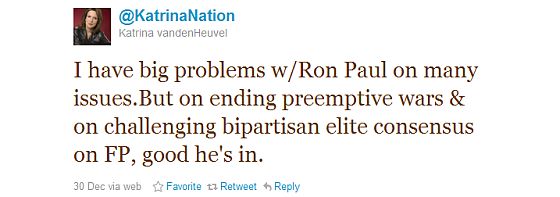
Glenn Greenwald writes: The Ron Paul candidacy, for so many reasons, spawns pervasive political confusion — both unintended and deliberate. Yesterday, The Nation‘s long-time liberal publisher, Katrina vanden Heuvel, wrote this on Twitter:
That’s fairly remarkable: here’s the Publisher of The Nation praising Ron Paul not on ancillary political topics but central ones (“ending preemptive wars & challenging bipartisan elite consensus” on foreign policy), and going even further and expressing general happiness that he’s in the presidential race. Despite this observation, Katrina vanden Heuvel — needless to say — does not support and will never vote for Ron Paul (indeed, in subsequent tweets, she condemned his newsletters as “despicable”). But the point that she’s making is important, if not too subtle for the with-us-or-against-us ethos that dominates the protracted presidential campaign: even though I don’t support him for President, Ron Paul is the only major candidate from either party advocating crucial views on vital issues that need to be heard, and so his candidacy generates important benefits.
Whatever else one wants to say, it is indisputably true that Ron Paul is the only political figure with any sort of a national platform — certainly the only major presidential candidate in either party — who advocates policy views on issues that liberals and progressives have long flamboyantly claimed are both compelling and crucial. The converse is equally true: the candidate supported by liberals and progressives and for whom most will vote — Barack Obama — advocates views on these issues (indeed, has taken action on these issues) that liberals and progressives have long claimed to find repellent, even evil.
As Matt Stoller argued in a genuinely brilliant essay on the history of progressivism and the Democratic Party which I cannot recommend highly enough: “the anger [Paul] inspires comes not from his positions, but from the tensions that modern American liberals bear within their own worldview.” Ron Paul’s candidacy is a mirror held up in front of the face of America’s Democratic Party and its progressive wing, and the image that is reflected is an ugly one; more to the point, it’s one they do not want to see because it so violently conflicts with their desired self-perception.
The thing I loathe most about election season is reflected in the central fallacy that drives progressive discussion the minute “Ron Paul” is mentioned. As soon as his candidacy is discussed, progressives will reflexively point to a slew of positions he holds that are anathema to liberalism and odious in their own right and then say: how can you support someone who holds this awful, destructive position? The premise here — the game that’s being played — is that if you can identify some heinous views that a certain candidate holds, then it means they are beyond the pale, that no Decent Person should even consider praising any part of their candidacy.
The fallacy in this reasoning is glaring. The candidate supported by progressives — President Obama — himself holds heinous views on a slew of critical issues and himself has done heinous things with the power he has been vested. He has slaughtered civilians — Muslim children by the dozens — not once or twice, but continuously in numerous nations with drones, cluster bombs and other forms of attack. He has sought to overturn a global ban on cluster bombs. He has institutionalized the power of Presidents — in secret and with no checks — to target American citizens for assassination-by-CIA, far from any battlefield. He has waged an unprecedented war against whistleblowers, the protection of which was once a liberal shibboleth. He rendered permanently irrelevant the War Powers Resolution, a crown jewel in the list of post-Vietnam liberal accomplishments, and thus enshrined the power of Presidents to wage war even in the face of a Congressional vote against it. His obsession with secrecy is so extreme that it has become darkly laughable in its manifestations, and he even worked to amend the Freedom of Information Act (another crown jewel of liberal legislative successes) when compliance became inconvenient.
He has entrenched for a generation the once-reviled, once-radical Bush/Cheney Terrorism powers of indefinite detention, military commissions, and the state secret privilege as a weapon to immunize political leaders from the rule of law. He has shielded Bush era criminals from every last form of accountability. He has vigorously prosecuted the cruel and supremely racist War on Drugs, including those parts he vowed during the campaign to relinquish — a war which devastates minority communities and encages and converts into felons huge numbers of minority youth for no good reason. He has empowered thieving bankers through the Wall Street bailout, Fed secrecy, efforts to shield mortgage defrauders from prosecution, and the appointment of an endless roster of former Goldman, Sachs executives and lobbyists. He’s brought the nation to a full-on Cold War and a covert hot war with Iran, on the brink of far greater hostilities. He has made the U.S. as subservient as ever to the destructive agenda of the right-wing Israeli government. His support for some of the Arab world’s most repressive regimes is as strong as ever.
Most of all, America’s National Security State, its Surveillance State, and its posture of endless war is more robust than ever before. The nation suffers from what National Journal‘s Michael Hirsh just christened “Obama’s Romance with the CIA.” He has created what The Washington Post just dubbed a vast drone/killing operation,” all behind an impenetrable wall of secrecy and without a shred of oversight. Obama’s steadfast devotion to what Dana Priest and William Arkin called “Top Secret America” has severe domestic repercussions as well, building up vast debt and deficits in the name of militarism that create the pretext for the “austerity” measures which the Washington class (including Obama) is plotting to impose on America’s middle and lower classes.
The simple fact is that progressives are supporting a candidate for President who has done all of that — things liberalism has long held to be pernicious. I know it’s annoying and miserable to hear. Progressives like to think of themselves as the faction that stands for peace, opposes wars, believes in due process and civil liberties, distrusts the military-industrial complex, supports candidates who are devoted to individual rights, transparency and economic equality. All of these facts — like the history laid out by Stoller in that essay — negate that desired self-perception. These facts demonstrate that the leader progressives have empowered and will empower again has worked in direct opposition to those values and engaged in conduct that is nothing short of horrific. So there is an eagerness to avoid hearing about them, to pretend they don’t exist. And there’s a corresponding hostility toward those who point them out, who insist that they not be ignored.

ABC News reports: In his last official act of business in 2011, President Barack Obama signed the National Defense Authorization Act from his vacation rental in Kailua, Hawaii. In a statement, the president said he did so with reservations about key provisions in the law — including a controversial component that would allow the military to indefinitely detain terror suspects, including American citizens arrested in the United States, without charge.
The legislation has drawn severe criticism from civil liberties groups, many Democrats, along with Republican presidential candidate Ron Paul, who called it “a slip into tyranny.” Recently two retired four-star Marine generals called on the president to veto the bill in a New York Times op-ed, deeming it “misguided and unnecessary.”
“Due process would be a thing of the past,” wrote Gens Charles C. Krulak and Joseph P. Hoar. “Current law empowers the military to detain people caught on the battlefield, but this provision would expand the battlefield to include the United States – and hand Osama bin Laden an unearned victory long after his well-earned demise.”
The president defended his action, writing that he signed the act, “chiefly because it authorizes funding for the defense of the United States and its interests abroad, crucial services for service members and their families, and vital national security programs that must be renewed.”
Senior administration officials, who asked not to be named, told ABC News, “The president strongly believes that to detain American citizens in military custody infinitely without trial, would be a break with our traditions and values as a nation, and wants to make sure that any type of authorization coming from congress, complies with our Constitution, our rules of war and any applicable laws.”
The Associated Press adds: The administration also raised concerns about an amendment in the bill that goes after foreign financial institutions that do business with Iran’s central bank, barring them from opening or maintaining correspondent operations in the United States. It would apply to foreign central banks only for transactions that involve the sale or purchase of petroleum or petroleum products.
Officials worry that the penalties could lead to higher oil prices, damaging the U.S. economic recovery and hurting allies in Europe and Asia that purchase petroleum from Iran.
The penalties do not go into effect for six months. The president can waive them for national security reasons or if the country with jurisdiction over the foreign financial institution has significantly reduced its purchases of Iran oil.
The State Department has said the U.S. was looking at how to put them in place in a way that maximized the pressure on Iran, but meant minimal disruption to the U.S. and its allies.
In response to the threatened penalties, Iran warned this past week that it may disrupt traffic in the Strait of Hormuz, a vital Persian Gulf waterway. U.S. officials say that while they take all threats from Iran seriously, they view this latest warning as little more than saber rattling because disrupting the waterway would harm Iran’s economy.
The $662 billion bill authorizes money for military personnel, weapons systems, the wars in Afghanistan and Iraq and national security programs in the Energy Department for the fiscal year beginning Oct. 1.
The measure also freezes some $700 million in assistance until Pakistan comes up with a strategy to deal with improvised explosive devices.