
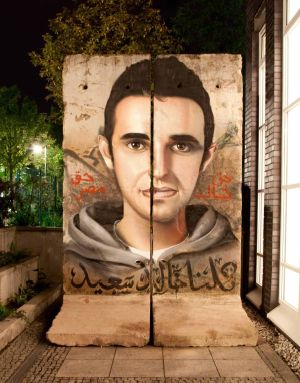
Amro Ali writes: On 6 June 2012, I will join countless others in commemorating the second anniversary of the death of Khaled Saeed, the twenty-eight-year-old Alexandrian who was beaten to death by plain-clothed policemen. The screams of Khaled echoed through Egypt and sparked the rapid countdown to the 2011 Egyptian Revolution.Khaled Saeed painting on the Berlin Wall by graffiti artist Andreas von Chrzanowski, photo by Joel Sames
Khaled was the neighbor down the street whom I, admittedly, paid little attention to. Yet his posthumous transformation from another face in the neighborhood to revolutionary poster child has become a source of both inspiration and concern. Inspiring in that he has given a focus and impetus to Egypt’s revolution, and concern in that his mythologization considerably conceals the real problems that the many “Khaled Saeeds” of Egypt face.
Khaled has been distorted almost beyond recognition. To understand the extent of this, based on interviews from friends, associates and my familiarity and understanding of the district, I attempt to provide a descriptive account of his life up until that fateful night in June 2010. The facts of his life are contrasted with his mythologization and the polarizing effects of both. His death was not just indicative of the corrupt and brutal police state; Khaled’s life was symptomatic of the widespread despair that continues to plague Egypt’s youth and that manifests in a plethora of symptoms from drug abuse to the strong desire to emigrate. The reconstruction of Khaled Saeed perpetuates self-defeating myths that, by elevating him into a figure with saint–like qualities, minimizes and simplifies the dynamics of his life that led up to his death.
Khaled’s tragedy was a turning point in my life. I first wrote about Khaled Saeed shortly after his death in an article titled, “Egypt’s Collision Course with History.” On the day Khaled died, I was in Australia reflecting on my late father who had died two years earlier on 6 June 2008, near to where Khaled passed away. When the news of Khaled’s death reached me, it shook my world. It was not just the manner of Khaled’s death that had disturbed me, but the deep reach of President Hosni Mubarak’s repressive police state into a neighborhood where I had grown up and idealized as a beacon of harmony. Up until then, I naively thought that such things happened to other people, in the slums, Islamist strongholds, in prisons, on the news, Alexandria’s rural outskirts, any “other area.” My area became that “other area.” [Continue reading…]
Category Archives: Egypt
Hosni Mubarak is in jail — but little has changed for Egypt
Magdi Abdelhadi writes: For the first time in Egypt’s history the pharaoh is behind bars. But the joy was not unalloyed. Some of his most powerful henchmen, the backbone of his police state, were acquitted of killing the protesters and are now free. That’s why Tahrir Square in Cairo and other cities have erupted in anger.
What also infuriated the public was that Mubarak was found guilty not of what he did, but rather of what he did not do. That’s how seemingly preposterous (but apparently technically correct) the verdict is. The former president was proven guilty of something like “serious dereliction of duty”: he failed to stop the killing of protesters.
The absence of incriminating evidence – as cited by Judge Ahmed Rifaat – was the most shockingly appalling of all facts, considering that Egyptians, in fact the whole world, saw on their television screens how the police shot and mauled the protesters last year.
The verdict should not have come as a surprise for those who followed the trial closely. The prosecutors failed to provide material proof (there was some circumstantial evidence on the type of weapons and ammunition issued to the anti-riot police) of specific orders from top police chiefs to the boots on the ground. At one point, the prosecutors publicly complained to the court that the police and intelligence services had refused to co-operate with the investigation.
The question now is why those agencies and the men who control them (all of them Mubarak-era appointees) have not been charged with “severe dereliction of duty” or, even worse, obstruction of justice. The answer is simple: they still rule Egypt. [Continue reading…]
Egypt: Protests grow in Tahrir after Mubarak verdict
Al Jazeera reports: Thousands of people descended on Tahrir Square to protest on Saturday night, a spontaneous outpouring of anger after a Cairo court sentenced former president Hosni Mubarak to life in prison but acquitted a number of other former regime officials.
The verdict was initially met with euphoria: Egyptians celebrated upon hearing that Mubarak was convicted of complicity in the murder of more than 800 protesters during the Egyptian revolution in January of 2011. It was the first time an Arab head of state had been convicted, and a major accomplishment for the revolution which toppled Mubarak nearly 18 months ago.
But the joy was short-lived. Mubarak’s two sons, Gamal and Alaa, were acquitted of corruption charges, and several senior security officials were found not guilty of murder. Some had wanted Mubarak to face the death penalty; others appreciated the verdict, but expected it would be overturned on appeal.
So they flocked to Tahrir Square, the heart of last year’s revolution, to voice their frustration, not just with the verdict but with Egypt’s post-revolution military leadership.
“It’s garbage,” Najdi Mohamed el-Din said of the verdict. “And it has made us realize something. The revolution of January 2011? We need to do it again, and we need to do it until everyone who was with Mubarak is gone.”
More than 5,000 people had gathered in Tahrir before midnight, and some planned to spend the night. The atmosphere felt almost nostalgic, as if protesters were reliving their roles from last year’s revolution. Many vowed not to leave the square until their demands were met.
Yet they struggled to articulate what, exactly, those demands were, and there were moments of disunity inside the square. At one point, the April 6 youth movement tried to hoist its flag; other protesters demanded they lower it. An hour later, a heated argument among another group ended with several men beating each other with folding chairs.
Several prominent politicians visited the square on Saturday night. Hamdeen Sabahi, the defeated leftist presidential candidate, was the first to appear, to an energetic welcome. “You are the president in our hearts,” some protesters chanted. Abdel Moneim Aboul Fotouh, the moderate Islamist candidate who placed fourth in last month’s presidential election, also made an appearance.
So did Mohammed Morsi, the Muslim Brotherhood’s candidate and one of two contenders in the runoff election later this month. In a press conference before his visit, he tried to present himself as the revolutionary candidate. “There will be no fair elections, no fair trials, unless the revolution continues,” he said.
Yet his newfound praise for the revolution – the Brotherhood has historically kept its distance from the protests in Tahrir – failed to win him much support from the crowd in Tahrir. “The Brotherhood is coming?” one man asked sarcastically. “Where have they been?”
Egyptian court sentences Mubarak to life in prison
The New York Times reports: An Egyptian judge on Saturday sentenced former President Hosni Mubarak to life in prison for the killing of unarmed demonstrators during the first six days of protests that ended his rule.
It was the first verdict against an Arab ruler brought before the law by a popular revolt, and for many Egyptians it may be the greatest achievement so far of the uprising that began 16 months ago. With the nation still awaiting the ratification of a new constitution, the election of a new president and the hand-over of power by its military rulers, the decision is Egypt’s most significant step yet toward establishing the principle that no leader is above the law.
Yet lawyers critical of Mr. Mubarak immediately warned that the verdict may not survive an appeal. The judge acquitted several lower-ranking security officials of responsibility for the same deaths, raising questions about the chain of command. He also dismissed corruption charges against Mr. Mubarak and his sons on technical grounds, and by early afternoon protesters angry at the flimsiness of the decision were pouring into Tahrir Square, the symbolic heart of the revolt.
Egyptian state television reported that within hours of the decision, Mr. Mubarak, 84, had suffered a “health crisis” as he was being flown by helicopter to a Cairo prison from the military hospital where he had awaited the verdict. He was being treated inside the helicopter which he refused to leave, the state network reported.
Egyptian elections: Choose none of the above
Al-Akhbar English reports: A day after the results of the first round of the presidential election were announced, the ground floor of the Journalists’ Syndicate was buzzing. Unlike the arguments blaring through the capital, the crowd wasn’t concerned with comparing the two candidates that made it to the runoffs. The keyword that evening was “boycott.”
“If you are here, it means you chose to boycott. We are here to discuss suggestions on how to do so,” journalist Rasha Azab told the crowd as the final snippets of sunlight filtered through the glass panels of the syndicate lobby on Tuesday.
Stickers blazoned with the campaign’s title, “Muqateoun” (Boycotters), were passed around. It wasn’t a place to discuss the pros and cons of the boycott; it was time for action.
A day earlier, the Presidential Election Committee (PEC) declared the winners of the first round: The Muslim Brotherhood (MB)’s Mohammed Mursi with 5.7 million votes, 25 percent, and ex-Air Force general Ahmed Shafik with 5.5 million, 24 percent.
Having the two most polarizing candidates as winners left voters grimacing at having to choose between an Islamist or military state. The campaign that materialized later on Tuesday aims to present a third option.
Do secular Egyptians now fear Islamists more than the military?
Issandr El Amrani writes: There’s been some buzz over the last day or so over a proposal for a national charter by secular, liberal, non-felool forces (aka most of the small parties in the Egyptian parliament) as well as several ideas over some kind of deal with the remaining presidential candidates on the shape of government. I keep seeing stipulations such as “no MB prime minister” or “vice-presidents from outside the MB” that makes it clear that these initiatives are largely targeted at candidate Mohammed Mursi. I barely see anything about negotiating with candidate Ahmed Shafiq.
I also — and I believe this is a big omission — see no details about restricting the powers of the military, getting rid of SCAF and retiring the generals who currently serve on it, overhauling the General Intelligence Services, or anything else that has been considered largely beyond the pale of political and media discourse since the fall of Hosni Mubarak. It kind of reinforces the feeling that a) most political activists seem to think the greatest threat is the Islamists, since many of the points are about preserving a secular state, b) there is not much courage out there (at least among the professional politicians) about raising the issue of the deep state, the military and the security services. Is this resignation, perception of what’s realistic, of lack of imagination?
Video: Is Egypt’s revolution under threat?
In Egypt, a revolution at the crossroads
Omar Ashour writes: Everything about Egypt’s revolution has been unexpected, and the first-round results in the country’s first-ever competitive presidential election are no different. The rise of former president Hosni Mubarak’s last prime minister, General Ahmad Shafiq, who will enter the presidential runoff alongside the Muslim Brotherhood candidate Mohamed Morsi, has raised eyebrows across the political spectrum. So did the meteoric rise of the Nasserist candidate Hamdin Sabbahi to third place, and the fourth-place finish of Abdel Moneim Aboul Fotouh, who was backed by liberals and hard-line Salafi Islamists alike.
Egypt’s voters overwhelmingly chose the revolution over the old regime and shattered the myth that the push for change is an urban, middle-class, Cairo-based phenomenon: The eight revolutionary candidates received more than 16.4 million votes. But their failure to unite on a single platform directly benefited Gen. Shafiq, who unexpectedly won 5.9 million votes (assuming no election-rigging).
Gen. Shafiq’s success shocked many revolutionaries. “He is a murderer. His place is in jail, not on top of Egypt after the revolution,” said one activist. Indeed, Gen. Shafiq has been linked to multiple cases of corruption and repression, including the “battle of the camels” on Feb. 2, 2011, when Mr. Mubarak’s henchmen attacked Tahrir Square, killing and wounding protesters.
The rise of Gen. Shafiq is explainable in some areas. In Upper Egypt, “more than 60% of Copts voted for him,” a source close to the Coptic Orthodox Church said, and in Coptic-majority areas the pro-Shafiq vote exceeded 95% because he is widely perceived as a bulwark against Islamism.
Moreover, many state employees (around 5.1 million of them are eligible to vote) and their families supported Gen. Shafiq, owing either to direct instructions from their bosses or to the perceived threat of creeping Muslim Brotherhood influence on government bureaucracies. And Gen. Shafiq received financing and support from Mr. Mubarak’s National Democratic Party (NDP), as well as from business and security interests that benefit from the status quo.
But this was not enough to explain Mr. Morsi’s defeat in the Muslim Brotherhood’s traditional strongholds. In Sharqiya, a bastion of hard-core Muslim Brotherhood support with 3.5 million voters, Gen. Shafiq defeated Mr. Morsi by more than 90,000 votes. In Gharbiya governorate, another Muslim Brotherhood stronghold, he beat Mr. Morsi by more than 200,000 votes. [Continue reading…]
Meanwhile, Reuters reports: A group of Egyptian protesters set fire to the campaign headquarters of presidential candidate Ahmed Shafiq in Cairo on Monday, the state news agency reported, after the ex-prime minister made it into the second round of the vote.
The privately-owned Al-Hayat channel broadcast images of a the fire at Shafiq’s campaign office in the Cairo district of Dokki, saying it had been caused by a group of protesters. It said there were no injuries.
Egypt: Revolutionary Socialists to support Morsy in runoff with conditions
Al-Masry Al-Youm reports: The Revolutionary Socialists have called for uniting in the face of presidential hopeful Ahmed Shafiq, describing him as the representative of counter-revolutionary forces.
The group in a statement issued Monday called on the Brotherhood to make a pledge to form a presidential panel and to pick a prime minister from outside the Brotherhood.
The statement said Shafiq, Hosni Mubarak’s last prime minister, would have not been able to reach the runoff had the counter-revolutionary camp not rallied all its strength, organizational abilities and suppressive media.
A Muslim Brotherhood win would resonate far beyond Egypt
Nathan J Brown writes: When it comes to the Muslim Brotherhood, even the irreligious evince a sudden interest in what lies within the inner reaches of the Islamists’ souls. Are they really democrats? What do they really believe? It is time for analysts to leave those questions to a higher authority. For now, it is much more important to ask what they intend to do and what they could do in office.
If balloting is free in the run-off in mid-June, Brotherhood presidential candidate Mohammed Morsi is the favourite to beat Ahmed Shafiq, President Mubarak’s last prime minister. If that happens, Egypt’s major democratic institutions, the parliament and the presidency, will be in Islamist hands. And while full oversight of the security services and military will be out of their grasp for the present – and important institutions like the judiciary will also likely push back against elements of their programme – the Brotherhood could soon have a fairly free hand to tackle many of the country’s domestic problems as it sees fit, and even to begin pushing Egyptian foreign policy in different directions.
When it comes to what the Brotherhood intends domestically, the movement has been stunningly loquacious in its attempts to sketch out a practical programme for administering the country. And that programme focuses much of its attention on good governance, the rule of law, the provision of social services, and an economic policy that owes more to the Washington consensus than to 7th-century Arabia.
Does the Brotherhood intend to apply Islamic law? That is where it begins to retreat into generalities, claiming that it will use Islam as a “reference” or pursue the “goals” of Islamic law, but it will do so through democratic and constitutional channels.
And when it comes to foreign policy, the Brotherhood has also been a bit more cagey: it wishes to “renegotiate” the peace treaty with Israel but will clearly face an Israeli government deeply resistant to making any formal changes; it has communicated reassuring messages to a stream of official American visitors but clearly has a regional agenda that would cause some headaches for the US; and it is deeply and emotionally opposed to the blockade on Gaza but has also effectively told its cousins in Hamas that their cause will have to wait.
The real question is how effective it can be in its programme when it is faced with crushing economic problems, a feisty set of public sector workers, and a public that has been fed the belief that ousting dishonest and corrupt leaders is enough to lead to immediate economic improvements. [Continue reading…]
Video: A showdown between old and new in Egypt
Unofficial results in first round of Egypt’s presidential election
Al-Masry Al-Youm has compiled a comprehensive tabulation of results from the first round of presidential elections, which ended yesterday.
The Muslim Brotherhood’s candidate, Mohamed Morsy, looks set to lead Egypt’s first presidential election poll following the uprising that deposed Hosni Mubarak last year, taking 5,446,460, or 24.9 percent of the votes. Ahmed Shafiq, a former civil aviation minister under Mubarak who was appointed during the president’s last days in office as prime minister, is a close second, with 5,338,285, or 24.5 percent of the votes. Nasserist candidate Hamdeen Sabbahi has surprised many observers by coming in third, with 4,616,937, or 21.1 percent of the votes. Abdel Moneim Abouel Fotouh, moderate Islamist and former Muslim Brotherhood member, was fourth with 3,889,195 or 17.8 percent of the votes. Amr Moussa, former secretary general of the Arab League and diplomat, came in fifth with 2,471,559, or 11.3 percent.
The results were obtained by Al-Masry Al-Youm reporters in 27 governorates, following up on results from 13,000 polling stations. According to Al-Masry Al-Youm’s calculations, overall turnout throughout the country was 43.3 percent, lower than many had expected going into the historic election.
Mohammed Morsi doesn’t rely on charisma
Ian Black writes: Mohammed Morsi, presidential candidate for the Muslim Brotherhood’s Freedom and Justice party, is an uninspiring figure but he is backed by the best-organised political force in the country, now honing its strategy to secure what would be a historic victory in a second round of voting in June.
Morsi, 60, is an engineer who has taught in the US as well as at Egyptian universities. An expert on precision metal surfaces, he worked at Nasa on the development of space shuttle engines in the early 1980s.
Making a virtue out of his modesty, Brotherhood officials say he was reluctant to run but was persuaded to do so when the more charismatic businessman Khairat al-Shater was disqualified.
Inside the Brotherhood, Morsi has long been a backroom operator who dealt with security – often liaising discreetly with the Mubarak regime – and internal discipline.
Little-known to the wider public, Morsi is a famously boring speaker who reduces Egyptian journalists to teeth-gnashing frustration as he rarely says anything remotely quotable.
Egyptian presidential election down to a choice between the Brotherhood and the military
The New York Times reports: The Islamist candidate of the Muslim Brotherhood appeared set to face former President Hosni Mubarak’s last prime minister in a runoff to become Egypt’s first freely elected president, several independent vote counts concluded Friday morning.
A small portion of the ballots remained to be counted. But out of a broad field of more than a dozen candidates, the runoff appears almost certain to pit the two most polarizing figures against each other in a reversion to the decades-old power struggle between Egypt’s secular-minded military elite and its longstanding Islamist opposition.
It was clear as early as Thursday night that a plurality of votes went to Mohamed Morsi, the American-educated engineer nominated by the Brotherhood, the secretive 84-year-old revival group that became the wellspring of political Islam around the world and already dominates the Parliament.
But only Friday morning did it appear that second place would go to Ahmed Shafik, a former Air Force general who briefly served as Mr. Mubarak’s last prime minister. A late entry into the race, he was a dark horse campaigning on promises to use a firm hand against the protests and lawlessness that have prevailed since Mr. Mubarak’s ouster. He presented himself as a strong check on the rise of the Islamists. Of all the candidates in the race, Mr. Shafik came closest to promising a restoration of the old order and aroused both vocal support and threats of a “second revolution” if he should win.
Mr. Shafik’s law and order message resonated with voters, helping him to overtake the two candidates previously considered, along with Mr. Mursi, to be the front-runners. One was Amr Moussa, a former foreign minister under Mr. Mubarak and former head of the Arab League, who had offered a softer but similar message. In the final weeks of the race, Mr. Moussa’s support appears to have all but collapsed in favor of Mr. Shafik.
Ahmad Sarhan, a spokesman for Mr. Shafik, said voters had rallied to the candidate because he promised to “save Egypt from the dark forces,” referring to the Muslim Brotherhood and more militant Islamists.
Mr. Shafik would bring back security, Mr. Sarhan said. “The revolution has ended,” he said. “It is one and a half years.” The other former front-runner who fell behind Mr. Shafik was Abdel Moneim Aboul Fotouh, a dissident former Brotherhood leader campaigning as both an Islamist and a liberal. He explicitly challenged the Brotherhood’s authority to speak as the voice of political Islam. His iconoclastic campaign promised to upend the old culture-war dichotomies of Egyptian and Arab politics, and it caught fire among an unlikely alliance of Brotherhood youth, ultraconservative Islamists known as salafis, and more secular minded leftists and liberals.
Egypt’s revolution won’t end with the presidential election
Jack Shenker writes: The apartment blocks on my street in downtown Cairo have accommodated many cycles of Egypt’s political tumult in the past 18 months.
A stone’s throw from Tahrir Square, they have been enveloped in teargas, pockmarked by Molotov cocktails, pressed into use as urban barricades by both revolutionaries and pro-Mubarak militias, and provided the backdrop for some of the post-Mubarak military generals’ most violent assaults on the citizens they swore to protect. They gaze over the gardens of the Egyptian Museum – a regular home for one of the army’s pop-up torture and detention centres where those still daring to rally for meaningful change have been brutally acquainted with the realities of a junta-curated “transition” to democratic rule.
This month, my buildings’ latest revolutionary iteration was unveiled – two giant billboards sporting beaming mugshots of Ahmed Shafiq: former Mubarak-era prime minister, current presidential candidate and feloul (“regime remnant”) figurehead par excellence. The elections campaign’s last batch of polls suggests Shafiq could emerge triumphant, sounding what many in the media would describe as the final death knell to the “liberal revolutionaries” of Tahrir who have been steadily battered – by guns at the hands of the state security forces, and by public delegitimisation at the hands of the state media – since those heady images of collective protest conquered global TV screens.
If Shafiq fails to win, the argument goes, then the similarly regime-tarnished former foreign minister Amr Moussa may squeak over the line, or the victor may emerge from one of the two Islamist camps consisting of Muslim Brotherhood candidate Mohamed Mursi and a Brotherhood breakaway alternative, Abdel Munim Aboul Fotouh. Any of the above options are said to be a sad body-blow to the spirit of Tahrir, but the very existence of a democratic electoral process is itself trumpeted as a conclusive success for the revolution.
There are a million empirical holes that could be picked in this chronicle – the only results we have so far (from Egyptians voting abroad) put Moussa and Shafiq in fourth and fifth places respectively, while the lazy insistence of characterising Aboul Fotouh as an unreconstructed Islamist (and hence automatically anti-Tahrir) bears little relation to the substance of his support on the ground. But away from the specifics, is this general evaluation even the best way of conceptualising the revolution? Or is the battle for the presidency merely the institutional tip of a far deeper revolutionary iceberg, just one site of contest and dissent among many? [Continue reading…]
Video: What kind of leader do Egyptians want?
Egyptians cast their votes on historic day
The National reports: Today, and tomorrow, the buzz that has scorched street corners, cafes and offices of Egypt for months will culminate in the country’s first free elections for president.
The man who takes the helm at this political transition, from sixty years of autocratic rule by military men to a representative democracy, will forever stand as a symbol of the popular uprising that forced the abdication of President Hosni Mubarak.
“This is a foundational election in the creation of Egypt’s first democratic government,” said Lisa Anderson, a political-science professor and the president of the American University in Cairo (AUC). “Like any democratic government, it will be flawed. But what’s important about this is the process of creating an accountable president and parliament … The biggest change is that Egyptians are realising they have a responsibility as citizens to elect a leader.”
The campaign ignited a nationwide debate about Egypt’s future. Candidates have criss-crossed the country in past weeks in an unprecedented exercise in democracy. There have been countless media appearances and sponsored viewings of campaign videos in public squares.
What do Egyptians want?
The 2012 Public Opinion Survey in Egypt was conducted from May 4-10 by the Brookings Institution.
Attitudes toward the United States
Attitudes toward the United States continue to be unfavorable (85%).
Asked to name the two steps by the United States that would improve the views of the US the most, 66% identified brokering Middle East peace and establishing a Palestinian state, 46% identified stopping economic and military aid to Israel, and 44% identified withdrawal of American forces from the Arabian Peninsula. Only seven percent identified withdrawal of American forces from Afghanistan as one of the two top steps, 12% identified an American push to spread democracy in the Middle East, and 18% identified providing more economic assistance to the region.
Although Egyptians in the past year have been understandably preoccupied with their own political and economic situation and have not been paying as much attention to the American elections as usual, and they probably know less about the republican candidates for president, that has not prevented them from giving their opinions. Presented with a choice between President Obama and likely Republican candidate Mitt Romney, 73% said they preferred Romney, and only 25% chose Obama. It is unlikely that most Egyptians know much about Romney, and the choice is more likely to be an expression of disappointment with Obama. When Obama first came to office in 2009, even before his important speech in Cairo, Egyptian public opinion of the President was more favorable than unfavorable. This contrasted with Israeli public opinion, which was more suspicious of Obama. Since then, there has been a reversal of fortune, where in a poll we conducted in Israel last February, Israeli Jews expressed preference for Obama over all the leading Republican candidates (although his lead over Romney was within the margin of error).
Attitudes toward Israel
Respondents were almost equally divided among those who would like to see Egypt maintain its peace treaty with Israel (46%) and those who would like to see it cancelled (44%). 10% would like to see the treaty amended. With regard to the prospects of lasting peace between Israel and the Palestinians, 55% indicated that they don’t believe this will ever happen, while only five percent said it will happen in the next five years, and 40% said it is inevitable, but it will take more time.
Attitudes toward Iran and its Nuclear Program
When asked in an open question to identify the two countries that posed the biggest threat to them, 97% included Israel in that list of two, 80% included the United States, and 20% included Iran. While Iran remains far behind Israel and the United States as a perceived threat, which is consistent with our polls over the past several years, those who identified Iran as one of the two biggest threats have increased from 8% in 2009 and 15% in October 2011 to 20% in the current poll.
If Iran acquires nuclear weapons, 61% of respondents say they would like Egypt to build its own weapons program, while 32% want Egypt to push for a nuclear weapons-free zone in the Middle East that includes Iran, Israel, and Arabs. Even if Iran does not build nuclear weapons, but Israel retains its own, 49% of respondents say they would like Egypt to build its own, while 45% say they prefer pushing for a nuclear weapons-free zone in the Middle East.

