Larry Derfner writes: The only way Israel is ever going to give up the occupation and its habit of military aggression is by going too far – by becoming such a Goliath that the Western world finally tells it to clean up its act or find some new allies. Tonight’s union between Bibi Netanyahu’s Likud and Avigdor Lieberman’s Yisrael Beiteinu into one big Likud Beiteinu – “Likud Is Our Home” – marks a sizable step in that direction.
Netanyahu hurt himself. I don’t know whether the new party will win more Knesset seats in the January 22 election than Likud and Yisrael Beiteinu could have won separately, but Netanyahu has dirtied himself in the eyes of the world, including even a lot of his mainstream Jewish supporters in the United States. Avigdor Lieberman has a thoroughly deserved international reputation as an Arab-hating, war-loving neo-fascist (this last label having been pinned on him even by Martin Peretz, the stridently pro-Israel ex-publisher of The New Republic.)
Foreign Minister Lieberman calls for expelling, by means of a land swap, hundreds of thousands of Israeli citizens simply for being Arab. He ran an election campaign highlighted by the slogan, “Only Lieberman understands Arabic.” He was a member of Kach in the late 1970s, which he understandably denies but which Kach veterans from that era swear to. He’s fantasized aloud in the Knesset about executing Arab MKs and threatened to bomb Egypt’s Aswan Dam. Plus, of course, he’s been under Israel Police investigation for corruption for nearly 15 years, and could face indictment pretty soon.
And now Netanyahu, who made Lieberman his right-hand man during his first term as prime minister, has identified himself completely with this guy. There was a report tonight by Channel 2′s well-connected Amnon Abramovitch that the unity deal calls for Lieberman to take over as PM in the fourth year of the next term, which Likud Beiteinu is likely to win in the upcoming election. [Continue reading…]
Category Archives: Israel
Israel’s real demographic problem
As used by Israel and its supporters, “demographic problem” is a racist concept — it simply means, as candid Jewish Israelis would put it: too many Arabs. But as the latest polling makes clear, Israel has too many racists. Now that’s a real demographic problem.
In his latest column, “Meet the Israelis,” Gideon Levy writes: Nice to make your acquaintance, we’re racist and pro-apartheid. The poll whose results were published in Haaretz on Tuesday, conducted by Dialog and commissioned by the Yisraela Goldblum Fund, proved what we always knew, if not so bluntly. It’s important to recognize the truth that has been thrown in our faces and those of the world (where the survey is making waves ). But it’s even more important to draw the necessary conclusions from it.
Given the current reality, making peace would be an almost anti-democratic act: Most Israelis don’t want it. A just, egalitarian society would also violate the wishes of most Israelis: That, too, is something they don’t want. They’re satisfied with the racism, comfortable with the occupation, pleased with the apartheid; things are very good for them in this country. That’s what they told the pollsters.
Until a courageous leadership arises here, the kind that appears only rarely in history, and tries to change this nationalist, racist mood, there’s no point in hoping for change to come from below. It won’t come; indeed, it can’t come, because it is contrary to the desires of most Israelis. This fact must be recognized.
The world must also recognize this. Those who long to reach an agreement and draw up periodic peace plans must finally recognize that Israelis are plainly telling them, “No thanks, we’re not interested.” [Continue reading…]
Israel’s war on African asylum seekers
Maya Paley writes: According to Israel’s Anti-Infiltration bill, infiltrators can now be detained for a minimum of three years and a maximum of forever. The detention facility consists of tent cities and constructed buildings in the Negev, which is being run by the Israel Prison Services. Detainees will also not be permitted to work.
Jews in the Diaspora, overall, have responded to this negative media attention as just another biased and unwarranted attack on Israel. Others have dismissed the asylum problem as an issue Israel needs to deal with on her own without meddling by those of us in the Diaspora. Some say vaguely that they worry about Israel’s demographics. And still others say it’s not a priority issue when we have Iran and Hezbollah threatening us.
Unfortunately, these are all excuses.
According to the Refugee Convention of 1951, which Israel helped establish and then signed, the Africans entering Israel through Sinai are “asylum seekers.” Strangely, the only people calling them asylum seekers are the Israeli humanitarian organizations. Even the international news agencies call them “migrants.” The Israeli government and Israeli news agencies call them “infiltrators.” The numbers of asylum seekers entering Israel has steadied since the fence has been built along the border, and the reality is that, according to a recently published Knesset report, they are only 0.75% of the population.
Words carry weight in national and international policy. According to the Refugee Convention, asylum seekers cannot be criminalized for entering a country, as they are not illegally crossing the border. They are seeking asylum and should, therefore, undergo a process through which they apply for refugee status and end up either accepted as refugees or denied status. This process, termed Refugee Status Determination, does not exist in Israel (although the government will claim otherwise). [Continue reading…]
Most Israeli Jews support apartheid regime in Israel
Gideon Levy reports: Most of the Jewish public in Israel supports the establishment of an apartheid regime in Israel if it formally annexes the West Bank.
A majority also explicitly favors discrimination against the state’s Arab citizens, a survey shows.
The survey, conducted by Dialog on the eve of Rosh Hashanah, exposes anti-Arab, ultra-nationalist views espoused by a majority of Israeli Jews. The survey was commissioned by the New Israel Fund’s Yisraela Goldblum Fund and is based on a sample of 503 interviewees.
The questions were written by a group of academia-based peace and civil rights activists. Dialog is headed by Tel Aviv University Prof. Camil Fuchs.
The majority of the Jewish public, 59 percent, wants preference for Jews over Arabs in admission to jobs in government ministries. Almost half the Jews, 49 percent, want the state to treat Jewish citizens better than Arab ones; 42 percent don’t want to live in the same building with Arabs and 42 percent don’t want their children in the same class with Arab children. Continue reading
More than half of contributions to Israeli politicians come from foreign donors
Haaretz reports: More than half of the contributions to politicians in the past two years – 53 percent of the NIS 13 million – came from people who live overseas, cannot vote in Israel and are not directly impacted by the elected officials’ decisions, Haaretz has found.
Prime Minister Benjamin Netanyahu raised 96.8 percent of his NIS 1.2 million in campaign contributions from foreign donors, according to the State Comptroller’s Office, which published the candidates’ campaign contribution reports for the last two years on its website on Thursday. (Netanyahu announced on Thursday that elections would be held January 22.)
Minister Moshe Ya’alon was the only one of the 26 well-financed politicians who raised 100 percent of his campaign funds overseas. Netanyahu raised the second-highest percentage at 96.8 percent, followed by Minister Limor Livnat at 94 percent.
At the other end of the scale, Labor Party leader Shelly Yacimovich raised just 0.03 percent of her contributions abroad, while Likud MK Ofir Akunis raised 7.3 percent overseas.
Among political parties, Likud raised the highest percentage abroad – 67 percent – while Kadima raised 65 percent overseas. By contrast, Meretz raised zero percent overseas and Habayit Hayehudi raised four percent of its contributions from foreign sources.
The end of Israel
Kobi Niv writes: Former U.S. Secretary of State Henry Kissinger said not long ago that in 10 years there would be no more Israel. What foolishness, right? Clearly, Israel will survive forever. First of all, because that is what our leaders say. Second, we have a fine army, smart bombs, a stable economy and high tech, too. And third, because God is with us. These are facts.
And yet, if you look at history, recent and distant, ours and others’, countries and regimes have fallen and disappeared, even those that had great armies and atom bombs. The communist Soviet empire, for example, with its army, police forces and missiles, existed for less than 70 years.
Indeed, the key question is not whether Israel will still exist in 10 years, but what kind of Israel will be here in 10 years, if any. True, it’s a hard question to answer, because the future, as we know, is unknown. But on the other hand, the future is almost always a consequence of processes that precede it. And the processes with which we are moving toward the future are painfully obvious.
A battle has been under way for some time for the soul of the Jewish-Israeli people. This battle, between the religious-Zionist wing and the secular-liberal wing, seems still to be undecided. Some calculate that in the coming elections, in a certain constellation, with the help of God and tricky combinations of events, the secular liberals will be able to establish a government, cancel out (with the help of some hocus-pocus ) heinous religious Zionism and send it packing to Canada or Kamchatka. But if we really look around, it is as clear as day that this battle has already been decided and that religious Zionism has won. This is no mistake, nor is it by chance. It has won because most of the Jewish people in Israel are religious Zionists, even if some disguise themselves during elections as supporting a “centrist party.” Continue reading
The Israeli election about nothing
Michael Koplow writes: As was widely expected, Prime Minister Benjamin Netanyahu announced yesterday that Knesset elections are going to take place within three months. The ostensible reason that Netanyahu provided was deadlock over the budget, but this was an obvious move on Netanyahu’s part given the political situation in Israel. The J14 social protests this past summer were a shadow of their previous incarnation, the situation on the southern border with Egypt appears relatively quiet for now, and Iran has been put on hold. Netanyahu’s Likud party is on top of the polls and the parties that make up the rest of his right-wing coalition bloc are all poised to do reasonably well.
More importantly though, Netanyahu’s opponents don’t appear to present much of a threat at the moment. Kadima’s erstwhile leader Tzipi Livni, who led the party to the most seats in the 2009 election, is now without a political home and has been reduced to communicating to the public through her Facebook page, and current Kadima head Shaul Mofaz is busily running the party into the ground. Labor will almost certainly do better this time than it did in 2009, but the consensus is that Shelley Yachimovich is not quite ready for prime time and needs some more seasoning before presenting a real threat to Netanyahu. While there are some plausible but remote scenarios in which Netanyahu is cast out of the prime minister’s residence, the overwhelming likelihood is that three months from now Netanyahu will remain exactly where he is. [Continue reading…]
Israel’s hypocrisy on a nuclear Middle East
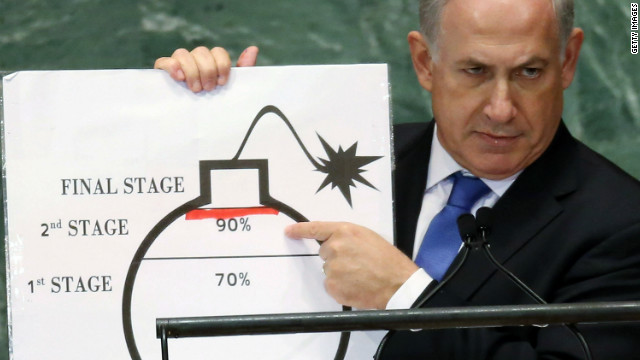
IPS reports: When world leaders packed their bags and headed home last week, there was one lingering memory of the General Assembly’s high-level debate: Benjamin Netanyahu’s dramatic presentation of a cartoonish nuclear red line, which hit the front pages of most mainstream newspapers in the United States.
The Israeli prime minister warned Iran against crossing that red line even though the Jewish state itself had crossed it when it went nuclear many moons ago.
As Mouin Rabbani, contributing editor to the Middle East Report, told IPS, “The real absurdity of Netanyahu lecturing the world about nuclear weapons was precisely that – an Israeli leader lecturing the world about the dangers of nuclear proliferation in the Middle East.”
The fact of the matter is that not only is Israel the region’s sole nuclear power, and not only has it on previous occasions all but threatened to use these weapons of mass destruction, but it has since its establishment consistently and steadfastly rejected ratification of the Nuclear Non-Proliferation Treaty (NPT), Rabbani said.
“It’s a bit like listening to (Hustler magazine publisher) Larry Flynt denouncing pornography – though to be fair to Flynt, it’s unlikely he will reach the levels of hypocrisy displayed by Netanyahu,” said Rabbani, a Middle East expert who has written extensively on the politics of the volatile region. [Continue reading…]
Spare a thought for Bibi’s medievalists
Daniel Levy writes: Let’s face it: September 27th, 2012, was not a good day for the Israeli Prime Minister’s office props and graphics department. Bibi is a showman and there is nothing new in him using visual aides, but going from Holocaust documents to cartoon bombs in just 6 months leaves a little wanting in the tastefulness stakes. Part of his strategy is to convince the world that he is crazy enough to go it alone militarily against Iran, lest he be dismissed as the boy who keeps crying wolf. The Bugs Bunny bomb graphic was part of the “I’m crazy enough to do it” shtick.
And Bibi has his red line. No really, he even has his own red marker pen.
Sure Bibi wants to continue to drive the Iran debate, to undermine negotiations and to push the U.S. ever closer to a military confrontation. And to keep that “will he — won’t he” guessing game going well into 2013. I still don’t think Netanyahu will do it, for reasons I have outlined in the past, but one part of his UN speech in particular struck me as suited to a man who is awfully detached from reality.
Netanyahu spent a long time outlining his version of the clash of civilizations meme — describing a struggle between Islamist medievalism and Israeli hi-tech modernity. But in so doing he appeared to be either forgetful of or intemperate towards a sizeable chunk of his own governing coalition. [Continue reading…]
Defusing Israel’s ‘detonator’ strategy
Patrick Tyler writes: Over six decades and through as many wars, the U.S. has escalated its commitment to Israel’s security, but it has neglected a corresponding insistence that Israel develop the institutions of diplomacy, negotiation and compromise necessary to fully engage the Arabs during a crucial period of Arab awakening. Every president since Eisenhower has pressed Israel to make the kind of concessions that are necessary for peace.
President Nixon said he would give Israel the “hardware” of weapons if Golda Meir would supply the “software” of diplomatic flexibility.
“The philosophical underpinning of U.S. policy toward Israel,” President Ford said, “had been our conviction — and certainly my own — that if we gave Israel an ample supply of economic aid and weapons, she would feel strong and confident, more flexible and more willing to discuss a lasting peace.” But after serial wars and a strong aversion within the ruling elite to compromise, Ford lamented, “I began to question the rationale for our policy.”
Israel deserves our attention and protection. But 60 years after its founding, it remains in the thrall of an original martial
impulse, the depth of which has given rise to succeeding generations of leaders who seem ever on the hair trigger in dealing with their rivals, and whose contingency planners embrace only worst-case scenarios in a process that magnifies the sense of national peril, encourages military preemption and covert subversion, and undermines any chance for a more engaging diplomacy based on compromise and accommodation.
Israel’s second prime minister, Moshe Sharett, a lifelong diplomat whose political career was destroyed by the circle of strong militaristic figures who coalesced around David Ben-Gurion in the 1950s, admonished his countrymen that “the question of peace must not be lost sight of for one single moment.” Yet Israel in the modern era has lost sight of peace.
Netanyahu’s push for a war at America’s expense
Michael C. Desch points out the audacity of Benjamin Netanyahu in his effort to try to commit the United States to fighting a preventive war on Israel’s behalf. The level of support the Jewish state already receives from the U.S. is unparalleled. One fifth of Israel’s defense spending is paid for by American taxpayers.
The United States has provided Israel with more than $160 billion in bilateral aid since 1948, most of it for military purposes. About 60 percent of all U.S. aid to foreign militaries now goes to Israel, constituting around 20 percent of the Jewish state’s annual military spending, according to the Congressional Research Service. Washington requires other recipients of its military aid to spend the money in the United States, but allows Israel to use a significant part of its aid allotment to buy weapons from its own defense industry rather than from U.S. suppliers.
The United States also takes steps to ensure Israel’s ready access to American arms. The United States prepositioned ammunition and equipment in Israel in the 1980s as part of its war reserve stocks for allies program, and now regularly allows the Israel Defense Forces to replenish their supplies from them, as they did after the 2006 conflict between Israel and Hezbollah. Israel also benefits more than any other country from the U.S. Excess Defense Articles program, a veritable military flea market open to “major non-NATO allies” of the United States, a designation that Israel obtained in 2001.
But perhaps it is in the area of missile defense that the “special relationship” is most clearly revealed. The United States has been a major financial backer of Israel’s short-range Iron Dome anti-missile system and has cooperated with Israel to develop longer-range systems, such as David’s Sling and the Arrow series of interceptors. And the U.S. Department of Defense budget request for next year includes nearly $1 billion for a new joint U.S.-Israeli missile defense project.
Moreover, the Congressional Research Service reports that the United States has deployed to Israel a highly capable U.S.-manned X-band radar system, known as the AN/TPY-2, that not only increases the range at which Israel can detect incoming missiles but also connects it to the United States’ own global system for detecting ballistic missiles. Israel’s ballistic missile defense network is also bolstered by the array of ground-based and ship-based ballistic missile detection and defense systems that the United States is deploying in the Persian Gulf.
On top of this largesse, in 2007, the George W. Bush administration made a ten-year commitment to provide $30 billion in military aid to Israel, and the Obama administration has kept that promise. Not to be outdone, the U.S. Congress recently passed legislation offering Israel new access to U.S. weapons and matériel, encouraging expanded Israeli cooperation with NATO, and promising to help preserve Israel’s “qualitative military edge” in the region.
In short, not only does the United States have Israel’s back — it has its front, top, and bottom, too.
Israel indicts Jewish teenagers over attack on Palestinian in Jerusalem
Reuters reports: Nine Jewish teenagers were indicted on Tuesday over a ferocious assault that nearly killed a young Arab in Jerusalem, an alleged hate crime in a city divided by religion and politics.
Israeli prosecutors said a girl, cursing and shouting anti-Arab taunts, lit the spark that set off a chain reaction of racist violence on August 16 in which Jamal Julani, a 17-year-old Palestinian, was punched, kicked and left for dead.
Julani’s heart stopped after the assault in a main Jerusalem square, where drunken teenagers often gather, but was brought back to life by a paramedic at the scene.
“Death to Arabs,” the youngsters chanted as they swept through the popular nightspot, rallying to the girl’s call to find and attack Palestinians, according to a summary of the charge sheet released by the Justice Ministry.
“Be a man and come and beat the Arabs,” one of the attackers shouted to the crowd, the indictment said.
Eight of the suspects are minors in their teens. A ninth suspect, aged 19, will be tried as an adult. Charges include assault and incitement to racism and violence.
Lawyers for the accused said they would study the indictment before entering a plea. It was not clear when the cases would go to trial.
The attack, which laid bare an undercurrent of racial tension in Jerusalem, was swiftly condemned by Prime Minister Benjamin Netanyahu and other Israeli leaders.
“This is something we cannot accept – not as Jews, not as Israelis,” Netanyahu said of the assault, whose intensity, along with the lack of remorse shown by some of the suspects in court appearances, jolted many in the Jewish state.
“He’s an Arab, and he cursed my mother, so he should die,” one suspect said at a remand hearing last week.
Julani comes from mainly Arab east Jerusalem, which was captured by Israel in the 1967 war. The state later declared that the city was the “complete and undivided” capital of Israel, an assertion not recognized by international powers.
Adnan Husseini, the Palestinian minister for Jerusalem affairs, said Palestinians in the city faced a constant battle against racism.
“This widely publicized incident revealed the true face of Israel and the true culture of hatred that is imbedded in its youth,” he told Reuters.
Rachel Corrie lawsuit result ‘dangerous precedent’ say human rights groups
The Guardian reports: Human rights organisations have warned of a “dangerous precedent” following an Israeli court’s dismissal of a civil lawsuit over the death of US activist Rachel Corrie, which stated that Israel could not be held responsible because its army was engaged in a combat operation.
Corrie “was accidentally killed in the framework of a ‘war-related activity’ … [and] the state bears no responsibility for the damages inflicted on the plaintiffs resulting from a war-related action,” said Judge Oded Gershon at Haifa district court.
The 23-year-old activist was crushed by a military bulldozer which she believed was intent on demolishing a Palestinian home in Rafah, southern Gaza, in March 2003. Gershon ruled that it was a “regrettable accident” that Corrie had brought upon herself. There had been no fault in the internal Israeli military investigation, which cleared the bulldozer driver of any blame, the court found. “The deceased was in a blind spot – the operator didn’t see her,” said Gershon.
Corrie had “put herself in a dangerous situation” and could have saved herself by moving out of the zone of danger, he said. The area was “the site of daily warfare” and a closed military zone, and the US government had warned its citizens not to go there.
Hussein Abu Hussein, the Corrie family’s lawyer, said the ruling sent “a very dangerous message and precedent that there are no restrictions on Israeli military behaviour in Gaza and the West Bank”. The ruling would “close the doors of justice to civilian victims”, including foreigners, and “expand a legal black hole” in which Israel seeks to evade responsibility for its actions.
The verdict, he said, was “yet another example of where impunity has prevailed over accountability and fairness. We knew from the beginning that we had an uphill battle to get truthful answers and justice, but we are convinced that this verdict distorts the strong evidence presented in court, and contradicts fundamental principles of international law with regard to protection of human rights defenders. In denying justice in Rachel Corrie’s killing, this verdict speaks to the systemic failure to hold the Israeli military accountable for continuing violations of basic human rights.”
Human Rights Watch said the ruling contravened international law, which is intended to protect non-combatants in war zones, and set “a dangerous precedent”. “The idea that there can be no fault for killing civilians in a combat operation flatly contradicts Israel’s international legal obligations to spare civilians from harm during armed conflict and to credibly investigate and punish violations by its forces,” said Bill van Esveld, a senior Middle East researcher at HRW.
Shawan Jabarin, director of the Palestinian human rights organisation, Al Haq, said: “Israel has claimed that it is not responsible for the death of a civilian in armed conflict. However, this flatly ignores international law, which stipulates that Israel is under an obligation to take all measures to ensure that no civilians will be harmed during hostilities, and must at all times distinguish between military targets and civilians.
“The presence of a civilian in a combat zone does in any way not affect their right to protection. Instead, their protected status applies regardless of their location in a conflict, and international law clearly states that they must be protected against acts of violence in all circumstances.”
Amnesty International: Amnesty International condemns an Israeli court’s verdict that the government of Israel bears no responsibility in the death of Rachel Corrie, saying the verdict continues the pattern of impunity for Israeli military violations against civilians and human rights defenders in the Occupied Palestinian Territories (OPT). The verdict shields Israeli military personnel from accountability and ignores deep flaws in the Israeli military’s internal investigation of Corrie’s death.
“Rachel Corrie was a peaceful American protestor who was killed while attempting to protect a Palestinian home from the crushing force of an Israeli military bulldozer,” said Sanjeev Bery, Middle East and North Africa advocacy director for Amnesty International USA.
“More than nine years after Corrie’s death, the Israeli authorities still have not delivered on promises to conduct a ‘thorough, credible and transparent’ investigation. Instead, an Israeli court has upheld the flawed military investigation and issued a verdict that once again shields the Israeli military from any accountability,” Bery said.
The verdict, issued by Judge Oded Gershon in the Haifa District Court, maintains that the Israeli military is not responsible for ‘damages caused’ because the D9 Caterpillar bulldozer was engaged in a combat operation in Rafah in the southern Gaza Strip on March 16, 2003.
International humanitarian law prohibits the destruction of property unless required by imperative military necessity, and requires that in any military operation, constant care is taken to protect civilians.
“Rachel Corrie was clearly identifiable as a civilian, as she was wearing a fluorescent orange vest when she was killed,” said Bery. “She and other non-violent activists had been peacefully demonstrating against the demolitions for hours when the Israeli military bulldozer ran over her.”
By upholding the flawed Israeli military investigation, completed within one month of Rachel Corrie’s death in 2003, the verdict seems to have ignored substantial evidence presented to the court, including by eyewitnesses. The full military investigation has never been made public, but US government officials have stated that they do not believe the investigation was ‘thorough, credible and transparent.’
Amnesty International has made similar criticisms of Israel’s system of military investigations for many years. For example, the organization has monitored the investigations carried out by IDF commanders and the Israeli military police into violations during Operation ‘Cast Lead’, launched by Israeli forces on December 27, 2008, in which hundreds of unarmed civilians in the Gaza Strip were killed.
Israel’s military investigations have lacked independence, impartiality, transparency, appropriate expertise and sufficient investigatory powers. The failure of both Israel and the Hamas de facto administration to conduct credible investigations into violations committed during the conflict led Amnesty International to call for the Gaza situation to be referred to the International Criminal Court.
Palestinian civilians from the OPT are killed or injured by the Israeli military all too frequently, but they face significant barriers in accessing Israeli civil courts, which means that Israeli civil courts rarely examine the killings of civilians in the OPT, particularly those in Gaza. Steep court fees required of claimants before the case can begin are beyond the means of most Palestinians. As part of Israel’s continuing closure of the Gaza Strip, the Israeli authorities deny Palestinian victims or witnesses from Gaza permission to enter Israel to testify in court, lawyers from Gaza cannot represent clients before Israeli courts, and Israeli lawyers cannot enter Gaza to meet with clients.
Amnesty International has repeatedly condemned Israel’s policy of demolishing homes and other structures in the OPT, but demolitions are still routine in the occupied West Bank. Over 600 structures were demolished in 2011, resulting in the forcible eviction of almost 1,100 people. In the first seven months of 2012, the Israeli military demolished 327 structures in the West Bank, displacing 575 people, according to the UN Office for the Coordination of Humanitarian Affairs.
‘I saw the whole beating, it’s a good thing that they beat the Arabs…’
The Institute for Middle East Understanding: Just days after a mob of Jewish Israelis beat and injured three Palestinian youth, one nearly to death, Israel’s Ynet news website conducted interviews in central Jerusalem’s Kikar Hahatulot [Cat Square], just a few hundred feet from the site of what was dubbed by Israeli police a “lynching.” The video is reminiscent of a controversial 2009 video made by Jewish-American journalist/author Max Blumenthal and American-Israeli journalist Joseph Dana titled “Feeling the hate in Jerusalem.”
IMEU also provides a translation of the transcript of the video.
‘Hunting season for Arabs is upon us’
Ynet reports: Two east Jerusalem teens are claiming they were assaulted by three men in Tel Aviv earlier this week in what could be another case of racist violence after last week’s Jerusalem lynch. One suffered a head injury and required eight stitches and the other sustained light wounds.
Suhib Hushia, 19, said he and his friend were assaulted on their way back from a Tel Aviv beach as they stopped at a parking lot to ask for directions.
“Suddenly three armed men approached us and started yelling at us,” he recalled. “We explained we were looking for directions but they shouted at us to leave.”
According to Hushia, one of the men was wearing a spike glove and slapped his friend. The three then assaulted Hushia using various objects he was unable to see.
Suhib’s brother reported that damage was caused to the victims’ car. He noted that the two had called the police and Magen David Adom but that no forces were sent to the scene as the operators could not understand the two who do not speak Hebrew.
He noted that officers at the Jerusalem police station, where they tried to file a complaint after the incident, told them to return later in the day as there was no Arabic-speaking officer. “This shows us the police’s powerlessness in dealing with racist assaults against Arabs.”
“I thought I was going to die,” Subib said, adding that the assailants had called him a “dirty Arab” and other swear words.
MK Ahmad Tibi (United Arab List Ta’al) said in response, “Hunting season for Arabs is at its height with support from a rightist government and racist Knesset.” He blamed the Israel Police for allowing hate crimes against Arabs to happen.
“Imagine Israel’s response had the tables been turned and a Jew was lynched at an Arab town. We are outraged and appalled over the wave of racist violence sweeping the country sponsored by the Right.”
Israeli policeman watched Palestinians being beaten by mob and did nothing
The Times of Israel reports: A policeman was present during a mass brawl in Jerusalem Thursday night that nearly left an Arab teen dead, but reportedly did nothing to stop what officials are calling an attempted “lynch.”
An eighth person was arrested late Wednesday in the Zion Square incident which officials say nearly killed 17-year-old East Jerusalemite Jamal Julani. Police are continuing to investigate the beating, which has roiled the country over the racist nature of the attack.
Eyewitnesses said they called the police at the start of the brawl, some 40 minutes before Julani was severely beaten. As a result, a policeman arrived on a motorcycle, but he stood and watched without stopping the mob as violence unfolded, Maariv reported on Wednesday.
“He was right in the mess,” and could see and hear everything going on, one of the witnesses told the Hebrew daily. The policeman “saw how they [the mob] were chasing Arabs and hitting them, but he didn’t care,” the witness said.
Phone records from the night of the attack show that both witnesses spoke to the police dispatcher, Maariv wrote.
The police confirmed that the policeman arrived at the scene. A Jerusalem police spokesperson did not address the questions of whether he witnessed the beating and whether he intervened or not.
A lynching in Jerusalem: Anatomy of Jewish racism

Jesse Benjamin writes: The news of an attempted mob lynching in Jerusalem’s Zion Square is trickling into Western news sources. It has been translated from angst-filled Hebrew-language Facebook pages written by eyewitnesses, stunned and harassed first responders, and translations gleaned from Haaretz via Mondoweiss, IMEU and others. The lack of outrage, and coverage, is almost as disturbing as the street level racial violence that showed itself in the heart of Israel, rolling in from the Wild West/West Bank where this is more common.
As I processed this, and recalled my own experiences in this exact spot, it seemed that somebody needed to shed light on what the significance of Zion Square is, why mob violence there is especially significant, and why Jews especially need to see this moment as yet another wake up call. My own privileged perspective on this is far removed from the daily violence and dispossession of Palestinian experiences, but my intention is to push other privileged Jews, Israelis and far away Western liberals to take this incident more seriously. Writing from Atlanta, I also want to underscore what the idea of lynching means, and what histories this act is therefore irrevocably connected to.
Zion Square was a refuge for me as a 16 year old. I slipped out the yeshiva side door and chose to live there, on the street, as a pathway to reinvention. The hippie musicians and jewelry makers who lined the streets back then, in 1987, took me in, and I eventually made it off the street, into a youth hostel where I got a bed in exchange for selling beer and running errands. I was an Israeli/US citizen who grew up secular in Toronto and upstate New York, before becoming a teenage Hassid in Brooklyn, en route to Israel and eventual re-engagement with my natal society. I became friends with 16 year olds Israelis who, unlike me, could not get a one-year deferment from military service or make a plan to get out before the draft grabbed hold of their lives. They were beatnikim , Hebrew plural for beatniks or hippies, in open rebellion and angst at the violence of military service that awaited them inescapably in a few short months, smoking hash, growing long hair, engaging world travelers and sometimes Palestinians anyone in our mixed street world in deep philosophical/political discussions about how to end, avoid or cope with the conflict. It was a powerful coming of age for me, and the pedestrian mall of Ben Yehuda, ending in the stone courtyard of Zion Square, was the hub of this activity, the nerve center of integration, questioning, folk music, exchange students, and occasional political protest. Ok, it was not utopian, things were already pretty segregated, and structural imbalance was already endemic, but it was very different then than now.
I left Israel in 1988, and returned a year later with a final one-year deferment, to study and check in on my still yeshiva-bound brother. All my friends were gone from the street, off to the front lines of the Intifada, carrying out Ariel Sharon’s orders to break the bones of young Palestinian protesters. When I did see them on Zion Square, they were broken people, with vacant eyes, literally unable to embrace me and engage in conversation of any kind. They were rushing to the bars to drink themselves into oblivion, filled with post-traumatic stress and suppressed rage/trauma, from the violent contradiction between their peace-loving souls and their new roles as occupation troops. Their long curly hair had been shaved to the scalp, and with it any pretense of humanity. Recognizing me long enough to talk and share was too painful for my old buddies. This was a shocking personal experience of Israel’s dissipating soul, and it also happened at Zion Square. Younger Israeli beatnikim continued to make the scene and mix with travelers and students, but the number of Palestinians who were willing to congregate or just pass through before sundown was already decreasing precipitously. [Continue reading…]
Lynch mob attacked Palestinians in Jerusalem as hundreds of bystanders did nothing
The New York Times reports: Seven Israeli teenagers were in custody on Monday, accused of what a police official and several witnesses described as an attempted lynching of several Palestinian youths, laying bare the undercurrent of tension in this ethnically mixed but politically divided city. A 15-year-old suspect standing outside court said, “For my part he can die, he’s an Arab.”
The police said that scores of Jewish youths were involved in the attack late Thursday in West Jerusalem’s Zion Square, leaving one 17-year-old unconscious and hospitalized. Hundreds of bystanders watched the mob beating, the police said — and no one intervened.
Two of the suspects were girls, the youngest 13, adding to the soul-searching and acknowledgment that the poisoned political environment around the Israeli-Palestinian conflict has affected the moral compass of youths growing up within it.
“If it was up to me, I’d have murdered him,” the 15-year-old suspect told reporters outside court on Monday. “He cursed my mother.” The young man who was beaten unconscious, Jamal Julani, remained in the hospital.
The mob beating came on the same day that a Palestinian taxi on the West Bank was firebombed, apparently by Jewish extremists, though there have been no arrests. The two episodes, along with a new report by the United States State Department labeling attacks by Jews on Palestinians as terrorism, have opened a stark national conversation about racism, violence, and how Israeli society could have come to this point.
“There appears to be a worryingly high level of tolerance — whether explicit or implicit — for such despicable acts of violence,” The Jerusalem Post editorialized on Monday. “A clear distinction must be made between legitimate acts of self-defense aimed at protecting Israel as a Jewish and democratic state, and pointless, immoral acts of violence.”
In the popular Yediot Aharonot newspaper, a commentator asked of the 13-year-old suspect, “Where on earth does a bar-mitzvah-age child find so much evil in himself?” The article said parents should be held responsible.
But on Channel 1 news Monday night, Nimrod Aloni, the head of the Institute for Educational Thought at a Tel Aviv teachers college, said, “this cannot just be an expression of something he has heard at home.”
“This is directly tied to national fundamentalism that is the same as the rhetoric of neo-Nazis, Taliban and K.K.K.,” Mr. Aloni said. “This comes from an entire culture that has been escalating toward an open and blunt language based on us being the chosen people who are allowed to do whatever we like.”