If Syria remains one nation, it will be a nation of orphans and widows

Robin Yassin-Kassab describes his recent trip into liberated Syria: At first the strangest sensation was the normality of the surroundings. A hot and breezy afternoon ran past the windows – stubbled wheat fields, rocky outcrops, smooth-topped tells. But the villages seemed much poorer here, some of their roads gnarled up by tanks. In one hamlet, the Jabhat al-Nusra logo was printed on the walls. Our secular hosts explained that the Islamist group, designated a terrorist organisation by the UK and US, had liberated this stretch of land.

We diverted to avoid al-Fu’aa, a Shia village still held by the regime, and drove on towards Taftanaz, where the scale of the damage wrought by shelling and aerial bombardment became terribly apparent. We passed streets of crumpled buildings, long banks of debris, shopfront shutters buckled by the vacuum bombs that suck in and ignite the air to create fireballs.

White paint on the walls warned: “Watch out – Taftanaz airfield ahead!” The airfield was liberated in January after two months of siege. The resistance lost many men here – the burnt and cratered fields around offer no cover whatsoever. Now ruined tanks and lopsided helicopters rest inside the perimeter, and Free Army militia sit guard at the entrance.

Next we drove into Saraqeb, a city of significant size, again notable for its war damage, and victim of a chemical attack in April. We stopped in the busy centre so one of us could vomit into roadside rubbish, while the others (one an uncovered woman) entered a cafe to eat haytalya, a local speciality. Jabhat al-Nusra runs a sharia court here. Its black flag flies atop the famous TV mast. Nevertheless, nobody looked twice at our friend’s unveiled hair. Saraqeb felt not like the Taliban’s Afghanistan but like Syria minus the regime: socially conservative but largely tolerant of difference.

The media image of the liberated areas suggests the regime has been replaced by heavy-handed militias. At least in Idlib province (Aleppo has suffered much more from thuggery, corruption and Islamist fanaticism, a fact much lamented by the activists and fighters I spoke to), it is not like that at all. No checkpoint stopped us. The men with guns were locals and were considered protectors, not oppressors.

Many men have fought. They fight for a while, then take time off to visit their families in the camps or to harvest the fields (those that haven’t been burned). Most have no political aim other than defending themselves by ending the regime. Some are Islamists, usually moderate and democratic.

One such is Abu Abdullah who, before his leg injury, fought with the rebel group Liwa al-Islam in Douma in the Damascus suburbs. He shocked me with his statement: “We aren’t fighting for freedom, but for Islam.” But the follow-up was more reassuring. “Europe,” he said, “is implementing Islam without being aware of it. It educates its people, it respects their rights, there’s one law for all.”

He doesn’t fight for “freedom” because to him the word means people doing anything they like, regardless of the rights of others. His vision of an Islamic state is one compatible with democracy; it wouldn’t enforce dress codes or ideological allegiances because (he quotes the Quran) “there is no compulsion in religion”.

As for the foreign fighters, Abu Abdullah, like everybody I spoke to, views them with disdain. Syria has enough men, he told me. Syria needs weapons, not men. Foreigners only cause problems. They increase the sectarian element, as Assad and Iran want. They ruin the revolution’s reputation. In any case, most of them aren’t fighting but resting, waiting for “the next stage”. [Continue reading…]


Facebooktwittermail

Jeffrey Toobin’s crazy logic

Three weeks ago, the mild-mannered New York Times reporter, James Risen, nailed Jeffrey — Snowden’s a criminal — Toobin, when Risen said:

“That’s the thing I don’t understand about the climate in Washington these days, is that people want to have debates on television and elsewhere, but then you want to throw the people who start the debates in jail.”

Having been left speechless, Toobin seems to have has spent the last three weeks struggling to come up with a come back.

This is what he came up with:

The assassinations of Martin Luther King, Jr., and Robert F. Kennedy led directly to the passage of a historic law, the Gun Control Act of 1968. Does that change your view of the assassinations? Should we be grateful for the deaths of these two men?

Of course not. That’s lunatic logic. But the same reasoning is now being applied to the actions of Edward Snowden. Yes, the thinking goes, Snowden may have violated the law, but the outcome has been so worthwhile.

Say what? James Earl Ray and Sirhan Sirhan were advocates of gun control? That’s the unintended lunatic logic in Toobin’s reasoning.

Somehow I doubt that Toobin’s capacity to reason is that impaired. His purpose, much more likely, is to make an emotive argument based not on reason, but insinuation. Having already committed himself to the position that Snowden is a criminal, Toobin now wants to up the ante by placing him on a par with infamous assassins.

For Toobin, Snowden’s unforgivable crime was that he stepped out of line. The man who Toobin views with utter contempt is a “thirty-year-old self-appointed arbiter of propriety [who] decided to break the law and disclose what he had sworn to protect. That judgment — in my view — was not Snowden’s to make.” In other words, Snowden’s job was to do as he was told and not have the temerity to question the judgement of his superiors. Snowden’s sole responsibility was to follow his orders, without question.

If Toobin actually believes that the issue at stake here is one of propriety, then he’s even more confused than he already appears.

A state that engages in mass surveillance on its own population, is not merely being intrusive. Those of us who object to the NSA gathering all our personal information are not objecting because we think the NSA is being rude. Information is power and the more information the government acquires, the more likely it becomes that the power which flows from this information will sooner or later be abused.

In a final desperate swipe, Toobin suggests that Snowden can hardly be imagined to have stayed in Hong Kong and now taken up temporary residence in Russia without either the Chinese government or the Russian government gathering the classified information in his possession. They surely snuck into his room and copied his hard drive while he was asleep.

However much Snowden might lack the kind of stature for which Toobin reserves his respect, the former NSA contractor is an expert on one issue about which Toobin knows nothing: cyber security. Snowden knew how to gather the intelligence and how to extract it. I have little doubt in his ability to now maintain its security.

And what Toobin is forgetting, through his fixation on trying to undo his own embarrassment, is that Russia and China do actually have other interests at stake. Hong Kong was only too pleased to be relieved of its Snowden problem by seeing his departure, and Russia’s reluctance to take on the burden was made only too obvious by its insistence that Snowden, while he remained in Moscow airports transit lounge, was not in Russia.

Maybe it’s time for Jeffrey Toobin to follow Snowden’s lead and go into hiding for a while.

Facebooktwittermail

New details show NSA surveillance covers 75% of all U.S. internet traffic

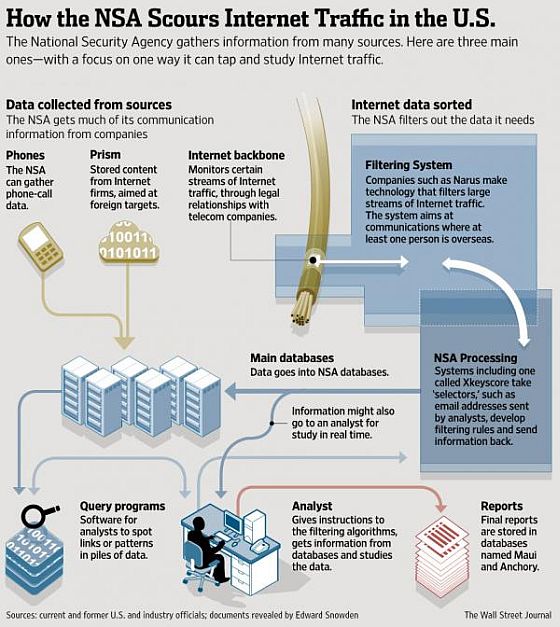
The Wall Street Journal reports: The National Security Agency—which possesses only limited legal authority to spy on U.S. citizens—has built a surveillance network that covers more Americans’ Internet communications than officials have publicly disclosed, current and former officials say.

The system has the capacity to reach roughly 75% of all U.S. Internet traffic in the hunt for foreign intelligence, including a wide array of communications by foreigners and Americans. In some cases, it retains the written content of emails sent between citizens within the U.S. and also filters domestic phone calls made with Internet technology, these people say.

The NSA’s filtering, carried out with telecom companies, is designed to look for communications that either originate or end abroad, or are entirely foreign but happen to be passing through the U.S. But officials say the system’s broad reach makes it more likely that purely domestic communications will be incidentally intercepted and collected in the hunt for foreign ones.

The programs, code-named Blarney, Fairview, Oakstar, Lithium and Stormbrew, among others, filter and gather information at major telecommunications companies. Blarney, for instance, was established with AT&T Inc., T +0.24% former officials say. AT&T declined to comment.

This filtering takes place at more than a dozen locations at major Internet junctions in the U.S., officials say. Previously, any NSA filtering of this kind was largely believed to be happening near points where undersea or other foreign cables enter the country.

Details of these surveillance programs were gathered from interviews with current and former intelligence and government officials and people from companies that help build or operate the systems, or provide data. Most have direct knowledge of the work.

The NSA defends its practices as legal and respectful of Americans’ privacy. According to NSA spokeswoman Vanee Vines, if American communications are “incidentally collected during NSA’s lawful signals intelligence activities,” the agency follows “minimization procedures that are approved by the U.S. attorney general and designed to protect the privacy of United States persons.”

As another U.S. official puts it, the NSA is “not wallowing willy-nilly” through Americans’ idle online chatter. “We want high-grade ore.”

To achieve that, the programs use complex algorithms that, in effect, operate like filters placed over a stream with holes designed to let certain pieces of information flow through. After the 2001 terrorist attacks, NSA widened the holes to capture more information when the government broadened its definition of what constitutes “reasonable” collection, according to a former top intelligence official.

The NSA’s U.S. programs have been described in narrower terms in the documents released by former NSA contractor Edward Snowden. One, for instance, acquires Americans’ phone records; another, called Prism, makes requests for stored data to Internet companies. By contrast, this set of programs shows the NSA has the capability to track almost anything that happens online, so long as it is covered by a broad court order.

The NSA programs are approved and overseen by the secret Foreign Intelligence Surveillance Court. NSA is required to destroy information on Americans that doesn’t fall under exceptions to the rule, including information that is relevant to foreign intelligence, encrypted, or evidence of a crime.

The NSA is focused on collecting foreign intelligence, but the streams of data it monitors include both foreign and domestic communications. Inevitably, officials say, some U.S. Internet communications are scanned and intercepted, including both “metadata” about communications, such as the “to” and “from” lines in an email, and the contents of the communications themselves.

Much, but not all, of the data is discarded, meaning some communications between Americans are stored in the NSA’s databases, officials say. Some lawmakers and civil libertarians say that, given the volumes of data NSA is examining, privacy protections are insufficient.

Sen. Ron Wyden, an Oregon Democrat, in 2012 sought but failed to prohibit the agency from searching its databases for information on Americans without a warrant. He has also pushed intelligence agencies to detail how many Americans’ communications have been collected and to explain whether purely domestic communications are retained in NSA’s databanks. They have declined.

“Technology is moving us swiftly into a world where the only barriers to this kind of dragnet surveillance are the protections enshrined into law,” Mr. Wyden says.

This month President Barack Obama proposed changes to NSA surveillance to improve oversight. Those proposed changes wouldn’t alter the systems in the U.S. that NSA relies upon for some of its most sensitive surveillance.

The systems operate like this: The NSA asks telecom companies to send it various streams of Internet traffic it believes most likely to contain foreign intelligence. This is the first cut of the data.

These requests don’t ask for all Internet traffic. Rather, they focus on certain areas of interest, according to a person familiar with the legal process. “It’s still a large amount of data, but not everything in the world,” this person says.

The second cut is done by NSA. It briefly copies the traffic and decides which communications to keep based on what it calls “strong selectors”—say, an email address, or a large block of computer addresses that correspond to an organization it is interested in. In making these decisions, the NSA can look at content of communications as well as information about who is sending the data.

One U.S. official says the agency doesn’t itself “access” all the traffic within the surveillance system. The agency defines access as “things we actually touch,” this person says, pointing out that the telecom companies do the first stage of filtering.

The surveillance system is built on relationships with telecommunications carriers that together cover about 75% of U.S. Internet communications. They must hand over what the NSA asks for under orders from the secret Foreign Intelligence Surveillance Court. The firms search Internet traffic based on the NSA’s criteria, current and former officials say.

Verizon Communications Inc., for example, has placed intercepts in the largest U.S. metropolitan areas, according to one person familiar with the technology. It isn’t clear how much information these intercepts send to the NSA. A Verizon spokesman declined to comment. [Continue reading…]

Facebooktwittermail

Four decades of fruitless U.S. military involvement in the Middle East

Andrew Bacevich writes: When it comes to Egypt, the U.S. has little leverage and therefore no real options. That’s according to the prevailing wisdom, at least.

Yet this analysis — endlessly reiterated in mainstream commentary — is misleading. The absence of leverage does not preclude options. It certainly does not require the Obama administration to debase itself by pretending that the military overthrow of a freely elected government is not a coup or by accepting the Egyptian army’s slaughter of civilians with no more than a tsk-tsk. The administration may choose to do these things, but not because circumstances oblige it to do so.

Identifying our options in Egypt requires examining U.S. policy in a broader context, since the events unfolding in that country are emblematic of a much larger failure.

It may help to recall how the United States forged its perverse relationship with the Egyptian army in the first place. That relationship dates from the 1978 Camp David accords brokered by President Jimmy Carter. Rather than receiving a commission, the broker in this case ended up on the hook, promising to compensate the contracting parties for doing what each had agreed to do. From that day to the present, the United States has annually funneled billions of taxpayer dollars to Egypt and Israel. Rather than furthering the cause of mutual understanding — funding education programs or cultural exchanges, for example — most of that money has gone to the purchase of advanced weaponry.

What are we to make of this arrangement? Writing in the New York Times, Thom Shanker and Eric Schmitt recently noted that “in the four decades before Camp David, Israel and Egypt fought several major wars; in the nearly four decades since, none.”

True enough, and a welcome development. Yet no less true, if much less welcome, is this: In the four decades before Camp David, the U.S. had managed to steer clear of war in the Middle East; in the nearly four decades since, U.S. involvement in hostilities throughout the region has become routine, with little to show as a result. [Continue reading…]

Facebooktwittermail

‘We walked into a river of blood, and then waded in it’

Ursula Lindsey, London Review of Books:

I prefer to see what happened as a great fire, which many shared in starting, some out of negligence and stupidity, some out of revenge, some of out greed and some out of inattention. Everyone thought his own actions explained the fire’s outbreak, but the truth, God knows, is they all joined in starting it… And what matters is that they started it, and the army came to power claiming to put it out.

I underlined this passage, earlier this summer, in Ezzedine Choukri Fishere’s novel Bab El Khoroug, (‘The Way Out’). Choukri Fishere is a former Egyptian diplomat, a professor of political science and the author of several previous novels. He published Bab El Khoroug in instalments in the Egyptian newspaper El Tahrir last year. The novel, set in the year 2020, looks back on a military takeover, a complete breakdown of government and security, the rise of an unlikely dictator and the massacres he oversees, the election of a Muslim Brotherhood president, and yet another military coup.

Not all the details are plausible and not all the scenarios correspond to anything we’ve seen. But the human, political and geostrategic elements are all familiar. By now, the only major plot point that doesn’t have a real-world parallel is the regional war that forms the book’s backdrop. [Continue reading…]

Facebooktwittermail

Israel-Saudi-UAE ‘axis’ undermining U.S. efforts in Egypt

The Wall Street Journal reports: The U.S.’s closest Middle East allies are undercutting American policy in Egypt, encouraging the military to confront the Muslim Brotherhood rather than reconcile, U.S. and Arab officials said.

The parallel efforts by Israel, Saudi Arabia and the United Arab Emirates have blunted U.S. influence with Egypt’s military leadership and underscored how the chaos there has pulled Israel into ever-closer alignment with those Gulf states, officials said.

A senior Israeli official called the anti-Muslim Brotherhood nations “the axis of reason.”

The Obama administration first had sought to persuade Egyptian military leader Gen. Abdel Fattah Al Sisi not to overthrow the elected government of President Mohammed Morsi and then to reconcile with his Muslim Brotherhood base.

Facebooktwittermail

U.S. insists it has not stopped aid to Egypt as pressure mounts on Obama

The Guardian reports: The US government is considering whether to suspend a delivery of Apache helicopters to Egypt, the White House said on Tuesday, with President Obama under increasing pressure over his response to the crisis in Cairo.

Secretary of state John Kerry was due to attend a top-level cabinet meeting on Tuesday to discuss cutting aid to Egypt as it emerged that the leader of the Muslim Brotherhood had been arrested in Cairo.

At a news briefing, the White House deputy press secretary Josh Earnest said the government was evaluating the delivery of “tranches” of aid to Egypt on a “case-by-case basis”, but said it was inaccurate to say that aid had been stopped.

“We’re evaluating these tranches based on a case-by-case basis. We’ll evaluate each one,” Earnest said.

“I know that it’s been publically reported that there is at some point a scheduled delivery of Apache helicopters coming up. That is an example of the kind of aid that is currently under review. A decision about the delivery of those helicopters has not been decided at this point.”

The US provides $1.3bn in aid to Egypt each year and has refused to withdraw that assistance. The Department of Defense launched a review into the delivery of that aid “in all forms” on 15 August, the day after the government crackdown on two pro-Morsi protest camps in Cairo. It is yet to report its findings.

Earnest’s comments contradict the statements of David Carle, a spokesman for senator Patrick Leahy, who said on Monday that the State Department and the foreign operations appropriations subcommittee had been told the “transfer of military aid was stopped”.

Facebooktwittermail

The whistleblower’s mad moral courage

Christopher Yates writes: You’ve got to be a little sick in the head to take a moral stand. Even more so if you’ve done it without financial or personal reward, or expectation of acknowledgement or acclaim. That, it seems, is the tacit consensus at Bradley Manning’s court martial. Last week, it heard expert witness regarding the medical and psychological factors which might mitigate or explain his decision to leak classified files to WikiLeaks in 2009.

It’s tempting to see this testimony as verging on the pathologising of political dissent. In the Brezhnev-era Soviet Union, writers and activists were commonly detained on mental health pretexts. The logic was that the state was so obviously correct in its policies, only a lunatic could think otherwise. By treating its critics as symptomatic, the regime could deny its opponents the dignity of a criminal charge and the opportunity to contend rationally with their accusers. Torture, drugging and incarceration could be carried out under the guise of treatment, and done so indefinitely – in some cases, inducing chronic mental health problems, closing the causative loop.

But Manning’s case is not comparable. Put alongside his own account, the diagnoses of fetal alcohol syndrome and gender dysphoria seem justified and accurate. Furthermore, the expert witnesses have noted that, in other areas, Manning’s behaviour falls outside standard diagnostic criteria. In short, it’s all a bit more complicated, and taken in the round, points in another direction – offering less of an insight into Bradley Manning’s personality, and rather more into yours and mine.

Because the implicit corollary to all of the above is that a better-adjusted private first class in Bradley Manning’s position would have watched the Collateral Murder video and done … nothing. Sure, he might have been mildly concerned or shocked, at least at first. But he’d have accepted the comforting constraints of rules and regulations. He’d probably have told himself that his superiors knew best, and resigned himself to the fact that such things just happen in wartime. Whatever the case, it was not his place to make a fuss, but rather to stick to the upkeep of the infrastructure that sustained and made it happen. [Continue reading…]

Facebooktwittermail

The Guardian and the constraints of state censorship

When the editor of The Guardian, Alan Rusbridger, published an op-ed yesterday on the arrest of Glenn Greenwald’s partner David Miranda at Heathrow airport on Sunday, Rusbridger waited until paragraph nine before describing the heavy-handed response of the British government to the Snowden leaks.

That the paper would be under pressure from the highest levels of government to shut down the story and that GCHQ goons would oversee the destruction of hard drives in The Guardian’s basement, would surely have warranted detailed coverage at the time of these events, accompanied by at least one strongly-worded editorial. So why did the paper’s editor wait two months to say anything, and why did he partially bury the story by reporting on it in the middle of the outcry following Miranda’s detention?

The short answer is: I don’t know. But the likely explanation is that The Guardian did not believe it was at liberty to disclose the latest example of Britain’s operation as a police state.

Prior to the incidents Rusbridger recounted, the Ministry of Defence had already moved to silence the press on June 7 by issuing a DA-Notice.

This is Britain’s Orwellian system of “guided media self-regulation”. Secret notices are issued advising newspaper editors when they should keep their mouths shut through a “voluntary” system which, if not followed, places an editor at risk of prosecution. It’s a bit like the friendly advice a Mafia enforcer gives someone on how to avoid getting his kneecaps shattered.

In the age of the internet, censorship is clearly an anachronism, but the fact that information might be widely available outside the UK is not in the eyes of the Ministry of Defence a justification for the same information to be disseminated further by British publications. The DA-Notice System cryptically advises: “just because something is on a foreign website, it does not necessarily mean that it has immediately been widely seen.” Which seems to imply, for instance, that just because a story appears in the New York Times, that doesn’t justify The Guardian covering it too.

On June 7, Jeff Stein reported:

The June 7 “DA-Notice,” or Defence Advisory Notice, which was itself confidential, accepted that the U.S. National Security Agency was sharing information gleaned from the surveillance programs with its British counterparts, and said UK intelligence organizations were worried about revelations of their own roles in the programs.

“There have been a number of articles recently in connection with some of the ways in which the UK Intelligence Services obtain information from foreign sources,” said the notice issued by the Defence Advisory Committee, a joint body with media organizations.

“Although none of these recent articles has contravened any of the guidelines contained within the Defence Advisory Notice System, the intelligence services are concerned that further developments of this same theme may begin to jeopardize both national security and possibly UK personnel,” it said.

The notice itself was marked “Private and Confidential: Not for publication, broadcast or use on social media.”

It warned British media not to publish information on “specific covert operations, sources and methods of the security services, SIS and GCHQ [the NSA’s British counterpart], Defence Intelligence Units, Special Forces and those involved with them, the application of those methods, including the interception of communications and their targets; the same applies to those engaged on counter-terrorist operations.”

British news organizations are concerned about the tenor of the advance warning.

“They’re sending out a notice saying nothing’s been published that damages national security but we’re concerned the press might (and on the back of developments in the US, no less),” said a media source.

The worry is that British authorities may be preparing to pursue reporters through the courts if they publish details on UK participation in the massive US electronic surveillance programs, code-named “PRISM” and “BLARNEY,” according to a report in The Washington Post.

At Columbia Journalism Review, Ryan Chittum writes:

Prior restraint is the nuclear option in government relations with the press and unfortunately, the British don’t have a First Amendment. But Rusbridger, having gone through the fire with Wikileaks, was prepared for that. The paper’s journalism is mostly being done in New York and the Snowden documents are dispersed in other countries.

Combine Rusbridger’s revelations with news of the detention of Greenwald’s partner David Miranda by UK authorities and you have a DEFCON 2 journalism event.

Miranda was serving as a human passenger pigeon, shuttling encrypted files on USB drives between filmmaker Laura Poitras and Greenwald because, as the whole world now knows, the Internet is fully bugged by the US and UK governments. So the UK, using an anti-terrorism statute, arrested Miranda on arrival at Heathrow, interrogated him for 9 hours, threatened to arrest him, and took his stuff. The war on whistleblowers has now escalated to disrupting journalists’ communications.

In light of Rusbridger’s disclosures, it’s even clearer that the detention of Miranda is part of an attack on American journalists authorized at the highest levels of the British government, and it’s an attack that is at the very least implicitly backed by the Obama administration.

Facebooktwittermail

David Cameron had advance warning of Miranda detention

The Guardian reports: David Cameron has been drawn into the controversy over the treatment of David Miranda after Downing Street confirmed that the prime minister was given advanced notice that police planned to detain the partner of Glenn Greenwald at Heathrow airport.

As the Home Office launched an aggressive offensive to justify the detention of Miranda, No 10 said the prime minister was informed of the planned police action.

A Downing Street source said: “We were kept abreast in the usual way. We do not direct police investigations.”

The confirmation from Downing Street, which follows a statement from the White House that it was given a “heads-up” about the detention of Miranda, came shortly after the Home Office suggested that Greenwald’s partner possessed “highly sensitive stolen information that would help terrorism”.

A Home Office spokesperson said: “The government and the police have a duty to protect the public and our national security. If the police believe that an individual is in possession of highly sensitive stolen information that would help terrorism, then they should act and the law provides them with a framework to do that. Those who oppose this sort of action need to think about what they are condoning. This is an ongoing police inquiry so will not comment on the specifics.”

In the duplicitous manner that seems to have become second-nature to government officials in this era, we are being told in a roundabout way that opposing Miranda’s detention is somehow supporting terrorism — think about what you are condoning, the British official ominously suggests.

It is the official himself who needs to think about what we are condoning.

To support Edward Snowden and those who have helped disseminate the information which he leaked, is to support an idea that rests at the foundation of representational democracy: that the preeminent responsibility of public officials is to represent the interests of the public. When the interests of the state conflict with those of the people, real democrats stand up for the people.

Facebooktwittermail

David Miranda’s arrest proves how sinister the British state has become

Nick Cohen writes: The detention of David Miranda at Heathrow is a clarifying moment that reveals how far Britain has changed for the worse. Nearly everyone suspects the Met [Metropolitan police] held Miranda on trumped up charges because the police, at the behest of the Americans, wanted to intimidate Miranda’s partner Glenn Greenwald, the conduit of Edward Snowden’s revelations, and find out whether more embarrassing information is on Greenwald’s laptop.

The Brazilian government has gone wild. (Greenwald lives in Brazil and his partner is Brazilian.) All kinds of people are saying, quite properly, that although they disagree with Greenwald’s politics they defend the right of citizens to hold governments to account.

You might have thought the Met would have been anxious to reply to its critics. You might have thought – expected indeed – that it would angrily rebut the charges, and provide irrefutable evidence that its officers are not like the goons of a dictatorship but remain the conscientious public servants of a democracy.

The Terrorism Act of 2000, which the Met used against Miranda, says that terrorism involves ‘serious violence against a person’ or ‘serious damage to property’. The police can also detain the alleged terrorist because he or she ‘endangers a person’s life’, ‘poses a serious risk to the health and safety of the public’ or threatens to interfere with ‘an electronic system’.

I wanted to ask the Met: Which of these above offences did your officers suspect that Miranda might have been about to commit? What reasonable grounds did they have for thinking he could endanger lives or property? And, more to the point, which terrorist movement did you believe Miranda was associated with: al-Qaeda, Hezbollah, Hamas, Continuity IRA, ETA, Shiv Sena, the provisional wing of the Unabomber Appreciation Society?

Greenwald may not thank me for saying this but in one respect America is an admirable country. In the US, the police reply to reporters’ questions. They may lie, but at least they reply. In the UK, they say nothing.

Facebooktwittermail

Obama’s quiet move to limit intelligence oversight

Politico reports: The White House dismissed the bulk of President Barack Obama’s premier panel of outside intelligence advisers earlier this year, leaving the blue-ribbon commission largely vacant as the public furor built over the National Security Agency’s widespread tracking of Americans’ telephone calls.

The President’s Intelligence Advisory Board stood 14 members strong through 2012, but the White House website was recently updated to show the panel’s roster shrinking to just four people.

In the past four years, the high-powered group has waded into the implications of WikiLeaks for intelligence sharing, and urged retooling of America’s spy agencies as the United States withdraws from big wars abroad.

Some analysts say the panel would have been an obvious choice to dig into the profound questions and concerns contractor Edward Snowden raised by leaking details about the NSA’s bulk collection of telephone metadata and internet traffic.

But the board’s thin ranks at present — and the remaining members’ close ties to Obama — may have fueled the decision the president announced last week to turn instead to a brand new and still unnamed body of outside experts to delve into the privacy issues raised by surveillance in the “Big Data” age.

Two PIAB members confirmed to POLITICO this week that they were asked to leave the longstanding panel as part of a broader reshuffle.

Facebooktwittermail

Egyptian police arrest spiritual leader of Muslim Brotherhood

The New York Times reports: The Egyptian police arrested the spiritual leader of the Muslim Brotherhood early on Tuesday, hours after a court ordered the release of former President Hosni Mubarak.

The arrest of the Brotherhood’s spiritual leader, Mohamed Badie, appeared to represent a red line the police never crossed during Mr. Mubarak’s own crackdowns on the group. Taken together with the fact that the former president’s release for the first time seems conceivable, the developments offered a measure of how far and how quickly the tumult shaking Egypt in recent days and weeks has rolled back the changes brought by the revolution of 2011.

The order for Mr. Mubarak’s release, under a government led by former officials who worked for him, conjured the incongruous notion that he might go free even as his democratically elected successor, the Islamist Mohamed Morsi, remained in detention by the military that ousted him in early July and installed an interim government.

In a kind of counterpoint, the arrest of Mr. Badie showed the severity of the crackdown on Islamist forces that has left hundreds dead. A private television network that supports the military leadership broadcast footage of Mr. Badie, 70, in custody, with triumphal music playing against images of him clad in a white robe and sitting on a white couch with a security officer’s automatic rifle visible nearby.

His incarceration, which followed the death of a son, Ammar, in clashes on Friday, was apparently designed to further deflate the Brotherhood’s resolve to maintain its challenge to the military-backed government with street protests clamoring for Mr. Morsi’s release. [Continue reading…]

Facebooktwittermail

Kurdish militias clash with al Qaeda-linked rebel faction in northeastern Syria

The Associated Press reports: Kurdish militias battled al-Qaida-linked rebel groups in northeastern Syria on Tuesday in the latest round of heavy fighting that has helped fuel a mass exodus of civilians from the region into neighboring Iraq, activists said.

Clashes between Kurdish fighters and Islamic extremist rebel groups have sharply escalated in Syria’s northern provinces in recent months. The violence, which has left hundreds dead, holds the potential to explode into a full-blown side conflict within Syria’s broader civil war.

Tuesday’s fighting, which pitted Kurdish militiamen against rebels from the Islamic State of Iraq and the Levant, was focused in three villages near the town of Ras al-Ayn in the predominantly Kurdish Hassakeh province, according to the Britain-based Syrian Observatory for Human Rights monitoring group. There was no immediate word on casualties.

Facebooktwittermail

The campaign to mislead the public about the scientific consensus on climate change

At the Bulletin of the Atomic Scientists, John Cook writes: Since the late 1980s, governments and policy makers have worked to develop policy to mitigate climate change. At the same time, opponents have worked to delay and prevent climate action—not just by attacking policy solutions, but also by attacking climate science. A key focus in this decades-long campaign has been to cast doubt on the scientific consensus that humans are causing global warming.

Why attack the consensus? In recent years, social scientists have started to put the pieces together. A study published in the journal Nature Climate Change in 2011, replicated by a 2013 study published in the journal Climatic Change, found that public perceptions about scientific agreement are linked to support for policy to mitigate climate change. When people think that scientists are still debating about what’s causing climate change, they’re less likely to support climate action.

Social scientists were not the first to come to this realization. Political consultant Frank Luntz advised Republicans in the 2000 presidential election to cast doubt on the consensus, arguing “should the public come to believe that the scientific issues are settled, their views about global warming will change accordingly.” More than a decade before social scientists observed the link between perceived consensus and support for climate policy, opponents of climate action understood this link and implemented communication strategies designed to erode public support for climate policy.

In fact, attacks on the consensus date back to the early 1990s. In 1991, the Western Fuels Association spent more than $500,000 on a campaign to “reposition global warming as theory (not fact).” More recently, an analysis of conservative columns published from 2007 to 2010 found that the most repeated climate myth was “there is no scientific consensus.” [Continue reading…]

Facebooktwittermail

British government pressured The Guardian to hand over the Snowden files

Alan Rusbridger, editor of The Guardian, writes: A little over two months ago I was contacted by a very senior government official claiming to represent the views of the prime minister. There followed two meetings in which he demanded the return or destruction of all the material we were working on. The tone was steely, if cordial, but there was an implicit threat that others within government and Whitehall favoured a far more draconian approach.

The mood toughened just over a month ago, when I received a phone call from the centre of government telling me: “You’ve had your fun. Now we want the stuff back.” There followed further meetings with shadowy Whitehall figures. The demand was the same: hand the Snowden material back or destroy it. I explained that we could not research and report on this subject if we complied with this request. The man from Whitehall looked mystified. “You’ve had your debate. There’s no need to write any more.”

During one of these meetings I asked directly whether the government would move to close down the Guardian’s reporting through a legal route – by going to court to force the surrender of the material on which we were working. The official confirmed that, in the absence of handover or destruction, this was indeed the government’s intention. Prior restraint, near impossible in the US, was now explicitly and imminently on the table in the UK. But my experience over WikiLeaks – the thumb drive and the first amendment – had already prepared me for this moment. I explained to the man from Whitehall about the nature of international collaborations and the way in which, these days, media organisations could take advantage of the most permissive legal environments. Bluntly, we did not have to do our reporting from London. Already most of the NSA stories were being reported and edited out of New York. And had it occurred to him that Greenwald lived in Brazil?

Facebooktwittermail

Britain is engaging in state terrorism

Simon Jenkins writes: The detention at Heathrow on Sunday of the Brazilian David Miranda is the sort of treatment western politicians love to deplore in Putin’s Russia or Ahmadinejad’s Iran. His “offence” under the 2000 Terrorism Act was apparently to be the partner of a journalist, Glenn Greenwald, who had reported for the Guardian on material released by the American whistleblower, Edward Snowden. We must assume the Americans asked the British government to nab him, shake him down and take his personal effects.

Miranda’s phone and laptop were confiscated and he was held incommunicado, without access to friends or lawyer, for the maximum nine hours allowed under law. It is the airport equivalent of smashing into someone’s flat, rifling through their drawers and stealing papers and documents. It is simple harassment and intimidation.

Greenwald himself is not known to have committed any offence, unless journalism is now a “terrorist” occupation in the eyes of British and American politicians. As for Miranda, his only offence seems to have been to be part of his family. Harassing the family of those who have upset authority is the most obscene form of state terrorism. [Continue reading…]

Reuters reports: U.S. officials did not ask the British government to question the partner of the journalist who first reported secrets leaked by fugitive U.S. intelligence agency contractor Edward Snowden, the White House said on Monday.

British authorities did, however, give their U.S. counterparts a “heads up” before detaining the partner of American journalist Glenn Greenwald, Brazilian David Miranda, the White House said.

“This was a decision that they made on their own, and not at the request of the United States,” White House spokesman Josh Earnest told reporters at a briefing. “This is something that they did independent of our direction,” he added.

Who needs direction when all it takes is a nod and a wink? The White House knew exactly what was happening and it had absolutely no objections.

Facebooktwittermail