
Is the US really bringing stability to Baghdad?
… any true assessment of the happiness or misery of Iraqis must use a less crude index than the number of dead and injured. It must ask if people have been driven from their houses, and if they can return. It must say whether they have a job and, if they do not, whether they stand a chance of getting one. It has to explain why so few of the 3.2 million people who are refugees in Syria and Jordan, or inside Iraq, are coming back.
In a first, Ahmadinejad to visit Iraq next month
Iranian President Mahmoud Ahmadinejad will travel to Iraq next month in the first such visit by a leader of the Islamic Republic, Iraqi officials said Thursday, adding that Iran had postponed a fourth round of talks with the United States to discuss Iraq’s security.
Invited by Iraqi President Jalal Talabani, Ahmadinejad is scheduled to arrive March 2 for a visit of two to three days to discuss bilateral relations, the officials said. He will also meet with Prime Minister Nouri al-Maliki.
The two neighbors fought an intense eight-year conflict in the 1980s during the rule of Saddam Hussein. But the ascent of a Shiite-dominated government in Iraq after the 2003 U.S.-led invasion ushered in a new era of friendship with overwhelmingly Shiite Iran.
The door to Iraq’s oil opens
The cynosure of Western eyes at the meeting of the Organization of Petroleum Exporting Countries, commonly known as OPEC, in Abu Dhabi, the United Arab Emirates, last December 5 was an unexpected personality – Iraqi Oil Minister Hussain al-Shahristani.
But that wasn’t a chance occurrence. By the time OPEC gathered in Vienna six weeks later, it was beyond doubt that Shahristani was on the way to becoming a celebrity in the West.
Shahristani is “a rare thing” in politics, to quote Toby Lodge, the well-known scholar on Iraq at the International Institute of Strategic Studies in London – “not too religious, not too political, not too secular, not too pro-American Shi’ite who [Grand Ayatollah Ali] Sistani would talk to”.
But for the ease with which Shahristani traversed in his later years the dividing line that separates religiosity and idealism from worldliness and pragmatism, Shahristani would have become a cult figure for human-rights activists, given his extraordinary background as a top nuclear scientist who turned a stubborn dissident, and then a reckless jail breaker from Saddam Hussein’s Abu Ghraib prison where he was tortured and tucked away in solitary confinement for an impossibly long 10 years till 1991.
Hezbollah chief warns Israel of wide war
Hezbollah’s leader threatened Thursday to strike Israel anywhere in the world in retaliation for what he said was its role in assassinating Imad Mughniyah, a Hezbollah commander blamed by the United States and Israel for killing hundreds in bombings, kidnappings and hijackings over a quarter-century.
In a video speech broadcast to thousands of mourners in a spare but sprawling tent in southern Beirut, Hasan Nasrallah said that because Israel had struck beyond what he called the “traditional battlefield” of Lebanon and Israel, it risked a borderless war with the Shiite Muslim group. Israel has denied involvement in the car bombing Tuesday that killed the 45-year-old Mughniyah in a tony neighborhood of Damascus, the Syrian capital.
“You have crossed the borders,” he said in the speech, which was vehement even by Nasrallah’s fiery standards. “Zionists, if you want this type of open war, then let it be, and let the whole world hear: We, like all other people, have a sacred right to defend ourselves, and everything we can do to defend ourselves, we will do.”
Top Pakistan lawyer in vote rigging tape row
Worries about vote rigging in Monday’s general election in Pakistan deepened yesterday when Human Rights Watch released an audio tape in which the government’s top lawyer allegedly predicts the vote will be “massively rigged”.
The recording, which was posted on the internet, features a voice identified as the attorney general, Abdul Malik Qayyum, advising a friend about which party to approach for a nomination in the parliamentary election.
“They will massively rig to get their own people to win. If you can get a ticket from these guys, take it,” he said in apparent reference to President Pervez Musharraf’s ruling party.
Where feudalism lives on
The main contest in the Pakistani general election on February 18 is seemingly between the Pakistan People’s Party (PPP), led by late Benazir Bhutto’s husband, Asif Zardari; the pro-Musharraf Pakistan Muslim League-Q (“Q” for “Qaid-e Azam”, the honorific for the state’s founder, Muhammad Ali Jinnah); and the opposition Pakistan Muslim League-N (“N” for Nawaz Sharif, former prime minister).
But no matter which party wins most seats and governs alone or in coalition, and which becomes the opposition, the privileges of feudal lords dominating the overwhelmingly rural society will remain intact.
The roots of feudal dominance lie in history. The Pakistan Muslim League, the parent of its present two versions, is the descendant of the All India Muslim League (AIML). Formed in 1906 to promote loyalty to the British Crown while advancing Muslim interests, the AIML was led by Muslim grandees and feudal lords. It was not until 1940 that it demanded partition of the Indian sub-continent, with Muslim majority areas constituting independent states. Unlike the anti-imperialist Indian National Congress, it lacked an economic programme favouring small and landless peasants, and trade unions for industrial workers.
How ‘inevitable’ got outmaneuvered
What happened to Hillary Clinton?
Last fall, she was the “inevitable” nominee whose “machine” would raise scads of cash and push her to an early victory. She demonstrated poise and knowledge in debates, and party leaders lined up behind her, fearful of missing her fast-moving train.
But this narrative was flawed from the beginning. Her campaign has suffered from profound organizational failures, small mistakes that took on larger import and miscalculations that have put her in a position where to survive, she must defeat Barack Obama in both Texas and Ohio next month.
McCain calls for Obama to use public financing
Hammering Senator Barack Obama for a fourth straight day, Senator John McCain said here on Friday that he expects Senator Obama to abide by his pledge use public financing for his general election if Mr. McCain does so as well.
“It was very clear to me that Senator Obama had agreed to having public financing of the general election campaign if I did the same thing,” he said after a town hall meeting here. “I made the commitment to the American people that if I was the nominee of my party, I would go the route of public financing. I expect Senator Obama to keep his word to the American people as well.”
Asked if he would use public financing even if Mr. Obama did not, he said: “If Senator Obama goes back on his commitment to the American people, then obviously we have to rethink our position. Our whole agreement was we would take public financing if he made that commitment as well. And he signed a piece of paper, I’m told, that made that commitment.”
Barack Obama’s secret weapon plots a new course for election victory
Steve Hildebrand describes himself as a “big fat goof” who is scared of flying. But, as the chief author of Barack Obama’s grassroots strategy, he is helping to rewrite America’s campaign rulebook.
While Hillary Clinton has won most of the key contests that she has made a priority, Mr Obama is leading the race for delegates because he has picked up most of the other states. “We have competed in large and small states — primaries and caucuses — and not let any state go by,” Mr Hildebrand explains in an interview with The Times. “It’s beyond me why the Clinton campaign did not do the same.”



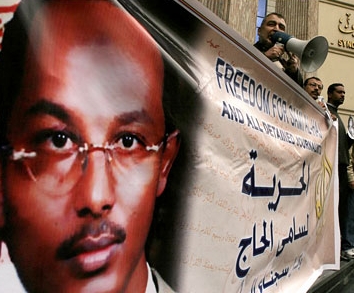 The most famous journalist you may never have heard of is Sami al-Hajj, an Al Jazeera cameraman who is on a hunger strike to protest abuse during more than six years in a Kafkaesque prison system.