
Daily Archives: November 16, 2008

EDITORIAL: Who comes first?

Who comes first?

The tribal areas of western Pakistan along with the least developed parts of southern and eastern Afghanistan have become the epicenter of international handwringing.

On one level, “the problem” revolves around government military forces being constrained by an international boundary, while their opponents can use that constraint to their advantage. On another level, there’s a struggle to find a suitable balance between bullying and helping as Nato pursues its bomb and build strategy.

The one constant is that no one seems to think that the indigenous population has the preeminent right to determine its own future.

Consider the Korengal Valley in eastern Afghanistan and the people who inhabit this rugged terrain. A fascinating photographic essay in the Boston Globe last week sheds light on some of the inherent contradictions in western efforts to impose a military solution on a topographical reality.

Look at the human craft in the physical structure of this mountainside settlement — something that might not be immediately apparent when viewing this hamlet down the barrel of a gun:
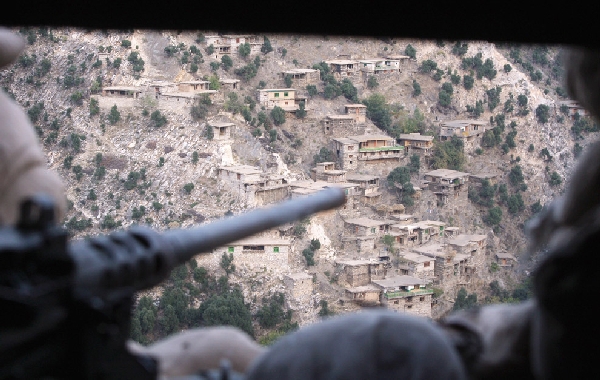
Note, there are no roads. To the western eye, this is a development problem.

At the same time it is also an extraordinary indigenous accomplishment. Men and women and donkeys alone did all the heavy lifting. But instead of admiring the ability of people to master the art of survival in a challenging environment, we regard them as living in a state of deprivation. With a road, life would be better — or so we think.

But do they want a road? Apparently not. The report says: “U.S. and Afghan officers tried to convince the [Korengal Valley] elders to accept a new paved road through the Korengal Valley as part of a large American development project. The elders refused the road, however, saying that they would prohibit anyone in their valley from working on the project.”

What would a road provide for the people of Korengal? Most predictably, the means for Americans to establish larger and more heavily equipped military bases. Beyond that, a road would provide the means to tame a harsh environment. It would diminish the value of the resilience of those who for centuries have survived without a road.

Where a people invest their pride, we see their backwardness and then are perplexed when they spurn our goodwill. We suffer from the burden that dogs every evangelist: how can you insult someone and help them at the same time?

Meanwhile, the narrative that drives out all others is that Afghanistan is now in a downward spiral with the Talilban having established control over a substantial portion of the country.

Counterinsurgency expert, David Kilcullen, tells The New Yorker:

We have built the Afghan police into a less well-armed, less well-trained version of the Army and launched them into operations against the insurgents. Meanwhile, nobody is doing the job of actual policing—rule of law, keeping the population safe from all comers (including friendly fire and coalition operations), providing justice and dispute resolution, and civil and criminal law enforcement. As a consequence, the Taliban have stepped into this gap; they currently run thirteen law courts across the south, and ninety-five per cent of the work of these courts is civil law, property disputes, criminal matters, water and grazing disputes, inheritances etc.—basic governance things that the police and judiciary ought to be doing, but instead they’re out in the countryside chasing bad guys. Where governance does exist, it is seen as corrupt or exploitative, in many cases, whereas the people remember the Taliban as cruel but not as corrupt. They remember they felt safer back then. The Taliban are doing the things we ought to be doing because we are off chasing them instead of keeping our eye on the prize—securing and governing the people in a way that meets their needs.

Kilcullen could have said, “The Taliban have established law and order across much of southern Afghanistan. What can we learn from their success?”

Most importantly, in a war that was originally billed as being driven by a moral imperative, how has it come to pass that in this “good war” our allies are corrupt while our opponents are able to establish some system of justice?

To ask such a question is not to excuse the brutality of the Taliban, but merely underline how utterly lost we have become in a country and a region we insist on trying to reshape even while it still eludes our understanding.


Facebooktwittermail

NEWS & VIEWS ROUNDUP: November 16

Sadr calls for resistance to U.S. presence in Iraq

As the Iraqi cabinet prepares to vote on a security agreement for American troops, the anti-American Shiite cleric Moktada al-Sadr called Friday for armed resistance against any agreement that allowed a continued United States presence in Iraq.

“I repeat my demand to the occupier to leave our land without keeping bases or signing agreements,” Mr. Sadr said in a statement read to thousands of supporters at Friday Prayer. “If they keep bases, then I would support honorable resistance.”

Tension is rising here over the agreement as the vote nears, even if few oppose it to the extremes of Mr. Sadr and his followers. An aide to Grand Ayatollah Ali al-Sistani, the most revered Shiite cleric in Iraq, also indicated that he would intervene in some way if the draft did not enjoy the full support of the Iraqi people. But Ayatollah Sistani, who far outranks Mr. Sadr, has consistently advocated nonviolence. [continued…]

Maliki tells Bush he now backs new U.S. troop deal

After months of tough negotiations and multiple revisions, Prime Minister Nouri al Maliki has decided to back the controversial U.S.-Iraq security agreement that calls for the complete withdrawal of American troops by the end of 2011, Iraqi and U.S. officials said Friday.

Maliki informed President George W. Bush in the last 24 hours that he’s “satisfied” with what Iraqi officials now are calling the “withdrawal agreement,” a Bush administration official said in Washington. Earlier, Maliki informed the Iraqi Presidency Council that he’d back it, Sami al Askari, a Shiite Muslim legislator who’s close to the premier, said Friday.

At Maliki’s meeting with the Presidency Council last week, President Jalal Talabani and Shiite Vice President Adil Abdul Mehdi responded that they and their political blocs also supported the draft, but the Sunni Muslim vice president, Tariq al Hashimi, declined to give his endorsement, Askari said. [continued…]

Obama’s biggest Guantanamo dilemma may lie in Yemen

President-elect Barack Obama’s pledge to close the prison camp at Guantanamo Bay, Cuba, faces a major obstacle: Yemen.

The Bush administration has transferred hundreds of Guantanamo prisoners to the custody of their home countries, but it’s been unable to win assurances from Yemen — whose approximately 100 prisoners are the largest group still jailed at Guantanamo — that the men, if they’re returned, won’t pose a threat to the United States.

By striking similar deals with nations such as Afghanistan and Saudi Arabia, Bush administration officials have dramatically reduced Guantanamo’s population over the past three years. Yemen, however, which has failed to stop homegrown militants from staging major attacks on American targets in the past decade, says it can’t continue to hold prisoners without charges. [continued…]

Post-Guantánamo: a new detention law?

As a presidential candidate, Senator Barack Obama sketched the broad outlines of a plan to close the detention center at Guantánamo Bay, Cuba: try detainees in American courts and reject the Bush administration’s military commission system.

Now, as Mr. Obama moves closer to assuming responsibility for Guantánamo, his pledge to close the detention center is bringing to the fore thorny questions under consideration by his advisers. They include where Guantánamo’s detainees could be held in this country, how many might be sent home and a matter that people with ties to the Obama transition team say is worrying them most: What if some detainees are acquitted or cannot be prosecuted at all?

That concern is at the center of a debate among national security, human rights and legal experts that has intensified since the election. Even some liberals are arguing that to deal realistically with terrorism, the new administration should seek Congressional authority for preventive detention of terrorism suspects deemed too dangerous to release even if they cannot be successfully prosecuted. [continued…]

This endless savagery is the Congo’s colonial legacy

Western media like to describe the conflict in the Congo as Africa’s First World War. Certainly, five million people have died in the Congo since 1997 and as many as six African countries have been involved in its war, but there the similarities end.

The 1914-1918 war in Europe was fought between sovereign nation states; although the warring factions in the Congo bear the trappings of sovereignty, they are little more than self-serving warlord formations organised on ethnic or tribal lines, seeking to control territory to sustain themselves, and for profit. Civilians are as terrified of the “national” army supposedly fighting on their behalf as they are of the rebel “invaders,” having learnt that either side is capable of unleashing murder, rape and pillage.

There is no nation-state in eastern Congo beyond the rag-tag formations who fight in the name of the government in Kinshasa, when they’re not extorting money from civilians or collaborating on lucrative secret mining deals with some of the very “enemies” they’re meant to be fighting. The state provides no healthcare or education: the brave souls of the NGOs do their best to feed the hungry and extend lives that are usually nasty, brutish and short.

War is not just good for business in eastern Congo: war is business. For the warlord commanders, control of land means ownership of its resources – the gold, diamonds, coltan and other minerals for which mining companies are willing to pay anyone capable of delivering security. [continued…]

Facebooktwittermail