
Daily Archives: January 4, 2009

EDITORIAL: Israeli propaganda campaign downplays the success of the truce – UPDATED

Israeli propaganda campaign downplays the success of the truce

(UPDATE: Since the graphs appearing below have been removed from the Israeli Ministry of Foreign Affairs (MFA) website, some readers might have doubts about there authenticity. However, Jeffrey Goldberg who blogs at the Atlantic, has kindly alerted me to the source that the MFA continues to cite for its statistics on rocket fire from Gaza in 2008. The graphs I reproduced can be found in that document.

Goldberg writes: “Israel’s Ministry of Foreign Affairs cites this report [PDF] that claims that 362 rockets and mortars were fired into Israel from Gaza into Israel during what the report calls the ‘lull’ in the fighting. I think it’s fair to say that, though the numbers of rocket and mortar attacks dropped off dramatically during the ceasefire, there were, indeed, attacks.”

What Goldberg fails to point out is that of these 362 rockets and mortars fired, 324 were launched after Israel broke the ceasefire on November 4, 2008. During the period in which the ceasefire was being maintained by both Hamas and Israel from June 18 until November 4, there were a total of 38 fired. This averages 8.5 rocket and mortar attacks per month. As far as I am aware, none of these were conducted by Hamas and the level of attacks can be seen as a measure of the effectiveness (not absolute) with which Hamas was able to reign in other militant groups such as Islamic Jihad.)
_____

For four months, from Summer into Fall, the truce between Israel and Hamas was a stunning success. Indeed, if Israel doubted Hamas’ ability or willingness to engage in a truce, the Jewish state would have had no reason to request that the truce be extended as its expiration approached and passed in late December.

But now is a time of war and not only is talk of a truce being ruled out by the authors of this war but history is being re-written in order to degrade the value of a ceasefire. The memory of a period of recent calm that was the most durable peace that the residents of southern Israel have experienced in recent years must now be erased.

The Israeli government’s own graphical representation of the calm told the story in terms that even a child could understand. This is the graph that the Israel Ministry of Foreign Affairs displayed on its web site demonstrating that from July to October, rocket fire, if not reduced to a perfect zero, came stunningly close. From an average of 179 rockets per month in the preceding period of 2008, the number fell to just three per month:
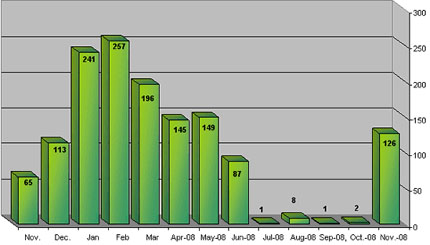
Now that the Israeli propaganda machine is revved up to full throttle, the image of an effective truce no longer suits the Israeli government’s purposes. Instead it has become more convenient to try and hide the numbers — with numbers! The foreign ministry has thus removed the simple graph shown above and replaced it with this:
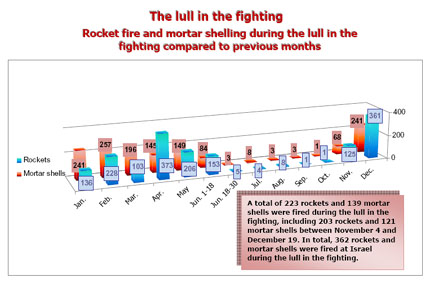
In the earlier image, graph blocks dramatically portrayed the rise and fall in rocket fire rates. In the revised image, blocks of equal size (containing numbers) are used to obscure the graph. The effect, clearly intended, is to try and portray the lull as really nothing more than a minor undulation in a period of unremitting attacks.

The message Israel now wants to sell is that the truce never really worked. Instead of acknowledging that the truce effectively collapsed when Israel launched Operation “Double Challenge” on November 5, the rocket fire that followed that Israeli raid is being used to obscure the fact that rocket fire had effectively been curtailed up to that point.*

On the IDF Spokesman web site, a post on rocket statistics simply omits the part of the record that Israel now finds inconvenient to acknowledge:

  • Between Hamas’ takeover and the start of the Tahadiya (State of Calm), (June 14, 2007 – June 16, 2008), there was an average of over 361 attacks per month—an increase of an additional 350%.
  • On Nov. 4 – 5, Israel launched Operation “Double Challenge”, targeting a tunnel Hamas was building as part of a plan to kidnap Israeli soldiers.
  • From the end of Operation “Double Challenge” until the end of the Tahadiya, (Nov. 4 – Dec. 19, 2008) a period of only a month and a half, there were 170 mortars, 255 Qassams, and 5 Grads fired upon Israel’s civilian population centers.
  • Since the end of the Tahadiya (Dec. 19, 2009) until the beginning of Operation “Cast Lead,” (Dec. 27, 2008) a period of little more than a week, there were approximately 300 mortars and rockets fired onto Israel.
  • Since the begining of Operation “Cast Lead”, there have been an additional 500 launches, 284 of which have been verified as rockets (both Qassams and Grads), and 113 as mortars.

Was four months of calm really worthless? Given that it became the precursor to war, the answer now apparently is yes.

But it didn’t have to turn out this way. The effectiveness with which Hamas enforced a truce should have provided the impetus for Israel to lift its economic siege of Gaza.

Instead, we are once again witness to Israel’s seemingly insatiable appetite for war, even while it never tires of professing its love of peace.

* Should anyone doubt that the Israeli raid (official declarations about Israel’s commitment to the truce notwithstanding) constituted a unilateral breach of the truce, consider what Israel and the world’s response would have been in the event that the raid had been launched from Gaza. Hamas gunmen conducted a raid inside Israeli territory, killing six Israeli soldiers.

That wouldn’t have been described as a breakdown in the truce; it would have been regarded as an act of war.


Facebooktwittermail

NEWS & VIEWS ROUNDUP: January 4

Why Israel went to war in Gaza

After the debacle of its 2006 invasion of Lebanon – not only a military disaster for Israel, but also a political and diplomatic one – the government in Tel Aviv spent months laying the groundwork at home and abroad for the assault on Gaza with quiet but energetic lobbying of foreign administrations and diplomats, particularly in Europe and parts of the Arab world.

A new information directorate was established to influence the media, with some success. And when the attack began just over a week ago, a tide of diplomats, lobby groups, bloggers and other supporters of Israel were unleashed to hammer home a handful of carefully crafted core messages intended to ensure that Israel was seen as the victim, even as its bombardment killed more than 430 Palestinians over the past week, at least a third of them civilians or policemen.

The unrelenting attack on Gaza, with an air strike every 20 minutes on average, has not stopped Hamas firing rockets that have killed four Israelis since the assault began, reaching deeper into the Jewish state than ever before and sending tens of thousands of people fleeing. Last night Israel escalated its action further, as its troops poured across Gaza’s border, part of what appeared to be a significant ground invasion. And a diplomatic operation is already in full swing to justify the further cost in innocent lives that would almost certainly result. [continued…]

If Obama is serious, he should get tough with Israel

Jews worry for a living; their tragic history compels them to do so. In the next few years, there will be plenty to worry about, particularly when it comes to Israel. The current operation in Gaza won’t do much to ease these worries or to address Israel’s longer-term security needs. The potential for a nuclear Iran, combined with the growing accuracy and lethality of Hamas and Hizbullah rockets, will create tremendous concern. Anxiety may also be provoked by something else: an Obama administration determined to repair America’s image and credibility and to reach a deal in the Middle East.

Don’t get me wrong. Barack Obama—as every other U.S. president before him—will protect the special relationship with Israel. But the days of America’s exclusive ties to Israel may be coming to an end. Despite efforts to sound reassuring during the campaign, the new administration will have to be tough, much tougher than either Bill Clinton or George W. Bush were, if it’s serious about Arab-Israeli peacemaking. [continued…]

U.S. quashes Arab-backed Gaza cease-fire resolution in UN Security Council meet

The United States thwarted an effort by Libya on Sunday to persuade the UN Security Council to call for an immediate ceasefire in Gaza after Israel launched a ground invasion, diplomats said.

Several council diplomats told reporters that the U.S. refusal to back a Libyan-drafted demand for an immediate truce at a closed-door emergency session had killed the initiative, since council statements must be passed unanimously. [continued…]

Israel’s aim in Gaza is to break Hamas resistance

On Saturday night, one week after the start of Operation Cast Lead in the Gaza Strip, the ground operation began. The Israel Defense Forces started deploying combat units to surround Hamas’ main power base. The goal is not to chase after and destroy every last rocket launcher, but rather to break the Hamas’ resistance and force it to agree to a long-term cease-fire whose terms are more reasonable from Israel’s perspective. [continued…]

And there lie the bodies

As Israel has been preoccupied with Gaza throughout the entire week, nobody has asked whose blood is being spilled and why. Everything is permitted, legitimate and just. The moral voice of restraint, if it ever existed, has been left behind. Even if Israel wiped Gaza off the face of the earth, killing tens of thousands in the process, as a Chechnyan laborer working in Sderot proposed to me, one can assume that there would be no protest.

They liquidated Nizar Ghayan? Nobody counts the 20 women and children who lost their lives in the same attack. There was a massacre of dozens of officers during their graduation ceremony from the police academy? Acceptable. Five little sisters? Allowed. Palestinians are dying in hospitals that lack medical equipment? Peanuts. Whatever happened to the not-so-good old days of Salah Shahadeh? When we liquidated him in July 2002, we also killed 15 women and children. At least back then, moral qualms were raised for a moment.

Here lie their bodies, row upon row, some of them tiny. Our hearts have turned hard and our eyes have become dull. All of Israel has worn military fatigues, uniforms that are opaque and stained with blood and which enable us to carry out any crime. Even our leading intellectuals fail to speak out on what havoc we have wreaked. Amos Oz urges: “Cease-fire now.” David Grossman writes: “Hold your fire. Stop.” Meir Shalev wants “a punitive operation.” And not one word about our moral image, which has been horribly distorted. [continued…]

Land, sea, sky: all will kill you

As a way to share time on the phone, while my friend Houda’s neighbourhood was under aerial assault for more than 40 minutes, she and I discussed at length comparisons between previous Israeli military sieges we had been under. The carefully planned and premeditated strategy of terrorising an entire population by intensive and heavy bombardment of both military and civic institutions – destroying the entire civic infrastructure of a people – was identical. What is unprecedented here is that in Gaza there is nowhere to evacuate people to safety: they are imprisoned on all sides, with an acute awareness of the impossibility of escape. Land, sea, sky: all will kill you. [continued…]

Rules of engagement from Baghdad to Gaza

There is a word for the straightforward killing of enemies by a superior force where the victims are sparsely equipped and the odds one-sided. Much of the world is calling Israel’s actions in Gaza a massacre. By contrast the American press has been cleansed and euphemized. “3rd Day of Bombings,” said the New York Times headline on December 30, “Takes Out Interior Ministry.” Takes out. The Times paid an involuntary homage to George W. Bush: “I think it’s a good thing for the world that we took out Saddam Hussein.” Under that phrase are half a million Iraqis killed and a country destroyed. And for Israel in Gaza?

The U.S. and Israel share many things. A form of government, it is sometimes said; a set of ideals. But much more in the past ten years the U.S. and Israel have shared a fantasy. The fantasy says that the Arabs understand only force. It says we can end terrorism by killing all the terrorists. The neighbors of the terrorists will be overawed. No new terrorists will be created. Finally, when every face on the president’s fifty-two card deck is crossed out and the known composition of Hamas is dead, we can “address the social conditions” that foster terrorism. But perhaps there are no such conditions. Do the terrorists not hate for hate’s sake?

You can see the shape of the fantasy most distinctly in the writings of those journalistic enablers who move into position as soon as either country starts a war that needs interpreting. “It was Israel at its best,” writes Yossi Klein Halevy, a typical war broker, in a New Republic column posted on December 29. “In response to random attacks aimed at civilians, Israel launched precise attacks aimed at terrorists.” Halevy does not add that the precise attacks killed almost 400 persons and that one death in every four was civilian. [continued…]

Can the Jewish people survive without an enemy?

Tony Karon: Many Jews, in Israel and in America, see Israel as surrounded by deadly threats, and would see the benign and peaceful world you describe as a dangerous fantasy. What do you say to your critics?

Avrum Burg: I have very low expectations of new thinking and insight emerging from the mainstream Israeli and Jewish establishment. Their role is to maintain the status quo. Israel is bereft of forward thinking. We are experts at managing the crisis rather than finding alternatives to the crisis. In Israel you have many tanks, but not many think tanks. One of the reasons I left the Israeli politics was my growing feeling that Israel became a very efficient kingdom, but with no prophecy. Where is it going?

My idea of Judaism can be represented through a classic Talmudic dilemma: You are walking along by the river and there are two people drowning. One is Rabbi [Meir] Kahane, and the other is the Dalai Lama. You can only save one of them. For whom will you jump? If you jump for Rabbi Kahane because genetically he’s Jewish, you belong to a different camp than mine, because I would jump for the Dalai Lama. As much as he’s not genetically Jewish, he’s my Jewish brother when it comes to my value system. That’s the difference between me and the Jewish establishment in Israel and America. [continued…]

Which one’s the terrorist?

“A war to the bitter end.” That is how Israel’s Defense Minister Ehud Barak described his country’s latest military campaign in the Gaza strip. It is refreshing to hear an Israeli politician refer to what the western press routinely calls “a crisis” or “a cycle of violence” as a war, for that is in fact what is taking place in Gaza. But if war is in indeed an accurate description of the current conflict between Israel and Hamas, then can we continue referring to Hamas’ attacks against Israel as acts of terrorism? If a government declares war against a terrorist group, does it not in effect transform the group’s members from terrorists into soldiers? In a battle between a state like Israel and a “non-state entity” like Hamas, are acts of terror distinguishable from acts of war? [continued…]

Facebooktwittermail