
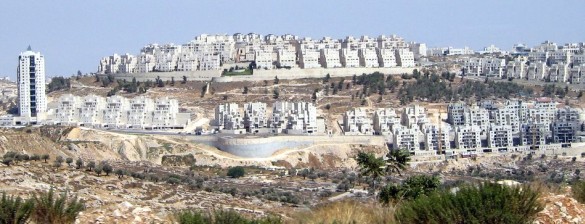
Let’s just ask ourselves what would have happened in Israel itself without what is known as the “settlement enterprise.” Where would another half a million women, children, and men live within the 1967 borders? How many new towns, neighborhoods, and communities would have to be built? What kind of infrastructure would have to be built? How many additional roads would we need to pave, instead of the ones paved in the West Bank, some of them for Israelis only? And what would have happened to the population density in central Israel and in western Jerusalem?
The evacuation of 8,000 Jewish settlers from the Gaza Strip and their absorption in Israel cost taxpayers NIS 10 billion. Those interested in turning back time and evacuating Israelis from the areas beyond the 1967 borders would have to invest NIS 600 billion [$160 billion] for that end. An unreal figure.
Without the Palestinians grasping the process, and without most of Israeli citizens giving it some thought, the areas beyond the 1967 borders have become the main absorption area for new Israeli citizens: New immigrants from the former Soviet Union, young Jerusalemites, haredim facing economic distress, etc. The “territories” served as Israel’s territorial backbone, and played this role with great success.
Israel’s Leftist camp believes that it has the upper hand, referring as ultimate proof to Likud Prime Minister Benjamin Netanyau’s declaration in favor of a Palestinian state, albeit with some conditions. Yet the Left is wrong: While it was engaged in the futile “diplomatic process,” the active Rightist camp, with the backing and assistance of all of Israel’s governments with the exception of one, engaged in developing Jewish settlements in the territories.
Half a million Jews beyond the Green Line constitute the point of no return. The talk about a “construction freeze” or “construction suspicion” at certain settlements are a joke and an insurance policy for the leaders – in Israel, in Palestine, and in the world – who know deep in their hearts that the decision had been made.
What we have here is two peoples that cannot be divided: A mixture of Jews and Palestinians that cannot be separated. It’s too late. [continued…]
Editor’s Comment — When Benjamin Netanyahu uttered the phrase, “Palestinian state”, it should have been taken as a signal that the two-state solution was well and truly dead.
Shimon Peres now says Salam Fayyad is a “Palestinian Ben-Gurion”. A Ben-Gurion or a Pétain?
The state Fayyad envisions may indeed provide the means for the effective pacification of the majority of Palestinians. And as a Haaretz commenter put it, the Palestinians may end up being able “to elect their own dog catchers, … issue Palestinian stamps and sing their own anthem and even have an Olympic ping-pong team.” What they will not gain is sovereignty.
As a Jewish 36-year-old mother of five told The National recently when asked whether her Palestinian neighbors had any right to their shared water supply:
“We should take care of the foreigners here, and give them running water and help them survive and live the proper way,” she says firmly, like a schoolmarm. “But we should do this only after they understand we are the rulers of this country. Until they deserve it, they can’t have the best conditions.”
Cap in hand, the Palestinians must ask their masters if they can be given a state — a little patchwork one without any real power.
Maybe they’d be better off simply asking for a vote.
EU sources: Terms set for renewal of Israel-PA talks
Negotiations between Israel and the Palestinians will resume next month on the basis of an understanding that the establishment of a Palestinian state will be officially announced in two years.
Palestinian and European Union sources told Haaretz that talks will initially focus on determining the permanent border between Israel and the West Bank.
Due to the Palestinians’ reservations over establishing a state with temporary borders, as was proposed during the second stage of the road map, this step will probably be defined as “early recognition” of Palestine. [continued…]
The most immediate issue raised by ‘borders first’ is whether it will deal with the Greater Jerusalem border. The issue here is not the Old City, the central focus of so much emotion and identity. It is the large central area of the West Bank, an area far beyond the old municipal boundaries of the city which extends deep into the central West Bank. Israel has developed huge settlements and a massive infrastructure which now almost surrounds East Jerusalem and which all but prevents any meaningful connection between the north and the south, and between the West Bank and East Jerusalem.
Will the negotiated border between the West Bank and Israel deal with the Jerusalem area? If the negotiated borders ratify the Israeli settlements and infrastructure as currently configured and proposed (including the controversial E-1 area), then the supposed Palestinian state would be essentially non-viable. It’s hard to imagine a government led by Netanyahu agreeing to remove existing settlements around the Greater Jerusalem area. But no Palestinian leader is likely to be able to sell a deal which ignores or ratifies the Greater Jerusalem settlement areas to his people, even if pressured to accept. If the negotiated borders ignore or defer the Jerusalem area – an idea I’ve heard in circulation – then the outcome would be meaningless and counter-productive. [continued…]
Dividing war spoils: Israel’s robbery of Palestinian property
While the news headlines were occupied with the freeze or suspension of Jewish settlements in the Occupied Palestinian Territories or with the competition for positions in the sixth Fateh conference in Bethlehem, Israel is putting into effect the most devastating operation since the ethnic cleansing of Palestine in al Nakba of 1948. This new operation aims to eliminate irrevocably Palestinian rights and historical roots in Palestine.
Ironically, Arab and Palestinian leaderships remain oblivious to these cataclysmic developments. In particular, the Palestinian leadership, whose main duty is to defend Palestinian rights, is bogged down with the assignment of internal political posts and fighting what it sees as its primary enemy, Hamas.
The Zionist leadership in Israel felt bold enough to transform the ideological slogan of ‘Jewish Israel’ into a reality on the ground. The Knesset, the Israel Parliament, passed a law on August 3rd, 2009, after its second and third readings, which allowed the sale of “Absentees” Palestinian refugees’ land to Jewish individuals and Jewish institutions exclusively anywhere in the world. Thus, the legal right of the original Palestinian owner to his land would be severed through creating a barrier between the owner and his property. The passing of the new law represents an audacious initiative by the current Israeli government that no previous Israeli government dared contemplate or venture into. [continued…]
There no question anymore that the only recipe for healing the Israeli-Palestinian wound is the termination of the occupation and the establishment of peace between the State of Israel and the new State of Palestine beside it. This demands meaningful and intense negotiations, within a fixed time span. That is impossible if at the same time settlements continue to expand. As the Palestinian lawyer Michael Tarasi aptly put it: ‘We are negotiating about the division of a pizza and in the meantime Israel is eating the pizza.’
That’s why Obama has presented the Israeli government with an unequivocal demand: an immediate stop to all building in the settlements, including East Jerusalem. A clear and logical demand. But while pressuring Netanyahu, he himself is exposed to heavy pressure at home over the health insurance system and the Afghan war…
The Americans recognise, of course, that our government is trying to deceive them. If they allow the building of just another 500 houses in the settlement blocks, and the completion of just another 2500 houses whose construction has already begun, and just a few more in East Jerusalem, in practice the building will go on unchecked.
The settlers know perfectly well that their whole enterprise has been based on deceit and trickery, house after house and neighbourhood after neighbourhood, and they are happy to allow Netanyahu to continue with this method. For the time being, they do not cry out, they are not worried, the more so as no large Israeli public movement has yet arisen in support of Obama’s peace efforts. [continued…]



