
When President Obama announced his 30,000-strong troop surge in December he said: “these additional American and international troops will allow us to accelerate handing over responsibility to Afghan forces and allow us to begin the transfer of our forces out of Afghanistan in July of 2011.”
It was another example of what has become all too familiar: Obama’s ability to govern like Bush without sounding exactly like Bush. He might as well have simply reused Bush’s line and said: “As Afghan forces stand up, we will stand down.” The difference in language is trivial. The real difference between now and 2005 when Bush said that in reference to Iraqi forces is that it turns out Bush’s objective was a bit more realistic.
Consider Rod Nordland’s portrayal or the way the Afghan National Police force is shaping up:
The NATO general in charge of training the Afghan police has some tongue-in-cheek career advice for the country’s recruits.
“It’s better to join the Taliban; they pay more money,” said Brig. Gen. Carmelo Burgio, from Italy’s paramilitary Carabinieri force.
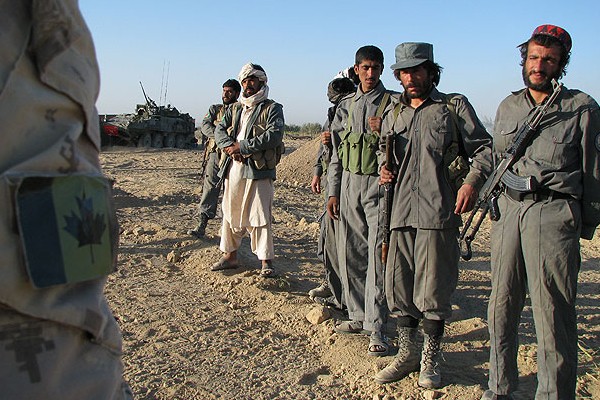
That sardonic view reflects a sobering reality. The attempts to build a credible Afghan police force are faltering badly even as officials acknowledge that the force will be a crucial piece of the effort to have Afghans manage their own security so American forces can begin leaving next year.
Though they have revamped the program recently and put it under new leadership, Afghan, NATO and American officials involved in the training effort list a daunting array of challenges, as familiar as they are intractable.
One in five recruits tests positive for drugs, while fewer than one in 10 can read and write — a rate even lower than the Afghan norm of 15 percent literacy. Many cannot even read a license plate number. Taliban infiltration is a constant worry; incompetence an even bigger one.
Now consider this description of the resistance that US Marines are facing in Helmand Province:
In areas where they have built bases, the Marines have undermined the Taliban’s position. But the insurgents have consolidated and adapted, and remain a persistent and cunning presence.
On the morning of the sweep, made by Weapons Company, Third Battalion, First Marines, a large communications antenna that rose from one compound vanished before the Marines could reach it. The man inside insisted that he had seen nothing. And when the Marines moved within the compounds’ walls, people in nearby houses released white pigeons, revealing the Americans’ locations to anyone watching from afar.
The Taliban and their supporters use other signals besides car horns and pigeons, including kites flown near American movements and dense puffs of smoke released from chimneys near where a unit patrols.
“You’ll go to one place, and for some reason there will be a big plume of smoke ahead of you,” said Capt. Paul D. Stubbs, the Weapons Company commander. “As you go to the next place, there will be another.”
“Our impression,” he added, “is the people are doing it because they are getting paid to do it.”
The people are getting paid… right.
You don’t have to be a Holywood screenwriter to see this description — the smoke signals, pigeon alerts and so forth — as a classic image of resistance. The foreign fighters are better armed, but the resistance fighters have the home-turf advantage — they’re being protected by the civilian population. Do the civilians have to get paid for their services? Conceivably, but I kind of doubt it. More likely it simply comes down to knowing who are “our boys”.




Paul, I got to disagree with you here on your portrayl of the Afghan insurgency simply as ‘the resistance’. This is not Israel/Palestine, this is Afghanistan. Tribalism is a dominant dynamic, which makes it more complex than a simple occuplier-resistance relation.
This is a great report that outlines current tribal trends in Kandahar and how mistakes in handling these relations directly led to the rise of insurgency. http://www.understandingwar.org/report/talibans-campaign-kandahar
Your loyal reader,
Jason
Jason – I absolutely agree that in Afghanistan it’s much more complex than occupier vs resistance but in a contest of affinities the US/Nato will invariably lose out if for no other reason than that the foreigners will inevitably leave. For an Afghan tribesman to “bet” in favor of the Taliban does not require that he be bribed – simply that he makes an intelligent guess about the future. Granted, this doesn’t necessarily mean that the locals are rooting for the Taliban as much as they will often perceive them as a more reliable bet.