
Daily Archives: February 5, 2010

The Siddiqui conviction: A verdict ‘based on fear, not on fact’

It should go without saying but yet again needs to be repeated: in an effective justice system, justice not only must be done but it must be seen to be done. In this respect the trial of Dr Aafia Siddiqui, which ended in New York on Wednesday was a miserable failure.

Although most Americans haven’t even heard the name of this MIT-trained neuroscientist, Dr Siddiqui’s case has captured the attention of much of her native Pakistan. Her conviction on two counts of attempted murder quickly led Pakistan’s President Asif Ali Zardari to direct his government to offer her legal assistance.

AP reported:

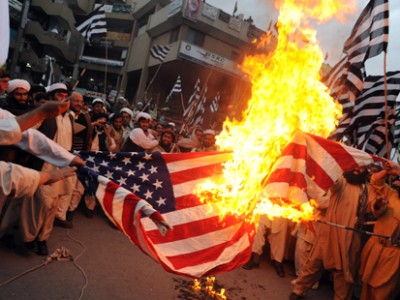
Pakistanis shouted anti-American slogans and burned the Stars and Stripes on Thursday in protest of a New York jury’s conviction of a Pakistani woman accused of trying to kill Americans while detained in Afghanistan.

The protests drew thousands in at least four cities, demonstrating the widespread distrust, and even hatred, of the U.S. in this country whose cooperation Washington needs to stabilize neighboring Afghanistan.

The New York Times said:

Defense lawyers argued that an absence of bullets, casings or residue from the M4 [– the rifle allegedly snatched and fired by the accused –] suggested it had not been shot. They used a video to show that two holes in a wall supposedly caused by the M4 had been there before July 18 [the date of the alleged crime].

They also pointed out inconsistencies in the testimony from the nine government witnesses, who at times gave conflicting accounts of how many people were in the room, where they were sitting or standing and how many shots were fired.

Ms. Siddiqui’s lawyers said they had not decided whether to appeal. They suggested that prosecutors had played to New Yorkers’ anxieties about terror attacks.

“This is not a just and right verdict,” Elaine Sharp, one of Ms. Siddiqui’s lawyers, said outside the courtroom. “In my opinion this was based on fear but not fact.”

If the views of jurors were shaped by irrational fears, it seems as though Judge Richard M. Berman suffered the same frailty. Far from recognizing that the conduct of the trial had wider implications for the relations between the US and Pakistan, so-called security considerations meant that journalists with the least interest in covering the case had the best access while those with the greatest interest weren’t allowed into the court room.

As Petra Bartosiewicz reported for Time magazine early in the proceedings:

[Dr Siddiqui’s] case has been major news in much of the Muslim world — and a crush of journalists from Pakistan have been struggling to gain access to a trial hemmed in by security-conscious New York City officials. How the foreign press is able to follow the court proceedings — and thus perceive the fairness of the trial — will have an impact on upcoming high-profile terrorism trials like that of Khalid Sheikh Mohammed and four other suspected 9/11 plotters, likely to be held in the same courthouse as the Siddiqui case.

“If we were able to file a transcript of the proceedings they’d probably print it,” Iftikhar Ali, a reporter with the Associated Press of Pakistan, said of the Siddiqui trial. “That’s how much interest there is in this case.” But Ali, like many other reporters from overseas, has been hampered in gaining access to the live proceedings. Journalists from Pakistan on assigment in New York have been largely excluded from the courtroom. Because of tight restrictions observed by the presiding Judge Richard Berman, not a single Pakistani reporter had been granted a press credential when opening statements began on Tuesday. They were instead sent to an overflow courtroom to watch the proceedings via video link.

In the overflow room this week I met journalists from Pakistan with United Nations and U.S. State Department issued press credentials. They work for some of the biggest outlets in their countries, including BBC Urdu, the Associated Press in Pakistan, Jang, Dawn, Geo and Haj TV. None were issued credentials for the trial, though some had applied weeks ago. We watched the proceedings on a flat screen television. The view didn’t include any of the exhibits being offered into evidence, among them multiple diagrams of the scene of the shooting and incriminating documents allegedly written by Siddiqui. At one point a key government eyewitness stepped off the witness stand and out of range of both the camera and microphone to use a visual aid to demonstrate where he was during the shooting. He was permitted to give much of his testimony off camera.

Ali, who has been at the court every day of the trial — including jury selection — was granted access to the main courtroom for about five minutes on the first day, but was escorted out when court security guards realized he was not on the list of approved media. At the time the only other occupants of the four-row press box, which covers half the available seating in the courtroom with room for about 20 individuals, were one each from the The New York Times, The New York Post and the New York Daily News. The court has officially recognized only media who carry New York Police Department issued press passes, traditionally reserved for reporters who regularly cover crime scenes and certain public events in the city. Out of the approximately 30 such individuals from U.S. news outlets who were eligible to attend the trial, most were not present for opening statements.

“We’ve been coming to all the pretrial hearings and we were never told there was going to be a different system for the trial. We were told the press will be allowed,” Ayesha Tanzeem, a journalist with Voice of America Urdu said. After TIME made inquiries on Thursday, individuals in the overflow room, including the Pakistani journalists, were for the first time ushered into the main courtroom during the afternoon session. But with the exception of a BBC Urdu reporter and a Samaa TV reporter who received official passes, none have been granted a press credential that would guarantee them a seat on future days.

The decision to accept solely the NYPD pass for the Siddiqui trial came from the judge’s chambers, says Elly Harrold of the District Executive’s office, the administrative arm at the federal courthouse. “Of course there are exceptions,” Harrold said, “but I’m not at liberty to discuss that.”

Although Siddiqui is not charged with any terrorism-related crime, security concerns are paramount though the procedures seem to be unevenly enforced. During the lunch break on the first day of the Siddiqui trial a group of Muslim men praying in the waiting areas outside the courtroom were afterwards asked to leave the floor. That prevented them from securing a place in line for the afternoon session. Several Muslim women in hijabs were also given similar instructions, but others in the same area, dressed in business attire, including this reporter, were permitted to stay. On the second day of the trial metal detectors were posted outside the courtroom and individuals were asked for photo identification and their names and addresses were logged by court security officers. At the close of proceedings on Thursday defense attorney Charles Swift protested the practice. “The suggestion is that the gallery may be a threat,” said Swift, calling the measure “highly prejudicial.”

If Charles Swift sounds like a familiar name it’s because he has the rare distinction of having stood up and successfully defended his country while its Constitution faced attack from the Bush administration. In Hamdan vs Rumsfeld, Swift won a major victory for the rule of law.

The case of Dr Siddiqui exposes a moral fallacy that has haunted America throughout the war on terrorism. It is this: that injustice is something that can only be done to the innocent.

We have abandoned what used to be the universally recognized foundation of a just legal system: that it treats the guilty and the innocent with fairness and impartiality.

(For fascinating background on the Siddiqui case, read Declan Walsh’s November 2009 report in The Guardian.)


Facebooktwittermail

Deal with the Taliban pragmatists — not the elusive ‘moderates’

Michael Semple, a fellow at the Carr Centre for Human Rights Policy at Harvard Kennedy School, says that an attempt to cut a deal with the Taliban should not be conceived as an effort to peel away moderates:

The people with whom any deal would have to be done, those Taliban prepared to contemplate accommodation, have a sense of their movement as a moral force that emerged to fight anarchy and corruption in civil war Afghanistan in an honourable tradition of jihad. They are deeply suspicious of apparent US support for the commanders and warlords against whom they were pitted well before 2001. Reluctant to accept that it was the alliance with al-Qaeda which turned the world against them, they resent their labelling as terrorists. They have a host of grievances, from persecution of Taliban who stayed in Afghanistan to the Guantánamo experience and the United Nations blacklists, which they point to as evidence that neither the US nor the Kabul government can be trusted.

Nevertheless, Taliban pragmatists claim they have little problem with an eventual break from al-Qaeda, that they will accommodate other Afghan political forces and that their stance on social issues is unlikely to be a block to agreement. Quizzed on justice and impunity, they protest that their record is no worse than the current Kabul government. The pragmatists do not expect to renounce jihad but to redefine it. They will not surrender but they hope that the Taliban movement might be rehabilitated as a moral Islamic force inside the Afghan political system.

Facebooktwittermail

Netanyahu faces arrest in Hamas hotel murder if Mossad link proved

From The National:

The Israeli prime minister, Benjamin Netanyahu, will be at the top of Dubai’s wanted list if the Israeli foreign intelligence service Mossad is proven to be behind the killing of a senior Hamas official, the Dubai Police chief said yesterday.

Lt Gen Dahi Khalfan Tamim told The National that “Benjamin Netanyahu, the Israeli prime minister, will be the first to be wanted for justice as he would have been the one who signed the decision to kill [Mahmoud] al Mabhouh in Dubai. We will issue an
arrest warrant against him.”

He did not, however, assert that Mossad was definitively responsible for the killing; Hamas has accused the Israeli agency of killing Mr al Mabhouh.

The website of Ireland’s Evening Herald reports:

Members of a hit squad who killed a top Hamas military commander used Irish passports to enter and leave Dubai, it’s been claimed.

The suspected Israeli hit team, including at least one woman, entered the United Arab Emirates using Irish documents, police authorities said.

Before jumping to any conclusions about the nationalities of the assassins in Dubai, it’s worth remembering that when Mossad agents attempted to murder Hamas’ political leader Khalid Meshaal in Jordan in 1997, the Israelis were using Canadian passports.

Facebooktwittermail

The war of terror

At Slate, Dahlia Lithwick writes:

…what was once tough on terror is now soft on terror. And each time the Republicans move their own crazy-place goal posts, the Obama administration moves right along with them.

It’s hard to explain why this keeps happening. There hasn’t been a successful terror attack on U.S. soil since 9/11. The terrorists who were tried in criminal proceedings since 9/11 are rotting in jail. The Christmas Day terror attack was both amateurish and unsuccessful. The Christmas bomber is evidently cooperating with intelligence officials without the need to resort to thumbscrews. In a rational universe, one might conclude that all this is actually good news. But in the Republican crazy-place, there is no good news. There’s only good luck. Tick tock. And the longer they are lucky, the more terrified Americans have become.

I’ve always argued that it’s misleading and dangerous to treat “terror” and “terrorism” as synonyms.

As “the war on terrorism” quickly became “the war on terror” — a contraction that generally seems to have been be viewed as nothing more than a tabloid construction — terror was treated as an inescapable consequence of terrorism, such that there was supposedly no reason to distinguish between the objects of our fear and the fear itself.

The problem with arguing that our fears have grown out of proportion to the threats is that all it will take is for there to be another major terrorist attack in America (note in, not on — the whole country is never in jeopardy of attack) and the fear-mongers will trumpet that they have been vindicated. Indeed, they will inevitably blame — alongside the attackers — those who previously suggested that America’s fears were overblown.

The alternative argument — one that no populist has the courage to press — is that in response to the 9/11 attacks, America plunged into a shameful state of national hysteria.

Al Qaeda presented a challenge to this country in 2001. It tried to find out whether nineteen men were capable of making 600 million knees wobble. It accomplished that feat with resounding success.

The spectacle of a whole nation being so easily terrorized had two immediate effects.

It demonstrated to jihadists that their presupposition that it is quite easy to make Americans afraid was well-founded.

And it led others (mostly Americans themselves) to view American fear as fertile ground in which commercial, political and military opportunities of incalculable value could easily be cultivated.

At no point did anyone of national stature step up and say to the American people: get a grip on yourselves. You should neither capitulate to the terrorists nor to the fear-mongers since they both have the same objective: they want to make you live in fear.

The fear-mongers say that the only way of averting fear is to feel safe and secure. That’s true — but only for about the first ten years in life. After that, as we mature we must learn how to live in a dangerous world without becoming enslaved by our own fears.

So, the first rule when it comes to dealing with terrorism is to remember that we are adults and that life demands a sufficient measure of courage such that we don’t shriek every time someone shouts boo!

Once we have a national consensus on our need to act like adults, then we proceed with all the practical and necessary steps to avoid becoming sitting ducks. Counter-terrorism then becomes a matter of prudence — not a vice for gripping the national psyche.

Facebooktwittermail

Off with his head!

Matthew Yglesias writes:

If the President wants to do something like implement a domestic policy proposal he campaigned on—charge polluters for global warming emissions, for example—he faces a lot of hurdles. He needs majority support on a House committee or three. He also needs majority support on a Senate committee or three. Then he needs to get a majority in the full House of Representatives. And then he needs to de facto needs a 60 percent supermajority in the Senate. And then it’s all subject to judicial review.

But if Scooter Libby obstructs justice, the president has an un-reviewable, un-checkable power to offer him a pardon or clemency. If Bill Clinton wants to bomb Serbia, then Serbia gets bombed. If George W Bush wants to hold people in secret prisons and torture them, then tortured they shall be. And if Barack Obama wants to issue a kill order on someone or other, then the order goes out. And if Congress actually wants to remove a president from office, it faces extremely high barriers to doing so.

Whether or not you approve of this sort of executive power in the security domain, it’s a bit of a weird mismatch. You would think that it’s in the field of inflicting violence that we would want the most institutional restraint. Instead, the president faces almost no de facto constraints on his deployment of surveillance, military, and intelligence authority but extremely tight constraint on his ability to implement the main elements of the his domestic policy agenda.

This kind of presidential power looks “weird” if viewed from a constitutional vantage point but maybe not as weird as an expression of American culture.

Having moved to this country twenty years ago from the country that America successfully wrestled its independence from, it’s often struck me that Americans did not fully reject the concept of monarchical rule; they simply wanted a kind of modified monarchy.

First off, the monarch would need to be a native — a vehement “no” to foreign rule.

Next, the monarch would need to be one of the people, be elected and not restricted to a line of inheritance. It wasn’t that Americans did want a king; they simply wanted everyone to be able to nurture the fantasy that some day they too might become the king.

But dynasties are OK. In fact, the occasional dynasty helps burnish the executive’s regal image.

And what’s more befitting of the powers of an American king than that he should be able to occasionally proclaim: “Off with his head!”

Who knows, maybe in a few years the old regal custom of hosting public executions will be re-instituted. No doubt they’d get excellent ratings on cable news.

Facebooktwittermail