
Ask a foreigner what Afghans most need and he’s most likely to say: to escape from poverty. Ask an Afghan and he’s more likely to say: to escape from foreign interference.
The latest news from Afghanistan is no cause for celebration. The New York Times reports:
The United States has discovered nearly $1 trillion in untapped mineral deposits in Afghanistan, far beyond any previously known reserves and enough to fundamentally alter the Afghan economy and perhaps the Afghan war itself, according to senior American government officials.
The previously unknown deposits — including huge veins of iron, copper, cobalt, gold and critical industrial metals like lithium — are so big and include so many minerals that are essential to modern industry that Afghanistan could eventually be transformed into one of the most important mining centers in the world, the United States officials believe.
An internal Pentagon memo, for example, states that Afghanistan could become the “Saudi Arabia of lithium,” a key raw material in the manufacture of batteries for laptops and BlackBerrys.
The vast scale of Afghanistan’s mineral wealth was discovered by a small team of Pentagon officials and American geologists. The Afghan government and President Hamid Karzai were recently briefed, American officials said.
While it could take many years to develop a mining industry, the potential is so great that officials and executives in the industry believe it could attract heavy investment even before mines are profitable, providing the possibility of jobs that could distract from generations of war.
After all, who wants fight a holy war when you could instead be risking your life for Rio Tinto or Anglo-American?
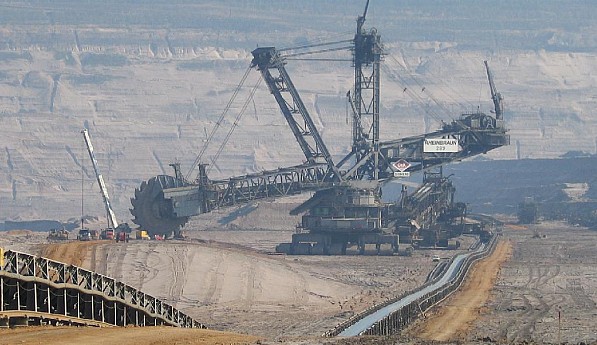
Mining is the quintessential parasitic relationship that humans have with this planet. As an exercise in plundering the resources of the earth, it’s natural that the enterprises engaged in this activity have a habit of giving far more attention to what they are in the business of acquiring, than they do to the means by which they acquire it. They have as little respect for their workers as they do for the environment.
The US officials who told the New York Times that Afghanistan is the new Eldorado, probably thought they were sharing “good news” from a place where that particular commodity is in a desperately short supply.
Afghans themselves now have reason to wonder whether after having succeeded for centuries in holding back imperial forces they are now in danger of falling victim to the most destructive possible takeover — by global mining conglomerates.
Some existential threats are imaginary or abstract but Afghanistan now faces a material and cultural threat that could ultimately prove more destructive than decades of war.




As we watch the failed policies to date of the U.S. actions, that the so called run up to the Kandahar adventure has been rescheduled for a possible September start, we are now told that there lies over 1 Trillion dollars worth of minerals, just waiting to be plunked from the ground. Of course, this little event has been known for quite awhile, but is just now arriving for U.S. & probably the rest of the known world! Great timing I would say, another reason that the U.S. & NATO forces should stay in country. Bah Humbug. Time to get out.
Stephanie Sanok of Cordesman’s Republican Center for Strategic and International Studies gave away the beans: Obama wants to invest in creating the mining infrastructure for Afghanistan for American exploitation:
http://news.yahoo.com/video/world-15749633/20332293
Note that this think-tank for the Corporate Industrial Complex lays out the expeditionary justifications exactly as the Left had charged during our anti-Communist interventions. But with the USSR defeated, the US is an avaricious imperial power like 19th Century Britain. Is this what Obama got the Nobel Peace Prize for? To act like a British Imperialist?
The Taliban is a nationalist Afghan movement, not a global Islamic terror group. It seems outrageous that we should allow ourselves to decide that Afghans are either too “corrupt” or too “fanatic” and therefore we should manage their mineral wealth. This is exactly what Bush unabashedly said about Iraqi oil. After all the lies about “fighting terrorism,” Obama had better show some light between himself and Bush/Rumsfeld/Cheney and the corporate predators. So far he has only proven to be their Sambo. Could it be because they are blackmailing him with knowledge that he was not really born in the US so is not a Native American?
While America is good at getting bogged down in pointless wars of atrition to saticfy a domistic MIC and parocial view of “empire”, China is best at developing resource based investments.
http://www.nytimes.com/2009/12/30/world/asia/30mine.html
”
S. Frederick Starr, the chairman of the Central Asia-Caucasus Institute, an independent research organization in Washington, said that skeptics might wonder whether Washington and NATO had conducted “an unacknowledged preparatory phase for the Chinese economic penetration of Afghanistan.”
“We do the heavy lifting,” he said. “And they pick the fruit.”
“
“The vast scale of Afghanistan’s mineral wealth was discovered by a small team of Pentagon officials and American geologists. ”
Hhmm, so the Pentagon officials took a few geologist, went for a stroll in the beautiful mountains of Afghanistan and happen to stumble over it … strange things do happen in that part of the world! As Norman said above the fact was known since Taliban time – what was unclear were the dimensions of these mineral deposits.
“After all, who wants fight a holy war when you could instead be risking your life for Rio Tinto or Anglo-American?”
If the political-military-industrial complex thinks that way then they have no clue about the Afghan people! But what do I say – they’ve proven time and again that they have no clue.
To borrow the words of Boutros Boutros Ghali (former Egyptian FM) to his then Israeli counter part: “You know everything about us, probably more than we know ourselves – but you’ll never be able to understand us.”
Natural resources are one of the main reasons for these pre-emptive wars of aggression: be it oil, minerals or water = hegemony and control of the raw material which enables our livestyle in relative luxury. Second reason in line is Israel.
Simple.
Surprise, surprise, there’s gold in them thar hills! Time to conquer Afghanistan and turn it into tech industry waste in Western landfills. Congratulations, the USGS has provided a million new reasons for the Afghans to kick the Yankee carpetbaggers out of their homeland.