Al Jazeera Investigates: What killed Arafat?
Visit Al Jazeera Investigates: What Killed Arafat? to watch extended interviews with Suha Arafat, Shlomo Ben Ami, and Mohammed Rashid, and read the medical file in this case.




Al Jazeera Investigates: What killed Arafat?
Visit Al Jazeera Investigates: What Killed Arafat? to watch extended interviews with Suha Arafat, Shlomo Ben Ami, and Mohammed Rashid, and read the medical file in this case.
Al Jazeera reports: It was a scene that riveted the world for weeks: The ailing Yasser Arafat, first besieged by Israeli tanks in his Ramallah compound, then shuttled to Paris, where he spent his final days undergoing a barrage of medical tests in a French military hospital.
Eight years after his death, it remains a mystery exactly what killed the longtime Palestinian leader. Tests conducted in Paris found no obvious traces of poison in Arafat’s system. Rumors abound about what might have killed him – cancer, cirrhosis of the liver, even allegations that he was infected with HIV.
A nine-month investigation by Al Jazeera has revealed that none of those rumors were true: Arafat was in good health until he suddenly fell ill on October 12, 2004.
More importantly, tests reveal that Arafat’s final personal belongings – his clothes, his toothbrush, even his iconic kaffiyeh – contained abnormal levels of polonium, a rare, highly radioactive element. Those personal effects, which were analyzed at the Institut de Radiophysique in Lausanne, Switzerland, were variously stained with Arafat’s blood, sweat, saliva and urine. The tests carried out on those samples suggested that there was a high level of polonium inside his body when he died.
“I can confirm to you that we measured an unexplained, elevated amount of unsupported polonium-210 in the belongings of Mr. Arafat that contained stains of biological fluids,” said Dr. Francois Bochud, the director of the institute.
The institute studied Arafat’s personal effects, which his widow provided to Al Jazeera, the first time they had been examined by a laboratory. Doctors did not find any traces of common heavy metals or conventional poisons, so they turned their attention to more obscure elements, including polonium.
It is a highly radioactive element used, among other things, to power spacecraft. Marie Curie discovered it in 1898, and her daughter Irene was among the first people it killed: She died of leukemia several years after an accidental polonium exposure in her laboratory.
At least two people connected with Israel’s nuclear program also reportedly died after exposure to the element, according to the limited literature on the subject.
But polonium’s most famous victim was Alexander Litvinenko, the Russian spy-turned-dissident who died in London in 2006 after a lingering illness. A British inquiry found that he was poisoned with polonium slipped into his tea at a sushi restaurant. [Continue reading…]
Ian Robertson writes: On 11 August 2011, Bob Diamond, chief executive of Barclays [who resigned today], delivered the BBC Today Programme business lecture. In it he declared that “culture” was the critical element in responsible banking, and the best test of it is “how people behave while no one is watching.” We now know that banking failed the test and so must ask why, in [Governor of the Bank of England] Sir Mervyn King’s words, “excessive compensation”, “shoddy treatment of customers”, “mis-selling” and “the deceitful manipulation of a key interest rate”, flourished in the banking sector. Cognitive neuroscience can point to some answers.
Senior bankers hold enormous power, greater than that of many elected national leaders. Largely unaccountable except to occasional shareholders meetings and often quiescent boards, their power is much less constrained than that of democratically elected leaders. And given that power is one of the most potent brain-changing drugs known to humankind, unconstrained power has enormously distorting effects on behaviour, emotions and thinking.
Holding power changes brains by boosting testosterone, which in turn increases the chemical messenger dopamine in the brain’s reward systems. Extraordinary power causes extraordinary brain changes, which in their extreme form manifest themselves in personality distortions, such as those seen in dictators like Muammar Gaddafi.
The “masters of the universe” who have arisen out of a deregulated world financial system were given unprecedented power that inevitably must have caused major changes to their brains. While power in moderate doses can make people smarter, more strategic in their thinking, bolder and less depressed, in too-large doses it can make them egocentric and un-empathic, greedy for rewards – financial, sexual, interpersonal, material – likely to treat others as objects, and with a dulled perception of risk. [Continue reading…]
Joris Luyendijk writes: David Cameron’s announcement of a parliamentary inquiry into the professional and cultural standards of the financial sector is likely to lead to the worst of all worlds. It all but precludes a genuinely wide-ranging Leveson-style inquiry, while handing this inquiry over to some of the very people who should be investigated: the political class.
The Leveson inquiry is so valuable because it not only digs into the professional and cultural standards of the British media, it also dissects its deeply unhealthy and corrupting entanglement with virtually the entire political establishment. Would a parliamentary inquiry have brought out all that? Imagine the Leveson inquiry headed by Tom Watson or Alastair Campbell.
To his credit, Labour leader Ed Miliband has called for a Leveson-style inquiry. His reasoning was puzzling though, arguing that only an independent inquiry would “restore confidence in our financial services”.
Over the past 10 months I have interviewed dozens of people working in finance in London and if I had to name one thing that this investigation did not do, it is restore confidence. External accountants explained how nobody at the major banks can have a complete overview any more – they have become simply too big. Well before RBS ran into deep trouble, IT consultants painted a truly terrifying picture of banks’ software operations. Forget too big to fail or too big to rescue, IT and accountancy interviewees said. We need to talk about too big to even manage. This former IT expert asked:
“Are so-called chief information officers, the top executives responsible for IT, aware of this? I doubt if they are and if they care. They are managers, skilled in office politics, not technical experts. Most CIOs rarely stay in their post more than a few years.”
Going over the 70 interviews now online here, a picture emerges of major banks whose CEO admiral is really a really well-paid PR operative, tasked with convincing the outside world that he is in charge of his fleet when in reality nobody any longer is.
The Guardian‘s Graeme Wearden reports live: Barclays has dragged the Bank of England, and the last Labour government, deeper into the Libor scandal.
Its submission to the Treasury Select Committee includes an email apparently written by Bob Diamond [the CEO of Barclays who resigned today] on 29 October 2008 (when the crisis was raging), following a telephone call with Paul Tucker of the Bank of England. In the message, Diamond writes that Tucker told him that “a number of senior officials in Whitehall” had expressed concern over the Libor numbers that Barclays had been reported (the rate at which other banks would lend to it).
The email goes on to suggest that other banks have been submitting rates that did not reflect their true cost of borrowing, and concludes by suggesting that Tucker had suggested that Barclays Libor submissions did not need to be so high.
Here is a full transcript of the message, which was sent to then chief executive John Varley, along with Jerry del Missier:
Further to our last call, Mr Tucker reiterated that he had received calls from a number of senior figures within Whitehall to question why Barclays was always toward the top end of the Libor pricing. His response was “you have to pay what you have to pay”. I asked if he could relay the reality, that not all banks were providing quotes at the levels that represented real transactions, his response “oh, that would be worse”.
I explained again our market rate driven policy and that it had recently meant that we appeared in the top quartile and on occasion the top decile of the pricing. Equally I noted that we continued to see others in the market posting rates at levels that were not representative of where they would actually undertake business. This latter point has on occasion pushed us higher than would otherwise appear to be the case. In fact, we are not having to “pay up” for money at all.
Mr Tucker stated the levels of calls he was receiving from Whitehall were ‘senior’ and that while he was certain we did not need advice, that it did not always need to be the case that we appeared as high as we have recently.
RED*This is dynamite, although I must caution that the Bank of England has not had a chance to respond.
*: RED, incidentally, stands for “Robert E Diamond”, and is the nickname used by Barclays staff.
Dexter Filkins writes: In the fall of 2009, the Americans stepped up their efforts to reinforce the Afghan government. American commandos swooped into villages almost every night, killing or carrying away insurgents. Local Taliban leaders — “shadow governors” — began disappearing. “Most of the Taliban governors lasted only a few weeks,” a Khanabad resident, Ghulam Siddiq, told me. “We never got to know their names.”
The most effective weapon against the Taliban were people like Mohammad Omar, the commander of a local militia. In late 2008, Omar was asked by agents with the National Directorate of Security (N.D.S.) — the Afghan intelligence agency — if he could raise a militia. It wasn’t hard to do. Omar’s brother Habibullah had been a lieutenant for Abdul Rasul Sayyaf, one of the leading commanders in the war against the Soviets, and a warlord who helped destroy Kabul during the civil war. The Taliban had killed Habibullah in 1999, and Omar jumped at the opportunity to take revenge. Using his brother’s old contacts, he raised an army of volunteers from around Khanabad and began attacking the Taliban. He set up forces in a string of villages on the southern bank of the Khanabad River. “We pushed all the Taliban out,” he told me.
The Taliban are gone from Khanabad now, but Omar and his fighters are not. Indeed, Omar’s militia appears to be the only effective government on the south side of the Khanabad River. “Without Omar, we could never defeat the Taliban,” a local police chief, Mohammad Sharif, said. “I’ve got two hundred men. Omar has four thousand.”
The N.D.S. and American Special Forces have set up armed neighborhood groups like Omar’s across Afghanistan. Some groups, like the Afghanistan Local Police, have official supervision, but others, like Omar’s, are on their own. Omar insists that he and his men are not being paid by either the Americans or the Afghan government, but he appears to enjoy the support of both. His stack of business cards includes that of Brigadier General Edward Reeder, an American in charge of Special Forces in Afghanistan in 2009, when the Americans began counterattacking in Kunduz.
The militias established or tolerated by the Afghan and American governments constitute a reversal of the efforts made in the early years of the war to disarm such groups, which were blamed for destroying the country during the civil war. At the time, American officials wanted to insure that the government in Kabul had a monopoly on the use of force.
Kunduz Province is divided into fiefdoms, each controlled by one of the new militias. In Khanabad district alone, I counted nine armed groups. Omar’s is among the biggest; another is led by a rival, on the northern bank of the Khanabad River, named Mir Alam. Like Omar, Alam was a commander during the civil war. He was a member of Jamiat-e-Islami. Alam and his men, who declined to speak to me, are said to be paid by the Afghan government.
As in the nineties, the militias around Kunduz have begun fighting each other for territory. They also steal, tax, and rape. “I have to give ten per cent of my crops to Mir Alam’s men,” a villager named Mohammad Omar said. (He is unrelated to the militia commander.) “That is the only tax I pay. The government is not strong enough to collect taxes.” When I accompanied the warlord Omar to Jannat Bagh, one of the villages under his control, his fighters told me that Mir Alam’s men were just a few hundred yards away. “We fight them whenever they try to move into our village,” one of Omar’s men said.
None of the militias I encountered appeared to be under any government supervision. In Aliabad, a town in the south of the province, a group of about a hundred men called the Critical Infrastructure Protection force had set up a string of checkpoints. Their commander, Amanullah Terling, another former Jamiat commander, said that his men were protecting roads and development projects. His checkpoints flew the flag of Jamiat-e-Islami. Terling’s group — like dozens of other such units around the country — is an American creation. It appears to receive lots of cash but little direct supervision. “Once a month, an American drives out here in his Humvee with a bag of money,” Terling said.
Together, the militias set up to fight the Taliban in Kunduz are stronger than the government itself. Local officials said that there were about a thousand Afghan Army soldiers in the province — I didn’t see any — and about three thousand police, of whom I saw a handful. Some police officers praised the militias for helping bring order to Kunduz; others worried that the government had been eclipsed. “We created these groups, and now they are out of control,” Nizamuddin Nashir, the governor of Khanabad, said. “The government does not collect taxes, but these groups do, because they are the men with the guns.”
The confrontations between government forces and militias usually end with the government giving way. When riots broke out in February after the burning of Korans by American soldiers, an Afghan Army unit dispatched to the scene was blocked by Mir Alam’s men. “I cannot count on the Army or the police here,” Nashir said. “The police and most of the soldiers are cowards.” He was echoing a refrain I heard often around the country. “They cannot fight.”
Much of the violence and disorder in Kunduz, as elsewhere in Afghanistan, takes place beyond the vision of American soldiers and diplomats. German, Norwegian, and American soldiers are stationed in Kunduz, but, in the three days I spent there, I saw only one American patrol. The American diplomats responsible for Kunduz are stationed seventy-five miles away, in a heavily fortified base in Mazar-e-Sharif. When I met a U.S. official and mentioned the reconstituted militias once commanded by Abdul Rasul Sayyaf, the official did not know the name. “Keep in mind,” he said, “I’m not a Central Asian expert.”
Largely prohibited from venturing outside their compounds, many American officials exhibit little knowledge of events beyond the barricades. They often appear to occupy themselves with irrelevant activities such as filling out paperwork and writing cables to their superiors in the United States. Some of them send tweets — in English, in a largely illiterate country, with limited Internet usage. “Captain America ran the half marathon,” a recent Embassy tweet said, referring to a sporting event that took place within the Embassy’s protected area. In the early years of the war, diplomats were encouraged to leave their compounds and meet ordinary Afghans. In recent years, personal safety has come to overshadow all other concerns. On April 15th, when a group of Taliban guerrillas seized buildings in Kabul and started firing on embassies, the U.S. Embassy sent out an e-mail saying that the compound was “in lockdown.” “The State Department has marginalized itself,” an American civilian working for the military said.
The more knowledgeable American officials say they have a plan to deal with the militias: as the U.S. withdraws, the militias will be folded into the Afghan national-security forces or shut down. But exactly when and how this will happen is unclear, especially since the Afghan security forces are almost certain to shrink. “That is an Afghan government solution that the coming years will have to determine,” Lieutenant General Daniel P. Bolger, the head of the NATO training mission, said.
Many Afghans fear that NATO has lost the will to control the militias, and that the warlords are reëmerging as formidable local forces. Nashir, the Khanabad governor, who is the scion of a prominent family, said that the rise of the warlords was just the latest in a series of ominous developments in a country where government officials exercise virtually no independent authority. “These people do not change, they are the same bandits,” he said. “Everything here, when the Americans leave, will be looted.”
Nashir grew increasingly vehement. “Mark my words, the moment the Americans leave, the civil war will begin,” he said. “This country will be divided into twenty-five or thirty fiefdoms, each with its own government.” Nashir rattled off the names of some of the country’s best-known leaders — some of them warlords — and the areas they come from: “Mir Alam will take Kunduz. Atta will take Mazar-e-Sharif. Dostum will take Sheberghan. The Karzais will take Kandahar. The Haqqanis will take Paktika. If these things don’t happen, you can burn my bones when I die.” [Continue reading…]
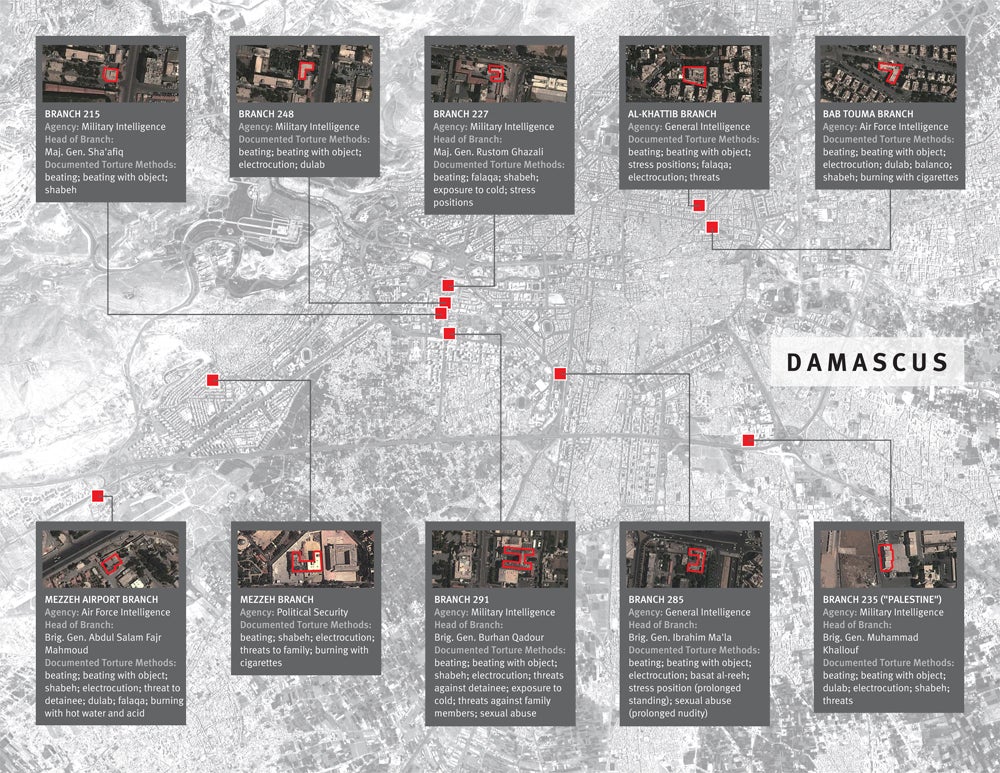
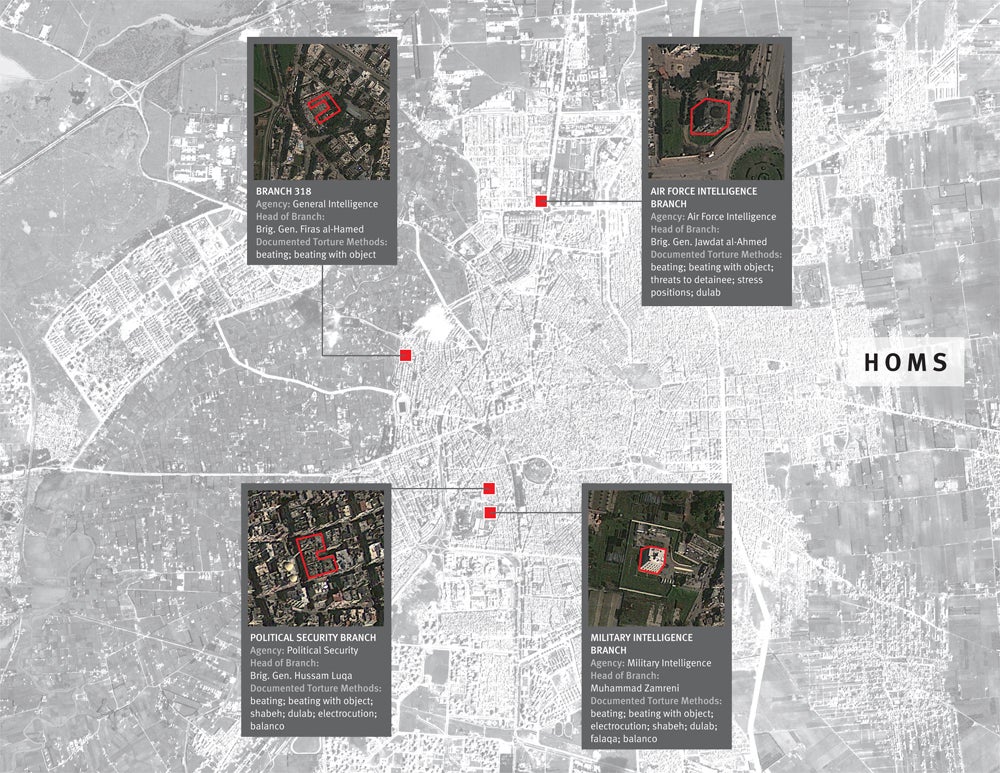
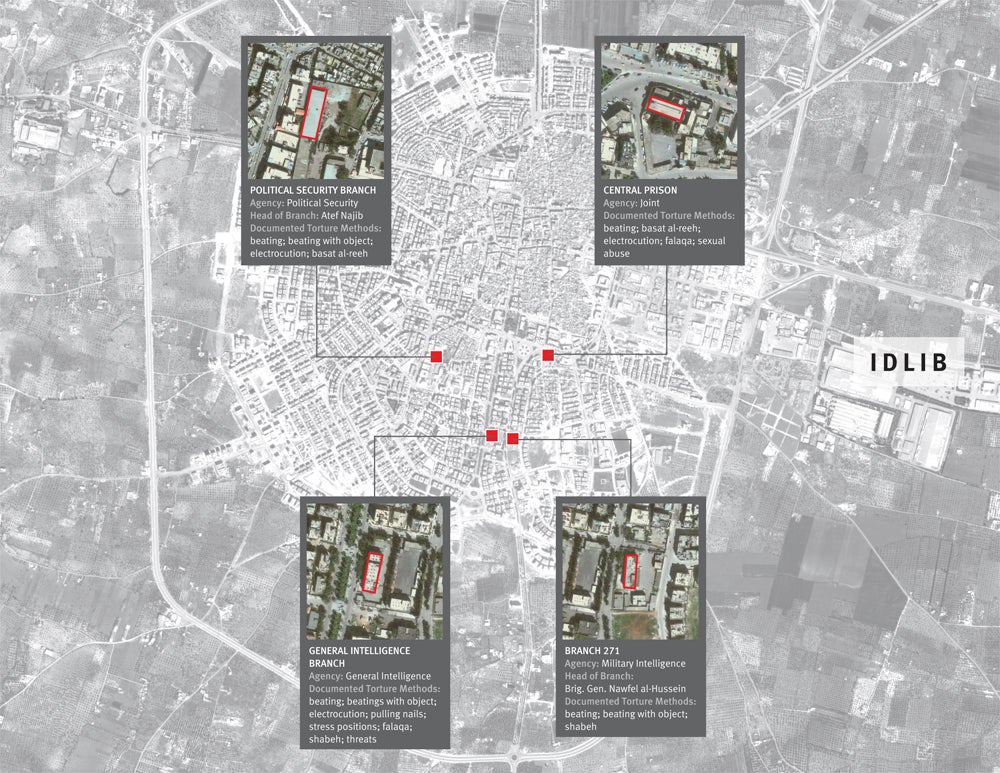
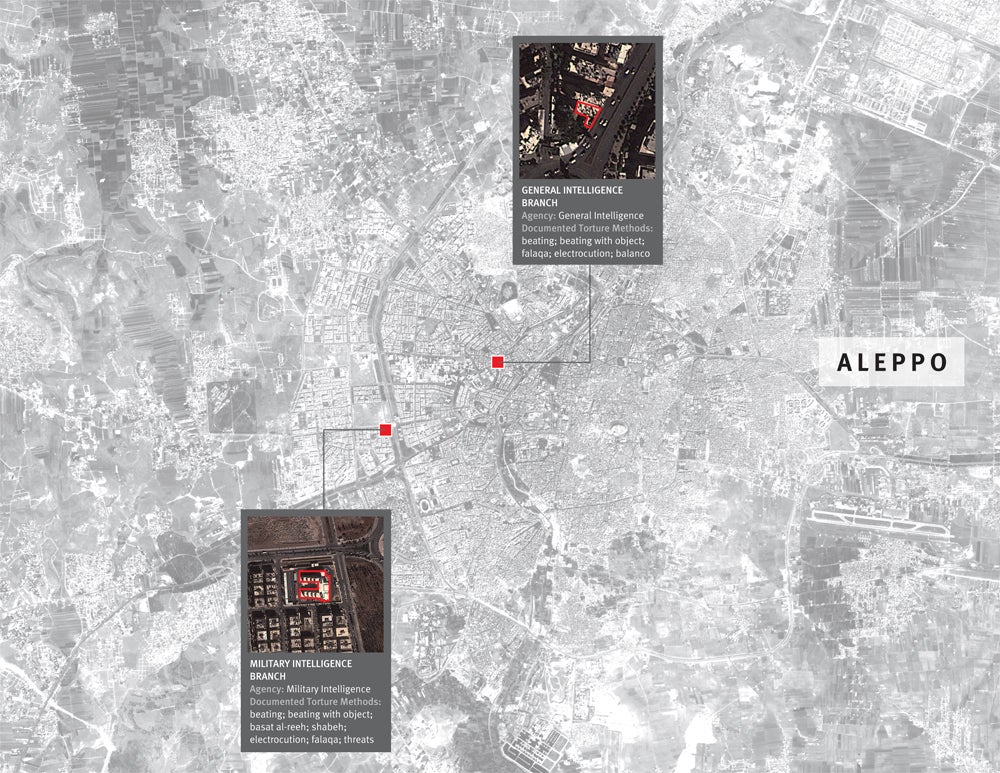
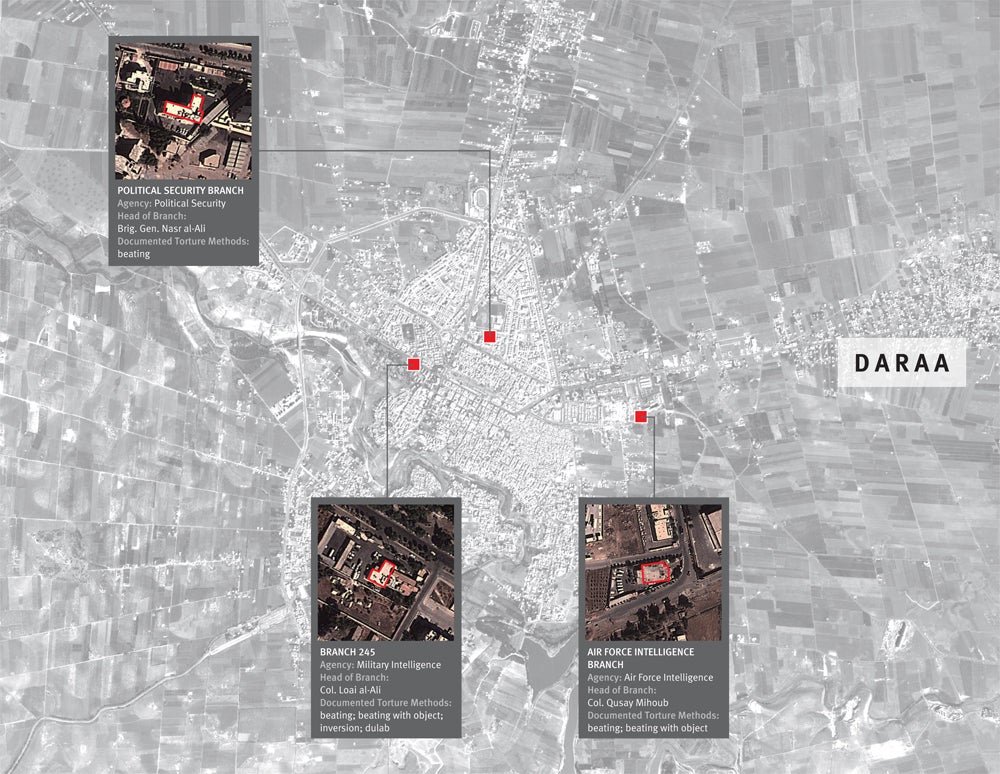
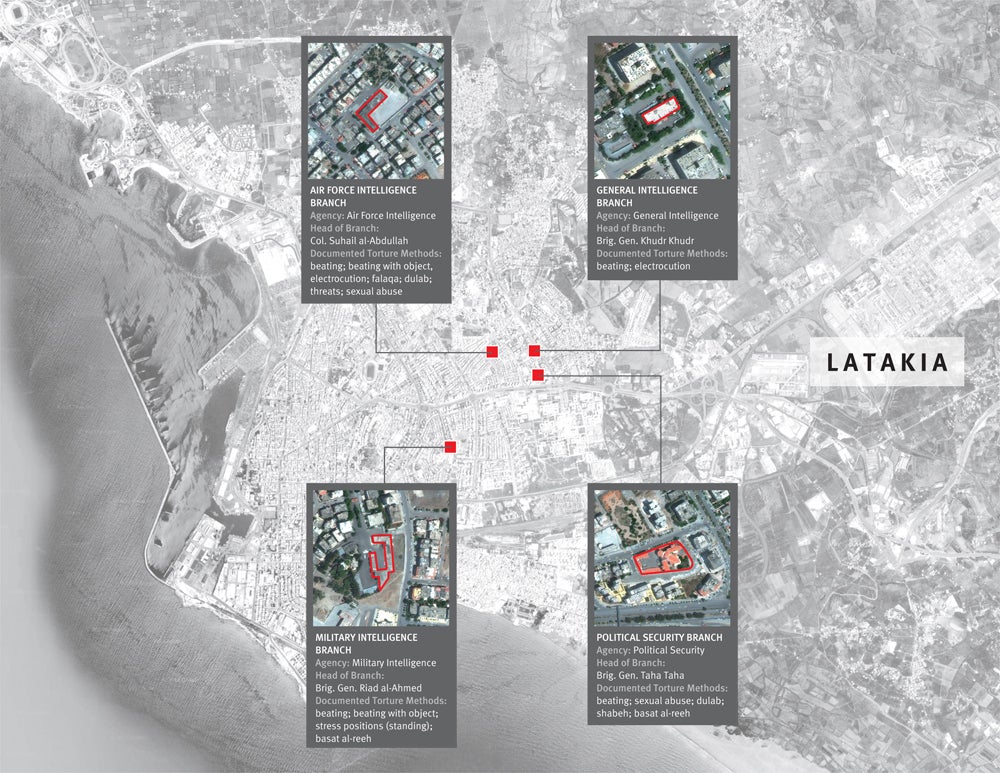
Human Rights Watch: Former detainees and defectors have identified the locations, agencies responsible, torture methods used, and, in many cases, the commanders in charge of 27 detention facilities run by Syrian intelligence agencies, Human Rights Watch said in a multimedia report released today. The systematic patterns of ill-treatment and torture that Human Rights Watch documented clearly point to a state policy of torture and ill-treatment and therefore constitute a crime against humanity.
The 81-page report, “Torture Archipelago: Arbitrary Arrests, Torture and Enforced Disappearances in Syria’s Underground Prisons since March 2011” is based on more than 200 interviews conducted by Human Rights Watch since the beginning of anti-government demonstrations in Syria in March 2011. The report includes maps locating the detention facilities, video accounts from former detainees, and sketches of torture techniques described by numerous people who witnessed or experienced torture in these facilities.
“The intelligence agencies are running an archipelago of torture centers scattered across the country,” said Ole Solvang, emergencies researcher at Human Rights Watch. “By publishing their locations, describing the torture methods, and identifying those in charge we are putting those responsible on notice that they will have to answer for these horrific crimes.”
Click to view in-depth, satellite images of the torture centers in the following cities: Damascus, Homs, Idlib, Aleppo, Daraa, and Latakia.
The Daily Beast reports: As the chairman of Barclays resigns in the wake of an interest-rate fixing scandal, the city of London is in crisis and Prime Minister David Cameron has announced an urgent Parliamentary inquiry.
“It’s a turning point,” said Martin Vander Weyer, a former director of the investment arm of the British bank, now known as Barclays Capital. “Three scandals have come in Britain in a perfect storm last week.” The NatWest online bank didn’t work for 10 days because of a software problem. Meanwhile, Barclays was caught mis-selling complex interest-rate insurance to small companies and, more important, a LIBOR scandal has emerged.
The London Interbank trading system, known as LIBOR, and its smaller counterpart, EURIBOR, between them set the benchmark for interest rates around the world. The self-regulated system relies on banks accurately reporting the costs of their own borrowing, but the Financial Service Authority and the U.S. Department of Justice fined Barclays a combined $450 million last week for fixing the rate from 2005 to 2009. The early misreporting was to the benefit of the company’s derivatives traders. During the credit crunch, when Lehman Brothers collapsed, Barclays systematically underreported its borrowing costs in order to appear healthier—and thus avoid the nationalization that overtook other British banks, such as Royal Bank of Scotland and Lloyds Halifax.
“It’s not a victimless crime,” Labour MP John Mann, a member of House of Commons Treasury select committee, told The Daily Beast. “If there’s fraud and misreporting, other people lose out: mortgage holders, other counterparties,” he said. “It’s like insider dealing”
Internal emails published by the Justice Department reveal a culture of greed and apparent insider trades, with one trader thanking another for rigging the rates: “Dude I owe you big time! Come over one day after work and I’m opening a bottle of Bollinger! Thanks for the libor.” The Serious Fraud Office in the U.K. is now investigating the case, with class-action lawsuits pending in the U.S.
Despite the resignation of chairman Marcus Agius, the CEO of Barclays, American-born Bob Diamond, remains in place. He wrote to his staff today to apologize to the thousands working in the retail branches for the misbehavior of the traders in the investment arm and to announce an internal investigation. However, Diamond is being described as “the most hated man in Britain” and is due to face the new parliamentary inquiry on Wednesday.
“Mr. Diamond should be sacked,” said Mann, “and LIBOR should be regulated rather than self-regulated.”
Diamond resigned today.
George Monbiot writes: The facts have changed, now we must change too. For the past 10 years an unlikely coalition of geologists, oil drillers, bankers, military strategists and environmentalists has been warning that peak oil – the decline of global supplies – is just around the corner. We had some strong reasons for doing so: production had slowed, the price had risen sharply, depletion was widespread and appeared to be escalating. The first of the great resource crunches seemed about to strike.
Among environmentalists it was never clear, even to ourselves, whether or not we wanted it to happen. It had the potential both to shock the world into economic transformation, averting future catastrophes, and to generate catastrophes of its own, including a shift into even more damaging technologies, such as biofuels and petrol made from coal. Even so, peak oil was a powerful lever. Governments, businesses and voters who seemed impervious to the moral case for cutting the use of fossil fuels might, we hoped, respond to the economic case.
Some of us made vague predictions, others were more specific. In all cases we were wrong. In 1975 MK Hubbert, a geoscientist working for Shell who had correctly predicted the decline in US oil production, suggested that global supplies could peak in 1995. In 1997 the petroleum geologist Colin Campbell estimated that it would happen before 2010. In 2003 the geophysicist Kenneth Deffeyes said he was “99% confident” that peak oil would occur in 2004. In 2004, the Texas tycoon T Boone Pickens predicted that “never again will we pump more than 82m barrels” per day of liquid fuels. (Average daily supply in May 2012 was 91m.) In 2005 the investment banker Matthew Simmons maintained that “Saudi Arabia … cannot materially grow its oil production“. (Since then its output has risen from 9m barrels a day to 10m, and it has another 1.5m in spare capacity.)
Peak oil hasn’t happened, and it’s unlikely to happen for a very long time. [Continue reading…]
Mark Ames writes: Progressive intellectuals have been acting very bipolar towards labor lately, characterized by wild mood swings ranging from the “We’re sorry we abandoned labor, how could we!” sentiment during last year’s Wisconsin uprising against Koch waterboy Scott Walker, to the recent “labor is dead/it’s all labor’s fault” snarling after the recall vote against Gov. Walker failed.
It must be confusing and a bit daunting for those deep inside the labor movement, all these progressive mood swings. At the beginning of this month, New York Times’ columnist Joe Nocera wrote a column about having a “V-8 Moment” over the abandonment of labor unions, an abandonment that was so thorough and so complete that establishment liberals like Nocera forgot they’d ever abandoned labor in the first place!
The intellectual-left’s wild mood swings between unrequited love towards labor unions, and unrequited contempt, got me wondering how this abandonment of labor has manifested itself. While progressives and labor are arguing, sometimes viciously, over labor’s current sorry state, one thing progressives haven’t done is serious self-examination on how and where this abandonment of labor manifests itself, how it affects the very genetic makeup of liberal assumptions and major premises.
So I did a simple check: I went to the websites of three of the biggest names in liberal activist politics: Amnesty International, Human Rights Watch, and the ACLU. Checking their websites, I was surprised to find that not one of those three organizations lists labor as a major topic or issue that it covers.
Go to Amnesty International’s home page at www.amnesty.org. On the right side, under “Human Rights Information” you’ll see a pull-down menu: “by topic.” Does labor count as a “Human Rights topic” in Amnesty’s world? I counted 27 “topics” listed by Amnesty International, including “Abolish the death penalty”, “Indigenous Peoples”, “ “Children and Human Rights” and so on. Nowhere do they have “labor unions” despite the brutal, violent experience of labor unions both here and around the world. It’s not that Amnesty’s range isn’t broad: For example, among the 27 topics there are “Women’s rights”, “Stop Violence Against Women” and “Sexual Orientation and Gender Identity”. There’s even a topic for “Business and Human Rights”—but nothing for labor.
Puzzled, I called Alex Edwards, Amnesty’s Media Relations guy in Washington DC, to ask him why labor unions didn’t rate important enough as a “topic” on Amnesty’s “list of topics.” Edwards was confused, claimed that he was totally unaware that there was a “list of topics” on Amnesty’s home page, and promised to get back to me. I haven’t heard back from him.
Next, I checked Human Rights Watch. From my experience in Russia and Eastern Europe, I’ve learned to expect less from HRW than I would from Amnesty—my memory of HRW during the Kosovo conflict and in others is that, when called to, HRW acts as a propaganda arm for the liberal hawk war party. But HRW has also done a lot of important good work in areas not covered by the press, and they’re certainly better than most—so does Human Rights Watch consider labor unions an important human rights issue?
Checking Human Rights Watch’s homepage (www.hrw.org), there’s a tab listing “topics”—14 topics in all. Once again, labor is not listed among Human Rights Watch’s covered “topics.” Instead, Human Rights Watch lists everything from “Children’s Rights” to “Disability Rights” to “LGBT Rights” and “Women’s Rights”—along with “Terrorism”, “Counterterrorism” and, I shit you not, “Business”—as vital human rights topics. But not labor. “Business”—but not “Labor.”
On the advice of an old friend, Jan Frel, I read an excellent book on the human rights industry, James Peck’s “Ideal Illusions,” which helps answer why labor rights have been airbrushed out of the language of human rights. [Continue reading…]
The Guardian reports: Five times a day for more than 15 years, Aphadi Wangara has led prayers at Sidi Yahya mosque in Timbuktu, one of three in the ancient Malian desert town. But the day after hardline Islamists attacked and damaged the 15th-century mosque, the softly spoken imam had no consoling words to offer.
“I prefer to keep my silence. What is in my heart cannot be said,” said Wangara, who is in his late 60s.
Barely 24 hours earlier, a group of Islamist militants had appeared outside the clay-coated mosque, armed with pickaxes and shouting “Allahu Akbar”. They broke down the entrance and destroyed a door locals believed had to stay shut until the end of the world. The militants, who belong to the al-Qaida-linked Ansar Dine, had already defaced mausoleums and tombs of local Sufi saints, prompting Unesco to declare Timbuktu an endangered world heritage site.
“There is a door that absolutely cannot be opened at the entrance of the [Sidi Yahya] mosque,” said Haidrata, a resident who gave only his first name. “We believe it is a profanity to open this door; it can only be opened on the day the world will end. The militants broke it down. They were shouting ‘Allahu Akbar’. When I asked them why, they said [it was] because they were being accused of destroying endangered monuments when they hadn’t done so – they wanted to show what they were really capable of.”
Ansar Dine and the Tuareg separatist MNLA movement say the local monuments and distinctive sun-baked mosques renowned for palm trees protruding from earthen walls, sprinkled throughout Mali, are idolatrous and contrary to their strict interpretation of Islam. Sanda Banama, an Ansar Dine spokesman, said the monuments were “un-Islamic”.
“In Islam, there are strict laws about the way and size in which tombs are built,” Banama said.
Timbuktu locatorAnsar Dine, who have seized the northern two-thirds of Mali after a coup toppled the southern Bamako-based government, continue to control Timbuktu, residents said. “People are still leaving their houses to go to the market but they are scared,” said Fatima Sow, who fled to Bamako on Sunday as pickup trucks with Ansar Dine militants prowled the city. “A while back the militants whipped a couple who they said were fornicating before marriage.”
Almost 1,000 kilometres south in Bamako, a transitional government struggling to exert control over the vast territory amid violent demonstrations and counter-coup attempts has appeared powerless to stop the attacks. But the assault on the Sidi Yahya mosque has prodded festering anger among ordinary Malians.
“Everybody is absolutely frustrated; everybody is angry. Many of those people will be willing to take to the streets and push the government into doing something,” said Tiégoum Maiga, who is organising a march through the capital on Wednesday. “The government says it can’t do anything but people in Timbuktu are using sticks and stones to defend themselves.”
Cheick Oumar Cisse, a former culture minister and one of Mali’s most famous film-makers, said: “It’s good that these things are being labelled crimes but it is not even the worst thing these terrorists have done. In January they attacked and disembowelled 100 Malian soldiers and the international community said nothing.
Just as I believe was the case when the Taliban (under Osama bin Laden’s direction) destroyed the Buddha statues in Afghanistan, the current bout of vandalism is not simply an expression of religious fanaticism. Attacks on cultural sites serve the political purpose of highlighting the hypocrisy of the West. We generally have little concern or interest in the lives of people living in countries like Mali and reserve our passion for the protection of cultural sites. This hypocrisy will be easy to exploit by those who want to stir up simmering anti-Western sentiment.
Nick Turse writes: “In operations in Iraq, Afghanistan and elsewhere, a failure to recognise, acknowledge and accurately define the operational environment led to a mismatch between forces, capabilities, missions and goals,” reads a new draft report by the Pentagon’s Joint Staff.
In Decade of War: Enduring Lessons from the Past Decade of Operations, the authors admit to failures in Iraq and Afghanistan and lay out a series of lessons for the future, including more effective efforts aimed at winning hearts and minds, integrating regular troops and special operations forces, coordination with other government agencies, coalition operations, partnering with the forces of host-nations and paying greater attention to the use of proxy forces.
The report has created a buzz in military circles and has been hailed as offering new insights, but the move away from ruinous large-scale land wars to a new hybrid method of war-fighting, call it “the Obama formula”, has been evident for some time. For the past several years, the US has increasingly turned to special operations forces working not only on their own but also training or fighting beside allied militaries (if not outright proxy armies) in hot spots around the world.
And along with those special ops advisers, trainers and commandos, ever more resources are flowing into the militarisation of spying and intelligence, the use of drone aircraft is proliferating, cyber-warfare is on the rise, as are joint operations between the military and increasingly militarised “civilian” government agencies.
The Obama administration has, in fact, doubled down again and again on this new way of war – from Africa to the Greater Middle East to South America – but what looks today like a recipe for easy power projection that will further US interests on the cheap could soon prove to be an unmitigated disaster – one that likely won’t be apparent until it’s too late. [Continue reading…]
CNN reports: There is no guarantee that a sweeping new international agreement on Syria will succeed in ending the conflict there, U.S. Secretary of State Hillary Clinton conceded, as opposition activists said the number of dead had skyrocketed in recent months.
“There is no guarantee that we are going to be successful. I just hate to say that,” Clinton told CNN.
But she expressed optimism that a new agreement hammered out Saturday would help ease President Bashar al-Assad out of power.
The first plan backed by Russia and China as well as the West, it calls for a transitional government as a step towards ending the 16-month uprising.
Opposition activists immediately criticized the deal as leaving open the possibility that al-Assad would remain in power.
“The new agreement provides vague language which is open to interpretation,” the opposition Local Coordination Committees of Syria said in a statement Sunday. “This provides yet another opportunity for the regime’s thugs to play their favorite game in utilizing time in order to stop the popular Syrian Revolution and extinguish it with violence and massacres across Syria.”
AFP reports: Syrian rebel fighters and activists said they would boycott an opposition meeting in Cairo overnight, denouncing it as a “conspiracy” that served the policy goals of Damascus allies Moscow and Tehran.
The two-day meeting, organised by the main exiled opposition bloc, the Syrian National Council, and other smaller groups, was intended to forge a united front for a political transition in Syria and was held as government troops kept up their bombardment of rebel forces in the city of Homs.
“We refuse all kinds of dialogue and negotiation with the killers . . . and we will not allow anyone to impose on Syria and its people the Russian and Iranian agendas,” said a statement signed by the rebel Free Syrian Army and “independent” activists.
The signatories attacked the Cairo talks for “rejecting the idea of foreign military intervention to save the people . . . and ignoring the question of buffer zones protected by the international community, humanitarian corridors, an air embargo on Syria and the arming of rebel fighters”.
The Cairo talks come after world powers meeting in Geneva at the weekend agreed on proposals to transition from the government of President Bashar al-Assad, but the plan was branded a failure by both the rebels and the Syrian state media.
The boycotters claimed the Cairo talks follow the “dangerous decisions of the Geneva conference, which aim to safeguard the regime, to create a dialogue with it and to form a unity government with the assassins of our children”.
“The Cairo conference aims to give a new chance to UN-Arab League envoy Kofi Annan to try again to convince Assad to implement his six-point plan . . . while forgetting that thousands have been martyred since the plan came into force,” they said.
More than 15,800 people have been killed since the uprising against the Assad regime began in March last year at the height of the Arab Spring rebellions across the Middle East and North Africa.
Of these, nearly 4700 have died since the ceasefire brokered by Mr Annan was supposed to have taken effect on April 12, according to the British-based Syrian Observatory for Human Rights.
Umair Haque writes: To the long, dismal list of fatally broken institutions — GDP, governments, schools, corporations — we can add the mysterious Libor, and its conveniently comfortable calculation. It’s difficult to overstate what a pillar of the global economy Libor is — it’s used in setting interest rates that affect the daily lives of pretty much every citizen of every advanced economy across the globe. And it’s difficult to overstate how troubling it is that this, too, is an institution rigged by the few, for the few; that this institution too, is, corrupted.
This scandal isn’t about price-fixing. It’s not about a bank. It’s not even about power and privilege, corruption and compromise. It’s about life, tragedy, and human potential. It’s about the capacity to create a worthwhile future. It is, in short, about you and I, and the places we seek for ourselves in the world.
Let me couch this for you in the pedestrian terms of financial hydraulics — the tawdry terms which seem to substitute for thinking in what’s become of our thin, shallow economic and political discourse. The most basic function of a financial system is to price money. If a financial system can’t undertake that simple task effectively — if the price of money is fixed like a roulette wheel stuck on red — all else must necessarily fail: investment must become malinvestment, speculation must precede creation, “profit” must become divorced from benefit, and wealth is effectively transferred from poor to rich, in a form of quiet but lethally effective institutionalized theft.
Now, let me couch this for you in the human terms of political economy — the terms in which you and I should rightly conceive of an “economy” as the sum of the enduring human good; not merely as a set of pipes for the grease of finance to be injected into.
Who authors the destiny of nations? Which compact governs the relations between the powerless and the privileged? Whose rights are sacrosanct? How are fortunes earned — and spent? What does “wealth” mean? If money is in a basic sense a currency in which the fruits of enterprise past are safely kept, to seed the soil of prosperity tomorrow — and if the value of that money itself is corrupted — can one be said to be a participant in “an economy”? Or is one more a pawn in a rigged game of self-destruction; a mark in a Ponzi scheme; a dull-eyed pack animal to which the engines of extraction are yoked? Does “freedom” — in the most primitive sense, autonomy from the circumscription of one’s own inalienable rights, those basic liberties which don’t just accrue to us, but inhere in us — still allow one freedom? Who’s who — master and servant, mechanism and operator, principal and agent, sovereign and serf?
These are the terms of the debate we’re not having. These are the words that are left unsaid. These are the concepts and ideas on which prosperity itself was built. These are the unspoken phrases that flit like ghosts through what’s left stammeringly unspoken by the finely-suited pundits and so-called “leaders” too cowering and afraid, too tempted and silenced, too timid and too petrified to challenge the primacy of a system that’s leaving millions to choke on the fumes of the collapse of their own futures. [Continue reading…]
Yves Smith writes: In case it isn’t yet apparent to you, the unfolding scandal over manipulation of Libor and its Euro counterpart Euribor is a huge deal. Even though at this point, only Barclays [the fourth largest bank in the world], the UK bank that was first to settle, is in the hot lights, at least 16 other major financial players, which means pretty much everybody, is implicated.
First, Libor is the basis for pricing over $10 trillion of loans. As the CTFC noted:
US dollar Libor is the basis for the settlement of the three-month Eurodollar futures contract traded on the Chicago Mercantile Exchange, which had a traded volume in 2011 with a notional value exceeding $564 trillion.
The Wall Street Journal puts total in contracts affected at $800 trillion.
Second is that price fixing is a criminal violation under the Sherman antitrust act. The Department of Justice stressed that Barclays had been the first bank to cooperate with the investigation and had been extremely forthcoming, and for that reason it would not be prosecuted if it complied with the settlement terms for two years. The implication is that the DoJ will not be as generous with other banks involved in the price-fixing scheme. This is an overview from the Financial Times of Barclay’s misdeeds:
The bank admitted that it lowballed estimates of its borrowing costs from late 2007 to May 2009 because it wanted to reassure investors of its strength during the financial crisis and it believed other banks were doing the same. It also admitted that its traders improperly influenced the rate submissions from 2005 to 2008 to make money on derivatives.
Note that, according to Barclays, there were two scandals: one is the usual “rogue traders” sort, which took place from 2005 to 2007 (funny how these CEOs take credit for overall performance for bonus purposes and blame inadequately supervised lower level employees whenever real trouble arises?); the second, as we will discuss, is that Barclays submitted lower rates for the daily Libor “fixing” than its actual funding costs to make itself look healthier than it was during the crisis. [Continue reading…]
Will Hutton writes: Investment banking is an organised scam masquerading as a business. It is defined by endemic conflicts of interest, systemic amoral behaviour and extreme avarice. Many of its senior figures should be serving prison sentences or disgraced – and would have been if British regulators had been weaned off the doctrine of ” light touch” regulation earlier and if the Serious Fraud Office’s budget had not been emasculated by Mr Osborne. It is a tax on wealth generation and an enemy of honest endeavour – the beast that is devouring British capitalism.
Matt Taibbi writes: Someday, it will go down in history as the first trial of the modern American mafia. Of course, you won’t hear the recent financial corruption case, United States of America v. Carollo, Goldberg and Grimm, called anything like that. If you heard about it at all, you’re probably either in the municipal bond business or married to an antitrust lawyer. Even then, all you probably heard was that a threesome of bit players on Wall Street got convicted of obscure antitrust violations in one of the most inscrutable, jargon-packed legal snoozefests since the government’s massive case against Microsoft in the Nineties – not exactly the thrilling courtroom drama offered by the famed trials of old-school mobsters like Al Capone or Anthony “Tony Ducks” Corallo.
But this just-completed trial in downtown New York against three faceless financial executives really was historic. Over 10 years in the making, the case allowed federal prosecutors to make public for the first time the astonishing inner workings of the reigning American crime syndicate, which now operates not out of Little Italy and Las Vegas, but out of Wall Street.
The defendants in the case – Dominick Carollo, Steven Goldberg and Peter Grimm – worked for GE Capital, the finance arm of General Electric. Along with virtually every major bank and finance company on Wall Street – not just GE, but J.P. Morgan Chase, Bank of America, UBS, Lehman Brothers, Bear Stearns, Wachovia and more – these three Wall Street wiseguys spent the past decade taking part in a breathtakingly broad scheme to skim billions of dollars from the coffers of cities and small towns across America. The banks achieved this gigantic rip-off by secretly colluding to rig the public bids on municipal bonds, a business worth $3.7 trillion. By conspiring to lower the interest rates that towns earn on these investments, the banks systematically stole from schools, hospitals, libraries and nursing homes – from “virtually every state, district and territory in the United States,” according to one settlement. And they did it so cleverly that the victims never even knew they were being cheated. No thumbs were broken, and nobody ended up in a landfill in New Jersey, but money disappeared, lots and lots of it, and its manner of disappearance had a familiar name: organized crime.
In fact, stripped of all the camouflaging financial verbiage, the crimes the defendants and their co-conspirators committed were virtually indistinguishable from the kind of thuggery practiced for decades by the Mafia, which has long made manipulation of public bids for things like garbage collection and construction contracts a cornerstone of its business. What’s more, in the manner of old mob trials, Wall Street’s secret machinations were revealed during the Carollo trial through crackling wiretap recordings and the lurid testimony of cooperating witnesses, who came into court with bowed heads, pointing fingers at their accomplices. The new-age gangsters even invented an elaborate code to hide their crimes. Like Elizabethan highway robbers who spoke in thieves’ cant, or Italian mobsters who talked about “getting a button man to clip the capo,” on tape after tape these Wall Street crooks coughed up phrases like “pull a nickel out” or “get to the right level” or “you’re hanging out there” – all code words used to manipulate the interest rates on municipal bonds. The only thing that made this trial different from a typical mob trial was the scale of the crime. [Continue reading…]