Tony Karon writes: Senator John McCain may be cranking up the political heat on the Obama Administration over Syria amid reports of a new massacre at Hama, but don’t expect Secretary of State Hillary Clinton to berate Kofi Annan over the failure of his peace plan when she meets the U.N. special envoy in Washington on Friday. Clinton knows better than the pundits and politicians bashing Annan that his mission is not an obstacle to more decisive action — it’s a product of the limited leverage and poor options available to Western powers to bring about regime change in Syria. The Administration is sticking with Annan’s failing plan because the alternatives seem even worse. Still, it’s also a safe bet that Clinton won’t like the special envoy’s message about what needs to be done to implement a viable negotiated solution.
Annan is more acutely aware than any of his critics why neither Syria’s regime nor its opponents have implemented the six-point peace plan to which they signed on in April. There’s no real “or else” option because the Western powers are unable or unwilling to go to war in Syria. The fact that Russia and China will block any U.N. authorization for foreign military intervention provides a convenient excuse for avoiding military action, but that camouflages a deeper apprehension among Western powers about being sucked into a potential quagmire in the Levant.
Annan’s mission, then, wasn’t to deliver ultimatums to Syrian leader Bashar al-Assad, but to find ways to bridge the vast chasm between the Western and Arab powers aligned with Syria’s opposition, and those like Russia, China and Iran either actively or passively backing the regime. And despite the rhetoric in Washington, it ought to be noted that the State Department sharply criticized the recent announcement by the rebel Free Syrian Army that it would no longer abide by Annan’s cease-fire plan. Still overwhelmingly outgunned by the regime, the rebels appear to be hoping that, sooner or later, the regime will unleash a bloodbath so appalling, it will force Western governments to use their own military power to finish off Assad. That’s an expectation the U.S. is clearly seeking to discourage. [Continue reading…]
Author Archives: News Sources
Syria accused of massacring 100
The Guardian reports: Syria’s government was accused on Wednesday of carrying out a new massacre in a small village near the central city of Hama, with an opposition group claiming 100 people, including many women and children, had been killed.
“We have 100 deaths in the village of al-Qubair, among them 20 women and 20 children,” said Mohammed Sermini, spokesman for the Syrian National Council, who accused the regime of being behind the incident.
The news looked certain to fuel a bitter debate about the increasingly bloody Syrian crisis and to underline the limits of what a deeply divided international community can achieve.
The British-based Syrian Observatory for Human Rights (SOHR) said the massacre was carried out at a farm by pro-regime shabiha militiamen armed with guns and knives after regular troops had shelled the area.
Reports and images of the incident spread rapidly on Twitter and other social networks but were impossible to verify independently given the lack of media access to much of Syria.
Campaign to boycott Egypt’s presidential election gains momentum
Robert Mackey reports: Activists in Cairo and Alexandria rallied on Wednesday on the second anniversary of the killing of Khaled Said, a young Egyptian whose death at the hands of police officers provoked outrage and acted as a catalyst for the wave of popular anger that eventually swept Hosni Mubarak from power eight months later.
As the Egyptian newspaper Al-Masry Al-Youm reports, Mr. Said’s mother, Laila Marzouk, said at his grave that she cannot bring herself to vote for either of the remaining candidates in Egypt’s presidential election.
According to an Egyptian blogger who writes as @TheMiinz, Ms. Marzouk told Al Watan, another Egyptian newspaper, that being forced to choose between Ahmed Shafiq, a retired general who served as Mr. Mubarak’s last prime minister, or Mohamed Morsi, the candidate of the Islamist Muslim Brotherhood, was like being asked to select one deadly disease over another.
Weiss and Finkelstein debate the two-state solution
Philip Weiss writes: Last month I wrote to Norman Finkelstein offering to debate the chapter dealing with the Israel lobby theory of Walt and Mearsheimer in his new book, Knowing Too Much: Why the American Jewish Romance with Israel is Coming to an End. He wrote back to say that’s just one section, and the book has much larger aims, why not discuss them? I agreed, and our email dialogue of the last two weeks follows. Note that this dialogue preceded Finkelstein’s appearance on Democracy Now! Monday.
Norman Finkelstein: My new book is the fruit of three decades of scholarly reflection on the Israel-Palestine conflict and also of being an active participant in the solidarity movement. (I first got involved on June 6, 1982, when Israel invaded Lebanon.) It is also the result of perhaps five years of intensive research, and three comprehensive rewrites of the manuscript. An honest reader would, I think, conclude that my book is the substantive version of the “Beinart thesis,” which, as it happens, I articulated in multiple venues long before Beinart came along. You might recall the conversation we had on the bus in Gaza after the 2008-9 Israeli invasion where I laid out my thesis that liberal American Jews were distancing themselves from Israel, and you expressed deep skepticism.
We are now at a crossroads in the conflict. I truly believe it is possible — not certain, not even probable, but still possible — that we can achieve a reasonable settlement within the two-state framework. But achieving this goal will require a maximum of political clarity and a vastly reduced amount of sloganeering.
Weiss: Here is where we differ. A historic compromise has been vitiated. Even David Shulman in the New York Review of Books understands this. And the crossroads we face is explaining to Americans that one regime exists between the river and the sea, and the trick is to make it a democracy. Unlike you, I believe, I would have been a bourgeois in the 1850s, and a Lincoln Republican; I would have been for a two-state solution that allowed slavery to persist in the south and vanish in time. Those historic compromises were also vitiated in the space of a few years; and lo and behold some Americans grew impatient and quoted the words, All people are created equal. As Palestinians are impatient today, and who can blame them. There is no equality under the Israeli regime. There has been none since it was founded.
The error here, on the part of American leaders and maybe you too, is the belief that somehow the failure of the peace process between 1994 and 2012 represents some form of treading water before we really swim. But 18 years is a very long time historically; it blights more than a generation; Arabs took Obama at his word when he went to Cairo and said that the settlements must end.
When the historic compromises of 1830 and 1850 were flouted in the 1850s, there were real results. People became impatient and within six years there was war. And my belief that the intractable question in Israel/Palestine is also likely to be resolved by “verry much bloodshed”—as the revolutionary egalitarian John Brown put it, a person I am sure I would have opposed at the time—is why I support BDS. It is a peaceful process.
Finkelstein: Our disagreements are three-fold: historical, political, and material.
A. There never has been a peace process, but rather an annexation process that used the “peace process” as a facade. The record is quite clear that the Israelis never envisaged a full withdrawal from the occupied Palestinian territory and the emergence of a truly independent Palestinian state. Rabin explicitly said this in the Knesset just before his death in 1995. (I run through the record on pp. 232-237 of Knowing Too Much.) Interestingly, even the International Crisis Group, which is generally strong on facts, but feeble (if not awful) on analysis, and which has championed the “peace process” since its inception, comes close to conceding these facts. (See its latest report, “The Emperor Has No Clothes.”) The Palestinian leadership under Arafat signed onto the “peace process” at Oslo because it was headed towards oblivion (bankruptcy) after backing the wrong horse in the First Gulf War. In return for being rescued by Washington and Tel Aviv, the Palestinian leadership agreed to act as Israel’s subcontractors in the occupied Palestinian territory. (Former Israeli foreign minister Shlomo Ben-Ami, in Scars of War, Wounds of Peace, is very frank on this point.) It is therefore analytically incorrect to draw any inferences for the prospects of a two-state settlement from a process that, from the outset, was never intended to achieve a two-state settlement. The only possibility for creating a real peace process, and not the sham of the past 20 years, is to mobilize the Palestinians’ most potent asset—i.e., the population itself—in a nonviolent grassroots struggle along the lines of the first intifada. The succession of practical victories won by the Palestinian hunger strikers (with relatively little concrete support from the Palestinian population) again demonstrated the efficacy of this strategy. [Continue reading…]

Video: Incitement against refugees leads to racist attacks in Israel
How Christian fundamentalists plan to teach genocide to schoolchildren
Katherine Stewart writes: The Bible has thousands of passages that may serve as the basis for instruction and inspiration. Not all of them are appropriate in all circumstances.
The story of Saul and the Amalekites is a case in point. It’s not a pretty story, and it is often used by people who don’t intend to do pretty things. In the book of 1 Samuel (15:3), God said to Saul:
“Now go, attack the Amalekites, and totally destroy all that belongs to them. Do not spare them; put to death men and women, children and infants, cattle and sheep, camels and donkeys.”
Saul dutifully exterminated the women, the children, the babies and all of the men – but then he spared the king. He also saved some of the tastier looking calves and lambs. God was furious with him for his failure to finish the job.
The story of the Amalekites has been used to justify genocide throughout the ages. According to Pennsylvania State University Professor Philip Jenkins, a contributing editor for the American Conservative, the Puritans used this passage when they wanted to get rid of the Native American tribes. Catholics used it against Protestants, Protestants against Catholics. “In Rwanda in 1994, Hutu preachers invoked King Saul’s memory to justify the total slaughter of their Tutsi neighbors,” writes Jenkins in his 2011 book, Laying Down the Sword: Why We Can’t Ignore the Bible’s Violent Verses (HarperCollins).
This fall, more than 100,000 American public school children, ranging in age from four to 12, are scheduled to receive instruction in the lessons of Saul and the Amalekites in the comfort of their own public school classrooms. [Continue reading…]
U.S. diplomatic mission bombed in Libya
The Guardian reports: A bomb exploded outside the gates of the US consulate in Libya’s second city, Benghazi, on Tuesday night, in the first attack on an American diplomatic target in the country since the fall of Gaddafi.
There were no casualties reported and the explosion caused damage to the surrounding wall but a US embassy spokesman in Tripoli said they were still waiting for a full damage assessment.
He said the culprits were unknown but that security has been tightened around US diplomatic missions in both Benghazi and the capital, Tripoli.
“The United States deplores the attack on the mission in Benghazi,” said the spokesman. “We want a full investigation.”
Suspicion will fall on jihadist militias operating in the eastern Libyan city, who came to prominence in April when they were filmed using hammers to smash tomb stones and monuments at the Commonwealth Graves cemetery in the city.
After the senior al Qaeda leader, Abu Yahya al-Libi, was assassinated in a drone attack on Monday, Noman Benotman, a former senior member of the Libyan Islamic Fighting Group (LIFG) who spent significant time with al-Libi in the 1990s, spoke to CNN. Benotman says that al-Libi had significant influence with al Qaeda in the Islamic Maghreb (AQIM), al Qaeda’s North African affiliate. CNN reported: “With his death, it is possible there may be a backlash by pro al Qaeda forces in Libya. According to several sources, al Qaeda has developed a presence in eastern Libya, where it has recruited and trained several hundred fighters.”
Video: How effective are the U.S. drone strikes?
Obama assures Jewish leaders he cares more about Israelis than Palestinians
Haaretz reports: U.S. President Barack Obama told a delegation of the U.S. Orthodox Jewish community at the White House on Tuesday that his administration is decidedly more attentive to Israel than it is to the Palestinians.
Obama was speaking at a meeting between White House Chief of Staff Jack Lew and leaders of the Orthodox Jewish community, including Dr. Simcha Katz, Rabbi Steven Burg and Nathan Diament of the Orthodox Union.
Meeting participants who wished to remain nameless told Haaretz that the delegation asked Obama what lessons he has learned from events related to the Israel-Palestine peace process, and that the U.S. president said that it is very difficult, and that there are many possibilities for misunderstanding. There is only tension because both sides feel pressured to compromise, he said.
Obama also said that he understands the Prime Minister Benjamin Netanyahu wants no restraints, like the leader of any country. He assured his guests that he and Netanyahu get along well on a personal level – but that Netanyahu does not want to appear weak.
Six days in Israel, 45 years ago
Miko Peled writes: In early June 1967, as I cowered with my mother and sisters in the “safest” room of our house near Jerusalem — the downstairs bathroom — we feared the worst. None of us imagined that the war that had just begun would end in six days. It was inconceivable that the Israeli army would destroy three Arab armies, kill upward of 15,000 Arab soldiers (at a cost of 700 Israeli casualties), triple the size of the state of Israel and, for the first time in two millenniums, give the Jewish people control over the entire land of Israel, including the crown jewel, the Old City of Jerusalem.
Many believe now, as they believed then, that Israel was forced to initiate a preemptive strike in 1967 because it faced an existential threat from Arab armies that were ready — and intending — to destroy it. As it happens, my father, Gen. Matti Peled, who was the Israel Defense Forces’ chief of logistics at the time, was one of the few who knew that was not so. In an article published six years later in the Israeli newspaper Maariv, he wrote of Egypt’s president, who commanded the biggest of the Arab armies: “I was surprised that Nasser decided to place his troops so close to our border because this allowed us to strike and destroy them at any time we wished to do so, and there was not a single knowledgeable person who did not see that. From a military standpoint, it was not the IDF that was in danger when the Egyptian army amassed troops on the Israeli border, but the Egyptian army.” In interviews over the years, other generals who served at that time confirmed this, including Ariel Sharon and Ezer Weitzman.
In 1967, as today, the two power centers in Israel were the IDF high command and the Cabinet. On June 2, 1967, the two groups met at IDF headquarters. The military hosts greeted the generally cautious and dovish prime minister, Levi Eshkol, with such a level of belligerence that the meeting was later commonly called “the Generals’ Coup.” [Continue reading…]
Officials say Mubarak’s health is worsening rapidly
The New York Times reports: Former President Hosni Mubarak’s health has deteriorated so sharply since he was sentenced to life in prison on Saturday that the authorities are close to a decision to return him to a hospital outside the penal system, Interior Ministry officials said on Wednesday
Before his sentencing, Mr. Mubarak had been confined to hospitals but not jailed. Relocating Mr. Mubarak, 84, would stoke five days of street protests over the verdicts handed down against him and several top security officials last weekend in a trial for corruption and the killing of protesters.
On Wednesday, the state news agency said that Mr. Mubarak had suffered several heart attacks, a nervous breakdown, high blood pressure and severe depression since his transfer to a prison hospital. He was in the hospital’s intensive care unit and on a ventilator, the state news agency said.
Security officials said Wednesday that an Interior Ministry medical committee had examined him and recommended moving him to a military hospital or other medical center.
An extraordinary crowd of tens of thousands flooded central squares of the capital and other cities Tuesday night in scenes rivaling the early days of the protests that brought him down. And the outrage has become a powerful but unpredictable variable in the runoff set for June 16 and 17 to decide Egypt’s first competitive presidential election in which Mr. Mubarak’s last prime minister, Ahmed Shafik, faces Mohamed Morsi of the Muslim Brotherhood, Egypt’s largest Islamist group.
Video: Protests turn into occupations throughout Egypt
De-mythologizing Khaled Saeed
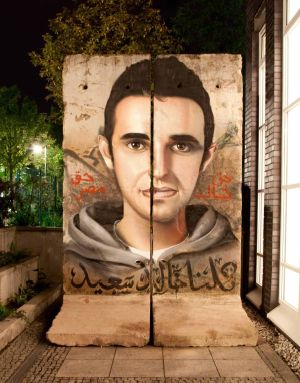
Amro Ali writes: On 6 June 2012, I will join countless others in commemorating the second anniversary of the death of Khaled Saeed, the twenty-eight-year-old Alexandrian who was beaten to death by plain-clothed policemen. The screams of Khaled echoed through Egypt and sparked the rapid countdown to the 2011 Egyptian Revolution.Khaled Saeed painting on the Berlin Wall by graffiti artist Andreas von Chrzanowski, photo by Joel Sames
Khaled was the neighbor down the street whom I, admittedly, paid little attention to. Yet his posthumous transformation from another face in the neighborhood to revolutionary poster child has become a source of both inspiration and concern. Inspiring in that he has given a focus and impetus to Egypt’s revolution, and concern in that his mythologization considerably conceals the real problems that the many “Khaled Saeeds” of Egypt face.
Khaled has been distorted almost beyond recognition. To understand the extent of this, based on interviews from friends, associates and my familiarity and understanding of the district, I attempt to provide a descriptive account of his life up until that fateful night in June 2010. The facts of his life are contrasted with his mythologization and the polarizing effects of both. His death was not just indicative of the corrupt and brutal police state; Khaled’s life was symptomatic of the widespread despair that continues to plague Egypt’s youth and that manifests in a plethora of symptoms from drug abuse to the strong desire to emigrate. The reconstruction of Khaled Saeed perpetuates self-defeating myths that, by elevating him into a figure with saint–like qualities, minimizes and simplifies the dynamics of his life that led up to his death.
Khaled’s tragedy was a turning point in my life. I first wrote about Khaled Saeed shortly after his death in an article titled, “Egypt’s Collision Course with History.” On the day Khaled died, I was in Australia reflecting on my late father who had died two years earlier on 6 June 2008, near to where Khaled passed away. When the news of Khaled’s death reached me, it shook my world. It was not just the manner of Khaled’s death that had disturbed me, but the deep reach of President Hosni Mubarak’s repressive police state into a neighborhood where I had grown up and idealized as a beacon of harmony. Up until then, I naively thought that such things happened to other people, in the slums, Islamist strongholds, in prisons, on the news, Alexandria’s rural outskirts, any “other area.” My area became that “other area.” [Continue reading…]
NATO realpolitik and U.S. responsibility for the fate of Afghan women
Meredith Tax writes: Why is it so hard for people in the anti-war movement to hold two ideas in their heads at the same time? Can’t we want to end the war in Afghanistan and at the same time practice solidarity with its victims?
As the Taliban, prompted by Pakistan’s ISI, becomes ever more aggressive, Afghan women and civil society campaigners are asking for support to protect the gains they’ve made, but nobody in the US government – or the left – seems to be listening.
Obama’s realpolitik has replaced the Bush administration’s rhetoric about bringing democracy to the region. “Afghan good enough” is the magic phrase in Washington. If this entails throwing women overboard, hey, that’s realpolitik. In March, 2011, Rajiv Chandrasekaran of the Washington Post asked a senior State Department officer what the policy would be towards women as the US withdrew. The answer:
“Gender issues are going to have to take a back seat to other priorities … There’s no way we can be successful if we maintain every special interest and pet project. All those pet rocks in our rucksack were taking us down.”
The war has cost too much in lives and money to be sustainable, and no one questions that it has been badly managed. The latest US blunder, according to Human Rights Watch, has been to make a huge strategic investment in the Afghan Local Police force; unfortunately, the ALP is full of rapists and thugs who are not held accountable for their crimes. The latest horror story concerns Lal Bibi, an 18-year-old girl abducted by an ALP leader in Kunduz province, chained to a wall, and raped, beaten and tortured for five days in revenge for an offense by a distant cousin. Normally, Lal Bibi’s family would have killed her – they may yet do so – but they have gone public and are trying to get justice. Meanwhile, the US military continues to express confidence in the Afghan Local Police.
And if its misjudgment is behind the ALP, the US is equally to blame for the rise of the Taliban; together with Saudi Arabia and Pakistan, the US funded them and gave them weapons in the late 1970s, when they wanted a proxy to fight the Soviets. Thus the US people have some responsibility to make sure that the result of all this intervention is not the Talibanization of the Karzai government.
Further, Obama has committed us to financial aid to Afghanistan for the forseeable future. What kind of financial aid should the US be giving, and what conditions should it place on such aid?
The anti-war movement isn’t discussing these issues. It simply echoes the position of the Obama administration – out as soon as possible and no questions asked. The movement’s entire attention seems to be focused on drones, as if wanting to end the war precludes thinking constructively about peace. [Continue reading…]
The Shabiha: Inside Assad’s death squads
The Telegraph reports: The door to Dr Mousab Azzawi’s clinic, on the Mediterranean coast of Syria, was always open to anyone who needed help. But, operating in the heartland of the feared Shabiha militia, there were some patients the doctor would have preferred not to treat.
“They were like monsters,” said Dr Azzawi, who worked in Latakia. “They had huge muscles, big bellies, big beards. They were all very tall and frightening, and took steroids to pump up their bodies.
“I had to talk to them like children, because the Shabiha likes people with low intelligence. But that is what makes them so terrifying – the combination of brute strength and blind allegiance to the regime.”
As President Bashar al-Assad’s country continues its savage slide towards full-blown civil war, the violent, dark and secretive world of the Shabiha is coming out into the open.
Nine days ago, 108 people were butchered by the Shabiha in the town of Houla. The pro-Assad thugs went through the village, house to house, and slit the throats of anyone they came across – including 49 children. Exactly a week later, the Shabiha pulled 12 factory workers off a bus in the town of Qusayr, 40 miles to the south; tied their hands behind their backs, and shot them in the head.
Video: Is Syria’s conflict being fought in Lebanon?
Israel asks Arab visitors to open emails to search
The Associated Press reports: When Sandra Tamari arrived at Israel’s international airport, she received an unusual request: A security agent pushed a computer screen in front of her, connected to Gmail and told her to “log in.”
The agent, suspecting Tamari was involved in pro-Palestinian activism, wanted to inspect her private email account for incriminating evidence. The 42-year-old American of Palestinian descent refused and was swiftly expelled from the country.
Tamari’s experience is not unique. In a cyber-age twist on Israel’s vaunted history of airport security, the country has begun to force incoming travelers deemed suspicious to open personal email accounts for inspection, visitors say.
Targeting mainly Muslims or Arabs, the practice appears to be aimed at rooting out visitors who have histories of pro-Palestinian activism, and in recent weeks, has led to the expulsion of at least three American women.
It remains unclear how widespread the practice is.
However, asked about Tamari’s claims, the Shin Bet security agency confirmed she had been interrogated and said its agents acted in accordance with the law.
Israel has a long history of using ethnic profiling, calling it a necessary evil resulting from its bitter experience with terrorist attacks. Arab travelers and anyone else seen as a risk are often subjected to intense questioning and invasive inspections, including strip searches.
From dreams to drones: who is the real Barack Obama?
Pankaj Mishra writes: Perhaps it is time to ask again: who is Barack Obama? And how has Pakistan featured in his worldview? The first question now seems to have been settled too quickly, largely because of the literary power of Obama’s speeches and writings. His memoir, Dreams From My Father, was quickened by the drama of the self-invented man from nowhere – the passionate striving, eloquent self-doubt and ambivalence that western literature, from Stendhal to Naipaul, has trained us to identify with a refined intellect and soul. Not surprisingly, Obama’s careful self-presentation seduced some prominent literary fictionists, inviting comparisons to James Baldwin.
Later biographies of Obama, published after he became president, have complicated the picture of him as the possessor of diversely sourced identities (Kenya, Indonesia, Hawaii, Harvard). David Maraniss’s new biography shows that at college the bright student from Hawaii’s closest friends were Pakistanis, and he carried around a dog-eared copy of Ralph Ellison’s Invisible Man.
But Obama also began early, as one girlfriend of his reported to her diary, to “strike out”, “shedding encumbrances, old images”. “Do you think I will be president of the United States?” he asked a slightly bemused Pakistani friend, who then witnessed “Obama slowly but carefully distancing himself from the Pakistanis as a necessary step in establishing his political identity”.
“For years,” Maraniss writes, “Obama seemed to share their attitudes as sophisticated outsiders who looked at politics from an international perspective. But to get to where he wanted … he had to change.” Obama’s Pakistani friend recalls: “The first shift I saw him undertaking was to view himself as an American in a much more fundamental way.”
In an incorrigibly rightwing political culture, this obliged Obama to always appear tougher than his white opponents. During his 2008 presidential debates with John McCain, Obama often startled many of us with his threats to expand the war in Afghanistan to Pakistan. More disquietingly, he claimed the imprimatur of Henry Kissinger, who partnered Richard Nixon in the ravaging of Cambodia, paving the way for Pol Pot, while still devastating Vietnam.
It can’t be said Obama didn’t prepare us for his murderous spree in Pakistan. It is also true that drone warfare manifests the same pathologies – racial contempt, paranoia, blind faith in technology and the superstition of body counts – that undermined the US in Vietnam.
The White House has been used before to plot daily mayhem in some obscure, under-reported corner of the world. During the long bombing campaign named Rolling Thunder, President Lyndon Johnson personally chose targets in Indochina, believing that “carefully calculated doses of force could bring about desirable and predictable responses from Hanoi“.
But of course “force”, as James Baldwin pointed out during Kissinger and Nixon’s last desperate assault on Indochina, “does not reveal to the victim the strength of his adversary. On the contrary, it reveals the weakness, even the panic of his adversary and this revelation invests the victim with patience”. [Continue reading…]