Author Archives: News Sources

Egypt transition on brink of collapse

Sharif Abdel Kouddous reports: As Egypt enters the final days of its so-called “transition,” the entire political process is on the verge of collapse.

The essential foundations of a post-Mubarak government that were supposed to have been lain over the past 16 months – the legislature, the presidency, the constitution – each suffer a crisis of legitimacy, the result of a military-managed transitional process so deformed that it barely make sense anymore.

Meanwhile, the lack of any semblance of reform within key state institutions – most notably the security forces, the judiciary and the media – was reconfirmed in the most dramatic of ways this month with the verdict in the trial of Hosni Mubarak, his sons and other top regime officials.

The turmoil has triggered massive protests across the country barely three weeks from the scheduled handover of power from military to civilian rule, with hundreds of thousands of Egyptians taking to the streets in a bid to reclaim their revolution.

The escalation of political crises began last month in the wake of the highly anticipated presidential elections. The first round of the poll left the country with a bitter, divisive outcome, pitting Ahmed Shafik, a stalwart of the Mubarak regime against Mohammed Mursi of the Muslim Brotherhood.

The result has left the majority of voters facing the most difficult of dilemmas, forced to choose between one candidate who is the very embodiment of the former regime that they rose up against last year; and the other a member of a conservative Islamist group that is that is, in many ways, the mirror establishment – highly hierarchical and disciplined, supported by patronage networks – and is widely viewed as having abandoned the revolution early on in the pursuit of its own interests. [Continue reading…]

Facebooktwittermail

Netanyahu — Israel’s editor-in-chief

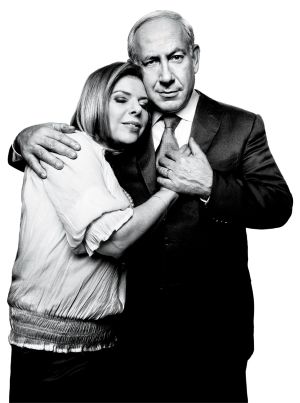
David Margolick writes: Seconds into any conversation about Netanyahu, the subject of Sara, whom he married in 1991, invariably comes up. It’s amazing how many otherwise sane Israelis see her Lady Macbeth–like hand in every corner of her husband’s life and work — whom he hires, what he does and doesn’t do, whom he can and cannot see. One hears constantly that Sara “has something” on her husband, stemming from her decision to stick by him after the highly publicized affair to which he admitted early in their marriage when his political career hung in the balance. One also hears of a supposed contract between the two of them, said to have been drafted by a former attorney general of Israel, squirreled away in some safe. Or of Bibi cowering in the bathroom, calling the childhood friends of his whom she has excommunicated.

Friend and foe alike have stories about Sara — about a tantrum or feud or some abuse of the household help — or some illustration of her vanity, like the time when, dissatisfied with the picture of her that Yediot Aharonot was about to run, she had her husband call the paper’s famously private owner, Noni Mozes, from Washington, demanding it be changed. People offer medical or psychological diagnoses, and speculate, without any apparent knowledge, about the medications she might be on. Her every misstep or peccadillo is covered minutely in the Israeli press (at least that portion Adelson doesn’t own), particularly her repeated run-ins with the help, several of which have led to lawsuits. Since ordering employees to call her “Ha Giveret” (“The Lady”) — an act of colossal hubris in a country rooted in unpretentious egalitarianism — it’s what she’s routinely and derisively called.

Numerous former staffers say her imbroglios periodically bring governance to a halt, forcing her husband to leave key meetings to tend to trivial matters or simply to calm her down. No one seriously contends that she will determine what happens with Iran. But many think she denies Netanyahu the serenity a man in his position needs. “She is a clear and present danger to the national security of the state of Israel,” one of Netanyahu’s prime critics, Ben Caspit, of the Israeli tabloid Maariv, told me. Just how, foreign minister Avigdor Lieberman is said to have asked, can a man control a government when he can’t control his wife? (Already hobbled by a pending corruption investigation, Lieberman, who heads the party of former Soviet immigrants, is considered a big loser in the recent political machinations. So too are Yair Lapid, a former anchorman who’d recently launched his own party, and Shelly Yachimovich, whose Labor Party stood to regain some seats — and at least some of its historic influence — in a new vote.)

For all his political pre-eminence, Netanyahu, still convinced Israeli liberal elites consider him a “usurper,” remains highly suspicious, even paranoid. “In every criticism, Bibi sees an attempt to bring him down,” Uzi Arad, his former national-security adviser and one of many people with whom he has had a falling-out, told Yediot Aharonot in March. So he’s insular: his principal lawyer — David Shimron, who handles the numerous lawsuits Bibi and Sara have brought against their household employees and the press — is his cousin; a cousin-in-law, Yitzhak Molcho, is his most important diplomat, marginalizing both Lieberman (at least as foreign minister) and Israel’s ambassador to Washington, Michael Oren; Netanyahu’s long-time chief of staff, Natan Eshel, forced to resign earlier this year in a sexual-harassment scandal, never really went away and handled the recent negotiations with Kadima. Shimon Shiffer of Yediot Aharonot says that Netanyahu once told him that he has no friends, something Netanyahu denies saying. One often hears — and not just from Netanyahu’s detractors — “Bibi has two types of friends: those he has betrayed, and those he will betray.”

Netanyahu was recently quoted by Steve Linde of The Jerusalem Post as saying that Israel’s most formidable foes were The New York Times and Haaretz, the newspaper of Israel’s intelligentsia. (He denies saying or believing this, and Linde subsequently published a clarification.) But Netanyahu has feuded with the Times and, one former aide tells me, considers Times columnist Thomas Friedman, a frequent critic, to be a mouthpiece of the Obama administration. That battle pales, though, next to Netanyahu’s wars with the Israeli press, which pilloried him during his first term. Like many Israelis on the left, it never forgave Netanyahu for Rabin’s assassination, which it believed his inflammatory language helped foment.

Netanyahu has expended vastly more energy — and enjoyed far greater success — reshaping the Israeli media than seeking peace with the Palestinians. As one observer puts it, he is less Israel’s prime minister than its editor in chief.

Netanyahu’s influence over the media comes in large part due to the financial support of his friend, American billionaire casino boss Sheldon Adelson.

Adelson, who reportedly first met Netanyahu in the 1990s, speaks no Hebrew and does not live in Israel, though his wife is Israeli. But, most likely with Netanyahu’s coaching, he came to believe that Israel’s three main newspapers did not represent the diverse Israeli public, and resolved to give Israelis what he called — borrowing Fox News’s slogan — a more “fair and balanced” alternative. At first he tried to buy Maariv. His pitch wasn’t subtle; he accused the paper’s owner, Ofer Nimrodi, of being a bad Zionist. (Nimrodi, his parents, and his two sons have all served in either Israeli intelligence or the Israeli Defense Forces.) Not surprisingly, a deal never happened. So, in 2007, Adelson launched a new paper, Israel Hayom (“Israel Today”). Instantly, understandably, it was dubbed “Bibiton”: “Bibi’s Newspaper” in Hebrew. Israeli journalists compare it half-facetiously to Pravda or Tishreen, the house organ of Syrian president Bashar al-Assad. Because its biases are so blatant, the conservative columnist Kalman Libeskind, of Maariv, recently wrote, he’d never thought it worth criticizing. But its “complete symbiosis” with Netanyahu and his interests, he complained, sometimes “really makes you want to puke.”

From its debut, Adelson’s paper — the tens or even hundreds of millions of dollars he has dumped into it dwarfs the comparative pittance he invested in Newt Gingrich’s failed presidential bid — enjoyed two advantages: it’s free (even with home delivery) and ubiquitous, handed out everywhere. By leaching away readers and advertisers, it posed a mortal threat to Yediot Aharonot and Maariv. Maariv has already fallen into new, more Bibi-friendly hands. And after a period of all-out war with Netanyahu — in which, for instance, it plastered details of a maid’s lawsuit against the First Couple over several pages — Yediot Aharonot has recently toned things down. Many see that as evidence of a hudna, or truce, between Netanyahu and the paper, though who has conceded what isn’t clear.

“Almost the whole Israeli media is dependent upon Bibi,” says a former editor of Maariv, Amnon Dankner, “and while I won’t say they’re not criticizing him, the music has changed — to quieter, less vociferous tones.” [Continue reading…]

Facebooktwittermail

Most Israeli Jews agree: African migrants are ‘a cancer’

The Times of Israel reports: Fifty-two percent of Jewish Israelis identify with the statement by MK Miri Regev last month that African migrants are “a cancer in the body” of the nation, and over a third condone anti-migrant violence, according to the Israel Democracy Institute (IDI) Peace Index for May 2012.

Broken down by political and religious affiliation, the monthly index’s findings reveal that among Jews there is a direct correlation between right-wing political affiliation and a racist attitude toward migrants. Thus, 86 percent of Shas voters and 66 percent of Likud voters polled expressed identification with Regev’s controversial statement, as opposed to 32 percent of Labor voters and four percent of Meretz voters.

The degree of religiosity attested to by respondents also accounted for a large disparity in the findings, with 81.5% and 66% of self-described ultra-Orthodox and Orthodox, respectively, agreeing with Regev’s statement, as opposed to 38% of secular Israelis.

Only 19% of Arab respondents agreed that the migrants were “a cancer.”

Facebooktwittermail

Segregating Gazans has made them easier to demonise

Amira Hass writes: A stout sense of humour and self-irony is the least most Israelis expect of Gazans. It is certainly true today, when they are spoken of almost solely through the hyperbole of military commentators who jump frantically from discussing the Iranian threat to the danger that the tiny, overcrowded, impoverished and besieged enclave poses to the state of Israel, a global military power.

But that sense of humour is also lost in the victim-oriented Palestinian media reports or the militant statements of anonymous veiled speakers and lower-tier Hamas politicians of which the meagre Israeli media diet ordinarily consists.

Now we would struggle to understand stories such as the following anecdote, relayed to me by the Fatah activist Abu Mustafa. Thirty years ago, Mustafa was being tortured by an Israeli interrogator. “You must be getting a double salary,” Mustafa told the oversized interrogator, who was stepping on his back and squeezing his arms. “How come?” The Israeli was surprised. “Because of your weight,” said Mustafa, as he was struggling with the pain. According to this thin and shy man, the interrogator burst out laughing, was unable to continue his chore and left the room. Did Mustafa want to mellow his own memory of the torture when he shared that story with me, or did his humour indeed reach home with his tormentor?

Even 25 years ago, the relationship between Gazans and Israelis was very different. Back then, Gazans were a reservoir of cheap labour and still flocked to the streets of Israeli towns – to be found in every restaurant, clothing factory, garage and construction site. How were they seen then by the ordinary Israeli? Were they mere functional shadows who disappeared in their dorm shanties? Dispensable ghosts? Savages? An Uncle Tom? [Continue reading…]

Facebooktwittermail

Obama’s friend in Turkey

In his ongoing effort to atone for Davos 2009, David Ignatius writes: As President Obama was feeling his way in foreign policy during his first months in office, he decided to cultivate a friendship with Turkey’s headstrong prime minister, Recep Tayyip Erdogan. Over the past year, this investment in Turkey has begun to pay some big dividends — anchoring U.S. policy in a region that sometimes seems adrift.

Erdogan’s clout was on display this week as he hosted a meeting here of the World Economic Forum (WEF) that celebrated the stability of the “Turkish model” of Muslim democracy amid the turmoil of the Arab Spring. One panel had the enraptured title “Turkey as a Source of Inspiration.”

In a speech Tuesday, Erdogan named Turkey’s achievements over the decade he has been in power: Its economy has grown an annual average of 5.3 percent since 2002, the fastest rate of any country in the Organization for Economic Cooperation and Development; gross domestic product has more than tripled, as have its foreign reserves; investment from abroad has increased more than 16 times.

For Erdogan, receiving a visit from the WEF was a kind of vindication. The Turkish leader walked angrily offstage at the group’s 2009 meeting in Davos, Switzerland, after a panel moderator (yours truly) didn’t allow him time to respond to Israeli President Shimon Peres’s remarks about the Gaza war. This week, that moment seemed well in the past. [Continue reading…]

Facebooktwittermail

The Karzai Rule

Amy Davidson writes: If we’re talking about a Buffett Rule for taxes, we might also think about a Karzai Rule. This could be formulated as subjecting the the billions of taxpayer dollars we are sending to Afghanistan to the same rate of scrutiny we give to the income of a billionaire, or his secretary. That doesn’t seem to be the case now. The Times, this week, had a report on how the family of President Hamid Karzai is engaged in an end-of-days fight over whatever money and power is left to Kabul. The family has become rich enough on graft and other forms of corruption—funded, in many cases, by American contracts and piles of aid money—for factions to form among his relatives. One brother, Mahmoud Karzai, says another, Shah Wali Karzai, essentially stole fifty-five million dollars from a real-estate development venture called Aino Mena. Shah Wali says that he just moved the money because Mahmoud was going to steal it and move it abroad as he’s done with other funds (which Mahmoud denies). These charges are not mutually exclusive. Figuring out which brother of the President we’re keeping in power is guilty of stealing how much makes legal sense. But this may also be one of those cases where two people each tell you that the other is crazy, or corrupt, and all you can work out is that at least one of them is—and that maybe you shouldn’t be giving money to either of them.

Another question: Does anyone think that that Aino Mena, a big housing development outside of Kandahar, through which tens or hundreds of millions of dollars are apparently flowing, actually makes any economic sense? I could misapprehend the Afghan housing market, but it seems from a distance to be about as sensibly run as the Kabul Bank, where lending resembled looting and which ultimately failed, and involved some of the same characters. (See Dexter Filkins’s story for the details.) Then again, since, according to the Times, it is being built on “land that Afghan military officials have claimed was illegally seized from the Ministry of Defense,” it might make some money.

One odd aspect of the story is that a number of members of the Karzai family are actually American citizens, including Mahmoud. They lived here for many years in exile; they started a chain of Afghan restaurants, which are supposed to have pretty good food. This is also why Mahmoud is under investigation on various tax-evasion charges, and here the Karzai Rule suggests another question: If you can’t even tax the true income of the expatriate multimillionaire American associates of a corrupt foreign regime, should the taxes of a secretary in America be paying for it? [Continue reading…]

Facebooktwittermail

The last American prisoner of war

Michael Hastings writes: The mother and father sit at the kitchen table in their Idaho farmhouse, watching their son on YouTube plead for his life. The Taliban captured 26-year-old Bowe Bergdahl almost three years ago, on June 30th, 2009, and since that day, his parents, Jani and Bob, have had no contact with him. Like the rest of the world, their lone glimpses of Bowe – the only American prisoner of war left in either Iraq or Afghanistan – have come through a series of propaganda videos, filmed while he’s been in captivity.

In the video they’re watching now, Bowe doesn’t look good. He’s emaciated, maybe 30 pounds underweight, his face sunken, his eye sockets like caves. He’s wearing a scraggly beard and he’s talking funny, with some kind of foreign accent. Jani presses her left hand across her forehead, as if shielding herself from the images onscreen, her eyes filling with tears. Bob, unable to look away, hits play on the MacBook Pro for perhaps the 30th time. Over and over again, he watches as his only son, dressed in a ragged uniform, begs for someone to rescue him.

“Release me, please!” Bowe screams at the camera. “I’m begging you – bring me home!”

Private First Class Bowe Bergdahl arrived in Afghanistan at the worst possible moment, just as President Barack Obama had ordered the first troop surge in the spring of 2009. Rather than withdraw from a disastrous and increasingly deadly war started by his predecessor, the new commander in chief had decided to escalate the conflict, tripling the number of troops to 100,000 and employing a counterinsurgency strategy that had yet to demonstrate any measurable success. To many on Obama’s staff, who had been studying Lessons in Disaster, a book about America’s failure in Vietnam, the catastrophe to come seemed almost preordained. “My God,” his deputy national security adviser Tom Don­ilon said at the time. “What are we getting this guy into?” Over the next three years, 13,000 Americans would be killed or wounded in Afghanistan – more than during the previous eight years of war under George W. Bush.

Bowe’s own tour of duty in Afghanistan mirrored the larger American experience in the war – marked by tragedy, confusion, misplaced idealism, deluded thinking and, perhaps, a moment of insanity. And it is with Bowe that the war will likely come to an end. On May 1st, in a surprise visit to Bagram Air Force Base in Afghanistan, President Obama announced that the United States will now pursue “a negotiated peace” with the Taliban. That peace is likely to include a prisoner swap – or a “confidence-building measure,” as U.S. officials working on the negotiations call it – that could finally end the longest war in America’s history. Bowe is the one prisoner the Taliban have to trade. “It could be a huge win if Obama could bring him home,” says a senior administration official familiar with the negotiations. “Especially in an election year, if it’s handled properly.” [Continue reading…]

Facebooktwittermail

U.S. troops are killing themselves at fastest pace since nation began a decade of war

The Associated Press reports: Suicides are surging among America’s troops, averaging nearly one a day this year — the fastest pace in the nation’s decade of war.

The 154 suicides for active-duty troops in the first 155 days of the year far outdistance the U.S. forces killed in action in Afghanistan — about 50 percent more — according to Pentagon statistics obtained by The Associated Press.

The numbers reflect a military burdened with wartime demands from Iraq and Afghanistan that have taken a greater toll than foreseen a decade ago. The military also is struggling with increased sexual assaults, alcohol abuse, domestic violence and other misbehavior.

Because suicides had leveled off in 2010 and 2011, this year’s upswing has caught some officials by surprise.

The reasons for the increase are not fully understood. Among explanations, studies have pointed to combat exposure, post-traumatic stress, misuse of prescription medications and personal financial problems. Army data suggest soldiers with multiple combat tours are at greater risk of committing suicide, although a substantial proportion of Army suicides are committed by soldiers who never deployed.

The unpopular war in Afghanistan is winding down with the last combat troops scheduled to leave at the end of 2014. But this year has seen record numbers of soldiers being killed by Afghan troops, and there also have been several scandals involving U.S. troop misconduct.

The 2012 active-duty suicide total of 154 through June 3 compares to 130 in the same period last year, an 18 percent increase. And it’s more than the 136.2 suicides that the Pentagon had projected for this period based on the trend from 2001-2011. This year’s January-May total is up 25 percent from two years ago, and it is 16 percent ahead of the pace for 2009, which ended with the highest yearly total thus far.

Suicide totals have exceeded U.S. combat deaths in Afghanistan in earlier periods, including for the full years 2008 and 2009.

Facebooktwittermail

U.N. monitors shot at in Syria, Annan plan crumbles

Reuters reports: U.N. monitors came under fire in Syria on Thursday while trying to investigate reports of a new massacre that raised the pressure on world powers struggling to halt the carnage and save a peace plan from collapse.

U.N. Secretary-General Ban Ki-moon described as “unspeakable barbarity” the reported killing of at least 78 villagers by forces loyal to Syrian President Bashar al-Assad and warned that a civil war was imminent.

Speaking at a special session of the U.N. General Assembly on Syria, international envoy Kofi Annan acknowledged his U.N.-Arab League peace plan was not working and said there must be “consequences” for those who do not comply.

Ban said hopes for consolidating the peace plan were fading and Annan himself warned the U.N. Security Council that the crisis in Syria could soon spiral out of control, diplomats said. Annan, Ban’s predecessor as U.N. secretary-general, called for “substantial pressure” on Damascus to stop the violence.

Facebooktwittermail

The fractures that could pull Libya apart

Nicholas Pelham writes: Eight months after Muammar Qaddafi’s overthrow, journalists seeking wars in Libya have to journey deep into the Sahara and beyond the horizons of most Libyans to find them. A senior official of Libya’s temporary ruling body, the National Transitional Council (NTC), flippantly waved away an invitation to leave his residence at the Rixos, Qaddafi’s palatial Tripoli hotel, to join a fact-finding delegation to Kufra, a trading post 1,300 kilometers to the southeast, near Sudan and Chad. “Isn’t it Africa?” he asks.

Yet for Libya’s new governors, the turbulent south—home to Libya’s wells of water and oil—is unnerving. Since Mustafa Abdel Jalil, the NTC chairman, declared an end to the civil war last October, the violence in the south is worse than it was during the struggle to oust Qaddafi. Hundreds have been killed, thousands injured, and, according to UN figures, tens of thousands displaced in ethnic feuding. Without its dictator to keep the lid on, the country, it seems, is boiling over the sides.

Kufra, some six hundred kilometers from the nearest Libyan town, epitomizes the postwar neglect. Several on the NTC’s nine-man mission I accompanied in late April were making their first visit there. The air of exuberance we felt flying aboard Qaddafi’s private jet and breakfasting on salmon-filled omelets cooked by his dashing stewardess, clad in a scarlet uniform, vanished as we began our descent. How much protection could we expect from the two members of the mission who had been included to protect the group and who had been recruited for the journey from the Kufra’s two fighting tribes—the Arab Zuwayy and the black Toubou? A NTC official criticized the pilot for approaching the runway from the town, where we made an easy target, not the desert. The airfield was deserted.

“We have a tradition of welcoming our guests,” said the Zuwayy’s tribal sheikh, Mohammed Suleiman, in less than welcoming tones, once we had found his mansion. “But we’re cursing this government for abandoning us to the Africans.” A room full of sixty tribesmen echoed his rebuke; since the revolution, members of the Toubou tribe had swarmed into the town and were threatening to wrest control of the oil fields nearby, he said. For the sheikh, the only solution was to expel them.

The catalyst for the fighting had been the NTC’s appointment of a Toubou leader to guard the Chad frontier, thus putting him in control of trans-Saharan smuggling, apparently as a reward for his support in the revolution. Gasoline, which in Libya is cheaper than water, subsidized flour, and guns go out; whisky and migrants come in. Though the Zuwayy had ten times as many Mercedes trucks as the Toubou, their incomes had plummeted. As animosities rose, the two tribes divided their mixed town of Kufra into fortified zones and fired mortars at each other’s houses. In fighting that followed this spring, 150 were killed.

After a communal meal of lambs’ heads served on vast tin trays, we crossed town to the Toubou quarter. Red-tiled Swiss-style villas gave way to African cinder-block shanties, some blackened by bombing. Tarmac roads led into sandy tracks. Where the Zuwayy had served us a feast on thick blood-red carpets, the Toubou poured glasses of goat yogurt. The Zuwayy had chandeliers; the Toubou had a flickering neon strip and sporadic blackouts. “The air-conditioning is broken,” their spokesmen apologized. The NTC delegates, who sat silently during the Zuwayys’ browbeating, now seemed like feudal lords chiding troublesome peasants; as we left they said the Toubou border guards were outlaws. The next day fighting flared. At a gathering of Libya’s many militias in Benghazi, nearly a thousand kilometers to the north, startled UN officials ducked for cover as Zuwayy and Toubou gunmen faced off in the corridors.

Some nine hundred kilometers west of Kufra as the crow or plane flies—for there are no roads—Sabha, the provincial capital of the southwestern Fezzan, also suffered from ethnic strife. On March 27, in the midst of a heated session of a local military council meeting to discuss the allocation of payments to former fighters, the representative of the Awlad Suleiman, another Arab tribe, shot three Toubou councilors dead. As the fighting spread, Arab snipers took to their villa rooftops and lobbed Katyusha rockets across the tin wall separating their neighborhood from the Toubou shantytown of Tayuri. Footage on their mobile phones shows tribesmen parking their tanks at Tayuri’s entrance and shelling its shacks. When the firing subsided three days later, the Toubou counted seventy-six dead in the shantytown alone. Scores more were killed on the roads.

Like the Toubou, North Africa’s indigenous Berbers — or Imazighen as they prefer to call themselves — depict Qaddafi’s rule as four decades of unremitting Arabization. To erase their ethnicity, they say, Qaddafi labeled them mountain Arabs, replaced their historic place-names with Arab ones, and suppressed the Ibadi school of Islam that many Imazighen follow on account of its more egalitarian bent. Unlike Sunnis, the mainstream Ibadi school opens up leadership of the Muslim community to all ethnic groups, not only the Quraish, the Prophet Muhammad’s Arab tribe. Qaddafi accused mothers who spoke the Amazigh tongue, Tifinagh, at home of feeding poison to their children. [Continue reading…]

Facebooktwittermail

Is humanity pushing Earth past a tipping point?

Wired reports: Could human activity push Earth’s biological systems to a planet-wide tipping point, causing changes as radical as the Ice Age’s end — but with less pleasant results, and with billions of people along for a bumpy ride?

It’s by no means a settled scientific proposition, but many researchers say it’s worth considering — and not just as an apocalyptic warning or far-fetched speculation, but as a legitimate question raised by emerging science.

“There are some biological realities we can’t ignore,” said paleoecologist Anthony Barnosky of the University of California, Berkeley. “What I’d like to avoid is getting caught by surprise.”

In “Approaching a state shift in Earth’s biosphere,” published June 6 in Nature, Barnosky and 21 co-authors cite 100 papers in summarize what’s known about environmental tipping points.

While the concept was popularized by Malcolm Gladwell’s accounts of sudden, widespread changes in society, the underlying mathematics — which won physicist Kenneth Wilson a Nobel Prize in 1982 — have far-reaching implications.

In the last few decades, scientists have found tipping behaviors in various natural environments, from locale-scale ponds and coral reefs to regional systems like the Sahara desert, which until 5,500 years ago was a fertile grassland, and perhaps even the Amazon basin.

Common to these examples is a type of transformation not described in traditional ideas of nature as existing in a static balance, with change occurring gradually. Instead, the systems seem to be dynamic, ebbing and flowing within a range of biological parameters.

Stress those parameters — with fast-rising temperatures, say, or a burst of nutrients — and systems are capable of sudden, feedback loop-fueled reconfiguration.

According to some researchers, that’s what happened when life’s diversity exploded in an eyeblink 540 million years ago, or much more recently when a glacier-chilled Earth became in a couple thousand years the temperate garden that cradled human civilization.

But while the Cambrian explosion and Holocene warming were sparked by natural, planet-wide changes to ocean chemistry and solar intensity, say Barnosky and colleagues, there’s a new force to consider: 7 billion people who exert a combined influence usually associated with planetary processes. [Continue reading…]

Facebooktwittermail

‘Big data’ from social media, elsewhere online redefines trend-watching

The Washington Post reports: From a trading desk in London, Paul Hawtin monitors the fire hose of more than 340 million Twitter posts flying around the world each day to try to assess the collective mood of the populace.

The computer program he uses generates a global sentiment score from 1 to 50 based on how pessimistic or optimistic people seem to be from their online conversations. Hawtin, chief executive of Derwent Capital Markets, buys and trades millions of dollars of stocks for private investors based on that number: When everyone appears happy, he generally buys. When anxiety runs high, he sells short.

Hawtin has seen a gain of more than 7 percent in the first quarter of this year, and his method shows the advantage individuals, companies and governments are gaining as they take hold of the unprecedented amount of data online. Traders such as Hawtin say analyzing mathematical trends on the Web delivers insights and news faster than traditional investment approaches.

The explosion in the use of Google, Facebook, Twitter and other services has resulted in the generation of some 2.5 quintillion bytes each day, according to IBM.

“Big data,” as it has been dubbed by researchers, has become so valuable that the World Economic Forum, in a report published last year, deemed it a new class of economic asset, like oil.

“Business boundaries are being redrawn,” the report said. Companies with the ability to mine the data are becoming the most powerful, it added.

While the human brain cannot comprehend that much information at once, advances in computer power and analytics have made it possible for machines to tease out patterns in topics of conversation, calling habits, purchasing trends, use of language, popularity of sports, spread of disease and other expressions of daily life.

“This is changing the world in a big way. It enables us to watch changes in society in real time and make decisions in a way we haven’t been able to ever before,” said Gary King, a social science professor at Harvard University and a co-founder of Crimson Hexagon, a data analysis firm based in Boston.

The Obama campaign employs rows of people manning computers that monitor Twitter sentiment about the candidates in key states. Google scientists are working with the Centers for Disease Control and Prevention to track the spread of flu around the world by analyzing what people are typing in to search. And the United Nations is measuring inflation through computers that analyze the price of bread advertised in online supermarkets across Latin America.

Many questions about big data remain unanswered. Concerns are being raised about personal privacy and how consumers can ensure that their information is being used fairly. Some worry that savvy technologists could use Twitter or Google to create false trends and manipulate markets.

Even so, sociologists, software engineers, economists, policy analysts and others in nearly every field are jumping into the fray. And nowhere has big data been as transformative as it has been in finance. [Continue reading…]

Facebooktwittermail

Renewing a debate over secrecy, and its costs

Scott Shane reports: In recent years, the United States has pioneered the use of two innovative weapons, drones and cyberattacks, that by many accounts have devastated Al Qaeda and set back Iran’s nuclear effort.

Now those programs are at the heart of a bipartisan dispute over secrecy, with Congressional Republicans accusing the Obama administration of leaking classified information for political advantage and Democrats lodging their own protests about high-level disclosures.

Prompted in part by recent articles in The New York Times on the use of drones to carry out targeted killings and the deployment of the Stuxnet computer worm against the Iranian nuclear program, the Republican and Democratic leaders of the House and Senate intelligence committees issued a joint statement on Wednesday urging the administration “to fully, fairly and impartially investigate” the recent disclosures and vowing new legislation to crack down on leaks.

“Each disclosure puts American lives at risk, makes it more difficult to recruit assets, strains the trust of our partners and threatens imminent and irreparable damage to our national security,” said the statement, a rare show of unity.

The protest focused on the dangers of leaks that the Congressional leaders said would alert adversaries to American military and intelligence tactics. But secrecy, too, has a cost — one that is particularly striking in the case of drones and cyberattacks. Both weapons raise pressing legal, moral and strategic questions of the kind that, in a democracy, appear to deserve serious public scrutiny. Because of classification rules, however, neither has been the subject of open debate in Congress, even as the Obama administration has moved aggressively ahead with both programs.

“The U.S. is embarked on ambitious and consequential moves that will shape the security environment for years to come, whether they succeed or fail,” said Steven Aftergood, who studies government secrecy at the Federation of American Scientists. “Secrecy cloaks not only the operations, but their justification and rationale, which are legitimate subjects of public interest.”

Mr. Aftergood said drones and cyberattacks were “extreme examples of programs that are widely known and yet officially classified.” That, he said, has prevented informed public discussion of some critical questions. Should the United States be inaugurating a new era of cyberattacks? What are the actual levels of civilian casualties caused by the drone attacks, and what are the implications for national sovereignty?

“Keeping these programs secret may have a value,” said Jack Goldsmith, a Harvard law professor and Bush administration Justice Department official who writes about national security and the press. “But there’s another value that has to be considered, too — the benefit of transparency, accountability and public discussion.” [Continue reading…]

Facebooktwittermail

New Jersey Muslims file federal suit to stop New York Police Department from spying on them

The Associated Press reports: A Muslim civil rights group that has worked closely with the Obama administration to build better relationships with American Muslims is suing the New York Police Department over its surveillance programs.

Eight Muslims filed a federal lawsuit Wednesday in New Jersey to force the NYPD to end its surveillance and other intelligence-gathering practices that have targeted Muslims since the 2001 terrorist attacks. The lawsuit alleged that the NYPD’s activities were unconstitutional because they focused on people’s religion, national origin and race.

It is the first lawsuit to directly challenge the NYPD’s surveillance programs that targeted entire Muslim neighborhoods, chronicling the daily life of where people ate, prayed and got their hair cut. The surveillance was the subject of series of stories by The Associated Press that revealed the NYPD intelligence division infiltrated dozens of mosques and Muslim student groups and investigated hundreds.

The Muslims suing the NYPD are represented by Muslim Advocates, a California-based civil rights group that meets regularly with members of the Obama administration. Its executive director, Farhana Khera, said she was disappointed that the Obama administration hasn’t been more involved.

“We do not think that they’ve been given sufficient attention and attention in a speedy manner,” Khera said. “We do think this is an immensely important issue to have the nation’s largest police department targeting Americans based on religion. We do think it merits the attention of the federal government.”

Facebooktwittermail

Cyber-weapons are a very very bad idea

Karl Vick writes: Eugene Kaspersky, the Russian cyber sleuth who last week revealed the most sophisticated virus yet targeting Iran, was greeted as a hero at the Tel Aviv University conference on digital security Wednesday. He didn’t pretend not to know why, any more than the Israeli audience that played along with the coy remarks its officials have made about the country’s role in the digital espionage bedeviling the Iranian program.

“Maybe there are some people here who are not happy with work I was doing with Stuxnet and Flame,” he told an audience of more than 1,000 at the university’s annual International Conference on Cyber Security. (Stuxnet was the previous virus that hit Iran, targeting its nuclear program; Flame hit the petroleum industry.) Then the keynote speaker, clad in jeans and an untucked linen shirt, leaned forward and said in a stage whisper, “I’m really sorry.” Waves of laughter and applause followed. “It’s not personal,” Kaspersky went on, drawing out the laughter, which had a quality of mutual congratulation. “It’s my job…. So next time, be more careful.”

But when the room quieted down, the guru got serious. Cyber-weapons, Kaspersky advised, “are a very very bad idea.” Whatever advanced knowledge allowed engineers to fashion the malicious software targeted at Iran’s nuclear program will, in short order, become known to other nations, he said, and next time could well be directed back at the originators — the very worry President Obama reportedly voiced in approving the digital espionage in a joint program with Israel. “I’m afraid that in the future there will be other countries in this game,” Kaspersky said. “It’s only software. Maybe ‘hacktivists’ will become cyber-terrorists. And maybe the traditional terrorists will be in touch with the cyber-terrorists.

Facebooktwittermail

Israel’s deployment of nuclear missiles on subs from Germany

Der Spiegel reports: Research SPIEGEL has conducted in Germany, Israel and the United States, among current and past government ministers, military officials, defense engineers and intelligence agents, no longer leaves any room for doubt: With the help of German maritime technology, Israel has managed to create for itself a floating nuclear weapon arsenal: submarines equipped with nuclear capability.

Foreign journalists have never boarded one of the combat vessels before. In an unaccustomed display of openness, senior politicians and military officials with the Jewish state were, however, now willing to talk about the importance of German-Israeli military cooperation and Germany’s role, albeit usually under the condition of anonymity. “In the end, it’s very simple,” says Israeli Defense Minister Ehud Barak. “Germany is helping to defend Israel’s security. The Germans can be proud of the fact that they have secured the existence of the State of Israel for many years to come.”

On the other hand, any research that did take place in Israel was subject to censorship. Quotes by Israelis, as well as the photographer’s pictures, had to be submitted to the military. Questions about Israel’s nuclear capability, whether on land or on water, were taboo. And decks 2 and 3, where the weapons are kept, remained off-limits to the visitors.

In Germany, the government’s military assistance for Israel’s submarine program has been controversial for about 25 years, a topic of discussion for the media and the parliament. Chancellor Angela Merkel fears the kind of public debate that German Nobel literature laureate Günter Grass recently reignited with a poem critical of Israel. Merkel insists on secrecy and doesn’t want the details of the deal to be made public. To this day, the German government is sticking to its position that it does not know anything about an Israeli nuclear weapons program.

But now, former top German officials have admitted to the nuclear dimension for the first time. “I assumed from the very beginning that the submarines were supposed to be nuclear-capable,” says Hans Rühle, the head of the planning staff at the German Defense Ministry in the late 1980s. Lothar Rühl, a former state secretary in the Defense Ministry, says that he never doubted that “Israel stationed nuclear weapons on the ships.” And Wolfgang Ruppelt, the director of arms procurement at the Defense Ministry during the key phase, admits that it was immediately clear to him that the Israelis wanted the ships “as carriers for weapons of the sort that a small country like Israel cannot station on land.” Top German officials speaking under the protection of anonymity were even more forthcoming. “From the beginning, the boats were primarily used for the purposes of nuclear capability,” says one ministry official with knowledge of the matter.

Insiders say that the Israeli defense technology company Rafael built the missiles for the nuclear weapons option. Apparently it involves a further development of cruise missiles of the Popeye Turbo SLCM type, which are supposed to have a range of around 1,500 kilometers (940 miles) and which could reach Iran with a warhead weighing up to 200 kilograms (440 pounds).
[…]
Armed with nuclear weapons, the submarines are a signal to any enemy that the Jewish state itself would not be totally defenseless in the event of a nuclear attack, but could strike back with the ultimate weapon of retaliation. The submarines are “a way of guaranteeing that the enemy will not be tempted to strike pre-emptively with non-conventional weapons and get away scot-free,” as Israeli Admiral Avraham Botzer puts it.

In this version of tit-for-tat, known as nuclear second-strike capability, hundreds of thousands of dead are avenged with an equally large number of casualties. It is a strategy the United States and Russia practiced during the Cold War by constantly keeping part of its nuclear arsenal ready on submarines. For Israel, a country about the size of the German state of Hesse, which could be wiped out with a nuclear strike, safeguarding this threat potential is vital to its very existence. At the same time, the nuclear arsenal causes countries like Iran, Syria and Saudi Arabia to regard Israel’s nuclear capacity with fear and envy and consider building their own nuclear weapons.

This makes the question of its global political responsibility all the more relevant for Germany. Should Germany, the country of the perpetrators, be allowed to assist Israel, the land of the victims, in the development of a nuclear weapons arsenal capable of extinguishing hundreds of thousands of human lives?

Is Berlin recklessly promoting an arms race in the Middle East? Or should Germany, as its historic obligation stemming from the crimes of the Nazis, assume a responsibility that has become “part of Germany’s reason of state,” as Chancellor Merkel said in a speech to the Israeli parliament, the Knesset, in March 2008? “It means that for me, as a German chancellor, Israel’s security is never negotiable,” Merkel told the lawmakers. [Continue reading…]

The BBC adds: The former German Chancellor Helmut Schmidt once said he was unhappy with Chancellor Angela Merkel’s statement in 2008 that Germany bore responsibility for the security of the state of Israel.

Rather, Mr Schmidt said, “Germany has a special responsibility to ensure that such crimes as occurred in the Holocaust never occur again. But Germany has no responsibility for Israel.”

Facebooktwittermail

Far-right Europeans and Israelis: this toxic alliance spells trouble

Rachel Shabi writes: Last month, demonstrations against African refugees in Tel Aviv turned violent. Protesters looted shops, broke windows and firebombed buildings, including a nursery. Days ago, arsonists torched the home of 10 African migrants in Jerusalem, injuring four, and leaving the unequivocal graffiti: “Get out of the neighbourhood.”

On Monday, Israeli TV reported that Haifa’s council had warned local businesses that they risked losing their licences if they employed African refugees, and that shopkeepers in the southern town of Sderot were refusing to serve migrants. Israeli statistics show some 60,000 African migrants have entered the country in the past seven years through the Egyptian Sinai desert – many of them asylum seekers fleeing repression or war in Sudan, South Sudan and Eritrea. Israel, much like Europe, seems consumed with worry about being “swamped” by developing-world refugees – although, perhaps in part because of its location, the fears in Israel sound more visceral. So far, Israel’s approach has been to build a steel fence on the Egyptian border and a giant detention centre in the south, and to pass a law that allows the detention of migrants for up to three years. Since its creation, fewer than 150 people have been recognised as refugees in Israel.

The crude response from politicians has been as disturbing as the scenes on the streets. Last week, the interior minister, Eli Yishai, said: “Most of those people arriving here are Muslims who think the country doesn’t belong to us, the white man.” He has also described the refugees as rapists and criminals. Weeks ago, Miri Regev, a Likud member of the Knesset, referred to Sudanese people in Israel as a cancer. Former TV presenter and emerging politician Yair Lapid last month lambasted some Knesset members as “inciters” leading a pogrom, and wrote: “I wonder how they have the nerve to call themselves Jews.” [Continue reading…]

Facebooktwittermail

A war on Palestinian soccer: Free Mahmoud al-Sarsak

Ramzy Baroud writes: Palestinian national soccer team member Mahmoud al-Sarsak completed 81 days of a grueling hunger-strike. He has sustained the strike despite the fact that nearly 2,000 Palestinian inmates had called off their own 28-day hunger strike weeks ago.

Although the story of Palestinian prisoners in Israel speaks to a common reality of unlawful detentions and widespread mistreatment, al-Sarsak’s fate can also be viewed within its own unique context. The soccer player, who once sought to take the name and flag of his nation to international arenas, was arrested by Israeli soldiers in July 2009 while en route to join the national team in the West Bank.

Al-Sarsak was branded an ‘illegal combatant’ by Israel’s military judicial system, and was since imprisoned without any charges or trial.

Al-Sarsak is not alone in the continued hunger strike. Akram al-Rekhawi, a diabetic prisoner demanding proper medical care, has refused food for 57 days.

Both men are in dire medical condition. Al-Sarsak, once of unmatched athletic build, is now gaunt beyond recognition. The already ill al-Rekhawi is dying.

According to rights groups, an Israeli court on May 30 granted prison doctors 12 days to allow independent doctors to visit the prisoners, further prolonging their suffering and isolation.

Physicians for Human Rights – Israel, which has done a remarkable job battling the draconian rules of Israeli military courts, petitioned the court to meet with both al-Sarsak and al-Rekhawi.

Sadly, the story here becomes typical. PHRI, along with other prisoners’ rights groups, are doing all that civil society organizations can do within such an oppressive legal and political situation.

Families are praying. Social media activists are sending constant updates and declaring solidarity. Meanwhile, the rest of the world is merely looking on — not due to any lack of concern for human rights, but due to the selective sympathy of Western governments and media.

Think of the uproar made by US media over the fate of blind Chinese political activist Chen Guangcheng. When he took shelter in the US embassy in Beijing, a near-diplomatic crisis ensued.

Guangcheng was finally flown to the US on May 19, and he recently delivered a talk in New York before an astounded audience.

“The 40-year-old, blind activist said that his lengthy detention (of seven years) demonstrates that lawlessness is still the norm in China,” reported the New York Post.

“Is there any justice? Is there any rationale in any of this?” Chen asked. Few in the US media would contend with the statement. But somehow the logic becomes entirely irrelevant when the perpetrator of injustice is Israel, and the victim is a Palestinian. [Continue reading…]

Facebooktwittermail