CNN reports: Median income would soar by more than $22,000. Nearly 26 million jobs would be created. The unemployment rate would fall to 3.8%.
Those are just a few of the things that would happen if Bernie Sanders became president and his ambitious economic program were put into effect, according to an analysis given exclusively to CNNMoney. The first comprehensive look at the impact of all of Sanders’ spending and tax proposals on the economy was done by Gerald Friedman, a University of Massachusetts Amherst economics professor.
Friedman found that if Sanders became president — and was able to push his plan through Congress — median household income would be $82,200 by 2026, far higher than the $59,300 projected by the Congressional Budget Office.
In addition, poverty would plummet to a record low 6%, as opposed to the CBO’s forecast of 13.9%. The U.S. economy would grow by 5.3% per year, instead of 2.1%, and the nation’s $1.3 trillion deficit would turn into a large surplus by Sanders’ second term [Continue reading…]
Defense News reports: Sweden’s discomfort over Russia’s long-term political and military ambitions in the Baltic Sea and High North has risen further after a senior military chief stated the Nordic state could find itself under attack “within a few years.”
The warning, made by Swedish Armed Forces’ Maj. Gen. Anders Brännström, came the same week that NATO Secretary General Jens Stoltenberg confirmed, in the organization’s Annual Report, that Russian Tupolev Tu-22M3 bombers accompanied by Sukhoi Su-27 jets conducted a simulated “training” nuclear strike targeting key Swedish defense installations in March 2013.
Brännström stated, in an internal military document forwarded to officers and soldiers attending the armed forces’ Markstrids’ (Land Combat) conference in the sub-Arctic town of Boden, that the changed post-Cold War security landscape will require Sweden to downgrade international missions and prioritize reinforcing national defense readiness and capabilities. [Continue reading…]
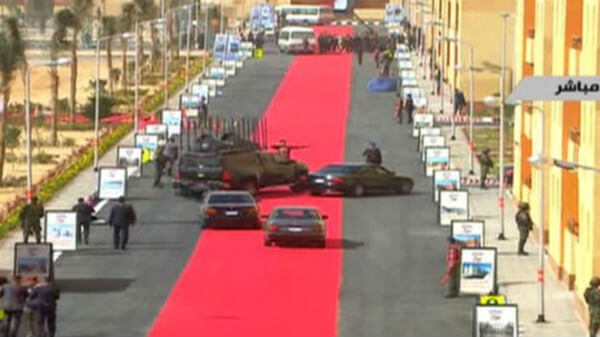
CNN reports: Morocco has switched on what will be the world’s largest concentrated solar power plant.
The new site near the city of Ouarzazate — famous as a filming location for Hollywood blockbusters like “Lawrence of Arabia” and “Gladiator” — could produce enough energy to power over one million homes by 2018 and reduce carbon emissions by an estimated 760,000 tons per year, according to the Climate Investment Funds (CIF) finance group.
As His Majesty Mohammed VI of Morocco pressed a button on 4 February 2016, the first phase of the three-part project was set in motion. [Continue reading…]
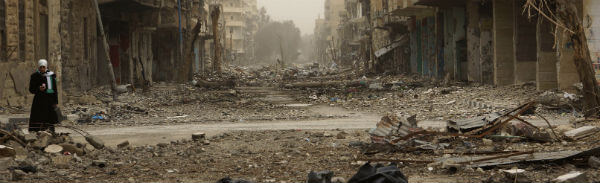
Hisham Melhem writes: Once again tens of thousands of Syrians are being uprooted and forced to flee their ancestral lands around the ancient city of Aleppo by the incessant assaults waged against them by the government that claims to represent them in Damascus. The country roads leading to the Turkish borders are being traversed by haggard people carrying with them remnants of shattered lives, dragging little children shivering in February’s cold, wandering under the last skies of Syria, and wondering if they will ever return.
Syria’s northern skies have been given by the Assad regime to Russia’s prowling bombers which have been spewing deadly fires and cluster bombs indiscriminately against areas controlled by the opposition groups. The ground has been given to marauding fighters from neighboring Lebanon and Iraq and from as far away as Afghanistan and other Central Asian states, in what can only be called a new “Shiite Internationale”, to help a minority regime bereft of the manpower needed to retake and subdue the rebellious country.
Those in the West, particularly in the United States, who may have allowed themselves to entertain the scandalous notion that things could not get worse in Syria, should be forced to see the blank and numb faces of people on the move who are already beyond pain and hope, to realize the folly of their wishful thinking. Syria’s new tragic chapter is unfolding under watchful but impotent Western eyes.
Secretary of State John Kerry, who has a deep and almost mystical belief in the power of diplomacy to settle violent disputes, a belief based on the naïve assumption that his peers are as rational and as well-meaning like him, found himself doing what he does best with Russia; pleading for cooperation, and reminding Russians of their obligation to enforce the U.N. Security Council Resolution 2254 that they co-sponsored to provide a roadmap to a political agreement.
White House press secretary Josh Earnest was truly earnest when he borrowed one of Kerry’s retorts, reminding the Russians that their “military strategy inside of Syria undermines the goals of their political strategy”. If only those obtuse Russians would listen to us explaining to them how best to reconcile their seemingly contradictory goals. The naiveté of this political position is matched only by the immense self-deception the Obama administration shared with many Syria “hands” in academe claiming that there is no ‘military’ solution to the civil war in Syria. [Continue reading…]
Emile Hokayem writes: What a difference a year makes in Syria. And the introduction of massive Russian airpower.
Last February, President Bashar al-Assad’s regime and its Shiite auxiliaries mounted a large-scale attempt to encircle Aleppo, the northern city divided between regime and rebels since 2012 and battered by the dictator’s barrel bombs. Islamist and non-Islamist mainstream rebels — to the surprise of those who have derided their performance, let alone their existence — repelled the offensive at the time. What followed was a string of rebel advances across the country, which weakened Assad so much that they triggered Moscow’s direct intervention in September, in concert with an Iranian surge of forces, to secure his survival.
Fast-forward a year. After a slow start — and despite wishful Western assessments that Moscow could not sustain a meaningful military effort abroad — the Russian campaign is finally delivering results for the Assad regime. This week, Russian airpower allowed Assad and his allied paramilitary forces to finally cut off the narrow, rebel-held “Azaz corridor” that links the Turkish border to the city of Aleppo. The city’s full encirclement is now a distinct possibility, with regime troops and Shiite fighters moving from the south, the west, and the north. Should the rebel-held parts of the city ultimately fall, it will be a dramatic victory for Assad and the greatest setback to the rebellion since the start of the uprising in 2011.
In parallel, Russia has put Syria’s neighbors on notice of the new rules of the game. Jordan was spooked into downgrading its help for the Southern Front, the main non-Islamist alliance in the south of the country, which has so far prevented extremist presence along its border. Turkey’s shooting down of a Russian military aircraft that crossed its airspace in November backfired: Moscow vengefully directed its firepower on Turkey’s rebel friends across Idlib and Aleppo provinces. Moscow also courted Syria’s Kurds, who found a new partner to play off the United States in their complex relations with Washington. And Russia has agreed to a temporary accommodation of Israel’s interests in southern Syria.
Inside Syria, and despite the polite wishes of Secretary of State John Kerry, the overwhelming majority of Russian strikes have hit non-Islamic State (IS) fighters. Indeed, Moscow and the Syrian regime are content to see the United States bear the lion’s share of the effort against the jihadi monster in the east, instead concentrating on mowing through the mainstream rebellion in western Syria. Their ultimate objective is to force the world to make an unconscionable choice between Assad and IS. [Continue reading…]
Hassan Hassan writes: Is Syrian president Bashar Al Assad finally winning? One can feel a deep sense of grief running through opposition factions whether inside or outside Syria over how events have unfolded over the past two weeks.
Pro-regime forces have made a series of major gains in northern, central and southern Syria over the past week.
More strikingly, they broke a three-year siege imposed by the rebels around the Shia towns of Nubbol and Zahraa, 20 kilometres from Aleppo city, which represents a major setback for the rebels especially as it could disrupt a game of encirclement and counter-encirclement that sustained the rebels’ control of much of Aleppo since 2012.
Five months after the regime’s forces seemed incapable of halting the string of victories achieved by the rebels in northern Syria, which led to the Russian military intervention to prop up their ally, the regime appears to be on the offensive. The offensive is seen n northern Latakia, the western Ghouta near Damascus, Deraa and in the rural areas of Hama, Idlib and Aleppo. The regime appears to have made an impressive comeback.
It is hard to judge how one side is doing through such tactical gains. The rebels were clearly on the winning side just a year ago, while the regime’s army suffered from a shortage in manpower, as admitted by Mr Al Assad himself during his last speech in August.
The breaking of the siege of Nubbol and Zahraa last week, as well as the siege of Kweiris airbase near Raqqa in November and the takeover of Sheikh Maskeen in Deraa last month, were spearheaded by foreign militias beholden to Iran.
The opposition’s real crisis is much deeper, hence the state of grieving widely felt by the rebels. These setbacks come amid profound internal, regional and international challenges that could tip the balance dramatically in favour of the regime. [Continue reading…]
The New York Times reports: When the Syrian refugees first started streaming into this bedraggled border town, Gassim al-Moghrebi was their tireless benefactor, distributing donations of food, money and clothes and sheltering as many as possible in two apartments he owned.
“All of Ramtha was just like me,” Mr. Moghrebi said, describing a good will rooted in family ties that spanned the border, and sympathy for the victims of a pitiless war. “One man had 10 apartments. He gave them to the Syrians for free.”
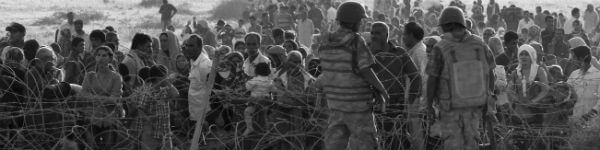
But now, as Syria witnesses a new escalation of violence, including waves of Russian airstrikes, and as Syrians flee for safety again by the tens of thousands, neighboring countries are increasingly overwhelmed and reluctant to let them in. In many places, that early altruism has hardened into resentment — an ominous turn for those fleeing war.
Desperate Syrians are backed up at the borders of Jordan and Turkey, barred from entering or else just allowed to trickle in. Increasingly, they find escape routes closing. [Continue reading…]
The Guardian reports: The bombs are falling so fast in Aleppo now that often rescuers don’t have time to reach victims between blasts. If the deadly explosions that struck on just one day last week had been evenly spaced, they would have struck every other minute around the clock.
“Sometimes there are so many airstrikes, we are just waiting and waiting at our headquarters, and the jets don’t leave the skies,” says Abdulrahman Alhassan, a 29-year-old former bank engineer from the city who coordinates “white helmet” rescue teams in the city.
“When at last we can’t see any more, we have to rush to all the sites to rescue people and evacuate them at once,” he said. On Friday, the group counted 900 airstrikes by government forces and their Russian backers, apparently throwing every weapon they have at the already devastated city.
Aid groups and people still inside the city believe the barrage is preparing the way for a blockade. The main supply line north of Aleppo has already been cut, and it will not take long before shortages bite in a ruined, desperate city.
“The Russian airstrikes are trying to completely destroy the area before they get on the ground and start the siege,” said Saad, a 35-year-old aid worker who chose to stay on and is now trapped inside the city. He says the bombing campaign was hitting both morale and food supplies. [Continue reading…]
BuzzFeed reports: A howling wind filled the air with sand, enveloping the small desert outpost. Shivering from the January cold, a skinny, bedraggled man in mismatched desert camouflage fatigues, a scarf wrapped around his face, took a deep breath and stepped forward. He tightened his grip on his AK-47 as the car pulled up to the checkpoint. Without a helmet or bulletproof vest, he warily approached, asking for identification papers, searching for weapons and checking the trunk. This time there was nothing inside, save for some rope and a few empty burlap sacks, likely to be filled with wheat or barley for the drive back. He relaxed, and waited for the next car to arrive.
Just a few years ago, the land around this outpost, 180 miles southeast of the Libyan capital of Tripoli, was a nature reserve where the deposed leader, Muammar al-Qaddafi, and his entourage would come for retreats, hunting for wild game. The spacious villas that housed them are dotted around, now empty, looted for their gaudy fixtures and fittings. Inhabitants of a nearby village have mostly fled. Once a sleepy patch of desert, Abu Grein has now become the front line against the Libyan branch of ISIS, a gathering force now threatening to demolish what’s left of the country.
The men at the checkpoints, ambling back and forth between shipping containers used as makeshift shelters, know that any one of the cars and trucks passing could be loaded to the brim with explosives, or jihadis seeking to kill them.
Mostly the militiamen come from the nearby city-state of Misrata. They knew that if ISIS gets through this front, their families and neighbors back home will be put at risk. From their stronghold in the city of Sirte about 90 minutes up the road, the list of atrocities carried out by ISIS is seemingly endless; they have dispatched suicide bombers, launched attacks on checkpoints, laid booby-trapped bombs, beheaded Christians and others, stormed the most upmarket hotel in the country, hijacked oil tankers and attacked oil facilities, kidnapped civilians, and captured fighters from the collection of dwindling militiamen that guard the front. [Continue reading…]
BuzzFeed reports: A second member of the notorious ISIS execution cell once headed by “Jihadi John” has been unmasked as a “quiet and humble” football fan from west London, BuzzFeed News and the Washington Post can reveal.
Thirty-two-year-old Alexanda Kotey has been identified by British and American intelligence services as one of four ISIS guards, collectively known as the “Beatles”, who are responsible for beheading 27 hostages. The guards were given their nickname by hostages because of their British accents.
It can be revealed that Kotey travelled to the Middle East alongside three other known extremists on a controversial aid convoy to Gaza organised by the London mayoral candidate George Galloway in 2009 – and friends in west London have not heard from him since.
He is the second member of the cell to be identified, after “Jihadi John” was exposed as west Londoner Mohammed Emwazi, who was killed by US a drone strike in November. The other members of the cell, nicknamed “Ringo”, “George”, and “Paul”, remain among the world’s most wanted men and are being hunted by intelligence and security services on both sides of the Atlantic. [Continue reading…]
Sebastian Meyer writes: As a journalist based in northern Iraq for the past six years, I’ve seen the war with the Islamic State closer than I’d like. In the summer of 2014, my best friend, a man I’d come to love and respect during my time reporting here, was taken prisoner by the militants. We were more like brothers than friends, and I haven’t heard from him since.
I was filming about 180 miles away on the evening he disappeared. I drove through the night to join a group of his friends and family in a rescue effort. While the militants stormed west across Iraq, we worked exhaustively to find him. (I can’t say more about him, because doing so could put him in further danger.) We were driven by rage and desperation.
Months later, Diji Terror, a Kurdish counterterrorism unit based in Sulaymaniyah, granted my request to interview an ISIS fighter I’d heard they had captured. Finally, a small chance to press the Islamic State for answers about its tactics. A chance for some catharsis.
Ali was seized during a nighttime raid caught on film: In the footage officials showed me, Diji troops handcuffed, blindfolded and bundled him off on a helicopter. Ali had beheaded prisoners, they told me; I couldn’t help but think of my friend.
When I met him, Ali wore an orange jumpsuit and plastic sandals. [Continue reading…]
The New York Times reports: The centerpiece of a plan for stemming gun violence that President Obama announced to great fanfare last month largely amounts to this: an updated web page and 10,000 pamphlets that federal agents plan to give out at gun shows.
In a tearful display of anger and sadness in the East Room of the White House, Mr. Obama ordered a series of steps intended to limit gun violence and vowed to clamp down on what he called widespread evasion of a federal law requiring gun dealers to obtain licenses.
But few concrete actions have been put in motion by law enforcement agencies to aggressively carry out the gun dealer initiative, despite the lofty expectations that Mr. Obama and top aides set.
Obama administration officials said they have no specific plans to boost investigations, arrests or prosecutions of gun sellers who do not comply with the law. No task forces have been assembled. No agents or prosecutors have been specifically reassigned to such cases. And no funding has been reallocated to accelerate gun sale- investigations in Washington or at the offices of the 93 United States attorneys. [Continue reading…]
The Associated Press reports: Czech police say unknown attackers have set a refugee center on fire in the Czech capital of Prague, injuring one person.
Spokeswoman Iveta Martinkova says about 20 people attacked the Klinika center in Prague’s No. 3 district with Molotov cocktails Saturday about 7:30 p.m. She says it’s not clear who was behind the attack and police are investigating.
The attack took place just hours after thousands of people rallied in Prague against Muslims and immigration. [Continue reading…]
The New York Times reports: The furor surrounding the death of an Italian student whose body was discovered Wednesday on an Egyptian roadside grew Friday as Italian investigators flew to Cairo to help find his killers, and it emerged that the young man had secretly written from Egypt for a left-wing Italian newspaper.
The newspaper, Il Manifesto, published an article on Friday that the Italian student, Giulio Regeni, 28, had written under a pseudonym weeks before he was found dead that was sharply critical of the Egyptian president, Abdel Fattah el-Sisi, while describing faltering attempts by Egyptian unions to organize.
There was no indication that Mr. Regeni’s writing led to his death, but the article contributed to the broader Italian outrage over Mr. Regeni’s injuries as news outlets pointed an accusatory finger at the Egyptian security forces. Egyptian officials said on Thursday that Mr. Regeni had been tortured extensively and probably died from a brain hemorrhage.
“Giulio, Egyptian police under accusation,” read the headline of La Stampa, a Turin-based daily newspaper.
Hoping to defuse a potentially damaging crisis with a relatively close European ally, Egyptian officials promised cooperation and vowed to find Mr. Regeni’s killers. The Italian prime minister, Matteo Renzi, spoke with Mr. Sisi by telephone and both agreed to cooperate to “unravel the mystery,” Mr. Sisi’s office said in a statement. [Continue reading…]
BBC News reports: Tens of thousands of Syrian refugees are moving to Turkey’s border to flee heavy fighting near the city of Aleppo, officials and activists have said.
Turkish Prime Minister Ahmet Davutoglu said up to 70,000 might be heading to the border, while a monitoring group put the number at about 40,000.
Intense Russian air strikes have helped Syria’s government troops make advances near the country’s largest city.
Meanwhile, Russia accused Turkey of preparing an invasion into Syria.
Also on Thursday, a Saudi military spokesman said the country was ready to send ground troops to Syria to fight the so-called Islamic State group. [Continue reading…]
The Independent reports: Forces loyal to Bashar al-Assad claimed to have severed the last rebel supply line to Aleppo last night in what would be a devastating blow to the Syrian opposition.
The attack, backed by Russian warplanes, was condemned by France for “torpedoing” tentative peace talks in Geneva, while the US said it was “difficult” to see how the air strikes, which the State Department said were mostly on civilian targets, would help resolve the conflict.
Pro-government media said that forces from the Syrian army and the Lebanese militia Hezbollah had reached two Shia towns north of the city that had been besieged by rebel insurgents. They claimed to have captured part of the only road that runs from Turkey to the rebel-held half of Aleppo, cutting its only supply route.
With pro-government forces close to surrounding Syria’s second city, the United Nations under-secretary general for humanitarian affairs, Stephen O’Brien, spoke yesterday of grave consequences for its beleaguered population if Aleppo was besieged by regime forces.
“What is happening in Syria is bad enough without something like that happening in Aleppo. But if the situation there gets worse we will have a large population at risk and we would need to get immediate access for road convoys to provide the necessary humanitarian assistance” he told The Independent. Aid groups also warned that a huge humanitarian crisis was looming, while people in the area were stockpiling food and supplies in anticipation of a siege. [Continue reading…]
The Guardian reports: The Russian defence ministry said on Thursday it had hit almost 900 targets in Syria in the previous three days. While Moscow’s intervention has the declared aim of battling the Islamic State terror group, military observers claim at least 70% of airstrikes have targeted opposition groups fighting to oust Assad. [Continue reading…]
Joyce Karam writes: “What are you talking about, 7000…No,no. We killed 38,000”, those were the words of former Syrian General Rifaat Assad in1982 as recounted by Thomas Friedman in his book “From Beirut to Jerusalem”. Rifaat, who is now in exile, was exulting about the number of Syrians his forces killed in Hama 34 years ago, quashing a rebellion against his brother’s dictatorship and setting the stage to what has followed.
The ghosts of Hama today hover all over Syria, cementing the pillars of the Assad doctrine to rule by fear and hold on to power at any cost even if it means surrendering the country to devastation, radicalization and ultimate death. From father to uncle to son, the Assad playbook has not changed, copying the narrative of Hama to Homs, Douma, Ghouta, Idlib, Daraa and Aleppo, and in the process leaving behind more than 250 thousands dead, millions displaced, and a society in shambles.
The 3-week assault on Hama in 1982 has laid the ground for how the Assad regime reacts to any signs of rebellion later. Not coincidentally, the same horror tactics utilized in Hama in 1982 with Assad the father were replicated by the son across Syria following the 2011 uprising.
In a chilling report by Amnesty International in 2012, survivors of the Hama massacre give their account of what happened, describing images of the dead splintered in the streets, left to be eaten by dogs and as a red flag for those whose lives were spared. Snipers were on the roofs, neighborhoods were razed and one survivor recalls the the attack on Mas’oud Mosque, where “some 60 men were killed before the security forces cut off their fingers and placed them along the mosque’s walls.” She tells Amnesty “for around two years after the massacre, no one dared remove the fingers. They were so frightened.” [Continue reading…]
This website or its third-party tools use cookies, which are necessary to its functioning. By closing this banner, you agree to the use of cookies.