Author Archives: News Sources

Responding to 9/11: Thoughts in the presence of fear

In 2001, shortly after the September 11 attacks, Wendell Berry wrote:

I. The time will soon come when we will not be able to remember the horrors of September 11 without remembering also the unquestioning technological and economic optimism that ended on that day.

II. This optimism rested on the proposition that we were living in a “new world order” and a “new economy” that would “grow” on and on, bringing a prosperity of which every new increment would be “unprecedented”.

III. The dominant politicians, corporate officers, and investors who believed this proposition did not acknowledge that the prosperity was limited to a tiny percent of the world’s people, and to an ever smaller number of people even in the United States; that it was founded upon the oppressive labor of poor people all over the world; and that its ecological costs increasingly threatened all life, including the lives of the supposedly prosperous.

IV. The “developed” nations had given to the “free market” the status of a god, and were sacrificing to it their farmers, farmlands, and communities, their forests, wetlands, and prairies, their ecosystems and watersheds. They had accepted universal pollution and global warming as normal costs of doing business.

V. There was, as a consequence, a growing worldwide effort on behalf of economic decentralization, economic justice, and ecological responsibility. We must recognize that the events of September 11 make this effort more necessary than ever. We citizens of the industrial countries must continue the labor of self-criticism and self-correction. We must recognize our mistakes. [Continue reading…]

Facebooktwittermail

Obama’s way is the wrong way to enforce international norms

Micah Zenko writes: Over the past two years, many thoughtful pieces have advocated for U.S. military intervention in Syria’s civil war. A review of such pieces reveals three core justifications: protecting civilians; altering the battlefield to help topple Assad or facilitate a diplomatic solution; and countering Iranian influence in the region. Very few have emphasized the need for the U.S. military to uphold international norms.

However, since the White House recently made norm-enforcement the primary, professed basis for attacking Syria, intervention advocates have adopted this reasoning. Indicative of this shift, in the 24 months preceding Secretary of State John Kerry’s August 26 speech, the words “international norm” and “Syria” appeared together 263 times in the 6,075 English-language news publications surveyed by the search engine Lexis Nexis, and 792 times in the 13 days after. Naturally, the normative argument has also become fodder for those opposing intervention, with Sen. Ted Cruz proclaiming on Sunday, “I don’t think that’s the job of our military, to be defending amorphous international norms.”

There are two fundamental questions at the heart of this debate that are worth discussing: what, exactly, norms are and how a state can and should go about enforcing them. The answers to these questions, taken together with recent, contradictory statements by the administration about its aims, reveal that, when it comes to international normative arguments, the U.S. is on shaky ground with its quest to strike Syria.

Norms, defined as “shared expectations about appropriate behavior held by a community of actors,” are socially constructed, highly contested, and forever changing. In international relations, both weak and powerful states attempt to promote and socialize norms that are in their own self-interest, while diminishing the salience of those that are not. As political scientist Ward Thomas notes, norms are “both products of and constraints upon state action, serving an essentially instrumental purpose.” For example, President Richard Nixon unilaterally abandoned U.S. offensive biological weapons programs (over the unanimous objection of the Joint Chiefs of Staff) in part for moral and diplomatic reasons, but also for material ones: Biological weapons provided no strategic deterrent advantages over nuclear weapons.

As compared to other norms, the one against the use of chemical weapons in warfare is widely endorsed, meeting international relations scholar Jeffrey Legro’s three criteria for what constitutes a robust norm: specificity, durability, and concordance. Somewhat counterintuitively, the norm’s durability has been further reinforced in Syria: Assad has been compelled to claim that he has never used chemical weapons, and his patron, Russia, is contending that chemical weapons attacks have only been conducted by rebel forces. Since Syrian security forces have not deployed chemical weapons in a widespread and indiscriminate manner since the opening days of the civil war, Assad has not embraced their use. He has also negotiated the — albeit delayed and constrained — United Nations chemical weapons inspection team access to sites where the attacks occurred to collect physical evidence.

With an understanding of what constitutes norms, the more pointed version of the second question of interest here is whether the U.S. bombing of Syria, with little overt or direct international support, would be the most widely accepted and enduring means of enforcing the norm against chemical weapons. As one senior administration official warned, “[D]oing nothing sends a message… that you can carry out chemical weapons attacks with impunity.” This assumes both that any alternatives to military force are “nothing,” and that the only way to enforce this international norm is with a few days of cruise missiles and airstrikes.

Unfortunately for the White House, there are norms about enforcement that contrast with its approach. Syria is a state party to the 1925 Geneva Protocol, which prohibits the use of “asphyxiating, poisonous or other gases” in warfare, and the International Covenant on Civil and Political Rights, which forbids the arbitrary deprivation of life. Neither of these treaties allows for a single country to be the arbiter and enforcement authority. Most world leaders and international lawyers believe Syria’s referral to the International Criminal Court, U.N. Human Rights Council, and/or the Security Council must be the first step before collective enforcement and punishment procedures are chosen.

If President Obama does not follow any of these near universally accepted enforcement procedures, and — with or without Congress’s approval — authorizes a near-unilateral attack against Assad regime targets, the U.S. will be derided, rejected, or ignored by much of the international community. An attack would build upon the already long and tragic history of American military involvement in the Middle East. Nobody in the region, or elsewhere for that matter, would conceive of this particular intervention in isolation from all the U.S. troops, missiles, and bombs that preceded them. Nothing captures public attention and anger like widely televised and well reported uses of military force. Should Obama proceed on the current path, the world will again remember America’s bombs far longer than the horrendous war crime that they were a response to. [Continue reading…]

Facebooktwittermail

Chemical weapons deal may end up strengthening Assad

USA Today reports: A deal allowing Bashar Assad to surrender Syria’s chemical weapons stockpiles runs the risk of extending his stay in power and undercutting support of rebels who have been fighting his regime with U.S. support, some analysts say.

“Assad is going to come out of this stronger,” said Flynt Leverett, a former National Security Council official who is now a professor at Penn State.

Instead of an attack that could weaken Syria’s military, particularly its ability to use chemical weapons, negotiations with Assad’s government could strengthen the Syrian leader, Leverett and others say.

No deal has been struck yet and the United States could still go ahead with a planned cruise missile strike if no agreement is reached, President Obama said in an address to the country Tuesday night.

The president asked Congress to postpone a vote on military action while pursuing diplomacy. But Obama said military action could still be used if diplomacy failed.

The plan was developed by Russia and would be formalized by the United Nations.

Analysts say the risk is that Russia and Syria will be tough negotiators who will use the talks as an attempt to build protection for Assad in return for giving up his regime’s chemical weapons, attempting to trade chemical weapons for allowing Assad to stay in power.

Russian Foreign Minister Sergey Lavrov has served as Russia’s permanent representative to the United Nations and understands the institution well, Leverett said. He has a reputation as a tough negotiator.

The process of removing Assad’s chemical weapons could take years, giving Assad and his Russian allies time. The destruction of Libya’s main chemical stockpiles were only completed this year, nearly 10 years after Moammar Gadhafi said he would relinquish his nuclear program and chemical weapons stockpiles.

During that time, Assad will likely be able to continue battling rebels while dealing with weapons inspectors and attempting to consolidate his power.

“In a sense it gives the regime permission to fire as much as it wants” if it doesn’t use chemical weapons, said Jeffrey White, an analyst at the Washington Institute for Near East Policy and a former Defense Intelligence Agency official. [Continue reading…]

Facebooktwittermail

‘It seems the world has decided it is OK for Assad to destroy Damascus with conventional weapons’

Reuters reports: Syrian warplanes bombed rebel suburbs of Damascus on Tuesday for the first time in three weeks, in an offensive that opposition activists said showed President Bashar al-Assad no longer feared attack by the United States.

Not seen in action around the capital since before August 21, when hundreds of people were killed in a poison gas attack that Western powers blame on Assad, government jets mounted attacks on three areas, some in support of assaults on the ground.

As world leaders discussed a Russian proposal to confiscate Syria’s chemical weapons and avert U.S. and French action, some of the heaviest fighting was in Barzeh, just north of central Damascus, where residents and opposition activists said air strikes and tank fire supported thrusts by pro-Assad militia.

The Syrian state news agency said troops “inflicted casualties on terrorists” in Barzeh and neighboring Qaboun.

“Even if the Russian initiative fails, the regime has at least bought itself time,” opposition activist Salah Mohammad said. “It seems to be calculating that no strike is coming soon.”

Mohammad said jets had staged three air raids on Barzeh on Tuesday while tanks on the heights of Qasioun mountain and in the government-held city center shelled the area in support of attacks by shabbiha militiamen pushing in to Barzeh from Ish al-Warwar, a district dominated by Assad’s minority Alawite sect.

“The fighting is heavy on that front,” Mohammed said. “The streets are narrow and tanks cannot be deployed.”

A woman living in Damascus said she could see shells hitting Barzeh, apparently fired from Qasioun. Speaking anonymously for fear of reprisals, she said: “Since chemical weapons are a red line, it seems the world has decided it is OK for Assad to destroy Damascus with conventional weapons.” [Continue reading…]

Facebooktwittermail

NSA shares raw intelligence including Americans’ data with Israel

The Guardian reports: The National Security Agency routinely shares raw intelligence data with Israel without first sifting it to remove information about US citizens, a top-secret document provided to the Guardian by whistleblower Edward Snowden reveals.

Details of the intelligence-sharing agreement are laid out in a memorandum of understanding between the NSA and its Israeli counterpart that shows the US government handed over intercepted communications likely to contain phone calls and emails of American citizens. The agreement places no legally binding limits on the use of the data by the Israelis.

The disclosure that the NSA agreed to provide raw intelligence data to a foreign country contrasts with assurances from the Obama administration that there are rigorous safeguards to protect the privacy of US citizens caught in the dragnet. The intelligence community calls this process “minimization”, but the memorandum makes clear that the information shared with the Israelis would be in its pre-minimized state.

The deal was reached in principle in March 2009, according to the undated memorandum, which lays out the ground rules for the intelligence sharing.

The five-page memorandum, termed an agreement between the US and Israeli intelligence agencies “pertaining to the protection of US persons”, repeatedly stresses the constitutional rights of Americans to privacy and the need for Israeli intelligence staff to respect these rights.

But this is undermined by the disclosure that Israel is allowed to receive “raw Sigint” – signal intelligence. The memorandum says: “Raw Sigint includes, but is not limited to, unevaluated and unminimized transcripts, gists, facsimiles, telex, voice and Digital Network Intelligence metadata and content.”

According to the agreement, the intelligence being shared would not be filtered in advance by NSA analysts to remove US communications. “NSA routinely sends ISNU [the Israeli Sigint National Unit] minimized and unminimized raw collection”, it says.

Although the memorandum is explicit in saying the material had to be handled in accordance with US law, and that the Israelis agreed not to deliberately target Americans identified in the data, these rules are not backed up by legal obligations. [Continue reading…]

Facebooktwittermail

NSA illegally gorged on U.S. phone records for three years

Wired reports: What happens when a secret U.S. court allows the National Security Agency access to a massive pipeline of U.S. phone call metadata, along with strict rules on how the spy agency can use the information?

The NSA promptly violated those rules — “since the earliest days” of the program’s 2006 inception — carrying out thousands of inquiries on phone numbers without any of the court-ordered screening designed to protect Americans from illegal government surveillance.

The violations continued for three years, until they were uncovered by an internal review, and the NSA found itself fighting to keep the spy program alive.

That’s the lesson from hundreds of pages of formerly top secret documents from the Foreign Intelligence Surveillance Court, released today by the Obama administration in response to a successful Freedom of Information Act lawsuit brought by the Electronic Frontier Foundation.

“Incredibly, intelligence officials said today that no one at the NSA fully understood how its own surveillance system worked at the time so they could not adequately explain it to the court,” says EFF activist Trevor Timm. “This is a breathtaking admission — the NSA’s surveillance apparatus, for years, was so complex and compartmentalized that no single person could comprehend it.”

Intelligence Director James Clapper, in a blog post today, blamed the unlawful spying in part on “the complexity of the technology employed in connection with the bulk telephony metadata collection program,” and said it was not done deliberately.

But the secret surveillance court, set up in 1978 to oversee intelligence-gathering activities, didn’t see it that way. In 2009, in response to the government telling the court that it was searching call records without “reasonable articulable suspicion” or RAS, the court said the government’s explanation “strains credulity.” [Continue reading…]

Facebooktwittermail

HRW report on the August 21 attacks on Ghouta, Damascus

The summary of a newly released Human Rights Watch report says: This report details two alleged chemical weapons attacks in Syria on the opposition-controlled Damascus suburbs of Eastern and Western Ghouta, located 16 kilometers apart, on the morning of August 21, 2013. The attacks killed hundreds of civilians, including large numbers of children. Human Rights Watch analyzed witness accounts of the rocket attacks, information on the likely source of the attacks, the physical remnants of the weapon systems used, and the medical symptoms exhibited by the victims of the attack as documented by medical staff.

Our investigation finds that the August 21 attacks were likely chemical weapons attacks using a surface-to-surface rocket system of approximately 330mm in diameter—likely Syrian-produced—and a Soviet-era 140mm surface-to-surface rocket system to deliver a nerve agent. Evidence suggests the agent was most likely Sarin or a similar weapons-grade nerve agent. Three local doctors told Human Rights Watch that victims of the attacks showed symptoms which are consistent with exposure to nerve gas, including suffocation; constricted, irregular, and infrequent breathing; involuntary muscle spasms; nausea; frothing at the mouth; fluid coming out of noses and eyes; convulsing; dizziness; blurred vision; and red and irritated eyes, and pin-point pupils.

The evidence concerning the type of rockets and launchers used in these attacks strongly suggests that these are weapon systems known and documented to be only in the possession of, and used by, Syrian government armed forces. Human Rights Watch and arms experts monitoring the use of weaponry in Syria have not documented Syrian opposition forces to be in the possession of the 140mm and 330mm rockets used in the attack, or their associated launchers.

The Syrian government has denied its responsibility for the attack, and has blamed opposition groups, but has presented no evidence to back up its claims. Based on the available evidence, Human Rights Watch finds that Syrian government forces were almost certainly responsible for the August 21 attacks, and that a weapons-grade nerve agent was delivered during the attack using specially designed rocket delivery systems. The scale and coordinated nature of the two attacks; against opposition-held areas; the presence of government-controlled potential launching sites within range of the targets; the pattern of other recent alleged chemical weapon attacks against opposition-held areas using the same 330mm rocket delivery system; and the documented possession of the 140mm and 330mm rocket systems able to deliver chemical weapons in the government arsenal—all point towards Syrian government responsibility for the attacks.

Human Rights Watch has investigated alternative claims that opposition forces themselves were responsible for the August 21 attacks, and has found such claims lacking in credibility and inconsistent with the evidence found at the scene. Claims that the August 21 deaths were caused by an accidental explosion by opposition forces mishandling chemical weapons in their possession are inconsistent with large numbers of deaths at two locations 16 kilometers apart, and documentation of rocket attacks on the sites that morning, as evidenced by witness accounts, the damage visible on the rockets themselves, and their impact craters.

Facebooktwittermail

Chemical weapons deal ‘deceptively attractive’

The New York Times reports: Spread far and wide across Syria, the chemical weapons complex of the fractured state includes factories, bunkers, storage depots and thousands of munitions, all of which would have to be inspected and secured under a diplomatic initiative that President Obama says he is willing to explore.

But monitoring and securing unconventional weapons have proved challenging in places like Iraq, North Korea and Iran — even in peacetime. Syria is bound up in the third year of a bloody civil war, with many of the facilities squarely in battlefields.

“I’m very concerned about the fine print,” said Amy E. Smithson, an expert on chemical weapons at the Monterey Institute of International Studies in California. “It’s a gargantuan task for the inspectors to mothball production, install padlocks, inventory the bulk agent as well as the munitions. Then a lot of it has to be destroyed — in a war zone.”

“What I’m saying is, ‘Beware of this deal,’ ” Dr. Smithson added. “It’s deceptively attractive.”

As difficult as it may be to reach a diplomatic solution to head off a United States strike on Syria, the details of enforcement are themselves complex and uncertain, people with experience monitoring weapons facilities said.

Syria would first have to provide specifics about all aspects of its chemical weapons program. But even that step would require negotiation to determine exactly what should be declared and whether certain systems would be covered, because many delivery systems for chemical weapons — including artillery, mortars and multiple-rocket launchers — can also fire conventional weapons.

Then, experts said, large numbers of foreign troops would almost certainly be needed to safeguard inspectors working in the midst of the civil war.

“We’re talking boots on the ground,” said one former United Nations weapons inspector from Iraq, who spoke on the condition of anonymity because he still works in the field on contracts and did not want to hurt his chances of future employment. “We’re not talking about just putting someone at the gate. You have to have layers of security.”

Destruction and deactivation of those weapons could then take years. [Continue reading…]

Facebooktwittermail

The U.S. should seize the opportunity created by Iranian voters

Scott Lucas writes: In a prime-time interview on State TV on Tuesday night, President Rouhani had a message for the US and its allies.

The President said that Iran is ready for “serious talks” with the 5+1 Powers on Tehran’s nuclear program — as soon as possible — on the basis of mutual respect and trust.

Rouhani was not making any concessions. Indeed, he made clear that Iran will not give up sovereignty and the right to enrich uranium, and emphasized that any agreement must be “win-win”. However, the President signaled that the West could be assured he has the space and authority to reach a settlement:

The preparations have been made on our side. The first measure was for me to decide whether the negotiating body was, like in the past, the Secretariat of the Supreme National Security Council [which reports to the Supreme Leader]….I determined and announced that the Ministry of Foreign Affairs [which reports to the President] would be responsible for nuclear talks….

We are absolutely ready for serious negotiations with the world, both with P5+1 and the IAEA [International Atomic Energy Agency].

The President’s office has also used Rouhani’s English-language Twitter account to put out the message that Iran is “committed to international regulations” over its nuclear program. While this is not a new message for Tehran to give, the President has made sure to emphasize it without burying it in rhetoric. [Continue reading…]

Facebooktwittermail

How Assad wooed the American Right, and won the Syria propaganda war

Foreign Policy: Even before President Barack Obama put his plans to strike the Syrian regime on hold, he was losing the battle of public opinion about military intervention. Part of the credit, no doubt, goes to a successful media blitz by Syrian President Bashar al-Assad’s regime and its supporters. In an interview aired on Monday night, Assad himself advanced his government’s case to Charlie Rose, saying that the United States had not presented “a single shred of evidence” proving the Syrian military had used chemical weapons.

Assad has always been able to skillfully parry Western journalists’ criticisms of his regime — and, at times, it has won him positive international coverage. Before the uprising, the U.S. media often described the Assad family as Westernized leaders who were trying to bring their country into the 21st century. The most infamous example was Vogue‘s profile of Asma al-Assad, which described Syria’s first lady as “a thin, long-limbed beauty with a trained analytic mind … [with] a killer IQ.” But even experts in the field went along: Middle East historian David Lesch wrote a biography of Bashar describing the president as a modernizer, before changing his mind during the uprising.

The carnage over the past two and a half years put an end to much of this praise — but now pro-Assad media outlets have found a new way to influence the American debate. Assad supporters’ claims have repeatedly been republished unquestioningly by right-wing commentators in the United States, who share their hostility toward both Sunni Islamists and the Obama administration. It’s a strange alliance between American conservatives and a regime that was one of America’s first designated state sponsors of terror, and continues to work closely with Iran and Hezbollah.

“There is evidence — mounting evidence — that the rebels in Syria did indeed frame Assad for the chemical attack,” conservative talk show host Rush Limbaugh told his audience on Sept. 3. “But not only that, but Obama, the regime, may have been complicit in it. Mounting evidence that the White House knew and possibly helped plan the Syrian chemical weapon attack by the opposition!”

Limbaugh’s cited an article by Yossef Bodansky on Global Research, a conspiracy website that has advanced a pro-Assad message during the current crisis. “How can the Obama administration continue to support and seek to empower the opposition which had just intentionally killed some 1,300 innocent civilians?” Bodansky asked.

Bodansky is an ally of Bashar’s uncle, Rifaat al-Assad — he pushed him as a potential leader of Syria in 2005. Rifaat is the black sheep of the Assad family: He spearheaded the Syrian regime’s brutal crackdown on the Muslim Brotherhood in the early 1980s, but then was forced into exile after he tried to seize power from his brother, President Hafez al-Assad, in 1983. Despite his ouster, however, Rifaat is just as hostile to a Sunni Islamist takeover as other members of the Assad family — a position Bodansky appears to share. Ending Alawite rule in Syria, Bodansky wrote on another pro-Assad website, “will cause cataclysmic upheaval throughout the greater Middle East.” [Continue reading…]

Facebooktwittermail

Syria confirms it has chemical weapons

The Wall Street Journal reports: Syria said it would cease production of chemical weapons and disclose the locations of its stockpiles to the United Nations, Russia and others, as Damascus seized on a possible diplomatic route to avert international military action.

The statement by Syrian Foreign Minister Walid Moallem represented the first direct admission by the Syrian government that it possesses chemical weapons. Mr. Moallem said Syria aimed to sign the international convention banning chemical weapons.

The offer came as Syria’s ally Russia clashed with France over a possible U.N. Security Council resolution aimed at forcing Syria to hand over its stockpiles, following what the U.S. and France said was the Syrian government’s use of chemical weapons in an attack outside Damascus on Aug. 21.

Syria has denied a role in the attack, blaming opposition rebels in the country’s 2½-year old civil war.

President Barack Obama has mounted a campaign at home and abroad for support for military action to punish Syrian President Bashar al-Assad’s regime for the attacks.

That campaign, and U.S. congressional debate over supporting military action, have been sidetracked by a Russian proposal that led to Syria’s unexpected offer.

Mr. Obama has agreed to explore the possibility of a Syrian chemical-weapons handover, the White House said, even as he continued to seek support for a U.S. military strike from a reluctant Congress.

Mr. Obama traveled to the Capitol to meet with Senate Democrats and Republicans on Tuesday, ahead of a prime-time speech to make his case to the American public. Secretary of State John Kerry and Defense Secretary Chuck Hagel again testified on Capitol Hill to press the case for military action.

Secretary of State John Kerry warned Tuesday that it would be “exceedingly difficult” for Syria to meet the international community’s conditions for giving up its chemical weapons and avoiding a threatened U.S. military strike.

But a new international debate also took shape over a possible U.N. resolution.

French Foreign Minister Laurent Fabius said France’s proposal would invoke Chapter 7, a clause that allows member states to use all possible means, including military action, to enforce a U.N. resolution.

Mr. Fabius said the resolution would call for consequences if the regime of Mr. Assad fails to comply with the proposed program, adding that “all options remain on the table.”

Russia’s Foreign Ministry rejected the French proposal because of the Chapter 7 reference, as well as the suggestion that the resolution would blame the Syrian government for deploying chemical weapons. [Continue reading…]

Facebooktwittermail

Obama’s rogue state tramples over every law it demands others uphold

George Monbiot writes: You could almost pity these people. For 67 years successive US governments have resisted calls to reform the UN security council. They’ve defended a system which grants five nations a veto over world affairs, reducing all others to impotent spectators. They have abused the powers and trust with which they have been vested. They have collaborated with the other four permanent members (the UK, Russia, China and France) in a colonial carve-up, through which these nations can pursue their own corrupt interests at the expense of peace and global justice.

Eighty-three times the US has exercised its veto. On 42 of these occasions it has done so to prevent Israel’s treatment of the Palestinians being censured. On the last occasion, 130 nations supported the resolution but Barack Obama spiked it. Though veto powers have been used less often since the Soviet Union collapsed in 1991, the US has exercised them 14 times in the interim (in 13 cases to shield Israel), while Russia has used them nine times. Increasingly the permanent members have used the threat of a veto to prevent a resolution being discussed. They have bullied the rest of the world into silence.

Through this tyrannical dispensation – created at a time when other nations were either broken or voiceless – the great warmongers of the past 60 years remain responsible for global peace. The biggest weapons traders are tasked with global disarmament. Those who trample international law control the administration of justice. [Continue reading…]

Facebooktwittermail

Syrian refugees

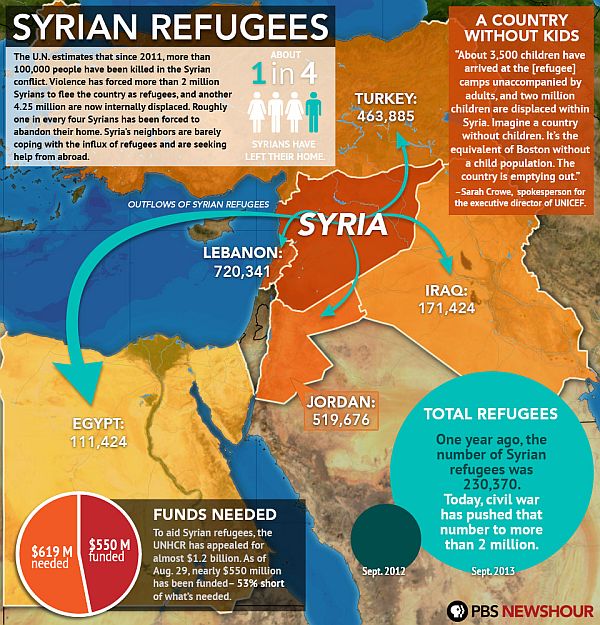
Note: Israel is by far the wealthiest country bordering Syria yet it hasn’t accepted any refugees. Some people may counter that Syrians wouldn’t want to seek refuge in the Jewish state. But Israel wouldn’t need to accommodate refugees inside Israel in order to accept them. Refugee camps could be created in the Golan Heights, which is to say, inside Israeli-occupied Syria.

Facebooktwittermail

Russia gets Obama off the hook

Scott Lucas writes: Unresolved questions are flying over Russia’s proposal that Syria to give up chemical weapons stocks, in exchange for the US lifting its threat of airstrikes. Did Moscow seize upon a blunder by US Secretary of State John Kerry on Monday morning to make the proposal? Or did Russia and the Obama Administration work behind the scenes to come to an acceptable compromise?

In either case, the immediate outcome is that the Russians have gotten President Obama off the political hook.

Twenty-four hours ago, Obama was facing domestic and international humiliation, piled upon his indecision and mis-steps since the Assad regime’s August 21 chemical weapons attacks.

In the week following the attacks, the US President fumbled over whether the US would carry out a “limited” military response to the mass killing. Then on August 30, when US Secretary of State John Kerry finally put Washington on the verge of action with a tough speech, Obama abruptly changed course. The President believed a strike was necessary, but rather than taking the decision himself, he would put the issue to Congress.

For the sake of his domestic position, Obama had given the Assad regime a window of at least two weeks to resume a mass offensive against insurgent positions. But even the move on the home front was on the verge of backfiring last weekend: polling of Congressional representatives indicated there would be an embarrassing rejection of Obama’s proposal for limited intervention.

Other developments had hindered Obama. The British Parliament’s rejection of immediate action undermined a “coalition” for the airstrikes, and the President’s military has waged an internal but well-publicized battle against any intervention.

Still, the headline after Congress’s verdict looked set to be that the Commander-in-Chief had failed to Command.

And then on Monday, Russia offered salvation — whether as part of a smart, back-channel plan with the Americans or as an opportunistic gambit.

Moscow’s seizure of the political high ground, offering “peace” through Syria’s relinquishing of chemical weapons and the deferral of US airstrikes, meant that Obama could step back from the Congressional cliff. As the President told national television on Monday night that he supported the Russian plan in principle, the Senate postponed its vote, set for Wednesday. That in turn delays a decision by the House of Representatives, the more likely of the two chambers to reject intervention.

Of course, none of this — so far — offers a practical answer as to how Syria’s chemical weapons will be secured and handed over. Such a process is likely to take many weeks, and it can only be achieved if there is a cease-fire on the ground, a far-from-likely prospect. [Continue reading…]

Facebooktwittermail

France to seek UN backing for Russian plan on Syrian chemical arsenal

The New York Times reports: As the diplomatic pace quickened around Russia’s plan for Syria to relinquish control of its chemical weapons, France said on Tuesday it would propose a United Nations Security Council resolution enshrining the idea while Moscow said it was working with the authorities in Damascus on a “workable, precise and concrete plan” to carry the proposal forward.

“We are hoping to present this plan in the near future,” Sergey V. Lavrov, the Russian foreign minister, said. “We will be ready to work through this plan and improve it with the participation of the U.N. general secretary, with chemical weapons control organizations and with the members of the Security Council.”

The Russian blueprint also won backing from China, which has resisted Western calls for military action against Syria but said on Tuesday that it supported Moscow’s avowed effort to avert an American strike following last month’s poison gas attacks outside Damascus.

Hours before President Obama planned to deliver a major national address on the Syrian crisis, the rapid-fire developments elicited skepticism from many regional and international players who questioned the motives behind the Russian gambit and questioned whether Moscow’s plan would enable the Syrian authorities to buy time. [Continue reading…]

Facebooktwittermail

Dismantling Syria’s chemical weapons arsenal is ‘nice idea but tough to achieve,’ experts say

Reuters reports: Any deal with Syria to hand over its chemical weapons in the middle of a chaotic civil war would be difficult for inspectors to enforce and destroying them would likely take years, U.S. officials and experts caution.

Syria’s strongest backer, Russia, proposed on Monday that Damascus save itself from a U.S. military strike over its alleged use of chemical weapons by putting its stockpiles under international control.

The proposal was welcomed by Syria and seized upon by the secretary-general of the United Nations. U.S. President Barack Obama said the offer was a potential breakthrough but had to be handled with skepticism.

Syria has never signed a global treaty banning the storage of chemical weapons and is believed to have large stocks of sarin, mustard gas and VX nerve agents. The actual use of chemical weapons is banned by a 1925 treaty to which Damascus is a signatory.

Accounting for Syria’s chemical arms cache – believed to be spread over dozens of locations – would be difficult, as would be shielding arms inspectors from violence.

“This is a nice idea but tough to achieve,” said one U.S. official speaking on condition of anonymity.

“You’re in the middle of a brutal civil war where the Syrian regime is massacring its own people. Does anyone think they’re going to suddenly stop the killing to allow inspectors to secure and destroy all the chemical weapons?” the official said.

Amy Smithson, an expert on nuclear, biological and chemical weapons at the James Martin Center for Nonproliferation Studies in Washington, said a lack of hard data on Syria’s chemical weapons inventory would complicate verification. [Continue reading…]

Facebooktwittermail

Israel skeptical about Russian plan; Netanyahu said to be personally lobbying Congress to support attack on Syria

The Times of Israel reports: Details of a deal to put Syria’s chemical weapons under international control are highly murky, Knesset foreign affairs chief Avigdor Liberman said Tuesday, warning that the plan could potentially serve the interests of the Assad regime.

Speaking to Israel Radio, the head of the Knesset Foreign Affairs and Defense Committee said Syrian President Bashar “Assad is winning time and lots of it,” as a result of the Russian plan. Comparing the situation to that of Iran’s nuclear program, he noted that the Syrian leader could use the initiative to “buy time” and stall any real international involvement, military or other.

Liberman, a former foreign minister, warned that Israel was determined not to be dragged into the conflict but would not shy away from retaliating if the country was attacked, no matter who the aggressor may be.

The New York Times reports: The American Israel Public Affairs Committee, the powerful pro-Israel lobby in Washington, plans to dispatch 300 of its members to Capitol Hill on Tuesday as part of a broad campaign to press Congress to back President Obama’s proposed strike on Syria, the group said Monday.

The push by the group, known as Aipac, which included asking its supporters to call members of Congress, came as Israeli newspapers reported Monday that President Obama urged Prime Minister Benjamin Netanyahu to get personally involved in lobbying Congress. The reports said that Mr. Netanyahu had called several members himself.

But while those reports could not be confirmed, the intense push by Aipac and other Jewish and pro-Israel groups put Israel in a bind, after a week of trying to stay on the sidelines of the debate. Mr. Netanyahu’s government strongly supports an American strike to punish President Bashar al-Assad of Syria for his apparent use of chemical weapons, and as a warning to his Iranian patrons. But Israelis are deeply worried about being blamed by a wary American public for another military gambit in the Middle East, or of losing their broad bipartisan support if they land on the wrong side of the vote.

“It is a major dilemma, what Israel should do on the Hill,” a senior Israeli official said Monday, speaking on the condition of anonymity because of a dictate from Mr. Netanyahu not to discuss the Syria situation publicly. “We don’t want to be identified with pressing for a strike. This is not for us — we don’t want anybody to think this is for us,” the official said. “But if the president asks us for assistance, who are we to refuse?”

Mark Regev, a spokesman for Mr. Netanyahu, declined to discuss the prime minister’s conversations with Mr. Obama, or to say whether Mr. Netanyahu had indeed called members of Congress, as reported by the newspaper Yediot Aharonot. The Israeli official who spoke anonymously pointed to a Facebook post last week by Michael B. Oren, Israel’s ambassador to Washington, agreeing with President Obama’s argument for attacking Syria, as having given the green light for Aipac to spring into action.

But if Aipac, as an American organization, has a role to play in Washington debates, several Israeli analysts said that any direct involvement by Israeli officials was problematic.

“Israel as Israel should stay away from this campaign,” said Zvi Rafiah, a longtime Israeli diplomat and consultant on American politics. “We should not be the one that pushes the American people to do or not do anything they want or don’t want.”

Facebooktwittermail