At the Bulletin of the Atomic Scientists, John Cook writes: Since the late 1980s, governments and policy makers have worked to develop policy to mitigate climate change. At the same time, opponents have worked to delay and prevent climate action—not just by attacking policy solutions, but also by attacking climate science. A key focus in this decades-long campaign has been to cast doubt on the scientific consensus that humans are causing global warming.
Why attack the consensus? In recent years, social scientists have started to put the pieces together. A study published in the journal Nature Climate Change in 2011, replicated by a 2013 study published in the journal Climatic Change, found that public perceptions about scientific agreement are linked to support for policy to mitigate climate change. When people think that scientists are still debating about what’s causing climate change, they’re less likely to support climate action.
Social scientists were not the first to come to this realization. Political consultant Frank Luntz advised Republicans in the 2000 presidential election to cast doubt on the consensus, arguing “should the public come to believe that the scientific issues are settled, their views about global warming will change accordingly.” More than a decade before social scientists observed the link between perceived consensus and support for climate policy, opponents of climate action understood this link and implemented communication strategies designed to erode public support for climate policy.
In fact, attacks on the consensus date back to the early 1990s. In 1991, the Western Fuels Association spent more than $500,000 on a campaign to “reposition global warming as theory (not fact).” More recently, an analysis of conservative columns published from 2007 to 2010 found that the most repeated climate myth was “there is no scientific consensus.” [Continue reading…]
Author Archives: News Sources
British government pressured The Guardian to hand over the Snowden files
Alan Rusbridger, editor of The Guardian, writes: A little over two months ago I was contacted by a very senior government official claiming to represent the views of the prime minister. There followed two meetings in which he demanded the return or destruction of all the material we were working on. The tone was steely, if cordial, but there was an implicit threat that others within government and Whitehall favoured a far more draconian approach.
The mood toughened just over a month ago, when I received a phone call from the centre of government telling me: “You’ve had your fun. Now we want the stuff back.” There followed further meetings with shadowy Whitehall figures. The demand was the same: hand the Snowden material back or destroy it. I explained that we could not research and report on this subject if we complied with this request. The man from Whitehall looked mystified. “You’ve had your debate. There’s no need to write any more.”
During one of these meetings I asked directly whether the government would move to close down the Guardian’s reporting through a legal route – by going to court to force the surrender of the material on which we were working. The official confirmed that, in the absence of handover or destruction, this was indeed the government’s intention. Prior restraint, near impossible in the US, was now explicitly and imminently on the table in the UK. But my experience over WikiLeaks – the thumb drive and the first amendment – had already prepared me for this moment. I explained to the man from Whitehall about the nature of international collaborations and the way in which, these days, media organisations could take advantage of the most permissive legal environments. Bluntly, we did not have to do our reporting from London. Already most of the NSA stories were being reported and edited out of New York. And had it occurred to him that Greenwald lived in Brazil?
Britain is engaging in state terrorism
Simon Jenkins writes: The detention at Heathrow on Sunday of the Brazilian David Miranda is the sort of treatment western politicians love to deplore in Putin’s Russia or Ahmadinejad’s Iran. His “offence” under the 2000 Terrorism Act was apparently to be the partner of a journalist, Glenn Greenwald, who had reported for the Guardian on material released by the American whistleblower, Edward Snowden. We must assume the Americans asked the British government to nab him, shake him down and take his personal effects.
Miranda’s phone and laptop were confiscated and he was held incommunicado, without access to friends or lawyer, for the maximum nine hours allowed under law. It is the airport equivalent of smashing into someone’s flat, rifling through their drawers and stealing papers and documents. It is simple harassment and intimidation.
Greenwald himself is not known to have committed any offence, unless journalism is now a “terrorist” occupation in the eyes of British and American politicians. As for Miranda, his only offence seems to have been to be part of his family. Harassing the family of those who have upset authority is the most obscene form of state terrorism. [Continue reading…]
Reuters reports: U.S. officials did not ask the British government to question the partner of the journalist who first reported secrets leaked by fugitive U.S. intelligence agency contractor Edward Snowden, the White House said on Monday.
British authorities did, however, give their U.S. counterparts a “heads up” before detaining the partner of American journalist Glenn Greenwald, Brazilian David Miranda, the White House said.
“This was a decision that they made on their own, and not at the request of the United States,” White House spokesman Josh Earnest told reporters at a briefing. “This is something that they did independent of our direction,” he added.
Who needs direction when all it takes is a nod and a wink? The White House knew exactly what was happening and it had absolutely no objections.
Egypt: Beyond the voice of battle
Jack Shenker writes: No matter how many times you witness it, the transformation is still a dizzying one. Kiosks that once vended chocolate and cigarettes, deployed as a gunman’s shield. Shop window shutters framing sugar-sopped cakes or risqué clothes mannequins, now the roughage of a street barricade and clouded in teargas. Rooftops normally barnacled with satellite dishes and humming AC units, today specked with sniper rifle sights. All that familiar stuff, wrenched from an old reality and pressed into use as something different. Two and a half years in, the urban shift from mundane to martial remains as abnormal as ever.
What is happening in Egypt at the moment, and what is being lost? Lives, above all else; hundreds of them — on the streets of Cairo mainly, but also beyond the capital in towns and villages beyond the gaze of the global media. It feels remarkable to have to say this when the sentiment is so obvious, but in the bitter atmosphere of recrimination and accusation that seemingly pervades all Egypt debate at present, it must be said nonetheless: The biggest tragedy of recent weeks is the death of so many, and the maiming of so many more.
Once again, Egyptians are scrawling their names on their arms in a simple effort to avoid being reduced to a number in a morgue, or worse still consigned to the ranks of the uncounted. Amid footage of besieged mosques, robocop machine-gun fire and the dreadful, desperate sight of people throwing themselves off bridges to escape a maze of bullets, it’s that little detail — the writing on the arms — that always chills me the most. Like efforts by volunteers to collect and catalogue the belongings of the dead, some of whom risked their lives to retrieve plastic bags stuffed with scraps of non-life as army bulldozers closed in, writing a name on an arm feels like the most basic affirmation of presence in the face of a state committed to inflicting absence by the bucket load: Absence of heartbeats, absence of humanity, absence of anything but a narrative in which everything is black and white and people are units to be slotted into predrawn political templates. Writing a name on an arm says, devastatingly, “No — I was here too.”
But beyond people, something else is being lost, too — just as those most invested in the old Egypt intended. For me, the most powerful expression of Egypt’s revolution has never been anything tangible, but rather that state of mind when the world seems to tip on its head and bevel with possibility, where the landscape of imagination is recast. I first encountered it on January 25 2011, as I marched alongside a group of anti-Mubarak protesters down the Corniche in central Cairo, and felt a heart-pounding distortion of the air as a line of armed Central Security Forces fanned across the road with their shields up, blocking the path ahead.
Prior to that day, I’d attended countless demonstrations consisting of a few dozen Egyptians shunted to some inconspicuous corner of the street, a tight bristle of political energy marooned in an ocean of black-clad troops. The deployment of the police across the road in front of us was a signal that the next section of this script was due to commence; we would come a stop, engage in some minor scuffling, and then be herded into a harmless protest pen so that the capital could get on with its day. But on this occasion, with reports of mass unrest spreading throughout the city, something was different. Nobody among the marchers slowed, nobody broke ranks, and instead they just kept on going, right towards those shields, chanting and glaring mutinously into the eyes of those that held them — each of whom glanced uneasily around at one another and wondered nervously how to respond. In the end, the troops simply gave way. And as we pushed past them and onto the empty street behind, several protesters broke into a run — or more accurately a skip, a dance, a hodgepodge of hops and jumps — and many began whooping and hollering and even kissing the ground.
Doubtless, more important things were happening elsewhere at that moment, beyond that little carpet of liberated asphalt. Certainly episodes of much greater drama would unfold afterwards, both later that evening, as security forces broke the occupation of Tahrir Square with volleys of tear gas, and three days on, when over 100 police stations were burnt to a cinder and Egypt’s people finally forced Mubarak’s security forces to flee into the night. But for me, that single moment in time — when those around me spontaneously decided to break through the police line and rewrite a mothballed script from the bottom up, that nanosecond where the globe spun, a street was reclaimed and everything in the old universe seemed to stagger, pitch and tumble forward into infinite opportunity — that was revolution, distilled to its purest form. It felt like a tiresome step dance had just gone freestyle as the performers rethought their collective horizons, and careened wildly into a space they had always been told was not for them. It felt like nothing could be the same again. [Continue reading…]

At the root of Egyptian rage is a deepening resource crisis
Nafeez Mosaddeq Ahmed writes: With more than 600 people killed and almost 4,000 injured from clashes between Egyptian security forces and Muslim Brotherhood protesters, the country’s democratic prospects look dismal. But while the violence is largely framed as a conflict between Islamism and secularism, the roots of the crisis run far deeper. Egypt is in fact on the brink of a protracted state-collapse process driven by intensifying resource scarcity.
Since the unilateral deposition of President Morsi, the army’s purported efforts to “restore order” are fast-tracking the country toward civil war. The declaration of a month-long state of emergency—ironically in the name of defending “democracy”—suggests we are witnessing the dawn of a new era of unprecedented violence with the potential to destabilize the entire region.
Underlying growing instability is the Egyptian state’s increasing inability to contain the devastating social impacts of interconnected energy, water and food crises over the last few decades. Those crises, already afflicting other regional states like Yemen and Syria, will unravel prevailing political orders with devastating consequences—unless urgent structural transformation to address those crises becomes a priority. The upshot is that Egypt’s meltdown represents the culmination of long-standing trends that, without a change of course, can only escalate with permanent repercussions across the Middle East and North Africa (MENA), and beyond. [Continue reading…]
Obama’s foreign policy image takes hit with Egypt upheaval
The Hill, noting that the New York Times “editorial board opined that it was ‘past time’ for Obama to reverse decades of unquestioning support for Egypt’s military,” reports:
Some experts think the damage is already done.
“People on different sides – whether it’s Arab governments or opposition groups – don’t take the U.S. seriously,” said Shadi Hamid, the director of research for the Brookings Doha Center who has lived in the region for the past four years and was in Egypt this week. “There is a widespread perception that Obama is a weak, feckless leader. That’s not just Republican talking points – it’s what people here in the region actually think and say on a regular basis.”
Hamid said there’s an “emerging consensus that Obama has gotten the Middle East wrong” because he’s convinced the United States only has limited power to shape events in the region. As a result, Hamid told The Hill, Obama missed a chance to embrace the Arab Spring by strongly opposing Bahrain’s crackdown on protesters, intervening early on in Syria’s uprising against Bashar Assad and labeling Morsi’s ouster a coup.
“It sends a very dangerous message if the U.S. is not even willing to respect its own law on matters of national security,” Hamid said. “The fact that we can’t call things what they are makes us a laughing-stock in the region. That’s why people don’t care about what Obama says and his rhetoric.”
The White House declined to comment. [Continue reading…]
Key loophole allows NSA to avoid telling Congress about thousands of abuses
TechDirt: As we’ve noted, one of the key claims by NSA surveillance defenders was that the program had strong oversight from Congress. However, with the revelations last week about thousands of abuses, it’s become quite clear that this isn’t true. Late on Friday, Rep. Jim Himes, who is on the House Intelligence Committee, claimed that he was unaware of those violations, was told that there were “no abuses” and that these kinds of abuses are unacceptable:
Possibility of 1000s of NSA violations unacceptable. Many intel comm members unaware of this report. In fact, we have been told no abuses.
— Jim Himes (@jahimes) August 16, 2013
Remember, this isn’t just a Congressional Rep, but a member of the Intelligence Committee, who is in charge of overseeing the NSA surveillance program. Hell, he’s even on the oversight subcommittee, and no one told him about any abuses, despite thousands happening per year. That’s astounding, and highlights how the claims of Congressional oversight are clearly bogus. [Continue reading…]
Greenwald to publish U.K. secrets after Britain detains partner
Reuters reports: The journalist who first published secrets leaked by fugitive former U.S. intelligence agency contractor Edward Snowden vowed on Monday to publish more documents and said Britain will be “sorry” for detaining his partner for nine hours.
British authorities used anti-terrorism laws on Sunday to detain David Miranda, partner of U.S. journalist Glenn Greenwald, as he passed through London’s Heathrow airport.
Miranda, 28, a Brazilian citizen, said he was questioned for nine hours before being released without charge, minus his laptop, cellphone and memory sticks, which were seized.
Greenwald, a columnist for Britain’s the Guardian newspaper who is based in Rio de Janeiro, said the detention was an attempt to intimidate him for publishing documents leaked by Snowden disclosing U.S. surveillance of global internet communications.
Snowden, who has been granted asylum by Russia, gave Greenwald from 15,000 to 20,000 documents with details of the U.S. National Security Agency’s surveillance programs.
“I will be far more aggressive in my reporting from now. I am going to publish many more documents. I am going to publish things on England too. I have many documents on England’s spy system. I think they will be sorry for what they did,” Greenwald, speaking in Portuguese, told reporters at Rio’s airport where he met Miranda upon his return to Brazil.
“They wanted to intimidate our journalism, to show that they have power and will not remain passive but will attack us more intensely if we continue publishing their secrets,” he said.
Miranda told reporters that six British agents questioned him continuously about all aspects of his life during his detention in a room at Heathrow airport. He said he was freed and returned his passport only when he started shouting in the airport lounge.
Brazil’s government complained about Miranda’s detention in a statement on Sunday that said the use of the British anti-terrorism law was unjustified.
Many Brazilians are still upset with Britain’s anti-terrorism policies because of the death of Brazilian electrician Jean Charles de Menezes, who was mistaken for a suspect in a bombing attempt in 2005. Menezes was shot seven times in the head by police on board an underground train at a London station.
Reuters also reports: British authorities came under pressure on Monday to explain why anti-terrorism powers were used to detain for nine hours the partner of a journalist who has written articles about U.S. and British surveillance programmes based on leaks from Edward Snowden.
Brazilian David Miranda, the partner of American journalist Glenn Greenwald, was detained on Sunday at London’s Heathrow Airport where he was in transit on his way from Berlin to Rio de Janeiro. He was released without charge.
“The detention of David Miranda is a disgrace and reinforces the undoubted complicity of the UK in U.S. indiscriminate surveillance of law-abiding citizens,” Michael Mansfield, one of Britain’s leading human rights lawyers, told Reuters.
“The fact that Snowden, and now anyone remotely associated with him, are being harassed as potential spies and terrorists is sheer unadulterated state oppression,” he wrote in an email.
U.N. says thousands of Syrians fleeing to Iraq

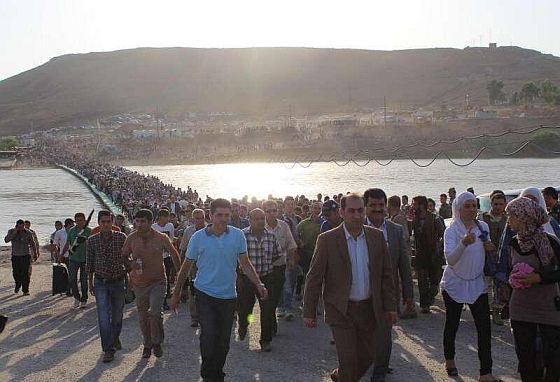
UNHCR photo shows mass exodus of Syria refugees fleeing to Iraq.
The Associated Press reports: In a mass exodus, around 30,000 Syrians have fled their homeland’s bloody civil war and crossed over into neighboring Iraq’s northern self-ruled Kurdish region over the past five days, the U.N. refugee agency said Monday.
The massive influx of people, many of whom are Syrian Kurds seeking refuge from escalating violence in northeastern Syria, has put severe strain on the resources of aid agencies as well as Iraqi Kurdistan’s regional government.
“Syrian refugees are still pouring into Iraq’s northern Kurdish region in huge numbers and most of them are women and children. The reason behind this sudden flow is still not clear,” said Youssef Mahmoud, a spokesman for the U.N. refugee agency in Iraq’s Kurdish region.
“Today, some 3,000 Syrian refugees crossed the borders and that has brought the number to around 30,000 refugees since Thursday,” he said, adding that the latest wave has brought the number of Syrian refugees in the Kurdish region to around 195,000. [Continue reading…]
The Brotherhood starts anew in Syria
Raphaël Lefèvre writes: While the Egyptian Brotherhood makes global headlines and Tunisia’s Ennahda Party struggles to remain in power, very little is publicly known about the state of Syria’s Muslim Brotherhood. In recent weeks, much has been made of the decrease in the group’s influence over the Syrian National Coalition (SNC). In contrast, not a lot has been said on the Brotherhood’s actual influence inside Syria and its strategy for the revolution. How exactly does the movement plan on dealing with recent trends in the conflict, such as the rise of Islamic extremism in opposition ranks?
A series of interviews conducted with prominent Syrian Brotherhood members and other members of the opposition in Istanbul and Beirut reveal that the group is adapting to an increasingly fragmented Syria made up of competing centers of power. But even if it seems to be gaining some traction on the ground through humanitarian assistance, political activism and armed opposition, the Syrian Brotherhood is still facing enormous external and internal challenges.
“We’ll have to deal with two major problems in the coming months and years,” one member of the Syrian Brotherhood leadership remarked bluntly. “The first is to continue to rebuild our structure and, perhaps most importantly, our image [which has been] tainted by 30 years of absence.”
In Syria, membership in the Muslim Brotherhood has been punishable by death since a law was passed to that effect in July 1980. In February 1982, a large-scale regime massacre in the city of Hama led most remaining members to flee to neighboring countries, where they are today estimated to number around 7,000–10,000. “The second problem,” argued the Brotherhood leader, “will be to deal with our own internal challenges.” The thirty-year exile of Brotherhood members has indeed stirred up tension within the group along regional and generational lines. An election to select the next leader is due next year, and it could be a turning point in the group’s future.
It was this simmering tension that led the Brotherhood leadership to agree, early on in the uprisings, on a “decentralization” policy: every regional sub-group forming the core of the Brotherhood would have to decide on the best strategy to return to Syria, rebuild a local following, and contribute to the revolutionary effort. [Continue reading…]
Iraqi official says Iran’s new president ‘means serious business’ with U.S.
Barbara Slavin reports: Iraqi Foreign Minister Hoshyar Zebari said on Aug. 16 that his country is ready to serve as a “bridge” between the United States and Iran, and believes that the Iranian leadership’s acquiescence to the recent election of Hassan Rouhani means that it is serious about resolving the nuclear dispute.
Zebari, in Washington for consultations that primarily focused on rising regional sectarianism, terrorism and the Syria conflict, said in response to a question from Al-Monitor that Rouhani, 64, a cleric partly educated in Scotland, is “a credible leader” who has “very strong relations with all the key leaders in Iran.”
Still, “there are many ways his election could have been scuttled,” had Supreme Leader Ayatollah Ali Khamenei and other power centers in Iran decided to do so, Zebari said. That Khamenei accepted the election of the least hard-line candidate allowed to run “was a statement by the Islamic Republic to the international community that it means serious business” on the nuclear issue, the veteran Iraqi official said. Zebari added that Rouhani’s win also reflected “enormous pressures” from the Iranian people who are eager to ease Iran’s diplomatic isolation and economic distress. [Continue reading…]
As northeast Asia bakes, climate scientists predict more extreme heat waves on the horizon
Time magazine reports: Northeast Asia is on fire. Yesterday temperatures in Shanghai hit an all-time high of 105.4ºF (40.8ºC), the hottest day in the coastal megacity since Chinese officials began keeping records some 140 years ago — during the Qing dynasty. On Aug. 12 the heat reached 105.8ºF (41ºC) in the southern Japanese city of Shimanto, the hottest temperature ever recorded in the country. Hundreds of people throughout South Korea have been hospitalized because of heatstroke, even as the government was forced to cut off air-conditioning in public buildings because of fears of a power shortage. As heat waves go, it’s a tsunami, similar to the brutally hot weather that singed Europe 10 years ago, which contributed to the deaths of over 30,000 people.
It’s also a glimpse of a blazingly hot future. We know that temperatures will generally rise as the globe warms thanks to increased greenhouse-gas emissions. (It’s right there in the name: global warming.) But as a new study published in Environmental Research Letters shows, the sort of scorching heat waves currently baking Northeast Asia are likely to become more frequent and more severe in the decades to come — and that’s going to happen no matter what we do about carbon emissions in the near future. There are some very uncomfortable summers on the horizon.
The study, by researchers at the Potsdam Institute for Climate Impact Research (PIK) in Germany and the Complutense University of Madrid in Spain, used climate models to project how heat extremes would change over the next century. The scientists found that extreme heat waves like the one that baked much of the U.S. in 2012 — when the country had its warmest year on record — are projected to cover double the amount of land globally by 2020 and quadruple the territory by 2040. The most severe heat waves — so-called five-sigma events, because they would involve temperatures that are five standard deviations above the norm — would go from essentially nonexistent today to covering about 3% of the globe by 2040. [Continue reading…]
Global communications systems use as much electricity as the whole world used in 1985
The Daily Mail: Your iPhone guzzles more energy than your refrigerator.
iPhones burn through significantly more energy than a new mid-sized refrigerator, according to a new study. The average new mid-sized refrigerator uses about 322 kilowatt hours a year while your iPhone uses about 361 kilowatt hours annually. The majority of that energy isn’t used to charge your battery, it’s used to power data centers responsible for the wireless connections and data streaming that bring your device to life.
This revelation was made in ‘The Cloud Begins with Coal: Big Data, Big networks, Big Infrastructure and Big Power,’ a paper published by the technology investment advisory Digital Power Group.
The world’s communications systems use 1,500 terawatt hours – 10 per cent of global energy and as much as Germany and Japan combined, according to the paper. The usage is equal to total global electricity usage in 1985. [Continue reading…]
Egypt: Mubarak expected to be released from jail within 48 hours — updated
Reuters reports: Hosni Mubarak, the former Egyptian president overthrown in an uprising in 2011, will be released from jail in the next 48 hours after a prosecutor cleared him in a corruption case, his lawyer Fareed El-Deeb told Reuters on Monday.
He was speaking after judicial authorities ordered Mubarak released in one of the remaining corruption cases against him.
The only legal grounds for Mubarak’s continued detention rest on another corruption case which will be cleared up later this week, Deeb said.
“All we have left is a simple administrative procedure that should take no more than 48 hours. He should be freed by the end of the week,” Deeb said.
Mubarak, 85, still faces a retrial on charges of complicity in the murder of protesters during the 2011 revolt.
Egypt prosecutor orders deposed President Mursi detained for 15 days in a new case of inciting violence: state news agency #breaking
— Reuters Top News (@Reuters) August 19, 2013
Egypt’s ‘war on terrorism’ and growing xenophobia
Sarah Carr writes: It’s trite but worth remembering that an excellent barometer of political freedom is how a regime treats the media. Deposed President Mohamed Morsi attempted to shut critics up through clumsy litigation – charges of insulting him, or the judiciary and so on. It was a classic Hosni Mubarak technique but Morsi used it far more frequently. Another technique was tacitly approving or at least not doing anything when Salafi preacher Hazem Salah Abou Ismail and friends set up shop outside the Media Production City in October 6 City, in order to intimidate Lamis al-Hadidi and other vocally anti-Brotherhood presenters beyond state control.
But just like the Muslim Brotherhood failed in everything they did while in power, they failed in this, too: the cases never had the chilling effect desired and Morsi and co. were regularly ripped apart in the press, by Bassem Youssef and others. In fact the Brotherhood themselves liked to crow about their critics being left alone as an example of their political largesse. They never understood that using underhand measures to intimidate your opponents does not make you a just leader and that leaving the press alone is a positive obligation not an act of charity.
The current regime meanwhile is combining the very best of pre-2011 media repression techniques with a classic February 2011 xenophobia campaign with the force of an Interior Ministry stretching its sinewy muscles as it resurrects itself.
The xenophobia campaign began gently with allegations that Syrians and Palestinians were in the Brotherhood Rabea al-Adaweya sit-in. After Rabea al-Adaweya was broken up, the anti-West rhetoric intensified and allegations that western media support the Brotherhood widened to include not only CNN but mostly every foreign news outlet. After Friday’s clashes in Ramses Square, the propaganda machine revved up a few notches and the media filmed bearded, detained men they suggested were foreigners. Prior to this on Thursday, General Mahmoud Polo Shirt Badr from the Tamarod battalion of the Egyptian army urged Egyptian citizens to form popular committees to defend their neighborhoods against the terrorist threat. There are many well-intentioned people in popular committees but anyone who experienced the January 2011 revolution (uprising? brief glitch?) will tell you that they are also a vehicle for vigilantism and an excellent way of indirect control by the state: There was what seemed to be coordinated harassment of foreigners during certain days in 2011 from the top – state media – to the bottom – on the ground in popular committees.
We are seeing the beginnings of this again now. After the detained “foreign” men were shown on television on Friday night the next day in Ramses Square foreign journalists were physically attacked and detained. Two had to be bundled into an army APC for their own safety. Another was marched to Azbakeya Police Station and told firmly to leave Egypt. He was subsequently the victim of a citizens’ arrest on the same day. Another female journalist who works for a foreign outlet said that while in Ramses Square, a cop ordered men around her to beat her up, telling them that she is American. The Presidency on Saturday gave a presser in which Mostafa Hegazy, an advisor, repeatedly talked about Egyptians’ “bitterness” at international coverage of events. On Sunday, the Der Spiegel correspondent was detained for seven hours while at Rabea al-Adaweya and claimed that the main accusation against him was “bad reports in the Western press.” [Continue reading…]
Why are Egyptian liberals supporting the bloodshed?
Reuters reports: Mahmoud Badr, whose petition campaign helped to bring down Egypt’s Islamist president, insists the bloodshed that has followed is a necessary price for saving the nation from the Muslim Brotherhood.
And he has a message for U.S. President Barack Obama, who has expressed alarm at the violent crackdown on the Brotherhood that has led to more than 700 deaths: “Don’t lecture us on how to deal with the Brotherhood’s terrorism.”
As for aid money, he says, Obama can keep it – and “go to hell”.
Badr, like many Egyptians who consider themselves liberals, has little patience with the human rights groups who call the repression a setback for democracy.
“What Egypt is passing through now is the price, a high price, of getting rid of the Brotherhood’s fascist group before it takes over everything and ousts us all,” Badr, 28, told Reuters in a telephone interview.
Reuters now reports: Some 38 supporters of the Muslim Brotherhood died on Sunday in an incident at an Egyptian prison, security and legal sources said, giving conflicting versions of the deaths.
The Interior Ministry did not immediately confirm the death toll, but said in a statement that a number of detainees had tried to escape from a prison on the outskirts of Cairo and had taken a police officer hostage.
In subsequent clashes, the ministry said an undisclosed number of people had died from inhaling tear gas rounds. It added that the officer was freed but badly wounded.
However, offering a different explanation, a legal source told Reuters that the Brotherhood followers had suffocated in the back of a crammed police van while being taken to prison.
Egypt committing state terrorism, al-Sisi and al-Assad are same: Turkish PM; Palestinian Authority backs Egypt’s military
Hurriyet Daily News reports: Turkish Prime Minister Recep Tayyip Erdoğan has accused Egypt’s interim rulers of committing state terrorism and compared army chief Abdel Fattah al-Sisi to Syrian leader Bashar al-Assad as scores more were killed in a crackdown and hundreds were besieged in Cairo’s al-Fath Mosque by security forces.
“The Al-Fath Mosque is under siege. People’s place of worship is innocent. They have burned, destroyed our mosques in Syria and in Egypt. Either Bashar or Sisi, there is no difference between them. There is no salvation with oppression,” Erdoğan said during a defiant speech in the northwestern province of Bursa Aug. 17 where he attended the launching ceremony of an urban renovation project.
Erdoğan also slammed Egyptian officials for describing supporters of toppled President Mohamed Morsi as “terrorists.”
“People are saying ‘we ask for our vote to be honored.’ But there are those calling them terrorists. But I am saying that state terrorism is currently underway in Egypt,” Erdoğan said.
Meanwhile WAFA reports: The Palestinian leadership said Friday in a statement that harming the Egyptian security will also harm the Arab national security and its fundamental cause.
“The Palestinian leadership and people are closely following the developments in Egypt,” said the statement. “They consider any attempt to harm the Egyptian security is an attempt to harm the Arab and Islamic national security and a threat to the Palestinian cause,” it added.
“The Egyptian security is the safety valve of the Arab national security and the unruly hands that are trying to jeopardize the Egyptian state and to harm its security and the stability of the Egyptian people are serving a dubious scheme aimed at the unity of Egypt and the security and stability of all Arab countries,” added the statement.
The Palestinian leadership welcomed the position of Saudi Arabia and its king from the Egyptian crisis and called on “everyone to support Egypt and to oppose any interference in its internal affairs.”
Why the U.S. won’t cut military aid to Egypt
Juan Cole lists the top ten reasons: 1. The US doesn’t give much aid to the Egyptian people per se. Only $250 mn a year out of $1.55 bn is civilian. The aid is to cement a relationship between the Egyptian officer corps and the Pentagon.
2. The military aid, $1.3 billion a year, is mostly in-kind, a grant of weaponry . It must be spent on US weapons manufacturers. It is US arms manufacturers like Lockheed-Martin and General Dynamics (and their employees) who would suffer if it were cut off.
3. The Congress gave the Egyptian Generals a credit card to buy weapons, and they’ve run up $3 billion on it for F-16s and M1A1 tanks. If the US cancelled aid, the US government would still have to pick up that bill.
4. Even most of the civilian aid is required to be spent on US goods and materiel. It is corporate welfare for the US
5. The aid was given as a bribe to the Egyptian elite to make nice with Israel. Given the chaos in Sinai, and Egypt’s instability, Congress is more worried about that issue than at any time in 40 years.
6. The Israelis asked the US not to suspend the aid. [Continue reading…]