Author Archives: News Sources

Is a second revolution really what Egypt needs?

Shadi Hamid writes: Supporters of the Tamarod (“rebel”) movement are taking to streets on June 30th in what is likely to be a massive show of force. Their goals are deceptively simple — pushing President Mohamed Morsi out of power and holding early presidential elections. When asked, however, how they plan to do this, the answers acquire a certain vagueness. Egyptians have every right to call for Morsi to resign — and that right must be protected — but he is obviously under no obligation to heed their calls. So, then what?

There is no legal or constitutional mechanism through which Morsi, who was elected with 51.7 percent of the vote just a year ago, can be ousted. Realistically, there is only one way he falls – if mass violence and a total collapse of public order provoke the military to step in. In this sense, for Tamarod to “succeed,” Egypt must fail. For some in the opposition, this short-term cost — as devastating as it might be — is justified because the alternative of continued Muslim Brotherhood rule will fundamentally alter the very nature of Egypt.

Opposition figures have been flirting with the possibility of various kinds of coups against an incompetent, unpopular — though democratically elected — president. Some, like April 6th’s Tarek al-Khouli and human rights activist Dalia Ziada, have explicitly called for military intervention. Others, like Mohamed ElBaradei and Ahmed el-Borai have taken to issuing what the journalist Evan Hill calls “non-request requests” for the army to step in. Still others, including leaders of Tamarod, have called for the judiciary to intervene and “annul” Morsi’s presidency. [Continue reading…]

Facebooktwittermail

Renewed violence in Egypt

The Guardian reports: Egypt suffered renewed outbreaks of violence on Friday as Muslim Brotherhood offices were attacked in at least four provinces two days before the scheduled start of mass protests against the president and Brotherhood associate Mohamed Morsi.

Two people were killed in Alexandria on Friday – one an American bystander who was watching an attack on local Brotherhood offices – and 70 were injured. Clashes were reported in several other cities between Morsi’s often secular-minded critics – who seek his immediate resignation – and his allies in the Muslim Brotherhood and other Islamist groups, who defend his democratic legitimacy.

Six people have now been killed in the renewed violence this week. According to Brotherhood officials, a former MP from their political wing was among the dead on Thursday.

Egypt Daily News reports: On Friday thousands of protesters vowed to remain in Tahrir Square in their call for the ouster of President Mohammed Morsi, and many started erecting tents in preparation for mass demonstrations on 30 June.

Marches from various locations in Cairo, including Talaat Harb Street, Mostafa Mahmoud and Sayeda Zeinab, brought in thousands of protesters into the square in the afternoon.

“We are staying for the long run, we are not leaving before [Morsi] does,” yelled one protester in the square.

Facebooktwittermail

Syria’s oilfields create surreal battle lines amid chaos and tribal loyalties

Ghaith Abdul-Ahad writes: A northern wind had been blowing since early morning, lifting a veil of dust that had blocked the sun and turned the sky the colour of ash. Abu Zayed was sitting on the porch of his unfinished concrete home, watching the storm build. He loved sandstorms. They reminded him of Dubai, where he had lived before the war. He admired the people there for turning a desert into a paradise. They had vision, he told his followers.

Six months ago, he left the Gulf emirate to join the Syrian revolution, attending opposition conferences in Istanbul and Cairo, jostling for position on behalf of his father, the leading sheikh of a powerful tribe in eastern Syria.

But Abu Zayed soon became disgusted with the bickering among the rebel leadership. “There is an opposition council in every hotel lobby in Istanbul,” he said. “You can’t distinguish them from the regime.”

Instead, like other disaffected tribal leaders, Abu Zayed returned home to his ancestral land and put his energy into building up his clan, taking control of his energy-rich ancestral lands.

Most of the oil and gas fields in eastern Syria lie idle or pump meagre quantities that are refined using primitive techniques to generate a pittance, but Abu Zayed’s land has a huge gas plant. It stands less than a mile from his home.

His father had chosen him out his 40 brothers to look after the plant because he was seen as a man of vision. The war had given him a chance to realise his dream: to build an oil-fuelled emirate.

The hard edges of Syria’s frontlines – dogmatic, revolutionary, Islamist or pure murderously sectarian – almost melt away outside the oilfields. New lines emerge pitting tribesmen against battalions, Islamists against everyone else, and creating sometimes surreal lines of engagement, where rebels help maintain government oil supplies in return for their villages being spared from bombardment and being allowed to siphon oil for themselves.

“There is chaos now,” Abu Zayed said. “The Free Syrian Army is chasing loot, and they don’t care about civilians. The military councils are stealing the aid and then selling it. There are dozens of battalions here, we don’t even know who is manning a checkpoint at the end of the street. Some people are saying the days of Bashar [al-Assad] were better, that the opposition has betrayed the people.

“But we can organise this situation,” he said. “Look at this gas plant, it’s under our control. Things are organised here and we can do the same for other oil and gas fields.

“Most of the people who control the oilfields around here are making about 5m Syrian pounds [£32,000] a day. They exploit a field for a few weeks, but because of the chaos, another powerful cousin or battalion soon arrives to fight for it and take control of it.

“I tell these people to lease me the field for S£10m a month. I collect all the fields under my control, bring in companies to exploit them properly and organise truck convoys to sell the gas to Turkey. Then we’ll buy Patriot [missile] batteries and drones to protect the fields against the regime.”

His ambition did not stop there. “Once you have economic power you can convene a council for the tribes here inside the country, and organise all the military units in one military council,” he said.

Using the old definition of tribal land from the French colonial era, before the Syrian republic and its socialist laws that smashed feudal property, each tribe is now claiming ownership of the fields that lie in its wajeh (tribal territory). As the Syrian regime has crumbled, society in the desert east has fallen back on the tribes. “Even [al-Qaida affiliate] Jabhat al-Nusra can’t do anything against us,” said Abu Zayed. “They try to get fields but they can’t. Not Nusra, not even the Americans could take these fields from us with all the weapons we have now.” [Continue reading…]

Facebooktwittermail

Ecuador cools on Edward Snowden asylum as Assange frustration grows

The Guardian reports: The plan to spirit the surveillance whistleblower Edward Snowden to sanctuary in Latin America appeared to be unravelling on Friday, amid tension between Ecuador’s government and Julian Assange, the founder of WikiLeaks.

President Rafael Correa halted an effort to help Snowden leave Russia amid concern Assange was usurping the role of the Ecuadoran government, according to leaked diplomatic correspondence published on Friday.

Amid signs Quito was cooling with Snowden and irritated with Assange, Correa declared invalid a temporary travel document which could have helped extract Snowden from his reported location in Moscow.

Correa declared that the safe conduct pass issued by Ecuador’s London consul – in collaboration with Assange – was unauthorised, after other Ecuadorean diplomats privately said the WikiLeaks founder could be perceived as “running the show”. [Continue reading…]

Facebooktwittermail

The NSA only targets citizens of the world (which includes America)

Shane Harris writes: The National Security Agency has said for years that its global surveillance apparatus is only aimed at foreigners, and that ordinary Americans are only captured by accident. There’s only one problem with this long-standing contention, people who’ve worked within the system say: it’s more-or-less technically impossible to keep average Americans out of the surveillance driftnet.

“There is physically no way to ensure that you’re only gathering U.S. person e-mails,” said a telecommunications executive who has implemented U.S. government orders to collect data on foreign targets. “The system doesn’t make any distinction about the nationality” of the individual who sent the message.

While it’s technically true that the NSA is not “targeting” the communications of Americans without a warrant, this is a narrow and legalistic statement. It belies the vast and indiscriminate scooping up of records on Americans’ phone calls, e-mails, and Internet communications that has occurred for more than a decade under the cover of “foreign intelligence” gathering.

The NSA is routinely capturing and storing vast amounts of the electronic communications of American citizens and legal residents, even though they were never individually the subject of a terrorism or criminal investigation, according to interviews with current and former intelligence officials, technology experts, and newly released government documents. [Continue reading…]

Facebooktwittermail

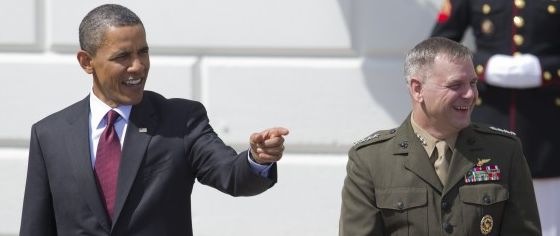
Obama’s ‘favorite general’ target of leak investigation

NBC News reports: Legal sources tell NBC News that the former second-highest-ranking officer in the U.S. military is now the target of a Justice Department investigation into an alleged leak of classified information about a covert U.S. cyberattack on Iran’s nuclear program.

According to legal sources, retired Marine Gen. James “Hoss” Cartwright, the former vice chairman of the Joint Chiefs of Staff, has been notified that he’s under investigation for allegedly leaking information about a massive attack using a computer virus named Stuxnet on Iran’s nuclear facilities. Gen. Cartwright, 63, becomes the latest alleged leaker targeted by the Obama administration, which has already prosecuted or charged eight individuals under the Espionage Act.

Last year, the New York Times reported that Cartwright, a four-star general who was vice chairman of the Joint Chiefs from 2007 to 2011, conceived and ran the cyber operation, called Olympic Games, under President Bush. President Obama ordered the cyberattacks sped up, and in 2010 an attack using the Stuxnet worm temporarily disabled 1,000 centrifuges that the Iranians were using to enrich uranium.

The Times story included details of the Olympic Games operation, including the cooperation of Israeli intelligence. The story said that President Barack Obama had ordered the attacks, which began during the Bush administration, to continue even after Stuxnet “escaped” from the Natanz nuclear plant in Iran and began to spread via the Internet. The virus was first publicly identified by a computer security company in June 2010.

The story described meetings in the White House Situation Room and was based on 18 months of interviews with “current and former American, European and Israeli officials involved in the program.” It credited Gen. Cartwright with presenting the original idea for Stuxnet to President Bush, said the NSA had developed the Stuxnet worm in tandem with the Israelis, and said thumb drives were first used to introduce the virus into the Natanz plant in 2008.

“This leak was very damaging,” said former California congresswoman Jane Harman, now a member of the Defense Policy Board. “Clearly what was going on here was a method and it should have been protected and I think it’s had devastating consequences.”

President Obama said in June 2012 that his attitude toward “these kinds of leaks” was “zero tolerance,” and that they were “criminal acts.”

According to legal sources, the original FBI probe into the Stuxnet leak focused on whether the information came from someone in the White House. By late last year, according to legal sources, FBI agents were zeroing in on Cartwright, who retired from the military in August 2011.

The Washington Post adds: Although Obama forged a quick rapport with Cartwright — White House officials referred to him as the president’s favorite general — the president chose not to promote him to chairman in 2011, in part because of concern that Cartwright had frayed his relationships with too many senior generals during the surge debate. Within the Pentagon, “he wasn’t seen as a team player,” said a senior military official who worked on the Joint Staff.

After retiring, Cartwright took a position at the Center for Strategic and International Studies and has spoken frequently on national security issues. He has emerged as a growing critic of the Obama administration’s expanded use of drones to counter the al-Qaeda threat.

At at event in Chicago in March, Cartwright said that the United States was beginning to see “blowback” from that targeted killing campaign. “If you’re trying to kill your way to a solution, no matter how precise you are, you’re going to upset people even if they’re not targeted.”

Facebooktwittermail

Stuxnet helped heat up cyberarms race

NBC News reports: Cybersecurity experts tell NBC News that the [Stuxnet] attack may not have done as much damage to the Iranian nuclear effort — which Tehran insists is geared toward developing nuclear energy, not weapons — as was initially reported in some media accounts.

And it has raised the stakes in the race to create online weaponry.

Iranian Ambassador Hossein Moussavian, in a Feb. 21 appearance at the Center for National Security at Fordham Law School, said the attack prompted Tehran to make development of its own cyberwar capability a priority.

“The U.S., or Israel, or the Europeans, or all of them together, started war against Iran,” he said. “Iran decided to have…to establish a cyberarmy, and today, after four or five years, Iran has one of the most powerful cyberarmies in the world.”

Scott Borg, a U.S.-based cybersecurity expert, said that while Iran may be exaggerating its offensive capabilities, there is no doubt that it has developed a “serious capability” to wage cyberwar.

“It’s exaggerating the present capabilities,” he said, “but it’s working toward the future.”

As an example, Borg and U.S. officials note that when the U.S. leveled new sanctions on Iranian banks last year, U.S. banks suddenly came under attack – apparently from Iran itself or its hired proxies.

Facebooktwittermail

U.S. military restricts access to The Guardian website

The Monterey County Herald reports: The Army admitted Thursday to not only restricting access to The Guardian news website at the Presidio of Monterey, as reported in Thursday’s Herald, but Armywide.

Presidio employees said the site had been blocked since The Guardian broke stories on data collection by the National Security Agency.

Gordon Van Vleet, an Arizona-based spokesman for the Army Network Enterprise Technology Command, or NETCOM, said in an email the Army is filtering “some access to press coverage and online content about the NSA leaks.”

He wrote it is routine for the Department of Defense to take preventative “network hygiene” measures to mitigate unauthorized disclosures of classified information.

“We make every effort to balance the need to preserve information access with operational security,” he wrote, “however, there are strict policies and directives in place regarding protecting and handling classified information.”

In a later phone call, Van Vleet said the filter of classified information on public websites was “Armywide” and did not originate at the Presidio.

Presidio employees described how they could access the U.S. site, www.guardiannews.com, but were blocked from articles, such as those about the NSA, that redirected to the British site. [Continue reading…]

Facebooktwittermail

NSA collected U.S. email records in bulk for more than two years under Obama

The Guardian reports: The Obama administration for more than two years permitted the National Security Agency to continue collecting vast amounts of records detailing the email and internet usage of Americans, according to secret documents obtained by the Guardian.

The documents indicate that under the program, launched in 2001, a federal judge sitting on the secret surveillance panel called the Fisa court would approve a bulk collection order for internet metadata “every 90 days”. A senior administration official confirmed the program, stating that it ended in 2011.

The collection of these records began under the Bush administration’s wide-ranging warrantless surveillance program, collectively known by the NSA codename Stellar Wind.

According to a top-secret draft report by the NSA’s inspector general – published for the first time today by the Guardian – the agency began “collection of bulk internet metadata” involving “communications with at least one communicant outside the United States or for which no communicant was known to be a citizen of the United States”.

Eventually, the NSA gained authority to “analyze communications metadata associated with United States persons and persons believed to be in the United States”, according to a 2007 Justice Department memo, which is marked secret. [Continue reading…]

Facebooktwittermail

How the NSA is still harvesting your online data

The Guardian reports: A review of top-secret NSA documents suggests that the surveillance agency still collects and sifts through large quantities of Americans’ online data – despite the Obama administration’s insistence that the program that began under Bush ended in 2011.

Shawn Turner, the Obama administration’s director of communications for National Intelligence, told the Guardian that “the internet metadata collection program authorized by the Fisa court was discontinued in 2011 for operational and resource reasons and has not been restarted.”

But the documents indicate that the amount of internet metadata harvested, viewed, processed and overseen by the Special Source Operations (SSO) directorate inside the NSA is extensive.

While there is no reference to any specific program currently collecting purely domestic internet metadata in bulk, it is clear that the agency collects and analyzes significant amounts of data from US communications systems in the course of monitoring foreign targets. [Continue reading…]

Facebooktwittermail

CIA embedded in the NYPD

The New York Times reports: Four Central Intelligence Agency officers were embedded with the New York Police Department in the decade after Sept. 11, 2001, including one official who helped conduct surveillance operations in the United States, according to a newly disclosed C.I.A. inspector general’s report.

That officer believed there were “no limitations” on his activities, the report said, because he was on an unpaid leave of absence, and thus exempt from the prohibition against domestic spying by members of the C.I.A.

Another embedded C.I.A. analyst — who was on its payroll — said he was given “unfiltered” police reports that included information unrelated to foreign intelligence, the C.I.A. report said.

The once-classified review, completed by the C.I.A. inspector general in December 2011, found that the four agency analysts — more than had previously been known — were assigned at various times to “provide direct assistance” to the local police. The report also raised a series of concerns about the relationship between the two organizations.

The C.I.A. inspector general, David B. Buckley, found that the collaboration was fraught with “irregular personnel practices,” that it lacked “formal documentation in some important instances,” and that “there was inadequate direction and control” by agency supervisors. [Continue reading…]

Facebooktwittermail

What Edward Snowden has accomplished

After noting the ways in which Edward Snowden has vilified and idolized, Roger Cohen asks a more relevant and dispassionate question: what do we know now, that we would not have known at this time in the absence of Snowden’s whistleblowing?

We would not know how the N.S.A., through its Prism and other programs, has become, in the words of my colleagues James Risen and Eric Lichtblau, “the virtual landlord of the digital assets of Americans and foreigners alike.” We would not know how it has been able to access the e-mails or Facebook accounts or videos of citizens across the world; nor how it has secretly acquired the phone records of millions of Americans; nor how through requests to the compliant and secret Foreign Intelligence Surveillance Court (F.I.S.A.) it has been able to bend nine U.S. Internet companies to its demands for access to clients’ digital information.

We would not be debating whether the United States really should have turned surveillance into big business, offering data-mining contracts to the likes of Booz Allen and, in the process, high-level security clearance to myriad folk who probably should not have it. We would not have a serious debate at last between Europeans, with their more stringent views on privacy, and Americans about where the proper balance between freedom and security lies.

We would not have legislation to bolster privacy safeguards and require more oversight introduced by Senator Patrick Leahy, Democrat of Vermont and the chairman of the Judiciary Committee. Nor would we have a letter from two Democrats to the N.S.A. director, Gen. Keith B. Alexander, saying that a government fact sheet about surveillance abroad “contains an inaccurate statement” (and where does that assertion leave Alexander’s claims of the effectiveness and necessity of Prism?).

In short, a long-overdue debate about what the U.S. government does and does not do in the name of post-9/11 security — the standards applied in the F.I.S.A. court, the safeguards and oversight surrounding it and the Prism program, the protection of civil liberties against the devouring appetites of intelligence agencies armed with new data-crunching technology — would not have occurred, at least not now.

All this was needed because, since it was attacked in an unimaginable way, the United States has gone through a Great Disorientation. Institutions at the core of the checks and balances that frame American democracy and civil liberties failed. Congress gave a blank check to the president to wage war wherever and whenever he pleased. The press scarcely questioned the march to a war in Iraq begun under false pretenses. Guantánamo made a mockery of due process. The United States, in Obama’s own words, compromised its “basic values” as the president gained “unbound powers.” Snowden’s phrase, “turnkey tyranny,” was over the top but still troubling.

One of the most striking aspects of the Obama presidency has been the vast distance between his rhetoric on these issues since 2008 and any rectifying action. If anything he has doubled-down on security at the expense of Americans’ supposedly inalienable rights: Hence the importance of a whistleblower.

Facebooktwittermail

Snowden’s delayed flight to Ecuador

Mark Weisbrot writes: If Edward Snowden can make it to Ecuador, it will be a good choice for him and the world. The government, including the president, Rafael Correa, and the foreign minister, Ricardo Patiño, proved their steadfastness in the face of threats and abuse last year when they granted asylum to WikiLeaks’ founder Julian Assange.

The media took advantage of the fact that most of the world knows very little about Ecuador to misinform their audience that this government “represses the media”. The same efforts are already under way in the Snowden case. Without defending everything that exists in Ecuador, including criminal libel laws and some vague language in a new communications law, anyone who has been to the country knows that the international media has presented a gross caricature of the state of press freedom there. The Ecuadorian private media is more oppositional than that of the US, trashing the government every day.

Unfortunately, groups like Americas Watch (of Human Rights Watch) and the Committee to Protect Journalists, which do good work in some countries, have joined Washington’s campaign against Ecuador, publishing gross exaggerations. These groups should be a bit more worried about the chilling effect that the Obama administration’s unprecedented prosecution of whistleblowers has had on investigative journalism in the United States. [Continue reading…]

Matthew Aid adds: Something strange is going on here. According to WikiLeaks, it thought it had an agreement with the Ecuadorian government to immediately give Edward Snowden asylum upon his arrival. The Ecuadorians now appear to be retreating from their previous promises, perhaps because of pressure from the US government, or even perhaps because Quito is trying to extract concessions from Washington.

Whatever the case may be, there is, according to a confidential source inside WikiLeaks, a lot of anger about the Ecuadorian government’s behavior in this matter. In the meantime, Edward Snowden remains trapped in a Catch-22 legal limbo inside the transit lounge at Moscow’s Sheremetevo International Airport waiting for news.

USA Today now reports: Ecuador said Thursday it is renouncing a trade pact up for renewal by the U.S. Congress because it had become a “new instrument of blackmail” involving the fate of an NSA leaker who has asked for political asylum from the South American country.

Facebooktwittermail

Myanmar’s government-backed Buddhist extremists

Reuters reports: The Buddhist extremist movement in Myanmar, known as 969, portrays itself as a grassroots creed.

Its chief proponent, a monk named Wirathu, was once jailed by the former military junta for anti-Muslim violence and once called himself the “Burmese bin Laden.”

But a Reuters examination traces 969’s origins to an official in the dictatorship that once ran Myanmar, and which is the direct predecessor of today’s reformist government. The 969 movement now enjoys support from senior government officials, establishment monks and even some members of the opposition National League for Democracy (NLD), the political party of Nobel peace laureate Aung San Suu Kyi.

Wirathu urges Buddhists to boycott Muslim shops and shun interfaith marriages. He calls mosques “enemy bases.”

Among his admirers: Myanmar’s minister of religious affairs.

“Wirathu’s sermons are about promoting love and understanding between religions,” Sann Sint, minister of religious affairs, told Reuters in his first interview with the international media. “It is impossible he is inciting religious violence.”

Sann Sint, a former lieutenant general in Myanmar’s army, also sees nothing wrong with the boycott of Muslim businesses being led by the 969 monks. “We are now practicing market economics,” he said. “Nobody can stop that. It is up to the consumers.”

President Thein Sein is signaling a benign view of 969, too. His office declined to comment for this story. But in response to growing controversy over the movement, it issued a statement Sunday, saying 969 “is just a symbol of peace” and Wirathu is “a son of Lord Buddha.”

Wirathu and other monks have been closely linked to the sectarian violence spreading across Myanmar, formerly known as Burma. Anti-Muslim unrest simmered under the junta that ran the country for nearly half a century. But the worst fighting has occurred since the quasi-civilian government took power in March 2011.

Two outbursts in Rakhine State last year killed at least 192 people and left 140,000 homeless, mostly stateless Rohingya Muslims. A Reuters investigation found that organized attacks on Muslims last October were led by Rakhine nationalists incited by Buddhist monks and sometimes abetted by local security forces. [Continue reading…]

Facebooktwittermail

Research shows that Monsanto’s big claims for GMO food are probably wrong

AlterNet: Oops. The World Food Prize committee’s got a bit of egg on its face — genetically engineered egg. They just awarded the World Food Prize to three scientists, including one from Syngenta and one from Monsanto, who invented genetic engineering because, they say, the technology increases crop yields and decreases pesticide use. (Perhaps not coincidentally, Monsanto and Syngenta are major sponsors of the World Food Prize, along with a third biotech giant, Dupont Pioneer.)

Monsanto makes the same case on its website, saying, “Since the advent of biotechnology, there have been a number of claims from anti-biotechnology activists that genetically modified (GM) crops don’t increase yields. Some have claimed that GM crops actually have lower yields than non-GM crops… GM crops generally have higher yields due to both breeding and biotechnology.”

But that’s not actually the case. A new peer-reviewed study published in the International Journal of Agricultural Sustainability examined those claims and found that conventional plant breeding, not genetic engineering, is responsible for yield increases in major U.S. crops. Additionally, GM crops, also known as genetically engineered (GE) crops, can’t even take credit for reductions in pesticide use. The study’s lead author, Jack Heinemann, is not an anti-biotechnology activist, as Monsanto might want you to believe. “I’m a genetic engineer. But there is a different between being a genetic engineer and selling a product that is genetically engineered,” he states. [Continue reading…]

Facebooktwittermail

America’s stealthy global military engagement

Gordon Adams writes: We are out of Iraq; we are getting out of Afghanistan; there is no appetite for U.S. military engagement in Syria. What is a guy in uniform to do?

On June 11, Michael Hirsh suggested that the United States has “lost its nerve” internationally. Obama, he argues, has stepped back from the global leadership role and military presence it once had. Many Americans support what Hirsh calls “America’s gradual withdrawal from foreign entanglements” — they want the U.S. military home soon, out of Afghanistan, and definitely not in Syria. Time, as my carpenter up in Maine says, for us to “stop messing around in other people’s business.”

Some commentators think this trend is dangerous. David Barno, a retired Army three-star at the Center for a New American Security, urges the United States to stay globally engaged. Barno, who has overseen some really good research on U.S. defense planning, told Hirsh, “The sour taste [about overseas involvement] is obscuring the fact that American power around the world underwrites the global system and is the guarantor of peace.”

Even Barno, though, is cautious — even self-contradictory — about how deeply the United States should commit itself abroad. As he wrote about Syria, “U.S. interests are far better served by exercising restraint, supporting Syria’s neighbors, and performing a humanitarian role. After 10 years of bloody and inconclusive U.S. involvement in the wars of this region, slipping into another military intervention in this part of the world defies both common sense and broader U.S. vital interests.”

Barno’s objection to American retrenchment, though, is a classic restatement of the dominant view among Washington policymakers about our role in the world: We are the good guys, we keep the peace, we set the framework for the rules, what would the world be like without us? It’s hard to reconcile wariness about intervention with promotion of the U.S. role as the global system administrator. (See Tom Barnett’s website for another classic call for the United States to assume such responsibilities.) Muscle-flexing and caution don’t mix well.

I wouldn’t call this caution isolationism, though — or “neo-isolationism,” as Hirsh does. What is happening is the latest episode in a historic pattern of muscular U.S. engagement, by which we think the military can fix a problem, followed by failure or stalemate (Korean truce, Vietnam loss, Iraq and looming Afghanistan disasters), and ending with reluctance to use the military as the leading edge of American foreign policy.

But be careful here. The decision to pull back on massive engagements of military force does not mean force is not going to be used. It just goes underground. In fact, I would argue that today, the U.S. military is way, way out in front in setting the terms for future U.S. global engagement, and in ways that may not suit our national interests. [Continue reading…]

Facebooktwittermail

U.S. begins shipping arms for Syrian rebels

The Wall Street Journal reports: The Central Intelligence Agency has begun moving weapons to Jordan from a network of secret warehouses and plans to start arming small groups of vetted Syrian rebels within a month, expanding U.S. support of moderate forces battling President Bashar al-Assad, according to diplomats and U.S. officials briefed on the plans.

The shipments, related training and a parallel push to mobilize arms deliveries from European and Arab allies are being timed to allow a concerted push by the rebels starting by early August, the diplomats and officials said, revealing details of a new covert plan authorized by President Barack Obama and disclosed earlier this month.

The CIA is expected to spend up to three weeks bringing light arms and possibly antitank missiles to Jordan. The agency plans to spend roughly two weeks more vetting an initial group of fighters and making sure they know how to use the weapons that they are given, clearing the way for the first U.S.-armed rebels to enter the fight, diplomats briefed on the CIA’s plans said.

Talks are under way with other countries, including France, about pre-positioning European-procured weapons in Jordan. Saudi Arabia is expected to provide shoulder-fired antiaircraft missiles, known as Manpads, to a small number of handpicked fighters, as few as 20 at first, officials and diplomats said. The U.S. would monitor this effort, too, to try to reduce the risk that the Manpads could fall into the hands of Islamists.

Up to a few hundred of the fighters will enter Syria under the program each month, starting in August, according to diplomats briefed on CIA plans. [Continue reading…]

Facebooktwittermail