Author Archives: News Sources

Outrage at Syrian rebel shown ‘eating soldier’s heart’

Time magazine reports: The video starts out like so many of the dozens coming out of the war in Syria every day, with the camera hovering over the body of a dead Syrian soldier. But the next frame makes it clear why this video, smuggled out of the city of Homs and into Lebanon with a rebel fighter, and obtained by TIME in April, is particularly shocking. In the video a man who is believed to be a rebel commander named Khalid al-Hamad, who goes by the nom de guerre Abu Sakkar, bends over the government soldier, knife in hand. With his right hand he moves what appears to be the dead man’s heart onto a flat piece of wood or metal lying across the body. With his left hand he pulls what appears to be a lung across the open cavity in the man’s chest. According to two of Abu Sakkar’s fellow rebels, who said they were present at the scene, Abu Sakkar had cut the organs out of the man’s body. The man believed to be Abu Sakkar then works his knife through the flesh of the dead man’s torso before he stands to face the camera, holding an organ in each hand. “I swear we will eat from your hearts and livers, you dogs of Bashar,” he says, referring to supporters of Syrian President Bashar Assad. Off camera, a small crowd can be heard calling out “Allahu akbar” — God is great. Then the man raises one of the bloodied organs to his lips and starts to tear off a chunk with his teeth.

Two TIME reporters first saw the video in April in the presence of several of Abu Sakkar’s fighters and supporters, including his brother. They all said the video was authentic. We later obtained a copy. Since then TIME has been trying to ensure that the footage is not digitally manipulated in any way — a faked film like this would be powerful propaganda for the regime, which portrays the rebels as terrorists — and, as yet, TIME has not been able to confirm its integrity. Abu Sakkar has not commented on whether the man in the video is indeed him because he is currently fighting on the front lines in Syria, according to fighters under his command. The video became public on May 12 when it was posted online by a proregime group and is indeed now being used as propaganda by regime supporters (and has already been shared 1,115 times on Facebook and has over 46,000 views on YouTube). These 27 seconds of footage provide a glimpse at how brutal the Syrian war has become — and a startling example of how technology appears to be fueling that brutality.

Jim Muir adds: Human Rights Watch (HRW) says Abu Sakkar is the leader of a group called the Independent Omar al-Farouq Brigade, an offshoot of the Free Syrian Army (FSA) Al-Farouq Brigades. He insults Alawites, the minority offshoot of Shia Islam to which Mr Assad belongs.

“The desecration and mutilation of a killed person is definitely a war crime,” Peter Bouckaert, emergencies director of Human Rights Watch, told the BBC. “This one particularly disturbing because of the sectarian nature of the language used by Abu Sakkar.”

HRW said those committing war crimes on either side had to know that there was no impunity and that they would be brought to account.

The human rights group said Abu Sakkar had been filmed before, firing rockets into Shia areas of Lebanon and posing with the bodies of guerrillas from the Lebanese Hezbollah movement killed fighting alongside Syrian government forces.

“Abu Sakkar is a very significant commander – he’s in charge of one of the most important battles happening in Syria right now,” said Mr Bouckaert. “The danger is that extremists on both sides will feel the need to respond in kind.”


Facebooktwittermail

Saudis overtaking Qatar in sponsoring Syrian rebels

Hassan Hassan writes: Last week, a 12-member delegation from the Syrian opposition visited Saudi Arabia, for an unprecedented two-day official meeting.

Saudi authorities had consistently declined to meet the opposition, despite repeated requests. This was partly because the kingdom has opposed Muslim Brotherhood dominance in the Syrian National Council and then the National Coalition, owing to the Brotherhood’s alliance with Qatar and Turkey and opposition to inclusivity.

But last week, surprisingly, the Saudi foreign minister, Saud Al Faisal, met Syrian Brotherhood deputy leader Mahmoud Farouq Tayfour, in one-to-one talks.

The Brotherhood had previously been confident in its alliance with Qatar and Turkey, and saw no need to offer concessions to engage other countries, including Saudi Arabia. So this meeting, which came after an “eager appeal” from the Brotherhood, suggests a shift in regional dynamics.

Two separate sources close to the opposition say Mr Tayfour assured the Saudi minister that “Syria’s Brotherhood will definitely not be like Egypt’s Brotherhood”.

He also “harshly” criticised Qatar’s role, even though Qatar had helped revive the Brotherhood in Syria after the Baathists massacred it out of existence in 1982. [Continue reading…]

Facebooktwittermail

How the media and the public overlook threats to the freedom of others

Glenn Greenwald writes: For years, the Obama administration has been engaged in pervasive spying on American Muslim communities and dissident groups. It demanded a reform-free renewal of the Patriot Act and the Fisa Amendments Act of 2008, both of which codify immense powers of warrantless eavesdropping, including ones that can be used against journalists. It has prosecuted double the number of whistleblowers under espionage statutes as all previous administrations combined, threatened to criminalize WikiLeaks, and abused Bradley Manning to the point that a formal UN investigation denounced his treatment as “cruel and inhuman”.

But, with a few noble exceptions, most major media outlets said little about any of this, except in those cases when they supported it. It took a direct and blatant attack on them for them to really get worked up, denounce these assaults, and acknowledge this administration’s true character. That is redolent of how the general public reacted with rage over privacy invasions only when new TSA airport searches targeted not just Muslims but themselves: what they perceive as “regular Americans”. Or how former Democratic Rep. Jane Harman – once the most vocal defender of Bush’s vast warrantless eavesdropping programs – suddenly began sounding like a shrill and outraged privacy advocate once it was revealed that her own conversations with Aipac representatives were recorded by the government.

Leave to the side how morally grotesque it is to oppose rights assaults only when they affect you. The pragmatic point is that it is vital to oppose such assaults in the first instance no matter who is targeted because such assaults, when unopposed, become institutionalized. Once that happens, they are impossible to stop when – as inevitably occurs – they expand beyond the group originally targeted. We should have been seeing this type of media outrage over the last four years as the Obama administration targeted non-media groups with these kinds of abuses (to say nothing of the conduct of the Bush administration before that). It shouldn’t take an attack on media outlets for them to start caring this much.

Second, we yet again see one of the most significant aspects of the Obama legacy: the way in which it has transformed and degraded so many progressive precincts. [Continue reading…]

Facebooktwittermail

Leak investigations are an assault on the press, and on democracy, too

Margaret Sullivan writes: The ability of the press to report freely on its government is a cornerstone of American democracy. That ability is, by any reasonable assessment, under siege.

Reporters get their information from sources. They need to be able to protect those sources and sometimes offer them confidentiality. If they can’t be sure about that – and it looks increasingly like they can’t – the sources will dry up. And so will the information.

Sad to say, that seems to be exactly what the Justice Department has in mind with its leak investigations, two of which involve Times journalists. One has to do with the chief Washington correspondent David Sanger’s book and articles about American cyberattacks against Iran, the other is Scott Shane and Jo Becker’s article from last May about Mr. Obama’s “kill list.”

The Times’s executive editor, Jill Abramson, put it simply when I asked her about it Tuesday: “The press is supposed to hold government accountable. These investigations intrude on that process.”

The Times stories that are the subject of leak investigations “were in the great tradition of Washington reporting, helping people understand how decisions were made,” The Times’s newsroom lawyer, David McCraw, told me Tuesday. “There was no compromising of national security involved.”

“The net effect is universal,” he said. “People are less willing to talk, and that’s a loss for everyone.”

The Times is one of the many news and press rights organizations that signed a strongly worded letter sent to the Justice Department leadership on Tuesday.

This isn’t just about press rights. It’s about the right of citizens to know what their government is doing. In an atmosphere of secrecy and punishment – despite the hollow promises of transparency — that’s getting harder every day.

Facebooktwittermail

Khamenei’s plan to prevent the revival of Iran’s Green Movement

Mohsen Milani writes: In normal presidential elections, it is only the candidates and their platforms that matter. Not so in Iran. There, the key player in the upcoming presidential elections is the septuagenarian supreme leader, Ayatollah Ali Khamenei, who is constitutionally barred from running for the office. He recognizes that the election result will have a profound impact on his own rule and on the stability of the Islamic Republic. So behind the scenes, he has been doing everything in his power to make sure that the election serves his interests. But the eleventh-hour declarations of candidacy by Hashemi Rafsanjani, Iran’s president between 1989 and 1997, and by Esfandiar Rahim Mashaei, President Mahmoud Ahmadinejad’s chief of staff and close confidant, have made his task more difficult.

The first part of Khamenei’s four-pronged strategy is to conduct an orderly election. The nightmare scenario for Khamenei is a repeat of the June 2009 presidential election, in which allegations that Ahmadinejad had stolen victory from his challenger, Mir Hossein Mousavi, led to massive demonstrations and the birth of the popular reformist Green Movement.

Khamenei could have stayed above the fray, as elites expected him to do. Instead, he lost credibility as a neutral arbiter when he sided with Ahmadinejad, rejected all allegations of fraud, and blamed Ahmadinejad’s opponents for inciting violence. His offer of public support for the president opened a fissure among the elites that has never quite healed. It also preceded a massive crackdown on activists who were castigated as American stooges and arrested. Even more, the disputed election alienated millions who felt truly robbed of their voices.

Given that history, Khamenei has made a concerted effort this time around to discredit potential protesters before they take to the streets. The Revolutionary Guards and security forces have launched a propaganda campaign to link any interruption on election day or after to the United States and its purported plans to destabilize the regime. For example, Yadollah Javani, the head of the political bureau of the Revolutionary Guards, has warned that the slogan “free and fair election” is a U.S. code word for sedition.

All this comes at a time when the Revolutionary Guards and security forces have enjoyed even more impunity than usual as they arrest activists and bloggers and shutter hostile websites and newspapers. In March 2013, the government claimed that it discovered and shut down a network of some 600 anti-government journalists who were planning to disrupt the presidential election. In reality, they were placed under surveillance in order to cut off their links to journalists and activists outside of Iran. And although there has not yet been any increase of forces on the streets, one can be sure that in June, the police will be ready for action. [Continue reading…]

Facebooktwittermail

Why sanctions on Iran are not working

Trita Parsi and Reza Marashi write: As EU foreign policy chief Catherine Ashton and Iran’s lead envoy Saeed Jalili meet in Istanbul on May 15, the six global powers negotiating with Tehran face an increasingly inconvenient truth: while sanctions are having a devastating effect on Iran’s economy, they have not changed Tehran’s nuclear calculus. Although some policymakers and pundits privately concede this point, there is no consensus as to why. Hardliners tend to argue that sanctions are not tough enough and must be intensified. Elements on the left argue that sanctions must be given time to make an impact.

In reality, both sides miss the real reasons that have rendered sanctions unsuccessful – by failing to offer a credible exit from the sanctions pain, neither the Iranian government nor stakeholders in the Iranian system believe that a change in nuclear policy will lead to the alleviation of their economic suffering.

The current sanctions policy is based on a shaky assumption – the belief that economic pain and dissatisfaction among political elites automatically will result in pressure on the Iranian regime to change its nuclear course. This assumption does not hold. The economic pain imposed on Iran is intense – but directionless.

Instead, stakeholders in the Iranian system favouring a change are stuck between a dominant narrative that portrays the West as a brutal group out to “get” Iran and keep it dependent on foreign powers, and Western pressure that has failed to offer a convincing exit from the sanctions pain. The two have proven mutually reinforcing and have weakened those elements that the West hoped would push for a nuclear course correction. [Continue reading…]

Facebooktwittermail

Iraq is unraveling

Michael Knights writes: As American troops were pulling out of Iraq in 2010, the U.S. effort to stabilize the country resembled the task of an exhausted man who had just pushed a huge boulder up a steep hill. Momentum had been painstakingly built up and the crest approached. Was it safe to stop pushing and hope that the momentum would take the boulder over the top? Or would the boulder grind to a halt and then slowly, frighteningly roll back toward us?

Now we know — and to be honest, the answer is hardly a surprise. Iraq is a basket case these days, and none of its problems came out of the blue. In the latest bout of sectarian and ethnic bloodletting, coordinated bomb attacks ripped through Shiite neighborhoods in Baghdad and also northern Iraq, killing more than 30 people. The spasm of violence followed clashes between the Iraqi army and Sunni protesters and insurgents last month, where the federal government temporarily lost control of some town centers and urban neighborhoods in Kirkuk, Nineveh, and Diyala provinces.

Negative indicators abound: Armed civilian militias are reactivating, tit-for-tat bombings are targeting Sunni and Shiite mosques, and some Iraqi military forces are breaking down into ethnic-sectarian components or suffering from chronic absenteeism. Numerous segments of Iraq’s body politic — Kurdish, Sunni Arab, and Shia — are exasperated over the government’s inability to address political or economic inequities, and are talking seriously about partition. [Continue reading…]

Facebooktwittermail

The law behind the A.P. phone-record scandal

Lynn Oberlander writes: The cowardly move by the Justice Department to subpoena two months of the A.P.’s phone records, both of its office lines and of the home phones of individual reporters, is potentially a breach of the Justice Department’s own guidelines. Even more important, it prevented the A.P. from seeking a judicial review of the action. Some months ago, apparently, the government sent a subpoena (or subpoenas) for the records to the phone companies that serve those offices and individuals, and the companies provided the records without any notice to the A.P. If subpoenas had been served directly on the A.P. or its individual reporters, they would have had an opportunity to go to court to file a motion to quash the subpoenas. What would have happened in court is anybody’s guess — there is no federal shield law that would protect reporters from having to testify before a criminal grand jury — but the Justice Department avoided the issue altogether by not notifying the A.P. that it even wanted this information. Even beyond the outrageous and overreaching action against the journalists, this is a blatant attempt to avoid the oversight function of the courts.

It is not, again, as if the government didn’t have options. The D.C. Circuit (in a 2005 opinion upholding a finding of contempt against the Times’s Judith Miller and Time’s Matt Cooper for refusing to testify about who had disclosed Valerie Plame’s identity as a C.I.A. operative) has held that there isn’t a First Amendment privilege for journalists to refuse to testify before a criminal grand jury, as has the Second Circuit (in a 2006 case in which the government was trying to find out who told the Times about a planned raid on two foundations suspected of providing aid to terrorists). In the wake of the decisions, there was a renewed effort to pass a federal shield law—though the proposed law would not have provided absolute protection in cases of national security — but, with the rise of WikiLeaks, that discussion died.

The Times’s case provides the facts most similar to the A.P.’s. The prosecutor had asked the Times to provide phone records; when the Times refused, he threatened to get the records directly from the phone companies. The Times then went to court and sought a declaratory judgment that its records were protected by reporter’s privilege. The Second Circuit ruled that phone records — even those held by a third party, such as a phone company—were subject to the same common-law privilege that would apply to the journalists’ own records. However, the court noted that there wasn’t a constitutional privilege to refuse to disclose such records to a criminal grand jury, and that any common-law privilege would be not absolute but “qualified” — meaning that it could be overcome by a compelling government interest. The Circuit, however, declined to define the privilege, other than to say that it wouldn’t stand up in the case before it.

Crucially, though the Times lost that case, 2–1, all of the judges agreed that government could not act unilaterally, without judicial review. [Continue reading…]

Facebooktwittermail

In AP surveillance case, the real scandal is what’s legal

Timothy Lee writes: On Monday the Associated Press reported that the Justice Department “secretly obtained two months of telephone records of reporters and editors for The Associated Press.” But here’s what’s really scary: The Justice Department’s actions are likely perfectly legal.

U.S. law allows the government to engage in this type of surveillance—on media organizations or anyone else — without meaningful judicial oversight.

The key here is a legal principle known as the “third party doctrine,” which says that users don’t have Fourth Amendment rights protecting information they voluntarily turn over to someone else. Courts have said that when you dial a phone number, you are voluntarily providing information to your phone company, which is then free to share it with the government.

This all dates back to a 1979 Supreme Court decision. Police had asked the phone company for information about the numbers dialed from a robbery suspect’s phone. The suspect objected, pointing to a famous 1967 ruling holding that the Fourth Amendment requires a warrant to record the audio of a phone call. He argued that the same principle ought to apply when the government records information about the numbers a suspect dials.

The Supreme Court rejected this argument. “We doubt that people in general entertain any actual expectation of privacy in the numbers they dial,” Justice Harry Blackmun wrote for the court. He pointed out that telephone customers are used to seeing numbers they’ve dialed on their monthly telephone bill.

Blackmun’s reasoning may have turned on the fact that automatic dialing was a relatively new development in 1979. Previously, telephone users had to tell a human operator which number they wished to reach, making it plausible to regard the phone company as an active participant in the phone-dialing process, but a mere passive conduit in transmitting the phone call itself.

Technological progress has rendered this distinction increasingly dubious. For example, cell phone companies now keep records about the locations of their customers’ phones. The government has argued that this “non-content” information should be available without a warrant. Yet such records amount to a detailed record of everywhere the phone’s owner has been in the past month; a much more intrusive form of surveillance than a list of the phone numbers a customer has dialed. [Continue reading…]

Facebooktwittermail

Rape culture in the U.S. military

Belen Fernandez writes: Last weekend, the US Air Force’s sexual assault prevention chief was arrested on charges of sexual battery – a fitting prelude, no doubt, to the Pentagon’s just-released report on soaring sex crimes in the military.

According to the report, an estimated 26,000 sex crimes took place in 2012. This beats the previous year’s estimate by 7,000.

A 2010 Time magazine article paints a bleak picture of a military advertised by upbeat patriot-pundits as the epitome of noble altruism and teamwork:

What does it tell us that female soldiers deployed overseas stop drinking water after 7 pm to reduce the odds of being raped if they have to use the bathroom at night? Or that a soldier who was assaulted when she went out for a cigarette was afraid to report it for fear she would be demoted – for having gone out without her weapon? Or that, as Representative Jane Harman puts it, “a female soldier in Iraq is more likely to be raped by a fellow soldier than killed by enemy fire.”

Of course, females are not the only victims of military sex crimes; 13,900 of last year’s cases were reported by men. [Continue reading…]

The Associated Press reports: Lawmakers say they’re outraged that for the second time this month a member of the armed forces assigned to help prevent sexual assaults in the military is under investigation for alleged sexual misconduct.

The back-to-back Army and Air Force cases highlight a problem that is drawing increased scrutiny in Congress and expressions of frustration from Defense Secretary Chuck Hagel. Lawmakers said it was time for Hagel to get tough with the military brass.

“This is sickening. Twice now, in a matter of as many weeks, we’ve seen the very people charged with protecting victims of sexual assault being charged as perpetrators,” Sen. Patty Murray, D-Wash., said. “It’s an astonishing reminder that the Pentagon has both a major problem on its hands and a tremendous amount of work to do to assure victims — who already only report a small fraction of sexual assaults — that they are changing the culture around these heinous crimes.

“Secretary Hagel needs to act swiftly to re-examine sexual assault services across the department to ensure that these disturbing betrayals of trust are ended,” Murray said.

Hagel said he was directing all the services to retrain, re-credential and rescreen all sexual assault prevention and response personnel and military recruiters, his spokesman, George Little, said after Tuesday’s announcement that a sergeant first class at Fort Hood, Texas, was accused of pandering, abusive sexual contact, assault and maltreatment of subordinates.

Facebooktwittermail

Obama is worse than Nixon, says Pentagon Papers lawyer

New York Observer: James C. Goodale, the so-called “father of reporters’ privilege” and the author of a new book called Fighting for the Press (CUNY Journalism Press, 255 pp., $20), was in his office at the Debevoise & Plimpton law firm, where he’s a partner, comparing Barack Obama to Richard M. Nixon.

“Nixon and Agnew were like listening to a Fox News program all day long, every day,” he said. “In their eyes, the Eastern establishment press were against them and they were against it and they were going to destroy it as best they can.” But, he said, “Obama has all these things that he’s done to the press on national security matters that Nixon never did.”

Mr. Goodale, 79, was the general counsel of The New York Times during the 1971 Pentagon Papers case, when President Nixon ordered the old grey lady to cease publication of excerpts from a 7,000-page document, which detailed America’s involvement in Vietnam over the course of three decades. The Times published the first excerpt on June 13, 1971. By June 26, the case had reached the Supreme Court. Over the course of a few days, the justices ruled in a 6-3 decision that the U.S. government could not censor the Times. Nixon then convened a grand jury to indict the Times for conspiracy to violate the Espionage Act – “which really doesn’t mean anything,” Mr. Goodale said, rubbing his forehead in distress — but the case quickly fell apart. Fighting for the Press reads like a political thriller, with Nixon providing some dark comic relief. The guy was not exactly subtle: “As far as the Times is concerned,” he said to John Mitchell, the U.S. Attorney General, “hell they’re our enemies.”

Now, the man who successfully fought Nixon says President Obama has an even more troubling record. [Continue reading…]

Facebooktwittermail

52 media groups protest DOJ’s Associated Press action

Politico: More than 50 major media organizations on Tuesday sent a letter to the Department of Justice protesting the seizure of two months of The Associated Press’ phone records and calling for the department to “mitigate the damage it has caused.”

In a letter to Attorney General Eric Holder and Deputy Attorney James M. Cole, the organizations — which include POLITICO and Allbritton Communications Company — ask that the DOJ return the secretly subpoenaed phone records and explain how government lawyers “overreached so egregiously in this matter.”

The department should also announce any other pending media-related subpoenas and publicly disclose additional information about who has had access to the AP phone records, the groups wrote.

“The scope of this action calls into question the very integrity of Department of Justice policies toward the press and its ability to balance, on its own, its police powers against the First Amendment rights of the news media and the public’s interest in reporting on all manner of government conduct, including matters touching on national security which lie at the heart of this case,” the letter from The Reporters Committee for Freedom of the Press and 51 other news organizations including Advance Publications, Cox Media Group, The McClatchy Company, The New York Times Company and NPR, among many others, stated.

The media organizations also noted that no one could “remember an instance where such an overreaching dragnet for newsgathering materials was deployed by the Department, particularly without notice to the affected reporters or an opportunity to seek judicial review” in the 30 years since the department issued guidelines about its subpoena practices for journalists’ phone records. [Continue reading…]

Facebooktwittermail

The Obama administration’s Nixonian attacks on freedom of the press

Trevor Timm at the Freedom of the Press Foundation writes: As part of a new leak investigation, the Justice Department has secretly obtained the call records for twenty phone lines owned by the Assocated Press (AP), which could put sources for as many as one hundred reporters at risk. The AP called the move a “massive and unprecedented intrusion,” saying they “regard this action by the Department of Justice as a serious interference with AP’s constitutional rights to gather and report the news.”

We agree. It’s time to stop looking at all of these leak investigations and prosecutions as ancillary to press freedom; they are a direct attack on it. This should be an important wake-up call for journalists.

While this incident has brought the Justice Department’s crackdown on leakers to a new extreme, it’s important to remember, this storm has been brewing for a while now. In five years, the Obama administration has prosecuted more leakers under the Espionage Act than all other administrations combined, and virtually all these prosecutions have engulfed journalists one way or another.

As part of this current investigation, we’ve known the FBI has been data mining government officials’ phone and email records for months, looking for links to journalists on a systematic scale. The Washington Post reported in January, the FBI is using new, “sophisticated software to identify names, key words and phrases embedded in e-mails and other communications, including text messages, which could lead them to suspects.”

According to the Post, “The FBI also looks at officials’ phone records — who called whom, when, for how long.” Anytime the FBI found a government official has contact with the unknown number of “particular” journalists, FBI agents were “confronting” officials with this information.

As the New York Times reported on their front page in August of last year, these leak investigations are “casting a distinct chill over press coverage of national security issues as agencies decline routine interview requests and refuse to provide background briefings.” The Huffington Post recently interviewed several of the nation’s most prominent national security journalists, all of whom confirmed it’s a perilous time for journalists who are reporting on what the government considers secret.

The Justice Department does not deny this. When asked about the Obama administration’s crackdown on leakers last June, a senior Justice Department (DOJ) official told longtime national security reporter Shane Harris that the DOJ is “out for scalps.” Harris’ DOJ source also “made it clear that reporters who talked to sources about classified information were putting themselves at risk of prosecution.” [Continue reading…]

Facebooktwittermail

Building the infrastructure for a totalitarian state

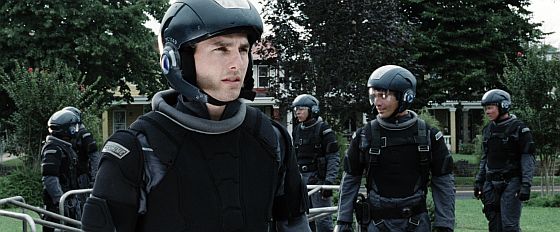
Hendrik Hertzberg writes: In Steven Spielberg’s sci-fi masterpiece “Minority Report,” set in the year 2054 and released nine months after the attacks of September 11, 2001, homicide-squad detectives no longer spend their time tracking down people who have committed murder. Instead, they go after people who are about to commit murder, swooping down to stop them in the nick of time. Spielberg’s police officers don’t fight crime, they fight “Pre-Crime.” They don’t catch killers, they catch pre-killers.

The enormous anti-terror establishment that the United States has created in the years since 9/11 has a similar purpose. Its vast, sprawling, expensive array of governmental, quasi-governmental, and nominally private institutions and their tools—high tech, like ubiquitous surveillance cameras, satellites, wiretaps, computer algorithms, facial-recognition software, drones, and data collection and analysis on a global scale; lower tech, like networks of agents, bags of cash, and airport security checkpoints—are designed primarily to stop acts of terrorism before they happen. That turns out to be a good deal more difficult than investigating such an act once it occurs.

Or so it appears, judging from the contrast between the total unexpectedness of the Boston Marathon bombings, on April 15th, and the stunning speed with which the alleged (and there’s no reason to doubt the accuracy of the allegation) perpetrators were identified. Seventy-four hours after the carnage, we saw their pictures; eight hours after that, one was dead; six hours after that, we learned their names and perused their tweets and YouTube favorites; twelve hours after that, on the night of the fifth day, the second was in custody. To be sure, it was mainly traditional police work that solved the crime and cornered the criminals. But key clues—including two surveillance-camera images, culled from thousands, that were eventually found to be of Tamerlan and Dzhokhar Tsarnaev—were unearthed with the help of an all-pervasive, largely terror-sired security technosphere. [Continue reading…]

Facebooktwittermail

Stephen Hawking’s boycott hits Israel where it hurts: science

Hilary Rose and Steven Rose write: Stephen Hawking’s decision to boycott the Israeli president’s conference has gone viral. Over 100,000 Facebook shares of the Guardian report at last count. Whatever the subsequent fuss, Hawking’s letter is unequivocal. His refusal was made because of requests from Palestinian academics.

Witness the speed with which the pro-Israel lobby seized on Cambridge University’s initial false claim that he had withdrawn on health grounds to denounce the boycott movement, and their embarrassment when within a few hours the university shamefacedly corrected itself. Hawking also made it clear that if he had gone he would have used the occasion to criticise Israel’s policies towards the Palestinians.

While journalists named him “the poster boy of the academic boycott” and supporters of the boycott, divestment and sanctions (BDS) movement celebrated, Ha’aretz, the most progressive of the Israeli press, drew attention to the inflammatory language used by the conference organisers, who described themselves as “outraged” rather than that they “regretted” Hawking’s decision.

That the world’s most famous scientist had recognised the justice of the Palestinian cause is potentially a turning point for the BDS campaign. And that his stand was approved by a majority of two to one in the Guardian poll that followed his announcement shows just how far public opinion has turned against Israel’s relentless land-grabbing and oppression.

Hawking’s public refusal follows that of prominent singers, artists and writers, from Brian Eno to Mike Leigh, Alice Walker and Adrienne Rich, all of whom have publicly rejected invitations to perform in Israel. But what winds Israel up is the fact that this rejection is by a famous scientist and that science and technology drive its economy. Hawking’s decision threatens to open a floodgate with more and more scientists coming to regard Israel as a pariah state. [Continue reading…]

Facebooktwittermail

Revised Guantanamo force-feed policy exposed

Jason Leopold reports: Hunger striking Guantanamo prisoners who are force-fed a liquid nutritional supplement undergo a brutal and dehumanising medical procedure that requires them to wear masks over their mouths while they sit shackled in a restraint chair for as long as two hours, according to documentation obtained by Al Jazeera. The prisoners remain this way, with a 61cm – or longer – tube snaked through their nostril until a chest X-ray, or a test dose of water, confirms it has reached their stomach.

At the end of the feeding, the prisoner is removed from the restraint chair and placed into a “dry cell” with no running water. A guard then observes the detainee for 45-60 minutes “for any indications of vomiting or attempts to induce vomiting”. If the prisoner vomits he is returned to the restraint chair.

That’s just a partial description of the “chair restraint system clinical protocol” which medical personnel are instructed to follow when administering a nutritional supplement to prisoners who have been selected for force-feeding by Guantanamo Commander Rear Admiral John Smith.

Standard operating procedure

The restraint system, published here for the first time, along with the feeding procedures policy, was contained in a newly revised Standard Operating Procedure (SOP) for Guantanamo hunger strikers, obtained exclusively by Al Jazeera from United States Southern Command (SOUTHCOM), which has oversight of the joint task force that operates the prison.

The 30-page manual contains the most detailed descriptions to date pertaining to the treatment of hunger strikers and prisoners who undergo force-feedings. The SOP replaced a previous SOP issued in 2003 – revised in 2005 – which was declassified several years ago by the Pentagon, albeit with redactions. The new, unredacted policy obtained by Al Jazeera went into effect March 5 – one month after Guantanamo prisoners launched their protest over the inspection of their Qurans.

The procedure appears to have been revised and implemented in order to deal with a mass hunger strike. [Continue reading…]

Facebooktwittermail