



Alternet: This week the sane among us will scoff at those hoarding candles and food for another apocalypse that fails to materialize. We’ll laugh at the accounts of people readying their bunkers and at store shelves being wiped clean. We know that the world will not come to a cataclysmic end on December 21.
Here’s what we’re not so good at understanding: We are part of a slowly enfolding tragedy in which the end of the world as we know it may be getting closer and closer. It won’t happen on any particular day that we can pinpoint and there won’t be a giant explosion or a big flood that will wipe everything away. There will be many floods and fires over many years. One species, one crop dying off after another.
This may seem like a bad disaster flick straight out of Hollywood, but unfortunately, all of us have already been cast in this drama and it’s called Climate Change. The prognosis for heading off this catastrophe is not great … but it’s also not impossible. We don’t need fear-mongering, but we do need a kick in the pants. And that’s a gross understatement. We need decisive action on a scale that we’ve yet to see materialize. There are great things being done and wise words being written. Osha Gray Davidson has detailed Germany’s rise as an renewable energy giant, and says that we can follow in its footsteps if we want. Alex Steffen believes cities will be the key to transforming our future and has presented a path for change. Bill McKibben and 350.org have led one campaign after another to raise consciousness, fight fossil fuel giants, stop dirty energy, and ignite action. Unless more of us join in their efforts and create new ones of our own, we’ll be headed toward a disaster in which no amount of canned goods or personal bunkers will save us. Here are five scary reasons things may be about to get a whole lot worse. [Continue reading…]
A feature report for Der Spiegel (I linked to the first part on Sunday), describes the experiences of drone operator, Brandon Bryant.
Bryant remembers the first time he fired a missile, killing two men instantly. As Bryant looked on, he could see a third man in mortal agony. The man’s leg was missing and he was holding his hands over the stump as his warm blood flowed onto the ground — for two long minutes. He cried on his way home, says Bryant, and he called his mother.
“I felt disconnected from humanity for almost a week,” he says, sitting in his favorite coffee shop in Missoula, where the smell of cinnamon and butter wafts in the air. He spends a lot of time there, watching people and reading books by Nietzsche and Mark Twain, sometimes getting up to change seats. He can’t sit in one place for very long anymore, he says. It makes him nervous.
His girlfriend broke up with him recently. She had asked him about the burden he carries, so he told her about it. But it proved to be a hardship she could neither cope with nor share.
When Bryant drives through his hometown, he wears aviator sunglasses and a Palestinian scarf. The inside of his Chrysler is covered with patches from his squadrons. On his Facebook page, he’s created a photo album of his coins, unofficial medals he was awarded. All he has is this one past. He wrestles with it, but it is also a source of pride.
When he was sent to Iraq in 2007, he posted the words “ready for action” on his profile. He was assigned to an American military base about 100 kilometers (63 miles) from Baghdad, where his job was to take off and land drones.
As soon as the drones reached flying altitude, pilots in the United States took over. The Predator can remain airborne for an entire day, but it is also slow, which is why it is stationed near the area of operation. Bryant posed for photos wearing sand-colored overalls and a bulletproof vest, leaning against a drone.
Two years later, the Air Force accepted him into a special unit, and he was transferred to the Cannon Air Force Base in New Mexico. He and a fellow soldier shared a bungalow in a dusty town called Clovis, which consists mainly of trailers, gas stations and evangelical churches. Clovis is located hours away from the nearest city.
Bryant preferred night shifts, because that meant it was daytime in Afghanistan. In the spring, the landscape, with its snow-covered peaks and green valleys, reminded him of his native Montana. He saw people cultivating their fields, boys playing soccer and men hugging their wives and children.
When it got dark, Bryant switched to the infrared camera. Many Afghans sleep on the roof in the summer, because of the heat. “I saw them having sex with their wives. It’s two infrared spots becoming one,” he recalls.
He observed people for weeks, including Taliban fighters hiding weapons, and people who were on lists because the military, the intelligence agencies or local informants knew something about them.
“I got to know them. Until someone higher up in the chain of command gave me the order to shoot.” He felt remorse because of the children, whose fathers he was taking away. “They were good daddies,” he says.
[…]
At some point, Brandon Bryant just wanted to get out and do something else. He spent a few more months overseas, this time in Afghanistan. But then, when he returned to New Mexico, he found that he suddenly hated the cockpit, which smelled of sweat. He began spraying air freshener to get rid of the stench. He also found he wanted to do something that saved lives rather than took them away. He thought working as a survival trainer might fit the bill, although his friends tried to dissuade him.The program that he then began working on in his bungalow in Clovis every day was called Power 90 Extreme, a boot camp-style fitness regimen. It included dumbbell training, push-ups, chin-ups and sit-ups. He also lifted weights almost every day.
On uneventful days in the cockpit, he would write in his diary, jotting down lines like: “On the battlefield there are no sides, just bloodshed. Total war. Every horror witnessed. I wish my eyes would rot.”
Excerpt from Of Empires and Citizens: Pro-American Democracy or No Democracy at All? by Amaney A. Jamal:
They hate what we see right here in this chamber—a democratically elected government. . . . They hate our freedoms—our freedom of religion, our freedom of speech, our freedom to vote and assemble.
— President George W. Bush, September 20, 2001, quoted in The Stakes: America in the Middle East by Shibley Telhami.
Perhaps nothing is more insulting to Arab societies than U.S. claims that America values freedoms in ways that ordinary Muslim and Arab citizens don’t—or even worse, can’t. It is one thing to claim that the United States has strong geostrategic interests in the region that render democracy inconsequential; it is another altogether to sell such interest, which has resulted in authoritarian durability, as the result of something inherently undemocratic among the people of the region. Not only has the United States continued to invest in the myth of a civilizational divide but it now designs policies to remedy this clash that miss the root cause of the problem and, indeed, perpetuate it.
Because democratic inferiority is the policy theory du jour, we are now confronted with a new set of policies aimed at addressing it. The United States is currently engaged in bolstering liberal and secular elements of Arab societies as a means to counter the influence of Islamists. This strategy does little to address the sources of anti-Americanism in the region. But describing the problem as an ideological one exonerates the United States from culpability because this strategy implies that Islamists are problematic because of their Islamic belief systems and not their anti-Americanism.
In fact, commentators often assume that Islamists are anti-American by default, failing to recognize the significant variation that exists among Islamists in their anti-American sentiments. While Islamists have shown significant levels of moderation on domestic political issues relating to Islam, whether it is human rights, women’s rights, or democracy, they have been less compromising on the issues that they are most passionate about, like foreign policy. Islamist groups have shown a remarkable willingness to play within the rules of democratic elections—in part because they can be confident about the level of their support among the voters. According to Muriel Asseburg, “The democratic openings that have been achieved, albeit limited, have encouraged many Islamists to pursue their agendas through the ballot box rather than violence; when and where Islamists have been allowed to do so, they have started to work for change within the political systems.” [Continue reading…]
The Cable: The American people are weary of war and aren’t up for another military adventure in either Syria or Iran, former Nebraska senator and potential defense secretary Chuck Hagel told The Cable.
Hagel sat down for a 90-minute exclusive interview in his Georgetown office in May, well before President Barack Obama began vetting him for a top national security position in his second-term cabinet, perhaps to replace Leon Panetta at the Pentagon.
In previously unreleased portions of that interview, Hagel commented on how the United States should move forward in Syria and Iran, urging caution, patience, and a focus on multilateral diplomacy.
“I think we’ve got to be very wise and careful on this and continue to work with the multilateral institutions in the lead in Syria. I don’t think America wants to be in the lead on this,” he said. “What you have to do is manage the problem. You manage it to a higher ground of possible solutions, ultimately to try to get to a resolution. You don’t have control over what’s going on in Syria.”
“You’ve got to be patient, smart, wise, manage the problem,” he said.
The Obama administration has resisted intervention in Syria based on the risk that arming the opposition directly could fuel the fire and out of concern that establishing a no-fly zone would require a major U.S. commitment with uncertain results.
Hagel said he agreed with that policy, and urged caution and patience when dealing with the Syrian crisis — though it’s worth reiterating that these remarks were made in May.
“I don’t think I’d do anything different from what the Obama administration is doing. I think they are handling this responsibly and working with everybody. It’s frustrating; it’s maddening. I get all that. But we’re still in the longest war in American history and our standing in that part of the world is not that good,” he said.
Hagel believes that the world is moving toward more diffused power structure where the United States no longer remains the single unchallenged superpower. That, combined with America’s internal problems and the desire for Americans to end over a decade of war, points to the need for a diplomatic solution in Syria, he said.
“We’ve got to understand great-power limitations. There are so many uncontrollable variables at play in Syria and the Middle East,” Hagel said. “You work through the multilateral institutions that are available, the U.N., the Arab league. The last thing you want is an American-led or Western-led invasion into Syria.” [Continue reading…]
Nouriel Roubini writes: The risks facing the eurozone have been reduced since the summer, when a Greek exit looked imminent and borrowing costs for Spain and Italy reached new and unsustainable heights. But, while financial strains have since eased, economic conditions on the eurozone’s periphery remain shaky.
Several factors account for the reduction in risks. For starters, the European Central Bank’s “outright monetary transactions” program has been incredibly effective: interest-rate spreads for Spain and Italy have fallen by about 250 basis points, even before a single euro has been spent to purchase government bonds. The introduction of the European Stability Mechanism (ESM), which provides another €500 billion ($650 billion) to be used to backstop banks and sovereigns, has also helped, as has European leaders’ recognition that a monetary union alone is unstable and incomplete, requiring deeper banking, fiscal, economic, and political integration.
CommentsBut, perhaps most important, Germany’s attitude toward the eurozone in general, and Greece in particular, has changed. German officials now understand that, given extensive trade and financial links, a disorderly eurozone hurts not just the periphery but the core. They have stopped making public statements about a possible Greek exit, and just supported a third bailout package for the country. As long as Spain and Italy remain vulnerable, a Greek blowup could spark severe contagion before Germany’s election next year, jeopardizing Chancellor Angela Merkel’s chances of winning another term. So Germany will continue to finance Greece for the time being. [Continue reading…]
The Associated Press reports: Just under a third of voters turned out for the first stage of the referendum on a constitution meant to be a historic milestone in setting Egypt’s future — a showing critics say deepens doubts over the legitimacy of a charter that has already polarized the country.
The dismal showing also raises the question whether Egyptians have been turned off by the turmoil that has characterized the country’s politics throughout the nearly two years since the ouster of Hosni Mubarak’s autocratic regime.
Last Saturday’s voting took place in 10 of Egypt’s 27 provinces, including Cairo and the nation’s second largest city Alexandria. Some 26 million voters were eligible to vote, but only 32 percent of them did. Voting in the remainder 17 provinces will take place the coming Saturday.
The turnout was the second lowest of the relentless series of five nationwide elections that Egyptians have been called to in the 22 months since Mubarak’s fall in last year’s popular uprising. The highest was nearly 60 percent in the election of parliament’s lawmaking lower chamber. The lowest was an embarrassing 8 percent for the vote for the upper chamber, a largely toothless body that the public cares little about.
Besides the low turnout, preliminary results show that the “yes” vote carried the first round only by a slim margin of 56 percent — hardly the resounding endorsement the Islamists were looking for to silence the increasingly vocal and united opposition that called on supporters to vote “no.”
For weeks, legal experts in Egypt have said if turnout is low and the final majority in favor of the constitution is lower than 70 percent, it would raise damaging questions about how representative the document is of the nation.
NBC News’ Chief Foreign Correspondent Richard Engel and members of his network production team were freed from captors in Syria after a firefight at a checkpoint on Monday, five days after they were taken prisoner, NBC News said early Tuesday.
“After being kidnapped and held for five days inside Syria by an unknown group, NBC News Chief Foreign Correspondent Richard Engel and his production crew members have been freed unharmed. We are pleased to report they are safely out of the country,” the network said in a statement.
The captors were unidentified and were not believed to be loyal to the Assad regime.
Engel, 39, along with other employees the network did not identify, disappeared shortly after crossing into northwest Syria from Turkey on Thursday. The network had not been able to contact them until learning that they had been freed on Monday.
The network said there was no claim of responsibility, no contact with the captors and no request for ransom during the time the crew was missing.
After entering Syria, Engel and his team were abducted, tossed into the back of a truck and blindfolded before being transported to an unknown location believed to be near the small town of Ma’arrat Misrin. During their captivity, they were blindfolded and bound, but otherwise not physically harmed, the network said.
Early Monday evening local time, the prisoners were being moved to a new location in a vehicle when their captors ran into a checkpoint manned by members of the Ahrar al-Sham brigade, a Syrian rebel group. There was a confrontation and a firefight ensued. Two of the captors were killed, while an unknown number of others escaped, the network said.
The NBC News crew was unharmed in the incident. They remained in Syria until Tuesday morning when they made their way to the border and re-entered Turkey, the network said. They were to be evaluated and debriefed, but had communicated that everyone was in good health.
Peter Aylward writes: There is still little information about the perpetrator of the atrocity in Newtown, Connecticut, although I would be surprised if Adam Lanza didn’t fit the general profile of mass killers: a loner, introverted and on the margins of his social group. What has been reported is that he killed his mother, then went on to kill 20 pupils and six adults at the school where she apparently had links, before taking his own life.
This incident has deep resonance with the Dunblane massacre in Scotland in 1996 when Thomas Watt Hamilton walked into a primary school and shot dead 16 young children and a teacher before killing himself. My own recent research into the Dunblane tragedy established early developmental trauma in Hamilton highlighted by an unhealthy, problematic relationship with his mother and sibling and crucially an absent, and abandoning, father. This was also the situation for Anders Breivik, the mass killer in Norway.
My experience with the assessment and treatment of homicidal perpetrators at Broadmoor hospital informs me that both Hamilton’s and Breivik’s murderous rage had their roots in unresolved family relationships and conflicts that became displaced into their community; not simply that somebody has a difficult childhood and later becomes a troubled adult.
One understandable response to such incidents is to review gun laws in the hope that this will prevent further incidents occurring. This might restrict firearms access – in America’s case, this may well be a crucial step. But this in itself will never be enough: rather like the security scanning machines at airports, tighter regulation alone would do little to help us understand the murderousness in the mind. Such violent acts appear incomprehensible and the subsequent inquiries too often reach a simplistic conclusion by focusing on the social or political grievances of the perpetrator, coupled with a diagnosis of mental illness or personality disorder or both.
This misses the crucial fact that the perpetrator’s crime is inextricably linked to the individual’s early experience. All responses to violence need to include a full understanding of the history of the perpetrator in an attempt to establish the “why”. This will offer the only opportunity we have to establish the fundamental truth. The question arises, how does society deal with “marginalised” individuals in their midst like Hamilton, Breivik or Lanza, and how do we try to prevent such events from recurring?
It is sadly inevitable that we will continue to experience individuals committing criminal acts as a corollary to fundamentally feeling uncontained, excluded and emasculated (originating from the experience in their first tier of socialisation, namely the family). So there is a vital role to be played by the next tier of socialisation, namely education.
I believe we need to educate the next generation of mothers and fathers, starting at the earliest phase of schooling, about relationships. This would include the vital importance of developing the capacity to reflect, thereby mitigating exclusion and promoting that fundamental human need of a sense of belonging. [Continue reading…]
Luke Harding writes: I had come in search of families displaced by Syria’s war. But when I entered Qabbasin secondary school I was surprised to discover lessons were going on. Two months ago head Nasar Mamar decided to reopen.
There was fighting going on down the road in Aleppo. But Qabbasin, some 40km away, was comparatively safe – safe, if you ignored the regime jets flying overhead. “We need Syria to be an educated country. We should not be afraid,” Mamar explained, taking me on a tour of his classrooms.
Downstairs I found 30 boys in the middle of an English lesson. Written on the blackboard was some useful vocabulary: “library” and “explorer”, and examples of the present continuous tense – “I am eating. I am reading” – with a neat translation in Arabic. Their teacher was 30-year-old Abu Hassan. Hassan said he had fled from Aleppo. He was now working as an unsalaried volunteer. “I want to teach. It’s my job,” he said.
Hassan was melancholic when I asked him about the destruction of Aleppo – “my lovely city”, as he put it. Much of it is now a smouldering ruin: the medieval souks dating back to the 14th century part-destroyed; the old citadel the frontline between embattled government troops, the Free Syrian Army and jihadist militias.
Syria’s war reached Aleppo nearly six months ago. Since then the city’s cosmopolitan charm has been snuffed out; it is a place of hunger, cold, misery and death from the sky, he said.
I asked Hassan whom he thought was responsible for his Syria’s collapse, moral and social. He thought for a moment, then replied: “For me, all of us. All of us have wrong actions. I wish everything would be back how it was.” Hassan said he was an English graduate from Aleppo University. He declined to give me his full family name. “I’d rather not,” he said. I left Hassan’s classroom – lit only by a weak winter sun – urging the boys to study hard.
Many of the pupils now back at school had fled with their families from Aleppo. Syria’s uprising began in March 2011; since then the town’s population has swollen from 18,000 to 30,000.
It’s a similar story across rebel-controlled northern Syria: millions are displaced, staying with relatives, renting private rooms, or crammed into dismal border camps. Qabbasin has a mixed population of Arabs and Kurds, and despite tensions elsewhere is a model of inter-ethnic co-operation. Mamar, the head, is a Kurd; most of his staff are Arabs; the headteacher at the girls’ school next door is a Turkman. [Continue reading…]
George Monbiot writes: “Mere words cannot match the depths of your sorrow, nor can they heal your wounded hearts … These tragedies must end. And to end them, we must change.” Every parent can connect with what President Barack Obama said about the murder of 20 children in Newtown, Connecticut. There can scarcely be a person on earth with access to the media who is untouched by the grief of the people of that town.
It must follow that what applies to the children murdered there by a deranged young man also applies to the children murdered in Pakistan by a sombre American president. These children are just as important, just as real, just as deserving of the world’s concern. Yet there are no presidential speeches or presidential tears for them, no pictures on the front pages of the world’s newspapers, no interviews with grieving relatives, no minute analysis of what happened and why.
If the victims of Mr Obama’s drone strikes are mentioned by the state at all, they are discussed in terms which suggest that they are less than human. The people who operate the drones, Rolling Stone magazine reports, describe their casualties as “bug splats”, “since viewing the body through a grainy-green video image gives the sense of an insect being crushed”. Or they are reduced to vegetation: justifying the drone war, Obama’s counterterrorism adviser Bruce Riedel explained that “you’ve got to mow the lawn all the time. The minute you stop mowing, the grass is going to grow back“. [Continue reading…]
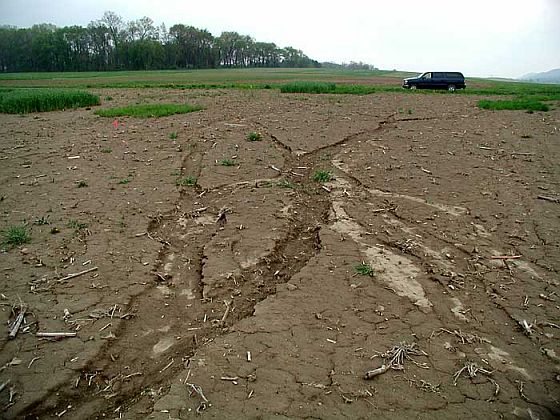
Time: It’s a strange notion, but some experts fear the world, at its current pace of consumption, is running out of useable topsoil. The World Economic Forum, in collaboration with TIME, talked to University of Sydney professor John Crawford on the seismic implications soil erosion and degradation may have in the decades to come.
Is soil really in danger of running out?
A rough calculation of current rates of soil degradation suggests we have about 60 years of topsoil left. Some 40% of soil used for agriculture around the world is classed as either degraded or seriously degraded – the latter means that 70% of the topsoil, the layer allowing plants to grow, is gone. Because of various farming methods that strip the soil of carbon and make it less robust as well as weaker in nutrients, soil is being lost at between 10 and 40 times the rate at which it can be naturally replenished. Even the well-maintained farming land in Europe, which may look idyllic, is being lost at unsustainable rates.
Why haven’t we heard more about this?
Probably because soil isn’t sexy. People don’t always think about how it’s connected with so many other things: health, the environment, security, climate, water. For example, agriculture accounts for 70% of our fresh water use: we pour most of our water straight onto the ground. If soil is not fit for purpose, that water will be wasted, because it washes right through degraded soil and past the root system. Given the enormous potential for conflict over water in the next 20-30 years, you don’t want to exacerbate things by continuing to damage the soil, which is exactly what’s happening now. [Continue reading…]
Another reason soil is something the average American doesn’t think about is because it has been degraded in language. We call it dirt and dirt is hard to value.

Reuters reports: Syrian Vice President Farouq al-Sharaa said that neither the forces of President Bashar al-Assad nor rebels seeking to overthrow him can win the war which is now being fought on the outskirts of Assad’s powerbase in Damascus.
Sharaa, a Sunni Muslim in a power structure dominated by Assad’s Alawite minority, has rarely been seen since the Syrian revolt erupted in March 2011 and is not part of the president’s inner circle directing the fight against Sunni rebels.
But he is the most prominent figure to say in public that Assad will not win. He was speaking to the pro-Assad al-Akhbar paper in an interview from Damascus which is now hemmed in by rebel fighters to the south.
Assad’s forces have used jets and artillery to try to dislodge the fighters from around Damascus but the violence has crept into the heart of the capital and rebels announced on Sunday a new offensive in the central province of Hama.
Sharaa said the situation in Syria, where more than 40,000 people have been killed, was deteriorating and a “historic settlement” was needed to end the conflict, involving regional powers and the U.N. Security Council and the formation of a national unity government “with broad powers”.
Der Spiegel: For more than five years, Brandon Bryant worked in an oblong, windowless container about the size of a trailer, where the air-conditioning was kept at 17 degrees Celsius (63 degrees Fahrenheit) and, for security reasons, the door couldn’t be opened. Bryant and his coworkers sat in front of 14 computer monitors and four keyboards. When Bryant pressed a button in New Mexico, someone died on the other side of the world.
The container is filled with the humming of computers. It’s the brain of a drone, known as a cockpit in Air Force parlance. But the pilots in the container aren’t flying through the air. They’re just sitting at the controls.
Bryant was one of them, and he remembers one incident very clearly when a Predator drone was circling in a figure-eight pattern in the sky above Afghanistan, more than 10,000 kilometers (6,250 miles) away. There was a flat-roofed house made of mud, with a shed used to hold goats in the crosshairs, as Bryant recalls. When he received the order to fire, he pressed a button with his left hand and marked the roof with a laser. The pilot sitting next to him pressed the trigger on a joystick, causing the drone to launch a Hellfire missile. There were 16 seconds left until impact.
“These moments are like in slow motion,” he says today. Images taken with an infrared camera attached to the drone appeared on his monitor, transmitted by satellite, with a two-to-five-second time delay.
With seven seconds left to go, there was no one to be seen on the ground. Bryant could still have diverted the missile at that point. Then it was down to three seconds. Bryant felt as if he had to count each individual pixel on the monitor. Suddenly a child walked around the corner, he says.
Second zero was the moment in which Bryant’s digital world collided with the real one in a village between Baghlan and Mazar-e-Sharif.
Bryant saw a flash on the screen: the explosion. Parts of the building collapsed. The child had disappeared. Bryant had a sick feeling in his stomach.
“Did we just kill a kid?” he asked the man sitting next to him.
“Yeah, I guess that was a kid,” the pilot replied.
“Was that a kid?” they wrote into a chat window on the monitor.
Then, someone they didn’t know answered, someone sitting in a military command center somewhere in the world who had observed their attack. “No. That was a dog,” the person wrote.
They reviewed the scene on video. A dog on two legs?
When Bryant left the container that day, he stepped directly into America: dry grasslands stretching to the horizon, fields and the smell of liquid manure. Every few seconds, a light on the radar tower at the Cannon Air Force Base flashed in the twilight. There was no war going on there.
Modern warfare is as invisible as a thought, deprived of its meaning by distance. It is no unfettered war, but one that is controlled from small high-tech centers in various places in the world. The new (way of conducting) war is supposed to be more precise than the old one, which is why some call it “more humane.” It’s the war of an intellectual, a war United States President Barack Obama has promoted more than any of his predecessors. [Continue reading…]
The New York Times reports: A group advocating a more transparent government has formed a nonprofit organization called the Freedom of the Press Foundation to serve as a conduit for donations to organizations like WikiLeaks. The goal is to insulate those groups’ fund-raising efforts from political and business pressures.
In December 2010, Visa, MasterCard and PayPal announced that they would no longer accept transactions for WikiLeaks, the online leak group that released thousands of secret documents from the American government. The move to cut off donations, which came after vocal protests against the organization’s activities from members of Congress, eliminated the vast majority of financing for WikiLeaks.
Board members of the Freedom of the Press Foundation include Daniel Ellsberg, the whistle-blower who disclosed the Pentagon Papers; Glenn Greenwald, a journalist who writes about civil liberties for The Guardian; John Perry Barlow, a co-founder of the Electronic Frontier Foundation; Xeni Jardin of the Web site Boing Boing; and John Cusack, an actor who has been a vocal opponent of government secrecy. [Continue reading…]