In the New Yorker, Dexter Filkins has a 10,000 word profile of Major General Qassem Suleimani, the leader of a branch of Iran’s Revolutionary Guard called the Quds Force, thousands of whose members are now fighting in Syria. It’s worth reading the whole article, but I’ve picked out some of the most important passages below.
For Suleimani, defending Assad is a matter of pride. He is quoted as having said: “We’re not like the Americans. We don’t abandon our friends.”
Iran’s intervention in Syria escalated sharply late last year.
A turning point came in April, after rebels captured the Syrian town of Qusayr, near the Lebanese border. To retake the town, Suleimani called on Hassan Nasrallah, Hezbollah’s leader, to send in more than two thousand fighters. It wasn’t a difficult sell. Qusayr sits at the entrance to the Bekaa Valley, the main conduit for missiles and other matériel to Hezbollah; if it was closed, Hezbollah would find it difficult to survive. Suleimani and Nasrallah are old friends, having coöperated for years in Lebanon and in the many places around the world where Hezbollah operatives have performed terrorist missions at the Iranians’ behest. According to Will Fulton, an Iran expert at the American Enterprise Institute, Hezbollah fighters encircled Qusayr, cutting off the roads, then moved in. Dozens of them were killed, as were at least eight Iranian officers. On June 5th, the town fell. “The whole operation was orchestrated by Suleimani,” Maguire, who is still active in the region, said. “It was a great victory for him.”
Despite all of Suleimani’s rough work, his image among Iran’s faithful is that of an irreproachable war hero—a decorated veteran of the Iran-Iraq War, in which he became a division commander while still in his twenties.
*
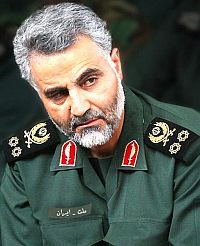 In March, 2009, on the eve of the Iranian New Year, Suleimani led a group of Iran-Iraq War veterans to the Paa-Alam Heights, a barren, rocky promontory on the Iraqi border. In 1986, Paa-Alam was the scene of one of the terrible battles over the Faw Peninsula, where tens of thousands of men died while hardly advancing a step. A video recording from the visit shows Suleimani standing on a mountaintop, recounting the battle to his old comrades. In a gentle voice, he speaks over a soundtrack of music and prayers.
“This is the Dasht-e-Abbas Road,” Suleimani says, pointing into the valley below. “This area stood between us and the enemy.” Later, Suleimani and the group stand on the banks of a creek, where he reads aloud the names of fallen Iranian soldiers, his voice trembling with emotion. During a break, he speaks with an interviewer, and describes the fighting in near-mystical terms. “The battlefield is mankind’s lost paradise—the paradise in which morality and human conduct are at their highest,” he says. “One type of paradise that men imagine is about streams, beautiful maidens, and lush landscape. But there is another kind of paradise—the battlefield.”
*
In the chaotic days after the attacks of September 11th, Ryan Crocker, then a senior State Department official, flew discreetly to Geneva to meet a group of Iranian diplomats. “I’d fly out on a Friday and then back on Sunday, so nobody in the office knew where I’d been,” Crocker told me. “We’d stay up all night in those meetings.” It seemed clear to Crocker that the Iranians were answering to Suleimani, whom they referred to as “Haji Qassem,” and that they were eager to help the United States destroy their mutual enemy, the Taliban. Although the United States and Iran broke off diplomatic relations in 1980, after American diplomats in Tehran were taken hostage, Crocker wasn’t surprised to find that Suleimani was flexible. “You don’t live through eight years of brutal war without being pretty pragmatic,” he said. Sometimes Suleimani passed messages to Crocker, but he avoided putting anything in writing. “Haji Qassem’s way too smart for that,” Crocker said. “He’s not going to leave paper trails for the Americans.”
Before the bombing began, Crocker sensed that the Iranians were growing impatient with the Bush Administration, thinking that it was taking too long to attack the Taliban. At a meeting in early October, 2001, the lead Iranian negotiator stood up and slammed a sheaf of papers on the table. “If you guys don’t stop building these fairy-tale governments in the sky, and actually start doing some shooting on the ground, none of this is ever going to happen!” he shouted. “When you’re ready to talk about serious fighting, you know where to find me.” He stomped out of the room. “It was a great moment,” Crocker said.
The coöperation between the two countries lasted through the initial phase of the war. At one point, the lead negotiator handed Crocker a map detailing the disposition of Taliban forces. “Here’s our advice: hit them here first, and then hit them over here. And here’s the logic.” Stunned, Crocker asked, “Can I take notes?” The negotiator replied, “You can keep the map.” The flow of information went both ways. On one occasion, Crocker said, he gave his counterparts the location of an Al Qaeda facilitator living in the eastern city of Mashhad. The Iranians detained him and brought him to Afghanistan’s new leaders, who, Crocker believes, turned him over to the U.S. The negotiator told Crocker, “Haji Qassem is very pleased with our coöperation.”
The good will didn’t last. In January, 2002, Crocker, who was by then the deputy chief of the American Embassy in Kabul, was awakened one night by aides, who told him that President George W. Bush, in his State of the Union Address, had named Iran as part of an “Axis of Evil.” Like many senior diplomats, Crocker was caught off guard. He saw the negotiator the next day at the U.N. compound in Kabul, and he was furious. “You completely damaged me,” Crocker recalled him saying. “Suleimani is in a tearing rage. He feels compromised.” The negotiator told Crocker that, at great political risk, Suleimani had been contemplating a complete reëvaluation of the United States, saying, “Maybe it’s time to rethink our relationship with the Americans.” The Axis of Evil speech brought the meetings to an end. Reformers inside the government, who had advocated a rapprochement with the United States, were put on the defensive. Recalling that time, Crocker shook his head. “We were just that close,” he said. “One word in one speech changed history.”
*
Last December, when Assad’s regime appeared close to collapse, American officials spotted Syrian technicians preparing bombs carrying the nerve agent sarin to be loaded onto aircraft. All indications were that they were plotting an enormous chemical attack. Frantic, the Americans called leaders in Russia, who called their counterparts in Tehran. According to the American defense official, Suleimani appeared to be instrumental in persuading Assad to refrain from using the weapons.
Suleimani’s sentiments about the ethics of chemical weapons are unknown. During the Iran-Iraq War, thousands of Iranian soldiers suffered from chemical attacks, and the survivors still speak publicly of the trauma. But some American officials believe that his efforts to restrain Assad had a more pragmatic inspiration: the fear of provoking American military intervention. “Both the Russians and the Iranians have said to Assad, ‘We can’t support you in the court of world opinion if you use this stuff,’ ” a former senior American military official said.
The regime is believed to have used chemical weapons at least fourteen times since last year. Yet even after the enormous sarin attack on August 21st, which killed fourteen hundred civilians, Suleimani’s support for Syria has been unbending. To save Assad, Suleimani has called on every asset he built since taking over the Quds Force: Hezbollah fighters, Shiite militiamen from around the Arab world, and all the money and matériel he could squeeze out of his own besieged government. In Baghdad, a young Iraqi Shiite who called himself Abu Hassan told me that he was recruited to fight by a group of Iraqi men. He took a bus to the Iranian city of Mashhad, where he and three dozen other Iraqis received two weeks of instruction from Iranian trainers. The men travelled to the Shiite shrine of Sayyidah Zaynab, near Damascus, where they spent three months fighting for the Assad government, along with soldiers from Hezbollah and snipers from Iran. “We lost a lot of people,” Abu Hassan told me.
Suleimani’s greatest achievement may be persuading his proxies in the Iraqi government to allow Iran to use its airspace to fly men and munitions to Damascus. General James Mattis, who until March was the commander of all American military forces in the Middle East, told me that without this aid the Assad regime would have collapsed months ago. The flights are overseen by the Iraqi transportation minister, Hadi al-Amri, who is an old ally of Suleimani’s—the former head of the Badr Brigade, and a soldier on the Iranian side in the Iran-Iraq War. In an interview in Baghdad, Amri denied that the Iranians were using Iraqi airspace to send weapons. But he made clear his affection for his former commander. “I love Qassem Suleimani!” he said, pounding the table. “He is my dearest friend.”
So far, Maliki has resisted pressure to supply Assad overland through Iraq. But he hasn’t stopped the flights; the prospect of a radical Sunni regime in Syria overcame his reservations about becoming involved in a civil war. “Maliki dislikes the Iranians, and he loathes Assad, but he hates Al Nusra,” Crocker told me. “He doesn’t want an Al Qaeda government in Damascus.”
This kind of starkly sectarian atmosphere may be Suleimani’s most lasting impact on the Middle East. To save his Iranian empire in Syria and Lebanon, he has helped fuel a Sunni-Shiite conflict that threatens to engulf the region for years to come—a war that he appears happy to wage. “He has every reason to believe that Iran is the rising power in the region,” Mattis told me. “We’ve never dealt him a body blow.”
In June, a new, moderate President, Hassan Rouhani, was elected in Iran, promising to end the sanctions, which have exhausted the country and demolished its middle class. Hopes have risen in the West that Khamenei might allow Rouhani to strike a deal. Although Rouhani is a moderate only by Iranian standards—he is a Shiite cleric and a longtime adherent of the revolution—his new administration has made a series of good-will gestures, including the release of eleven political prisoners and an exchange of letters with President Obama. Rouhani is in New York this week to speak at the United Nations and, possibly, to meet with Obama. The talks will surely center on the potential for Iran to restrain its nuclear program, in exchange for relaxed sanctions.
Many in the West are hoping that Iran will also help find an end to the grinding war in Syria. Assad’s deputy prime minister recently offered the possibility of a cease-fire, saying, “Let nobody have any fear that the regime in its present form will continue.” But he did not say that Assad would step down, which the rebels have said is a necessary condition of negotiations. There have been hints from powerful Iranians that Assad isn’t worth holding on to. In a recent speech, the former President Hashemi Rafsanjani said, “The people have been the target of chemical attacks by their own government.” (After a leaked recording of the speech caused a stir in Iran, Rafsanjani denied the remarks.) But a less sympathetic regime in Syria would split the Axis of Resistance, and radically complicate Iran’s partnership with Hezbollah. In any case, the Iranian regime may be too fragmented to come to a consensus. “Anytime you see a statement coming out of the government, just remember there’s a rat’s nest of people fighting underneath the surface,” Kevan Harris, a sociologist at Princeton who has studied Iran extensively, told me. As Rouhani tries to engage the West, he will have to contend with the hard-liners, including Suleimani and his comrades, who for more than a decade have defined their foreign policy as a covert war on the U.S. and Israel. “They don’t trust the other side,” Harris said. “They feel that any concession they make will be seen by the West as a sign of weakness.”
For Suleimani, giving up Assad would mean abandoning the project of expansion that has occupied him for fifteen years. In a recent speech before the Assembly of Experts—the clerics who choose the Supreme Leader—he spoke about Syria in fiercely determined language. “We do not pay attention to the propaganda of the enemy, because Syria is the front line of the resistance and this reality is undeniable,’’ he said. “We have a duty to defend Muslims because they are under pressure and oppression.” Suleimani was fighting the same war, against the same foes, that he’d been fighting his entire life; for him, it seemed, the compromises of statecraft could not compare with the paradise of the battlefield. “We will support Syria to the end,” he said.




