Politico: More than 50 major media organizations on Tuesday sent a letter to the Department of Justice protesting the seizure of two months of The Associated Press’ phone records and calling for the department to “mitigate the damage it has caused.”
In a letter to Attorney General Eric Holder and Deputy Attorney James M. Cole, the organizations — which include POLITICO and Allbritton Communications Company — ask that the DOJ return the secretly subpoenaed phone records and explain how government lawyers “overreached so egregiously in this matter.”
The department should also announce any other pending media-related subpoenas and publicly disclose additional information about who has had access to the AP phone records, the groups wrote.
“The scope of this action calls into question the very integrity of Department of Justice policies toward the press and its ability to balance, on its own, its police powers against the First Amendment rights of the news media and the public’s interest in reporting on all manner of government conduct, including matters touching on national security which lie at the heart of this case,” the letter from The Reporters Committee for Freedom of the Press and 51 other news organizations including Advance Publications, Cox Media Group, The McClatchy Company, The New York Times Company and NPR, among many others, stated.
The media organizations also noted that no one could “remember an instance where such an overreaching dragnet for newsgathering materials was deployed by the Department, particularly without notice to the affected reporters or an opportunity to seek judicial review” in the 30 years since the department issued guidelines about its subpoena practices for journalists’ phone records. [Continue reading…]
Category Archives: US government
The Obama administration’s Nixonian attacks on freedom of the press
Trevor Timm at the Freedom of the Press Foundation writes: As part of a new leak investigation, the Justice Department has secretly obtained the call records for twenty phone lines owned by the Assocated Press (AP), which could put sources for as many as one hundred reporters at risk. The AP called the move a “massive and unprecedented intrusion,” saying they “regard this action by the Department of Justice as a serious interference with AP’s constitutional rights to gather and report the news.”
We agree. It’s time to stop looking at all of these leak investigations and prosecutions as ancillary to press freedom; they are a direct attack on it. This should be an important wake-up call for journalists.
While this incident has brought the Justice Department’s crackdown on leakers to a new extreme, it’s important to remember, this storm has been brewing for a while now. In five years, the Obama administration has prosecuted more leakers under the Espionage Act than all other administrations combined, and virtually all these prosecutions have engulfed journalists one way or another.
As part of this current investigation, we’ve known the FBI has been data mining government officials’ phone and email records for months, looking for links to journalists on a systematic scale. The Washington Post reported in January, the FBI is using new, “sophisticated software to identify names, key words and phrases embedded in e-mails and other communications, including text messages, which could lead them to suspects.”
According to the Post, “The FBI also looks at officials’ phone records — who called whom, when, for how long.” Anytime the FBI found a government official has contact with the unknown number of “particular” journalists, FBI agents were “confronting” officials with this information.
As the New York Times reported on their front page in August of last year, these leak investigations are “casting a distinct chill over press coverage of national security issues as agencies decline routine interview requests and refuse to provide background briefings.” The Huffington Post recently interviewed several of the nation’s most prominent national security journalists, all of whom confirmed it’s a perilous time for journalists who are reporting on what the government considers secret.
The Justice Department does not deny this. When asked about the Obama administration’s crackdown on leakers last June, a senior Justice Department (DOJ) official told longtime national security reporter Shane Harris that the DOJ is “out for scalps.” Harris’ DOJ source also “made it clear that reporters who talked to sources about classified information were putting themselves at risk of prosecution.” [Continue reading…]
Assault on press freedom: Justice Department secretly seized Associated Press phone records
Reuters reports: The Associated Press on Monday said the U.S. government seized records from phone lines assigned to AP offices and its reporters over a period of two months in 2012, which the news service described as a “massive and unprecedented intrusion.”
AP Chief Executive Gary Pruitt, in a letter posted on the agency’s website, said the AP was informed last Friday that the Justice Department gathered records for more than 20 lines assigned to the agency and its reporters.
Phone lines at AP bureaus in New York, Hartford and Washington were among those affected by the records seizure, as well as an AP phone at the U.S. House of Representatives, the AP said.
“There can be no possible justification for such an overbroad collection of the telephone communications of The Associated Press and its reporters,” Pruitt said in the letter, which was addressed to Attorney General Eric Holder.
How the U.S. military protects its own rapists
National Journal reports: Based on the Pentagon’s most recent survey on the issue in 2010, the epidemic [of rapes and sexual assaults] affects more than 19,000 victims each year. Meanwhile, according to annual Veterans Affairs Department surveys, 20 percent of female veterans screen positive for “military sexual trauma,” as do 1 percent of male veterans — many of them victims of male-on-male rape. Cumulatively, the data suggest that hundreds of thousands of current and former members of the military have been raped, sexually assaulted, or subjected to “unwanted” sexual contact. In 2010 alone, the VA conducted nearly 700,000 free outpatient counseling sessions to veterans suffering from military sexual trauma.
And the military-justice system has failed to check that epidemic. Persistent, corroborated accounts (by victims and sex-crimes experts) describe a command climate that tends to cast suspicion and blame on victims. Too often, the system treats reports of rape and sexual assault not as heinous crimes to be prosecuted harshly but as unwanted distractions from “good order and discipline” to be dealt with, hastily, at the lowest command level. Frequently, this means simply transferring or demoting suspected perpetrators for “sexual harassment” and referring distraught victims to uniformed mental-health experts who diagnose them with “personality disorders” and help wash them out of the military.
A decade of conflict has almost certainly exacerbated the scourge. The Army had to relax its recruitment standards to fill the ranks at the height of the fighting in Iraq and Afghanistan, and an anonymous 2008 survey by the Naval Health Research Center reported that as many as 15 percent of incoming recruits had either committed or attempted rape before entering the military — twice the rate of their civilian cohorts. Counterinsurgency warfare also placed service members in a high-stress/low-oversight environment that was tailor-made for sexual predators: 25 percent of women and 27 percent of men who claimed “unwanted sexual contact” said that the assaults occurred in combat zones. Army investigators received increased reports of combat-theater rapes only after units returned to their home bases, where victims felt safer to report the assaults. (Of more than 130 women killed in Iraq and Afghanistan, nearly 40 percent died of “noncombat-related” injuries, often gunshots. Some were suicides, but others occurred under suspicious circumstances. A number of the deaths came after the women reported being raped.) “About half the women we see with military sexual trauma also have trauma from combat exposure,” said Deleene Menefee, a psychologist at the VA’s medical center in Houston. “On top of taking fire from the enemy outside the gates, they’ve had to cope with the trauma and fear of being attacked by the enemy from within.” [Continue reading…]
Video: Pentagon study finds 26,000 military sexual assaults last year
The CIA’s rogue operations
Following the New York Times’ revelation earlier this week that the CIA has been regularly delivering shopping bags full of cash to Afghan President Hamid Karzai, Sarah Chayes writes:
Karzai’s relationship with the CIA is believed to long predate the tense days in late 2001 when CIA officers joined him and his followers in the mountains north of Kandahar as the Taliban regime was falling. In a 2003 conversation, the most renowned commander of anti-Soviet resistance fighters in southern Afghanistan, where I lived at the time, told me that in the late 1980s Karzai introduced him to CIA officials so he could obtain some of the all-important Stinger missiles that helped the Afghan fighters neutralize Soviet helicopters. U.S. support of the anti-Soviet resistance was covert. Very few Afghans had direct contact with the CIA. Most received U.S. money or military equipment by way of Pakistani intermediaries. Karzai, according to this commander, was one of the early exceptions.
Given this long relationship with the CIA, Karzai may believe that the agency somehow represents the true voice of the U.S. government. Indeed, the competing and often contradictory exhortations and demands transmitted by ambassadors and special envoys who come and go, the successive commanders of international forces with their different approaches, the congressional delegations who troop through his office, even secretaries of State or Defense, must start to sound like a lot of cacophonous noise to the man on the receiving end. Amid the din, CIA money can ring a clear note.
The tendency to read CIA signals as conveying the “real” intent of the U.S. government is not limited to Afghan leaders. In his book The Arab Center, for example, former Jordanian Foreign Minister Marwan Muasher describes a tense episode in 2004 when Jordan was promoting a broad-based Arab initiative to break the deadlock in the Middle East peace process.
A meeting between President George W. Bush and King Abdullah II was hanging in the balance, with the king awaiting the result of fraught negotiations between Muasher and National Security Advisor Condoleezza Rice over the contents of a letter of intent from Bush to Abdullah. A full day of talks resulted in a mutually agreeable formulation.
But in the meantime, a CIA official had been speaking back channel with Jordan’s intelligence chief, waiting on the West Coast with the king; the CIA official urged the delegation to fly home to Jordan, and it did. In the end, the king and his advisors concluded that it was the CIA, not the national security advisor, that really counted in the U.S. government, and the Middle East peace process remained stalled. [Continue reading…]
CIA Kabul chief used ‘ghost money’ to bypass U.S. ambassador creating secret channel to Karzai
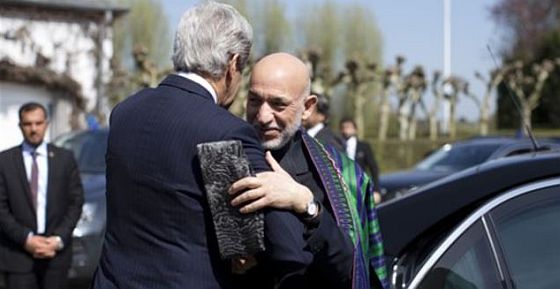
The Guardian reports: The CIA and MI6 have regularly given large cash payments to Hamid Karzai’s office with the aim of maintaining access to the Afghan leader and his top allies and officials, but the attempt to buy influence has largely failed and may have backfired, former diplomats and policy analysts say.
The Guardian understands that the payments by British intelligence were on a smaller scale than the CIA’s handouts, reported in the New York Times to have been in the tens of millions, and much of the British money has gone towards attempts to finance peace initiatives, which have so far proved abortive.
That failure has raised questions among some British officials over whether eagerness to promote a political settlement may have been exploited by Afghan officials and self-styled intermediaries for the Taliban.
Responding to the allegations while on a visit to Helsinki on Monday, Karzai said his national security council (NSC) had received support from the US government for the past 10 years, and the amounts involved were “not big” and were used for a variety of purposes including helping those wounded in the conflict. “It’s multi-purpose assistance,” he said, without commenting on the allegations that the money was fuelling corruption.
Yama Torabi, the director of Integrity Watch Afghanistan said that the presidency’s low-key response to the reports had “outraged people”.
“As a result, we don’t know what was the amount of money that was given, what it was used for and if there was any corruption involved. Money when it is unchecked can be abused and this looks like one. In addition, it can be potentially used to corrupt politicians and political circles, but there is no way to know this unless there is a serious investigation into it,” Torabi told The Guardian.
Kabul sources told the Guardian that the key official involved in distributing the payments within the NSC was Ibrahim Spinzada, a close confidant of the president known as Engineer Ibrahim. There is, however, no evidence that Spinzada personally gained from the cash payments or that in distributing them among the president’s allies and sometimes his foes he was breaking Afghan law.
Officials say the payments, referred to in a New York Times report as “ghost money”, helped prop up warlords and corrupt officials, deepening Afghan popular mistrust of the Kabul government and its foreign backers, and thereby helped drive the insurgency.
The CIA money has sometimes caused divisions between the various branches of US government represented in Kabul, according to diplomats stationed in Kabul, particularly when it helped give the CIA chief of station in Kabul direct access to Karzai without the US ambassador’s knowledge or approval. [Continue reading…]
The CIA is the biggest source of corruption in Afghanistan

The New York Times reports: For more than a decade, wads of American dollars packed into suitcases, backpacks and, on occasion, plastic shopping bags have been dropped off every month or so at the offices of Afghanistan’s president — courtesy of the Central Intelligence Agency.
All told, tens of millions of dollars have flowed from the C.I.A. to the office of President Hamid Karzai, according to current and former advisers to the Afghan leader.
“We called it ‘ghost money,’ ” said Khalil Roman, who served as Mr. Karzai’s deputy chief of staff from 2002 until 2005. “It came in secret, and it left in secret.”
The C.I.A., which declined to comment for this article, has long been known to support some relatives and close aides of Mr. Karzai. But the new accounts of off-the-books cash delivered directly to his office show payments on a vaster scale, and with a far greater impact on everyday governing.
Moreover, there is little evidence that the payments bought the influence the C.I.A. sought. Instead, some American officials said, the cash has fueled corruption and empowered warlords, undermining Washington’s exit strategy from Afghanistan.
“The biggest source of corruption in Afghanistan,” one American official said, “was the United States.”
The United States was not alone in delivering cash to the president. Mr. Karzai acknowledged a few years ago that Iran regularly gave bags of cash to one of his top aides.
At the time, in 2010, American officials jumped on the payments as evidence of an aggressive Iranian campaign to buy influence and poison Afghanistan’s relations with the United States. What they did not say was that the C.I.A. was also plying the presidential palace with cash — and unlike the Iranians, it still is. [Continue reading…]
U.S. gives big, secret push to Internet surveillance
Wired reports: Senior Obama administration officials have secretly authorized the interception of communications carried on portions of networks operated by AT&T and other Internet service providers, a practice that might otherwise be illegal under federal wiretapping laws.
The secret legal authorization from the Justice Department originally applied to a cybersecurity pilot project in which the military monitored defense contractors’ Internet links. Since then, however, the program has been expanded by President Obama to cover all critical infrastructure sectors including energy, healthcare, and finance starting June 12.
“The Justice Department is helping private companies evade federal wiretap laws,” said Marc Rotenberg, executive director of the Electronic Privacy Information Center, which obtained over 1,000 pages of internal government documents and provided them to CNET this week. “Alarm bells should be going off.”
Those documents show the National Security Agency and the Defense Department were deeply involved in pressing for the secret legal authorization, with NSA director Keith Alexander participating in some of the discussions personally. Despite initial reservations, including from industry participants, Justice Department attorneys eventually signed off on the project. [Continue reading…]
How Big Pharma profits from war
Richard A. Friedman writes: Last year, more active-duty soldiers committed suicide than died in battle. This fact has been reported so often that it has almost lost its jolting force. Almost.
Worse, according to data not reported on until now, the military evidently responded to stress that afflicts soldiers in Iraq and Afghanistan primarily by drugging soldiers on the front lines. Data that I have obtained directly from Tricare Management Activity, the division of the Department of Defense that manages health care services for the military, shows that there has been a giant, 682 percent increase in the number of psychoactive drugs — antipsychotics, sedatives, stimulants and mood stabilizers — prescribed to our troops between 2005 and 2011. That’s right. A nearly 700 percent increase — despite a steady reduction in combat troop levels since 2008.
The prescribing trends suggest that the military often uses medications in ways that are not approved by the Food and Drug Administration and do not comport with the usual psychiatric standards of practice.
The military tests prospective enlistees with an eye toward screening out those with serious psychiatric disorders. So you would expect that the use of these drugs in the military would be minimal — and certainly less than in the civilian population. But the opposite is true: prescriptions written for antipsychotic drugs for active-duty troops increased 1,083 percent from 2005 to 2011; the number of antipsychotic drug prescriptions in the civilian population increased just 22 percent from 2005 to 2011, according to IMS Health, an independent medical data company.
The data suggest that military doctors may prescribe psychoactive drugs for off-label use as sedatives, possibly so as to enable soldiers to function better in stressful combat situations. Capt. Michael Colston, a psychiatrist and program director for mental health policy in the Department of Defense, confirmed this possibility. In an e-mail to me, Dr. Colston acknowledged that antipsychotic drugs have been used to treat insomnia, anxiety and aggressive behavior.
Yes, the medicating of combat troops has been done in such a way that it constitutes a form of drug abuse. A year ago the Army Surgeon General warned that medications being widely used to treat PTSD risk making the condition worse. And the dramatic rise in suicides has been widely linked to the effects of suicide-triggering medications.
But there is a gaping whole in Friedman’s commentary: no recognition that the misprescribing of psychiatric drugs by military doctors does not so much contrast with the practice of civilian doctors — it is merely an amplification of already excessive use in the wider population.
Look at the numbers that the author cites. A 1,083 percent increase in prescriptions for antipsychotic drugs for troops is contrasted with a 22 percent increase among civilians during the same period, 2005 to 2011. Yes, that’s a massive difference, but consider the 22 percent increase on its own.
This has nothing to do with a rise in the incidence of mental illness during this period. What it reflects is the massively effective marketing operations of the pharmaceutical manufacturers, in collusion with doctors who either get bribed or brainwashed, as they push off-label prescribing of these powerful and dangerous drugs.
At the same time there has been a relentless drive to expand the boundaries of diagnosis so that problems previously not regarded as illnesses — such as grief — can be medicated, or so that diagnoses previously reserved for adults are broadened to include teenagers and now even young children. Moreover, this class of drugs has been prescribed with increasing frequency to seniors even when this is known to increase the risk of mortality.
There is a reason that psychiatry is arguably the most corrupt branch of medicine and the most natural partner for the pharmaceutical industry. No other doctors have the opportunity to offer treatments based purely on subjective opinion.
Marcia Angell, former Editor in Chief of The New England Journal of Medicine writes:
As psychiatry became a drug-intensive specialty, the pharmaceutical industry was quick to see the advantages of forming an alliance with the psychiatric profession. Drug companies began to lavish attention and largesse on psychiatrists, both individually and collectively, directly and indirectly. They showered gifts and free samples on practicing psychiatrists, hired them as consultants and speakers, bought them meals, helped pay for them to attend conferences, and supplied them with “educational” materials. When Minnesota and Vermont implemented “sunshine laws” that require drug companies to report all payments to doctors, psychiatrists were found to receive more money than physicians in any other specialty. The pharmaceutical industry also subsidizes meetings of the APA and other psychiatric conferences. About a fifth of APA funding now comes from drug companies.
Drug companies are particularly eager to win over faculty psychiatrists at prestigious academic medical centers. Called “key opinion leaders” (KOLs) by the industry, these are the people who through their writing and teaching influence how mental illness will be diagnosed and treated. They also publish much of the clinical research on drugs and, most importantly, largely determine the content of the DSM. In a sense, they are the best sales force the industry could have, and are worth every cent spent on them. Of the 170 contributors to the current version of the DSM (the DSM-IV-TR), almost all of whom would be described as KOLs, ninety-five had financial ties to drug companies, including all of the contributors to the sections on mood disorders and schizophrenia.
The drug industry, of course, supports other specialists and professional societies, too, but [Daniel] Carlat [author of Unhinged: The Trouble with Psychiatry — A Doctor’s Revelations About a Profession in Crisis] asks, “Why do psychiatrists consistently lead the pack of specialties when it comes to taking money from drug companies?” His answer: “Our diagnoses are subjective and expandable, and we have few rational reasons for choosing one treatment over another.” Unlike the conditions treated in most other branches of medicine, there are no objective signs or tests for mental illness — no lab data or MRI findings — and the boundaries between normal and abnormal are often unclear. That makes it possible to expand diagnostic boundaries or even create new diagnoses, in ways that would be impossible, say, in a field like cardiology. And drug companies have every interest in inducing psychiatrists to do just that.
Since the misfortune of Americans at large continues to provide such a lucrative market for those who trade in the myth that sorrow can be washed away with pills, then to the corporate drug cartels the misery of war must look like nothing less than El Dorado.

The ATF wants ‘massive’ online database to find out who your friends are
Wired reports: The ATF doesn’t just want a huge database to reveal everything about you with a few keywords. It wants one that can find out who you know. And it won’t even try to friend you on Facebook first.
According to a recent solicitation from the Bureau of Alcohol, Tobacco, Firearms and Explosives, the bureau is looking to buy a “massive online data repository system” for its Office of Strategic Intelligence and Information (OSII). The system is intended to operate for at least five years, and be able to process automated searches of individuals, and “find connection points between two or more individuals” by linking together “structured and unstructured data.”
Primarily, the ATF states it wants the database to speed-up criminal investigations. Instead of requiring an analyst to manually search around for your personal information, the database should “obtain exact matches from partial source data searches” such as social security numbers (or even just a fragment of one), vehicle serial codes, age range, “phonetic name spelling,” or a general area where your address is located. Input that data, and out comes your identity, while the computer automatically establishes connections you have with others.
Many other specific requirements are also to be expected for a federal law enforcement agency: searching names, phone numbers, “nationwide utility data” and reverse phone searches. The data will then be collected to help out during investigations and provide “relevant information and intelligence products.” There’s no hint the database is to be used to track gun sales, which is a big part of the ATF’s job, as the bureau is prohibited by law from establishing a centralized electronic database for gun purchases. [Continue reading…]
Video: Obama’s promotion of a promoter of torture and failure to close Guantanamo
FBI pursuing real-time Gmail spying powers as “top priority” for 2013
Slate: Despite the pervasiveness of law enforcement surveillance of digital communication, the FBI still has a difficult time monitoring Gmail, Google Voice, and Dropbox in real time. But that may change soon, because the bureau says it has made gaining more powers to wiretap all forms of Internet conversation and cloud storage a “top priority” this year.
Last week, during a talk for the American Bar Association in Washington, D.C., FBI general counsel Andrew Weissmann discussed some of the pressing surveillance and national security issues facing the bureau. He gave a few updates on the FBI’s efforts to address what it calls the “going dark” problem — how the rise in popularity of email and social networks has stifled its ability to monitor communications as they are being transmitted. It’s no secret that under the Electronic Communications Privacy Act, the feds can easily obtain archive copies of emails. When it comes to spying on emails or Gchat in real time, however, it’s a different story.
That’s because a 1994 surveillance law called the Communications Assistance for Law Enforcement Act only allows the government to force Internet providers and phone companies to install surveillance equipment within their networks. But it doesn’t cover email, cloud services, or online chat providers like Skype. Weissmann said that the FBI wants the power to mandate real-time surveillance of everything from Dropbox and online games (“the chat feature in Scrabble”) to Gmail and Google Voice. “Those communications are being used for criminal conversations,” he said. [Continue reading…]
CIA ramps up role in Iraq — here come the death squads?
When it comes to fighting “al Qaeda affiliates”, the U.S. approach under Obama seems no less lawless than it was under Bush. And with a history of complicity in the operation of death squads in Iraq (even during a period when hundreds of international journalists were reporting from there), it’s hard not to wonder how much latitude the CIA will give itself now that the world pays so little attention to what happens inside Iraq.
The Wall Street Journal reports: The Central Intelligence Agency is ramping up support to elite Iraqi antiterrorism units to better fight al Qaeda affiliates, amid alarm in Washington about spillover from the civil war in neighboring Syria, according to U.S. officials.
The stepped-up mission expands a covert U.S. presence on the edges of the two-year-old Syrian conflict, at a time of American concerns about the growing power of extremists in the Syrian rebellion.
Al Qaeda in Iraq, the terrorist network’s affiliate in the country, has close ties to Syria-based Jabhat al Nusra, also known as the Nusra Front, an opposition militant group that has attacked government installations and controls territory in northern Syria. The State Department placed al Nusra on its list of foreign terror organizations in December, calling the group an alias for al Qaeda in Iraq.
In a series of secret decisions from 2011 to late 2012, the White House directed the CIA to provide support to Iraq’s Counterterrorism Service, or CTS, a force that reports directly to Iraqi Prime Minister Nouri al-Maliki, officials said.
The CIA has since ramped up its work with the CTS — taking control of a mission long run by the U.S. military, according to administration and defense officials. For years, U.S. special-operations forces worked with CTS against al Qaeda in Iraq. But the military’s role has dwindled since U.S. troops pulled out of the country at the end of 2011.
Petraeus linked to Iraqi torture centers
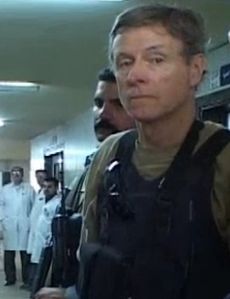
The Guardian reports: The Pentagon sent a US veteran of the “dirty wars” in Central America to oversee sectarian police commando units in Iraq that set up secret detention and torture centres to get information from insurgents. These units conducted some of the worst acts of torture during the US occupation and accelerated the country’s descent into full-scale civil war.James Steele
Colonel James Steele was a 58-year-old retired special forces veteran when he was nominated by Donald Rumsfeld to help organise the paramilitaries in an attempt to quell a Sunni insurgency, an investigation by the Guardian and BBC Arabic shows.
After the Pentagon lifted a ban on Shia militias joining the security forces, the special police commando (SPC) membership was increasingly drawn from violent Shia groups such as the Badr brigades.
A second special adviser, retired Colonel James H Coffman, worked alongside Steele in detention centres that were set up with millions of dollars of US funding.
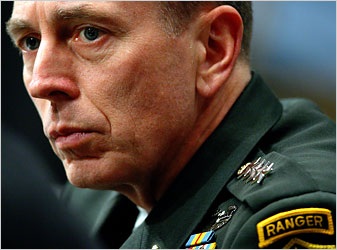
Coffman reported directly to General David Petraeus, sent to Iraq in June 2004 to organise and train the new Iraqi security forces. Steele, who was in Iraq from 2003 to 2005, and returned to the country in 2006, reported directly to Rumsfeld.
The allegations, made by US and Iraqi witnesses in the Guardian/BBC documentary, implicate US advisers for the first time in the human rights abuses committed by the commandos. It is also the first time that Petraeus – who last November was forced to resign as director of the CIA after a sex scandal – has been linked through an adviser to this abuse.
Coffman reported to Petraeus and described himself in an interview with the US military newspaper Stars and Stripes as Petraeus’s “eyes and ears out on the ground” in Iraq. [Continue reading…]
An Air Force rape victim speaks out
The New York Times reports: After her Air Force training instructor raped Virginia Messick, a young recruit, he told her it was fun and they should do it again, she remembers. Then he threw her clothes at her and ordered her to take a shower.
Ms. Messick was unable to move, cry or scream. She was a 19-year-old from rural Florida, in her fifth week of basic training at Lackland Air Force Base, and she had just been assaulted by the man the Air Force had entrusted with her life.
After the April 2011 attack, Ms. Messick completed basic training, following orders from the instructor for nearly a month more. Afraid of the consequences, she did not tell anyone what he had done. “How am I supposed to go about reporting something,” asked Ms. Messick, “when the person I’m supposed to report to is the person who raped me?”
Now, after leaving the Air Force, Ms. Messick is the first victim of a still-unfolding sexual assault scandal at Lackland to speak publicly about what she has endured. Since accounts of sexual violence at the base began to surface in late 2011, it has emerged as the largest such episode in Air Force history.
Ms. Messick, now 21, is one of 62 trainees identified as victims of assault or other improper conduct by 32 training instructors between 2009 and 2012 at Lackland, a sprawling base outside San Antonio that serves as the Air Force’s basic training center for enlisted personnel. So far, seven Air Force instructors have been court-martialed, including Staff Sgt. Luis Walker, now serving a 20-year sentence for crimes involving 10 women, including Ms. Messick. Eight more court-martial cases are pending. Fifteen other instructors are under investigation, and two senior officers have been relieved of command. [Continue reading…]
Inside the U.S. military’s culture of sex abuse, denial and cover-up
Rolling Stone reports: The scandal of rape in the U.S. Armed Forces, across all of its uniformed services, has become inescapable. Last year saw the military’s biggest sex-abuse scandal in a decade, when an investigation at Lackland Air Force Base in San Antonio revealed that 32 basic-training instructors preyed on at least 59 recruits. In Fort Bragg, North Carolina, Army Brig. Gen. Jeffrey Sinclair is currently facing court-martial for sex-crimes charges, including forcible sodomy, for alleged misconduct against five women. In October, an Air Force technical sergeant filed an administrative complaint describing a work environment of comprehensive harassment – in which all women are “bitches”; and claimed that during a routine meeting in a commander’s office, she was instructed to take off her blouse and “relax” – edged with menace and punctuated by violent assaults. In December, a Department of Defense report revealed that rape is rampant at the nation’s military academies, where 12 percent of female cadets experienced “unwanted sexual contact.” And an explosive series of federal lawsuits filed against top DOD brass on behalf of 59 service members (including Rebecca Blumer [a 23-year-old Navy intelligence analyst whose story of being raped and then penalized by command and ostracized by her unit, features in this report]) allege that the leadership has done nothing to stop the cycle of rape and impunity – and that by failing to condemn sexual assault, the military has created a predators’ playground.
“Sexual assaults make up the fabric of daily American military life,” says former Marine Capt. Anu Bhagwati, executive director of the advocacy group Service Women’s Action Network. Research suggests that one out of every three women in the U.S. military is the victim of sexual assault, making military women twice as likely to be raped as civilians. (Victims are disproportionately female, given that women make up less than 15 percent of the military, but men are victimized, too: More than 40 percent of vets receiving treatment for Military Sexual Trauma are men.) An anonymous DOD survey found that in 2010, an astonishing 19,000 service members were sexually assaulted; a mere 13.5 percent of those attacks were reported to authorities. Victims have little incentive to report, since the military’s insular justice system rarely holds perpetrators accountable. Of the sliver of sexual assaults reported last year, 92 percent never saw the inside of a courtroom but rather were dismissed or administered wrist-slap penalties like fines, reduced PX privileges or counseling – a prosecution record even outgoing Secretary of Defense Leon Panetta has called “an outrage.”
Incredibly, this ugly picture comes after two decades of very public sex scandals – Tailhook in 1991, Aberdeen in 1996, the Air Force Academy in 2003 – after each of which the DOD swore “zero tolerance,” then resisted any meaningful reform. But as survivors have begun to speak up, and legislators resolve to take action, the military finds itself facing a public relations crisis at a time when it’s not only trying to justify its $633 billion budget but also desperate to step up recruitment. Women, widely seen as a way to help stop attrition of troops – and now, for the first time, cleared to serve in combat alongside their male peers – are projected to make up one-quarter of the armed services by 2025. [Continue reading…]


Coffman reported directly to General David Petraeus, sent to Iraq in June 2004 to organise and train the new Iraqi security forces. Steele, who was in Iraq from 2003 to 2005, and returned to the country in 2006, reported directly to Rumsfeld.