Category Archives: nuclear issues

NEWS: Syria’s “tall building shaped like a square”

Syria nuclear probe may be inconclusive

The IAEA has been studying before-and-after commercial aerial photos of the site and has asked Syria for explanations. But Syria has not replied and the pictures alone are unlikely to yield conclusions, the diplomat told Reuters.

“IAEA experts are looking back at the evolution of this facility. But with these pictures alone they feel they may be unable to draw conclusions,” the diplomat, familiar with IAEA affairs but not authorised to speak on the record, told Reuters.

“If the IAEA got credible indications from anyone of nuclear procurement or activity, that would be different. But imagery of a tall building shaped like a square, that’s not enough (to tell whether or not the site may have been a nuclear site).” [complete article]

Facebooktwittermail

OPINION: Time to talk to Iran

Sen. Hagel’s message to Bush

Now is the time for the United States to active consider when and how to offer direct, unconditional, and comprehensive talks with Iran. The offer should be made even as we continue to work with our allies on financial pressure, in the UN Security Council on a third sanctions resolution, and in the region to support those Middle East countries who share our concerns with Iran. The November report by IAEA Director General ElBaradei to the IAEA Board of Governors could provide an opportunity to advance the offer of bilateral talks.

An approach such as this would strengthen our ability across the board to deal with Iran. Our friends and allies would be more confident to stand with us if we seek to increase pressure, including tougher sanctions on Iran. It could create a historic new dynamic in US-Iran relations, in part forcing the Iranians to react to the possibility of better relations with the West. We should be prepared that any dialogue process with Iran will take time, and we should continue all efforts, as you have, to engage Iran from a position of strength.

We should not wait to consider the option of bilateral talks until all other diplomatic options are exhausted. At that point, it could well be too late. [complete article]

Facebooktwittermail

NEWS & ANALYSIS: Arab nuclear solutions

Gulf Arabs offer to provide uranium to Iran: report

U.S.-allied Gulf Arab states are willing to set up a body to provide enriched uranium to Iran to defuse Tehran’s stand-off with the West over its nuclear plan, Saudi Arabia’s foreign minister told a magazine on Thursday.

Saudi Arabia and other Gulf countries — Kuwait, Oman, Qatar, Bahrain and the United Arab Emirates — share Western concerns that Iran’s nuclear energy program will lead to it acquiring atomic bombs, a claim Tehran denies.

“We have proposed a solution, which is to create a consortium for all users of enriched uranium in the Middle East,” Foreign Minister Prince Saud al-Faisal told the Middle East Economic Digest (MEED). [complete article]

Middle East racing to nuclear power

This week Egypt became the 13th Middle Eastern country in the past year to say it wants nuclear power, intensifying an atomic race spurred largely by Iran’s nuclear agenda, which many in the region and the West claim is cover for a weapons program.

Experts say the nuclear ambitions of majority Sunni Muslim states such as Libya, Jordan, Yemen, and Saudi Arabia are reactions to Shiite Iran’s high-profile nuclear bid, seen as linked with Tehran’s campaign for greater influence and prestige throughout the Middle East.

“To have 13 states in the region say they’re interested in nuclear power over the course of a year certainly catches the eye,” says Mark Fitzpatrick, a former senior nonproliferation official in the US State Department who is now a fellow at the International Institute for Strategic Studies in London. “The Iranian angle is the reason.” [complete article]

Facebooktwittermail

EDITORIAL: The box on the Euphrates

The box on the Euphrates

Writing in The American Conservative, former CIA officer Philip Giraldi sees in the Syrian-nuclear-reactor story the hallmarks of a disinformation campaign:

In the intelligence community, a disinformation operation is a calculated attempt to convince an audience that falsehoods about an adversary are true, either to discredit him or, in an extreme case, to justify military action. When such a campaign is properly conducted, information is leaked to numerous outlets over a period of time, creating the impression of a media consensus that the story is true, as each new report validates earlier ones.
[…]
The [news] pieces [on the target of the Israeli air attack in Syria] have a common thread: they rely entirely on information provided by Israeli sources without independent corroboration. And the ongoing play they are getting in the international media, without much critical commentary and without direct attribution to Israel, mark them as classic disinformation.

As nuclear proliferation expert Jeffery Lewis notes, the latest revelation — that the “box-on-the-Euphrates” is at least four years old, its existence having already been noted by the intelligence community (IC) — provides a compelling explanation why national security adviser Stephen J. Hadley has kept such a tight lid on the dissemination of the “new” intelligence: “we’d already looked at the building and Hadley knew what the IC would say.”

In the absence of further hard evidence, the ensuing commentary and analysis, most of which is extremely sketchy, has nevertheless become conventional wisdom in part because a few usually reliable sources have given the narrative a veneer of credibility:

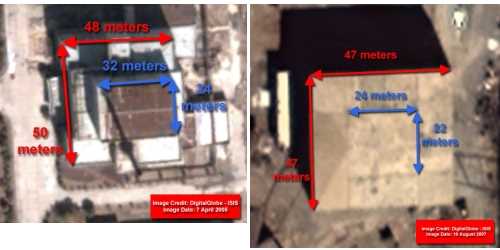
    — Respected former IAEA inspector, David Albright, has lent support to the idea that the box resembles the North Korean Yongbyon reactor based on not a lot more than the fact that the two buildings share the same diameter footprint. But whereas Yongbyon comprises a larger box with smaller boxes stacked on top of it, the image of the Syrian cube has been helpfully marked up with locations for imaginary boxes. “There also appears to be a faint square on top of the Syrian building’s roof. It is unclear whether something would be built there, but its dimensions, 24 meters by 22 meters, are consistent with the subsequent construction of an upper roof.” Four years after this faint square was first photographed, it remained a faint square [PDF].

boxes.jpg

    Global Security‘s John Pike refers to the site as being located in “the middle of nowhere” — everyone has now seen images of the barren location — yet one only needs to spend a few minutes on Google Earth to discover that the Box on the Euphrates lies right in the middle of Syria’s agricultural heartland with sizable communities either direction from this supposedly isolated location.

middle of nowhere

    This makes it all the more strange that nothing in the images appear to indicate the existence of a secure perimeter to this facilitiy — something that can easily be discerned if one looks at similar resolution images of, for instance, Israel’s nuclear facility at Dimona. However laid-back the Syrians might be, I’d wager that come the day that there was anything of high value at this site, there would be some serious security to keep out unwelcome intruders.
    — Washington’s high priest of gossip, Chris Nelson, after originally being convinced that the facility was related to Scud missile assembly, has now been won over to the nuclear reactor theory. The “evidence” that shifted his opinion? The fact that US-North Korea negotiator Chris Hill, in his recent Congressional testimony, did not refuted the theory. The absence of a denial is the same as an affirmation? Not according to my understanding of logic.

So what do we really know at this point?

A large cube-shaped building next to the Euphrates was visible from space in 2003. Given its size it must have taken a while to construct. The primary structure looked pretty much the same from above in August 2007. New images reveal that it’s not there now, the site has been leveled and it is reasonable to assume that the site clearing occured after, and very likely as a result of, an Israeli air force attack on September 6, 2007.

Do we have hard evidence that Syria was engaged in constructing a nuclear reactor? Not yet. Are any journalists hunting down that hard evidence? Probably not — why go to the trouble when you can kick back and get paid for schmoozing with John Bolton.

Meanwhile, IAEA director Mohamed ElBaradei is pissed off about the “bomb first and then ask questions later” approach. “I think it undermines the system and it doesn’t lead to any solution to any suspicion, because we are the eyes and ears of the international community. It’s only the agencies and inspectors who can go and verify the information.” He notes that in all the years that John Bolton and his cohorts have been making accusations about a Syrian nuclear program, “we have not received information about any nuclear-related activities, clandestine nuclear-related activities in Syria.”

Perhaps then we can infer that the real target of the Israeli strike was not a nuclear facility: it was the IAEA inspections processa troublesome log that the neocons are eager to clear off the road leading to Tehran.

Facebooktwittermail

NEWS & EDITOR’S COMMENT: Israel can live with a nuclear Iran

Israel’s foreign minister: Iran nukes pose little threat to Israel

Foreign Minister Tzipi Livni said a few months ago in a series of closed discussions that in her opinion that Iranian nuclear weapons do not pose an existential threat to Israel, Haaretz magazine reveals in an article on Livni to be published Friday.

Livni also criticized the exaggerated use that Prime Minister Ehud Olmert is making of the issue of the Iranian bomb, claiming that he is attempting to rally the public around him by playing on its most basic fears. Last week, former Mossad chief Ephraim Halevy said similar things about Iran. [complete article]

Editor’s Comment — While George Bush warns the world that Iran’s pursuit of nuclear weapons could lead to World War III, Israel’s foreign minister says, behind closed doors — in other words in a situation where she means what she says — that Iranian nuclear weapons would not pose an existential threat to Israel.

This should be banner headline news. The Washington press corp should be hounding administration officials, demanding an explanation for this utterly glaring clash of perspectives. Instead, what do we get? Silence.

This is what things have come down to: We live in a state where the dissemination of information is controlled much more efficiently than it was in the Soviet Union. At least the Russians understood they were being lied to. Most Americans, on the other hand, are completely ignorant of the incestuous relationship between the press and the government. In this system shaped by unspoken agreements, there is no need for some clumsy Ministry of Information. All the managing editors of the major outlets can be relied upon to shape their products (within an acceptable latitude) in alignment with political and commercial power — even when that means that they knowingly makes themselves instruments of an altogether avoidable disaster. They will plead that they are merely messengers, yet they are no less culpable than the lunatics in political office. They choose what to report and what to ignore.

(Note: As of 10.00GMT 10/26/07, the Haaretz magazine article referred to above has not appeared. If/when it is posted (it might only be available in print), it should appear here.)

Facebooktwittermail

NEWS & EDITOR’S COMMENT: Syria levels the rubble

Satellite photos show cleansing of Syrian site

New commercial satellite photos show that a Syrian site believed to have been attacked by Israel last month no longer bears any obvious traces of what some analysts said appeared to have been a partly built nuclear reactor.

Two photos, taken Wednesday from space by rival companies, show the site near the Euphrates River to have been wiped clean since August, when imagery showed a tall square building there measuring about 150 feet on a side.

The Syrians reported an attack by Israel in early September; the Israelis have not confirmed that. Senior Syrian officials continue to deny that a nuclear reactor was under construction, insisting that Israel hit a largely empty military warehouse. [complete article]

Editor’s Comment — Who destroyed the evidence? We have been given to understand that the square building at the Syrian site was blown up by Israeli bombs. If anyone was concerned about demonstrating what the building was for, perhaps it should have been left in tact. Independent IAEA investigators could have determined what was there. Israel’s rumored accusations might have been substantiated — or not.

Instead, now all we have are satellite images revealing something and its absence, along with purported intelligence photos taken on the ground somewhere yet no means to establish the authenticity of that evidence — evidence which thus far has not been made publicly available.

The Syrian site has now been cleared, or “cleansed,” as Pravda-style the Times reports. So what? Syria does not have an open democratic government — but that’s not news, is it?

Facebooktwittermail

NEWS, OPINION & EDITOR’S COMMENT: The secret that can’t be told

The right confronts Rice over North Korea policy

A fight has erupted between conservatives on national security and Secretary of State Condoleezza Rice over the Bush administration’s pursuit of diplomacy with North Korea in the face of intelligence that North Korea might have helped Syria begin construction on a nuclear reactor.

The debate moved to Capitol Hill on Wednesday, when Ms. Rice had a tense private meeting with Representative Ileana Ros-Lehtinen of Florida, the senior Republican on the House Foreign Affairs Committee. Just days earlier, Ms. Ros-Lehtinen was the co-author of an opinion article questioning the White House approach, which offers incentives to North Korea to dismantle its nuclear program.

That article also criticized the Bush administration for what it called the “veil of secrecy” surrounding intelligence that led to an Israeli airstrike in Syria last month on the suspected reactor site, and for the fact that only a handful of lawmakers have been briefed on the subject. [complete article]

What happened in Syria?

We are concerned that, although the Bush administration refuses to discuss the Israeli airstrike with the American people or with the majority of Congress, it has not hesitated to give information on background to the press to shape this story to its liking. New York Times writer David Sanger authored and coauthored articles on Oct. 14 and 15 that appeared to reflect extensive input from senior policy makers. Washington Post writer Glenn Kessler coauthored an article on Sept. 21 that also cited inside information from the administration. We believe this is unacceptable. [complete article]

Editor’s Comment — And where exactly in the contract of employment for journalists at the New York Times and the Washington Post does it say that reporters are meant to help the White House shape a story to its liking? Is that under the “business as usual” clause?

Hoekstra and Ros-Lehtinen do of course have their own ax to grind here, but if two Republican members of the secret circle say that the secret should be let out, what are we waiting for? And while these members of Congress are pressing the White House, why not the Israeli government too? It was an Israeli air strike after all.

And then there’re a few more details about the evidence. Why is the building next to the Euphrates being referred to as a “pumping station” rather than as “a building that might be a pumping station”? The photo in the Times doesn’t appear to show evidence of pipelines running between the purported pumping station and the building purported to house a future reactor. Moreover, no one spells out the necessity of having a water pumping station nearby what is claimed to be a gas-cooled reactor. But then again, all of these are questions that should be addressed by the IAEA and not half-assed journalists, unaccountable government officials, uninformed politicians, and blogging dilettantes.

Facebooktwittermail

NEWS & EDITOR’S COMMENT: Pinpointing what?

Photographs said to show Israeli target inside Syria

Independent experts have pinpointed what they believe to be the Euphrates River site in Syria that was bombed by Israel last month, and satellite imagery of the area shows buildings under construction roughly similar in design to a North Korean reactor capable of producing nuclear material for one bomb a year, the experts say.

Photographs of the site taken before the secret Sept. 6 airstrike depict an isolated compound that includes a tall, boxy structure similar to the type of building used to house a gas-graphite reactor. They also show what could have been a pumping station used to supply cooling water for a reactor, say experts David Albright and Paul Brannan of the Institute for Science and International Security (ISIS).

U.S. and international experts and officials familiar with the site, who were shown the photographs yesterday, said there was a strong and credible possibility that they depict the remote compound that was attacked. Israeli officials and the White House declined to comment. [complete article]

Editor’s Comment — There is now a “strong and credible possibility” that satellite photographs reveal the target of Israel’s strike on Syria. Which is to say, the photographs reveal where Israel hit — not what Israel hit.

It’s thus curious that with mantra-like repetition we keep on being told that the site in Syria resembled a “North Korea-style reactor.” No such thing exists. There is no North Korean style of nuclear reactor. All the North Koreans did was make use of the declassified design of the Magnox reactor first used in the UK at Calder Hall — it’s a design that has been publicly available for 50 years! It involves the use of unrefined uranium, there is no containment dome; gas — not water — is the coolant. The facility is housed in non-descript industrial buildings which means it’s almost impossible for satellite imagery to provide hard evidence that such buildings would have been designed to contain a reactor. Such evidence would have to be gathered by IAEA inspectors on the ground and since Syria — unlike Israel — is a signatory of the Non-Proliferation Treaty, Syria would presumably be legally required to provide inspectors access to the site. Rather than push for the evidence to be exposed, Israel preferred to destroy it.

Israel, we are being led to assume, has a greater interest in disregarding international law than in demonstrating to its allies and the rest of the world that Syria might have been engaged in developing a clandestine weapons program. Given that Israel clearly has complete contempt for world opinion, why should the world not with equal contempt dismiss Israel’s fears?

Facebooktwittermail

NEWS: Iran’s policy of nuclear ambiguity

Iran has new nuclear negotiator, but similar stance

Iran’s new chief nuclear negotiator made his international debut in Rome on Tuesday, to a chorus of unusually blunt criticism by politicians in Tehran that the departure of his predecessor was unwise.

Saeed Jalili, the negotiator, met with the European Union foreign policy chief, Javier Solana, who has been asked by the United States, Russia, China, Britain, France and Germany to find a formula to persuade Iran to suspend key nuclear activities.

Curiously, at Mr. Jalili’s side was Ali Larijani, his predecessor, who took the lead in the closed-door talks and in remarks afterward to reporters.

Mr. Solana described the talks as “constructive,” and Mr. Larijani called them “good.” But there was no movement on the one issue that matters, said participants in the meeting who spoke under normal diplomatic rules: Iran’s refusal to suspend uranium enrichment as required by the United Nations Security Council. [complete article]

Facebooktwittermail

ANALYSIS: The faultlines in Iranian power

Iran rocks its nuclear boat

Various commentators, especially in Europe and the United States, have been quick in interpreting Larijani’s resignation as a “bad omen” reflecting a triumph for hardliners led by Ahmadinejad. But that is simplistic and ignores a more complex reality in the Iran’s state affairs. The quest for greater centralization of nuclear decision-making has met a contradictory response in, on the one hand, the move for more direct input by Khamenei, and, on the other hand, a parallel effort by Ahmadinejad to gain greater control of decision-making.

Regarding the former, in the aftermath of Russian President Vladimir Putin’s recent Tehran visit, where he submitted a nuclear proposal not to his equal, Ahmadinejad, but rather to Khamenei [1] , thus belittling Iran’s president, Khamenei has reportedly held a meeting with all top officials of the regime and informed them for the first time that an American military attack on Iran is “a possibility” that “should be taken seriously”.

Khamenei has reportedly promised Putin to “study and consider” his proposal. Confusingly, though, while Larijani has announced that Putin did pass on a proposal for resolving the nuclear standoff, Ahmadinejad has insisted that Putin did not present any such proposal and limited himself to the expansion of bilateral and multilateral relations. [complete article]

Facebooktwittermail

FEATURE: The U.S. has been gearing up for a war with Iran for years

The secret history of the impending war with Iran that the White House doesn’t want you to know

This is what Leverett and Mann fear will happen: The diplomatic effort in the United Nations will fail when it becomes clear that Russia’s and China’s geopolitical ambitions will not accommodate the inconvenience of energy sanctions against Iran. Without any meaningful incentive from the U.S. to be friendly, Iran will keep meddling in Iraq and installing nuclear centrifuges. This will trigger a response from the hard-liners in the White House, who feel that it is their moral duty to deal with Iran before the Democrats take over American foreign policy. “If you get all those elements coming together, say in the first half of ’08,” says Leverett, “what is this president going to do? I think there is a serious risk he would decide to order an attack on the Iranian nuclear installations and probably a wider target zone.”

This would result in a dramatic increase in attacks on U.S. forces in Iraq, attacks by proxy forces like Hezbollah, and an unknown reaction from the wobbly states of Afghanistan and Pakistan, where millions admire Iran’s resistance to the Great Satan. “As disastrous as Iraq has been,” says Mann, “an attack on Iran could engulf America in a war with the entire Muslim world.”

Mann and Leverett believe that none of this had to be. [complete article]

Facebooktwittermail

NEWS: The damning photos we don’t get to see

The case for Israel’s strike on Syria

…as ABC News reported in July, the Israelis made the decision to take the facility out themselves, though the U.S. urged them not to. The Bush administration, with Secretary of State Condoleezza Rice and Defense Secretary Robert Gates leading the way, said the Israelis and the U.S. should “confront not attack.”

The official said the facility had been there at least eight months before the strike, but because of the lack of fissionable material, the United States hesitated on the attack because it couldn’t be absolutely proved that it was a nuclear site.

But the official told ABC News, “It was unmistakable what it was going to be. There is no doubt in my mind.” [complete article]

Editor’s Comment — Hmmm… “A senior U.S. official” has no doubt in his mind — sounds like Cheney or someone who spends too much time in his company. And of course there’s no reason why we would need to see the compelling photographic evidence when we can see such excellent computer graphics.

Facebooktwittermail

ANALYSIS: Larijani’s shock departure

Ali Larijani resigns

Ali Larijani, Iran’s chief nuclear negotiator and the secretary of the Supreme National Security Council, has resigned. This is a big deal!

The fact that Larijani had threatened to resign several times was an open secret in Iran; a fact that was even acknowledged by the government spokesman, Gholam-hossein Elham, in his announcement of Larijani’s resignation (Al Jazeera has good round up of some of Larijani’s conflicts with Ahmadinejad).

What is surprising is Ayatollah Khamenei’s agreement to this resignation and the reported replacement of Larijani by Saeed Jalili, a deputy foreign minister for European affairs who actually has very little diplomatic experience (Jalili’s experience at the foreign Ministry prior to being assigned as deputy minister by Ahmadinejad was in personnel matters). What Jalili does have is a very close relationship with Ahmadinejad. As such, the move, if it is confirmed, reflects yet another enhancement of Ahmadinejad’s fortunes in Iranian politics.

So far the Iranian system seems to be in a state of shock. Larijani was considered a successful handler of the Iranian nuclear file and his agreement with the IAEA regarding a work plan to resolve the remaining outstanding issues over Iran’s nuclear program an important step forward. [complete article]

Facebooktwittermail

NEWS: The Syrian nuclear mirage

U.N. nuclear agency examines Syria images

U.N. experts have begun analyzing satellite imagery of the Syrian site struck last month by Israeli warplanes, looking for any signs it was a secret nuclear facility, diplomats said Friday.

It was unclear where the material was obtained or what exactly it showed. One of the diplomats, who is linked to the International Atomic Energy Agency, said the experts were studying commercial images, contrary to earlier suggestions they came from U.S. intelligence.

Separately, a senior diplomat familiar with the issue indicated the experts were looking at several possible locations for the Israeli strike. Two other diplomats said initial examination of the material found no evidence the target was a nuclear installation, but emphasized it was too early to draw definitive conclusions. [complete article]

Syrians disassembling ruins at site bombed by Israel, officials say

While expressing concern over the prospect that Syria may have decided to launch a nuclear program in secret, some weapons experts question why neither Israel nor the United States made any effort before the secret attack — or in the six weeks since — to offer evidence to the International Atomic Energy Agency, a move that would trigger an inspection of Syria by the nuclear watchdog.

“The reason we have an IAEA and a safeguard system is that, if there is evidence of wrongdoing, it can be presented by a neutral body to the international community so that a collective response can be pursued,” said Daryl Kimball, executive director of the Arms Control Association. “It seems to me highly risky and premature for another country to bomb such a facility.” [complete article]

US intelligence does not show Syrian nuclear weapons program, officials say

One US intelligence source familiar with the events expressed concern about recent news reports describing Syria as having a functioning nuclear weapons program and cautioned against attributing those reports to the US intelligence community.

“The allegations that North Korea was helping to build a nuclear reactor have not been substantiated by US intelligence,” said this intelligence official, adding, “ but that hasn’t stopped Dick Cheney and his minions at the NSC, Elliot Abrams and Steve Hadley, from leaking the information [to the press], which appears to be misleading in the extreme.” [complete article]

See also, Syrian “copy” of Yongbyon? (Arms Control Wonk) and Syrian’s comment on bomb target mistranslated: U.N. (Reuters).

Facebooktwittermail

NEWS: Nuclear-armed Iran risks world war, Bush says

Nuclear-armed Iran risks world war, Bush says

President Bush issued a stark warning on Iran on Wednesday, suggesting that if the country obtained nuclear arms, it could lead to “World War III.”

“We got a leader in Iran who has announced that he wants to destroy Israel,” Mr. Bush said at a White House news conference, referring to a remark by the Iranian president, Mahmoud Ahmadinejad, that Israel “will disappear soon.” Mr. Bush said he had “told people that if you’re interested in avoiding World War III, it seems like you ought to be interested in preventing them from having the knowledge necessary to make a nuclear weapon.”

Mr. Bush has said in the past that he would never “tolerate” a nuclear-armed Iran. But the comment on Wednesday was another sign that he did not accept a view stated last month by Gen. John P. Abizaid, who retired this year as the top American commander in the Middle East. The general said that “there are ways to live with a nuclear Iran.” [complete article]

Facebooktwittermail

NEWS: Iraqi contracts with Iran and China concern U.S.; Putin pledges to complete Iranian nuclear reactor

Iraqi contracts with Iran and China concern U.S.

Iraq has agreed to award $1.1 billion in contracts to Iranian and Chinese companies to build a pair of enormous power plants, the Iraqi electricity minister said Tuesday. Word of the project prompted serious concerns among American military officials, who fear that Iranian commercial investments can mask military activities at a time of heightened tension with Iran.

The Iraqi electricity minister, Karim Wahid, said that the Iranian project would be built in Sadr City, a Shiite enclave in Baghdad that is controlled by followers of the anti-American cleric Moktada al-Sadr. He added that Iran had also agreed to provide cheap electricity from its own grid to southern Iraq, and to build a large power plant essentially free of charge in an area between the two southern Shiite holy cities of Karbala and Najaf.

The expansion of ties between Iraq and Iran comes as the United States and Iran clash on nuclear issues and about what American officials have repeatedly said is Iranian support for armed groups in Iraq. American officials have charged that Iranians, through the international military wing known as the Quds Force, are particularly active in support of elite elements of the Mahdi Army, a militia largely controlled by Mr. Sadr. [complete article]

Vladimir Putin pledges to complete Iranian nuclear reactor

President Putin forged an alliance with Iran yesterday against any military action by the West and pledged to complete the controversial Iranian nuclear power plant at Bushehr.

A summit of Caspian Sea nations in Tehran agreed to bar foreign states from using their territory for military strikes against a member country. Mr Putin, the first Kremlin leader to visit Iran since the Second World War, insisted that the use of force was unacceptable.

“It is important… that we not only not use any kind of force but also do not even think about the possibility of using force,” he told the leaders of Iran, Azerbaijan, Kazakhstan and Turkmenistan. [complete article]

Putin calls war in Iraq ‘pointless’

President Vladimir Putin, in his latest jab at Washington, suggested Thursday that the U.S. military campaign in Iraq was a ”pointless” battle against the Iraqi people, aimed in part at seizing the country’s oil reserves.

Putin has increasingly confronted U.S. foreign policy in recent months, deepening the chill between Washington and Moscow. Among other things, he has questioned U.S. plans for a missile defense system in Europe and the U.S. push for sanctions against Iran for its nuclear programs. [complete article]

Olmert urges Putin to back new Iran sanctions

Prime Minister Ehud Olmert met Tuesday with President Vladimir Putin, pressing Moscow to support new sanctions on Tehran over its nuclear activities and urging Russia not to sell arms to Iran or Syria.

Hosting Olmert for a brief, abruptly announced visit, Putin promised to brief the Israeli leader on his talks with Iranian leaders this week and acknowledged his guest’s dismay over Tehran’s nuclear program, which Israel and the United States say is aimed at developing atomic weapons. [complete article]

Facebooktwittermail

OPINION: Portents of a nuclear al-Qaeda

Portents of a nuclear al-Qaeda

Rolf Mowatt-Larssen is paid to think about the unthinkable. As the Energy Department’s director of intelligence, he’s responsible for gathering information about the threat that a terrorist group will attack America with a nuclear weapon.

With his shock of white hair and piercing eyes, Mowatt-Larssen looks like a man who has seen a ghost. And when you listen to a version of the briefing he has been giving recently to President Bush and other top officials, you begin to understand why. He is convinced that al-Qaeda is trying to acquire a nuclear bomb that will leave the ultimate terrorist signature — a mushroom cloud.

We’ve all had enough fear-mongering to last a lifetime. Indeed, we have become so frightened of terrorism since Sept. 11, 2001, that we have begun doing the terrorists’ job for them by undermining the legal framework of our democracy. And truly, I wish I could dismiss Mowatt-Larssen’s analysis as the work of an overwrought former CIA officer with too many years in the trenches.

But it’s worth listening to his warnings — not because they induce more numbing paralysis but because they might stir sensible people to take actions that could detect and stop an attack. That’s why his boss, Energy Secretary Samuel Bodman, is encouraging him to speak out. Mowatt-Larssen doesn’t want to anguish later that he didn’t sound the alarm in time. [complete article]

Facebooktwittermail

NEWS & EDITOR’S COMMENT: “Nuclear project” – story still under construction

Analysts find Israel struck a nuclear project inside Syria

Israel’s air attack on Syria last month was directed against a site that Israeli and American intelligence analysts judged was a partly constructed nuclear reactor, apparently modeled on one North Korea has used to create its stockpile of nuclear weapons fuel, according to American and foreign officials with access to the intelligence reports.

The description of the target addresses one of the central mysteries surrounding the Sept. 6 attack, and suggests that Israel carried out the raid to demonstrate its determination to snuff out even a nascent nuclear project in a neighboring state. The Bush administration was divided at the time about the wisdom of Israel’s strike, American officials said, and some senior policy makers still regard the attack as premature.
[…]
The officials did not say that the administration had ultimately opposed the Israeli strike, but that Secretary of State Condoleezza Rice and Defense Secretary Robert M. Gates were particularly concerned about the ramifications of a pre-emptive strike in the absence of an urgent threat.

“There wasn’t a lot of debate about the evidence,” said one American official familiar with the intense discussions over the summer between Washington and the government of Prime Minister Ehud Olmert of Israel. “There was a lot of debate about how to respond to it.”
[…]
The partly constructed Syrian reactor was detected earlier this year by satellite photographs, according to American officials. They suggested that the facility had been brought to American attention by the Israelis, but would not discuss why American spy agencies seemed to have missed the early phases of construction.

North Korea has long provided assistance to Syria on a ballistic missile program, but any assistance toward the construction of the reactor would have been the first clear evidence of ties between the two countries on a nuclear program. North Korea has successfully used its five-megawatt reactor at the Yongbyon nuclear complex to reprocess nuclear fuel into bomb-grade material, a model that some American and Israeli officials believe Syria may have been trying to replicate.
[…]
While Bush administration officials have made clear in recent weeks that the target of the Israeli raid was linked to North Korea in some way, Mr. Bush has not repeated his warning since the attack. In fact, the administration has said very little about the country’s suspected role in the Syria case, apparently for fear of upending negotiations now under way in which North Korea has pledged to begin disabling its nuclear facilities.

While the partly constructed Syrian reactor appears to be based on North Korea’s design, the American and foreign officials would not say whether they believed the North Koreans sold or gave the plans to the Syrians, or whether the North’s own experts were there at the time of the attack. It is possible, some officials said, that the transfer of the technology occurred several years ago. [complete article]

Editor’s Comment — In spite of the fact that hard evidence has yet to be produced, let’s for now take it as given that Syria was building some type of nuclear facility and that it was destroyed by an Israeli air attack. Although the Times notes, as has been repeated so often, that “information about the raid has been wrapped in extraordinary secrecy,” the question — why the secrecy? — remains all important.

Suppose Israel was reluctant to be perceived as having acted without US support and it waited until it got the green light from Washington — except, when the green light came, it came from the Vice President’s office. Now that would be one incredibly compelling reason for secrecy from all quarters! That’s something neither Cheney, nor Bush, nor Olmert could afford to reveal.

Of course I speculate, but while this story remains so murky, speculation will be rife.

Facebooktwittermail