The Associated Press reports: Egyptian vigilantes beat two men accused of stealing a rickshaw, then stripped them half-naked and hung them from a tree in a bus station in a small Nile Delta town on Sunday, according to security officials who said both men died.
The killings came a week after the attorney general’s office encouraged civilians to arrest lawbreakers and hand them over to police.
It was one of the most extreme cases of vigilantism in two years of sharp deterioration in security following Egypt’s 2011 uprising. The worsening security coupled with a police strike prompted the attorney general’s call for citizen arrests last week.
The state-run newspaper Ahram reported on its website that the two were dragged in the street after being caught “red-handed” trying to steal a rickshaw. It said they were beaten but alive before they were hung.
Category Archives: Egypt
Deadlock in Cairo
Hazem Kandil writes: The Egyptian revolt is trapped in a balance of weakness. None of the key actors has the power to consolidate a new regime, or even to resurrect the old one. Alliances are necessary, but nobody knows which will last. Every combination seems equally plausible, but each would lead the country in a very different direction. Egypt’s old regime depended on a ‘power triangle’: an uneasy partnership between the military (primarily the army), the security services (the police and secret police under the control of the Interior Ministry), and the political establishment. The uprising in January 2011 disrupted this delicate balance. It inadvertently enhanced the leverage of the military, left the security services largely untouched and created a political vacancy which Islamists, secular revolutionaries and old regime loyalists all scrambled to fill. The three political rivals would find themselves playing a game of musical chairs under the fretful gaze of the military and the security services, and it isn’t yet clear who is the winner.
The armed forces facilitated the popular uprising that ousted Mubarak because – contrary to the academic consensus – they had become the least privileged partner in Egypt’s ruling bloc. Eager to increase its autonomy and regional influence, the army welcomed the chance to renegotiate the existing power arrangements. The Supreme Council of the Armed Forces (SCAF) dissolved Mubarak’s National Democratic Party and flirted with the idea of restructuring the Interior Ministry and restricting the powers of the security services. But since no one turned up who was powerful enough to replace Mubarak, the SCAF was forced instead to co-operate with the ministry to avert chaos. By the summer of 2012, it was ready to hand over government to anyone who seemed reasonably capable, so long as they pledged to respect the military’s status. The Muslim Brotherhood was the most plausible candidate. Its familiar willingness to appease whoever was in power made it a safer ally than any of the embittered remnants of the old regime. And the hostility of its rhetoric where Israel is concerned had the twin advantages of justifying the maintenance of a strong army, while alarming Western powers just enough to make them accept the army’s continued oversight: the army would curb Islamist excess, should there be any.
Mohamed Morsi was sworn in in June, and six weeks later, on 12 August, he managed to reshuffle the armed forces’ general command without offending military sensibilities. The defence minister and chairman of the SCAF, Mohamed Hussein Tantawi, and the military chief of staff, Sami Hafez Anan, were decorated and given honorary roles after leaving their posts. Other high-ranking officers did even better: the outgoing commander of the navy was put in charge of the Suez Canal; the commander of the air defence force became chairman of the Arab Organisation for Industrialisation; and another senior SCAF officer, Mohamed al-Assar, became assistant minister of defence. To further emphasise his reluctance to rock the boat, Morsi chose their replacements from a list of senior commanders. The director of military intelligence, Abdel Fattah al-Sisi, was handed the defence portfolio, and the commander of the Third Field Army, Sedky Sobhy, was promoted to chief of staff. On the night these measures were announced, Morsi promised – it was a telling speech – to respect the armed forces’ independence. He also promised weapons and training from a wider range of sources, i.e. not just the US. In November the army was able to buy Turkish drones for the first time. Morsi also gave his support to the army’s counterterrorist operations in Sinai in order to satisfy the military’s overwhelming desire to re-establish sovereignty over the peninsula, demilitarised since the Camp David Accords. The extent of the Islamists’ deference to the military was made plain when the Supreme Guide of the Muslim Brotherhood was forced to retract derogatory remarks he had made about the military’s willingness to bend to the wishes of politicians. And at the end of February, it was reported that Morsi had cancelled plans to replace the now intransigent al-Sisi as minister of defence in light of the armed forces’ objections. [Continue reading…]
Ultras violence spreads, and Morsi runs out of answers
Issandr El Amrani writes: In the days that followed the toppling of Hosni Mubarak, Egypt’s revolutionaries feared the plots of the deep state: the military and political nomenklatura of the regime, deep-pocketed businessmen and security agencies conspiring to save what they could of a system tailor-made for them. It may turn out that the fear was misplaced. What Egypt suffers most from today is not plots hatched in the shadows, but a shallow state that is cracking on the surface.
In parts of the country, citizens are in open rebellion against that state, which has long failed to provide economically and, since the 2011 uprising, has largely failed to provide security. In recent weeks, the targets of often-violent protests have been administrative buildings, the offices of provincial governors and anything associated with the police.
What prompts these protests is often a sense of injustice, as in the now weeks-long turmoil that has hit the Suez Canal region and Port Said in particular. The spark may have been the death sentences handed out to 21 football supporters from the city for their role in the February 2012 stadium massacre. The sense of grievance, though, is wider and is obscuring the fact that football hooligans need to be held to account.
Like the droogs of Anthony Burgess’s A Clockwork Orange, some young Egyptian men seem to have grown fond to taking to the streets for some mindless ultra-violence. They may fancy themselves as freedom fighters, but they are bullies.
In Cairo, Ultras from Al Ahly, the leading Egyptian football team, have for weeks staged protests to block major thoroughfares and the metro system. They have used violence and intimidation. The torching of a police social club, the country’s association football federation, a fast-food restaurant and the offices of a newspaper on Saturday is the culmination of an environment in which these Ultras feel increasingly emboldened to act antisocially whenever they feel wronged. [Continue reading…]
Egypt court suspends April general elections
BBC News reports: An Egyptian administrative court has suspended general elections that were scheduled to begin next month.
It said the law covering the polls needed to be reviewed by the Supreme Court to determine whether it conformed to the constitution.
President Mohammed Morsi had said the polls would begin on 22 April, taking place in four stages over two months.
The elections have been boycotted by the main opposition, amid continuing street protests.
‘They beat us like animals’: Egypt’s children detained, abused
Al Ahram: In an impoverished district of Alexandria, Sherifa Abdel-Meneem described finding bruises and gashes all over her 13-year-old son’s body, Abdel-Rahman, who was picked up by Egyptian security forces at a protest on 27 January and detained for over two weeks.
“He won’t tell me where the marks come from or what the security forces did to him, he’s too scared… when he went missing no words can describe how I felt, I wasn’t sure I’d see my son ever again,” said Abdel-Meneem.
The latest spat of arrests during a political context occurred on Tuesday, when the Egyptian Coalition for Children’s Rights reported a further 13 children were taken during a police raid on Cairo’s Tahrir Square. One of boys picked up by the police, Walid Ahmed Abdel Sayed, was12 years old.
Since the start of 2013, rights groups have been reporting an increase in police brutality towards children.
Young children detained and tortured after protests in Egypt
The Independent reports: Hundreds of children – some as young as nine – have been illegally detained and in many cases tortured by the Egyptian police following the protests which erupted after the second anniversary of the 2011 uprising.
In what lawyers and activists say is a retrenchment of state brutality akin to the worst abuses of power during Hosni Mubarak’s regime, large numbers of children have been unlawfully imprisoned in camps used by Egypt’s central security forces.
Rights groups say that many of those detained have been subjected to cruel mistreatment, including beatings, electrocution and “hanging” torture. Others were forced by their tormentors to strip naked before being drenched with cold water.
One lawyer said he believed that up to 400 children, many of them barely teenagers, may have been rounded up during police operations following the outbreak of street clashes on 25 January, the anniversary of Egypt’s rebellion two years ago. [Continue reading…]
Egypt’s Shura Council members blame women for getting raped
Egypt’s Daily News reports: The Shura Council Human Rights Committee addressed on Monday the recent wave of sexual harassment proliferating during mass protests, calling for specifying places of protest for females.
“Women should not mingle with men during protests,” said Reda Al-Hefnawy, Freedom and Justice Party (FJP) member. “How can the Ministry of Interior be tasked with protecting a lady who stands among a group of men?”
Adel Afifi, a prominent board member of the Salafi Party Al-Asala, blamed women for the sexual harassment phenomenon. “A woman who joins protests among thugs and street inhabitants should protect herself before asking the Ministry of Interior to offer her protection,” Afifi said, adding that police officers are incapable of protecting themselves.
Salafi Al-Nour Party member Salah Abdel Salam also believed women were responsible for sexual harassment. “The woman bears the offence when she chooses to protest in places filled with thugs,” Abdel Salam said. He added that, nevertheless, the phenomenon needs to be addressed.
“Women sometimes cause rape upon themselves through putting themselves in a position which makes them subject to rape,” Afifi said.
Egypt court suspends YouTube over anti-Islam film
Reuters reports: An Egyptian court ordered the suspension of online video service YouTube for a month on Saturday for broadcasting a film insulting the Prophet Mohammad, state media reported.
The country’s administrative court ordered the ministries of communication and investment to block YouTube, owned by Google, inside Egypt because it had carried the film “Innocence of Muslims”, said state news agency MENA.
The 13-minute video, billed as a film trailer and made in the United States, provoked a torrent of anti-American unrest in Egypt, Libya and dozens of other Muslim countries in September.
The video depicts the Prophet as a fool and a sexual deviant. For most Muslims, any portrayal of the Prophet is considered blasphemous.
The court said it was ruling on a case brought about the film several months ago, without going into further detail.
Video: Egyptian women protest against sexual harassment
Egyptian Salafi preacher supports rape of women protesters
Al Arabiya reports: An Egyptian Salafi preacher said raping and sexually harassing women protesters in Cairo’s Tahrir Square is justified, calling them “crusaders” who “have no shame, no fear and not even feminism.”
In an online video posted Wednesday, Ahmad Mahmoud Abdullah, known as “Abu Islam” and owner of the private television channel of “al-Ummah,” said these women are no red line.
“They tell you women are a red line. They tell you that naked women — who are going to Tahrir Square because they want to be raped — are a red line! And they ask Mursi and the Brotherhood to leave power!,” he said.
Abu Islam added that these women activists are going to Tahrir Square not to protest but to be sexually abused because they had wanted to be raped.
“They have no shame, no fear and not even feminism. Practice your feminism, sheikha! It is a legitimate right for you to be a woman,” he said.
“And by the way, 90 percent of them are crusaders and the remaining 10 percent are widows who have no one to control them. You see women talking like monsters,” he added.
‘Bread, freedom, social justice’ — an urgent and still unanswered demand in Egypt
Elijah Zarwan writes: In Cairo last week, on a crowded public bus near Tahrir Square, passengers were trapped, pressed tightly together and choking on tear gas, as the vehicle struggled to maneuver around a standoff between hapless police conscripts and a crowd of young men making a stand along the bank of the Nile. The commuters were furious. “Who are these people?” some spat as the bus inched past stunted teenagers throwing rocks and making obscene gestures.
That question has been asked again and again over the last two years as nearly identical scenes have played out with numbing regularity. Most Cairenes, President Mohamed Morsi, his cohorts in the Muslim Brotherhood, and the generals who ruled the country before them have agreed on a quick verdict: that “these people” are hired thugs, pawns either of shadowy remnants of the old regime or of unnamed foreign governments. As Morsi charged last week, they are “the counterrevolution incarnate.”
Some among the rock-wielding crowd might indeed be paid agents. Sometimes groups of them arrive in the city center in the back of mini pickup trucks. Some young protestors appear to take direction from older men with mustaches and bad leather jackets. Sometimes their faces bear knife scars, broken noses, and other telltale signs of lives spent in Cairo’s underworld. Often their eyes are glazed, and their speech is erratic from the use of cheap pills. That — and the fact that the Mubarak regime cultivated an auxiliary militia of drug addicts and criminals in poor neighborhoods for use when it was more convenient for civilian forces to carry out oppression — suggests that some of the chaos might, in fact, be organized.
But it would be a mistake to dismiss the protesters as paid thugs, or to blame the unrest on revolutionary anniversary pangs, Muslim Brotherhood misrule, or a court’s verdict — although those are all elements of it. True, it is difficult to systematically track the demographics of a stampede, but what most of those rushing to escape birdshot and tear gas canisters have in common is that they are male, urban, young, and unemployed; they have very little to lose, and even less confidence in a political class that does not represent them. For them, the mantra of the uprising that began two Januarys ago — “Bread, freedom, social justice” — remains an urgent and unanswered demand. [Continue reading…]
Egypt at risk of complete breakdown of law and order
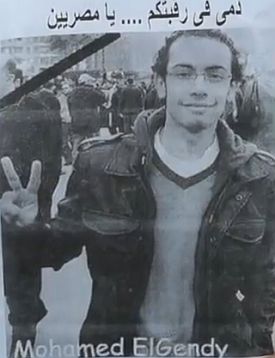
The Associated Press reports: An Egyptian opposition party on Monday claimed police tortured one of its members to death, electrocuting him and beating him repeatedly on the head — the latest case alleging police brutality in a crackdown on anti-government protesters.
Mohammed el-Gindy, a 28-year-old activist, died of his wounds early Monday at a Cairo hospital after he was “tortured to death,” the Egyptian Popular Current party said in a statement.
The Interior Ministry had no immediate comment.
El-Gindy went missing for several days after protesting on Jan. 27 in Cairo’s Tahrir Square. The protesters are opposed to Egypt’s Islamist President Mohammed Morsi’s policies and are pressing him to amend the constitution, which was drafted by a panel dominated by Islamists and approved in a public referendum last year.
Party spokeswoman Mona Amer said she saw el-Gindy’s body and that it carried marks of torture. She said he was electrocuted, had broken ribs and a “cord appeared to have been wrapped around his neck.” A medical report cited brain hemorrhage as cause of death.
Amnesty International: Almost every girl and woman – regardless of age, social status or choice of attire – who has walked the streets or taken public transport in Cairo, has experienced some form of verbal or physical sexual harassment.
This isn’t new. For years, Egyptian women’s rights activists and others have called on the authorities to recognize the seriousness of the problem.
There needs to be a fundamental shift in institutionalized attitudes that discriminate against women.
The Egyptian authorities must introduce legal reforms, prosecute perpetrators and address root causes, because the plight of women who have experienced sexual violence has been ignored.
Blame is placed on the victims for being dressed “indecently,” or for daring to be present in “male” public spaces.
The horrific testimonies emerging following protests commemorating the second anniversary of the “25 January Revolution” have brought to light how violent mob sexual attacks against women have happened, but have rarely been brought to public attention.
International Crisis Group: It is difficult to know which is most dangerous: the serious uptick in street violence; President Morsi’s and the Muslim Brotherhood’s serial inability to reach out to the rest of the political class inclusively; or the opposition clinging to the hope of some extraneous event (demonstrations, foreign pressure, judicial rulings or military intervention) allowing it to gain power while bypassing arduous compromise and politics. They are tied of course: the president’s cavalier treatment of the constitution-writing process and the judiciary and the opposition’s lethargic approach to politics and rejection of Islamist legitimacy alike have eroded the authority of state institutions. This encourages in turn unrest and contributes to the economic slide. Together, these heighten risks of a complete breakdown of law and order. For two years, political factions repeatedly have failed to reach consensus on basic rules of the game, producing a transition persistently threatening to veer off the road. It is past time for the president and opposition to reach an accommodation to restore and preserve the state’s integrity.
Since President Mubarak’s ouster, the level of violence has ebbed and flowed, yet each new wave brings the country closer to tipping point. Already, some police officers, beleaguered by attacks on their headquarters, are considering removing their uniforms and going home; there is talk of brewing discontent among Central Security Forces, the riot control police; and criminal gangs along with looters profit from the chaos. There are new shocking images of police brutality. Many young Egyptians increasingly appear disillusioned with electoral politics, and some are drawn to anarchical violence.
The situation is made worse by deteriorating economic conditions. As foreign currency reserves decline, the government finds it ever more difficult to prop up the Egypt’s pound or maintain fuel and food subsidies. One should not be surprised to see larger segments of the population joining in socio-economic riots. By current trends, Egypt could find itself in a vicious cycle of economic under-performance and political instability, the one fuelling the other.
Victim of Egyptian police torture says ‘officers were helping me’
Al Ahram reports: Hamada Saber, the man who was dragged and beaten by Central Security Forces (CSF) as recorded on a video aired by Al-Hayat satellite TV on Friday night, told prosecutors on Saturday that protesters and not security forces “initiated” the assault against him, according to a report on Ahram Arabic news website.
The one-and-a-half minute video that shocked Egypt and the world showed an unarmed, naked Saber repeatedly kicked by police officers, dragged on the asphalt and beaten with batons as CSF officers battled anti-Morsi protesters in the vicinity of the presidential Palace on Friday night.
Speaking from a police hospital where he is recieving medical treatment, the 50 year old house-painter told investigators that the CSF officers protected him, adding that “the ministry of interior is standing by my side and they are providing me with medical care.”
However, late on Friday night, in a phone call also to ONTV, Reda Sobhi, Saber’s nephew, had condemned the police attack on his uncle saying Saber was peacefully attending the protest with his wife and children.
“God is our only saviour,” Sobhi told the Satellite channel ONTV in desperation saying he and lawyers failed to locate his uncle’s whereabouts in the hours after the video of the assault was aired as police declined to give them exact information of where they took Saber.
However, in a shocking turnaround of events on Saturday, Saber and his wife, speaking from the same police hospital the CSF transferred Saber to in the wake of their assault on him, seemed to blame the protesters for the bulk of the suffering he was subjected to on the previous night.
“I was standing at Roxy Square [near the palace] drinking a soda, when a large number of protesters who mistook me for a CSF officer because of my black attire attacked me and stripped me of my clothes,” said Saber.
“The protesters were angered by the fact that I tried to dissuade them from firing bird shots at the police,” claimed Saber.
Fathya, the assaulted man’s wife who was by his bedside at the police hospital, sent a message of gratitude to the ministry of interior.
“The police are very respectful and are standing by our side, and the minister’s assistant for human rights has passed by and will come again tomorrow [Saturday],” Fathya told ONTV.
Moreover, on Saturday night, Saber, told state TV that he was caught in the fight between protesters and the police.
“The protesters fired an unknown bullet at me and robbed me. When I saw the CSF soldiers coming at the crowd, I was scared and I ran. The soldiers chased after me yelling they wanted to help me. When I fell, they caught me and said: ‘you gave us a hard time, man.'”
Police and presidency conduct immediate damage control
Immediately after the gruesome assault video hit channels and social media outlets worldwide on Friday night, the ministry of interior issued a statement condemning the attack, and vowed to open an immediate inquiry.
As the Minister of Interior Mohamed Ibrahim faced angry calls for him to resign, the statement assured the public that “the ministry rejects the involvement of its officers in such assaults which affect the relationship between the people and the police.”
As many activists held President Morsi politically responsible for the assault on Saber because of his publicly stated, unconditional support for police actions against protesters, the presidency also issued a statement condemning the assault.
Egypt protests galvanised by video of police beating naked man
The Guardian reports: A video of a protester being beaten and stripped naked has galvanised protests against the police and government in Egypt.
Hamada Saber, a middle-aged man, remained in a police hospital on Saturday, the morning after he was shown on television, dragged over naked tarmac and beaten by half a dozen policemen who had pulled him to an armoured vehicle near the presidential palace.
President Mohamed Morsi’s office promised an investigation into the incident, which followed the deadliest wave of bloodshed of his seven-month rule. His opponents say it proves that he has chosen to order a brutal crackdown like that carried out by Hosni Mubarak against the uprising that toppled him in 2011.
Another protester was shot dead on Friday and more than 100 were injured, many seriously, after running battles between police and demonstrators who attacked the palace with petrol bombs.
That unrest followed eight days of violence that saw dozens of protesters killed in the Suez Canal city of Port Said and Morsi respond by declaring a curfew and state of emergency there and in two other cities.
“Stripping naked and dragging an Egyptian is a crime that shows the excessive violence of the security forces and the continuation of its repressive practices – a crime for which the president and his interior minister are responsible,” the liberal politician Amr Hamzawy said on Twitter.
The incident recalled the beating of a woman by riot police on Tahrir Square in December 2011. Images of her being dragged and stomped on – her black abaya cloak torn open to reveal her naked torso and blue bra – became a rallying symbol for the revolution and undermined the interim military rulers who held power between Mubarak’s fall and Morsi’s rise.
Tahrir Square: Where some people demand dignity for themselves even as they violently strip it from others
Last Sunday, Tom Dale, Egypt Independent‘s news editor, wrote: A woman was sexually assaulted with a bladed weapon on Friday night, leaving cuts on her genitals, in central Cairo, in the midst of what was purportedly a revolutionary demonstration.
Read that line over again a few times, and think on it.
If you have any more room in your mind for horror after the past 24 hours: After the deliverance of death sentences to 21 civilian fans of the Port Said football club (themselves accused of brutal crimes), after stadiums full of other fans cheered those same death sentences in Cairo, after the death toll in the resultant clashes surpassed 30, then keep thinking on it.
She was one among at least 19 women sexually assaulted in and around Tahrir Square on Friday night, according to accounts collated by Operation Anti-Sexual Harassment, an activist group. Several women were stripped, and raped, publicly, as men pushed their fingers inside them. There were other attacks involving bladed weapons. Six women required medical attention. No doubt there were more assaults, uncounted.
One brave survivor of such an attack last November published her story on the website of the Nazra feminist group.
“All that I knew was that there were hundreds of hands stripping me of my clothes and brutally violating my body. There is no way out, for everyone is saying that they are protecting and saving me, but all I felt from the circles close to me, sticking to my body, was the finger-rape of my body, from the front and back; someone was even trying to kiss me… I was completely naked, pushed by the mass surrounding me to an alley close to Hardee’s restaurant … I am in the middle of this tightly knit circle. Every time I tried to scream, to defend myself, to call on a savior, they increased their violence,” she wrote.
At 6 pm last Friday (25 January) I was walking in the square, in the area where the large stage normally is, just as dark was falling, when I saw another such incident.
Perhaps 30 meters away, an eddy in the crowd had formed, with a woman of perhaps 40, apparently Egyptian, at its center. Concentric rings of men swirled around her as she screamed. I tried to get close to her, pushing my way through.
The crowd around her eventually moved her to the green railings, as she continued to scream. I was just a few meters away when she disappeared from view, pushed to the floor. When I regained sight of her, she had been stripped naked, and the terror was visible on her face.
As I pushed forward it was all but impossible to work out who was part of the assault, and who was trying to help. Many claimed to be trying to help, only to become part of the attack.
I identified one young man who was certainly an attacker, grabbed him, and pulled him back. He turned to me; I expected a punch, or at least a snarl. Instead he just grinned.
At one point, her naked body was folded face forward over the green railings which divide the pavements of the square from the road.
I lost sight of her again, believed she had been pulled over the railings, and went to make my way round to the other side. I don’t know if I was mistaken, or how or why she ended up going back, but when I saw her again she was on the tarmac, finally being defended by two or three large guys using belts as whips. An ambulance eventually made its way to her, through the crowd, and she was bundled in.
As I walked away, a few people asked me what had happened: I told them, “sexual assault, very ugly, very serious.” Each time, someone chipped in to deny what had happened just a few meters away.
If evidence were needed, five minutes later it began again a few dozen meters away, the whorl, the scream, the fingers pushing. This time, a few of us managed to get one woman away, a girl in her teens, but she had been separated from her mum, and was sobbing uncontrollably.
We hid by a kiosk to try and calm her but the kiosk owners asked us to leave because we were blocking the refrigerator. Eventually, she ended up hidden behind the metal shutter of a restaurant, still without her mum.
It is neither my place nor my wish to draw conclusions about “the revolution” from all this: I do not believe that is possible or wise. But I can say that as the familiar chants resonated in the square, the demands for justice, a new government and new constitution, I felt a little sick. Tahrir Square and its environs are not just a revolutionary space, they are also the terrain of brutal sexual assault.
It is both a place in which people both demand dignity for themselves and, in some cases, violently strip it from others. [Continue reading…]

Morsi rejects calls for new unity government in Egypt
The New York Times reports: President Mohamed Morsi of Egypt, meeting with Chancellor Angela Merkel on Wednesday, rejected calls for a new unity government in response to the violent demonstrations rocking his country and defended his decision to impose a state of emergency and curfew in three cities.
“In Egypt there is a stable government working day and night in the interest of all Egyptians,” Mr. Morsi said. A new government will not be formed before the upcoming parliamentary election, Mr. Morsi said.
At a moment of acute political crisis at home in Egypt, Mr. Morsi found himself on a previously scheduled visit to Berlin, where he also met with the economy minister, Philipp Rösler, and leading representatives of German businesses. Germany is Egypt’s third most important trading partner, and investment and development aid from Germany will be necessary if Egypt hopes to get back on its feet, analysts say.
His visit to Germany was controversial, with newspapers and television commentators questioning whether Egypt was on the path to democracy. In a country conscious of its responsibility for the Holocaust, Mr. Morsi’s past comments about Jews and Zionists have also raised concerns.
After the two leaders met, Mr. Morsi and Ms. Merkel held a joint news conference at the chancellery building on Wednesday afternoon. A German reporter asked Mr. Morsi about comments in which he described Zionists as “bloodsuckers” and “the descendants of apes and pigs.”
Mr. Morsi said his statements had been taken out of context. “I am not against Judaism as a religion,” he said. “I am not against Jews practicing their religion. I was talking about anybody practicing any religion who spills blood or attacks innocent people — civilians. I criticize such behavior.
“My religion instructs me to believe in all the prophets and to respect all religions as well as every person’s freedom of religion,” Mr. Morsi continued. “Everyone believes in and practices his religion the way he sees fit as long as it remains lawful in the country he lives in.”
Ms. Merkel made it clear that Germany would continue its support of Egypt’s transition to democracy only if Mr. Morsi’s government upheld certain democratic ideals.
“One thing that is important for us is that the channels of dialogue are always open with all political forces in Egypt, so that the different political forces can play their role,” Ms. Merkel said. [Continue reading…]
Egypt: Video of snipers in Port Said?
Issandr El Amrani writes: There have been some disturbing reports of what is described as sniper fire (although it may simply be gunfire, not actual snipers) in Port Said in the last two days. The videos below, some of which whose provenance cannot be verified, paint a rather scary picture
The one below, for instance, shows men dressed in black paramilitary garb – perhaps special forces – using a rooftop position to fire on people on the streets (or perhaps merely survey the streets). There is no way to confirm the place and date of the video, although it is an Egyptian flag that is seen and it is plausibly Port Said. The video is titled to suggest the armed men are Muslim Brothers, but there is nothing to confirm that.