Category Archives: Iraq

How ISIS’s win in Ramadi reveals new weapons, tactical sophistication and prowess

The Wall Street Journal reports: In late April, a commander for Islamic State said his forces were ready to launch an offensive to take Ramadi, and the group called for fighters to redeploy to Iraq from Syria.

Three weeks later, the jihadist group seized the capital of Anbar province after relentless waves of suicide bombings.

U.S. defense chief Ash Carter has blamed Ramadi’s fall mainly on Iraqi forces’ lack of will to fight. But Islamic State’s battlefield performance suggests the terrorist group’s tactical sophistication is growing—a development the Iraqis and the U.S.-led coalition have so far failed to counter, said Iraqi officials, former U.S. officials and military analysts studying the organization.

An examination of how Ramadi fell indicates that Islamic State commanders executed a complex battle plan that outwitted a greater force of Iraqi troops as well as the much-lauded, U.S.-trained special-operations force known as the Golden Division, which had been fighting for months to defend the city.

Islamic State commanders evaded surveillance and airstrikes to bring reinforcements to its front lines in western Iraq. The group displayed a high degree of operational security by silencing its social media and propaganda teams during the Ramadi surge.

The group also churned out dozens of formidable new weapons by converting captured U.S. military armored vehicles designed to be impervious to small-arms fire into megabombs with payloads equal to the force of the Oklahoma City bombing. [Continue reading…]


Facebooktwittermail

Only Iran is confronting ISIS, says commander of Quds Force

Reuters reports: The general in charge of Iran’s paramilitary activities in the Middle East said the United States and other powers were failing to confront Islamic State, and only Iran was committed to the task, a news agency on Monday reported.

Major General Qassem Soleimani, commander of the elite Quds Force responsible for protecting the Islamic Republic’s interests abroad, has become a familiar face on the battlefields of Iraq, where he often outranks local commanders.

“Today, in the fight against this dangerous phenomenon, nobody is present except Iran,” the Tasnim news agency quoted Soleimani as saying on Sunday in reference to Islamic State.

Iran should help countries suffering at the hands of Islamic State, said Soleimani, whose force is part of Iran’s Islamic Revolutionary Guards Corps (IRGC), Mehr news agency reported.

The Sunni militant group has taken key cities in Iraq and Syria in the past week, routing regular forces in both countries with apparent ease.

“Obama has not done a damn thing so far to confront Daesh: doesn’t that show that there is no will in America to confront it?” Mehr quoted Soleimani as saying, using a derogatory Arabic term for Islamic State.

“How is it that America claims to be protecting the Iraqi government, when a few kilometres away in Ramadi killings and war crimes are taking place and they are doing nothing?” [Continue reading…]

Christian Science Monitor adds: The comments have created a “Twilight Zone”-esque conversation in which former US military officers – whose troops were killed during the height of the Iraq War by the roadside bombs that Quds force advisers helped Iraqi insurgents make – say that Soleimani may have a point.

“Quite frankly, Soleimani is correct,” says retired Col. Peter Mansoor, who served as the executive officer for Gen. David Petraeus in Iraq.

Facebooktwittermail

Chaos in Iraqi forces contributed to ISIS’s biggest win this year

The Washington Post reports: It was around 9 p.m. when police Col. Hamid Shandoukh peered across the dark waters of the Euphrates River and spotted the skiffs carrying Islamic State fighters toward his front line in the city of Ramadi.

The commander mustered his forces — a mixture of tribal fighters and local policemen — to defend their position on the river snaking through the city.

But it soon became clear that this was no ordinary assault. As the security forces trained their guns on the river in front of them, they came under attack from behind. [Continue reading…]

Facebooktwittermail

Barack Obama still misunderestimates ISIS

J.M. Berger writes: The Obama administration’s misguided rhetoric on ISIL finally sped over the edge of a cliff over the last week. Officials stand now like Wile E. Coyote, still taking steps over thin air, bemused, in the moment before gravity takes hold.

With the fall of Ramadi, and continuing through the fall of Palmyra, officials up to and including President Barack Obama have sought to recast the Islamic State’s victories as “tactical” setbacks. Variations on this line were trotted out by the Pentagon and other officials first, and reiterated by the President in an interview published Thursday, in response to a question about the loss of Ramadi: “No, I don’t think we’re losing. There’s no doubt there was a tactical setback, although Ramadi had been vulnerable for a very long time, primarily because these are not Iraqi security forces that we have trained or reinforced.”

For those who do not speak Wonkese, making reference to an enemy’s “tactical” success is code for saying that the enemy is not “strategic.”

To be strategic, according to the dictionary definition, is to identify long-term goals and take action to accomplish them. In the Washington vernacular, the act of Being Strategic implies a near mystical quality of superior thinking possessed by some, and clearly lacking amongst the vulgarians of the world — heedless brutes such as ISIL. Tactics are short-term ploys, easy to dismiss. Strategy is for winners.

Perversely, the United States is itself sorely lacking in strategy, whether in its pedestrian or mythical definitions, with regard to the problem of ISIL. We have deployed a fairly limited collection of tactics, with an increasingly baseless confidence that these will “buy time” for improbable political resolutions in Iraq and Syria. Buying time is inherently tactical, or in this case, magical.

In contrast to the Mideast hopes and dreams we have tossed in a box labeled “strategy,” ISIL does in fact have a strategy, which it is pursuing aggressively. ISIL’s long-term goal is a transnational caliphate, and its strategy to achieve that has been clearly laid out if you take the time to understand it: [Continue reading…]

Facebooktwittermail

With victories, ISIS dispels hope of a swift decline

The New York Times reports: Just last month, when Western and Iraqi officials talked about the Islamic State, it was mostly to list a series of setbacks to the terrorist group: defeated in the Syrian town of Kobani, battered by a heavy airstrike campaign, forced out of a growing list of towns and cities in Iraq.

But in just the past week, the Islamic State has turned that story around. Last weekend it solidified its hold on Iraq’s Anbar Province with a carefully choreographed assault on the regional capital, Ramadi. And on Wednesday, it stretched its territory in Syria into the historically and strategically important city of Palmyra.

Confounding declarations of the group’s decline, the twin offensives have become a sudden showcase for the group’s disciplined adherence to its core philosophies: always fighting on multiple fronts, wielding atrocities to scare off resistance and, especially, enforcing its caliphate in the Sunni heartland that straddles the Iraqi-Syrian border. In doing so, the Islamic State has not only survived setbacks, but also engineered new victories.

“Nobody here from the president on down is saying that this is something that we’ll just overcome immediately,” a senior State Department official said in a briefing with reporters on Wednesday, in which the ground rules demanded anonymity. “It’s an extremely serious situation.” [Continue reading…]

BBC News: More than 40,000 people were displaced from the key Iraqi town of Ramadi earlier this week, when it was captured by Islamic State fighters.

As the fighters attacked, the Iraqi army left the town instead of defending it and its people.

Now, as militants appear to be moving east from the city, pushing more displaced residents before them, Iraqis are asking why their army could not defend their town.

BBC News also reports: Islamic State militants have seized the last Syrian government-controlled border crossing between Syria and Iraq, a Syria monitoring group says.

Government forces withdrew from al-Tanf – known as al-Waleed in Iraq – crossing as IS advanced, the Syrian Observatory for Human Rights (SOHR) said.

Facebooktwittermail

Anyone telling you ISIS is in decline isn’t paying attention

Hassan Hassan writes: Once again, in less than a year, Iraqi soldiers abandoned their positions en masse and fled in the face of advancing Islamic State forces. The fall of the city of Ramadi, the provincial capital of Anbar province, leaves no doubt about the jihadi group’s capabilities: Despite U.S. attempts to paint it as a gravely weakened organization, the Islamic State remains a powerful force that is on the offensive in several key fronts across Syria and Iraq.

Ramadi is far from the only front on which the Islamic State is advancing. The group last week launched an offensive, supported by multiple suicide operations, in the eastern Syrian city of Deir Ezzor against President Bashar al-Assad regime’s holdouts in the military air base. In the central city of Palmyra, it attacked a regime base near the ancient Roman ruins. It also recently clashed with Syrian rebels and the regime in the eastern countryside of Aleppo, the provinces of Homs and Hama, and the southern city of Quneitra, near the border with Israel.

Nor are the Islamic State’s gains in Iraq confined to Ramadi. The group has advanced deep into the Baiji oil refinery, the largest in the country. And it has since pushed on from Ramadi, attacking the nearby town of Khalidiya; if the group is successful, that might provide it with the territorial depth to advance on Baghdad.

The Islamic State’s recent advance did not take the world by surprise, as it did when the group captured Mosul and other areas across Iraq last year. This time, the United States said it conducted seven airstrikes in Ramadi, in an effort to prevent its fall, in the 24 hours before the city was lost. Local officials in Ramadi, meanwhile, had repeatedly warned that the city would be overrun if they did not receive urgent reinforcements. But the international and Iraqi support that arrived was simply insufficient to hold the city.

Therefore, the prevalent narrative that the Islamic State is destined to decline appears to be false. Rather than suffering from resource and manpower shortages, the group is only increasing its grip on the local populations in its strongholds of Mosul and Raqqa, Syria; it is also attracting a considerable number of recruits, especially among teenagers. [Continue reading…]

Facebooktwittermail

Fall of Ramadi to ISIS weakens rule of Iraqi premier

The New York Times reports: As Shiite militiamen began streaming toward Ramadi on Monday to try to reverse the loss of the city to the Islamic State, the defeat has given new momentum to Prime Minister Haider al-Abadi’s rivals within his own Shiite political bloc.

At the urging of American officials who sought to sideline the militias, Mr. Abadi had, in effect, gambled that the combination of United States airstrikes and local Sunni tribal fighters would be able to drive Islamic State fighters out of the city as fighting intensified in recent weeks. The hope was that a victory in Ramadi could also serve as a push for a broader offensive to retake the Sunni heartland of Anbar Province.

But as the setback brought the Shiite militias, and their Iranian backers, back into the picture in Anbar, intensified Shiite infighting appeared to leave the prime minister more vulnerable than ever. And it presented a new example of how developments on the Iraqi battlefield have sometimes instantly shifted political currents in the country.

“Abadi does not have a strong challenge from Iraq’s Sunnis or Iraqi Kurds,” said Ahmed Ali, an Iraqi analyst in Washington with the Education for Peace in Iraq Center. “It’s from the Shia side.” [Continue reading…]

Facebooktwittermail

Fall of Ramadi reflects failure of Iraq’s strategy against ISIS, analysts say

The Washington Post reports: As Islamic State militants repeatedly attacked ­Ramadi this year, police solicited cash from local families and businessmen to buy weapons, one officer recalled. The Iraqi government didn’t pay the police for months, he said.

“We begged and begged for more support from the government, but nothing,” said Col. Eissa al-Alwani, a senior police officer in the city.

The fall of Ramadi amounts to more than the loss of a major city in Iraq’s largest province, analysts say. It could undermine Sunni support for Iraq’s broader effort to drive back the Islamic State, vastly complicating the war effort.

Prime Minister Haider al-Abadi on Tuesday reiterated a government pledge to train and arm Sunni fighters to rout the extremists from the predominantly Sunni province. The government had announced a military campaign that envisioned taking back Anbar province in the coming months and then moving on for a climactic battle with the extremists in Mosul, Iraq’s ­second-largest city.

But the plan to form an effective Sunni fighting force was slow to take shape, hobbled by government concerns that some of the Sunnis might be close to the Islamic State, analysts say. [Continue reading…]

Facebooktwittermail

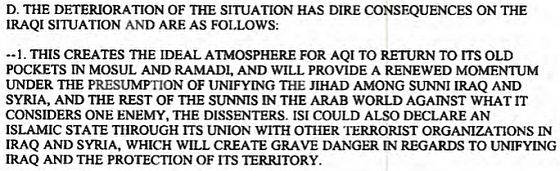
Defense Intelligence Agency report in 2012 warned about rise of ISIS in Iraq

Fox News reports: Seventeen months before President Obama dismissed the Islamic State as a “JV team,” a Defense Intelligence Agency report predicted the rise of the terror group and likely establishment of a caliphate if its momentum was not reversed.

While the report was circulated to the CIA, State Department and senior military leaders, among others, it’s not known whether Obama was ever briefed on the document.

The DIA report, which was reviewed by Fox News, was obtained through a federal lawsuit by conservative watchdog Judicial Watch. Documents from the lawsuit also reveal a host of new details about events leading up to the 2012 Benghazi terror attack — and how the movement of weapons from Libya to Syria fueled the violence there. [Continue reading…]

Facebooktwittermail

Experts: U.S. claims Ramadi a mere setback are ‘delusional’

McClatchy reports: The Obama administration Monday called the fall of the capital of Iraq’s Anbar province to the Islamic State a temporary setback that Iraqi forces would reverse with U.S. support. Experts dismissed that assessment as ludicrous.

“Delusional, really, is the better word,” Ali Khedery, a former U.S. official who served as an adviser to five U.S. ambassadors to Iraq and three heads of U.S. Central Command, said of the administration’s statement. “It’s unbelievable, frankly. I now know what it’s like to have lived through Vietnam, I guess.”

Experts called the loss a stunning blow to the Iraqi government and U.S. strategy.

It wasn’t clear why the administration clung to an upbeat message three days after the Islamic State overran most of Ramadi and a day after Iraq’s best special forces unit fled the city with other troops, local police and tribal fighters. The message was delivered in nearly identical verbiage by White House, State Department and Pentagon spokesmen and was reinforced by a statement from Army Gen. Martin Dempsey, the chairman of the Joint Chiefs of Staff. [Continue reading…]

Facebooktwittermail

Giving ISIS the battle they want in Iraq

Imran Khan writes: It was the worst defeat for Iraq’s elite security forces since the f‎all of Mosul just under year ago.

The images coming from Ramadi, the capital of Anbar province, looked more like a force in defeat rather than a tactical withdrawal.

They fled in the face of a campaign by the Islamic State of Iraq and the Levant (ISIL) group, which used firepower, car bombs and brute force for over a year to wear the Iraqi security forces down.

For ISIL it was a big victory.

Reports from Anbar suggest ISIL forces are now massing and gearing up for the next battle. A battle that they have wanted for a long time.

On Monday the Iraqi government announced that it had deployed at least ,3000 ‎Shia militia members to Habbineyeh airbase in Anbar in preparation for an assault on ISIL fighters.

The Iranians have stepped up support for the militias and the US-led coalition has increased air strikes in the last 72 hours on ISIL targets in Ramadi.

A very loose coalition of Iraqi Shia forces, Iranian support and America and the West. It is the war that ISIL have always wanted.

Across ISIL messages boards and social media accounts, ISIL sympathisers have drawn parallels between this conflict and ‎the Battle of Badr fought in 624 CE between the earliest followers of the Prophet Muhammad and the Quraish, the largest tribe in what is now Saudi Arabia. [Continue reading…]

Facebooktwittermail

To recapture Ramadi from Islamic State, Iraq must use this formula

Hayder al-Khoei writes: The fall of Ramadi, the capital of Iraq’s largest province, is a major defeat for the Iraqi security forces. It follows a period in which a number of strategic advances have been made by Iraqi forces elsewhere in the north and east of the war-torn country. Dreams of an offensive to defeat Islamic State in Mosul this year will now be crushed. Iraq will instead focus its resources and attention on liberating Ramadi, which lies just 60 miles to the west of Baghdad.

The complex realities on the ground will also lead to difficult choices being made on all sides of the conflict. Iraqi Prime Minister Haidar al-Abadi’s approval to send in the Shi’ite-dominated Hashid Shaabi paramilitary forces to the Sunni-dominated Anbar region will worry many, but it comes at the request of local Sunnis who are desperate to defend their areas against Islamic State. The Anbar governor, provincial council and local tribes have publically asked Baghdad to send in these paramilitary forces to support Iraq’s security forces and Sunni tribesmen.

Unlike in Tikrit, several Sunni tribes in Ramadi have already been resisting Islamic State for years now. As 3,000 Shi’ite fighters have deployed to the west of Ramadi following Abadi’s green light, 4,000 Sunni tribesmen have now been deployed in the west to prevent further Islamic State advances in Anbar. Sunni-Shi’ite military cooperation — aside from the official security forces that are themselves mixed — will be a crucial element in this campaign. Sunni tribal fighters are also officially part of the Hashid Shaabi in Anbar, so this paramilitary force is no longer exclusively Shi’ite. [Continue reading…]

Facebooktwittermail

ISIS solidifies foothold in Libya to expand reach

The Wall Street Journal reports: Islamic State leaders in Syria have sent money, trainers and fighters to Libya in increasing numbers, raising new concerns for the U.S. that the militant group is gaining traction in its attempts to broaden its reach and expand its influence.

In recent months, U.S. military officials said, Islamic State has solidified its foothold in Libya as it searches for ways to capitalize on rising popularity among extremist groups around the world.

“ISIL now has an operational presence in Libya, and they have aspirations to make Libya their African hub,” said one U.S. military official, using an acronym for the group. “Libya is part of their terror map now.”

Islamic State’s growth as a powerful anti-Western force has militant groups throughout the world trying to latch onto its notoriety. But until recently, affiliates have operated with a great degree of independence and there was little evidence they were taking orders from the group’s core leadership in Syria and Iraq, American officials said.

The core group benefited by pointing to the mushrooming number of affiliates to show its self-styled caliphate was expanding. But the gains in North Africa mark the first expansion of the group’s reach outside the Middle East beyond rebranding efforts by militants trying to secure direct support from the Syrian-based extremists, U.S. officials said. [Continue reading…]

Facebooktwittermail

ISIS killed hundreds as it took Iraq’s Ramadi

The Associated Press reports: Islamic State militants likely killed up to 500 Iraqi civilians and soldiers and forced 8,000 people to flee from their homes as they captured the Iraqi city of Ramadi, a provincial official said Monday, while the extremists went door-to-door looking for policemen and pro-government tribesmen.

Iraq’s government and Iranian-backed Shiite militias vowed to mount a counter-offensive and reclaim Ramadi, the capital of the overwhelmingly Sunni Anbar province. Iran’s Defense Minister Gen. Hossein Dehghan flew to Baghdad on a surprise visit for urgent talks with Iraqi leaders.

The fall of Ramadi was a stunning defeat for Iraq’s security forces and military, which fled as the Islamic State extremists overwhelmed the last hold-out positions of pro-government forces, despite the support of U.S.-led airstrikes targeting the extremists. Online video showed Humvees, trucks and other equipment speeding out of Ramadi, with soldiers desperate to reach safety gripping onto their sides.

Since Friday, when the battle for the city entered its final stages, “we estimate that 500 people have been killed, both civilians and military,” said a spokesman for the Anbar provincial government, Muhannad Haimour.

The figures could not be independently confirmed, but Islamic State militants have in the past killed hundreds of civilians and soldiers in the aftermath of their major victories.

Some 8,000 people fled the city, Haimour said. It was not immediately clear how many people remain in Ramadi — once a city of 850,000 that has been draining population for months amid fighting with the extremists besieging it. An enormous exodus took place in April, when the U.N. estimates some 114,000 residents streamed out of Ramadi and surrounding villages. [Continue reading…]

Facebooktwittermail

ISIS threatens to capture massive Iraqi oil refinery

The Washington Post reports: Six months after the government triumphantly announced that Islamic State militants had retreated from Iraq’s largest refinery, the extremist group is again threatening to overrun the facility.

For weeks, soldiers, police officers and Shiite militiamen have struggled to hold their ground inside the Baiji oil complex during a brutal siege by the Islamic State. The militant group’s suicide bombers have relentlessly struck the perimeters of the refinery, about 150 miles north of the capital, and pushed deep inside the massive facility.

The Baiji operation shows how the Islamic State has remained resilient even after suffering setbacks at the hands of pro-government forces and losing fighters and equipment to U.S. airstrikes, according to analysts, Iraqi officials and militiamen. On Friday, the group also pushed into the heart of Ramadi, a city further to the south that has been fending off attacks by the Islamic State for more than a year. [Continue reading…]

Facebooktwittermail

U.S. ground forces in Syria — the first in a series of such missions?

The New York Times reports: American Special Operations forces mounted a rare raid into eastern Syria early Saturday, killing a leader of the Islamic State and about a dozen militant fighters, as well as capturing his wife and freeing an 18-year-old Yazidi woman whom Pentagon officials said had been held as a slave.

In the first successful raid by American ground troops since the military campaign against the Islamic State began last year, two dozen Delta Force commandos entered Syria aboard Black Hawk helicopters and V-22 Ospreys and killed the leader, a man known as Abu Sayyaf. One American military official described him as the Islamic State’s “emir of oil and gas.”

Even so, Abu Sayyaf is a midlevel leader in the organization — one terrorism analyst compared him to Al Capone’s accountant — and likely is replaceable in fairly short order. And the operation, while successful, comes as the Islamic State has been advancing in the Iraqi city of Ramadi, demonstrating that the fight against the Sunni militant group in both Iraq and Syria remains very fluid.

Yet the Pentagon’s description of a nighttime raid that found its intended target deep inside Syria without any American troops being wounded or killed illustrates not only the effectiveness of the Delta Force, but of improving American intelligence on shadowy Islamic State leaders. [Continue reading…]

Foreign Policy adds: the fact that the White House gave the green light for an operation into Syria, combined with reports that the Delta operators removed a substantial trove of intelligence material from the site, might indicate that the raid could be the first in a series of such missions.

Delta has had a task force in Iraqi Kurdistan since at least last year with a mission of trying to find Islamic State leaders to kill or capture. During the war against the Islamic State’s predecessor organization, al Qaeda in Iraq, Delta and the other components of the military’s Joint Special Operations Command developed a system called “F3EAD” — for Find, Fix, Finish, Exploit, Analyze, Disseminate — in which strike forces would raid objectives such as militant safe houses not only to kill or capture the militants but to gain as much material of intelligence value as possible. By sucking information out of hard drives and cell phones, as well as quickly interrogating anyone taken prisoner, Delta and other JSOC forces were able to launch several missions a night, each based on intelligence gained in the previous raid. That dynamic could repeat itself here. [Continue reading…]

Facebooktwittermail

U.S. rushing new weapons to Iraq as ISIS takes control of Ramadi

McClatchy reports: The Islamic State on Friday took control of the provincial government center of Ramadi, the capital of Iraq’s largest province, and appeared to be in control of most of the city in a major defeat for the Iraqi government.

Islamic State forces also appeared to be closing in on government positions in two other key locations in Anbar province, the towns of Baghdadi and Karmah, in a broad offensive that if successful would end the government presence in all of the province’s major population centers. The capture of Baghdadi also would cut the supply lines to the Iraqi garrison protecting the strategic Haditha Dam.

U.S. officials offered conflicting views of the events, with the State Department and the Pentagon at first downplaying the significance of what had taken place. But a later statement from the White House made clear that the situation was urgent and that the United States was rushing shipments of heavy weapons, ammunition and supplies to Iraq to deal with the Islamic State advance.

The new weapons shipments will include an unspecified number of shoulder-fired rockets especially useful in blasting car bombs, which the Islamic State used particularly effectively in its Ramadi offensive.

The new weapons shipments came after Vice President Joe Biden spoke with Iraqi Prime Minister Haider al Abadi, according to the statement, which said Biden thanked Abadi for “his steadfast leadership . . . at a time of significant security challenges, including today’s ISIL attack on Ramadi.”

“The vice president assured the prime minister of continued and expedited U.S. security assistance to confront ISIL,” the statement said, using the government’s preferred acronym for the Islamic State.

At Ramadi, government troops reportedly were still fighting in some isolated areas. But the city was essentially under the control of the Islamic State after a fierce assault that began with a series of car bombs on Iraqi government security facilities overnight. By late afternoon, security forces appeared to be in full flight as militants consolidated control over the area and prevented anyone from leaving. [Continue reading…]

Facebooktwittermail

ISIS leader, Abu Sayyaf, killed in Syria by U.S. special forces

Reuters reports: American special operations forces killed a senior Islamic State leader who helped direct the group’s oil, gas and financial operations during a raid in eastern Syria, U.S. officials said on Saturday.

The White House said President Barack Obama ordered the overnight raid that killed the man identified as Abu Sayyaf. U.S. officials said his wife, Umm Sayyaf, was captured in the raid and was being held in Iraq.

This was the first known U.S. special forces operation inside Syria apart from a failed secret effort to rescue a number of U.S. and other foreign hostages held by Islamic State in northeastern Syria last year.

White House National Security Council spokeswoman Bernadette Meehan said in a statement that U.S. personnel based out of Iraq conducted the operation in al-Amr in eastern Syria.

“During the course of the operation, Abu Sayyaf was killed when he engaged U.S. forces,” Meehan said.

“The president authorized this operation upon the unanimous recommendation of his national security team and as soon as we had developed sufficient intelligence and were confident the mission could be carried out successfully and consistent with the requirements for undertaking such operations,” Meehan said.

Meehan said the operation was conducted “with the full consent of Iraqi authorities” and “consistent with domestic and international law.”

The White House said the U.S. did not inform Syrian President Bashar al-Assad’s government in advance of the raid, or coordinate with Damascus. Shortly before the U.S. announcement, Syrian state television said the Syrian army killed an Islamic State leader responsible for oil-related affairs, identifying him as Abu al-Taym al-Saudi. [Continue reading…]

Facebooktwittermail