The Associated Press reports: Mosul resident Mohammed Younis says he had nothing to do with the Islamic State group’s capture of his city or its mass killings, beheadings and other atrocities — but that may not be enough to spare him if the extremists are driven out.
A letter left on his doorstep by a shadowy group calling itself the Freemen of Mosul said “vengeance is coming,” and contained vague threats of eye-for-an-eye retribution. Dozens of other Mosul families have reported similar threats, and as Iraqi forces backed by feared Shiite militias gradually push up from Baghdad into the Sunni heartland, some fear the retreat of the extremist group could set off a new round of violence.
Younis thinks he was targeted because his cousin is a suspected Islamic State militant. “Because of the acts of a criminal cousin, me and some of my relatives will be killed or displaced,” he said. “We have nothing to do with Daesh, but I think that nobody will listen when payback time comes,” he added, using the Arabic acronym for the group.
Iraqi troops and Iranian-backed Shiite militias launched a long-awaited offensive this month aimed at capturing Saddam Hussein’s hometown of Tikrit, a Sunni bastion on the Tigris river whose capture would pave the way for an assault on Mosul, which could come as soon as next month.
Iraq’s government has sought to rally Sunni support, hoping to recruit powerful tribes to drive out the extremists and reunite the country. But past offensives have been followed by threats and reports of vicious sectarian reprisals. [Continue reading…]
Category Archives: Iraq
ISIS: Inside the army of terror
In ISIS: Inside the Army of Terror, authors Michael Weiss and Hassan Hassan set out to answer a simple question that was repeatedly being asked on cable news shows in the summer and fall of 2014: Where did ISIS come from, and how did it manage to do so much damage in so short a period of time?
As they note, while this may have seemed like a compelling question at the time, it was also strange, given that the United States has been fighting ISIS in Iraq — in the group’s various incarnations — for almost a decade.
In the book’s introduction (which follows) we learn that the path which led many young men to fight for ISIS commonly began with the desire to fight against the Assad regime.
In late 2011, Abdelaziz Kuwan approached his Syrian uncle to connect him to Riad al-Asaad, a colonel in the Syrian Air Force and one of the earliest military defectors from the dictatorship of Bashar al-Assad. Abdelaziz, a sixteen-year-old teenager from Bahrain, wanted to join the armed rebellion in Syria, but his parents forbade him from going. So he defied them.
In early 2012, he flew first to Istanbul and then, as so many other foreign fighters have done, took a thirteen-hour bus ride to the southern Turkish border town of Reyhanli. From there, he crossed into the Syrian province of Aleppo, the northern countryside that had by then completely fallen into the hands of the armed anti-Assad rebellion. Abdelaziz fought for moderate rebel factions for several weeks before deeming them too corrupt and ineffective. Then he migrated through various Islamist brigades, joining first Ahrar al-Sham and then Jabhat al-Nusra, which later revealed itself to be the al-Qaeda franchise in Syria. Having earned a reputation as a fearless and religiously devout fighter, Abdelaziz nonetheless grew disenchanted with his Islamist comrades and faced pressure from his family to return to Bahrain. He did at the end of 2012. Once home, Abdelaziz’s mother promptly confiscated his passport.
“I walk in the streets [of Bahrain] and I feel imprisoned,” Abdelaziz told the authors a year later, still pining for his days as a holy warrior. “I feel tied up. It’s like someone is always watching me. This world means nothing to me. I want to be free. I want to go back. People are giving their lives, that’s the honorable life.”
Abdelaziz’s family had moved to Bahrain from eastern Syria in the 1980s. His parents provided him with the means to lead a decent life. “His father raised him well,” one relative recalled. “He did not make him need anyone and wanted him to be of a high social status.” The relative added that Abdelaziz was “quiet,” “refined,” and “always behaved like a man.”
Abdelaziz stayed in Bahrain for three months before he managed to persuade his mother to give him back his passport. He left for Syria three days later. Once he arrived, Abdelaziz joined the Islamic State of Iraq and al-Sham (ISIS), which was then rising in prominence as one of the most disciplined and well-organized jihadist groups in Syria. Abdelaziz later said that in his last few months in Bahrain he made the decision to join ISIS after speaking with “some of the brothers” in Syria via Skype. His prior experience with other Islamist factions ideologically similar to ISIS was an advantage in joining one that was dominated by foreign fighters. Abdelaziz rose through the ranks of ISIS, first becoming a coordinator among local emirs and other rebel groups, then delivering messages and oral agreements on behalf of his leader. When ISIS seized enormous swaths of territory in both Syria and Iraq in the summer of 2014, Abdelaziz was promoted to a security official overseeing three towns near the Syrian-Iraqi border town of Albu Kamal, long a portal between the two countries for men like him.
In ISIS, Abdelaziz discovered new things about himself. He learned that he was violent, brutal, and determined. He beheaded enemies. He kept a Yazidi girl in his house as a sabiyya, or sex slave. She was his prize for his participation in battles against the Iraqi Kurdish peshmerga forces and other Kurdish militias in Sinjar, Iraq, near the Syrian border. According to ISIS’s propaganda magazine, Dabiq, one-fifth of the sex slaves taken from Sinjar was distributed to ISIS’s central leadership to do with as it so chose; the remainder was divided amongst the rank and file, like Abdelaziz, as the spoils of war.
Abdelaziz showed us a picture of his sabiyya. She was in her late teens. She “belonged” to Abdelaziz for about a month before she was handed off to other ISIS commanders.
Continue reading
Iraqi forces and Shi’ite militia fighters struggle in advance towards Tikrit
Reuters reports: Iraqi security forces and Shi’ite militia fighters struggled to advance on Saturday into the two towns of al-Alam and al-Dour near Tikrit, their progress slowed by fierce defense from Islamic State militants.
“We are facing a strong resistance from terrorist groups and we are trying to surround Daesh inside al-Alam and al-Dour and cut all supply routes for them,” said al-Alam mayor Laith al-Jubouri, referring to the Islamic State fighters.
Army and militia fighters entered the southern and eastern parts of al-Dour on Friday. Commanders said at the time that the town had been completely recaptured, but officials said only parts of it had been retaken. [Continue reading…]
The rapidly closing window for national reconciliation in Iraq
National Journal reports: When his three-car convoy pulled up to a police checkpoint in Baghdad on Friday the 13th of February, Sheikh Qassem al-Janabi had little reason for concern. An influential Sunni moderate who was assisting the Iraqi government’s efforts to draw Sunni tribes away from the orbit of the Islamic State of Iraq and Syria, the charismatic Sheikh Janabi had many friends in high places.
He was in the capital, supposedly far away from any likely ISIS assassins. And he was a longtime friend of the United States, which in the past year had sent military forces back to Iraq to counter the ISIS terrorist group. Sheikh Janabi was riding with seven bodyguards and his son Mohamed, recently returned to Iraq from earning a law degree from the University of Glasgow. They were traveling from their tribal homeland south of Baghdad on the Muslim day of prayer.
The men at the police checkpoint were impostors and suspected Shiite militiamen, and they bundled up Janabi and his entourage at gunpoint, quickly driving them away. Their bodies were later found across town in the ramshackle Shiite slum of Sadr City. Janabi was slumped in the back of one of the cars, his hands tied behind his back with his own belt, a bullet in his head. The bodies of his son Mohamed and seven bodyguards lay nearby, all of them shot execution style. To reach Sadr City, the gunmen would likely have passed through several police checkpoints, raising questions of possible official collusion in the murders.
When the history of the second Iraq civil war is written, the death of Sheikh Qassem al-Janabi may prove notable for what it said about the rapidly closing window for national reconciliation, and for foreshadowing the ominous turn toward outright sectarianism that the fighting in Iraq has taken. Certainly the Sunni lawmakers who walked out of parliament in mass protest on learning of his murder understood his importance, both real and symbolic. Along with other moderate Sunni tribal leaders who first turned against al-Qaida in 2006-07 and took part in the “Anbar Awakening” during Iraq’s first civil war, Janabi rejected the terrorists’ vision of a purifying civil war between Sunnis and Shiites. Instead he continued to embrace the U.S. vision of a unified and democratic Iraq until the day of this death. [Continue reading…]
Inside the Christian militias defending Iraq’s Nineveh plains
Matt Cetti-Roberts writes: Gen. Benham, the leader of a new Assyrian Christian militia in northern Iraq, sits in the sparse barracks where his men train to defend their homelands from Islamic State.
In August, the jihadi militants forced Benham from his home in the central Iraqi village of Hamdaniyah, 51 kilometers southeast of Mosul. “ISIS stole everything that I made, what my father made, what my grandfather made,” Benham says.
“They took all of this from me in one minute. I only came here with my shirt and trousers, my son and my daughter.”
Christian villages dotting the Nineveh plains fell to the Islamic State last summer when the Kurdish Peshmerga withdrew. More than 100,000 people fled from the jihadi group.
Now, seven months later, many of the villages are still under Islamic State control. Assyrian Christians have little faith in the Peshmerga — although they’re allies — and have decided to take the fight into their own hands, forming lightly armed bands of politically-aligned militias.
The Nineveh Plain Protection Units, or NPU, of which Benham is a part, is one of the new Assyrian Christian militias.
In the unit’s temporary home near Kirkuk, more than 200 Assyrian Christian men are undergoing training in infantry skills, basic weapon handling and working as a unit — with help from former U.S. soldiers.
Benham served for several decades in the Saddam-era Iraqi army, but most of his men have little or no fighting experience, and some have never even fired a rifle. [Continue reading…]
Iran gains influence in Iraq as Shiite forces fight ISIS
The New York Times reports: All along the green irrigated plains in the heart of what American occupying troops used to call the Sunni triangle, lampposts and watchtowers are flying the flags of the Badr Organization, a Shiite militia long hated and feared by many Iraqi Sunnis.
The road from Baghdad to Tikrit is dotted with security checkpoints, many festooned with posters of Iran’s supreme leader and other Shiite figures. They stretch as far north as the village of Awja, the birthplace of Saddam Hussein, on the edge of Tikrit, within sight of the hulking palaces of the former ruler who ruthlessly crushed Shiite dissent.
More openly than ever before, Iran’s powerful influence in Iraq has been on display as the counteroffensive against Islamic State militants around Tikrit has unfolded in recent days. At every point, the Iranian-backed militias have taken the lead in the fight against the Islamic State here. Senior Iranian leaders have been openly helping direct the battle, and American officials say Iran’s Revolutionary Guards forces are taking part.
Iraqi officials, too, have been unapologetic about the role of the militias. They project confidence about their fighting abilities and declare that how to fight the war is Iraq’s decision, as militia leaders criticize American pressure to rely more on regular forces. [Continue reading…]
ISIS attacks a major archaeological site in Iraq
The New York Times reports: The Islamic State militant group attacked the ancient archaeological site of Nimrud in northern Iraq and damaged it with heavy vehicles, Iraq’s Ministry of Tourism and Antiquities said Thursday.
It was the latest in a series of attacks on ancient structures and artifacts in Syria and Iraq that the group has destroyed in the name of its harsh interpretation of Islamic law. Last week, Islamic State militants videotaped themselves destroying statues and artifacts in the Mosul Museum and at the Nergal Gate entryway to ancient Nineveh. The militants captured the city during its offensive blitz through much of Iraq last June. “The terrorist gangs of ISIS are continuing to defy the will of the world and the feelings of humanity after they committed a new crime that belongs to its idiotic series,” the ministry said in a statement on its Facebook page, referring to the Islamic State, also known as ISIS, ISIL or Daesh.
Nimrud is the sprawling site of a city founded by the Assyrian King Shalamansar I, who died in 1245 B.C. Among the most impressive objects at Nimrud are the colossal statues known as “lamassu,” mythological creatures that depict either lions or winged bulls with bearded human heads. Pairs of the 17-ton statues are at the Metropolitan Museum of Art and the British Museum. [Continue reading…]
Capitol Hill — still Israeli-occupied territory
Philip Weiss writes: In the Emperor’s New Clothes, only the little boy can say that the emperor is naked. The good news about yesterday’s speech by Netanyahu to a joint meeting of Congress is that lots of media are taking on that boy’s role, and pointing out the nudity: exclaiming over the fact that a foreign leader came into our house of government to try and overrule our president on foreign policy. Chris Matthews was especially forceful, describing it as a takeover. While a New York Times article said that Democrats have to choose between “loyalty to the Jewish state” and the president.
But journalists have a bigger job than merely exclaiming. They must explain to readers why this outrage took place. Why did Netanyahu get this platform? The answer is the power of the Israel lobby inside our politics. And while there was some talk about the Christian Zionist component of the lobby compelling Republicans to show up, no one could explain why so many Democrats– about 175 of them– sat still for this insult to the president. They did so because of the importance of the Jewish part of the lobby inside the Democratic Party, epitomized by Alan Dershowitz in the gallery. This was surely obvious to viewers. But the media were silent on that score. [Continue reading…]
Netanyahu addressing Congress in 2002 and 2015 — same script, but then it was Iraq, now Iran.
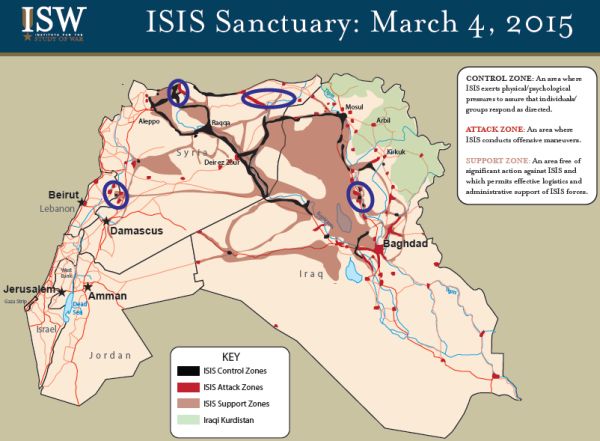
ISIS-controlled territory in Iraq and Syria has not significantly diminished since June 2014
U.S. strategy in Iraq increasingly relies on Iran
The New York Times reports: At a time when President Obama is under political pressure from congressional Republicans over negotiations to rein in Tehran’s nuclear ambitions, a startling paradox has emerged: Mr. Obama is becoming increasingly dependent on Iranian fighters as he tries to contain the Islamic State militant group in Iraq and Syria without committing American ground troops.
In the four days since Iranian troops joined 30,000 Iraqi forces to try to wrest Saddam Hussein’s hometown of Tikrit back from Islamic State control, American officials have said the United States is not coordinating with Iran, one of its fiercest global foes, in the fight against a common enemy.
That may be technically true. But American war planners have been closely monitoring Iran’s parallel war against the Islamic State, also known as ISIS or ISIL, through a range of channels, including conversations on radio frequencies that each side knows the other is monitoring. And the two militaries frequently seek to avoid conflict in their activities by using Iraqi command centers as an intermediary.
As a result, many national security experts say, Iran’s involvement is helping the Iraqis hold the line against Islamic State advances until American military advisers are finished training Iraq’s underperforming armed forces.
“The only way in which the Obama administration can credibly stick with its strategy is by implicitly assuming that the Iranians will carry most of the weight and win the battles on the ground,” said Vali R. Nasr, a former special adviser to Mr. Obama who is now dean of the School of Advanced International Studies at Johns Hopkins University. “You can’t have your cake and eat it too — the U.S. strategy in Iraq has been successful so far largely because of Iran.” [Continue reading…]
Airstrikes starting to take toll on ISIS’s money flow
McClatchy reports: The Islamic State might be the best-funded radical Islamist group, perhaps in history, but the coalition air campaign that’s targeting its oil-refining operations and military assets has begun to damage its ability to earn.
And by denying the group additional territorial expansion, the airstrikes have limited the opportunities for it to profit from capturing new infrastructure and banks, according to a recent report by a money-laundering watchdog group, as well as U.S. officials and residents of Islamic State territory.
The Islamic State, a self-styled modern caliphate that controls much of northern and western Iraq and eastern Syria, turned itself into perhaps the richest and best-equipped military non-state actor last June after seizing tremendous amounts of money and equipment from the Iraqi government as it swept through Mosul and to the western and northern outskirts of Baghdad while the Iraqi army collapsed.
The Islamic State is thought to have at least 30,000 combatants and 5 million to 6 million people under its control, leaving a huge economy to be taxed and extorted.
Thousands of armored vehicles and thousands of tons of military equipment, much of it modern weaponry supplied to Iraq by the United States, were seized in the rout last June, along with cash reserves from government banks, mostly in local currency, of at least $500 million, according to the Financial Action Task Force, an international money-laundering body that examined the group’s complex financial operations in a report released in late February.
That windfall came as the group was already making millions of dollars a day pumping and refining oil and petroleum products from previously captured oil fields, mostly in eastern Syria, where the group has wrested control of at least 50,000 barrels per day of oil and refined petroleum output, according to the task force’s report, a number widely supported by reports from the area.
Although the task force notes recent efforts by Turkish and Kurdish officials to limit the Islamic State’s ability to export these products by smuggling, not all the exporting has been stopped. Even the group’s rudimentary oil-refining ability — a process commonly targeted by coalition airstrikes — while damaged, is probably sufficient to at least support the group’s huge military operation and provide some income stream. [Continue reading…]
Iran’s ‘Supermani’: fabled general, Internet sensation
The Los Angeles Times reports: In one image he calmly rubs elbows with Iran’s top leaders. In another, he bestows an avuncular gaze on a gaggle of militia fighters.
No matter where he appears, Gen. Qassem Suleimani, commander of Iran’s elite Quds force, remains the stuff of U.S. policymakers’ nightmares: a murky yet seemingly ubiquitous figure with a penchant for turning up in Middle Eastern trouble spots and proxy wars — often at several battlegrounds simultaneously, it would seem, judging by his outsized and at times fictitious presence on the Web and in breathless international press reports.
“Supermani” is the handle one wag has bestowed upon Tehran’s inscrutable point man.
His mission? Thwarting the goals of Washington and its allies at every turn, while adding to the revolutionary glory of the Islamic Republic of Iran.
The actual effectiveness of Tehran’s fabled emissary may be open to question. But in cyberspace, Suleimani — with a graying beard, steady mien and passing resemblance to “The Most Interesting Man in the World” of Dos Equis fame — has emerged as a kind of Iranian master manipulator, schemer and super-spy. His presence on any battlefield, according the ever-expanding if often apocryphal legend, is tantamount to victory for fighters fortunate to bask in his presence. [Continue reading…]
Iraq’s attack against ISIS in Tikrit catches U.S. ‘by surprise’
Nancy A. Youssef reports: The Iraqi military launched a major campaign to take back a key city from the self-proclaimed Islamic State over the weekend — a move that caught the U.S. “by surprise,” in the words of one American government official.
The U.S.-led coalition forces that have conducted seven months of airstrikes on Iraq’s behalf did not participate in the attack, defense officials told The Daily Beast, and the American military has no plans to chip in.
Instead, embedded Iranian advisers and Iranian-backed Shiite militias are taking part in the offensive on the largely Sunni town, raising the prospect that the fight to beat back ISIS could become a sectarian war.
The news is the latest indication that not all is well with the American effort against the terror group. On Friday, U.S. defense officials told The Daily Beast that a planned offensive against the ISIS stronghold of Mosul had been indefinitely postponed. Over the weekend, an American-backed rebel group in Syria announced that it was dissolving, and joining an Islamist faction.
Then there was the unexpected battle for Tikrit. Over the weekend, a reported 30,000 troops and militiamen—mostly Shiites —stormed the Sunni dominated city of Tikrit, former Iraqi President Saddam Hussein’s hometown and the symbolic birthplace of his three decades of repressive practices against the majority Shiite population.
U.S. officials were largely left in the dark of the planning and timing of the operation, defense officials said. The Pentagon said Monday it was not conducting airstrikes in support of the Tikrit offensive because the Iraqi government did not ask for such help. [Continue reading…]
Iran backs Iraq military campaign to reclaim Tikrit from ISIS
The Wall Street Journal reports: Iran took a leading role in the Iraqi military’s largest offensive yet to reclaim territory from Islamic State, throwing drones, heavy weaponry and ground forces into the battle while the U.S. remained on the sidelines.
The operation that began Monday aims to retake Tikrit, best known as the hometown of Saddam Hussein, 80 miles north of the capital Baghdad. In addition to supplying drones, Iran’s powerful Revolutionary Guard force has fighters on the ground with Iraqi units, mostly operating artillery and rocket batteries, according to a U.S. military official. Iraqi Shiite militias closely allied with Iran are also heavily involved.
Iran’s semiofficial Fars news agency reported that Qasem Soleimani, head of the Revolutionary Guard’s overseas unit Quds Force, was on the ground near Tikrit advising commanders.
The offensive is a test of Iraqi security forces’ fitness for the much more daunting challenge of recapturing Mosul, Iraq’s second-largest city.
It has also thrown a new spotlight on Shiite Iran’s role in assisting Shiite-dominated Iraq to regain control of large parts of the country taken by the Sunni radical group Islamic State. Tehran has wielded increasing influence over Iraq’s military affairs after Iraqi security forces proved unable to contain the Islamic State onslaught that began in summer. [Continue reading…]
Time adds: [M]ilitary planners believe that Tikrit’s Sunnis have grown tired of ISIS’s harsh rule for 10 months. They hope that some of those Sunnis will now be willing to turn their guns against ISIS. Iraqi Prime Minister Haider al-Abadi has offered these Sunni tribes a pardon, and a last chance to come back into the fold with the national government.
“I call upon those who have been misled or committed a mistake to lay down arms and join their people and security forces in order to liberate their cities,” said Abadi at a press conference on Sunday in Samarra, 60 miles north of Baghdad.
During the American occupation of Iraq, these local Sunni tribes did rise-up against ISIS’s Al-Qaeda predecessor and fought in coordination with US-forces against other Sunni militiamen through the Sunni Awakening Movement.
“Sunni tribes of Tikrit could turn against ISIS,” says Hamed al-Mutlaq, a member of the Iraqi parliament and an influential Sunni politician. “They prefer the security forces to be in control. They would rather be with the Iraqi forces than ISIS.”
While tribal leaders may not want to see ISIS wielding all the influence in their territory, they’re even less likely to want to see Shiite militiamen controlling their streets.
“We know that there are Sunni tribal sheiks that don’t like [ISIS],” says Pollack. “But there are other Sunni sheiks who are more scared of the Shiite militias than they are of [ISIS].”
And they have reason to be. These Shiite militias that are marching alongside the Iraqi government forces have been accused of kidnappings, forced evictions and summary executions of Sunni civilians.
“The use of Shiite militias is a big problem,” says Mutlaq. “They have burned houses, terrorized and abducted people in Diyala, Samarra and Baghdad. They have a bad reputation.” [Continue reading…]
U.S. rethinks plan to retake Mosul
The Wall Street Journal reports: The U.S. military is considering a months-long campaign of airstrikes to squeeze Islamic State fighters in Mosul before inserting Iraqi ground forces to retake the city, officials said Friday.
The on-the-ground fight to retake Mosul isn’t likely to start until the fall at the earliest, after an intensified air campaign to target Islamic State leaders and cut off supply lines in and around the city, the officials said.
The emerging plan is at odds with a briefing by a U.S. military’s Central Command official in February in which he said the U.S. and Iraq were looking at starting a campaign to liberate Mosul, Iraq’s second-largest city, by April or May.
Afterward, Iraqi and American officials cast doubt on the likely readiness of Iraqi forces.
U.S. military officials now say they believe that Iraqi’s best military units are many months away from being in a position to successfully conduct such an operation. Those forces haven’t yet begun their training at the bases set up by American military officers in Iraq.
“When we feel that the Iraqi forces are ready to go and win decisively, we will go and advise the Iraqis to begin the operation,” a military official said. [Continue reading…]
ISIS may not be a global threat, but neither is it a problem with a ready solution
The New York Times reports: The reports are like something out of a distant era of ancient conquests: entire villages emptied, with hundreds taken prisoner, others kept as slaves; the destruction of irreplaceable works of art; a tax on religious minorities, payable in gold.
A rampage reminiscent of Tamerlane or Genghis Khan, perhaps, but in reality, according to reports by residents, activist groups and the assailants themselves, a description of the modus operandi of the Islamic State’s self-declared caliphate this week. The militants have prosecuted a relentless campaign in Iraq and Syria against what have historically been religiously and ethnically diverse areas with traces of civilizations dating to ancient Mesopotamia.
The latest to face the militants’ onslaught are the Assyrian Christians of northeastern Syria, one of the world’s oldest Christian communities, some speaking a modern version of Aramaic, the language of Jesus.
Assyrian leaders have counted 287 people taken captive, including 30 children and several dozen women, along with civilian men and fighters from Christian militias, said Dawoud Dawoud, an Assyrian political activist who had just toured the area, in the vicinity of the Syrian city of Qamishli. Thirty villages had been emptied, he said. [Continue reading…]
In the aftermath of the war in Iraq, some Americans, perceiving echoes of the government-fueled national hysteria that followed 9/11, now regard the attention being given to ISIS as disproportionate to the size of the threat.
A few days ago, one commentator described ISIS as: “A nasty nuisance, which has killed thousands in the Middle East, but a nuisance nonetheless.”
If one subscribes to the Steven Pinker view of the world, then how bad the current situation is, just comes down to numbers.
Fewer people have been killed by ISIS than by barrel bombs dropped by the Assad regime in Syria, or were killed during the U.S.-led invasion and occupation of Iraq.
The threat to humanity posed by climate change, far exceeds all other global threats, including what can arguably be called a minor threat from ISIS.
But if an issue is defined as not rising above the threshold of being a nuisance, solely based on numbers, then since between 1882 and 1968 only 3,446 blacks were lynched in America, should the racial violence occurring during that chapter in this country’s history be described as having been no more than a nasty nuisance?
The very fact that we view lynching as emblematic of a chapter in history, illustrates the fact that significance can never be reduced to numbers.
In France, the death toll from the Charlie Hebdo shootings was little more than the average number of fatalities that occur every day on France’s roads.
Since statistically, the French face little more risk from terrorism than they face from traffic accidents, does that mean the French government should devote the same amount of time and resources to addressing road safety as they do to tackling terrorism?
Again, this doesn’t just come down to numbers. For one thing, there’s no reason to view road safety as a problem that risks escalating. Neither is there reason to imagine that individuals or groups of people have a specific interest in making the roads more dangerous. Road safety is an issue that gains ongoing and appropriate attention from every relevant constituency from central government to local government, town planners to school teachers, and vehicle manufacturers to medics.
The fact that it is the type of issue that generally gets effectively addressed, is the very reason it is largely ignored in political and popular discourse.
Conversely, while it’s easy to say that ISIS presents a problem that needs “to be dealt with,” the very fact that it remains unclear what mechanisms might be effective in tackling this problem, is one of the main reasons ISIS continues to grab the headlines.
ISIS might not represent an unstoppable force and yet its campaign of violence has proved very difficult to contain.
Politicians glibly talk about the strategy for defeating ISIS, yet no one has made a convincing case that such a strategy has been found.
Some observers believe that each time another ISIS headline appears, the group has simply been served up the attention it craves, but to dismiss this as a group of attention-seekers is to gravely misjudge ISIS’s ambitions.
A year ago, before ISIS had become a household name but after it taken over Fallujah, President Obama wanted to downplay its significance in what became an infamous dismissal — he said they were just “a jayvee team.”
In those early months of 2014, ISIS used America’s inattention to its full advantage.
Whether showered with or starved of attention, ISIS pursues its goals because they have less concern about how they are perceived by Americans, or for that matter the rest of the world, than we might imagine.
The issue now is less about the quantity of attention ISIS garners that it is about the quality of that attention.
When viewed through the paradigm of the war on terrorism, it’s natural and appropriate to point to that neocon project’s manifold failures. We might also see this as the latest manifestation in a problem that cannot wholly be solved. In other words, that we need to learn how to live with what can be regarded as a manageable amount of terrorism.
But maybe we are being distracted by the category of terrorism itself.
In spite of the fact that ISIS has engaged in what are generally viewed as some of the most grotesque acts of terrorism ever carried out, it differs from all other terrorist groups in at least two fundamental ways:
- It has spawned a mass movement, and
- It has captured and now governs large tracts of territory.
While there was recent furious debate about whether ISIS should be called Islamic, there has been little discussion about its claim to have created a state.
That claim is treated as too preposterous as to merit consideration — the so-called Islamic State is surely destined to implode.
And yet that hasn’t happened and it isn’t about to happen. Neither is this a state that stands any chance of being recognized by any other, but nor does it seek such recognition. On the contrary, the recognition it seeks is from all those who reject the legitimacy of nation states — and this constituency is large and growing.

The contradiction between the secular and fundamentalist roots of ISIS is more apparent than real
ISIS: Inside the Army of Terror, by Hassan Hassan and Michael Weiss — a Chatham House review: Despite its declaration of a new ‘caliphate’ based on jihadist principles, much of the senior leadership Islamic State is actually made up of Saddam-era Baath Party members.
A study of the origins and make-up of Islamic State characterizes the jihadist group as a ‘spectral hold-over’ of the old regime.
‘Most of its top decision-makers served either in Saddam Hussein’s military or security services. In a sense, ‘secular’ Baathism has returned to Iraq under the guise of Islamic fundamentalism.’
The authors, Syrian researcher Hassan Hassan, who hails from the town of Albu Kamal on the Iraqi border, and the American journalist Michael Weiss, write that this contradiction between secular and fundamentalist is more apparent than real.
Despite the secular origins of the Baath party, Saddam Hussein used it to preserve the dominance of Iraq’s Sunni Muslims – only 20 per cent of the population – and repress the majority Shia. In the declining years of his rule Saddam Hussein adopted an overtly religious path, in the hope of co-opting the Sunni Muslim leadership. In fact, Saddam lost control of his so-called Islamic Faith Campaign and many Baath Party members fell under the spell of the imams. [Continue reading…]
ISIS burns 8,000 rare books and manuscripts in Mosul
Fiscal Times reports: While the world was watching the Academy Awards ceremony, the people of Mosul were watching a different show. They were horrified to see ISIS members burn the Mosul public library. Among the many thousands of books it housed, more than 8,000 rare old books and manuscripts were burned.
“ISIS militants bombed the Mosul Public Library. They used improvised explosive devices,” said Ghanim al-Ta’an, the director of the library. Notables in Mosul tried to persuade ISIS members to spare the library, but they failed.
The former assistant director of the library Qusai All Faraj said that the Mosul Public Library was established in 1921, the same year that saw the birth of the modern Iraq. Among its lost collections were manuscripts from the eighteenth century, Syriac books printed in Iraq’s first printing house in the nineteenth century, books from the Ottoman era, Iraqi newspapers from the early twentieth century and some old antiques like an astrolabe and sand glass used by ancient Arabs. The library had hosted the personal libraries of more than 100 notable families from Mosul over the last century. [Continue reading…]